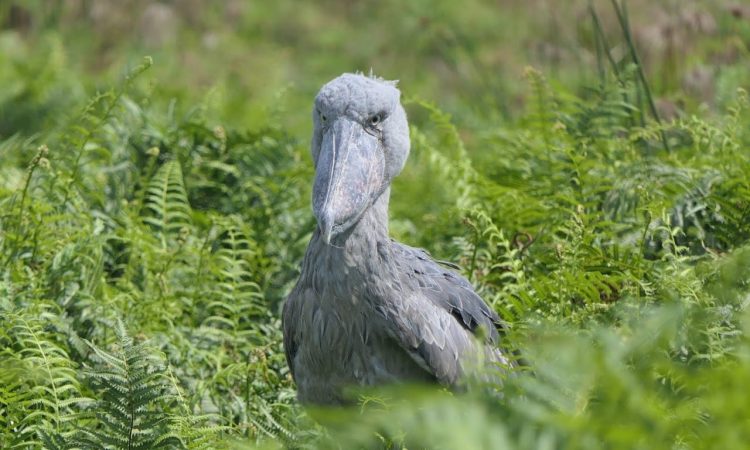
Uganda is a premier birding destination globally, hosting over 1,065 species—more than half of all birds found in Africa. Top hotspots include Mabamba Bay Wetland (the best place to spot the prehistoric Shoebill), Bwindi Impenetrable National Park (famous for Albertine Rift endemics, including the African Green Broadbill), and Queen Elizabeth National Park (over 600 species)
36-days-grand-uganda-bird-watching-safari
30-days-best-uganda-birding-safari-extravaganza-and-wildlife-safari
25-days-complete-uganda-birding-safari-extravaganza-with-wildlife-viewing
22-days-best-uganda-primate-and-birding-safari-adventure
20-days-uganda-birding-safari-wildlife-gorilla-and-chimpanzee-tracking
10-days-best-uganda-birding-safari-and-wildlife-experience
1-day-perfect-mabamba-swamp-shoebill-stork-uganda-birding-safari
1. Mabamba Bay Wetland
Mabamba Bay Wetland sits roughly 40 kilometers west of Entebbe and is a must-visit for your Uganda birding safaris. Taking a canoe ride through the dense papyrus swamps takes about 2 to 3 hours, offering birders a chance to spot the iconic and highly elusive Shoebill, known locally as Shoebill Stork. You can also spot species like the Malachite Kingfisher and Papyrus Gonolek.
2. Murchison Falls National Park
Located in northwestern Uganda, about 300 kilometers from Kampala, Murchison Falls is the country's largest national park. A morning boat cruise along the Victoria Nile, lasting about 3 to 4 hours, allows you to observe the Goliath Heron, Red-throated Bee-eater, and the Saddle-billed Stork. The savannah areas are perfect for a Uganda bird watching tour that yields Secretary Birds.
3. Bwindi Impenetrable National Park
Set in southwestern Uganda, Bwindi is approximately 500 kilometers from Kampala and requires 8 to 9 hours to reach by road. Recognized as a top spot for Uganda bird watching, it boasts over 350 species, including 23 Albertine Rift endemics. The Mubwindi Swamp trail, an intensive 5-hour walk, is ideal for spotting the African Green Broadbill and the handsome Regal Sunbird.
4. Queen Elizabeth National Park
Queen Elizabeth national park, situated in western Uganda, this diverse park is about 400 kilometers from Kampala and offers one of the highest bird lists in Africa, exceeding 600 species. A boat ride along the Kazinga Channel, which lasts about 2 hours, exposes birders to African Skimmers, Pink-backed Pelicans, and various kingfishers.
5. Kibale National Park
Found in western Uganda, Kibale is roughly 300 kilometers from Kampala and takes around 5 hours to drive to. The park is a haven for the coveted Green-breasted Pitta. Guided nature walks in the forest canopy, lasting 3 to 4 hours, provide opportunities to spot the Great Blue Turaco, Crowned Eagle, and the White-throated Bee-eater.
6. Lake Mburo National Park
Lake Mburo National Park is located in western Uganda, this national park is about 230 kilometers from Kampala, a 3.5-hour drive. The acacia woodlands and surrounding swamps make it ideal for spotting the Papyrus Yellow Warbler, Brown-chested Lapwing, and the fast-flying African Finfoot. A boat ride here lasts about 2 hours and is excellent for viewing waterbirds.
7. Kidepo Valley National Park
Found in the remote northeastern corner of Uganda, Kidepo is about 700 kilometers from Kampala and is often accessed via a 1.5-hour domestic flight from Entebbe to Apoka. The Narus Valley is excellent for a birding Uganda safari, featuring the Black-breasted Barbet, Clapperton's Francolin, and the spectacular Abyssinian Ground Hornbill.
8. Semuliki National Park
Situated in the remote western region within the Albertine Rift Valley, Semuliki is about 380 kilometers from Kampala. The area boasts over 440 species with Congo-biome species rarely found elsewhere in East Africa. On a 4-hour trail trek near the Sempaya Hotsprings, birders frequently encounter the Piping Hornbill, Blue-billed Malimbe, and Nkulengu Rail.
9. Rwenzori Mountains National Park
Mountain Rwenzori located in western Uganda near the DRC border, this park is approximately 370 kilometers from Kampala. Trekking through the montane forest zones, which takes anywhere from 3 to 7 hours depending on the trail, rewards birders with sightings of the Rwenzori Turaco, Long-eared Owl, and the striking Golden-winged Sunbird.
10. Mgahinga Gorilla National Park
Positioned in the extreme southwestern corner, Mgahinga is 510 kilometers from Kampala and requires a 9-hour drive. The lower scrub zones and volcano slopes offer a premier birding Uganda safari experience, taking about 4 hours, where you can spot the extremely rare Shelley's Crimsonwing, Archer's Robin-Chat, and the Dusky Crimsonwing.
11. Mabira Central Forest Reserve
Mabira forest located along the Kampala-Jinja highway, this ancient rainforest is about 54 kilometers from Kampala, taking just over 1 hour to reach. A half-day canopy walk or ziplining tour yields sightings of the Cassin's Hawk-Eagle, Blue-throated Roller, and the White-spotted Flufftail.
12. Budongo Central Forest Reserve
Located south of Murchison Falls National Park, Budongo is about 230 kilometers from Kampala. The Royal Mile is a celebrated birdwatching trail requiring about 4 hours of walking. This reserve is famous for West African bird species, such as Puvel's Illadopsis, the Yellow-footed Flycatcher, and the Chocolate-backed Kingfisher.
13. Entebbe Botanical Gardens
Entebbe Botanical Garden established in 1898, these gardens rest on the northern shores of Lake Victoria, just 40 kilometers from Kampala. A leisurely 2-hour stroll through the tall trees and lakefront vegetation gives birders easy access to the Great Blue Turaco, Eastern Plantain-eater, and various colorful weavers.
14. Lutembe Bay Wetland
Located just 18 kilometers from Kampala along the Entebbe Road, Lutembe Bay is a designated Ramsar site. A 2 to 3-hour wetland birding excursion is ideal for viewing large flocks of migratory birds, such as the White-winged Black Tern, Caspian Plover, and the African Marsh Harrier.
15. Zika Forest
Located about 23 kilometers from Kampala, Zika Forest is famous for its dense, layered canopy. A 3-hour guided nature walk is excellent for forest-dwelling species, including the Great Sparrowhawk, Klaas's Cuckoo, and the Speckled Tinkerbird.
16. Echuya Forest Reserve
Positioned between Kabale and Kisoro in southwestern Uganda, Echuya is about 450 kilometers from Kampala. A 4-hour trek through this high-altitude swamp and forest presents excellent opportunities to find the Grauer's Rush Warbler and the Mountain Masked Apalis.
17. Sango Bay Area
Sango Bay sits in the southeastern part of Uganda, along the western shores of Lake Victoria, about 250 kilometers from Kampala. The extensive swamps and forests here take about 4 to 5 hours to explore, yielding the Pel's Fishing Owl, Shoebill, and various papyrus endemics.
18. Nabugabo Wetland
Located near Masaka in the Lake Victoria basin, Nabugabo is approximately 170 kilometers from Kampala. A 3-hour canoe ride or shoreline walk around Lake Nabugabo offers superb sightings of the Blue-headed Coucal, Papyrus Gonolek, and the Carruthers's Cisticola.
19. Musambwa Islands
These rocky islands are situated in Lake Victoria, about 5 kilometers offshore from the Kasensero landing site in the Rakai district. A boat trip taking around 1 to 2 hours reveals breeding colonies of the Grey-headed Gull, Long-tailed Cormorant, and the Swift Tern.
20. Kajjansi Aquaculture Ponds
Located just 14 kilometers from Kampala on the Entebbe Road, these man-made fish ponds cover a large area. Spending 2 hours birding here is fantastic for waterbirds, including the African Openbill, Black Crake, and the Lesser Jacana.
Where is the absolute best place in Uganda to spot the prehistoric Shoebill?
If finding the iconic Shoebill is at the absolute top of your list, Mabamba Bay Wetland is your best bet. Located about 40 kilometers west of Entebbe on the edge of Lake Victoria, this vast papyrus swamp offers the highest success rate for sightings in East Africa.
The experience itself is blissfully quiet. You board a traditional wooden motorized canoe and weave through narrow water channels cut through dense papyrus reeds. Local guides, who track individual birds daily, maneuver silently so you can get remarkably close without causing stress. Watching a massive Shoebill stand completely motionless in the shallows for minutes on end—waiting to snatch a lungfish with its heavy, shoe-shaped bill—feels like looking at a living dinosaur.
A typical outing lasts 2 to 3 hours, making it an easy half-day trip right after landing at Entebbe Airport or before heading home. While you search, you'll also spot vibrant kingfishers and the elusive Papyrus Gonolek. While other sites like Lutembe Bay or Sango Bay host Shoebills occasionally, Mabamba’s consistency makes it the gold standard.
Which birding destination in Uganda boasts the highest total species count?
When it comes to pure volume and diversity, Queen Elizabeth National Park takes the crown. Situated in western Uganda about 400 kilometers from Kampala, this reserve boasts an extraordinary record of over 600 bird species—one of the highest counts for any single national park in Africa.
The secret to this staggering variety lies in its mixed terrain. Within a single day, you move through savanna grasslands, crater lakes, moist lowland forests, and freshwater channels. A highlight for any birder here is the 2-hour boat cruise along the Kazinga Channel, a natural waterway connecting Lake Edward and Lake George.
As the boat drifts along the banks, you'll see African Skimmers slicing their lower mandibles through the water, Pink-backed Pelicans preening in groups, and Pied Kingfishers hovering overhead. On land, game drives yield raptors, bustards, and francolins. Because you can spot big game like tree-climbing lions and elephants on the very same tracks where you are logging bird sightings, Queen Elizabeth delivers incredible overall value for any safari.
What makes Bwindi Impenetrable National Park a holy grail for serious birders?
While tourists know Bwindi for mountain gorilla trekking, serious birders revere it as a holy grail destination for high-altitude forest species. Located in southwestern Uganda about 500 kilometers from Kampala, Bwindi harbors around 350 species, but its real draw is hosting 23 Albertine Rift endemics—birds found nowhere else on earth outside this specific mountain corridor.
The absolute pinnacle of birding here is the Mubwindi Swamp trail in the Ruhija sector. This intensive 5-hour walk takes you down through misty, ancient rainforest draped in moss and giant ferns.
Your main target on this trail is the African Green Broadbill, a tiny, bright-green bird with a blue throat that is notoriously hard to find anywhere else on the continent. Along the way, you can also cross off stunning high-altitude specialists like the Regal Sunbird and the Grauer's Rush Warbler. Walking through Bwindi takes physical effort—the trails are steep and can be muddy—but the feeling of standing in an untouched montane forest while logging rare endemics makes every step worthwhile.
If I only have a single day or a few hours near Kampala, where should I go birding?
You don't need to drive 8 hours into the wilderness to experience world-class birding. If you're short on time, destinations right on Kampala's doorstep like the Entebbe Botanical Gardens, Lutembe Bay, or Mabira Forest offer fantastic lists.
For a gentle, highly productive morning, the Entebbe Botanical Gardens (40 km from Kampala) feature towering canopy trees along the shores of Lake Victoria. On a simple 2-hour walk, you can easily spot the massive Great Blue Turaco, Eastern Plantain-eaters, and bright weaving birds nesting in the palms.
If you prefer waterbirds, Lutembe Bay lies just 18 kilometers down the Entebbe Road. This Ramsar-protected wetland is famous for hosting massive, swirling flocks of migratory birds like White-winged Black Terns and Caspian Plovers between October and March.
Alternatively, if you want authentic rainforest birding, Mabira Forest sits 54 kilometers east along the Jinja highway. A half-day hike here yields true forest interior species like the Cassin's Hawk-Eagle and the Blue-throated Roller.
What unique bird species can I expect to find in Kibale National Park?
Kibale National Park, located roughly 300 kilometers west of Kampala, is widely known as Africa’s primate capital due to its chimpanzees. However, birders travel here for one legendary superstar: the Green-breasted Pitta.
This elusive, ground-dwelling bird with vibrant green, blue, and crimson plumage is one of the most sought-after sightings on the entire continent. Guided pitta walks usually start before dawn when the males display and call from low perches before disappearing into the dense forest floor. Navigating the damp trails on a 3-to-4-hour morning walk requires patience, but sighting one is a career highlight for any birder.
Beyond the pitta, Kibale’s multi-layered forest canopy is packed with life. You will frequently hear and see the Great Blue Turaco crashing through the upper branches, alongside the powerful Crowned Eagle hunting overhead and colorful White-throated Bee-eaters catching insects along the forest clearings.
Which parks are best for combining boat cruises with birdwatching?
Water safari cruises offer some of the most relaxed and productive birding in Uganda because boats allow you to approach wildlife closely without scaring them off. The top three parks for water-based birding are Murchison Falls National Park, Queen Elizabeth National Park, and Lake Mburo National Park.
At Murchison Falls (300 km from Kampala), a 3-to-4-hour morning boat cruise along the Victoria Nile brings you right up to clay riverbanks riddled with nest holes of bright Red-throated Bee-eaters. You'll also see Goliath Herons—the world's largest heron—and Saddle-billed Storks wading through the shallows.
Over at Queen Elizabeth, the Kazinga Channel cruise gets you within yards of resting waterbirds like African Skimmers and spoonbills.
For a quieter, intimate experience, Lake Mburo (230 km from Kampala) offers a 2-hour boat ride along papyrus-lined shores where you can search for the African Finfoot—a shy, secretive water bird that swims close to overhanging roots.
What makes Semuliki National Park distinct from other Ugandan birding spots?
Located about 380 kilometers from Kampala near the border of the Democratic Republic of Congo, Semuliki National Park is unique because it represents an easterly extension of the vast Congo Basin rainforest. Because of this distinct ecosystem, it contains West and Central African bird species found nowhere else in East Africa.
Out of Semuliki's 440 recorded species, a massive portion are Guinea-Congo biome specialists. A typical 4-hour trek along the trails near the Sempaya Hotsprings takes you into a humid, lowland jungle filled with towering buttress roots and dense vines.
Here, birders look for noisy flocks of Piping Hornbills, the strikingly bright Blue-billed Malimbe, and the rare, skulking Nkulengu Rail calling at dawn and dusk. The climate is hot and sticky, and the forest is thick, but for life-listers wanting to add Central African forest species to their counts without traveling deep into the Congo, Semuliki is an absolute must.
How does remote birding in Kidepo Valley differ from southern Ugandan sites?
Tucked away in the far northeastern corner of Uganda near the South Sudan border, Kidepo Valley National Park (700 km from Kampala) feels like a completely different world compared to the lush, green forests of the south. It features dry, open savannas, rugged mountain backdrops, and sandy river valleys.
Because of its semi-arid climate, Kidepo hosts species typical of the Horn of Africa and dry northern biomes that simply cannot survive in southern Uganda. Game drives through the Narus Valley yield sightings of the Secretary Bird hunting snakes on foot, the heavy Abyssinian Ground Hornbill foraging in pairs, Clapperton's Francolin, and the Black-breasted Barbet.
Reaching Kidepo requires either a long day's drive or a 1.5-hour domestic flight from Entebbe to Apoka airstrip. Because it is so remote, visitor numbers are extremely low. Birding here gives you a true wilderness experience where you can scan wide-open plains under massive skies without another vehicle in sight.
What should birders expect when visiting high-altitude spots like Rwenzori and Mgahinga?
Birding in Rwenzori Mountains National Park and Mgahinga Gorilla National Park takes you into cool, mist-shrouded montane environments characterized by bamboo zones, thick moss, and giant lobelias. Situated in the far southwest (370 km and 510 km from Kampala), these parks require good physical fitness due to steep, rocky terrain.
Trekking these high-altitude trails—ranging from 3 to 7 hours depending on your route—brings rewards you won't find in the lowlands. At Mgahinga, walking the lower volcano slopes gives you a shot at finding the critically endangered Shelley's Crimsonwing, as well as Archer's Robin-Chat.
Up in the Rwenzori range, hiking through the montane forest zone reveals spectacular endemics like the Rwenzori Turaco—famous for its brilliant crimson wing feathers flashed in flight—and the Golden-winged Sunbird feeding on mountain flowers. The crisp air, dramatic mountain scenery, and highly specialized local birds provide a refreshing change of pace from standard savanna game drives.
How can I plan a practical birding itinerary that covers Uganda's top habitats?
To build an efficient birding itinerary, you should group destinations geographically so you aren't spending your entire trip sitting in a vehicle. A classic 10 to 14-day loop connects the best wetland, forest, and savanna sites in a logical circle.
- Start in the Center (Days 1–2): Begin in Entebbe with a morning canoe trip at Mabamba Bay for the Shoebill, followed by an afternoon walk at the Entebbe Botanical Gardens.
- Head West to the Forests (Days 3–6): Drive west to Kibale National Park (5 hours) for the Green-breasted Pitta, then head south to Queen Elizabeth National Park (2 to 3 hours) for savanna birds and the Kazinga Channel boat cruise.
- South to the Mountains (Days 7–10): Continue south to Bwindi Impenetrable National Park (Ruhija sector) for high-altitude Albertine Rift endemics like the African Green Broadbill.
- Return Loop (Days 11–12): Break up the drive back to Kampala by stopping at Lake Mburo National Park for acacia woodland species and the African Finfoot.
Booking bird watching safari in Uganda with us Roads of Adventure safaris
To book your bird watching safari in Uganda directly with Roads of Adventure Safaris, you can contact our team using our verified booking details or choose from our tailored ornithological itineraries.
