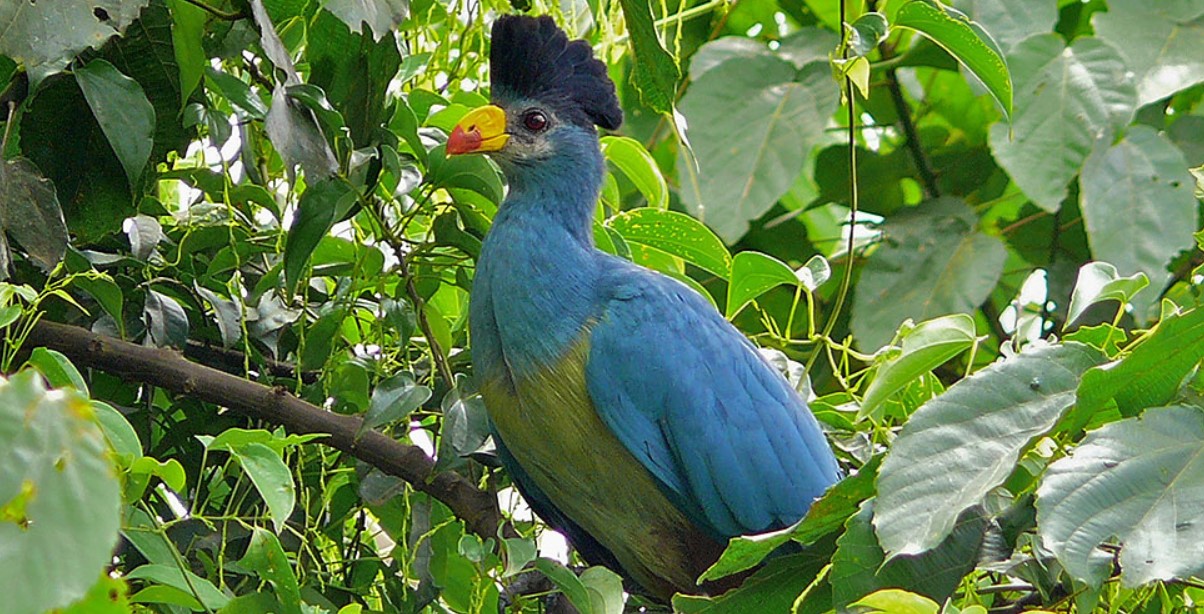
Kibale National Park is a premier birding destination, hosting over 375 species. Birding opportunities include early morning forest walks and swamp trails. Key locations and birds include the Kanyanchu Visitor Center for the elusive Green-breasted Pitta, the Sebitoli section for the Black-billed Turaco, and Bigodi Wetland Sanctuary for the Great Blue Turaco.
3-days-chimpanzee-tracking-in-kibale-forest-park-from-kigali
4-days-kibale-forest-chimpanzee-tracking-and-queen-elizabeth-national-park
Top Birding Opportunities & Species
1. Green-breasted Pitta (Pitta reichenowi)
The Green-breasted Pitta is arguably the ultimate prize of a Uganda birding safari in Kibale National Park. Famed for its breathtaking but cryptic plumage, this elusive species is a master of camouflage, blending seamlessly into the dappled light of the pristine rainforest floor. Serious birders from around the globe venture to Kibale specifically for the chance to catch a glimpse of this "holy grail" bird.
Finding the Green-breasted Pitta requires a mix of patience, expertise, and timing. It is notoriously difficult to spot because of its habit of skulking quietly through the dense, leaf-littered forest undergrowth. To maximize success, tracking usually begins at the crack of dawn when the forest is cool and quiet. During the breeding season (typically following the rains), lucky birders might hear its distinct, low-pitched mechanical wing-snapping display call, which it performs from a low perch to attract mates.
Experienced park guides are indispensable for this trek, as they know the specific territories and display grounds where the pitta is most frequently recorded. Foraging silently for insects, snails, and beetles, the bird will often remain perfectly still when approached, testing the sharp eyes of even the most seasoned birdwatchers. Because it spends so much time in the shadowy mid-story and ground layers, a sighting requires slow, methodical foot tracking along damp forest trails. Successfully checking this vibrant, jewel-like species off your life list is an unforgettable highlight that cements Kibale’s reputation as a world-class birding destination.
2. Albertine Rift Endemics
A Uganda birding safari to the western region of the country offers an unparalleled opportunity to encounter Albertine Rift endemics—species found nowhere else on earth except this unique montane rift ecosystem. Kibale National Park and its immediate peripheries act as a vital ecological corridor, allowing birders to tick off high-altitude and restricted-range specialists that are highly prized by international twitchers.
Among the most sought-after of these endemics is the Dusky Crimsonwing, a beautifully subtle, dark-plumaged estrildid finch that frequents the dense, tangled undergrowth and bamboo zones. Spotting one requires a keen eye for movement in the shadows. Sharing this specialized habitat is the Blue-headed Sunbird, a striking nectariivore boasting an iridescent blue head that contrasts brilliantly against the forest canopy when caught in a rare shaft of sunlight.
Moving into the mid-story, birders can look forward to locating the Collared Apalis, an active and vocal insectivore easily identified by its distinct chest band and energetic foraging habits through the vine tangles. Alongside it, the Red-faced Woodland Warbler can often be heard before it is seen, moving rapidly through the upper foliage in mixed-species feeding flocks. Tracking these endemics requires moving quietly along established trail systems, listening intently for their distinct calls. Because these birds are restricted to very specific altitudinal zones and microhabitats, encountering them provides a fascinating insight into the evolutionary biodiversity of the Albertine Rift.
3. Great Blue Turaco (Corythaeola cristata)
The Great Blue Turaco is one of the most spectacular, vibrant, and rewarding birds to observe on a Uganda birding safari. Standing at an impressive 70 to 75 centimeters in length, this massive, prehistoric-looking bird is a true icon of the African rainforest canopy. Unlike some of Kibale's more elusive residents, the Great Blue Turaco is relatively common and highly visible, making it a favorite for both dedicated ornithologists and casual wildlife photographers.
With its striking turquoise-blue body, deep yellow and red beak, and prominent black crest, this species looks like something straight out of a tropical paradise. They are highly social birds, often traveling in boisterous family groups of up to half a dozen individuals. They are most active in the early morning and late afternoon, loudly announcing their presence with a series of deep, resonant, chorusing calls that echo across the forest. Watchers can observe them executing clumsy yet fascinating "canopy running," leaping from branch to branch before taking off in a heavy, labored flight across gaps in the trees.
While they are regularly spotted in the main forest canopy of Kibale, the adjacent Bigodi Wetland Sanctuary offers some of the absolute best viewing opportunities. Here, the forest edge meets the swamp, providing an abundant supply of wild figs and musanga fruits, which form the bulk of their diet. Watching a group of Great Blue Turacos silhouetted against the African sky as they glide across the wetland boardwalk is a quintessential Kibale experience.
4. Black Bee-eater (Merops gularis)
For many enthusiasts on a Uganda birding safari, the Black Bee-eater stands out as one of the most visually stunning insectivores in the region. While many African bee-eaters are characterized by bright green or yellow plumage, this forest specialist breaks the mold with its dramatic, velvety-black body, electrified by a brilliant scarlet throat and streaks of luminous blue along its belly and wings.
The Black Bee-eater is primarily a resident of the high canopy, mid-story, and sunny forest edges, where it utilizes high, exposed dead branches as perfect hunting perches. From these vantage points, the bird scans the air for flying insects, particularly honeybees, wasps, and hornets. Once prey is spotted, it launches into a graceful, acrobatic aerial pursuit, snapping the insect out of mid-air with its long, decurved beak before returning to the same perch. It then characteristically rubs the insect against the wood to remove the stinger before swallowing it whole.
Kibale National Park provides an ideal habitat for this species, particularly along the wider forest tracks, road clearings, and light gaps where sunlight penetrates the dense canopy. They are often found in pairs or small family groups, and their soft, high-pitched calls help birders track their locations. Because they prefer the higher strata of the forest, bringing a high-quality pair of binoculars or a spotting scope is highly recommended to fully appreciate the brilliant, contrasting colors of this master aerial hunter.
5. African Pitta (Pitta angolensis)
The African Pitta is a legendary species among birdwatchers, representing one of the most thrilling and difficult-to-find targets on a Uganda birding safari. Like its green-breasted cousin, the African Pitta is an incredibly colorful, stocky, short-tailed bird that spends the vast majority of its life hidden in the deepest, most pristine patches of lowland and transitional tropical forests.
What makes the African Pitta particularly fascinating—and challenging—is its migratory behavior. It is an intra-African migrant, arriving in Kibale and surrounding western Ugandan forests during the wet seasons (typically from April to June and September to November) to breed. Outside of these months, the bird is virtually impossible to locate. During the breeding season, however, males become highly vocal and territorial. They perform a spectacular, brief courtship display, hopping up onto a low branch, puffing out their brilliant pink bellies, and delivering a loud, explosive "throaty whistle" accompanied by a flash of their vibrant blue wing coverts.
To see the African Pitta, birders must brave the humid, muddy conditions of the rainy season, navigating the forest floor quietly with an expert guide. The bird spends its days leaf-tossing, flipping over damp litter to find beetles, larvae, and earthworms. Because it is highly sensitive to disturbance, absolute silence and patience are required. Catching a glimpse of its rainbow-like plumage—combining green, blue, buff, black, and crimson—amidst the dark understory is a rare privilege reserved for the most dedicated safari travelers.
6. Papyrus Endemics
Exploring beyond the dense rainforest canopy of Kibale opens up a completely different ecological niche: the vast, towering papyrus swamps. A comprehensive Uganda birding safari to this area must include a morning or afternoon spent navigating the boardwalks of the Bigodi Wetland Sanctuary, a community-run reserve that serves as a vital haven for highly specialized papyrus endemics.
The undisputed star of this habitat is the Papyrus Gonolek (Laniarius mufumbiri). This striking member of the bushshrike family is a visual masterpiece, sporting a jet-black back, a vibrant crimson breast, and a distinct golden-yellow crown. Despite its bright colors, it is a notorious skulker, living deep within the dense, swaying stalks of papyrus (Cyperus papyrus). Birders must listen out for its synchronized, low duets—a combination of deep bell-like clicks and whistles shared between pairs—to pinpoint its location before waiting patiently for it to pop out into a brief clearing.
Alongside the Gonolek, the swamp is home to other restricted-range specials such as the Papyrus Canary and the elusive White-winged Swamp Warbler. These birds have evolved exclusively to thrive in the permanent wetlands of the Albertine region, relying entirely on the unique microclimate and insect life found within the papyrus stands. Walking along the narrow wooden boardwalks of Bigodi, surrounded by towering reeds and the calls of hidden swamp specialists, offers a stark, beautiful contrast to the interior forest birding of Kibale.
7. Hornbills & Parrots
The towering emergent trees and ancient fruiting figs of Kibale National Park make it a prime kingdom for large, charismatic canopy dwellers. Any Uganda birding safari here will be soundtracked and visually dominated by the dramatic presence of various hornbill and parrot species, which rely heavily on the park's intact primary forest structure for nesting hollows and food.
Among the loudest and most prominent are the White-thighed Hornbill and the Black-and-white-casqued Hornbill. These massive birds are impossible to miss as they fly heavily across the forest canopy, their wings making a loud, rhythmic rushing sound in the air. Their massive, hollow casques sit atop large beaks, used expertly to pluck wild fruits or tear apart bark in search of insects. Their raucous, laughing, and braying calls echo through the trees, providing a constant ambient soundtrack to the forest trek.
Living in the same high strata is the world-famous African Grey Parrot. Known globally for its incredible intelligence, seeing these birds wild and free in their natural habitat is a profound experience. They are highly gregarious, often seen flying in synchronized pairs or large flocks high above the forest line, silhouetted against the early morning sky as they commute from roosting sites to feeding areas. Their wild vocalizations—a chaotic mix of sharp whistles, squawks, and mimics—reveal their locations long before they land in the upper boughs of majestic mahogany or fig trees, offering superb viewing for birders equipped with spotting scopes.
8. African Finfoot (Podica senegalensis)
The African Finfoot is an enigmatic, highly specialized aquatic bird that represents a prized bucket-list addition to any Uganda birding safari. Neither a duck nor a rail, this unique waterbird belongs to its own distinct family (Heliornithidae) and is perfectly adapted to life along quiet, shaded, and undisturbed river systems and flooded forest wetlands.
Kibale and its surrounding water networks, including the slow-moving streams feeding into the Bigodi Wetland Sanctuary and nearby crater lakes, provide the ideal, low-disturbance habitat this secretive bird requires. The African Finfoot is notoriously shy; at the slightest sign of danger or human presence, it prefers to swim rapidly into the overhanging vegetation or literally "run" across the water’s surface using its brightly colored, lobed orange feet to seek cover in the dark riverbanks.
Observing the African Finfoot requires a stealthy approach, often by sitting quietly at a hidden vantage point overlooking a calm stretch of water or tracking slowly along riverbanks. It is typically seen swimming low in the water, much like a cormorant, with its slender neck jerking back and forth as it searches for aquatic insects, small fish, snails, and amphibians. With its sleek, brownish-grey body, sharp pointed bill, and striking white stripe running down the side of its neck, a clear, unobstructed view of an African Finfoot foraging peacefully in the dappled forest light is a true triumph for any visiting birder.
9. White-tailed Ant-thrush (Neocossyphus poensis)
For birders tracking elusive ground and understory species on a Uganda birding safari, the White-tailed Ant-thrush is a classic target. This medium-sized, largely rufous-brown bird is a dedicated resident of the dark, humid forest floor and lower mid-story, completely adapted to life beneath the dense canopy of Kibale National Park.
True to its name, this species has a highly specialized foraging behavior: it is a regular follower of army ant columns. As massive swarms of aggressive army ants march across the forest floor, they flush out thousands of hidden insects, including crickets, beetles, spiders, and roaches. The White-tailed Ant-thrush, often alongside other illadopsises and bulbuls, attends these columns, staying just ahead of the ant wave to effortlessly pick off the fleeing prey.
When it is not following ants, it can be found quietly foraging along established walking trails and old logging tracks within the park. It is a shy bird, but it possesses a distinct habit that gives away its identity: when startled or moving between perches, it frequently fans its tail, revealing flashing white outer tail feathers that contrast sharply against the dark forest backdrop. To spot the White-tailed Ant-thrush, birders must walk slowly, stopping frequently to scan the ground and low vine tangles, listening carefully for the rustle of dry leaves that indicates a busy bird feeding in the shadows.
10. Kingfishers & Trogons
The gallery forests, swamp edges, and shaded streams of Kibale National Park provide a rich sanctuary for some of the most colorful insectivores and fishers in Africa. A Uganda birding safari through these habitats offers excellent chances to spot highly sought-after kingfishers and the spectacular Narina Trogon.
Among the forest-dwelling kingfishers, the Blue-breasted Kingfisher and the Shining-blue Kingfisher are top priorities. Unlike common kingfishers that hunt in wide-open lakes, these species prefer the deep shade of gallery forests and slow-moving forest creeks. The Shining-blue Kingfisher is a dazzling jewel, boasting an ultra-marine blue back that flashes brilliantly as it darts low over the water. It perches silently on low, overhanging branches, waiting to dive for small fish and aquatic larvae. The Blue-breasted Kingfisher is slightly larger and can often be found further away from water, sitting motionless in the mid-story as it hunts for large insects and lizards.
Sharing these shaded microhabitats is the magnificent Narina Trogon (Apaloderma narina). Widely considered one of Africa’s most beautiful birds, it features a brilliant metallic-green back and a shocking, bright crimson underbelly. Despite these bold colors, it can be incredibly difficult to spot; it has a habit of sitting perfectly still on a branch, turning its green back to onlookers to blend completely with the foliage. Hearing its soft, repetitive, hooting call is often the only clue that this forest masterpiece is watching you from the mid-story.
How many bird species can be found in Kibale Forest?
Kibale Forest National Park is an absolute powerhouse for a Uganda birding safari, boasting a checklist of over 375 recorded bird species. This incredible diversity is driven by the park’s varied altitudes, which create a unique ecological overlap where montane and lowland forests meet. While it is internationally famous for primates, serious avitourists flock here because the dense canopy protects true forest "specials" that are difficult or impossible to see anywhere else in East Africa. Researchers have even noted that if you account for the wider conservation ecosystem, the regional list pushes past 600 species. For anyone keeping a life list, Kibale isn't just an option—it is an essential stop.
What is the most famous bird to spot in Kibale?
The ultimate crown jewel of a Uganda birding safari in Kibale is the legendary Green-breasted Pitta (Pitta reichenowi). Adorned in a mosaic of emerald green, vivid blue wing patches, and a deep red belly, it is arguably one of the most beautiful yet elusive forest birds on the planet. Finding it requires entering the forest at the crack of dawn. It spends its time hopping silently across the dark forest floor, tossing leaf litter aside in search of insects. During its brief breeding display window, males make a distinct, frog-like explosive grunt while leaping off the ground, which is often the only clue guides have to isolate its location in the dense undergrowth.
Are there Albertine Rift endemics in the park?
Yes, Kibale Forest serves as a critical refuge for six highly prized Albertine Rift endemic bird species, making it an indispensable routing for any targeted Uganda birding safari. Among these regional specialties, you can cross off the elusive White-naped Pigeon, the brilliantly colored Blue-headed Sunbird, and the secretive Red-throated Alethe. The park also protects species like the Dusky Crimsonwing, Collared Apalis, and the Purple-breasted Sunbird. Furthermore, Kibale holds a distinct advantage over other regional parks by hosting four species that are virtually unrecorded in any other Ugandan national park: Cassin's Spinetail, the Blue-headed Bee-eater, Masked Apalis, and the highly threatened Nahan’s Francolin.
What are the best birding spots within the park?
The epicenter of birding inside the park is the Kanyanchu Visitor's Center, situated about 35 kilometers southeast of Fort Portal town. From here, a complex network of well-maintained forest trails loops through pristine, mature tropical forest where canopy and understory specialists thrive. Another highly recommended hotspot for a Uganda birding safari is the northern Sebitoli Sector. Located along the main highway from Kampala, Sebitoli offers a completely different forest-edge structure. The more open canopy here makes it vastly easier to photograph fast-moving target species, sunbirds, flycatchers, and various colorful barbets that prefer secondary growth and forest margins.
What is the Bigodi Wetland Sanctuary?
Located just on the fringe of the national park, the Bigodi Wetland Sanctuary is an award-winning, community-run conservation project that is a mandatory extension of any Uganda birding safari. This rich papyrus swamp and riverine forest ecosystem acts as a magnet for wetland specialists, adding over 200 distinct species to your regional trip list. A guided 4-hour boardwalk trail allows you to view iconic papyrus endemics like the secretive Papyrus Gonolek, White-winged Warbler, and Papyrus Canary. Because all guiding fees directly fund local schools, health clinics, and clean water initiatives, birding in Bigodi beautifully marries top-tier wildlife viewing with sustainable community development.
Chimpundu Lodge
Can I combine birding with chimpanzee trekking?
Combining these activities is exceptionally easy and highly recommended. Kibale is affectionately dubbed the "Primate Capital of the World," protecting 13 distinct primate species alongside its massive avian population. On a typical Uganda birding safari itinerary, travelers head out early in the morning for chimpanzee trekking or the full-day Chimpanzee Habituation Experience (CHEX). While moving through the forest tracking chimp vocalizations, your birding eyes don't have to turn off—you will frequently cross paths with rare understory birds. After lunch, the day transitions seamlessly into a dedicated afternoon birding walk along the Kanyanchu trails or into the neighboring Bigodi Swamp.
What kind of raptors can I see in the forest?
The massive, ancient trees of Kibale support an array of powerful forest raptors that keep eagle-eyed birders scanning the skies and upper branches. The most formidable predator of the canopy is the Crowned Eagle (or African Crowned Eagle), a massive raptor known for hunting monkeys right out of the trees. On a dedicated Uganda birding safari, you should also keep your binoculars ready for rarer forest-dwelling birds of prey, such as Cassin's Hawk-Eagle, Ayres's Hawk-Eagle, and the sleek Black Sparrowhawk. Spotting these apex avian predators soaring over clearings or perched silently in the upper strata is a dramatic highlight of forest birding.
What is the best time of year for birding in Kibale?
While birding is a year-round activity in Uganda, the absolute peak months to schedule a Uganda birding safari in Kibale are March to May and September to November. These periods coincide with the region's rainy seasons, which trigger a massive abundance of forest fruits, seeds, and insects. Consequently, resident forest birds enter their peak breeding seasons, meaning they are incredibly vocal, active, and showing off pristine breeding plumage. This wet window is also the premier time to track the Green-breasted Pitta. While forest trails can get muddy and require a bit of patience with rain showers, the sheer volume of bird activity makes it well worth it.
Kibale Forest National Park+ 2
9. Are there migratory birds in Kibale?
Yes, Kibale Forest serves as a crucial stopover and wintering ground for both Palearctic migrants (birds escaping the harsh European winter) and Afrotropical migrants moving across the continent. These seasonal visitors typically start arriving around November and remain in the forest until April. Introducing these species dramatically shakes up the species mix in the canopy and forest edges. During these months, your Uganda birding safari list can easily expand to include various migrant warblers, flycatchers, and cuckoos, interacting directly with the park's permanent residents and creating a fast-paced, highly rewarding listing environment for birders.
Chimpundu Lodge
Can I spot the Great Blue Turaco in Kibale?
You will almost certainly see the Great Blue Turaco (Corythaeola cristata), as it is one of the most prominent, common, and theatrical birds in the region. Unlike the highly secretive forest dwellers, this massive, colorful bird—featuring a striking turquoise-blue body, yellow-and-red beak, and a distinct black crest—is loud and social. They are frequently seen traveling in small family groups, heavily crashing through the fruit trees of the forest canopy. While they are common along the Kanyanchu trails, the open fringes of the Bigodi Wetland Sanctuary offer world-class, eye-level photography opportunities as they glide between forest patches on a Uganda birding safari.
What other colorful canopy birds should I look out for?
The upper canopy of Kibale is a swirling canvas of bright colors. Beyond the turacos, a primary target on your Uganda birding safari should be the dazzling Black Bee-eater, sporting a velvet-black body sharply contrasted by a neon-blue belly and scarlet throat. You will also listen for the persistent calls of the African Emerald Cuckoo, a bird that looks like a literal flying jewel. The canopy is also home to Ross's Turaco, the Black-and-white-casqued Hornbill, and an array of bizarrely vocal barbets and tinkerbirds, such as the Yellow-spotted Nicator and the Yellow-billed Barbet, keeping your binoculars trained skyward.
Do I need an experienced guide?
Attempting to bird in a dense tropical rainforest without an expert is an exercise in frustration. The canopy is thick, the lighting is dappled, and forest birds are masters of stealth. Booking a specialized, trained Uganda Wildlife Authority (UWA) birding guide is absolutely essential for a successful Uganda birding safari. These local experts don't just have incredible eyesight; they hunt primarily by ear. They can instantly identify an obscure call coming from 100 feet up in the canopy, mimic the call to bring the bird closer, and tell you precisely which branch or vine to focus your spotting scope on.
Shoebill Uganda Bird Tours
What should I pack for a Kibale birding safari?
Packing correctly ensures your comfort in a challenging rainforest environment. First and foremost, invest in high-quality, bright binoculars (an 8x42 or 10x42 pair is ideal for low-light forest conditions) and a comprehensive field guide like Birds of East Africa. For photography, a fast telephoto lens (at least 300mm to 600mm) is required to cut through the dark canopy. Dress in neutral-colored, long-sleeved shirts and trousers to protect against insects and stinging nettles. Finally, bring sturdy, waterproof hiking boots with excellent grip for muddy terrain, a durable rain jacket, and lightweight gaiters.
Kibale National Park
What are the accommodations like near the park?
Accommodations around Kibale Forest cater excellently to nature enthusiasts, offering choices from high-end luxury to rustic, budget-friendly options. Premium properties like Primate Lodge Kibale sit directly inside the national park boundaries, meaning the morning dawn chorus serves as your natural alarm clock. Excellent mid-range options like the Chimpanzee Forest Guesthouse are situated on elevated ridges overlooking beautiful crater lakes and tea plantations. The best part? Most of these lodges feature lush, bird-rich gardens right on your doorstep, allowing you to add species to your Uganda birding safari list while sipping your morning coffee.
Kibale National Park
How do I get to Kibale Forest for my birding safari?
Reaching Kibale Forest for your Uganda birding safari offers two distinct travel styles. The classic route is a scenic road safari starting from Kampala or Entebbe. Driving via the clean, bustling town of Fort Portal takes roughly 5 to 6 hours along smooth, fully tarmacked roads, winding beautifully through lush tea estates and rural homesteads. Alternatively, if you want to skip the long drive, you can book a domestic scheduled or charter flight from Entebbe International Airport. These flights land at the nearby Kasese Airstrip (about an hour's drive from the park) or the Nyakisharara Airstrip in Mbarara, maximizing your actual field time in the forest.
Booking Uganda birding safari with us Roads of Adventure safaris
Booking a birding safari with Roads of Adventure Safaris, based in Kampala, gives you access to expert-led tours tracking over 1,065 species, including the Shoebill Stork. They offer highly customizable packages ranging from 1-day trips to extensive 3-week expeditions that can seamlessly include primate tracking.
