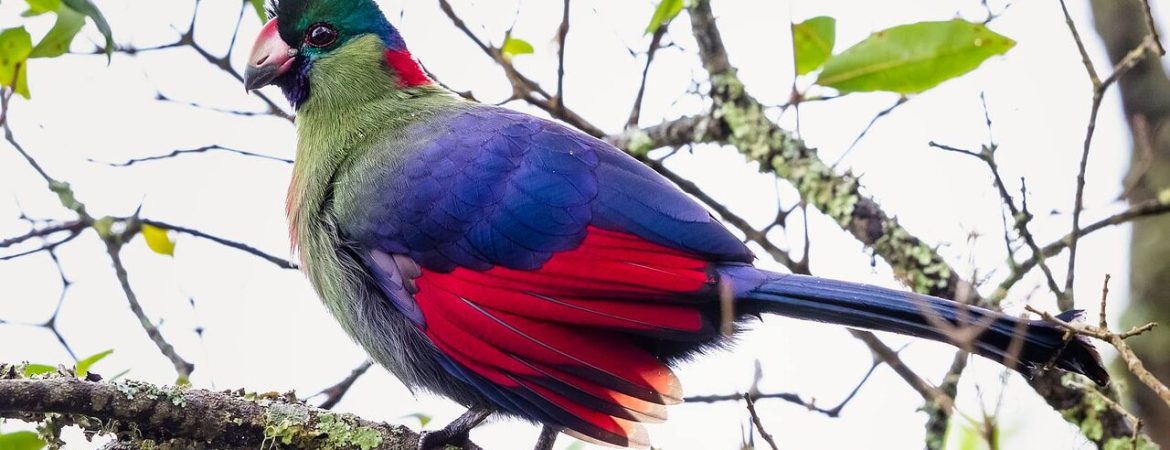
Mabira Forest, located between Kampala and Jinja, is a premier Ugandan birding site hosting over 300 species, including rare forest specialists like the Nahan’s Francolin, Cassin's Hawk-Eagle, and Tit Hylia. Key sightings include the Great Blue Turaco, African Dwarf Kingfisher, Forest Robin, and Weyn’s Weaver, especially along the Griffin Falls Trail.
30-days-best-uganda-birding-safari-extravaganza-and-wildlife-safari
25-days-complete-uganda-birding-safari-extravaganza-with-wildlife-viewing
22-days-best-uganda-primate-and-birding-safari-adventure
21-days-uganda-birding-safari-extravaganza-to-best-uganda-safari-parks
20-days-uganda-birding-safari-to-uganda-national-park
20-days-uganda-birding-safari-wildlife-gorilla-and-chimpanzee-tracking
14-days-classic-uganda-birding-safari-expedition
12-days-uganda-birding-tour-looking-for-rift-valley-endemic-birds-west-circuit
10-days-best-uganda-birding-safari-and-wildlife-experience
Key Bird Species to See in Mabira Forest on Uganda birding safari
Specialties & Rare Species: Nahan's Francolin, Cassin's Hawk‑Eagle, Tit Hylia, African Dwarf Kingfisher, White‑spotted Flufftail, Sabine’s Spinetail
Mabira Forest protects several highly sought species that are difficult to find elsewhere. Nahan’s Francolin is globally threatened and skulks in dense undergrowth, rewarding patient trackers. Cassin’s Hawk‑Eagle patrols the canopy, a powerful raptor best seen from forest clearings. The Tit (Green) Hylia is a tiny, active insectivore in the mid‑storey, often detected by its sharp calls. The African Dwarf Kingfisher flashes brilliant orange and blue in shaded ravines. White‑spotted Flufftail remains secretive in swampy understory; hearing it is often the first clue. Sabine’s Spinetail darts through the canopy edge and along stream corridors. Together these specialties define Mabira’s conservation value and make it a premier destination for committed birders prepared for patient, mixed‑species watching in a humid, species‑rich forest.
Turacos & Parrots: Great Blue Turaco, Black‑billed Turaco, Ross's Turaco, African Grey Parrot
Mabira’s canopy is alive with colorful turacos and parrots, often heard before they’re seen. The Great Blue Turaco is a large, flamboyant species whose deep green and blue plumage and distinctive calls are a forest hallmark. Black‑billed and Ross’s Turacos frequent fruiting trees and are easiest to spot at dawn when they move between feeding sites. African Grey Parrots occur in flocks and are attracted to fruiting figs and flowering trees; their loud, raucous calls carry far. Observing these species provides vivid encounters with forest frugivores that play crucial roles in seed dispersal and forest dynamics.
Hornbills & Raptors: Black‑and‑white Casqued Hornbill, African Pied Hornbill, Crowned Eagle, Ayres's Hawk‑Eagle
Mabira supports impressive hornbills and top‑order raptors, each occupying distinctive niches. The Black‑and‑white Casqued Hornbill, with its striking casque and large bill, forages for fruit in tall trees and is a marquee forest sighting. The African Pied Hornbill is more adaptable, seen along forest edges and clearings. Predatory birds include the powerful Crowned Eagle, an ambush hunter that preys on monkeys and large forest mammals, and Ayres’s Hawk‑Eagle, a more elusive raptor of canopy and escarpment. Spotting these species often requires scanning canopy gaps and riverine corridors, where their uplifts and hunting displays are most visible.
Understory & Forest Species: Forest Robin, Fire‑crested Alethe, Red‑capped Robin‑Chat, Red‑tailed Bristlebill, Green‑tailed Bristlebill, Yellow‑throated Tinkerbird
The forest understory in Mabira is richly populated by secretive, melodious species that reward close listening and quiet movement. The Forest Robin and Fire‑crested Alethe are shy, ground‑level insectivores that flit through leaf litter and low shrubs, often revealed by sudden bursts of song. Red‑capped Robin‑Chat favors forest margins and gardens, delivering clear, fluted phrases. Bristlebills—both Red‑tailed and Green‑tailed—are chunky, foliage‑gleaning babblers that move in family groups through dense tangles. The Yellow‑throated Tinkerbird, a small, fast pecker, is usually detected by its repetitive calls around fruiting trees. Together these species compose the forest’s near‑continuous soundtrack.
Other Notable Sightings: Blue‑breasted Kingfisher, African Emerald Cuckoo
Mabira yields several striking, occasionally encountered species that add variety to any trip. The Blue‑breasted Kingfisher prefers forest streams and shaded pools, where its electric turquoise back and rufous breast create superb photographic opportunities when the bird perches low over water. The African Emerald Cuckoo is a dazzling, glossy green passerine that appears at forest edges and gardens during the breeding season; its metallic sheen and soft calls make it memorable. Both species are indicators of healthy riparian and edge habitats within Mabira and are often encountered during targeted streamside watches or during morning and late‑afternoon mixed‑species flock activity.
What are the most endangered bird species I can find in Mabira Forest during a birding safari?
Mabira Forest supports several globally and regionally threatened bird species, but the most critical is Nahan’s Francolin (Ptilopachus nahani). Listed as Endangered on the IUCN Red List, Nahan’s Francolin has a highly restricted and fragmented distribution within the Guinea‑Congo forest biome; Mabira represents an important eastern outpost of suitable habitat in Uganda. This ground‑dwelling, rail‑like bird prefers dense, moist undergrowth — ridgelines, ravines and slopes with thick leaf litter — where it forages for seeds, invertebrates and fallen fruit. Detecting Nahan’s requires careful listening for its loud, ringing calls and patient, quiet walking along interior trails at dawn or dusk. Visual confirmation is uncommon because the species is secretive and stays near cover. Primary threats include habitat loss from logging and conversion to agriculture, hunting in some parts of its range, and the population fragmentation that reduces genetic exchange. Other species of conservation concern recorded in and around Mabira include the Black‑shouldered Nightjar and Papyrus Gonolek, both of which are tied to specific wetland and edge habitats; these species are sensitive to hydrological changes and wetland degradation. The presence of these threatened birds underscores Mabira’s conservation value. Responsible, guided birding supports protection by generating conservation income and by reducing disturbance through best practice. For the best chance to encounter endangered species, hire an experienced local guide, visit during peak calling seasons, and focus on interior trails and swampy gullies known to hold specialist taxa.
Which types of kingfishers are commonly seen around the wetlands and forest edges of Mabira?
Mabira’s mosaic of shaded streams, seepages, ponds and forest edges supports a notable assemblage of kingfishers, each adapted to slightly different microhabitats. The African Dwarf Kingfisher (Ispidina lecontei) is the smallest and most secretive: it favours tiny, shaded creeks and seepage lines within the forest interior. Often heard rather than seen, it sits motionless on low perches and darts rapidly to snatch minute fish and aquatic insects — glimpses are brief but spectacular due to its bright orange and blue plumage. The Shining‑blue Kingfisher (Alcedo quadribrachys) frequents slow, overgrown pools and forested stream margins; its vivid cobalt upperparts and rufous underparts flash in filtered light as it hunts small fish and invertebrates. The Blue‑breasted Kingfisher (Halcyon malimbica) prefers larger streams and river margins and is slightly more conspicuous; it perches openly on low branches above water, where anglers’ eyes are rewarded by its turquoise back and rich chestnut breast as it plunges for prey. Observing these species is best early morning or late afternoon when they are most active; dense canopy light can make photography challenging, so patience, a fast lens and an experienced guide who knows local pools and favorite perches are invaluable. Conserving riparian vegetation and maintaining clean waterways is crucial for these kingfishers, since alterations to stream flow or water quality can rapidly reduce prey availability and suitable hunting sites.
Is the Great Blue Turaco frequently spotted on a guided birding walk in Mabira?
Yes — the Great Blue Turaco (Corythaeola cristata) is one of Mabira’s most sought‑after canopy species and is encountered with reasonable regularity on guided walks. As the largest turaco, it is striking in both size and colour: deep blues and greens, a dramatic crest and bold, resonant calls that carry through the canopy. Turacos are largely frugivorous and track fruiting trees, so they tend to be predictable where large fig and fruiting trees occur. On guided walks, local rangers and birding guides will often take visitors to known feeding trees and habitual movement routes; because Great Blue Turacos move in family groups and are vocal, they are often heard before being seen. Observations are most likely at dawn and late afternoon when birds are active and moving between roosts and feeding sites. However, canopy height and dense foliage can limit close views; good sightings typically occur when birds cross canopy gaps, descend to lower branches, or when fruiting events draw them lower in the crown. Their regular occurrence is also an encouraging indicator of the forest’s health and availability of large fruiting trees. To maximise chances, join an early guided walk focused on canopy species, bring binoculars with a wide field of view and be prepared for listening and scanning rather than expecting prolonged, close-range views.
How does the White‑spotted Flufftail behave, and where can I find it in the forest?
The White‑spotted Flufftail (Sarothrura pulchra) is one of Mabira’s most secretive and enigmatic birds. Preferring swampy undergrowth, seepage areas and saturated leaf litter, this small, rail‑like species moves through dense tangles with furtive hops and sudden, fleeting runs. Visual detection is rare because its cryptic plumage blends seamlessly with wet understorey vegetation; more commonly, birders first hear its plaintive, repetitive calls emanating from marshy gullies or shaded banks. Flufftails feed on small invertebrates and organic matter found in damp leaf litter and shallow marshes, and they are most active during crepuscular periods and early morning when humidity is high. Locating one depends heavily on local knowledge: experienced guides will lead observers to known swamp patches, stream margins and seepage lines where flufftails have been recorded, and will employ careful, quiet approaches to avoid flushing birds unnecessarily. Ethical practices — minimizing playback, maintaining distance, and avoiding trampling sensitive wetlands — are crucial because waterlogged microhabitats are easily damaged and flufftails are sensitive to disturbance. Sightings are rewarding but often brief; for many visitors, hearing the species’ distinctive calls and catching a quick silhouette in a marshy channel constitutes a successful encounter. Preserving Mabira’s riparian and swamp systems is key to the flufftail’s continued presence, so guided visits that respect wetland integrity help both research and conservation.
What specialized bird species are considered special sightings in the Guinea‑Congo biome of Mabira?
Mabira sits at the eastern edge of the Guinea‑Congo forest biome and hosts several biome‑restricted or regionally characteristic species that are major targets for visiting birders. Among the most prized are Nahan’s Francolin, Capuchin Babbler (Turdoides atripennis), Yellow Longbill (Macrosphenus flavicans) and Grey Longbill (Macrosphenus concolor). These species are closely tied to the dense, humid lowland and submontane forest conditions typical of the Guinea‑Congo region and are less likely to be encountered elsewhere in East Africa. The Capuchin Babbler is a social, skulking understorey bird that forages in small noisy groups and is best located along quieter interior trails where tangles and dense secondary growth persist. Yellow and Grey Longbills are slender insectivores that probe foliage in the mid‑storey; they frequently participate in mixed‑species flocks and are best seen when flocks move through a reachable mid‑storey. Nahan’s Francolin, as noted earlier, is perhaps the rarest and most conservation‑sensitive of these, requiring patience and interior trail access. These specialized species reflect Mabira’s retained Guinea‑Congo characteristics and make the forest an essential site for birders seeking West/Central African taxa in Uganda. Targeted birding during mixed‑species flock activity, focusing on interior trails and using an experienced guide, maximises the chance of encountering these speciality birds. Their presence also highlights the importance of continued conservation of Mabira’s primary and mature secondary forest patches.
Which hornbill species are frequently recorded during a bird‑watching safari in Mabira Forest?
Mabira regularly features several conspicuous hornbill species that attract birders due to their size, calls and ecological role as seed dispersers. The Black‑and‑white Casqued Hornbill (Bycanistes subcylindricus) and the African Pied Hornbill (Lophoceros fasciatus) are among the most frequently recorded. The Black‑and‑white Casqued Hornbill is a large forest specialist with a prominent casque and bold black‑and‑white plumage; it forages primarily in tall canopy and emergent fruiting trees and is often heard before seen. Its loud, booming calls and sizeable silhouette against the canopy make it a memorable sight. The African Pied Hornbill is more adaptable and is often encountered along forest edges, clearings and secondary growth; it tends to move in pairs or small family groups and gives rapid, raucous calls. Both species are frugivorous and play essential roles in seed dispersal, helping maintain forest structure and regeneration. For sightings, scan fruiting fig trees, canopy gaps and riverine corridors during early morning and late afternoon when hornbills are most active. Local guides frequently know regular roosts and feeding trees, which increases the likelihood of good views. Observing these hornbills provides not only photographic opportunities but also insights into Mabira’s ecological dynamics, since healthy hornbill populations indicate abundant fruit resources and intact canopy structure.
What is the best time to see the elusive Green‑breasted Pitta within the forested trails?
The Green‑breasted Pitta (Pitta reichenowi) is a jewel of the understory but is notoriously difficult to locate due to its secretive habits and preference for dense leaf litter. The best time to seek this species in Mabira is during the breeding season when territorial males call more frequently, making them easier to locate acoustically. Early morning and late afternoon are the most productive periods overall, as pittas tend to be active around dawn and dusk. Walking quiet, interior trails that retain dense understorey and leaf litter increases the chance of hearing and possibly seeing a bird as it moves through its territory. Playback is sometimes employed by experienced guides to provoke a response, but it must be used sparingly and ethically to avoid undue stress. When sighted, the Green‑breasted Pitta reveals vivid greens, bold patterns and a compact, ground‑dwelling profile; such encounters are typically brief and require quick, calm photography. Patience, silence, and the assistance of a knowledgeable local guide who knows recent sightings and fine‑scale habitat preferences are essential. Visitors should accept that many successful “pitta” encounters are the result of careful listening and slow, methodical searching rather than long-distance spotting, and that even then sightings may be fleeting.
Are there any unique primate sightings that coincide with birding in Mabira Forest?
Yes — primates are a frequent and exciting part of the wildlife backdrop during birding walks in Mabira Forest. The forest supports several species that birders commonly encounter, notably Red‑tailed Monkeys (Cercopithecus ascanius), Grey‑cheeked Mangabeys (Lophocebus albigena) and Vervet Monkeys (Chlorocebus pygerythrus). These primates are often heard first — their calls and canopy movement can reveal fruiting trees or mixed‑species flock locations, indirectly aiding birding. Red‑tailed Monkeys are agile canopy dwellers, often seen in active groups feeding on fruits and insects. Grey‑cheeked Mangabeys are larger and more gregarious, sometimes moving in troops that attract raptors and influence bird distribution through disturbance and fruit depletion. Vervet Monkeys are adaptable and commonly occupy forest edges and nearby human‑modified areas. Observing primates adds ecological context to birding trips: troop movements tend to trigger mixed‑species flock activity, flush insect prey, and concentrate frugivores at feeding sites. Respectful viewing practices — maintaining distance, avoiding feeding, and following guide directions — ensure safe encounters and minimize stress to the animals. Coordinated primate and bird watching can produce memorable, multi‑taxon experiences that highlight Mabira’s biodiversity.
What kind of forest raptors should I look out for while exploring Mabira Forest?
Mabira hosts several forest‑adapted raptors that add a dramatic element to birding excursions. Key species to watch for include Cassin’s Hawk‑Eagle (Aquila africana), African Harrier‑Hawk (Polyboroides typus) and the nocturnal African Wood‑Owl (Strix woodfordii). Cassin’s Hawk‑Eagle is a powerful canopy predator that prefers dense forest and ambush hunting from concealed perches; it feeds on medium‑sized birds and small mammals and is often detected by scanning canopy gaps and emergent trees. The African Harrier‑Hawk is notable for its double‑jointed legs which it uses to probe tree cavities and extract nestlings and insects; it is frequently seen quartering forest edges and is adaptable in its diet and hunting tactics. African Wood‑Owls are nocturnal and require dusk or night surveys to detect; they roost quietly by day but can be located by pre‑dawn or dusk listening sessions. To find raptors, focus on canopy openings, riverine corridors, and tall emergent trees at dawn and dusk when activity peaks. Local guides can direct you to regular perches and recent sightings; combining daytime scanning with possible night walks (where allowed) extends the range of raptor encounters. Raptors in Mabira reflect the forest’s vertical structure and predator–prey dynamics, making them a rewarding target for patient observers.
What is the best birding trail in Mabira Forest for spotting the rare Nahan’s francolin?
The rare Nahan’s Francolin is a secretive understorey specialist best sought along the quieter interior trails of Mabira that penetrate deep, undisturbed forest. Trails that follow ridgelines, gullies, and steeper slopes with thick leaf litter and dense understory are ideal because the francolin prefers such microhabitats where cover is continuous. Local rangers and experienced bird guides usually know the specific sections of trail and time windows where the species has been recorded and will lead small, quiet groups to those areas at dawn or dusk when vocal activity is highest. Because Nahan’s is often heard rather than seen, guides rely on careful listening and triangulation of calls to locate individuals before attempting a visual approach. Ethical considerations matter: minimizing disturbance, avoiding off‑trail trampling of sensitive understorey, and keeping group sizes small increase the chance of a successful, low‑impact encounter. Visitors should plan for patient, slow walking and accept that many sightings may be brief or auditory-only; however, even a reliable call from a known territory is considered a conservation‑valuable record. Hiring a guide with recent sighting knowledge is the most effective strategy to maximize chances of this flagship encounter.
Which small, undergrowth birds can I photograph on a bird‑watching trip in Mabira?
Mabira’s understorey supports several attractive, photographable species that respond well to patient, low‑impact approaches. Notable subjects include the Red‑tailed Bristlebill (Bleda syndactylus), Green‑tailed Bristlebill (Bleda eximia) and Fire‑crested Alethe (Alethe castanea). Bristlebills are chunky, medium‑sized babblers that forage in family groups through dense tangles; they often pause on low perches when moving between clumps, providing photographic opportunities. The Fire‑crested Alethe is more ground‑oriented and can be coaxed into low, photogenic perches as it flicks through leaf litter and feeds on insects. For successful photography in the dim understorey, use a fast lens (f/2.8–f/4), higher ISO settings with a camera that handles noise well, and a tripod or monopod for stability. Approach slowly and stop frequently to allow birds to resume normal behavior; avoid flashes which can startle and displace them. Early morning light and overcast conditions provide soft, even illumination suitable for understorey shots. Working with a local guide who knows recent bird movements and favoured perches will significantly increase your chances of close, natural photographs while ensuring low impact on the birds and their habitat.
Are there any sunbird species visible in the trees during a 1‑day birding trip to Mabira?
Yes — even on a single‑day visit to Mabira you can encounter several sunbird species, most commonly the Grey‑headed Sunbird (Deleornis axillaris) and the Olive‑bellied Sunbird (Cinnyris chloropygius). These small, active nectar feeders frequent flowering trees, shrubs and forest edges, where they flit between blossoms probing for nectar and catching insects. Early morning is the peak time to see sunbirds because flowers hold the most nectar and birds are most actively feeding. A one‑day route that includes forest edge, a clearing with flowering shrubs, and a streamside patch of flowering plants will maximise your chances. Sunbirds are fast and often appear as rapid flashes of colour; binoculars and a telephoto lens help with identification and photography. Observing sunbirds provides a delightful complement to larger forest species, as they are often bold and conspicuous at feeding sites and will sometimes tolerate closer approaches than shy understorey birds. Guides can point out local flowering hotspots and recent nectar availability to focus your short visit for the best results.
Do I need a professional birding guide to identify birds in Mabira Forest?
Yes — hiring a professional birding guide or ranger is strongly recommended for Mabira Forest. The dense canopy, dim understorey and prevalence of secretive, skulking species make independent identification difficult, especially for those unfamiliar with Guinea‑Congo biome taxa. Local guides possess intimate knowledge of recent sightings, preferred microhabitats, vocalisations and subtle field marks that dramatically increase your success rate. They also ensure safety on trails, avoid sensitive areas, and practice ethical birding—such as limiting playback, controlling group size, and preventing habitat trampling. Guides can arrange targeted walks for specialty species, advise on the best times of day, and coordinate night walks for owls. For photographers and serious birders, a guide’s ability to locate regular perches and upcoming mixed‑species flocks can be invaluable. Additionally, hiring guides supports local livelihoods and conservation initiatives, creating a positive cycle that benefits both visitors and Mabira’s biodiversity.
What cuckoo species are commonly spotted, especially with their distinct calls in the forest?
Mabira’s forests host several cuckoo species that are often more easily detected by voice than by sight. The African Emerald Cuckoo (Chrysococcyx cupreus) is a flashy, metallic‑green species heard and seen in forest edges and clearings; its soft, fluted calls are distinctive and often lead observers to glimpses of glossy plumage. Klaas’s Cuckoo (Chrysococcyx klaas) is another vocal species with a high, thin whistling call and is commonly heard in the mid‑storey. The Dusky Long‑tailed Cuckoo (Cercococcyx mechowi) gives plaintive descending notes from dense foliage and is a furtive presence in shaded interiors. Cuckoos are often encountered at dawn and during mixed‑species flock activity when host species are active and vocal. Because some cuckoos are brood parasites, their presence may also signal the occurrence of particular host species in the area. Learning the calls and the microhabitat preferences of these cuckoos is essential; a knowledgeable guide will help with careful listening and locating likely perches. On a well‑timed walk you may both hear and glimpse these striking metallic and iridescent birds as they move through the canopy.
Which butterfly species are commonly seen alongside the unique birds in Mabira Forest?
Mabira’s butterfly fauna is rich and complements birding walks with frequent, colourful encounters. Swallowtails (Papilionidae), including various Papilio and Graphium species, are among the most conspicuous — they patrol forest glades, edges and riverbanks, often feeding at flowers, sap flows or puddling sites. These large, fast‑flying butterflies are attracted to sunlight patches and moist mineral sites and are readily photographed. In addition, Mabira hosts a diversity of nymphalids and hesperids with striking patterns and eyespots that flash as they flick through vegetation. Butterflies often concentrate along stream margins, muddy puddles and flowering shrubs; mid‑morning to early afternoon on sunny days is the most active period. For combined bird and butterfly watching, target forest clearings, edge habitats and riparian corridors where both taxa congregate. Documenting both birds and butterflies during a visit contributes to a fuller appreciation of Mabira’s biodiversity and supports conservation messaging about habitat mosaics. Field guides, a camera with a macro or telephoto lens and patient observation will yield rewarding finds among the Lepidoptera while you pursue the forest’s avian specialties.
Booking Uganda birding safari in Mabira Forest with us Roads of Adventure safaris
Book a thrilling 1-day birding safari to Mabira Forest with Roads of Adventure Safaris to explore Uganda's largest central forest, home to over 300 bird species. Located near Kampala, our expert-guided tours offer prime sightings of the Nahan’s Francolin, Great Blue Turaco, and various kingfishers in a lush, biodiverse setting. This guided adventure includes transport, lunch, and walking trails designed to maximize sightings of rare forest birds. Experience a fantastic, focused birding day with Roads of Adventure Safaris to see vibrant forest life and primates in Mabira
