Uganda offers world-class safari experiences where you can track mountain gorillas, spot rare tree-climbing lions, and cruise beneath thundering waterfalls. Top national parks include Bwindi Impenetrable, Murchison Falls, Queen Elizabeth, Kibale, and Lake Mburo
14-days-uganda-and-rwanda-safari-tour-itinerary
14-days-luxury-uganda-primate-safari-holiday
14-days-uganda-primate-safari-and-jinja-white-water-rafting
14-days-classic-uganda-birding-safari-expedition
14-days-best-africa-big-five-safari-in-uganda-and-best-gorilla-trekking-adventure
20-days-uganda-birding-safari-wildlife-gorilla-and-chimpanzee-tracking
20-days-uganda-birding-safari-to-uganda-national-park
20-days-uganda-safari-holiday-tour-package-itinerary
19-days-best-photography-uganda-birding-safari-and-wildlife-adventure
19-days-incredible-uganda-safari-tour-big-five-chimpanzees-and-mountain-gorillas
18-days-best-of-uganda-safari-holiday-vacation-to-all-best-parks
17-days-uganda-honeymoon-safari-holiday-tour
17-days-uganda-birding-safari-itinerary
17-days-best-safari-in-uganda-ending-in-kigali-rwanda
16-days-ultimate-uganda-safari-to-rwanda-safari-tour-package-combo
16-days-best-of-uganda-birding-safari-holiday-extravaganza
7-day-ultimate-uganda-primate-safari-chimpanzees-and-game-drives
6-days-best-gorilla-trekking-and-safari-uganda-parks
1. Bwindi Impenetrable National Park
The Primate Sanctuary
Tucked away in the rugged highlands of southwestern Uganda, Bwindi Impenetrable National Park is a place where time seems to stand still. This ancient, montane forest survived the last ice age, allowing an incredibly complex ecosystem to develop over hundreds of thousands of years. As its name implies, the canopy is incredibly dense, woven together by tangled vines, giant tree ferns, and thick undergrowth that blankets a landscape of steep ridges and deep valleys. The air here is cool, crisp, and frequently heavy with mist, creating a dramatic, ethereal atmosphere that feels entirely isolated from the modern world.
The ultimate draw to Bwindi is its status as the premier sanctuary for the critically endangered mountain gorilla. The park protects roughly half of the global population, with more than twenty habituated family groups spread across four distinct tracking sectors: Buhoma, Ruhija, Rushaga, and Nkuringo. Setting out at dawn with expert Uganda Wildlife Authority (UWA) rangers and trackers, travelers embark on a deeply rewarding trek through the wilderness. The hike itself is an adventure, requiring visitors to navigate slippery slopes and thick brush until the trackers signal that the family is near.
Spending a magical hour observing a gorilla family is an unparalleled wildlife experience. Travelers watch young juveniles roughhouse in the vines, mothers cradle their infants, and the massive, composed silverback keep a watchful eye over his troop. Beyond gorillas, Bwindi is a biodiversity hotspot. It supports over 120 mammal species, including forest elephants, chimpanzees, and l’Hoest’s monkeys. For avid birdwatchers, the forest is a legendary destination, hosting 350 distinct bird species, including 23 Albertine Rift endemics like the African green broadbill.
- Logistics & Tips: Bwindi is situated roughly 9 to 10 hours by road from Kampala or Entebbe. Many operators break up this long drive with a stop at Lake Mburo or choose a 1-hour scheduled flight into Kihihi or Kisoro airstrips. Because trekking sectors dictate where you stay, securing gorilla permits well in advance is the critical first step in planning any Bwindi itinerary.
2. Kibale Forest National Park
The Primate Capital
Kibale Forest National Park represents the ultimate tropical rainforest experience in East Africa. Located in western Uganda, just a short drive from the scenic crater lakes of Fort Portal, Kibale transitions beautifully from lowland forest to montane ecosystem. This lush, green expanse is defined by towering mahogany and fig trees that stretch up to 60 meters into the sky, creating a multi-layered canopy alive with sound. From the moment travelers step beneath the shade of the forest wall, they are surrounded by an orchestral chorus of cicadas, birds, and distant, echoing monkey calls.
Kibale is globally celebrated as the "Chimpanzee Capital of East Africa" for very good reason. The park boasts the highest density and diversity of primates on the continent, sheltering 13 distinct species. Among them, a population of over 1,500 wild chimpanzees thrives within the boundaries. The park offers two distinct levels of chimpanzee experiences: standard morning or afternoon tracking, and the comprehensive Chimpanzee Habituation Experience (CHEX), which allows travelers to accompany researchers for a half or full day as the chimps wake, forage, and build their nests.
Watching a chimpanzee community interact in the wild reveals an fascinating look into primate behavior. Visitors frequently see them grooming in small groups on the forest floor, communicating via powerful vocalizations that shake the canopy, or moving with incredible agility through the high branches. While searching for chimps, look up to spot other unique primates, including the endangered red colobus monkey, the rare L’Hoest’s monkey, and the black-and-white colobus. The forest floor also hides elusive wildlife like bush pigs, forest elephants, and blue duikers, alongside over 370 bird species, including the spectacular green-breasted pitta.
- Logistics & Tips: Kibale pairs flawlessly with an itinerary moving from Murchison Falls or Queen Elizabeth National Park. Nearby Bigodi Wetland Sanctuary offers an excellent afternoon boardwalk walk run by the local community, which is fantastic for spotting primates and large birds like the Great Blue Turaco.
3. Queen Elizabeth National Park
The Equator’s Ecosystem
Stretching across the floor of the Western Rift Valley, Queen Elizabeth National Park is Uganda’s most eclectically diverse safari destination. The park’s scenery is a spectacular tapestry of landscapes, featuring open savanna plains, dense papyrus swamps, shadowy crater lakes, and the humid Maramagambo Forest, all framed by the jagged, snow-capped peaks of the Rwenzori Mountains in the distance. Positioned directly on the equator, the park covers nearly 2,000 square kilometers, offering a classic safari experience complemented by unique aquatic and volcanic geography.
The undisputed centerpiece of a Queen Elizabeth safari is a boat launch along the Kazinga Channel, a natural 32-kilometer waterway connecting Lake Edward and Lake George. A boat cruise along these banks provides a front-row seat to one of the world's highest concentrations of hippopotamuses. Huge herds of elephants, buffalos, and waterbucks regularly gather at the water’s edge to drink and bathe, while Nile crocodiles sun themselves on the mudflats. The birdlife here is spectacular, with skimmers, pelicans, and kingfishers darting across the water, contributing to the park's massive checklist of over 600 bird species.
In the southern reaches of the park lies the remote Ishasha Sector, a landscape dominated by sprawling, old fig trees. Ishasha is famous for its unique population of tree-climbing lions. Unlike most lions that stay firmly on the ground, the prides here spend the heat of the day lounging high up in the branches to catch the breeze and escape tsetse flies. Further north, the Kasenyi Plains offer classic savanna game drives where leopards and lions hunt Uganda kobs, while the breathtaking Kyambura Gorge—a deep, forested canyon carved right out of the flat grassland—provides a unique sunken environment for tracking habituated chimpanzees.
- Logistics & Tips: Located about 6 to 7 hours west of Kampala, Queen Elizabeth serves as the natural geographical bridge between the chimp trekking in Kibale and the gorilla tracking in Bwindi. The park offers a fantastic variety of lodging options, ranging from luxury ridge-top lodges with panoramic rift valley views to intimate, riverside tented camps.
4. Murchison Falls National Park
Power of the Nile
Murchison Falls National Park, Uganda's largest and oldest protected conservation area, offers an iconic and powerful safari experience. The park is bisected by the historic Victoria Nile, which cuts through a landscape of rolling Borassus palm forests, expansive golden savannas, and riverine woodlands. The northern sector of the park presents classic, wide-open East African landscapes where massive herds of wildlife roam, while the southern sector features denser forest cover, creating a beautiful contrast in scenery and habitats within a single park.
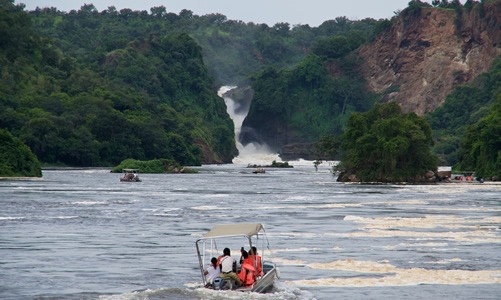
The park's namesake feature, Murchison Falls, is one of the most explosive natural displays on earth. Here, the entire, wide Victoria Nile forces its massive volume through a narrow, rocky canyon just seven meters wide. The river plunges 43 meters down into the "Devil's Cauldron" below with a deafening roar, creating a perpetual cloud of mist and brilliant rainbows. Travelers can view this spectacular show from a boat safari moving up the river, or take a guided walk to the top of the falls to stand right beside the rushing water and feel the ground vibrate from the sheer force.
Away from the river, the northern plains host exceptional wildlife viewing. Game drives reveal healthy populations of lions, leopards, spotted hyenas, and vast herds of Cape buffalo and African bush elephants. Notably, Murchison Falls is one of the best places in Uganda to see large numbers of the endangered Rothschild’s giraffe. The riverbanks downstream host thousands of hippos and giant Nile crocodiles, while the birdlife includes sought-after species like the prehistoric-looking Shoebill stork, which is frequently spotted in the delta marshes where the Nile flows into Lake Albert.
- Logistics & Tips: Situated roughly 5 hours north of Kampala, the journey to Murchison Falls can be easily paired with a morning stop at the Ziwa Rhino Sanctuary en route, allowing travelers to track wild rhinos on foot and tick off the full "Big Five" experience on their northern circuit.
5. Kidepo Valley National Park
The Rugged Frontier
For travelers seeking a true, unadulterated wilderness, Kidepo Valley National Park is a masterpiece of isolation. Located in the far northeastern corner of Uganda, along the rugged borders of South Sudan and Kenya, Kidepo is widely considered one of the most magnificent and untouched wilderness areas in all of Africa. The park is defined by two wide, seasonal river valleys—the Kidepo and Narus valleys—surrounded by dramatic, towering mountain ranges like Mount Morungole. During the dry season, the valleys turn into an arid oasis, drawing wildlife from miles around to the remaining water oases.
The sheer remoteness of Kidepo ensures that visitors enjoy an exclusive safari experience, often exploring the plains for hours without encountering another vehicle. The Narus Valley, which retains water year-round, is the wildlife heart of the park. It supports massive herds of Cape buffalo—sometimes numbering in the thousands in a single congregation—alongside abundant elephants, lions, leopards, and Rothschild’s giraffes. Kidepo is also home to several species that cannot be found anywhere else in Uganda, including the cheetah, bat-eared fox, striped hyena, caracal, and the elegant lesser kudu.
A visit to Kidepo is also deeply enriched by its cultural landscape. The surrounding Karamoja region is home to traditional pastoralist communities whose lifestyle centers around cattle and homesteads called manyattas. Travelers can arrange visits to learn about their enduring customs, traditional dances, and beadwork. Additionally, hikers can ascend into the Morungole mountains to meet the Ik people, one of the most isolated ethnic groups on the continent, offering a profound cultural connection that beautifully complements the raw wildlife experience.
- Logistics & Tips: Driving to Kidepo from Kampala is an intense, multi-day journey through northern Uganda. To maximize safari time and comfort for clients, a scheduled or private chartered flight from Entebbe directly to the Kidepo airstrip is highly recommended.
6. Lake Mburo National Park
The Savannah Gateway
Lake Mburo National Park may be one of Uganda's smaller savanna parks, but what it lacks in pure size, it easily makes up for in charm, accessibility, and unique activities. Situated in western Uganda, the park is a beautiful landscape of sculpted, rolling green hills, open valleys, and extensive acacia woodlands. At its heart lies a network of five lakes, with Lake Mburo being the largest. This diverse wetland environment creates a peaceful, tranquil setting that provides a wonderful introduction or a relaxing finale to a comprehensive Ugandan itinerary.
What makes Lake Mburo truly unique within Uganda is its distinct lack of dangerous predators like elephants and lions, which has allowed a completely different style of safari to flourish. It is one of the few places where travelers can safely leave their vehicles to explore the African bush on foot during a guided walking safari, ride horseback alongside herds of wild animals, or mountain bike along the park's dirt tracks. Feeling the thud of hooves on the ground while cycling next to a herd of zebras or impalas offers an intimate connection to nature that a vehicle simply cannot replicate.
The park is the premier destination in Uganda to see large herds of Burchell’s zebra and impalas, and it is home to massive, long-horned Ankole cattle that graze alongside the wildlife just outside the park boundaries. Following a successful translocation program, a thriving population of Rothschild’s giraffes now roams the acacia forests. Leopard sightings are also remarkably common on evening night drives. For bird enthusiasts, the lakes and surrounding papyrus swamps shelter over 350 species, including the rare African finfoot, red-faced barbet, and papyrus yellow warbler.
- Logistics & Tips: Located a convenient 3.5-hour drive from Kampala, Lake Mburo is the closest national park to the capital city. Its geographic position makes it the perfect halfway rest stop to break up the long drive down to the gorilla forests of Bwindi or the chimp canopies of Kibale.
1. How far in advance do I need to book a mountain gorilla trekking permit for Bwindi or Mgahinga?
Securing a mountain gorilla trekking permit is the single most critical timeline element when planning a Uganda safari for the 2026 to 2028 seasons. Because the Uganda Wildlife Authority (UWA) strictly limits habituated family encounters to just eight visitors per group for one hour daily, daily availability is finite. For peak travel seasons—which run during the dry months of June to September and December to February—it is highly recommended to book your permits minimally 6 to 10 months in advance.
Demand for these permits has risen steadily as travelers prioritize raw, impactful eco-tourism. Bwindi Impenetrable National Park has four distinct sectors (Buhoma, Ruhija, Rushaga, and Nkuringo), and your permit dictates exactly which region you must track in. Because accommodation choices are tied directly to the specific sector on your permit, booking late often means you might have to stay hours away from your starting trailhead, forcing an exhausting 4:00 AM transfer on the morning of your trek.
If you are eyeing the shoulder or rainy seasons (March to May and October to November), you might find flexibility closer to your dates, sometimes up to 2 to 3 months out. However, if you are planning a multi-generational family safari or traveling with a small private group that wishes to track the exact same gorilla family together, waiting is a massive gamble. Booking nearly a year out ensures you get your preferred sector—such as Buhoma for its luxury lodge accessibility or Rushaga for its stunning, rugged terrain—and allows your tour operator to seamlessly lock down the best nearby lodges before they fill up.
2. What is the current cost of gorilla and chimpanzee permits, and where do those funds go?
For the current 2026 through 2028 cycle, international tourist mountain gorilla trekking permits in Uganda are priced at $800 USD per person, while the immersive Gorilla Habituation Experience in southern Bwindi sits at $1,500 USD. Meanwhile, chimpanzee tracking permits in Kibale Forest National Park cost $250 USD, with the full-day Chimpanzee Habituation Experience costing $300 USD. While these figures represent a premium investment, they are directly tied to one of the most successful wildlife conservation frameworks in modern history.
When you purchase a permit, you are not simply buying an entry ticket; you are directly funding the survival of these endangered primates. The largest portion of the permit fee goes directly toward the intensive, round-the-clock protection of the parks. This includes paying competitive salaries to the highly trained Uganda Wildlife Authority (UWA) rangers, veterinary teams (like the Gorilla Doctors), and counter-poaching patrols who sweep the dense jungles daily for wire snares.
Crucially, 20% of all park entry and permit revenues are legally mandated to go directly to the local communities living along the park borders. This revenue-sharing program funds vital infrastructure, building health clinics, financing clean water projects, and constructing primary schools. By transforming these primates from perceived agricultural threats into priceless community assets, local residents become active guardians of the forest. Furthermore, a percentage of the fee goes toward compensating local farmers for crop damage caused by wandering wildlife, effectively mitigating human-wildlife conflict and ensuring that the conservation success story of southwestern Uganda continues to thrive for generations.
3. What is the difference between standard primate tracking and the Habituation Experience?
When planning a safari to Bwindi Impenetrable National Park or Kibale Forest National Park, travelers must choose between a standard tracking excursion and a Habituation Experience. The primary differences lie in the duration of the encounter, the size of the group, and the behavioral state of the primates you are observing.
A standard gorilla or chimpanzee trek is designed to view animals that are completely accustomed to human presence. The tracking group is capped at eight guests, and once the trackers locate the family, a strict one-hour countdown begins. During this hour, the primates generally act entirely natural—resting, grooming, or feeding right in front of you without alarm. This is an exceptional option for photographers and casual travelers who want a guaranteed, clear, and relatively relaxed window of observation.
The Habituation Experience (offered for gorillas in Bwindi's Rushaga sector and for chimpanzees in Kibale) is a deeper, raw look into conservation. This process involves a small group of up to four tourists joining specialized UWA researchers and habituators as they follow wild primate groups that are still undergoing the multi-year process of becoming comfortable around humans. Instead of one hour, you spend four full hours with them. The behavior can be far more dynamic, unpredictable, and active. You might find yourself moving fast through dense undergrowth as a wild chimp community moves through the canopy, or sitting quietly at a distance while a silverback cautiously assesses the researchers. This is a highly rewarding, raw choice for wildlife enthusiasts who want to actively participate in field research and experience a much longer, unscripted day in the jungle.
4. Should I choose a driving safari or fly between Uganda’s national parks?
Deciding whether to traverse Uganda by road or via domestic scheduled flights is a choice between immersive scenery and maximizing your time. A classic driving safari utilizes a customized 4x4 safari land cruiser with a pop-up roof. This option is highly rewarding because it reveals why Uganda is called the "Pearl of Africa." Driving gives you an intimate look at local life, passing through bustling roadside markets, terraced hillsides, and expansive tea estates. It also allows you to break up long journeys with key stops, like tracking wild rhinos at Ziwa or crossing the equator line. However, the drives can be long and physically demanding; for instance, traveling from Entebbe to Bwindi is a grueling 9 to 10-hour journey over winding, bumpy roads.
Conversely, flying safaris utilize scheduled or chartered domestic flights operated by local airlines like Aerolink, flying from Entebbe International Airport directly to wilderness airstrips like Kihihi (for Bwindi), Kasese (for Queen Elizabeth and Kibale), Pakuba (for Murchison Falls), and Kidepo. A flight that would normally take an entire day by road is reduced to a swift, scenic 1 to 2-hour journey, treating passengers to breathtaking aerial views of the East African Rift Valley and crater lakes.
For a premium 2026–2028 itinerary, a hybrid approach is often best. Flying from Entebbe straight to Murchison Falls, driving down through Kibale and Queen Elizabeth, and then flying back to Entebbe from Bwindi offers the ultimate balance. This saves you from the two longest, most exhausting driving segments while still allowing you to experience the classic overland journey through western Uganda's shifting landscapes.
5. Where can I see the "Big Five" in Uganda, and is it possible to see them in a single park?
The iconic "Big Five"—lion, leopard, African elephant, Cape buffalo, and rhinoceros—are a major highlight for safari-goers, but it is a common misconception that they roam together in a single Ugandan national park. Because of historical poaching in the 1970s and 80s, wild rhinos were completely wiped out within the country's national park system. Today, to tick off the complete Big Five on a single itinerary, travelers must combine a visit to a savanna national park with a stop at the Ziwa Rhino Sanctuary.
Located in Nakasongola district, directly on the highway leading north toward Murchison Falls, Ziwa is a highly successful, heavily guarded sanctuary that is currently home to a growing population of southern white rhinos. Here, travelers embark on a thrilling foot safari with armed rangers to walk within meters of these massive, prehistoric giants. Once you leave Ziwa and continue north into Murchison Falls National Park, you encounter the remaining four members of the Big Five. The park's northern delta plains host healthy populations of elephants, massive herds of Cape buffalo, lions, and elusive leopards hunting through the riverine thickets.
Alternatively, Queen Elizabeth National Park is another excellent savanna stronghold for four of the Big Five, famous for its elephants, buffaloes, leopards, and savanna lions. While you cannot spot all five in one single park boundary anywhere in Uganda today, a classic "Northern Circuit" safari that incorporates tracking rhinos on foot at Ziwa and then enjoying game drives across the savanna plains of Murchison Falls allows you to successfully check off the complete Big Five list in a seamless, logical flow.
6. What makes Kidepo Valley National Park worth the remote journey?
Kidepo Valley National Park is widely considered by safari purists to be the most magnificent and raw wilderness remaining in East Africa. Tucked away into the rugged, mountainous frontier of far northeastern Uganda along the borders of South Sudan and Kenya, Kidepo feels like Africa did half a century ago. Its vast, golden savannas are framed by the dramatic, jagged peaks of the Morungole mountain range, creating a spectacular backdrop that rivals any landscape on the continent. The park is completely untouched by mass tourism, meaning you can drive for hours enjoying world-class wildlife viewing without encountering another safari vehicle.
The park's unique geographical isolation means it supports an incredibly distinct ecosystem with wildlife species that simply cannot be found anywhere else in Uganda. While exploring the permanent waters of the Narus Valley, you will encounter massive herds of Cape buffalo numbering in the thousands, alongside healthy populations of elephants, lions, and giraffes. Kidepo is also Uganda's exclusive stronghold for unique arid-adapted predators, including the cheetah, bat-eared fox, striped hyena, caracal, and aardwolf.
Furthermore, Kidepo offers a profoundly enriching cultural dimension that goes far beyond standard tourist performances. The surrounding Karamoja region is home to the traditional, pastoralist Karamojong people, whose fierce dedication to their cattle-centric culture and traditional manyatta homesteads offers an incredible look into an enduring way of life. For adventurous hikers, an expedition into the high mountains reveals the Ik tribe, one of the most isolated ethnic communities in Africa. The sheer exclusivity, unique wildlife, and raw cultural authenticity make Kidepo worth every bit of travel effort.
7. What is the story behind the tree-climbing lions of Ishasha, and how can I see them?
In the southern sector of Queen Elizabeth National Park lies an area known as Ishasha, world-renowned for a fascinating behavioral anomaly: its resident lion prides spend their days high up in the branches of giant fig trees. While lions are occasionally seen climbing trees elsewhere in Africa when forced by specific circumstances, Ishasha is one of only two places on the entire continent where this bizarre behavior is an ingrained, daily cultural practice passed down through generations of the pride.
Wildlife biologists point to two main environmental drivers behind this unique evolutionary habit. First, the ground-level savannas of Ishasha can become intensely hot during the day, and climbing into the sprawling limbs of sycamore fig trees and albizia trees allows the lions to catch a cool, refreshing breeze blowing off the nearby Rift Valley lakes. Second, the long grass below is a breeding ground for tsetse flies and biting insects; by scaling the smooth bark and resting several meters up, the lions successfully escape these irritating pests.
To spot these majestic tree-climbing predators, your safari guide will head out on game drives through the southern circuits of the park during the late morning and afternoon hours, when the sun grows hot. Travelers scan the broad, horizontal branches of the low-slung fig trees, where it is common to spot an entire pride—from massive lionesses to growing cubs—draped lazily over the limbs, their paws dangling in the air as they sleep off a morning hunt. Seeing a 400-pound apex predator balancing gracefully in a tree canopy is an unforgettable visual highlight of a western Uganda safari circuit.
8. Why is the Kazinga Channel boat safari considered a premier birding and wildlife highlight?
The boat safari along the Kazinga Channel in Queen Elizabeth National Park is widely regarded as one of the most spectacular, high-density wildlife viewing experiences in the world. This natural 32-kilometer-long waterway connects Lake Edward and Lake George, slicing through the heart of the park's savanna plains. Because the channel provides a reliable, permanent source of fresh water year-round, it acts as an irresistible magnet for wildlife, particularly during the hot afternoon hours when animals converge on the banks to drink, cool down, and socialize.
Boarding a specialized double-decker safari boat allows you to glide quietly within meters of the shoreline, offering safe, close-up photographic opportunities that are impossible to replicate in a standard closed safari vehicle. The channel is home to one of the world's highest concentrations of hippopotamuses, with massive pods grunting, yawning, and splashing just feet from the boat. Huge herds of elephants and Cape buffalo wade into the shallows to bathe, while Nile crocodiles line the mudflats.
For birdwatchers, the Kazinga Channel is paradise. The waterway hosts a spectacular array of over 60 bird species along its banks on any given day. Travelers can watch vibrant malachite kingfishers dart into the water, massive flocks of great white pelicans preen on the sandbars, African fish eagles call from the trees, and rare African skimmers skim the water’s surface. The ease of viewing, combined with the sheer volume of mammals and birds interacting along the water’s edge, makes this brief 2-hour aquatic cruise an absolute must-do element of any comprehensive western Uganda safari.
9. What should I expect during a chimpanzee tracking excursion in Kibale Forest?
Chimpanzee tracking in Kibale Forest National Park is an exhilarating, fast-paced adventure that contrasts beautifully with the slow, deliberate pace of a mountain gorilla trek. As the "Chimpanzee Capital of East Africa," Kibale’s ancient, lush rainforest protects a population of over 1,500 wild chimpanzees, with several large communities expertly habituated for tourism. Your morning or afternoon excursion begins at the Kanyanchu visitors center with a safety briefing from UWA rangers before you plunge straight into the dense forest undergrowth.
Unlike gorillas, which tend to be stationary and ground-dwelling, chimpanzees are highly active, vocal, and arboreal primates. Expect to use your senses to find them; long before you see a chimp, you will hear the echoing chorus of pant-hoots, screams, and drum-like thuds as they strike the buttress roots of giant mahogany trees to communicate across the forest. Once your tracking group catches up with the community, you must be prepared to move dynamically. Chimps can travel quickly along the forest floor or spend their time 50 meters up in the canopy, leaping effortlessly between branches to forage for wild figs.
When they descend to the ground to groom, play, and rest, the experience is spectacular. You will sit a safe distance away, watching their deeply expressive social dynamics, intense facial expressions, and complex tool-using behaviors. The forest can be muddy, damp, and uneven, so wearing sturdy hiking boots with good grip and long trousers tucked into your socks (to ward off biting ants) is essential. It is a thrilling, multisensory journey that leaves you deeply impressed by the intelligence and raw energy of our closest living evolutionary relatives.
10. Can I experience a walking, cycling, or horseback safari in Uganda's national parks?
While classic 4x4 game drives are the standard framework of an African safari, Uganda offers fantastic opportunities to step out from behind the glass and experience the wild on foot, on a mountain bike, or from the saddle of a horse. These immersive, active safari experiences are primarily centered within Lake Mburo National Park and specific community conservancies, thanks to a unique ecological factor: the absence of large, dangerous predators like elephants and lions.
Lake Mburo is celebrated as Uganda’s premier destination for active adventure tourism. Because the park lacks dangerous megafauna, the Uganda Wildlife Authority allows visitors to embark on guided walking safaris accompanied by an armed ranger. Walking quietly through the acacia woodlands allows you to notice the finer details of the bush—tracking animal footprints in the soil, learning about traditional medicinal plants, and approaching herds of Burchell’s zebras, impalas, and topis on foot. The lack of engine noise creates an intimate connection with nature.
For an extra thrill, travelers can book a horseback safari operated by Mihingo Lodge, allowing you to ride alongside giraffes and zebras that view the horses as fellow animals rather than threats, letting you get remarkably close. Alternatively, mountain biking safaris take you along rugged dirt tracks both inside and outside the park borders, passing through local pastoralist villages where long-horned Ankole cattle graze alongside wild game. These active safaris offer a refreshing change of pace, keeping travelers moving and providing a unique perspective of East Africa's diverse landscapes.
11. What is the best time of year to visit Uganda for a safari between 2026 and 2028?
Uganda is a fantastic year-round destination thanks to its location on the equator and its elevated terrain, which keeps temperatures comfortable. However, the best time to visit for a safari between 2026 and 2028 depends on whether your priority is primate tracking, general wildlife viewing, or birdwatching. The country experiences two distinct dry seasons and two wet seasons each year.
The primary dry seasons run from June to September and December to February. These months are widely considered the peak times for a safari. In savanna parks like Murchison Falls and Queen Elizabeth, the lack of rain causes the bush to thin out, making wildlife significantly easier to spot. Animals naturally gather around permanent water sources like rivers and channels, guaranteeing spectacular sightings on game drives and boat cruises. In the rainforests of Bwindi and Kibale, the dry months mean trails are less muddy and easier to hike, and the sunny days make for excellent photography conditions under the forest canopy.
Conversely, the rainy seasons—occurring from March to May (the long rains) and October to November (the short rains)—offer unique advantages for budget-conscious or solo travelers. During these months, the country transforms into a lush, vibrant green paradise, and migratory birds arrive in huge numbers, making it the prime time for birdwatching safaris. Furthermore, lodges often lower their rates, and the popular tracking trails are beautifully quiet, offering a peaceful, exclusive jungle experience. Aside from a few heavy downpours, the sun usually comes out shortly after, meaning a rewarding safari is still completely viable if you bring quality waterproof gear.
12. What rare bird species can I find in Uganda, and where are the top birding hotspots?
Uganda is widely regarded by international ornithologists as the absolute premier birdwatching destination in Africa. Despite its relatively compact size, the country boasts an astonishing checklist of over 1,070 confirmed bird species, representing roughly half of Africa's total bird population. This incredible diversity is driven by Uganda’s unique geographical position, where the East African savanna meets the dense West African tropical rainforest, creating a spectacular variety of distinct ecosystems.
The undisputed crown jewel of a Ugandan birding safari is the prehistoric-looking Shoebill stork. This giant, elusive bird is famous for its massive, shoe-shaped bill and intense gaze. The best places to spot it include the Mabamba Swamp near Entebbe, the Ramsar-listed wetlands of Lake Mburo, and the Nile delta marshes within Murchison Falls National Park. For birding purists, Bwindi Impenetrable National Park is a mandatory pilgrimage site, voted as Africa's number one birding site for its 23 Albertine Rift endemic species, including the critically endangered African green broadbill, Shelley’s crimsonwing, and the blue-headed sunbird.
Another legendary hotspot is Semuliki National Park, located in a low-lying valley that represents the easternmost extension of the vast Congo Basin rainforest. Semuliki is home to spectacular Central African species found nowhere else in East Africa, such as the Nkulengu rail, piping hornbill, and the black-dwarfed hornbill. Combined with the waterbirds of the Kazinga Channel and the specialized species of Kibale Forest—like the elusive green-breasted pitta—Uganda offers an unparalleled birdwatching experience where even casual travelers are captivated by the incredible variety of colors and calls.
Booking visit to Uganda national parks with us Roads of Adventure safaris
Booking a safari with Roads of Adventure Safaris in Uganda is a straightforward process Roads of Adventure Safaris. They handle all your ground logistics, including permits, 4x4 transport, lodge bookings, and expert guides Safari in Uganda. A 30% deposit is typically required to lock in your dates Uganda safari tour.
