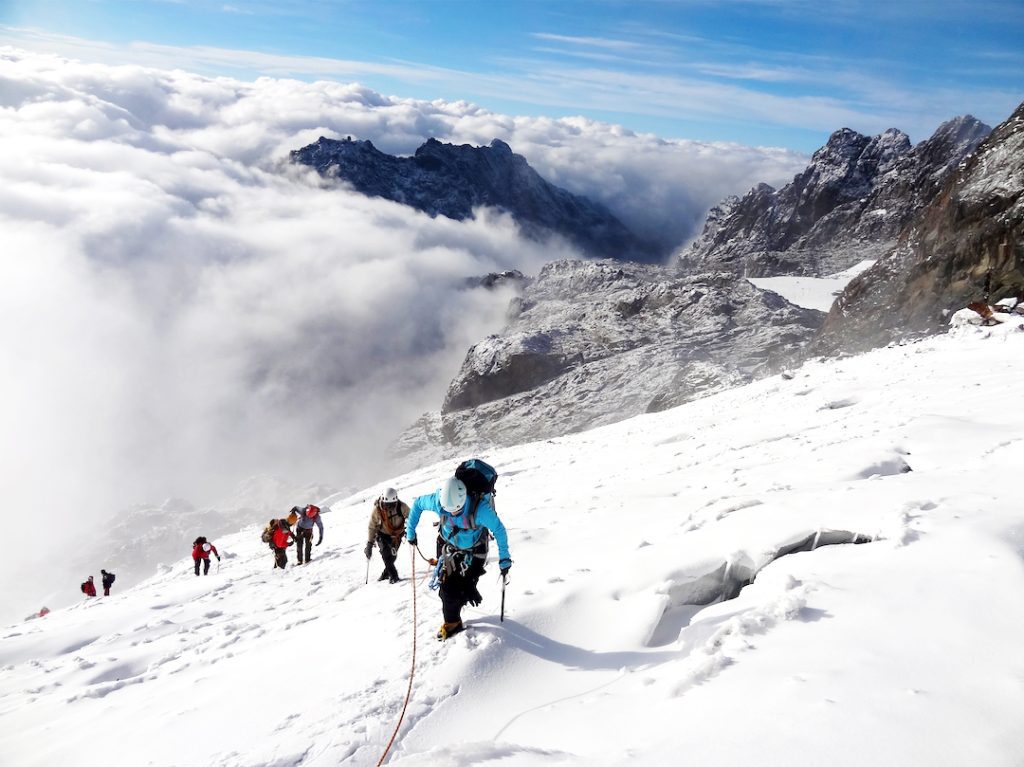
Trekking Uganda’s legendary “Mountains of the Moon” via the classic Central Circuit Trail is a bucket-list adventure through lush rainforests, bamboo thickets, alpine valleys, and dramatic glaciated peaks. Managed primarily by Rwenzori Mountaineering Services (RMS) alongside the Uganda Wildlife Authority (UWA), the overall cost of hiking this iconic route depends heavily on your trip duration, group size, and summit ambitions. Base package prices generally range from around $270 USD for a brief 2-day forest hike up to $1,350 USD or more for standard 7- to 8-day Margherita Peak summit expeditions. These base packages typically include licensed mountain guides, dedicated porters, daily meals, and wooden hut accommodation along the trail. However, mapping out your true budget also requires factoring in mandatory UWA park entry fees ($35 USD per day), technical climbing equipment rentals, ground transportation to the Nyakalengija trailhead, and crew tips.
8-days-mountain-rwenzori-hike-and-climb
9-days-rwenzori-hike-and-climb
15-days-rwenzori-hiking-safari-and-mountain-gorilla-trekking-vacation
11-days-best-rwenzori-mountain-hike-to-margherita-peak
10-days-mountain-rwenzori-hike-summiting-over-4-peaks
7-days-mountain-rwenzori-mountain-climbing-active-adventure-to-margherita-peak
7-days-mountain-rwenzori-mountain-climbing-active-adventure-to-margherita-peak
6-days-rwenzori-trek-with-mountain-stanley-margherita-albert-or-alexander
5-days-rwenzori-hike-to-either-mountain-sepeke-baker-or-luig-di-savoia
2-days-rwenzori-trek-to-nyabitaba-camp
1. 8-Day Trek with Margherita Peak (Mount Stanley, 5,109m)
The 8-day Margherita Peak trek is widely considered the gold standard for reaching the summit of Mount Stanley, the third highest point in Africa. For a group of 1 to 2 trekkers, the base package cost is $1,360 USD per person, while groups of 3 or more pay $1,280 USD per person. When factoring in the mandatory Uganda Wildlife Authority (UWA) park entrance fee of $35 USD per day, which totals $280 USD per person across eight days, the grand total cost comes out to $1,640 USD per person for 1 to 2 people or $1,560 USD per person for 3 or more people. This fee includes all mountain guides, food, cabin accommodation, and one porter per client carrying up to 15kg of luggage, while technical gear (crampons, ice axes, harnesses, and rubber boots) is hired separately at base camp.
Spreading the ascent across eight days provides a gradual elevation gain that significantly improves high-altitude acclimatization compared to shorter schedules. The expedition commences at Trekkers Hostel in Kyanjuki (1,450m) and ascends through lush Afro-montane forest to Sine Camp (2,596m) or Kalalama Camp (3,147m). Over the following days, climbers navigate giant bamboo zones, heather forests draped in Spanish moss, and scenic high-pass valleys such as Mutinda Valley and Bugata Camp (4,062m). The trail crosses the Bamwanjara Pass down to Hunwick’s Camp (3,975m) before making the final push to Elena Camp (4,541m), which serves as the high-altitude base for the summit bid. On summit morning, climbers tackle glaciers, fixed ropes, and snow slopes to stand atop Margherita Peak (5,109m). The descent follows a scenic loop down through Hunwick's Pass and Kiharo Camp (3,588m) along the rushing Nyamwamba River, giving hikers a complete overview of the mountain's unique ecological zones before returning to Kilembe.
2. 7-Day Trek with Margherita Peak (Mount Stanley, 5,109m)
The 7-day Margherita Peak trek covers the exact same technical climbing routes as the 8-day option, but compresses the itinerary for fit, experienced hikers who acclimatize rapidly to high altitudes. The base package cost is $1,360 USD per person for 1 to 2 trekkers, and $1,280 USD per person for groups of 3 or more. With the addition of the mandatory UWA park entrance fee of $35 USD per day ($245 USD total for 7 days), the complete grand total cost is $1,605 USD per person for 1 to 2 people or $1,525 USD per person for 3 or more people. This package covers full guide services, mountain hut accommodation, meals, and dedicated porter support up to 15kg of personal gear per client, with technical gear rented at base camp.
By eliminating one of the buffer acclimatization days, hikers make longer daily climbs and gain altitude at a much faster rate. The trek leaves Trekkers Hostel and ascends rapidly through Kalalama Camp, proceeding toward Bugata Camp and Hunwick’s Camp to set up the high-camp base at Elena Camp (4,541m). Reaching the glaciers and standing atop Margherita Peak within seven days requires strong physical stamina and endurance. After conquering the summit, climbers complete a quick descent down the Nyamwamba Valley via Kiharo Camp (3,588m) to finish back at base camp.
3. 9-Day Multi-Peak Expedition (Margherita Peak + 2 Extra Peaks + Weismann’s Peak)
Designed for avid mountaineers seeking maximum alpine exposure, this 9-day multi-peak trek combines the technical summit of Margherita Peak with two additional non-glaciated summits and Weismann’s Peak on the descent. The base package cost is $1,520 USD per person for 1 to 2 trekkers, and drops to $1,450 USD per person for groups of 3 or more. Adding the 9-day UWA park entrance fee of $315 USD per person ($35 USD per day) brings the grand total cost to $1,835 USD per person for 1 to 2 people or $1,765 USD per person for 3 or more people. The price includes all meals, accommodation in high-altitude huts, guide services, and one porter per client carrying up to 15kg.
After ascending through the forest, bamboo, and alpine moorland zones to reach Elena Camp and successfully climbing Margherita Peak (5,109m), the itinerary builds in side expeditions to two neighboring secondary peaks depending on weather conditions and group strength. As the expedition begins its return leg, the trail diverts across Oliver's Pass to scramble up Weismann’s Peak (4,620m). Climbers enjoy sweeping vistas across both the Ugandan and Democratic Republic of Congo borders, crossing alpine tarns, rocky scree, and surreal giant lobelia gardens before descending through Kiharo Camp to base.
4. 10-Day Grand Circuit Expedition (Margherita + Mt. Speke + Mt. Baker + Weismann’s Peak)
The ultimate 10-day grand circuit is the most comprehensive mountaineering challenge offered along the Kilembe Trail, designed for high-endurance climbers wanting to summit four distinct major peaks in the range. The base package cost is $1,660 USD per person for 1 to 2 trekkers, and $1,580 USD per person for groups of 3 or more. Adding the 10-day UWA park entrance fee of $350 USD per person ($35 USD per day) brings the grand total cost to $2,010 USD per person for 1 to 2 people or $1,930 USD per person for 3 or more people. As with all multi-day treks, full guide fees, accommodation, food, and porter service (15kg limit per client) are included, while technical climbing equipment is rented at the base.
This demanding expedition moves strategically between multiple high camps—including Elena Camp, Kitandara Camp, and Hunwick’s Camp—to position trekkers for summit pushes on Margherita Peak (5,109m), Mount Speke (4,890m), Mount Baker (4,842m), and Weismann’s Peak (4,620m). Trekkers spend over a week traversing steep rock faces, snowfields, and sharp ridges at elevations above 4,000 meters. The route delivers an unforgettable, immersive journey across the heart of the Rwenzori range before ending with a long descent down the Nyamwamba River valley.
5. 7-Day Trek to Mount Baker (4,842m)
This 7-day itinerary targets Mount Baker, the fifth highest mountain peak in Africa, providing a rugged alpine experience without the need for glaciated ice climbing. The base package cost is $1,230 USD per person for 1 to 2 trekkers, and $1,120 USD per person for groups of 3 or more. Incorporating the 7-day UWA park entrance fee of $245 USD per person ($35 USD per day), the total overall cost is $1,475 USD per person for 1 to 2 people or $1,365 USD per person for 3 or more people. The price covers hut accommodation, meals, guides, and one porter per client for up to 15kg of luggage.
The trek ascends through the Kilembe Valley via Sine and Kalalama camps, past the dramatic Mutinda Lookout, and onward to Bugata Camp and Hunwick's Camp. From Hunwick’s Camp, climbers scramble up steep, exposed rock ridges along Edward’s Pass to reach Mount Baker's rocky summit (4,842m). The top rewards hikers with clear views of the glaciated peaks of Mount Stanley and Mount Speke. The trip completes its loop by descending through the Kiharo Valley and down the river back to base.
6. 5-Day Trek to Weismann’s Peak (4,620m)
The 5-day Weismann’s Peak trek is an ideal mid-length mountain expedition for fit hikers who want to conquer a non-glaciated high peak without committing to technical gear or an 8-day itinerary. The base package cost is $860 USD per person for 1 to 2 trekkers, and $820 USD per person for groups of 3 or more. With the addition of the 5-day UWA park entrance fee of $175 USD per person ($35 USD per day), the grand total cost is $1,035 USD per person for 1 to 2 people or $995 USD per person for 3 or more people. This cost includes all meals, accommodation, guides, and one porter per client carrying up to 15kg.
The trail climbs steadily through montane forest and bamboo thickets up to Kalalama Camp (3,147m) before continuing into the moorland zone at Bugata Camp (4,062m). From Bugata, trekkers make their final summit push across open alpine terrain filled with giant groundsels and lobelias to reach Weismann’s Peak (4,620m). The peak offers views of Mount Stanley and Mount Baker. The trek then loops back down through Kiharo Camp to complete a multi-day journey back to Kilembe.
7. 4-Day Mutinda Lookout Trek (3,975m) & Hunwick’s Pass Loop
The 4-day Mutinda Lookout trek is designed for hikers focused on high-altitude scenery, stunning views, and biodiversity rather than scaling glaciers. The base package cost is $650 USD per person for 1 to 2 trekkers, and $620 USD per person for groups of 3 or more. Adding the 4-day UWA park entrance fee of $140 USD per person ($35 USD per day) brings the grand total cost to $790 USD per person for 1 to 2 people or $760 USD per person for 3 or more people. Included in the price are mountain cabins, food, guide services, and dedicated porters (15kg baggage allowance per client).
Starting from Kilembe base, hikers climb past Sine Camp to Kalalama Camp and enter the Mutinda Valley. On the third day, hikers ascend Mutinda Lookout (3,975m), a rock outcrop that offers panoramic views over Kasese town and the upper peaks. The route continues along a high scenic loop across Hunwick’s Pass down to Kiharo Camp (3,588m). On the final day, the trail follows the Nyamwamba River past waterfalls back to base camp.
8. 4-Day Waterfall Trek to Kalalama Camp (3,147m)
This 4-day waterfall trek centers on forest ecology, mountain streams, and birdwatching at a relaxed pace. The base package cost is $550 USD per person for 1 to 2 trekkers, and $510 USD per person for groups of 3 or more. Including the mandatory 4-day UWA park entrance fee of $140 USD per person ($35 USD per day), the total cost is $690 USD per person for 1 to 2 people or $650 USD per person for 3 or more people. The cost covers mountain cabin stays, meals, guides, and porter services.
The itinerary ascends slowly to Kalalama Camp (3,147m), leaving plenty of time to explore local waterfalls such as Enock’s Falls and hidden river cascades. Hikers spend their days trekking through lush forest zones, observing black-and-white colobus monkeys, blue monkeys, and endemic bird species like the Rwenzori turaco. It is a scenic option well-suited for families, casual hikers, and nature photographers.
9. 3-Day Trek (Kalalama Camp 3,147m & Samalira Camp 3,140m)
The 3-day short loop offers a overnight mountain experience into the lower moorland edge without pushing into high-altitude passes. The base package cost is $410 USD per person for 1 to 2 trekkers, and $380 USD per person for groups of 3 or more. Factoring in the 3-day UWA park entrance fee of $105 USD per person ($35 USD per day), the grand total cost comes out to $515 USD per person for 1 to 2 people or $485 USD per person for 3 or more people. This price includes all cabin accommodation, food, guide fees, and porter services.
Departing from Trekkers Hostel, hikers ascend through montane forest to Kalalama Camp (3,147m). Day two features a traverse across a scenic ridge to Samalira Camp (3,140m), crossing bamboo thickets and mountain stream valleys while taking in sweeping views of the lowlands and Queen Elizabeth National Park. On the third day, hikers descend through forest cover back to Kilembe, making it a concise mountain weekend trip.
10. 2-Day Forest & Mountain View Trek
The 2-day trek is a short overnight introduction to the Rwenzori range, tailored for travelers with limited time who want to spend a night in a mountain hut. The base package cost is $240 USD per person for 1 to 2 trekkers, and $210 USD per person for groups of 3 or more. With the 2-day UWA park entrance fee of $70 USD per person ($35 USD per day), the grand total cost is $310 USD per person for 1 to 2 people or $280 USD per person for 3 or more people. The fee includes mountain hut accommodation, meals, guide service, and porter support.
Starting at Kyanjuki (1,450m), hikers trek 6 km up the valley through lush forest to Sine Camp (2,596m) or up to Kalalama Camp. Along the way, hikers pass Enock’s Falls, towering forest canopies, and bamboo patches while spotting primates and bird life. After an overnight stay in the mountain hut, trekkers wake up to views of the surrounding valleys before making a steady descent back down to the Kilembe base camp.
11. 1-Day Nature Trek / Guided Forest Walk
The 1-day excursion is a full-day guided forest walk designed for day visitors or safarigoers stopping over in Kasese. The base package cost is $40 USD per person for 1 to 2 trekkers, and $35 USD per person for groups of 3 or more. Adding the 1-day UWA park entrance fee of $35 USD per person brings the grand total cost to $75 USD per person for 1 to 2 people or $70 USD per person for 3 or more people. This covers local guide services for the day (porters and accommodation are not required for day walks).
Leaving Trekkers Hostel in the morning, hikers walk to the UWA ranger post at 1,727 meters to check in. The trail enters the Afro-montane forest zone along the lower slopes of the Nyamwamba Valley. Guides highlight native flora, medicinal plants, and wildlife, pointing out Colobus monkeys, Blue monkeys, and native birds. The walk typically visits Enock’s Falls before looping back to the trailhead by late afternoon.
What is the main difference between the Central Circuit Trail and the Kilembe Trail?
Choosing between the Central Circuit and the Kilembe Trail comes down to history, management, and route terrain. The Central Circuit is the traditional, classic loop managed by the local Bakonzo community through Rwenzori Mountaineering Services (RMS) out of Nyakalengija. It follows a natural anti-clockwise route spanning roughly 65 kilometers. Because it is a true circuit, you never walk back along the same path, giving you fresh scenery each day. It passes through dramatic vegetation zones, including giant bamboo forests, high alpine bogs, and iconic lakes like Bujuku and Kitandara.
The Kilembe Trail, situated to the south and starting near Kasese, is a private operation covering roughly 85 kilometers. It features slightly modern hut facilities and steep, sweeping ridge lines. However, the lower sections of the Kilembe route often require trekking out along the same trail you ascended. In terms of pacing, the Central Circuit offers a slightly shorter total distance, which makes a 7-day summit feasible for fit hikers, whereas Kilembe usually stretches to 8 or 9 days to comfortably manage altitude and distance.
How physically difficult is it to hike to Margherita Peak?
Reaching Margherita Peak (5,109m) is widely regarded as one of Africa’s toughest mountain challenges, often considered more physically demanding than Mount Kilimanjaro or Mount Kenya. While Kilimanjaro involves steady, high-altitude endurance walking, the Rwenzori range demands a dynamic mix of steep mountain scrambling, navigating deep mud bogs, and technical glacier trekking.
The lower and middle elevations test your balance as you hike through the famous "bogs"—wetlands thick with mud and tussocks where rubber boots are essential. Above 4,500 meters at Elena Camp, the terrain shifts into sharp, exposed rock scrambles. The final summit push requires navigating actual glaciers using crampons, ice axes, and fixed ropes, alongside managing the thin air near 5,000 meters.
To handle this, you need solid leg strength, excellent cardio conditioning, and mental resilience. Training with heavy backpack hikes, stair-climbing, and core exercises for several months prior is strongly recommended. You don't need to be an elite mountaineer, but arriving in peak physical shape ensures you enjoy the incredible views rather than just surviving the climb.
When is the best time of year to trek the Rwenzori Mountains?
The absolute best times to trek the Rwenzori range are during the region's two distinct dry seasons: June to September and December to February. During these months, skies are noticeably clearer, trail visibility is higher, and rainfall drops significantly—making the famous mountain mud far more manageable and river crossings safer.
June through August often brings clear morning views of the jagged, snow-capped peaks, perfect for alpine photography. December through February is equally popular, offering warm lower valley temperatures and stable summit conditions.
Conversely, the heavy rainy seasons—spanning March to May and October to November—present serious challenges. Rainfall turns the forest and bog zones into slick, ankle-deep mud channels, while heavy fog can obscure glacier routes and lower summit visibility dramatically. While the mountains are open year-round, booking your trip during the dry windows gives you the highest safety margin, better summit odds, and far more comfortable conditions.
What is the breakdown of total costs for a 7-day Central Circuit trek?
Budgeting for a standard 7-day Margherita Peak trek via the Central Circuit requires combining the operator’s base package fee with mandatory government conservation park entry.
For a foreign non-resident trekker, a standard 7-day RMS package generally costs between $1,350 and $1,500 USD per person (depending on group size). This base fee covers professional mountain guides, dedicated porters, mountain hut accommodation, and all daily meals prepared on the mountain.
On top of the base package, the Uganda Wildlife Authority (UWA) charges a mandatory park entry fee of $35 USD per day per foreign non-resident. For seven days, this adds $245 USD total.
Additional expenses to budget for include:
- Technical Gear Rental: ~$50 to $100 USD (crampons, harness, ice axe, rubber boots).
- Crew Tips: ~$100 to $150 USD total across your guide and porter team.
- Transportation & Pre-Trek Stay: ~$100 to $200 USD for hotel lodging in Kasese/Nyakalengija and local transfers.
Altogether, an individual foreign trekker should budget a grand total of around $1,800 to $2,100 USD for a complete 7-day summit expedition.
What technical climbing gear do I need, and can I rent it at base camp?
Reaching the high glaciers of Margherita Peak requires specialized equipment to safely traverse ice slopes and exposed rock faces. The core technical kit includes:
- Crampons tailored to fit heavy-duty waterproof trekking boots.
- A lightweight climbing harness and carabiners for fixed-rope safety.
- An ice axe for stability on icy slopes.
- A climbing helmet to protect against falling rock fragments near the high ridges.
- Gumboots (knee-high rubber boots) for traversing lower bog zones.
You do not need to fly international gear overseas if you prefer to travel light. Both the Central Circuit base at Nyakalengija and the Kilembe base hostel maintain rentals for all essential gear. You can rent crampons, axes, harnesses, and rubber boots on-site for reasonable daily rates (roughly $5–$10 USD per item per day). However, you should bring your own personal layers: high-quality thermal base layers, a waterproof gore-tex shell jacket, insulated gloves, warm socks, and well-broken-in waterproof hiking boots.
How do altitude sickness and acclimatization work on the Rwenzori routes?
Acute Mountain Sickness (AMS) is a real factor in the Rwenzori Mountains because the elevation rises from roughly 1,450 meters at the base to over 5,100 meters at the summit. Because air pressure and oxygen levels drop noticeably as you climb, your body needs time to adapt to prevent headaches, nausea, fatigue, or dizziness.
The key to proper acclimatization is taking a gradual approach. Opting for a 7- or 8-day itinerary rather than rushing through a shorter schedule gives your body vital time to produce red blood cells as you move through intermediate camps like John Matte (3,505m) and Bujuku (3,962m).
On the trail, the golden rule is “pole pole” (slowly, slowly in Swahili). Maintain a steady, relaxed walking pace even on easy terrain, drink 3 to 4 liters of water daily, and eat carb-rich meals. Many trekkers also carry Diamox (acetazolamide) after consulting a physician. Most importantly, communicate openly with your mountain guides—they monitor your condition daily and can adjust camp pacing if you show signs of altitude stress.
What are the accommodation facilities like along the Central Circuit route?
Accommodation on the Central Circuit consists of permanent wooden mountain huts strategically located at key camp stops (such as Nyabitaba, John Matte, Bujuku, Kitandara, and Guy Yeoman). These structures offer solid shelter from wind, rain, and cold mountain nights, making camping in tents unnecessary unless group volumes are unusually high.
Inside the huts, sleeping arrangements are communal, featuring bunk beds lined with simple foam mattresses. You will need to pack your own high-grade winter sleeping bag rated to at least -10°C (14°F), as temperatures at higher camps like Elena or Bujuku drop near or below freezing at night.
Facilities are simple: dry pit-latrine toilets are located near the cabins, and dining takes place in shared mess shelters where your private chef prepares hot meals. There is no grid electricity along the trail, so bringing personal solar power banks or spare batteries is essential for keeping phones and camera equipment charged.
What role do porters and guides play on a Rwenzori mountain expedition?
Your mountain crew is the heart and soul of any successful Rwenzori expedition. By park regulations and safety standards, every trekking group is accompanied by licensed mountain guides, dedicated porters, and a camp chef.
Standard trekking packages assign one dedicated porter to each client, carrying up to 15kg of your personal luggage in a waterproof duffel bag. This support allows you to hike each day with only a light daypack containing water, snacks, extra layers, and your camera. Additional porters transport food supplies, cooking equipment, and safety gear up the mountain.
The guides are local Bakonzo experts who know every rock, weather change, and glacier crevasse. They set a safe pacing rhythm, handle fixed-rope safety on the glaciers, manage high-altitude decision-making, and share fascinating cultural stories about the mountain. Beyond logistics, the crew creates a warm, encouraging atmosphere that keeps morale high during tough climbs.
What wildlife, flora, and scenery can I expect to see during the hike?
Trekking the Rwenzoris is often described as walking through a real-world fantasy landscape, taking you through five distinct vegetation zones.
In the lower Afro-montane forest zone (1,800m to 2,500m), you walk beneath high tree canopies filled with primates like black-and-white colobus monkeys, blue monkeys, and colorful endemic birds like the vibrant Rwenzori Turaco. Above 2,500 meters, you enter dense bamboo thickets before rising into surreal heather forests covered in hanging mosses.
The high-altitude moorland zones (3,000m to 4,500m) feature prehistoric vegetation, including giant groundsels (Senecio) and towering giant lobelias set against dark alpine lakes like Lake Bujuku. Finally, above the vegetation line, the landscape shifts into dramatic granite rock faces, cascading waterfalls, and glittering equatorial ice glaciers—a bio-diverse spectacle matched by few other places on Earth.
What is the success rate for reaching Margherita Peak, and how can I maximize my chances?
The average summit success rate for reaching Margherita Peak ranges between 75% and 85% on standard 7- to 8-day itineraries. Failures to summit are rarely due to a single factor; they usually result from altitude sickness, inadequate physical stamina, or sudden adverse weather on summit morning.
To give yourself the highest chance of standing on top, keep these four tips in mind:
- Choose a 7- or 8-day itinerary: Never attempt to rush the summit in 5 days unless you are an elite athlete already acclimatized to high elevation.
- Pace yourself early: Avoid rushing during the first three days in the lower forests and bamboo zones.
- Invest in good gear: Waterproof layers, warm gloves, quality boots, and gaiters keep you dry and warm; once you get wet and cold, your energy drops fast.
- Hydrate continuously: Drink plenty of fluids daily to support acclimatization. Listening closely to your guides' instructions on glacier day will do the rest.
Booking Mountain Rwenzori hiking cost via central circuit trail with us Roads of Adventure safaris
standard 9-day summit trek through the Rwenzori Mountains via the Central Circuit trail with Roads of Adventure Safaris typically costs between $1,700 and $1,900 USD per person for foreign non-residents. If you choose a shorter 5-day non-summit trek, the price generally ranges from $820 to $1,150 USD for international travelers
