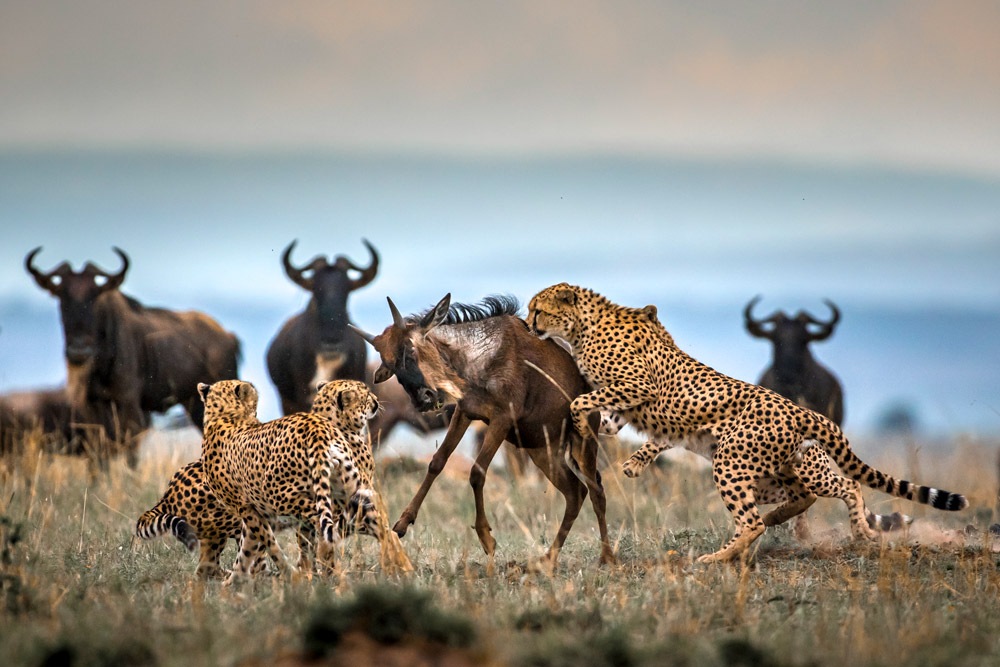
The primary engine driving the Great Migration is the endless quest for fresh grazing and seasonal rainfall. The wildebeest follow an instinctive circular clock synchronized with East Africa's rain patterns. During the wet season (around January through March), short-grass plains in the southern Serengeti offer nutrient-rich grass high in phosphorus and calcium—essential nourishment for pregnant and lactating females. However, as the dry season sets in and water sources vanish, the grasses wither. Triggered by weather shifts and the scent of rain miles away, the massive herds begin moving north toward the river basins and lush pastures of the northern Serengeti and Kenya's Masai Mara, where permanent water flows year-round.
7-days-best-great-wildebeest-migration-safari-in-tanzania
7-days-epic-africa-big-five-safari-in-tanzania-top-best-parks
7-days-budget-tanzania-safari-affordable-africa-budget-safari
7-days-kilimanjaro-climb-and-hiking-safari-ascent-to-peak
7-days-tanzania-wildlife-safari-africa-safari-tour-best-park-visits
7-days-best-southern-tanzania-safari-parks-nyerere-mikumi-ruaha-and-udzungwa
7-day-best-zanzibar-beach-holidays-combo-to-ruaha-and-mikumi-safari-parks
7-days-zanzibar-beach-activities-and-chimpanzee-tracking-in-mahale-mountains
7-days-amboseli-kenya-and-serengeti-fly-in-tanzania-safari
7-days-masai-mara-safari-tour-and-serengeti-safari-tour-in-kenya-and-tanzania
7-days-ultimate-budget-kenya-tanzania-safari-holiday-vacation
11-day-tanzania-safari-to-tarangire-lake-naron-serengeti-ngorongoro-and-lake-eyasi
10-days-perfect-tanzania-safari-itinerary
11-days-combined-rwanda-tour-and-tanzania-wildlife-safari-tour
11-days-ultimate-rwanda-safari-and-kenya-tanzania-safari-itinerary
12-days-best-east-africa-safari-tour-package-to-rwanda-tanzania-and-south-africa-safaris
10-days-family-tanzania-safari-tour-to-lake-manyara-serengeti-ngorongoro-crater-and-tarangire
12-days-tanzania-safari-and-culture-experience
12-days-best-tanzania-and-kenya-safari-combo-itinerary
12-days-uganda-safari-and-tours-combined-with-zanzibar-beach-vacation
How many animals take part in the wildebeest migration?
The spectacle involves roughly 1.5 million blue wildebeests, making it the largest land mammal migration on the planet. But they do not travel alone; they are joined by approximately 200,000 to 300,000 plains zebras, nearly 500,000 Thomson's gazelles, and thousands of grant's gazelles and elands. Altogether, more than two million herbivores move together across the ecosystem. This massive concentration of prey attracts large predator populations, including lions, leopards, cheetahs, spotted hyenas, and Nile crocodiles at river crossings.
Which countries host the wildebeest migration?
The migration spans two East African nations: Tanzania and Kenya. The vast majority of the cycle—roughly 80% to 85% of the distance—takes place within Tanzania's Serengeti National Park and surrounding conservation areas like Ngorongoro. Between July and October, the herds push northward across the border into Kenya's Masai Mara National Reserve. Once the short rains begin in late October or November, the herds head back south into Tanzania to complete the continuous loop.
How long is the entire route of the wildebeest migration?
The complete annual trek covers roughly 800 to 1,000 kilometers (500 to 600 miles) in a clockwise circuit through the Serengeti-Mara ecosystem. Because the herds move dynamically based on localized rain showers rather than a rigid track, individual animals often cover far greater total distances throughout the year as they backtrack, circle, and cross rivers multiple times searching for optimal grass.
Why is the wildebeest migration considered a natural wonder?
The Great Migration is celebrated as one of the Seven Natural Wonders of Africa due to its unmatched scale, ecological complexity, and dramatic wildlife interactions. It is a raw display of nature's food chain operating at maximum intensity. The dramatic river crossings—where thousands of wildebeest plunge into the Mara and Grumeti Rivers despite rushing currents and lurking Nile crocodiles—create some of the most intense wilderness scenes on Earth. Furthermore, the herds reshape the landscape: their grazing trims grasses, their droppings fertilize soils, and their movement sustains predator and scavenger populations across thousands of square miles.
Who first filmed or documented the modern wildebeest migration?
The migration was brought to global fame by German zoologist and conservationist Bernhard Grzimek and his son Michael Grzimek in the late 1950s. Flying a distinctive zebra-striped light aircraft, they conducted the first systematic aerial counts and mapped the herds' movements across the Serengeti. Their efforts culminated in the groundbreaking 1959 documentary film and companion book, "Serengeti Shall Not Die" (Serengeti darf nicht sterben). The film won the Academy Award for Best Documentary Feature in 1960 and established international support for preserving the Serengeti ecosystem.
What other animals join the wildebeest migration?
While wildebeest lead the numbers, plains zebras are their most important co-migrants, followed by Thomson's gazelles and Grant's gazelles. Topi antelopes and elands also trek along similar routes during key phases of the year. Trailing the herbivore herds is a full assemblage of carnivores and scavengers—lions, leopards, cheetahs, hyenas, wild dogs, vultures, and marabou storks—all capitalizing on the abundance of food along the migration corridor.
How fast do herds move during the wildebeest migration?
The herd's speed varies dramatically depending on the season and terrain. When grazing calmly across open plains, the animals saunter at a leisurely pace of 2 to 5 miles per hour (3 to 8 km/h). However, when triggered by predators, panic, or the urge to reach water, wildebeests can gallop in short bursts at speeds up to 50 miles per hour (80 km/h). During major treks or river crossings, a column of wildebeests can cover 30 to 50 miles (50 to 80 km) in a single day.
What role do zebras play in the wildebeest migration?
Zebras and wildebeests share a classic ecological partnership known as facilitative grazing. Zebras have sharp incisors that slice down the tall, tough, fibrous stems of mature grasses that wildebeest cannot easily digest. By stripping off this outer layer, zebras expose the tender, protein-rich lower leaves and shoots preferred by wildebeest. Additionally, zebras possess sharp eyesight and memory for routes, helping guide the overall herd direction, while wildebeests provide safety in sheer numbers and an acute sense of smell for detecting water.
How do Thomson's gazelles fit into the wildebeest migration?
Thomson's gazelles represent the third wave of the grazing succession. After zebras eat the coarse top stalks and wildebeests consume the broader mid-level leaves, the pastures are left short and carpeted with fresh, nitrogen-rich green shoots and herbs. This low-lying vegetation is perfect for the delicate muzzles of Thomson's gazelles. By trailing weeks behind the larger animals, gazelles feed on high-protein plant growth stimulated directly by the heavy grazing and trampling of the herds ahead of them.
When does the wildebeest migration start each year?
The Great Wildebeest Migration does not actually have a formal start date. It is a continuous, year-round circular movement of roughly 1.5 million wildebeest, accompanied by hundreds of thousands of zebras and gazelles, covering a 1,200-mile loop across the Serengeti ecosystem in Tanzania and the Masai Mara in Kenya. Because the herd constantly follows rainfall and fresh pasture, the movement never truly stops or resets. However, many safari guides mark January or February as a functional "beginning" of the annual cycle, as this is when the herds congregate on the southern plains to give birth and kick off a new generation.
What month does the wildebeest migration reach the Mara River?
The migration typically reaches the treacherous Mara River between July and August, with herds continuing to make river crossings back and forth through September and October. Driven by the exhaustion of southern pastures and an urgent need for the lush grazing lands in Kenya’s Masai Mara, massive columns of wildebeest gather along the steep banks of the river. The exact timing of the first major crossing fluctuates every year based on localized rainfall patterns upstream, making river crossings one of the most dynamic and unpredictable phases of the journey.
How do changing weather patterns affect the wildebeest migration?
Rainfall acts as the primary clock and navigator for the entire migration, as wildebeest possess an extraordinary ability to detect rain and fresh vegetation over vast distances. When weather patterns shift due to climate anomalies, wet-weather fronts, or unseasonal droughts, the herds alter their route and speed instantly. Unexpected early rains can cause the animals to turn around or delay their northward trek, while severe droughts force them to trek rapidly toward permanent water sources like the Mara River, leading to higher rates of exhaustion, malnutrition, and predator attacks along the way.
Is there a specific month when the wildebeest migration ends?
There is no specific month when the wildebeest migration ends because it operates as a closed, perpetual loop. The herds are constantly moving, grazing, and trekking throughout all twelve months of the year without a final destination. By November and December, as the short rains begin to green the southern Serengeti, the herds leave the Masai Mara and march south, completing their annual circuit only to immediately begin moving through the southern plains again as January approaches.
When does the calving season happen during the wildebeest migration?
The calving season takes place between January and March, reaching its dramatic peak during the month of February on the short-grass plains of the southern Serengeti and Ngorongoro Conservation Area. Over a concentrated window of just two to three weeks in February, roughly 500,000 wildebeest calves are born. Synchronizing births in such vast numbers serves as a crucial survival strategy known as predator swamping, which overwhelms local predators like lions, hyenas, and cheetahs and significantly improves each newborn's chances of reaching adulthood.
Can you predict the exact daily path of the wildebeest migration?
It is impossible to predict the exact daily path of the migration with absolute certainty. While the general annual migration route follows a broad, clockwise circuit between Tanzania and Kenya, daily decisions depend on real-time environmental triggers. A sudden thunderstorm miles away, local surface water availability, or heavy grazing pressure from other herds can shift the animals' path overnight. Wildlife trackers, park rangers, and safari guides rely on daily radio reports and field scouts rather than fixed schedules to pinpoint the animals' whereabouts.
What happens during the dry season in the wildebeest migration?
During the peak dry season, which stretches from June to October, seasonal water holes dry up and the southern and central plains turn to dust. In response, smaller scattered herds consolidate into massive, dense columns that push steadily northwest and north toward the permanent water systems of the Grumeti and Mara Rivers. As food grows scarce, the animals must cover greater distances each day, leading to severe physical strain and creating dramatic predator-prey encounters along river corridors and high-density grazing areas.
How do short rains trigger movement in the wildebeest migration?
In late October or early November, localized atmospheric shifts bring the "short rains" to the dry southern Serengeti and northern Tanzania. Wildebeest can smell rain and the scent of fresh plant growth across tens of miles, which triggers an immediate, collective instincts to move. Almost as soon as the first rain clouds appear, thousands of wildebeest assemble and march rapidly south across the central Serengeti to reach the newly sprouted, mineral-dense grasses in time for the upcoming calving season.
Does the wildebeest migration happen at night? Yes, the wildebeest migration continues actively through the night. Herds regularly trek and graze in the dark to take advantage of cooler nighttime temperatures, which helps them conserve energy and reduce water loss during the hot, arid months. However, high-risk maneuvers like crossing crocodile-infested rivers almost exclusively occur during broad daylight, as wildebeest rely on clear visual cues to evaluate water depth, current speed, and visible threats before plunging into deep water.
Why is February a peak time for the wildebeest migration in Ndutu? February is the absolute peak time in the Ndutu region of the southern Serengeti because of the area's rich volcanic soil chemistry. Historical volcanic eruptions from the nearby Ngorongoro Highlands coated these plains in ash high in calcium, phosphorus, and potassium—nutrients that are essential for pregnant and lactating female wildebeest. During February, hundreds of thousands of cows gather in Ndutu to give birth, drawn by the nutrient-rich grass and the open, short-grass landscape that makes it easier to spot approaching predators.
Where does the wildebeest migration begin in Tanzania?
The geographic anchor of the migration in Tanzania is the southern Serengeti, encompassing the Ndutu region and the surrounding Ngorongoro Conservation Area. This region features open, short-grass plains formed by historical volcanic ash from the nearby Rift Valley highlands. Because these grasses are rich in minerals like calcium and phosphorus, pregnant wildebeest cows congregate here during the wet season to give birth, making it the starting point for each annual generation before the herds head north.
Which river crossings are most famous in the wildebeest migration?
The two most famous river crossings along the migration route are the Mara River and the Grumeti River. The Mara River, flowing through northern Serengeti and the Masai Mara, is world-famous for its high, steep embankments and large Nile crocodile populations. The Grumeti River, located in the Western Corridor of the Serengeti, presents a critical water obstacle earlier in the season during May and June, where herds navigate narrow channels and dense riverine bush.
How do animals cross the Mara River during the wildebeest migration?
Crossing the Mara River is driven by intense herd dynamics and urgency rather than coordinated planning. Wildebeest gather along the banks in thousands until pressure from incoming animals forces the lead wildebeest to leap into the water. The herd then plunges down steep riverbanks in a massive frenzy, swimming across strong currents while battling fast-flowing water, submerged boulders, territorial hippos, and predatory crocodiles.
What park in Kenya marks the northern point of the wildebeest migration?
The Masai Mara National Reserve, along with its adjacent community conservancies in southwestern Kenya, marks the northernmost boundary of the migration. Covering roughly 580 square miles, the reserve provides essential dry-season pastures and reliable water from the Mara and Talek rivers when the southern Serengeti plains in Tanzania dry up between July and October.
Where do herds go after leaving the Masai Mara during the wildebeest migration?
After grazing the grasslands of the Masai Mara through October, the animals head south as atmospheric shifts bring early rains to Tanzania. The herds cross back over the Kenyan border into the northern Serengeti, moving through regions like Kogatende, Klein's Camp, and the Lobo Valley. They push steadily southward across the central Serengeti (Seronera) to return to the southern short-grass plains by late December.
How do national boundaries impact the route of the wildebeest migration?
The animals follow ecological signals like rain and grass growth, completely oblivious to the international border between Tanzania and Kenya. Wildlife management and conservation, however, require cross-border cooperation between authorities like the Tanzania National Parks Authority (TANAPA) and the Maasai Mara reserve management. Differences in land use, livestock grazing policies, and infrastructure along border regions directly influence how freely wildlife corridors remain open for the moving herds.
What obstacles do herds face during the wildebeest migration?
Throughout their 1,200-mile journey, the herds confront constant natural threats. Environmental hazards include prolonged droughts, flash floods, deep mud, and exhaustion during long treks. Predation is relentless, with lions, leopards, cheetahs, and hyenas tracking the herds on land, while giant crocodiles strike at water crossings. Disease, injury from trampled bottlenecks, and human pressures like fencing and illegal poaching outside protected zones add further peril.
Which Grumeti River challenges face the wildebeest migration?
When the migration reaches the Western Corridor between May and July, the Grumeti River presents distinct physical challenges. Unlike the deep channels of the Mara River, the Grumeti often consists of pools, thick mud beds, and swampy terrain that slow animals down, making them vulnerable to entrapment. Additionally, the river holds some of Africa's largest Nile crocodiles, which take advantage of low water levels to target animals attempting to wade across.
How do landscapes change along the path of the wildebeest migration?
The migration traverses a wide variety of East African ecosystems across the year. The route transitions from the wide, treeless short-grass plains of southern Ndutu to acacia woodlands and kopjes in the central Serengeti. Moving northwest, the terrain shifts into riverine forests along the Grumeti River, eventually opening into rolling hills, bushland, and open savannah in the northern Serengeti and Kenya's Masai Mara.
Where is the best viewpoint to watch the wildebeest migration?
Because the herds are constantly on the move, the best viewpoint depends entirely on the time of year. For calving and high predator activity, the Ndutu plains in southern Serengeti are ideal from January to March. For dramatic river crossings, the northern Serengeti (around Kogatende) and the Masai Mara provide prime viewing spots between July and September. Mobile safari camps that move seasonally with the herds offer the closest access to the action year-round.
Which major predators follow the wildebeest migration?
The primary predators that rely heavily on the migration are lions, spotted hyenas, Nile crocodiles, cheetahs, and leopards. While territorial predators like lions and leopards remain tied to established pride ranges and hunt the migration as it passes through, spotted hyenas often follow the herds across long distances, exploiting vulnerable calves, injured adults, and fresh carcasses along the route.
How do lions hunt during the wildebeest migration?
Lions utilize cooperative ambush strategies to target wildebeest, particularly near bottleneck areas like riverbanks, dense acacia bush, and natural watering holes. Instead of chasing swift wildebeest in open fields, lionesses use tall grass and terrain contours to stalk within striking distance before launching coordinated attacks, driving panic-stricken animals toward hidden pride members positioned along escape routes.
What danger do crocodiles pose to the wildebeest migration?
Nile crocodiles pose a lethal aquatic threat during river crossings at the Mara and Grumeti Rivers. Capable of growing up to 16 feet long, these ambush predators submerge silently in crossing bottlenecks, using massive jaw bite forces to grab wildebeest by the muzzle or limbs, drag them into deep water, and drown them before consuming the prey.
How do hyenas scavenge during the wildebeest migration?
Spotted hyenas act as both highly efficient hunters and opportunistic scavengers during the migration. They follow moving columns to pick off lagging, exhausted, or young wildebeest, while also cleaning up remains left behind by lions. During river crossings, hyenas patrol downriver banks to feast on animals that drowned or sustained broken limbs during chaotic scrambles.
Why do so many calves die during the wildebeest migration?
Calf mortality rates are exceptionally high due to a combination of heavy predation, physical exhaustion, and accidental separation. Newborn calves face immediate threats from hyenas, jackals, and lions during the February calving peak. Furthermore, long daily treks across rough terrain and chaotic, high-density river crossings frequently cause young calves to lose their mothers, resulting in fatal starvation or drowning.
How do adult wildebeests protect their young in the wildebeest migration?
Female wildebeest rely on herd density and active defense to protect their newborns. Mothers keep calves close to their flanks during movement and will aggressively charge smaller predators like jackals or lone hyenas using their sharp horns. However, their main defense is safety in numbers—synchronizing births en masse creates a protective buffer that lowers the statistical odds of any single calf being targeted.
What percentage of animals survive a full year of the wildebeest migration?
Roughly 85% to 90% of adult wildebeest survive a full annual migration circuit, as the species has evolved to sustain population numbers despite high predation and natural hazards. However, calf survival rates are significantly lower, with an estimated 30% to 50% of newborn calves dying from predation, disease, or fatigue within their first six months of life.
How do vultures benefit from the wildebeest migration?
Vultures derive immense ecological benefit from the migration, relying on the constant supply of carcasses generated by predator kills, drownings, and natural deaths. Species like the white-backed, Ruppell's, and lappet-faced vultures track the moving herds from high altitudes, rapidly descending on dead animals to clean carcasses down to the bone, which helps control disease spread across the ecosystem.
Do cheetahs hunt successfully during the wildebeest migration?
Cheetahs hunt very successfully during the migration by targeting young, newborn, and adolescent wildebeest rather than fully grown adults. Using their unmatched acceleration and keen eyesight on open plains, cheetahs stalk young calves during the wet season in Ndutu and southern Serengeti, securing high hunting success rates before larger scavengers like hyenas arrive to steal the catch.
How do leopards interact with herds in the wildebeest migration?
Leopards interact with the migration from cover, taking advantage of dense riverine forests, rocky kopjes, and thick woodlands where wildebeest pass through. As solitary stealth hunters, leopards stalk individual animals from tree branches or thick brush at night or early morning, drag smaller prey or calves up into trees to prevent scavengers from stealing their food, and return to territorial ranges after herds move along.
When is the best time for tourists to see the wildebeest migration?
The best time depends entirely on which specific migration event visitors want to witness. For the synchronized calving season and intense predator activity, January through March in the southern Serengeti and Ndutu plains is ideal. For dramatic Mara River crossings, the prime window runs from July through September in the northern Serengeti and Kenya's Masai Mara. Travelers seeking fewer crowds often prefer the transition months of April–May (when herds move through the central Serengeti) or October–November (when herds return south).
How can visitors book a trip to view the wildebeest migration?
Visitors can book a migration safari by partnering with experienced regional safari operators like Roads of Adventure Safaris, who coordinate customized ground transportation, park permits, experienced driver-guides, and lodge accommodations. Because seasonal movements dictate where herds will be located during any given month, working with a specialized operator ensures travelers stay in mobile tented camps or lodges situated directly along the active migration corridor. Booking 6 to 12 months in advance is recommended to secure permits and prime accommodations during peak months.
What conservation threats face the wildebeest migration today?
The migration faces growing ecological pressures from human population growth, agricultural expansion, illegal poaching for bushmeat, and habitat fragmentation. As human settlements expand outside protected park boundaries, traditional dispersal zones and wet-season grazing areas are increasingly blocked by agricultural fields, fences, and roads. Proposed infrastructure projects, such as major commercial highways across the northern Serengeti corridor, also threaten to bisect ancient migration pathways.
How does climate change threaten the future of the wildebeest migration?
Climate change alters precipitation cycles across East Africa, creating unpredictable rain patterns that disrupt the migration's natural timing. Severe, prolonged droughts dry up critical water sources and reduce grass growth, forcing herds to travel longer distances under extreme heat stress and leading to higher starvation rates. Conversely, intense unseasonal rains flood river basins and cause chaotic movements that misalign calving periods with nutrient-rich grass availability.
Are there eco-friendly camps near the route of the wildebeest migration?
Yes, numerous eco-friendly lodges and semi-permanent mobile tented camps operate along the migration route, designed to minimize environmental impact. These camps utilize solar power, composting systems, rainwater harvesting, and strict waste management protocols. Many mobile eco-camps break down completely and move location two to three times a year following the herds, leaving zero permanent structures or ecological footprint on the wilderness behind them.
How do local communities benefit from the wildebeest migration?
Local communities around national parks benefit through eco-tourism revenue-sharing models, community conservancies, and direct employment opportunities. Park entry fees help fund local schools, health clinics, and clean water projects in neighboring villages. Additionally, community-owned conservancies in areas like the Masai Mara rent land from local landowners, providing guaranteed lease payments and employment as rangers, guides, and hospitality staff in exchange for keeping land open for wildlife corridors.
What rules protect wildlife during the wildebeest migration?
Park management authorities enforce strict guidelines to safeguard migrating animals and preserve ecosystem health. Regulations mandate that safari vehicles stay on designated tracks, maintain minimum distances from animals, avoid driving through herds, and remain completely silent near river crossing sites to prevent scaring animals back into crocodile-infested waters. Speed limits, off-road driving bans, and strict curfews against night driving in core national parks further minimize animal disturbance.
How do vehicle crowds impact animals in the wildebeest migration?
Heavy vehicle congestion, particularly near popular river crossings, causes severe stress and disorientation among migrating herds. When dozens of safari vehicles crowd riverbanks or block access routes, wildebeest may hesitate for hours or abandon critical crossings entirely, risking exhaustion and starvation. Engine noise and reckless off-road driving can also flush animals toward hidden predators or destroy delicate grassland flora.
What role do local governments play in managing the wildebeest migration?
The governments of Tanzania and Kenya collaborate through statutory conservation bodies—such as the Tanzania National Parks Authority (TANAPA) and the Kenya Wildlife Service (KWS)—to manage wildlife policies, maintain park infrastructure, and conduct anti-poaching patrols. Local county governments and district councils establish management plans, regulate tourism facility developments, and enforce cross-border conservation agreements aimed at keeping ecological corridors open.
How can future generations protect the paths of the wildebeest migration?
Protecting the migration long-term requires expanding community-based conservation, establishing legally protected wildlife corridors outside national park boundaries, and encouraging sustainable land management. Combining satellite tracking technology with local community land-use planning helps secure buffer zones against agricultural encroachment and fencing. Educating young people, supporting eco-friendly travel, and promoting cross-border policies ensure the ecosystem remains wild and intact for future generations.
Booking wildebeest migration with us Roads of Adventure safaris
To book a Great Wildebeest Migration safari with Roads of Adventure Safaris, you can initiate a custom booking through their official Roads of Adventure Safaris Enquiry Page. As an established local tour operator based on Kampala-Entebbe Road, they specialize in tailormade East African wildlife itineraries ranging from $300 to $1,000 per person per day
