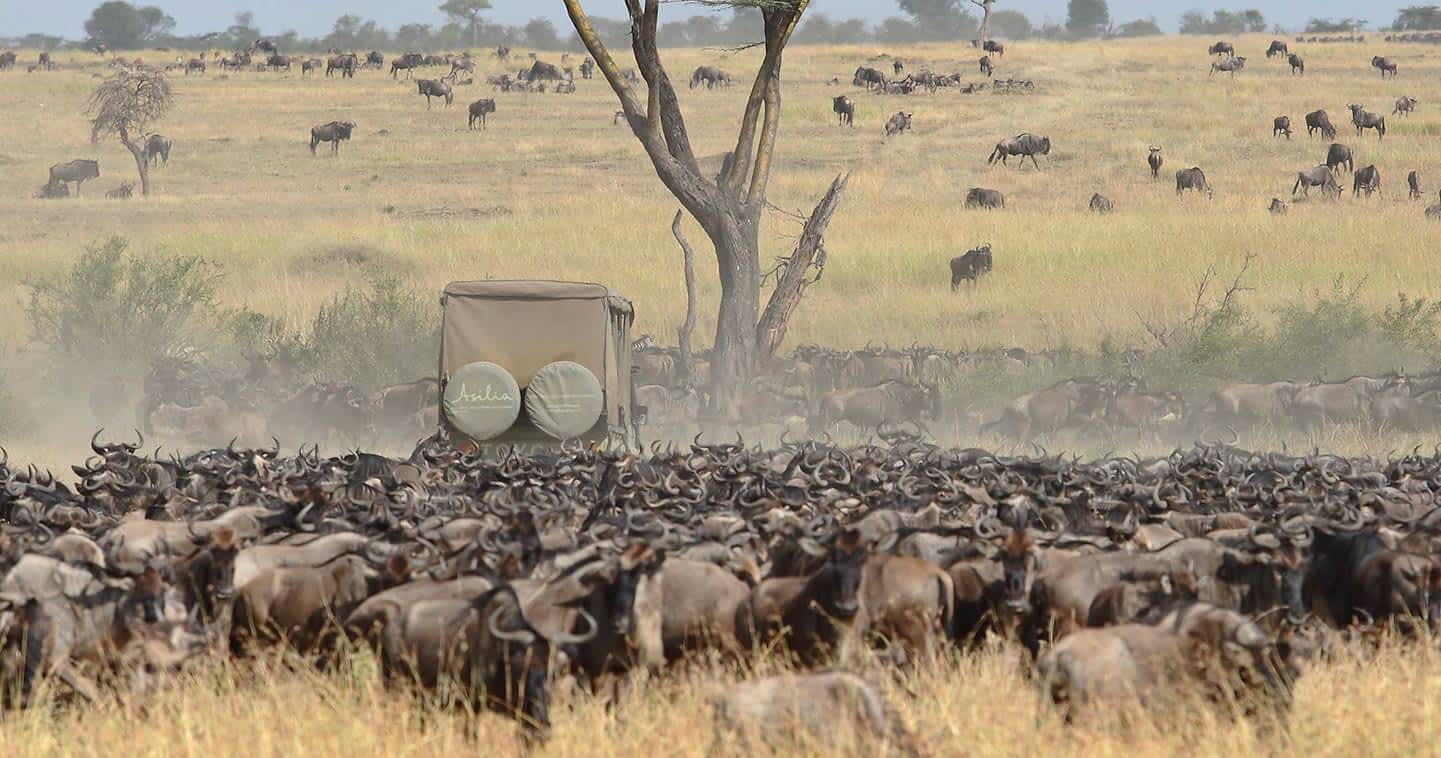
Yes, you can see both the Great Wildebeest Migration and the Big Five on a 7-day Tanzania safari, provided you travel during the appropriate season and visit key parks like the Serengeti and Ngorongoro Crater. A 7-day itinerary allows enough time for extensive game drives to locate the herds and spot lions, leopards, elephants, buffalo, and rhinos.
7-days-best-great-wildebeest-migration-safari-in-tanzania
7-days-epic-africa-big-five-safari-in-tanzania-top-best-parks
7-days-budget-tanzania-safari-affordable-africa-budget-safari
7-days-kilimanjaro-climb-and-hiking-safari-ascent-to-peak
7-days-tanzania-wildlife-safari-africa-safari-tour-best-park-visits
7-days-best-southern-tanzania-safari-parks-nyerere-mikumi-ruaha-and-udzungwa
7-day-best-zanzibar-beach-holidays-combo-to-ruaha-and-mikumi-safari-parks
7-days-zanzibar-beach-activities-and-chimpanzee-tracking-in-mahale-mountains
7-days-amboseli-kenya-and-serengeti-fly-in-tanzania-safari
7-days-masai-mara-safari-tour-and-serengeti-safari-tour-in-kenya-and-tanzania
7-days-ultimate-budget-kenya-tanzania-safari-holiday-vacation
Best Timing
To witness the most dramatic moments of the Great Migration, your timing is paramount. If you visit between July and October, you are aiming for the "River Crossing" phase. During this time, the herds are in the Northern Serengeti, braving the crocodile-infested waters of the Mara River. This is a high-adrenaline period where nature's raw struggle for survival is on full display. Conversely, if you plan your trip between January and March, you should focus on the southern Serengeti and the Ndutu plains. This is "Calving Season," where roughly 8,000 wildebeest are born every day. The lush green grass provides nutrients for the mothers, but the abundance of vulnerable calves attracts an incredible concentration of predators, including lions, cheetahs, and hyenas. Both windows offer unique spectacles: one defined by the grit of survival and the other by the vibrant, high-stakes circle of life.
The Big Five
While the Serengeti is famous for its scale, the Ngorongoro Crater is legendary for its density. If your primary goal is to check off the "Big Five" (lion, leopard, elephant, buffalo, and rhino) in a single day, this is the most reliable spot on the continent. The crater’s 600-meter-high walls create a natural enclosure, forming a self-contained sanctuary for over 25,000 large mammals. While lions and buffaloes are ubiquitous, and elephants wander through the Lerai Forest, the crater is most significant for its protection of the endangered black rhino. Seeing a rhino on the open plains of the crater floor is a core highlight of any 7-day trip. Because the animals remain within the caldera year-round, the game viewing is consistently excellent, offering a photographic "theater" where wildlife interactions—such as a hyena clan shadowing a lion kill—happen in plain view of the safari tracks.
Essential Parks
A balanced 7-day itinerary must weave together three distinct ecological narratives. Tarangire National Park serves as the "Land of Giants," famous for its ancient, gargantuan Baobab trees and a massive elephant population that congregate along the Tarangire River. It provides a rugged, wild start to the safari. Next, the Ngorongoro Crater offers a concentrated, high-density wildlife experience within a volcanic caldera, ensuring sightings of rare species like the black rhino. Finally, Serengeti National Park provides the "endless plains" experience. It is the heart of the journey, offering the cinematic scale of the Great Migration and the highest concentration of big cats in Africa. By combining these three parks, you transition from the dry, elephant-rich woodlands of the east to the volcanic highlands of the south and finally into the iconic, predator-heavy savannahs of the west and north.
Itinerary Focus
For a 7-day safari to be successful, it must be geographically agile. In the summer months (July–October), your itinerary should focus on the Northern Serengeti. This is where you will find the migration herds attempting to cross the Mara River into the Maasai Mara. Lodges in the Kogatende or Lamai regions are ideal for this. If you are traveling during the early months (January–March), you must shift your focus to the Southern Serengeti (Ndutu). This area has the nutrient-rich volcanic soil required for calving. During the "shoulder" months of April to June, the central Seronera Valley is the best base, as it serves as a permanent home for big cats and a transit point for the herds moving north. By aligning your accommodation with these specific regional migrations, you minimize long "transit" drives and maximize the time spent in the direct presence of the herds.
7 Days Tanzania wildlife safari wildebeest migration and Big five
This 7-Day Tanzania Wildlife Safari is a premier expedition through the crown jewels of East Africa’s "Northern Circuit." In 2026, Tanzania continues to set the global standard for wildlife conservation, offering a cinematic landscape where the "Big Five" roam across prehistoric volcanic calderas and endless savannahs. This specific itinerary is strategically engineered to capture the heart of the Great Wildebeest Migration, a thundering spectacle of over 1.5 million animals in constant pursuit of green pastures. From the ancient, baobab-studded plains of Tarangire to the enclosed Eden of the Ngorongoro Crater and the vast, golden horizon of the Serengeti, you will witness nature’s rawest dramas. Between high-action game drives, you will find sanctuary in luxury tented camps that blend modern comfort with the untamed spirit of the bush. This journey is more than a vacation; it is a profound immersion into a world where the rhythms of the wild have remained unchanged for millennia.
Day 1: Arusha to Tarangire National Park
Your Tanzanian odyssey begins with a scenic drive from Arusha to Tarangire National Park, the "Land of Giants." This park is defined by its massive, ancient Baobab trees and the largest concentration of elephants in the country. As you navigate the riverbanks, you’ll encounter herds hundreds strong, often congregating near the Tarangire River. The park is also a sanctuary for dry-country species like the fringe-eared oryx and the long-necked gerenuk. During your afternoon game drive, keep a sharp eye on the mahogany trees, as Tarangire is famous for its elusive tree-climbing lions. You will check into a lodge overlooking the valley, where the sight of elephants silhouetted against a fiery African sunset provides a breathtaking introduction to the wilderness. The evening is spent around a campfire, listening to the nocturnal calls of the savannah.
Day 2: Tarangire to Lake Manyara National Park
After a final morning game drive, you head toward Lake Manyara, a diverse gem nestled at the base of the Great Rift Valley escarpment. The park’s groundwater forest offers a lush contrast to the dry plains, providing a home to massive troops of baboons and blue monkeys. As the forest opens to the alkaline lake, you’ll see thousands of flamingos creating a pink haze along the shoreline. Watch for Manyara’s legendary tree-climbing lions and pods of hippos surfacing in the Simba River. This park is a birdwatcher’s paradise, with over 400 species ranging from the silvery-cheeked hornbill to the majestic martial eagle. In the late afternoon, you’ll ascend the escarpment to Karatu, where the cooler highland air and rolling coffee plantations offer a refreshing change of scenery and a peaceful night’s rest.
Day 3: Ngorongoro Crater Floor Safari
Today, you descend 600 meters into the Ngorongoro Crater, a UNESCO World Heritage site and the world’s largest intact volcanic caldera. This self-contained ecosystem is arguably the best place in Africa to see the "Big Five" in a single day. The crater floor is home to over 25,000 large mammals, including the highly endangered black rhino. You’ll spend the day traversing the short-grass plains and the Lerai Forest, witnessing prides of lions, spotted hyenas, and massive bull elephants. A picnic lunch near the hippo pool allows you to dine in the presence of prehistoric giants. The density of wildlife here is so high that you are virtually guaranteed to witness predator-prey interactions. After a full day of high-action game viewing, you’ll ascend back to the rim, enjoying a sunset view that captures the entire caldera in one frame.
Day 4: Transfer to Central Serengeti (Seronera)
Leaving the highlands, you head toward the Serengeti, passing through the Ngorongoro Conservation Area. A stop at a Maasai village offers a glimpse into the traditional lives of these iconic pastoralists. As you cross the Naabi Hill gate, the "Endless Plains" unfold before you. You’ll spend the afternoon in the Seronera Valley, the heart of the Serengeti. This region is world-renowned for its big cat density, particularly leopards and lions that utilize the granite kopjes as lookout points. The Seronera River ensures a year-round water supply, making it a permanent home for a vast array of wildlife even outside migration periods. You will arrive at your central Serengeti tented camp, where the proximity to the wild is absolute—separated from the majestic predators only by the canvas of your luxurious suite.
Day 5: Tracking the Migration (Northern or Southern Serengeti)
This day is entirely dedicated to the Great Wildebeest Migration. Depending on the month of your 2026 visit, your guide will lead you to where the herds are most concentrated. In the summer, you’ll head north toward the Mara River to witness the high-drama river crossings. In the early months, you’ll focus on the southern Ndutu plains for the calving season. The sheer scale of the migration—over a million wildebeest and zebras stretching to the horizon—is a sensory marvel. You’ll watch as herds navigate the threats of crocodiles and lions, driven by an ancient instinct to move. Between the thundering hooves, you’ll find cheetahs and hyenas on the hunt. This is the Serengeti at its most raw and powerful, a testament to the enduring cycles of life and death on the African savannah.
Day 6: Central Serengeti Game Exploration
With the migration as your backdrop, today focuses on the Serengeti’s permanent residents. You’ll explore different loops of the Seronera and Grumeti regions, searching for the "Big Five" elements you may have missed. The morning light provides the perfect opportunity to photograph prides of lions resting on kopjes or a leopard draped over an acacia branch. For an optional but unforgettable highlight, you can take a sunrise hot air balloon safari, drifting silently over the migration before a champagne breakfast in the bush. The afternoon drive might take you to the Retima Hippo Pool, where hundreds of hippos jostle for space. This full day of immersion allows you to appreciate the subtleties of the ecosystem, from the complex social structures of elephants to the vibrant plumage of the endemic Fischer’s lovebird.
Day 7: Serengeti to Arusha via Olduvai Gorge
On your final day, you enjoy a sunrise game drive as you exit the Serengeti, catching the animals at their most active. En route back to Arusha, you’ll stop at the Olduvai Gorge, the "Cradle of Mankind." A visit to the museum here provides a profound look at the fossilized footprints and tools of our earliest ancestors discovered by the Leakey family. After a final safari lunch, you continue the drive through the scenic highlands, passing through local villages and vibrant markets. You’ll arrive back in Arusha in the late afternoon, where you can pick up last-minute souvenirs like Tanzanite or local coffee. Your guide will transfer you to Kilimanjaro International Airport for your departure, concluding a week of thundering migrations and intimate wildlife encounters that have undoubtedly left an indelible mark on your soul.
1. Is 7 days enough for the migration and Big Five?
A week is widely considered the "sweet spot" for a Tanzanian safari. This duration allows you to navigate the Northern Circuit without feeling rushed, spending two to three days in the Serengeti (essential for the migration) while still having dedicated time for the Ngorongoro Crater and Tarangire. This timeframe balances the long transit drives with high-quality game viewing. Most 7-day itineraries are designed as a "loop" or a "linear" path with a bush flight back to Arusha, ensuring that you maximize your hours in the presence of wildlife rather than on the road.
2. Where is the migration during a 7-day safari?
The migration is a perpetual, clockwise loop driven by rainfall. From January to March, the herds are in the southern Ndutu plains for calving. In April and May, they move toward the Western Corridor. By June and July, they are heading into the Central and Northern Serengeti. From August to October, they occupy the Northern Serengeti/Mara region. By November and December, they begin their return south through the eastern boundaries. Because the herds are always moving, your 7-day itinerary must be geographically targeted to the specific region the herds are occupying during your travel month.
3. When is the best time to see the calving season?
February is the undisputed peak of the calving season. During this window, the southern Serengeti and the Ndutu area become a massive nursery, with roughly 8,000 wildebeest calves born every single day. The nutrient-rich volcanic soil produces short, sweet grasses that are vital for nursing mothers. For a 7-day safari, this is a period of intense activity; while the sight of thousands of wobbly-legged calves is heartwarming, it also triggers the highest concentration of predator action as lions, cheetahs, and hyenas take advantage of the abundance of vulnerable prey.
4. Can I see the Mara River crossing in 7 days?
Yes, but you must visit between July and October and focus your itinerary on the Northern Serengeti (Kogatende/Lamai). To make this work in seven days, many travelers opt to fly from Arusha directly into the northern airstrips to avoid the two-day drive through the central plains. Seeing the herds brave the crocodile-infested waters of the Mara River is one of nature’s most raw spectacles. It requires patience, as herds may gather on the banks for hours before one brave individual makes the leap, triggering a thundering, chaotic surge across the water.
5. Which of the Big Five can I see in Serengeti?
The Serengeti is a stronghold for four of the "Big Five": lions, leopards, elephants, and buffaloes. Lions are ubiquitous, often seen on granite kopjes, while leopards are frequently found in the Seronera Valley’s acacia trees. Elephants and buffaloes move in large herds across the central and northern regions. The black rhino is the most elusive of the five in the Serengeti; however, a small population resides in the Moru Kopjes area. While sightings there are possible, they are less frequent than in the Ngorongoro Crater, making the Serengeti better known for the "Big Four" plus the migration.
6. Where is the best place to see rhinos?
The Ngorongoro Crater is the most reliable destination in East Africa to see the endangered black rhino. Because the crater floor is a relatively small, enclosed environment of 260 square kilometers, the small population of rhinos is much easier to track than in the vast Serengeti. Most 7-day itineraries include at least one full day on the crater floor specifically to secure this "Big Five" encounter. Seeing a prehistoric-looking rhino grazing on the open plains with the steep caldera walls as a backdrop is a quintessential Tanzanian safari moment.
7. Can I see the Big Five in 7 days?
Absolutely. By combining Tarangire, Ngorongoro, and the Serengeti, you cover all the necessary habitats. Tarangire is world-famous for its massive elephant herds. Ngorongoro provides the most certain rhino sightings. The Serengeti and Ngorongoro both offer world-class lion and buffalo viewing, while the Serengeti and Tarangire are excellent for leopards. A well-constructed 7-day "Northern Circuit" safari is essentially a checklist for the "Big Five," and most travelers successfully spot all five within the first four or five days of their journey.
8. What to expect in terms of migration drama?
"Drama" is the defining characteristic of the migration. In the south (Jan–Mar), the drama is found in the hunt; cheetahs and lions are at their most active as they target young calves. In the north (July–Oct), the drama is the river crossing, where the struggle is against the current and massive Nile crocodiles. Even during the "trekking" phases in the central Serengeti, you will witness the sheer physical toll of the journey and the social interactions of over a million animals. It is a sensory experience of noise, dust, and raw survival that feels like being inside a wildlife documentary.
9. Are the herds in Tanzania all year?
Contrary to the popular belief that the migration "leaves" for Kenya, the herds actually spend about 9 to 10 months of the year in Tanzania. The Serengeti ecosystem is vast, and the herds only cross into Kenya’s Masai Mara for a few months (typically August to October) when the grass there is greener. Even during those months, a significant portion of the migration remains in the Northern Serengeti. Therefore, Tanzania is a viable migration destination year-round, provided you adjust your regional focus within the Serengeti to match the herds' location.
10. What is the typical 7-day itinerary?
The classic route begins in Arusha, followed by a day in Tarangire National Park (elephants). Day three usually involves a drive to the Ngorongoro Crater for a floor safari. Days four, five, and six are spent in the Serengeti, with the specific region (Central, North, or South) chosen based on the migration's current location. On day seven, you either drive back to Arusha (with a stop at Olduvai Gorge) or take a bush flight directly from a Serengeti airstrip back to the city to catch your international departure, maximizing your final hours of game viewing.
11. Is accommodation inside the parks necessary?
Staying inside the park boundaries or in "buffer zones" immediately adjacent is essential for a 7-day safari. The Serengeti is enormous, and staying outside the gates can add two to three hours of "commute" time each day. By staying in central or northern tented camps, you are in the heart of the action from the moment you wake up. These camps allow you to hear the lions roaring at night and start your game drives at the crack of dawn, which is when predators are most active and the light is best for photography.
12. When should I book my 7-day safari?
For the peak migration months (February for calving and July–September for crossings), you should book 12 to 18 months in advance. The high-demand tented camps in the North and South have limited capacity and sell out quickly. Booking early also ensures you secure the most experienced guides and the best-located camps, which are critical for seeing the river crossings. If you are planning a "Green Season" safari (November–May), 6 to 9 months is usually sufficient, though the February calving period remains a high-demand exception.
13. Are the parks crowded during migration?
Crowding can occur, particularly at "hot spots" like the Mara River crossings or in the Ndutu region during calving. However, the Serengeti is so vast that your guide can often find private sightings by exploring "off-the-beaten-path" loops. In the Ngorongoro Crater, vehicle numbers are more noticeable because of the confined space. In 2026, many operators and park authorities use radio coordination to manage vehicle flow. Choosing a "mid-range" or "luxury" camp often gives you access to quieter concessions or areas where fewer day-trippers venture, providing a more exclusive feel.
14. What are the best months for a 7-day trip?
If your goal is the migration, February and August/September are the "Gold Standard" months. February offers the calving spectacle and the best weather for the southern plains. August and September offer the legendary river crossings and the classic "dry season" safari experience where animals are easy to spot. If you prefer lush landscapes and fewer crowds, June and December are excellent "shoulder" months that still offer great migration views as the herds are in transit through the Central Serengeti.
15. Does the migration cross into Kenya?
Yes, the herds cross the border into the Masai Mara between August and October. However, the "border" is a political one, not a geographical one. The animals move back and forth across the Mara River, which serves as the boundary. Even when the bulk of the migration is in Kenya, there are still hundreds of thousands of animals in the Northern Serengeti. Tanzanian safaris during this time offer the advantage of seeing the crossings from the southern banks, often with slightly fewer crowds than the Kenyan side, and the ability to combine the sighting with the Ngorongoro Crater.
Booking 7 Days Tanzania wildlife safari with us Roads of Adventure safaris
Book a 7-day Tanzania wildlife safari with Roads of Adventure Safaris for a customized, seamless experience featuring top destinations like the Serengeti, Ngorongoro Crater, and Tarangire. The packages include expert guides, accommodation options (budget to luxury), park fees, and transport, with a focus on sustainable tourism. Contact them to tailor your adventure.
