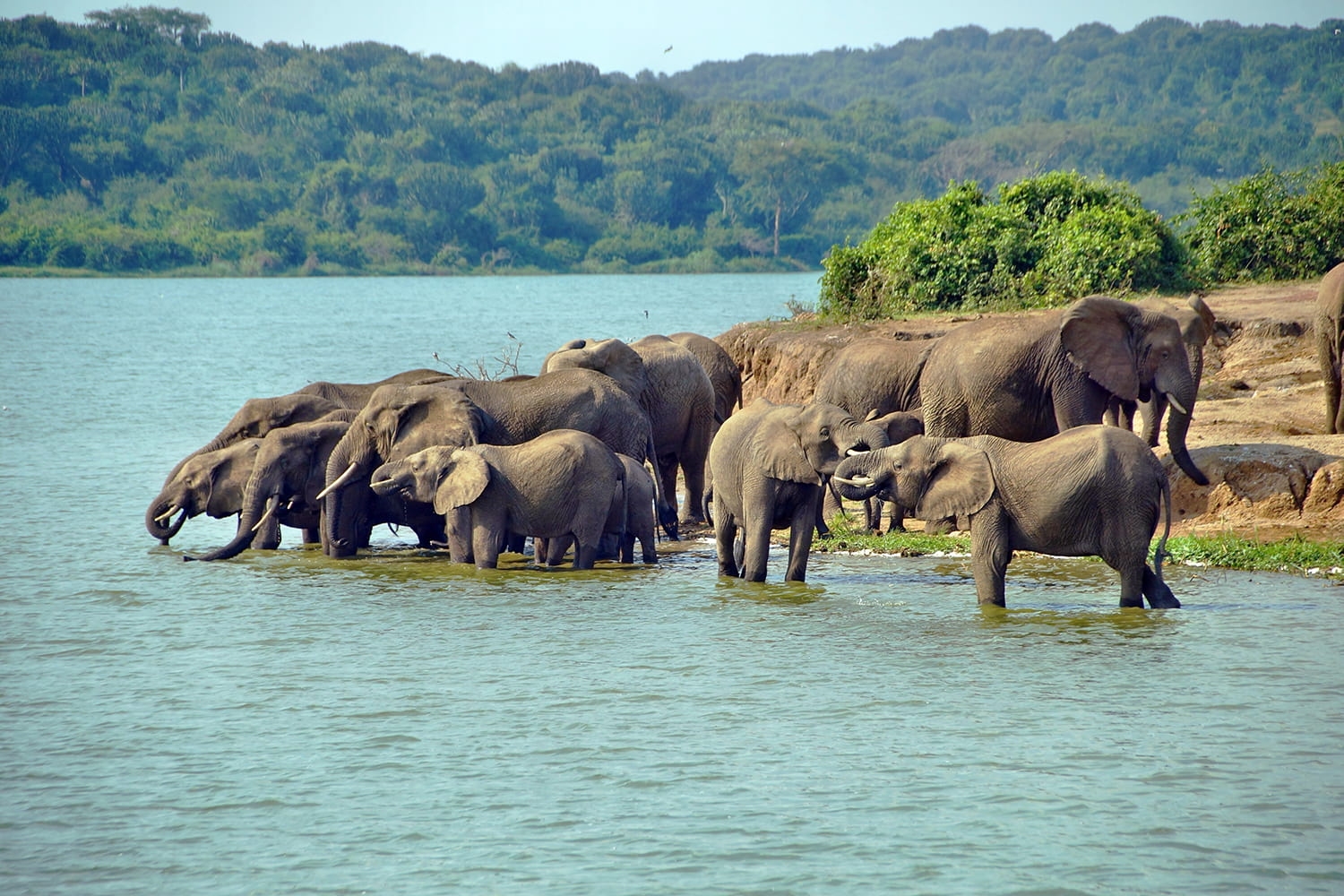
Queen Elizabeth National Park (QENP) is Uganda's most popular safari destination, spanning 1,978 across the western rift valley floor. It is a UNESCO World Biosphere Reserve renowned for its incredible biodiversity, housing 95 mammal species and over 600 bird species—the highest count in any Ugandan park.
3-days-trips-to-queen-elizabeth-national-park-for-chimpanzee-tracking-in-kyambura-gorge
3-days-uganda-safari-itinerary-to-queen-elizabeth-national-park
3-days-budget-queen-elizabeth-park-uganda-wildlife-safari-holiday
3-days-fly-luxury-uganda-safari-to-queen-elizabeth-national-park
Exploring the Heart of Queen Elizabeth National Park
The beauty of Queen Elizabeth National Park lies in its sheer variety. It isn't just one endless stretch of grass; it is a collection of distinct worlds, each with its own rhythm and residents. To truly experience it, you have to move between these sectors, feeling the temperature change as you drop into a gorge or watching the light shift over a volcanic crater. Here is a closer look at the highlights that make this park so special.
Ishasha Sector: The Realm of the Tree-Climbing Lions
There is something genuinely surreal about driving through the southern Ishasha Sector and spotting a 200kg lion draped over a branch like a house cat. While lions are usually terrestrial creatures, the prides here have developed a unique cultural habit of climbing high into the ancient sycamore-fig trees. As you navigate the dusty tracks, your eyes naturally learn to scan the horizontal limbs of these massive trees rather than just the grass. It is widely believed they do this to catch the cool breezes that skip over the savanna and to stay out of reach of the irritating tsetse flies that swarm near the ground.
The Ishasha Sector feels wilder and more remote than the rest of the park. It is a place of vast, golden plains and dramatic riverine forests along the border of the Congo. Beyond the famous lions, the area is a haven for massive herds of Cape buffalo and the elegant Topi antelope. There is a specific kind of silence in Ishasha, broken only by the wind in the trees or the distant trumpeting of an elephant. It is the kind of place where you stop the engine, wait, and let the wilderness reveal itself. For many, seeing a pride of lions lounging five meters above the ground is the definitive "bucket list" moment of a Ugandan safari.
Kazinga Channel: Africa’s Social Hub
If the savanna is the park’s stage, the Kazinga Channel is its vibrant social hub. This 32km waterway is a natural ribbon of blue connecting Lake Edward and Lake George, and it arguably offers the most relaxed wildlife viewing in Africa. When you board the boat, the perspective shifts. Instead of peering through a window, you are gliding past life at the water’s edge. The channel is famous for hosting one of the world's highest concentrations of hippos. You’ll see them in "pods" of dozens, ears twitching and nostrils huffing, occasionally engaging in a cavernous yawn that shows off their massive tusks.
The banks are a constant parade of activity. Giant Nile crocodiles bask in the sun with their mouths agape, while herds of elephants frequently wander down for a late-afternoon bath, splashing water over their backs with their trunks. For bird lovers, it is a sensory overload. You might see the prehistoric-looking Shoebill if you are incredibly lucky, but you are guaranteed to see thousands of pelicans, kingfishers, and fish eagles. There is a peacefulness to the channel; the animals are remarkably unbothered by the boats, allowing you to get close enough to hear an elephant’s rumble or the squabble of a hippo family.
Kasenyi Plains: The Classic Savanna Experience
The Kasenyi Plains are exactly what you imagine when you think of an African safari. These vast, open grasslands in the northeastern part of the park are the primary setting for early morning game drives. As the sun rises over the horizon, painting the grass in shades of amber, the plains come alive. This is the main breeding ground for the Uganda kob, and where there are kobs, there are predators. Watching a kob "lek"—where males compete for territory and mates—is a fascinating display of animal behavior.
Kasenyi is the best place to find the park's "ground-dwelling" lions. Following the tracks of a pride as they navigate the tall grass in search of a morning meal is an adrenaline-filled experience. However, the plains aren’t just about the hunt. You will see massive lone "bull" elephants wandering through the shrubs and family groups of warthogs scurrying along with their tails held high like antennae. The scale of Kasenyi is humbling; the wide-open views stretch all the way to the jagged peaks of the Rwenzori Mountains, making you feel very small in a very large, very beautiful world.
Kyambura Gorge: The Underground Forest
Nothing prepares you for the visual shock of Kyambura Gorge. One moment you are standing on the flat, dry savanna, and the next, you are looking down 100 meters into a lush, emerald-green "sunken forest." It looks like a tectonic crack in the earth that has been filled with a prehistoric jungle. Descending the steep trails into the gorge, the temperature drops and the sound of the wind is replaced by the chatter of birds and the rushing of the Kyambura River.
This is the home of a small, isolated community of habituated chimpanzees. Tracking them through the dense canopy is a visceral experience. You hear them before you see them—the famous "pant-hoot" calls echoing off the gorge walls can be hair-raising. Unlike the open plains, the gorge is intimate and closed-in. You have to push through vines and navigate muddy roots, feeling like a true explorer. Even if the chimps are being elusive, the gorge itself is a marvel of nature, home to Black-and-white Colobus monkeys, red-tailed monkeys, and a variety of colorful forest birds that you won't find anywhere else in the park.
Explosion Craters: A Volcanic Masterpiece
The Explosion Craters in the northern part of the park offer a dramatic shift from wildlife to geology. This area was shaped by violent volcanic activity thousands of years ago, leaving behind a series of deep, circular calderas. Some are filled with thick forests, others with sparkling blue water, and some with salty minerals. Driving the winding "Crater Drive" provides some of the most spectacular photography spots in Uganda, with views that stretch across the park toward the mountains and the lakes.
The most famous of these is the Katwe Salt Lake. For centuries, the local community has survived by mining salt here using traditional methods that haven't changed much since the 16th century. Seeing the salt pans and the miners working in the harsh, briny water is a powerful reminder of the human history that exists alongside the wildlife. It is a place of stark, rugged beauty. Visiting the craters at sunset is a particularly moving experience, as the light catches the different colors of the lakes and the shadows grow long over the volcanic ridges, ending your safari day on a note of quiet, ancient wonder.
Why is it called Queen Elizabeth National Park?
The park's name is a direct reflection of its colonial-era history and a significant royal milestone. When it was first gazetted in 1952, it was known as Kazinga National Park, named after the prominent waterway that bisects the landscape. However, only two years later, in 1954, it was renamed to honor the visit of Queen Elizabeth II. This was a momentous occasion for the protectorate at the time, as the young monarch traveled to Uganda to officially commission the Owen Falls Dam in Jinja and subsequently toured the western wildlife regions. The renaming was a gesture of diplomatic ties and has remained unchanged since Uganda gained independence in 1962. Today, the name serves as a bridge between the park's historical roots and its modern status as a premier global destination. While the name is British, the soul of the park is entirely Ugandan, managed with pride by the Uganda Wildlife Authority to preserve the heritage that the Queen once admired during her mid-century tour of the "Pearl of Africa."
Where is Queen Elizabeth National Park located?
Strategically positioned in the western reaches of Uganda, the park is a centerpiece of the Albertine Rift Valley. It lies approximately 410 kilometers from the capital city, Kampala, a journey that takes travelers through a diverse array of landscapes, from urban centers to lush tea plantations. One of the park's most famous geographic features is that it straddles the Equator. Visitors can find iconic circular monuments marking the 0° latitude line, allowing them to stand with one foot in the Northern Hemisphere and the other in the Southern Hemisphere. The park is bordered by several major landmarks: to the west lies Lake Edward and the border of the Democratic Republic of Congo; to the north, the towering "Mountains of the Moon" (the Rwenzoris); and to the south, the Ishasha River. This location makes it a vital ecological corridor, connecting different habitats and allowing for a level of biodiversity that is rarely matched in other parts of East Africa.
What is the best time to visit Queen Elizabeth National Park?
Timing your visit can significantly alter your safari experience, and generally, the dry seasons are the most rewarding. These periods occur from June to September and December to February. During these months, the savanna grass is shorter and thinner, making it much easier to spot elusive predators like leopards and lions. More importantly, as smaller inland water holes dry up, animals are forced to congregate around permanent water sources like the Kazinga Channel and the park’s various crater lakes. This makes for spectacular, high-density wildlife viewing, especially during afternoon boat cruises. Conversely, the wet seasons (March to May and October to November) turn the park into a vibrant, emerald-green paradise. While the tall grass makes mammal spotting slightly more challenging, it is the peak time for bird watchers, as migratory species from Europe and northern Africa arrive in droves. Furthermore, the air is crisp and clear, providing the most dramatic photographic backdrops of the Rwenzori Mountains.
Can I see tree-climbing lions in Queen Elizabeth National Park?
Yes, the park is one of the very few places on Earth where you can witness this rare behavioral phenomenon. The Ishasha sector, located in the southern part of the park, is world-famous for its population of tree-climbing lions. Unlike most lions that prefer to stay on the ground, the prides here have a cultural habit of spending their afternoons draped over the low-hanging branches of ancient sycamore-fig trees. This behavior is thought to be an adaptation to escape the blistering heat of the ground and to avoid the irritating bites of tsetse flies. Seeing a 400-pound male lion balanced precariously on a branch is a sight that feels both majestic and slightly surreal. Because this behavior is not found in the northern Kasenyi plains, it is vital to ensure your itinerary includes a dedicated drive through the southern fig-tree circuits. It remains one of the most sought-after experiences for wildlife photographers and nature enthusiasts visiting Uganda.
How big is Queen Elizabeth National Park?
Covering an expansive area of approximately 1,978 square kilometers, Queen Elizabeth National Park is the second-largest national park in Uganda, surpassed only by Murchison Falls. Its sheer size allows it to encompass a staggering variety of ecosystems within a single boundary. Within its borders, you will find open savannas, humid tropical forests, dense papyrus swamps, and over a dozen volcanic explosion craters. This vastness is what supports its incredible biodiversity, including 95 species of mammals and over 600 species of birds. The park is divided into several sectors, such as Kasenyi in the north, Mweya in the center, and Ishasha in the south, each offering a different climate and wildlife profile. Because of its scale, a 3-day safari only scratches the surface, but the well-maintained track system ensures that travelers can reach the most wildlife-rich areas efficiently, providing a sense of endless wilderness that feels truly untamed and preserved.
What are the main attractions in Queen Elizabeth National Park?
The park is a multi-dimensional destination where the attractions go far beyond the standard game drive. The undisputed crown jewel is the Kazinga Channel boat cruise, a 2-hour journey that brings you face-to-face with massive pods of hippos and bathing elephants. For those seeking a forest adventure, the Kyambura Gorge offers chimpanzee tracking in a "sunken forest" that feels like a prehistoric world. In the southern Ishasha sector, the draw is the tree-climbing lions, while the Kasenyi plains provide the classic African safari backdrop for spotting prides of lions on the hunt and massive herds of Uganda Kob. Additionally, the Katwe Explosion Craters offer some of the most scenic views in the country, combined with a touch of local culture at the salt mining works. Whether you are interested in predators, primates, birds, or volcanic geology, the park provides a comprehensive "sampler platter" of everything that makes East African nature so compelling.
Can I track chimpanzees in Queen Elizabeth National Park?
Yes, chimpanzee trekking is one of the park’s most exhilarating activities, primarily taking place in the Kyambura Gorge. Often referred to as the "Valley of Apes," this 100-meter-deep tectonic gash is filled with a lush tropical riverine forest that stands in stark contrast to the dry savanna above. Descending into the gorge is like stepping into a different world where a community of habituated chimpanzees resides. The experience of hearing their "pant-hoot" calls echoing off the canyon walls before seeing them swing through the canopy is visceral and unforgettable. While the success rate for sightings is slightly lower here than in Kibale National Park due to the chimps' mobility within the gorge, the dramatic scenery and the sense of adventure make it a favorite for many. For those who want a higher guarantee of sightings, the nearby Kalinzu Forest also offers excellent chimp trekking opportunities just outside the park's official boundary.
Is Queen Elizabeth National Park good for bird watching?
The park is nothing short of a pilgrimage site for ornithologists. With over 600 recorded bird species, it boasts one of the highest bird counts of any protected area in Africa. This incredible variety is due to the park’s location at the intersection of savanna, forest, and wetland ecosystems. During a single boat cruise on the Kazinga Channel, you can spot African Fish Eagles, Great White Pelicans, Saddle-billed Storks, and various types of Kingfishers. In the forests of Kyambura or Maramagambo, you might find the Black-bee-eater or the Blue-throated Roller. The park is also a vital stopover for migratory birds fleeing the northern hemisphere's winter. Whether you are a seasoned "birder" looking for rare species like the Shoebill (which is occasionally seen in the swamps) or a casual observer, the sheer volume of color and song in the air makes birding an unavoidable and delightful part of any safari here.
What animals are in the "Big Five" category in Queen Elizabeth National Park?
While the "Big Five" is a classic safari checklist, it is important to note that Queen Elizabeth National Park is home to four of the five members. You will find healthy populations of lions (including the tree-climbers), leopards (often seen in the thickets of Kasenyi or Mweya), elephants (which are ubiquitous throughout the park), and Cape buffaloes (found in massive herds near the water). The only missing member is the rhino, which went extinct in the wild in Uganda during the turbulent decades of the 1970s and 80s. However, the park compensates for this missing member with its unique primates, such as chimpanzees, and its massive hippopotamus population, which many travelers find just as impressive. If seeing the full Big Five is your goal, many visitors combine a trip to this park with a stop at the Ziwa Rhino Sanctuary on their way to or from Murchison Falls.
What is special about the Kazinga Channel in Queen Elizabeth National Park?
The Kazinga Channel is the lifeblood of the park and one of the most remarkable wildlife corridors in Africa. This 32-kilometer-long waterway connects Lake George to Lake Edward, and its constant flow of fresh water attracts an incredible density of life. What makes it special is the sheer visibility it affords; because animals are drawn to the banks to drink and cool off, a boat cruise provides an unobstructed view of wildlife behavior that you simply cannot get from a car. It is world-famous for having one of the highest concentrations of hippos on the planet. Seeing hundreds of these massive animals huffing and splashing just a few meters from your boat is a foundational safari experience. Additionally, the channel acts as a social gathering point for elephants, buffaloes, and monitor lizards, all while being framed by some of the most spectacular birdlife in East Africa.
Are there explosion craters in Queen Elizabeth National Park?
Yes, the northern part of the park is home to a dramatic volcanic landscape known as the Katwe Explosion Craters. These are not active volcanoes today, but rather extinct vents that erupted violently thousands of years ago, leaving behind deep, circular calderas. A drive along the 27-kilometer Crater Drive offers some of the most stunning panoramic views in Uganda, overlooking the "Mountains of the Moon" and the vast Rift Valley floor. Some craters have developed into lush forests, while others, like Lake Katwe, are hyper-saline. At Lake Katwe, you can witness a traditional salt mining industry that has been the backbone of the local economy for centuries. Seeing the miners manually harvest salt in the harsh environment is a powerful cultural experience that provides a human dimension to the park’s natural wonders. The craters are a photographer’s dream, especially at sunrise or sunset when the light hits the ridges.
What are the park entry fees for Queen Elizabeth National Park?
Managing a world-class conservation area requires significant resources, and the park entry fees are a vital contribution to these efforts. As of the most recent updates from the Uganda Wildlife Authority (UWA), the conservation fee for foreign non-residents is US$40 per person for a 24-hour period. For foreign residents (those with a valid work permit), the fee is typically US$30, while East African Community citizens pay 25,000 Uganda Shillings. These fees allow you access to the park’s road networks and general game viewing areas. It is important to remember that specific activities—such as the Kazinga Channel boat cruise (approx. $30), chimpanzee tracking in Kyambura ($50), or guided nature walks—carry additional costs. While the fees might seem like a significant part of your budget, they are directly reinvested into anti-poaching patrols, community development projects, and habitat restoration, ensuring that the park remains a sanctuary for generations to come.
How do I get to Queen Elizabeth National Park?
The park is highly accessible, offering options for both road travelers and those who prefer to fly. By road, it is a 7 to 8-hour drive from Kampala, typically taking the route through Masaka, Mbarara, and Bushenyi. While the drive is long, it is incredibly scenic and allows for the iconic stop at the Equator crossing. For those with a shorter timeframe or a higher budget, scheduled domestic flights are available from Entebbe International Airport or Kajjansi Airfield. These flights land at the Mweya Airstrip, located right in the heart of the park, or at the Kasese Airstrip, which is a short drive from the park gates. Flying reduces the travel time to just over an hour and provides a spectacular aerial view of the Rift Valley and the Rwenzori Mountains. Regardless of how you arrive, the transition from the busy highlands to the expansive savanna of the park is one of the most exciting parts of the journey.
What are the rules for visitors in Queen Elizabeth National Park?
To ensure the safety of both visitors and wildlife, the Uganda Wildlife Authority enforces a strict set of regulations. First and foremost, you must stay on designated tracks at all times; off-road driving is prohibited as it destroys the fragile vegetation and disturbs animal habitats. There is a speed limit of 40km/hr within the park to prevent accidental collisions with animals crossing the road. Visitors are strictly forbidden from feeding the wildlife, as this disrupts their natural diet and can make them aggressive toward humans. Additionally, you should never get out of your vehicle except at designated picnic spots or lodges, as predators are masters of camouflage. Littering is a serious offense, and all trash must be carried out with you. Following these rules is not just about avoiding fines; it’s about respecting the wild environment and ensuring that the animals remain truly wild and unbothered by human presence.
Is it safe to visit Queen Elizabeth National Park?
Yes, the park is considered very safe for tourists. Security is a top priority for the Ugandan government, and the park is patrolled 24/7 by a dedicated team of trained park rangers from the Uganda Wildlife Authority (UWA) and the Tourism Police. These professionals are well-armed and highly trained in both wildlife management and security protocols. At every major lodge and entry point, there is a visible security presence to ensure peace of mind. While the park is located near the border with the Democratic Republic of Congo, there is a strong military and ranger coordination to monitor all boundary areas. As with any travel, it is always wise to follow the advice of your professional guide and stay informed of current travel advisories. Thousands of visitors enjoy the park every year without incident, finding it to be a peaceful, welcoming, and extraordinarily beautiful sanctuary in the heart of Africa.
Booking Safaris to queen Elizabeth park with us Roads of Adventure safaris
Book a 3-day budget or luxury safari to Queen Elizabeth National Park with Roads of Adventure Safaris, based in Kampala. Packages feature tree-climbing lions in Ishasha, Kazinga Channel boat cruises, and game drives in Kasenyi plains. Safaris include expert guides, transportation, and accommodation ranging from budget to luxury, such as Mweya Safari Lodge.
