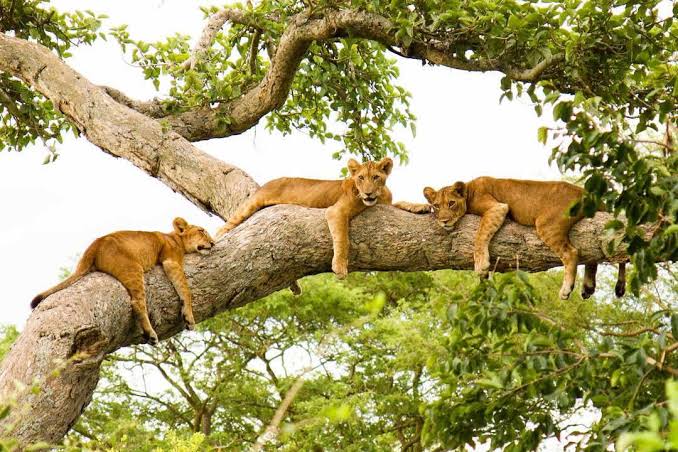
The primary location to spot tree-climbing lions during a Uganda safari is the Ishasha Sector, situated in the southern region of Queen Elizabeth National Park. While lions across the globe occasionally scramble up low branches, the prides in Ishasha display a consistent, culturally transmitted habit of lounging high in the limbs of mature fig and acacia trees. On rare occasions, travelers may also spot lions climbing trees in Murchison Falls National Park or Kidepo Valley National Park, but Ishasha remains the world's most reliable and famous destination for observing this unusual big cat behavior.
3-days-affordable-uganda-budget-gorilla-trekking-via-kigali
3-day-budget-gorilla-trekking-safari-in-uganda
2-days-affordable-budget-uganda-safari-to-queen-elizabeth-national-park
2-days-budget-uganda-safari-to-murchison-falls-park
4-days-budget-queen-elizabeth-park-and-chimpanzee-tracking-in-kalinzu-forest
6-days-budget-uganda-safari-and-gorilla-trekking
7-days-budget-uganda-safari-tour-package
10-days-luxury-uganda-gorilla-trekking-safari-and-big-five-safari-vacation
9-days-luxury-gorilla-and-uganda-safari-tour-package
8-days-luxury-uganda-wildlife-safari-tour-package
4-days-luxury-gorilla-trekking-safari-in-bwindi-fly-in-all-inclusive-tour
4-days-luxury-murchison-falls-and-jinja-uganda-safari-vacation
Where to Find Them
- Location: The southern part of Queen Elizabeth National Park near the border with the Democratic Republic of Congo.
- Habit: Lions here regularly lounge on the thick, low branches of large fig and acacia trees.
- Reason: They climb to escape ground heat and biting flies, or to get a better vantage point for hunting Uganda kobs.
Best Time to Visit
- Dry Seasons: June to September and December to February offer thinner vegetation and easier road access.
- Time of Day: Early morning or late afternoon game drives provide the highest chance to see lions resting or moving in the branches
Where is the best place to see tree-climbing lions in Uganda?
The absolute best place to observe tree-climbing lions in Uganda is the Ishasha Sector, located in the southern corridor of Queen Elizabeth National Park. Unlike typical lions that spend their days resting on the ground, the prides in Ishasha routinely climb high into the sprawling branches of sycamore fig and acacia trees. This behavior has become a well-documented regional phenomenon, drawing wildlife enthusiasts and photographers from all over the world. While lions in other African parks occasionally climb trees, Ishasha stands out because the habit is practiced consistently across generations by multiple resident prides. The open savanna landscape and distinct tree structures in Ishasha provide ideal perches, allowing visitors to view these massive carnivores sprawled comfortably above the ground during daytime game drives.
Why do lions in the Ishasha Sector climb trees?
Wildlife biologists attribute the tree-climbing behavior of Ishasha’s lions to a combination of environmental comfort and practical necessity. First, rising above the ground allows the lions to escape the scorching afternoon heat by catching cool, elevated breezes that flow across the open savanna. Second, staying high up in the canopy keeps them away from annoying ground-level insects, particularly biting tsetse flies that swarm in the lower brush during warmer hours. Additionally, climbing sturdy fig trees provides the prides with an excellent elevated vantage point to scan the surrounding grasslands for potential prey, such as Uganda kob, or to monitor the movements of competing predators. Over time, this practical adaptation has been passed down from mothers to cubs, establishing a unique cultural trait within these specific prides.
What specific species of trees do lions prefer to climb in Ishasha?
In the Ishasha Sector, lions demonstrate a clear preference for sycamore fig trees (Ficus sycomorus) and umbrella acacia trees (Acacia tortilis). Sycamore fig trees are especially popular because they feature massive, sturdy horizontal branches that branch out low to the ground, offering broad and comfortable platforms capable of supporting the heavy weight of full-grown lions. The thick, rough bark provides excellent traction for their powerful claws as they climb upward. Acacia trees are also frequently chosen because their wide canopy umbrellas afford shade while placing the animals high enough to catch passing breezes. Experienced safari guides actively search these specific tree species during morning and afternoon game drives, as they serve as the preferred resting spots for the resident prides.
Is Ishasha the only place in Uganda where lions climb trees?
While Ishasha is famous for this behavior, it is not strictly the only location in Uganda where lions have been seen in trees. On rare occasions, visitors and rangers have documented lions climbing low branches in Murchison Falls National Park and Kidepo Valley National Park. However, tree climbing in those northern parks is opportunistic and sporadic rather than a regular daily habit. In contrast, Ishasha is unique because tree climbing is an established, ingrained behavior shared across the entire local lion population. Therefore, while a lucky traveler might spot a lion elevated in Murchison Falls or Kidepo, Ishasha remains the only destination in Uganda where seeing tree-climbing lions is a primary, reliable safari highlight.
Where else in Africa can you see tree-climbing lions?
Outside of Uganda’s Ishasha Sector, the only other famous destination in Africa renowned for tree-climbing lions is Lake Manyara National Park in northern Tanzania. Similar to Ishasha, the lions of Lake Manyara adapted to climbing trees to escape biting insects and enjoy cool breezes amidst dense woodland surroundings. Sporadic tree-climbing behavior has also been recorded in Tanzania’s Serengeti National Park and South Africa’s Kruger National Park, though it remains far less predictable in those areas. Uganda’s Ishasha Sector and Tanzania’s Lake Manyara remain the two global strongholds where travelers have the highest statistical probability of capturing photos of lions lounging in tree canopies.
What is the best time of day to spot tree-climbing lions in Ishasha?
The best time of day to spot tree-climbing lions in Ishasha is during the warm late morning and early afternoon hours, typically between 11:00 AM and 3:00 PM. During the early morning and late evening, lions are usually active on the ground, hunting or patrolling their territorial boundaries. As the sun rises higher and ground temperatures heat up, biting insects become more active near the soil. To cope with the heat and bugs, the lions seek out large sycamore fig trees and climb into the canopy to sleep through the hottest part of the day. Game drives scheduled during midday offer the highest chance of finding them resting on limbs.
What time of year is best for viewing tree-climbing lions in Uganda?
The optimal time of year to view tree-climbing lions in Ishasha is during Uganda’s dry seasons, which run from June to September and December to February. During these dry months, the savanna vegetation is sparser, making it significantly easier to spot large cats resting high in the branches. Additionally, dirt tracks throughout the Ishasha Sector remain dry and easily navigable for 4x4 safari vehicles. Rainstorms during the wet seasons can make the clay tracks slippery and cause foliage to thicken, slightly reducing visibility. However, because the lions reside in Ishasha year-round, successful sightings occur in every month of the year.
How do lions get up into such high tree branches?
Despite their heavy bodies and powerful muscular frames, lions are remarkably agile when motivated. To reach high branches, a lion usually selects a tree with a sloping trunk or low-hanging main limbs. The cat takes a short running start, leaps upward, and uses its powerful hind legs to drive its body up the trunk while digging its sharp, retractable claws into the rough bark for grip. Once elevated, the lion carefully walks along the broad branches until it finds a fork or wide surface suitable for lying down. Descending can look somewhat awkward, as lions often back down trunk sections or make heavy leaps to the ground.
Are tree-climbing lions dangerous to safari visitors in vehicles?
Tree-climbing lions pose virtually no danger to safari visitors who remain inside open-top 4x4 safari vehicles accompanied by licensed guides. Lions view vehicles as neutral, non-threatening objects rather than potential prey or rivals. When lions are resting in trees, they are relaxed, conserving energy, and observing their surroundings. Uganda Wildlife Authority regulations mandate that safari vehicles stay on designated tracks and maintain a safe, respectful distance from the trees. As long as tourists refrain from making loud noises, standing on vehicle roofs, or trying to touch the trees, the encounter is entirely safe for both humans and wildlife.
How far is the Ishasha Sector from the main northern sector of Queen Elizabeth National Park?
The Ishasha Sector lies in the southern part of Queen Elizabeth National Park, roughly 60 to 70 kilometers (37 to 43 miles) south of the park's northern Kasenyi plains and Mweya Peninsula. Depending on road conditions and wildlife sightings along the transit route, driving between the northern sector and Ishasha typically takes between two and three hours in a 4x4 safari vehicle. Because of this reasonable distance, many Uganda safari itineraries seamlessly connect morning boat cruises on the Kazinga Channel in the north with afternoon game drives through Ishasha as travelers journey onward toward Bwindi Impenetrable National Park.
Can you combine a visit to see tree-climbing lions with mountain gorilla trekking?
Combining a tree-climbing lion safari in Ishasha with mountain gorilla trekking in Bwindi Impenetrable National Park is one of the most popular safari routes in East Africa. Geographically, the Ishasha Sector sits right along the northern border of the Bwindi highland region. The drive from Ishasha to Bwindi’s northern trekking sectors, such as Buhoma or Ruhija, takes only two to three hours. This proximity allows tour operators to structure efficient travel plans where guests search for tree-climbing lions in the afternoon, stay overnight near the park, and arrive at Bwindi’s forest gates ready for gorilla trekking the following morning.
How many tree-climbing lions live in the Ishasha Sector?
The lion population in the Ishasha Sector varies over time due to natural pride dynamics, cub survival rates, and territorial shifts across the nearby Democratic Republic of Congo border. Historically, Ishasha has supported approximately 30 to 40 lions spread across two or three primary resident prides. Conservation organizations, including the Uganda Wildlife Authority and the Wildlife Conservation Society, closely monitor these prides using tracking collars and ranger patrols to protect them from threats such as human-wildlife conflict and snaring. Despite fluctuations in pride numbers, the tree-climbing culture remains strong and continuous among the resident groups.
What other wildlife can you see in the Ishasha Sector besides lions?
While tree-climbing lions are the main attraction, the Ishasha Sector is rich in diverse savanna wildlife. The region supports massive herds of Uganda kob, which serve as the primary prey base for the resident lions. Visitors frequently encounter large herds of topis, bushbucks, buffaloes, and African elephants grazing across the grasslands. The Ishasha River, which forms the border between Uganda and the Democratic Republic of Congo, is home to dense populations of hippos and Nile crocodiles. Birdwatchers can also spot dozens of species, including martial eagles, black-headed lapwings, and various kingfishers along the riverbanks.
Are sightings of tree-climbing lions guaranteed during a safari in Ishasha?
While Ishasha offers the highest probability in the world for seeing lions in trees, wildlife sightings can never be 100% guaranteed on a wild safari. Lions are free-roaming animals that move across vast territories, including crossing the river into the Democratic Republic of Congo. On certain days, a pride might be resting deep in thick bush on the ground, hunting far from main tracks, or relaxing in trees obscured by heavy foliage. To maximize your chances of a successful sighting, safari experts recommend scheduling at least two game drives in Ishasha or spending a full day exploring different circuit loops.
What kind of vehicle is required for a game drive in the Ishasha Sector?
A sturdy 4x4 safari vehicle with a pop-up roof or open sides is essential for a game drive in the Ishasha Sector. The terrain consists of unpaved dirt tracks that can become rutted, muddy, or dusty depending on the season. A high-clearance 4x4 vehicle ensures smooth navigation over rough patches and river approaches. Furthermore, a pop-up roof allows passengers to stand up safely inside the vehicle, providing an elevated, unobstructed line of sight into the high branches of fig trees where lions rest, making photography and binocular viewing much easier.
How do safari guides track down tree-climbing lions in Ishasha?
Experienced safari guides track down tree-climbing lions using a combination of environmental clues, territory knowledge, and real-time communication. Guides know the specific fig trees historically favored by the prides and systematically check these traditional resting trees along established game tracks like the Southern Circuit and Edward Flats. They also look for fresh paw prints on dirt tracks, pay attention to warning calls from prey animals like Uganda kob or baboons, and consult with park rangers. Additionally, guides share updates over two-way radios when a pride is spotted lounging in a canopy.
Why do lions sleep for so many hours up in the trees?
Lions are apex carnivores that conserve energy by sleeping up to 16 to 20 hours a day. Digesting large, meat-heavy meals requires significant energy, forcing them to spend long periods inactive. Resting in tree branches gives them a safe, cool, and comfortable environment to sleep undisturbed by ground heat or pests. Up in the canopy, they can stretch out horizontally across thick limbs, remaining completely relaxed until ambient temperatures cool down in the late evening, signaling that it is time to climb down and begin hunting again.
Do cubs also climb trees in Ishasha?
Yes, lion cubs in Ishasha learn to climb trees at a young age by watching and imitating their mothers and pride adults. Playful cubs can often be seen testing their climbing skills on lower branches, scrambling up sloped trunks, and tumbling around on broad limbs. Learning to climb early helps young cubs escape potential ground dangers, such as hyenas or buffaloes, while building the physical strength and balance required to navigate high branches confidently as they mature into adults.
What should photographers bring to capture photos of tree-climbing lions?
To capture great photographs of tree-climbing lions, photographers should equip themselves with a telephoto zoom lens, such as a 100-400mm or 150-600mm. Because lions rest high up in leafy canopies, a long lens is necessary to bring the animals close in the frame while maintaining a respectful distance from the tree. A beanbag is highly recommended to steady the camera on the vehicle's pop-up roof frame. Photographers should also adjust exposure settings manually to compensate for bright, backlit skies behind shaded tree branches, ensuring clear detail on the lions' fur.
Are there specialized lion tracking experiences in Queen Elizabeth National Park?
Yes, the Uganda Wildlife Authority offers an experiential Lion Tracking Research activity, though it primarily operates in the northern Kasenyi sector rather than Ishasha. Led by carnivore researchers, this activity allows a limited number of guests to accompany scientists using telemetry equipment to locate radio-collared lions for research and monitoring purposes. While this experiential drive focuses on lion conservation data in the north, traditional photographic game drives in the southern Ishasha sector remain the standard way to find and view the tree-climbing prides in their favorite trees.
What accommodation options are available near the Ishasha Sector?
The Ishasha Sector offers a variety of accommodation options tailored to different budgets and travel styles. High-end luxury safari lodges and tented camps sit along the winding banks of the Ishasha River, featuring luxury canvas suites, gourmet dining, and direct wilderness views. Mid-range eco-lodges and comfortable tented camps are located just outside the park gates, offering scenic, eco-friendly stays. For budget travelers and self-drive safari enthusiasts, the Uganda Wildlife Authority operates public campsites and basic bandas near the sector headquarters, providing accessible lodging close to the lion tracks.
Is it possible to do a walking safari in the Ishasha Sector?
Standard walking safaris are generally not permitted in the core game viewing areas of the Ishasha Sector due to the presence of large carnivores, herds of elephants, and buffaloes. However, guided nature walks accompanied by armed Uganda Wildlife Authority rangers are available along designated trails near the Ishasha River and along park boundaries. These guided river walks focus on hippo pods, bird species, and riverside flora rather than tracking big game on foot, ensuring visitor safety while providing an immersive, ground-level wilderness experience.
How does the climate in Ishasha affect lion behavior?
Ishasha experiences a warm, tropical savanna climate with temperatures often reaching 28°C to 32°C (82°F to 90°F) during the day. This climate directly influences lion behavior. During cooler morning hours or cloudy days, lions are more likely to stay on the ground or walk along tracks. However, as the temperature rises toward midday, the intense ground heat forces the lions to seek relief. The cooling effect of elevated breezes in fig tree canopies, combined with shade from broad leaves, makes tree climbing a direct behavioral response to Ishasha's warm climate.
What threats do tree-climbing lions face in Uganda?
Tree-climbing lions in Ishasha face significant conservation challenges, primarily stemming from human-wildlife conflict along park borders. Lions that wander into adjacent agricultural communities may target livestock, leading to retaliatory poisoning by local farmers. Habitat fragmentation, wire snares set by bushmeat poachers, and accidental disease transmission from domestic animals also pose ongoing risks. To combat these threats, conservation groups collaborate with the Uganda Wildlife Authority on livestock compensation programs, community education, veterinary interventions, and anti-poaching patrols to safeguard these rare carnivores.
Why are fig trees so important to the Ishasha ecosystem?
Sycamore fig trees play a vital ecological role in the Ishasha Sector beyond serving as resting platforms for lions. These massive trees produce large crops of wild figs multiple times a year, providing an essential food source for primates like olive baboons and vervet monkeys, as well as fruit bats and numerous bird species. The deep root systems of fig trees help stabilize soil along riverbanks and dry riverbeds, preventing erosion. Additionally, their broad canopies create micro-climates that offer crucial shade for ground-dwelling mammals during the hottest hours of the day.
How do lions choose which specific tree to climb on any given day?
Lions choose resting trees based on shade coverage, branch accessibility, breeze direction, and proximity to prey movements. A pride usually targets a mature fig or acacia tree with low, gently sloped limbs that allow easy climbing. The tree must offer a thick leaf canopy to block direct sunlight and possess wide, horizontal branches capable of supporting multiple resting adult cats. Prides often return to the same handful of favored trees week after week if those trees consistently provide cool conditions and good views over surrounding kob mating grounds.
Can you see tree-climbing lions on a self-drive safari in Uganda?
Yes, experienced self-drive travelers can search for tree-climbing lions in the Ishasha Sector using a hired 4x4 vehicle. Park maps clearly outline the Southern Circuit and Edward Flats loops, where fig trees are densely concentrated. However, self-drive visitors should be comfortable navigating unpaved dirt tracks and reading animal behavior independently. Hiring an official Uganda Wildlife Authority ranger guide at the Ishasha gate to accompany your self-drive vehicle significantly increases your chances of finding lions, as rangers possess up-to-the-minute knowledge of where prides were last seen.
How does seeing tree-climbing lions enhance a broader East African safari?
Observing lions perched high in leafy tree branches adds a unique, memorable dimension to an East African safari. Most big cat sightings across Africa involve lions lying flat in golden grass or under low bushes. Seeing a 400-pound apex predator balance effortlessly on a tree branch twelve feet above the ground offers a striking visual contrast and showcase of animal adaptability. It creates an exceptional photographic opportunity that breaks the routine of standard game drives, making Ishasha a distinct highlight on any broader Ugandan itinerary.
What guidelines should visitors follow when viewing lions in trees?
When viewing tree-climbing lions, visitors must strictly adhere to park etiquette to protect animal welfare. Safari vehicles must remain on marked tracks at all times, as driving off-road damages delicate savanna soils and tree root systems. Passengers must keep noise levels low to avoid disturbing sleeping prides. Flash photography, throwing objects to get a reaction, or standing on vehicle roofs is strictly forbidden. Maintaining a respectful distance ensures the lions remain relaxed, allowing visitors to enjoy authentic, natural behavior without stressing the animals.
Why is local operator expertise important when planning an Ishasha safari?
Partnering with an experienced local tour operator ensures a well-organized safari to the Ishasha Sector. Local operators manage critical logistics, such as arranging reliable 4x4 safari vehicles suited for rough tracks, hiring skilled driver-guides with deep knowledge of lion movements, and booking strategic lodging near park entry points. Furthermore, established operators seamless connect an Ishasha lion drive with other regional highlights—such as Kazinga Channel boat cruises, chimpanzee tracking in Kibale, and mountain gorilla trekking in Bwindi—creating an efficient, stress-free travel itinerary.
Booking Uganda wildlife safaris with us Roads of Adventure safaris
Roads of Adventure Safaris involves reaching out via their official channels to customize your itinerary, secure permits, and pay a deposit.
