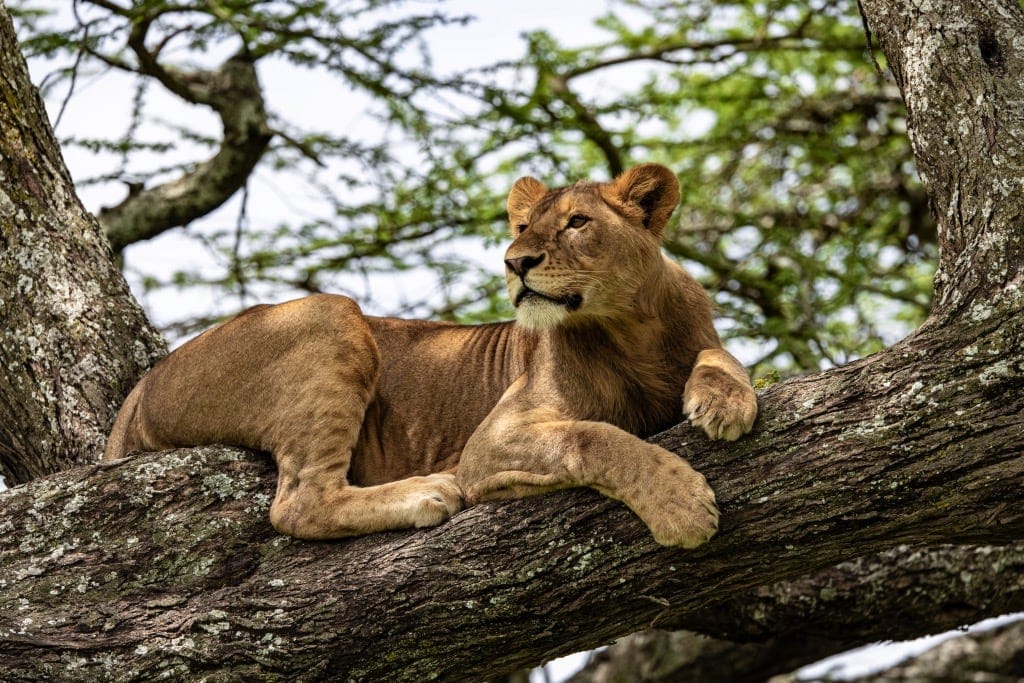
The 3-Day Ishasha Tree-Climbing Lions Safari is a specialized expedition into the remote southern wilderness of Queen Elizabeth National Park. While most safaris focus on the northern plains, this journey prioritizes the rugged Ishasha Sector, a landscape of expansive savannahs and ancient sycamore fig trees that host a rare biological marvel. Here, majestic lions spend their afternoons lounging high in the branches, a unique behavior found in only a few locations across Africa. This itinerary offers an intimate look at these iconic predators against the backdrop of the Albertine Rift Valley, where the scenery is wilder and the tourist crowds are thinner. Beyond the legendary tree-climbing prides, you will encounter massive herds of elephants, topis, and the elusive giant forest hog. Combining the thrill of predator tracking with the serenity of one of Uganda’s most secluded wildlife corridors, this safari provides a high-impact, authentic connection to the raw rhythms of the African bush.
Day 1: Journey to the Southern Wilderness
Your adventure begins with an early morning departure from Kampala, heading west toward the dramatic landscapes of the Albertine Rift. After a traditional lunch in Mbarara and a stop at the Equator for the classic geographic photo opportunity, you bypass the busier northern sectors and head directly for the Ishasha Sector. As you enter this remote region in the late afternoon, the scenery shifts to vast, open grasslands dotted with sprawling sycamore fig and acacia trees. Enjoy an introductory game drive where you may spot your first herds of buffaloes and the elegant topi, an antelope species predominantly found in this sector. You’ll check into your secluded lodge or safari camp, enjoying a sundowner overlooking the Ntungwe River while listening to the distant roars of lions beginning their nocturnal patrol under a canopy of stars.
Day 2: Tracking the Legendary Tree-Climbing Lions
Today is dedicated to uncovering the mysteries of Ishasha’s famous residents. At dawn, you’ll head into the park for a comprehensive game drive, specifically targeting the "home trees" where the tree-climbing lions are most frequently spotted. Watching a 400-pound predator draped over a sturdy branch like a housecat is a breathtaking sight, thought to be a strategy to escape the heat and ground-dwelling insects. In the afternoon, the exploration continues along the Edward Flats, a region bordering the Democratic Republic of Congo. Here, you’ll witness massive elephant herds traversing the plains and observe diverse birdlife, including the martial eagle. The lack of vehicle traffic in this sector ensures an exclusive, high-density wildlife experience, allowing you to photograph these unique prides and the surrounding wilderness in total tranquility before returning to your camp for dinner.
Day 3: Final Savanna Patrol and Return Journey
On your final morning, enjoy a final sunrise game drive to catch the predators before they retreat into the deep shade of the figs. This is an excellent opportunity to spot the elusive leopard or a hyena returning from a night of hunting. After a hearty bush breakfast, you begin the return journey toward Kampala or Entebbe. The drive winds back through the emerald tea estates of Bushenyi and the rolling hills of the Ankole region, offering a beautiful cultural transition from the wild savanna to the vibrant highlands. A final stop for local crafts at the Mpambire drum makers provides a cultural touchpoint before you arrive back in the capital by early evening. You leave with a full camera roll and the profound satisfaction of having witnessed one of nature’s most unique and captivating wildlife phenomena.
Where can I see tree-climbing lions in Uganda?
The primary and most famous location to witness this rare behavior is the Ishasha Sector, which forms the southern wing of Queen Elizabeth National Park. Unlike the northern Kasenyi Plains, which are characterized by open savanna, Ishasha is defined by sprawling riverine woodlands and ancient sycamore fig trees. While lions are occasionally seen in trees in other parts of Africa (such as Lake Manyara in Tanzania), Ishasha is globally recognized for the consistency and frequency of this behavior. The sector’s unique topography and the specific structure of its trees provide the perfect "natural lounges" for these predators, making it the most reliable spot in the world for travelers to capture the iconic image of a lion draped over a massive branch.
Why do lions climb trees in Ishasha?
Naturalists and biologists have proposed two primary theories for this peculiar behavioral adaptation. The first is climate control and relief from insects; the ground in Ishasha is often swarming with tsetse flies and other biting insects, and by ascending 10 to 15 feet into the branches, the lions catch the cooling breezes that sweep across the Rift Valley, effectively escaping the heat and the bugs. The second theory is tactical surveillance; the elevated position allows the prides to scan the tall savanna grasses for prey like Uganda Kob and Topi, while also keeping an eye out for potential threats like hyenas or rival prides. Over generations, this has become a learned behavior passed down from lionesses to their cubs.
What is the best time for an Ishasha lion safari?
The peak windows are the dry seasons, specifically June to September and December to February. During these months, the tracks are dry and easy to navigate, but more importantly, the lack of rain forces the lions to seek the deepest shade available, which is found in the dense canopies of the fig trees. In the rainy seasons, the trees can become slippery and the long grass makes them harder to spot from a distance. However, even in the "green" months, the lions still climb; you just need a more experienced guide to track the specific prides that are known to frequent certain "home trees" regardless of the weather.
Can I see tree-climbing lions in 3 days?
A 3-day itinerary is perfectly sufficient to explore Ishasha, provided the trip is structured correctly. Many travelers make the mistake of spending too much time in the northern sector and only doing a "drive-through" of Ishasha. To truly experience it, you should dedicate at least two full game drives to the southern sector. A typical 3-day plan might involve arriving in Ishasha on the afternoon of Day 1, spending all of Day 2 patrolling the fig trees and the Edward Flats, and a final sunrise drive on Day 3. This timeline accounts for the lions' behavior, as they usually climb the trees in the late morning (around 10:00 AM) and stay up until the cool of the late afternoon.
What other wildlife is in Ishasha, Queen Elizabeth?
While the lions are the headline act, Ishasha is home to a robust and diverse ecosystem. It is the best place in the park to see the Topi, a fast and elegant antelope with distinctive purple patches on its legs. You will also encounter massive herds of African elephants migrating between Uganda and the Democratic Republic of Congo. The sector is also a stronghold for the Cape buffalo and the elusive leopard, which is often even better camouflaged in the trees than the lions. For birders, the riverine forests along the Ntungwe River are home to the rare Shoebill stork (on lucky days) and the majestic Martial Eagle.
Are the climbing lions safe to view?
Safety is paramount in Queen Elizabeth National Park. Visitors view the lions from the safety of a customized 4x4 safari vehicle. The lions in Ishasha are habituated to the presence of vehicles and generally ignore them, treating the trucks as part of the landscape. However, it is an unfenced wilderness, and strict park rules apply: you are never permitted to leave the vehicle during a game drive, and your driver must maintain a respectful distance to avoid stressing the animals. UWA rangers frequently patrol the area to ensure that both the wildlife and the tourists are adhering to safety protocols, ensuring a secure and ethical viewing experience.
What kind of trees do lions climb in Ishasha?
The lions have a very specific preference for Sycamore Fig trees (Ficus sycomorus) and occasionally Acacia trees. The Sycamore Fig is ideal because it features low-slung, horizontal branches that are broad enough to support the weight of a 400-pound adult lion. These trees also provide a dense canopy of large, waxy leaves that offer total protection from the equatorial sun. During a game drive, your guide will specifically scan the "umbrella" shapes of these figs. Interestingly, certain prides have "favorite" trees that they return to day after day, some of which have become legendary among local guides for their high success rate of sightings.
How far is Ishasha from Kampala?
The drive from Kampala to Ishasha is approximately 8 to 9 hours, covering a distance of about 450 kilometers. Because of this distance, it is rarely done in a single straight shot. Most 3-day safaris include a stopover or start the tour from the northern sector of Queen Elizabeth (which is 2 hours closer) before moving south. Alternatively, many travelers now choose to fly from Entebbe to the Kihihi Airstrip, which is only a 45-minute drive from the Ishasha gate. If you are driving, the route through Mbarara and Bushenyi is incredibly scenic, taking you through tea estates and over the Kichwamba Escarpment.
Are tree-climbing lions only in Uganda?
While Ishasha is the most famous location, tree-climbing behavior is not entirely exclusive to Uganda. It has been documented in Lake Manyara National Park in Tanzania and occasionally in the Kruger National Park in South Africa. However, what makes Ishasha unique is the regularity of the behavior. In most other parks, seeing a lion in a tree is a rare, lucky event; in Ishasha, it is a consistent lifestyle choice for the resident prides. This high population density of tree-climbing individuals makes Ishasha the global capital for this specific wildlife phenomenon, drawing photographers and researchers from around the world.
What accommodation is available in Ishasha?
The Ishasha sector offers some of the most intimate and "wild" lodging experiences in Uganda. Ishasha Wilderness Camp is the premier luxury option, situated directly on the banks of the Ntungwe River where elephants often come to drink. For a mid-range experience, Ishasha Jungle Lodge or Enjojo Lodge provide excellent comfort with a focus on eco-tourism and local materials. For budget travelers, there are community-run campsites and basic cottages near the park gate. Staying inside or very close to the sector is vital, as it allows you to be on the tracks at sunrise without a long commute from the northern part of the park.
Do I need a 4x4 for this safari? A 4x4 safari vehicle is non-negotiable for Ishasha.
The tracks in the southern sector are much more rugged and less maintained than those in the north. During the rainy season, the black cotton soil can become extremely sticky, and even in the dry season, the sandy patches and river crossings require high ground clearance and four-wheel drive. Most importantly, a specialized safari vehicle comes with a pop-up roof, which is essential for looking up into the trees to spot the lions. Without the elevated view provided by a pop-up roof, you might miss a lion lounging just a few meters above your head.
What to bring for a 3-day Ishasha trip?
Success in Ishasha depends on your gear. High-quality binoculars (8x42) are essential for spotting a tail or a paw hanging down from a thick fig canopy. A camera with a long telephoto lens (at least 300mm–600mm) is necessary to get clear shots of the lions without disturbing them. Because Ishasha is lower in altitude than Kampala, it can be quite hot, so pack lightweight, breathable clothing in neutral tones. Don't forget a wide-brimmed hat, high-SPF sunscreen, and plenty of insect repellent for the evening. Lastly, bring a power bank, as some of the more remote lodges rely on solar power which can be limited at night.
Are there many prides in Ishasha?
There are currently three to four main prides that patrol the Ishasha sector. These prides are territorial and tend to stick to specific areas, such as the "Southern Circuit" or the "Northern Circuit" of Ishasha. Each pride can consist of anywhere from 3 to 15 individuals. It is common to see multiple lions—sometimes an entire family—sharing the same large fig tree. The males in Ishasha are particularly striking, often sporting thick, dark manes. Because the sector is relatively small compared to the vast Serengeti, the density of these prides means your chances of an encounter are statistically very high during a 3-day stay.
Why are Ishasha lions unique?
Beyond their climbing habits, the Ishasha lions are part of a unique cultural heritage in Ugandan conservation. They represent a specialized adaptation to a very specific environment. Their fame has helped protect the southern corridor of the park, which is a vital migratory route for elephants. To the local communities and international visitors alike, they are a symbol of the "Pearl of Africa's" ability to surprise and enchant. Their global fame ensures that Ishasha remains a high-priority conservation area, protecting not just the lions, but the entire ecosystem of the Edward Flats and the surrounding riverine forests.
Can I combine Ishasha with a boat safari?
Yes, this is the most common way to experience Queen Elizabeth National Park. A typical 3-day combined tour involves starting in the north on Day 1 for a Kazinga Channel boat cruise, which offers the best hippo and bird viewing. On Day 2, you would do a morning game drive in the Kasenyi Plains before transferring south (a 2-hour drive) to Ishasha. You then spend the afternoon of Day 2 and the morning of Day 3 focusing exclusively on the tree-climbing lions. This "North-to-South" loop ensures you see the best of both worlds: the high-density water wildlife of the north and the exclusive predator action of the south.
Booking 3 Days ishasha with us Roads of Adventure safaris
To book a 3-Day Ishasha Safari with Roads of Adventure Safaris, you can contact them directly through their official website or use their online enquiry form. This tour specifically targets the rare tree-climbing lions of the Ishasha sector in Queen Elizabeth National Park
