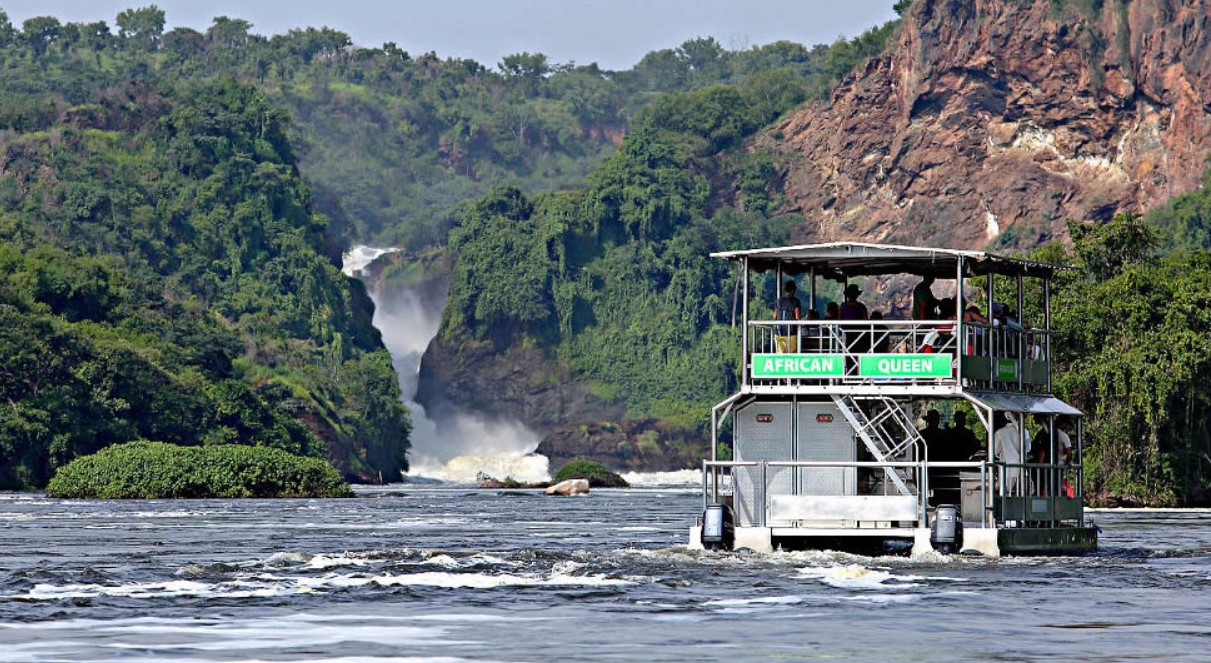
Murchison Falls National Park offers premier wildlife viewing in Uganda, featuring the world’s most powerful waterfall, Big Five game drives, and Nile boat cruises to see hippos, crocodiles, and rare shoebill storks. Key highlights include viewing Rothschild giraffes, lions, and elephants in the savanna, along with chimpanzee tracking in Budongo Forest.
Popular Uganda safari tour packages to Murchison falls national park
3-days-murchison-falls-national-park-best-uganda-safari-road-trip
3-days-best-honeymoon-uganda-safari-escape-to-murchison-falls-national-park
5-day-best-safaris-to-uganda-kidepo-and-murchison-falls-national-parks
5-days-kidepo-valley-uganda-safari-via-ziwa-rhino-sanctuary
6-days-best-of-murchison-and-kidepo-uganda-safari-via-ziwa
7-days-murchison-falls-uganda-safari-trip-via-ziwa-rhinos-kidepo-valley-and-jinja
7-days-uganda-tour-to-murchison-falls-via-ziwa-kibale-and-queen-elizabeth-national-park
9-days-africa-big-five-safari-in-uganda-safari-parks-and-gorilla-trekking
Murchison Falls & Top of the Falls
The centerpiece of any Uganda wildlife safari is the legendary Murchison Falls, where the world's longest river, the Victoria Nile, undergoes a dramatic transformation. At this point, the expansive river is compressed into a narrow, seven-meter rocky cleft, forcing the water to plunge 43 meters down into the "Devil's Cauldron." The sheer hydraulic force creates a thunderous roar and a permanent mist that supports a lush micro-ecosystem along the cliff faces. For travelers, there are two primary ways to experience this power. A boat trip to the base of the falls allows you to feel the spray and witness the white water from below, while a hike to the "Top of the Falls" provides a panoramic vantage point. From the summit, you can stand just feet away from the surging torrent, watching as the river explodes through the gorge, often creating vibrant rainbows in the midday sun. It is a sensory experience that defines the raw, untamed beauty of the Ugandan landscape.
Boat Cruise to the Delta
A boat cruise toward the Nile Delta is a tranquil yet essential component of a Uganda wildlife safari. As the Nile flows toward Lake Albert, it slows down and fans out into a network of papyrus-fringed channels and islands. This area is a magnet for biodiversity. While gliding along the river, visitors are treated to constant sightings of massive pods of hippos and some of the largest Nile crocodiles in Africa basking on the muddy banks. Elephants and buffaloes frequently descend to the water's edge to drink and bathe, offering incredible "water-level" photography opportunities. For birding enthusiasts, the Delta is one of the best places in the world to spot the prehistoric Shoebill stork. The calm pace of the boat allows for a detailed observation of the riverine flora and fauna, making it a peaceful contrast to the high-energy game drives on the savannah plains.
Game Drives (Buligi Peninsula)
The Buligi Peninsula, situated between the Victoria Nile and the Albert Nile, is the crown jewel for terrestrial sightings during a Uganda wildlife safari. This golden savannah landscape is home to a staggering concentration of mammals. Early morning or late afternoon game drives here offer the highest probability of spotting the "Big Four," including lions and the elusive leopard. The peninsula is also famous for its large herds of Rothschild’s giraffes—Uganda holds a significant portion of the global population of this endangered subspecies. As you traverse the tracks, you will encounter vast numbers of Cape buffaloes, Jackson’s hartebeest, and the elegant Uganda kob. The open plains, dotted with iconic Borassus palm trees, provide a quintessential African backdrop for viewing massive elephant bulls and family herds moving across the horizon. The visibility in Buligi is exceptional, ensuring that every drive feels like a journey through a living wildlife documentary.
Chimpanzee Tracking (Budongo Forest)
Located just south of the main savannah plains, the Budongo Forest offers a cooling, emerald-green contrast to the park's grasslands and is a vital stop on a Uganda wildlife safari. This ancient mahogany forest is home to over 500 chimpanzees, our closest biological relatives. Guided forest walks led by expert rangers allow visitors to track these highly intelligent primates through the undergrowth. Unlike the open plains, the forest is a world of shadows and complex sounds. When you locate a habituated community, you can observe their intricate social lives—watching them groom, play, and communicate with deafening "pant-hoots" that echo through the canopy. Beyond the chimpanzees, Budongo is a haven for other primates, including Black-and-White Colobus and Blue monkeys, as well as rare forest birds. It provides a profound, intimate wildlife encounter that emphasizes the incredible ecological diversity found within the Murchison Falls Conservation Area.
Hot Air Balloon Safaris
For those seeking a truly unique perspective on a Uganda wildlife safari, a hot air balloon flight offers an unparalleled bird’s-eye view of the park. Rising at dawn, the balloon drifts silently over the Buligi Peninsula and the Nile River as the sun begins to illuminate the savannah. From the air, the scale of the landscape becomes apparent—you can see the winding path of the Nile, the shimmering expanse of Lake Albert, and the vast herds of elephants and buffaloes moving below without the sound of an engine to disturb them. This romantic and peaceful experience allows for "aerial tracking" of predators returning from their night hunts and provides a sense of the sheer vastness of the African wilderness. The flight typically concludes with a celebratory "bush breakfast" in the middle of the savannah, complete with champagne, making it one of the most memorable and exclusive ways to appreciate the scenic grandeur of Murchison Falls.
Bird Watching
With a checklist of over 451 recorded species, Murchison Falls is a premier destination for any birding-focused Uganda wildlife safari. The park’s diverse habitats—ranging from riverine forests and papyrus swamps to open grasslands—ensure a high variety of sightings. The most sought-after prize is the Shoebill stork, often found in the Nile Delta. However, the riverbanks are also alive with the vibrant colors of the Malachite Kingfisher and the Red-throated Bee-eater. Along the water, you will frequently hear the iconic call of the African Fish Eagle and spot the unique African Skimmer as it "ploughs" the surface for fish. In the grasslands, the Secretary Bird and Abyssinian Ground Hornbill are common sights, while the forests host various species of turacos and sunbirds. Whether you are an expert ornithologist or a casual observer, the sheer volume and variety of avian life in Murchison provide a constant, colorful soundtrack to your safari adventure.
Ziwa Rhino Sanctuary
While not technically within the park, the Ziwa Rhino Sanctuary is a crucial "strategic stop" during a Uganda wildlife safari to Murchison Falls. Located in Nakasongola, this sanctuary is the only place in Uganda where you can see southern white rhinos in the wild. The experience is unique because it involves a guided "walking safari." Accompanied by expert rangers, you track these two-ton giants on foot, often getting within 30 meters of them as they graze. This intimate encounter is not only thrilling but also highly educational, as rangers explain the ongoing efforts to reintroduce rhinos to Uganda’s national parks after they were poached to extinction in the 1980s. Including Ziwa in your itinerary allows you to "complete" the "Big Five" experience—lions, leopards, elephants, buffaloes, and rhinos—while directly supporting one of the most successful conservation stories in the Pearl of Africa.
What is the most spectacular natural feature to see in Murchison Falls National Park?
The most spectacular natural feature in the park is undoubtedly Murchison Falls itself, a geological wonder where the Nile River undergoes a violent and dramatic transformation. As the river flows toward Lake Albert, its massive volume is suddenly funneled into a narrow, rocky cleft only six to seven meters wide. This compression forces the water to explode through the gap with a pressure of approximately 300 cubic meters per second, creating a thunderous roar that can be felt through the ground long before the falls are visible.
The water plunges 43 meters down into what is known as the "Devil's Cauldron," creating a massive plume of spray and a permanent rainbow that arches over the gorge. This site is significant not just for its beauty, but for its raw power; it is arguably the most powerful surge of water found anywhere on the planet. Visitors can experience this from multiple angles: by hiking to the "Top of the Falls" to stand on the edge of the vibrating cliffs, or by taking a boat to the base of the falls to see the white water churning from below. This feature is the beating heart of the park and serves as the primary landmark for any Uganda wildlife safari, representing the untamed energy of the Nile.
Which wildlife species are most commonly spotted during a morning game drive in the park?
A morning game drive on the northern banks of the Nile is the highlight of a Uganda wildlife safari, as this is when the predators are most active and the grazers are out in full force. The most iconic species frequently spotted is the Rothschild’s giraffe; Murchison Falls is home to the largest population of this endangered subspecies in the world. Their towering silhouettes against the Borassus palm-dotted savannah are a signature sight of the park.
Predators like lions are often found lounging in the golden grass or perched on thickets after a night of hunting. While leopards are more elusive, they are occasionally seen draped over the branches of acacia trees. The plains are also thick with massive herds of Cape buffaloes and African elephants, often seen moving in family groups toward the river. Among the smaller mammals, the Uganda kob is ubiquitous, with males frequently seen guarding their leks. You are also likely to spot Jackson’s hartebeest, Oribi, and the Defassa waterbuck. The sheer density of these animals in the early morning light creates a classic African safari atmosphere that is hard to match anywhere else in East Africa.
What is unique about the boat cruise experience to the base of the Murchison Falls?
The boat cruise to the base of the falls is a unique "river safari" that offers a perspective entirely different from a traditional land-based game drive. As the vessel moves upstream from the Paraa jetty, it acts as a floating observation deck, allowing guests to get remarkably close to the wildlife lining the banks. This journey is famous for its massive schools of hippos, which can be seen wallowing in the shallows or yawning to display their impressive tusks.
Equally impressive are the Nile crocodiles, some of the largest on the continent, which bask on the muddy shores with their mouths agape to regulate their body temperature. The uniqueness of this experience lies in the combination of these "water giants" and the approaching grandeur of the falls. As the boat nears the "Devil's Cauldron," the water becomes increasingly turbulent and white, and the air cools from the heavy mist. This is also a prime opportunity to spot elephants and buffaloes coming down to the river to drink and bathe. For birders, the riverbanks are a kaleidoscope of color, featuring Kingfishers, Fish Eagles, and the rare African Skimmer, making the boat cruise a multi-sensory highlight of a Uganda wildlife safari.
Are there opportunities to track chimpanzees while visiting Murchison Falls National Park in Uganda?
Yes, Murchison Falls offers world-class chimpanzee tracking opportunities, primarily within the Kaniyo Pabidi sector of the Budongo Forest Reserve. Located in the southern part of the park, this pristine forest of ancient mahogany and ironwood trees provides a lush contrast to the open savannah. Budongo is home to approximately 600 to 800 chimpanzees, with several communities successfully habituated for tourism.
Trekking here involves following expert rangers through the dense undergrowth, listening for the distinctive "pant-hoots" and screams that signal the location of a group. Once found, visitors spend an hour observing these intelligent primates as they groom, forage, and swing through the high canopy. Because Budongo is a research-focused site, the guides are exceptionally knowledgeable about the social dynamics and individual histories of the chimps. The experience is intimate and educational, often providing sightings of other primates such as Black-and-White Colobus and Blue monkeys. Tracking in Budongo is an excellent way to diversify a Uganda wildlife safari, allowing travelers to experience the "forest side" of Uganda’s biodiversity without traveling all the way to the southwestern parks.
Where is the best location in the park to spot the rare shoebill stork bird species?
The most reliable location to spot the prehistoric Shoebill stork in Murchison Falls is the Nile-Lake Albert Delta. This is the point where the Victoria Nile slows down and empties into Lake Albert, creating a vast expanse of papyrus-fringed wetlands and floating vegetation islands. This swampy ecosystem is the ideal hunting ground for the Shoebill, which stands motionless for hours as it waits for lungfish to surface.
To reach this area, visitors typically take a specialized delta boat cruise that heads downstream from Paraa. The delta is a tranquil environment, far removed from the more crowded parts of the river, offering a sense of isolation and discovery. While the Shoebill is a rare and elusive bird, sightings are particularly good during the dry season when water levels are lower, concentrating the birds in specific hunting spots. In addition to the Shoebill, the delta is a haven for other rare birds like the Saddle-billed Stork, Goliath Heron, and African Finfoot. For serious birders and photographers on a Uganda wildlife safari, the delta cruise is the most rewarding way to see this "living fossil" in its natural, undisturbed habitat.
What makes the Buligi Peninsula area a prime spot for game viewing in the park?
The Buligi Peninsula is the biological heart of Murchison Falls National Park. Located between the Victoria Nile and the Albert Nile, this triangle of land consists of open savannah, woodland, and riverine vegetation, creating a high-nutrient environment that supports a massive concentration of wildlife. The peninsula’s wide-open plains offer unobstructed panoramic views, making it significantly easier to spot animals from a distance compared to the more forested southern sectors.
The area is dominated by the iconic Borassus palm trees, which provide both food for elephants and a classic African backdrop for photography. Buligi is the primary territory for the park’s predators; lions are frequently seen on the "Queen’s Track," and leopards often hunt in the thickets near the Albert Nile. It is also the best place to witness the sheer scale of the park's elephant and buffalo populations. Because the peninsula is bounded by water on two sides, the wildlife is naturally concentrated within its tracks, ensuring that a single game drive can result in dozens of unique sightings. For any Uganda wildlife safari, the Buligi Peninsula represents the quintessential savannah experience, where the drama of the wild unfolds across a vast and beautiful stage.
Can visitors see all of the Big Five animals while on a safari in Murchison Falls?
On a Uganda wildlife safari specifically within Murchison Falls National Park, visitors can see four of the "Big Five": lions, leopards, elephants, and Cape buffaloes. The park has a high density of elephants and buffaloes, which are seen on almost every game drive. Lions are also frequently spotted on the northern banks, while leopards require a bit more patience and sharp eyes, usually found in the riverine thickets.
The fifth member, the rhino, is currently extinct within the park boundaries due to past poaching. However, the experience of seeing the "Big Five" is made possible by the Ziwa Rhino Sanctuary, which is located just south of the park on the road from Kampala. Most safari itineraries include a stop at Ziwa for a guided rhino trek on foot before proceeding to Murchison. By visiting both sites, travelers can "complete" the Big Five list in a single journey. This conservation strategy has been highly successful; while the rhinos are protected at Ziwa, the other four thrive in the vast wilderness of Murchison Falls, making the northern circuit the most comprehensive wildlife destination in the country.
How often can tourists see crocodiles and hippos along the banks of the Victoria Nile?
Seeing hippos and crocodiles along the Victoria Nile is not just possible; it is a near-certainty. The river supports one of the highest concentrations of these "water giants" in Africa. During a standard boat cruise to the base of the falls, you will encounter hundreds of hippos wallowing in the shallows. They are highly social animals, and you will often see them in large "schools," surfacing to snort water or engaging in territorial displays.
The Nile crocodiles are equally abundant, particularly on the sandy banks and muddy shores. Murchison is famous for having some of the largest crocodiles on the continent, with some individuals reaching lengths of over five meters. They are most commonly seen in the afternoon when they crawl out of the water to bask in the sun, holding their mouths open to stay cool. This behavior provides incredible close-up views for photographers. The predictability of these sightings is what makes the Nile boat cruise so popular; while land predators can be hit-or-miss, the "giants of the Nile" are always present, providing a constant and thrilling wildlife spectacle throughout the journey.
Is it possible to take a guided nature walk to see the smaller attractions in the park?
Yes, Murchison Falls offers excellent opportunities for guided nature walks, which allow visitors to slow down and appreciate the "smaller" wonders of the ecosystem that are often missed from a safari vehicle. The two primary locations for these walks are the Kaniyo Pabidi and Rabongo Forest sectors. These forests are home to ancient trees, vibrant butterflies, and a variety of primates.
During a nature walk, an expert ranger-guide will point out medicinal plants, track animal prints on the forest floor, and identify the calls of various forest birds. In addition to the "big" primates like chimpanzees, you are likely to see Black-and-White Colobus monkeys and the rare Blue monkey. There are also nature walks available along the banks of the Nile and around the Top of the Falls, where you can explore the unique flora that thrives in the permanent mist of the cascade. For those on a Uganda wildlife safari, a nature walk provides a more intimate connection with the environment, focusing on the intricate details of African botany and the smaller creatures that form the foundation of this vast wilderness.
What specific bird species can birdwatchers look for when visiting the Murchison Falls area?
With over 451 recorded bird species, Murchison Falls is a world-class birding destination. The variety of habitats—ranging from the fast-flowing Nile to the dry savannah and tropical forests—attracts a diverse avian population. The most iconic species is the Shoebill stork, usually found in the Nile Delta. However, the riverbanks are also famous for the African Fish Eagle, whose haunting call is the definitive sound of the African waterways.
Birders can also look for the Goliath Heron, the world's largest heron, and the uniquely beautiful African Skimmer, which can be seen "ploughing" the water’s surface for fish. In the savannah, you will encounter the Abyssinian Ground Hornbill, Secretary Birds, and various eagles. The park is also a haven for Kingfishers, with the Malachite, Pied, and Giant Kingfishers all commonly seen along the Nile. During the northern winter, the park hosts numerous Palearctic migrants, adding even more variety to the checklist. Whether you are on a boat cruise or a game drive, the constant presence of colorful and rare birds makes every moment of a Uganda wildlife safari an ornithological delight.
Is hiking to the top of the Murchison Falls worthwhile for tourists visiting the area?
Hiking to the top of Murchison Falls is widely considered a highlight of the park and is highly recommended for anyone who is physically able. The hike begins at a landing site near the base of the falls and follows a well-maintained trail up the ridge. The walk is not overly long (about 45 minutes) but it is moderately steep, providing several "lookout points" along the way that offer increasingly dramatic views of the river.
The experience of standing at the top is sensory overload. You can feel the vibration of the earth beneath your feet as the entire volume of the Nile crashes through the narrow gorge just meters away. The roar is deafening, and the spray creates a constant, cooling rain that is refreshing in the tropical heat. From the summit, you can look back down the Nile and see the boat you just left, looking like a tiny toy in the vast landscape. It is the best way to truly comprehend the sheer scale and power of the feature that gives the park its name, providing a sense of awe that is impossible to capture from a boat or a vehicle alone.
What kinds of primates can travelers expect to see apart from chimpanzees in the park?
While chimpanzees are the star primates of Murchison Falls, the park is home to several other fascinating monkey species that are frequently seen during a Uganda wildlife safari. In the forested areas of Budongo and Rabongo, visitors can easily spot the Black-and-White Colobus monkey, identifiable by its long, flowing white tail and "bearded" face. These monkeys are often seen performing spectacular leaps between the branches of mahogany trees.
Another common resident is the Blue monkey (which actually has a greyish-blue coat) and the Red-tailed monkey, known for its bright orange tail and white heart-shaped nose. In the more open areas and near the river, Olive baboons are ubiquitous, often seen in large troops grooming one another or foraging on the ground. You may also encounter the Vervet monkey, known for its blue scrotum and black face. The presence of these primates adds another layer of complexity to the park's wildlife, as they occupy different niches—from the forest canopy to the savannah floor—providing constant entertainment and photography opportunities throughout your journey.
What can visitors see regarding cultural experiences near the Murchison Falls National Park surroundings?
A Uganda wildlife safari is not just about animals; it is also an opportunity to connect with the local people who live alongside the park. The communities surrounding Murchison Falls are primarily Acholi and Alur, and many lodges work with community projects to offer authentic cultural exchanges. One of the most popular experiences is visiting a local village to see traditional Acholi dances. These high-energy performances, accompanied by rhythmic drumming and the "thumb piano" (adungu), are a celebration of their heritage and history.
Visitors can also engage in community-led conservation tours, where they learn about how local farmers are working to reduce human-wildlife conflict. You might visit a local school, a traditional homestead, or a marketplace to see how crafts are made. These interactions provide context to the conservation efforts in the park, showing how tourism revenue supports local livelihoods. Participating in a cultural visit adds a human dimension to your safari, offering a deeper understanding of the "Pearl of Africa" and the resilient, welcoming people who call this remarkable landscape home.
Where is the best spot to witness the stunning sunset over the Nile River within the park?
The most iconic spot to witness a sunset in Murchison Falls is the banks of the Nile near Paraa. Because Paraa is the central hub where the northern and southern banks meet, the river is wide and calm here, creating a perfect mirror for the sky. As the sun begins to dip toward the horizon, the sky turns into a canvas of deep oranges, purples, and fiery reds, silhouetteing the Borassus palms and the occasional hippo surfaced in the water.
Many visitors choose to take a "Sundowner" boat cruise, where you can enjoy a drink on the water while the sun sets behind the distant Blue Mountains of the Congo across Lake Albert. Alternatively, many lodges positioned on the southern ridge offer elevated "panorama views" that look out across the entire river valley. There is a profound stillness that settles over the park at dusk, punctuated only by the distant roar of the falls and the evening calls of the birds. It is the perfect way to end a day of game viewing, reflecting on the beauty of the Uganda wildlife safari as the African night begins.
Booking Uganda wildlife safari to Murchison falls park with us Roads of Adventure safaris
Book a 3-day or longer Murchison Falls National Park wildlife safari with Roads of Adventure Safaris to experience premier game drives, boat cruises, and top-of-the-falls viewing. Packages include tailored, all-inclusive itineraries, with expert local guides for hassle-free transport and lodging. Contact directly for personalized itineraries.
