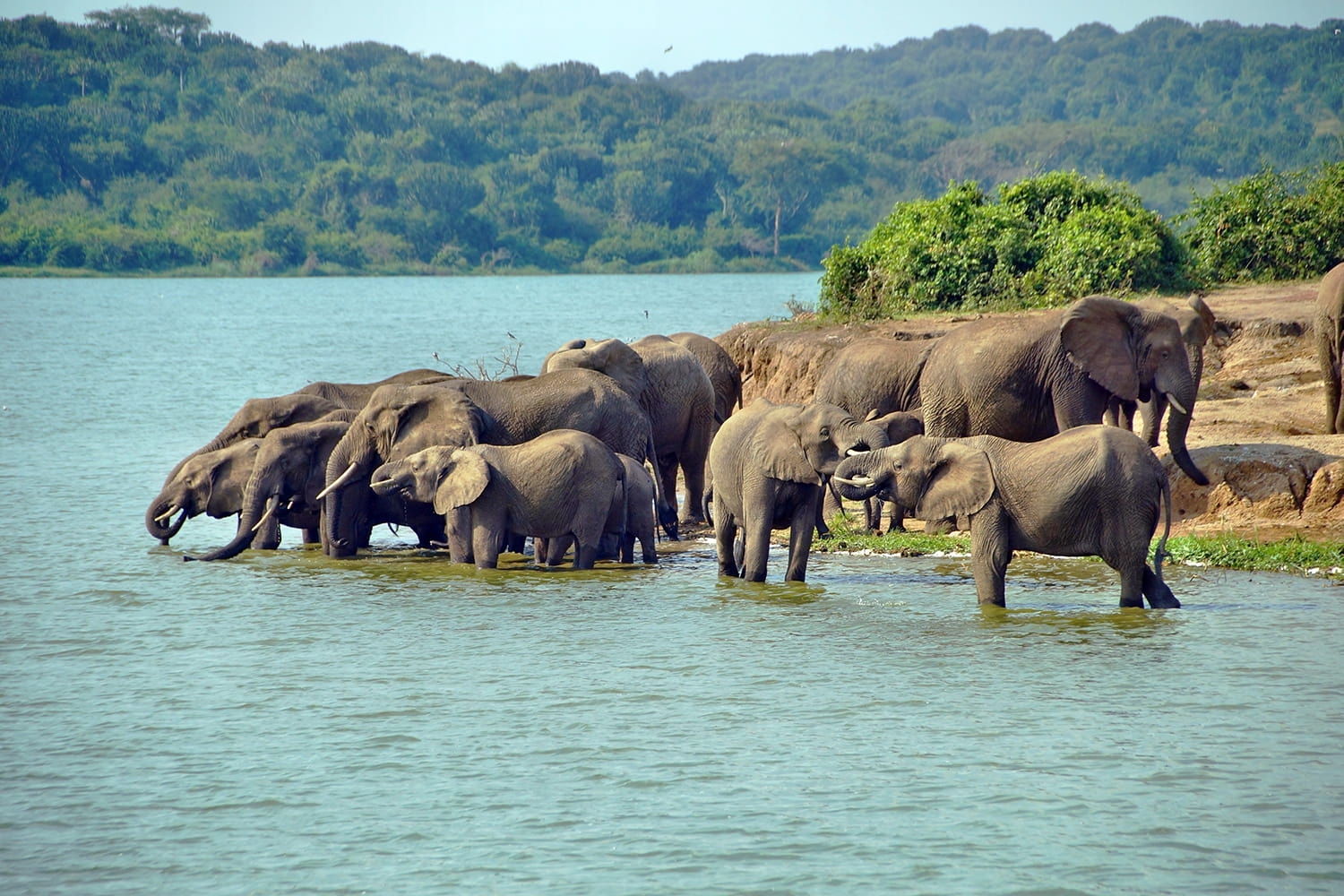
Queen Elizabeth National Park in western Uganda is most famous for its tree-climbing lions, massive boat safaris along the Kazinga Channel, and incredibly high biodiversity. It features over 600 bird species and diverse landscapes ranging from sweeping savannas to lush craters.
3-days-trips-to-queen-elizabeth-national-park-for-chimpanzee-tracking-in-kyambura-gorge
3-days-uganda-safari-itinerary-to-queen-elizabeth-national-park
3-days-budget-queen-elizabeth-park-uganda-wildlife-safari-holiday
3-days-fly-luxury-uganda-safari-to-queen-elizabeth-national-park
6-days-best-of-murchison-and-kidepo-uganda-safari-via-ziwa
6-days-safari-in-uganda-gorilla-trekking-and-chimpanzee-tracking
6-days-classic-uganda-rwanda-primate-and-wildlife-safari
6-days-uganda-primate-safari-and-wildlife-experience
6-days-budget-uganda-wildlife-safari-holiday-vacation
6-days-double-gorilla-trekking-uganda-and-rwanda-side
Tree-Climbing Lions: The Aerial Predators of Ishasha
Queen Elizabeth National Park holds a legendary status in global safari lore due to the unusual behavior of its apex predators in the remote, southern Ishasha sector. While lions (Panthera leo) are physically adapted for life on the ground, the prides of Ishasha are famous for scaling massive, low-forked sycamore fig trees and acacia branches. They climb up into the canopy by mid-morning, lazily draping their muscular limbs over the smooth bark to spend the hottest hours of the equatorial day suspended five to eight meters in the air.
Biologists point to a combination of environmental adaptations to explain this rare phenomenon. First, the elevated branches offer a cool, refreshing breeze that cuts through the stagnant heat of the valley floor. Second, climbing upwards allows the lions to escape the aggressive bites of tsetse flies and ground-dwelling insects that plague the high grasses. Finally, the trees serve as perfect, natural scouting towers, granting the predators an unobstructed view across the golden plains to monitor the movements of grazing herds of Uganda kob and topis. Watching a multi-generational pride—including heavy adult lionesses and playful cubs—sleeping soundly on limbs that seem far too narrow for their weight is an iconic, bucket-list visual that belongs exclusively to this specialized corner of Uganda.
Kazinga Channel: The Lifeline of the Park
The Kazinga Channel is a 40-kilometer-long natural waterway that slices smoothly through the heart of Queen Elizabeth National Park, linking the glittering waters of Lake Edward and Lake George. Operating a slow-moving boat safari along this fertile oasis is widely celebrated as one of the most high-density wildlife viewing experiences in all of East Africa. The channel acts as a permanent, reliable life support system, drawing an astonishing array of mammals and birds down to its mudbanks to drink, cool off, and socialize.
As the safari boat glides close to the shoreline, travelers are treated to front-row views of some of Africa’s largest continuous concentrations of hippos (Hippopotamus amphibius). Hundreds of these massive, grunting herbivores wallow together in tightly packed pods to protect their sensitive skin from the tropical sun. Alongside them, enormous Nile crocodiles bask open-mouthed on the sunny sandbars. The channel banks are constantly busy with activity; giant herds of Cape buffaloes wallow in the shallows, family herds of African elephants spray water over their backs, and waterbucks graze the fertile edges. The waterway is also an absolute dream for birdwatchers, providing sanctuary to elegant saddle-billed storks, pink-backed pelicans, and vibrant flocks of kingfishers that dive headfirst into the water.
Kasenyi Plains: The Golden Savannah Tracker
The Kasenyi Plains, occupying the vast northern sector of the park, represent the quintessential East African safari landscape. This sweeping expanse of golden, open savannah is punctuated by low acacia trees and scenic vistas of the Rwenzori Mountains rising dramatically along the distant horizon. Kasenyi is highly famous because it serves as the primary breeding ground for the Uganda kob (Kobus kob thomasi), a sleek, chestnut-colored antelope that gathers here by the thousands.
The presence of these massive, resident herbivore herds turns the Kasenyi Plains into a high-action theater for large predators. Pride of lions use the low contours of the landscape and the fringes of thickets to stalk their prey, making this the most reliable sector in the park for big cat sightings. Early morning game drives across the grassy loops routinely reveal leopards slinking through the tracks, spotted hyenas returning to their dens, and large herds of elephants moving in long, majestic lines across the plains. The open terrain and sharp visibility make Kasenyi an absolute favorite for wildlife photographers, who come to capture the dramatic, unscripted interactions between predators and prey against a beautiful, wide-open landscape.
Kyambura Gorge: The Sunken Rainforest Ecosystem
Kyambura Gorge is one of the most geologically dramatic and emotionally stirring features of Queen Elizabeth National Park. Popularly dubbed the "Valley of Apes," this remarkable feature is a deep, 100-meter fissure that tears violently through the flat, sun-baked savannah plains. When looking across the horizon, the gorge remains completely hidden until you reach the very edge, where the ground plunges down into a lush, dark green ribbon of dense, tropical riverine forest sustained by the fast-flowing Kyambura River.
Descending the steep wooden steps down into this sunken underworld feels like stepping onto a completely different planet. The hot, dry breeze of the savannah is instantly replaced by cool, humid air thick with the scent of wild ginger and damp earth. This isolated forest ecosystem protects a famous, highly unique community of habituated wild chimpanzees (Pan troglodytes). Walking through the dark canopy accompanied by expert rangers allows visitors to track these highly intelligent primates. Because the chimpanzees live within the strict confines of the gorge walls, their loud, rhythmic pant-hoots and the sound of them drumming on giant tree buttresses echo off the cliffs, creating an incredibly intense, atmospheric, and unforgettable tracking adventure.
Crater Lakes & Salt Mining: The Volcanic Legacy
The landscape of Queen Elizabeth National Park is deeply defined by its turbulent geological past, visible today in dozens of enormous, ancient volcanic explosion craters scattered across the northern hills. These spectacular craters, formed over thousands of years by violent volcanic activity, have transformed into dramatic, deep blue salt lakes and lush, forested bowls that give the park a highly unique, dramatic visual identity.
Among these, the Katwe Explosion Craters are internationally famous for blending geological beauty with rich cultural history. At the bottom of the Katwe crater sits a hyper-saline lake where local communities have harvested salt using traditional methods passed down through generations since the 16th century. The lake is divided into a geometric grid of shallow evaporation pans lined with mud and wood. Visitors can watch local miners navigate the highly corrosive waters to harvest rock salt by hand, providing a fascinating look at an ancient, climate-dependent industry. Nearby, other craters like the Bunyaruguru series offer scenic viewpoints where travelers can look out over dual crater lakes separated by a single thin ridge of earth, showcasing nature's incredible capacity for dramatic landscape design.
1. Why are the tree-climbing lions of the Ishasha sector globally famous?
The supreme fame of a Queen Elizabeth National Park safari often centers on the rare behavior of its apex predators in the remote southern Ishasha sector. While lions (Panthera leo) are physically built for ground hunting, the prides here are famous for scaling massive, low-forked sycamore fig and acacia trees. By mid-morning, adult lionesses and playful cubs can be seen lazily draping their heavy limbs over branches, sleeping five to eight meters in the air. Biologists note this is an environmental adaptation: the high canopy catches a cool breeze that cuts through the stagnant heat of the valley floor, elevates them above the swarms of biting tsetse flies in the grass, and provides a perfect vantage point to scout for grazing kobs.
2. What makes the Kazinga Channel boat safari a high-density wildlife highlight?
The 40-kilometer natural waterway of the Kazinga Channel, which slices through the park to link Lake Edward and Lake George, is famous for hosting one of the highest concentrations of hippos and crocodiles in Africa. Taking a launch cruise along this fertile oasis provides front-row views of a vibrant riverine ecosystem. Because the channel is a permanent water source, massive herds of Cape buffaloes wallow in the mud, family herds of elephants come down to bathe and drink, and waterbucks graze the edges. The banks are also a paradise for birdwatchers, teeming with pink-backed pelicans, saddle-billed storks, and kingfishers diving for fish right beside the boat.
3. How do the Kasenyi Plains serve as the premier theater for predator tracking?
The Kasenyi Plains in the northern sector of the park represent the quintessential East African safari landscape. This sweeping expanse of golden savannah, framed by the distant, snow-capped Rwenzori Mountains, is famous as the primary breeding ground for the Uganda kob (Kobus kob thomasi). Because thousands of these chestnut-colored antelopes are permanently resident here, the plains serve as a high-action hunting ground for large predators. Early morning game drives along the Kasenyi tracking loops offer the highest probability in the park for spotting prides of lions stalking prey, secretive leopards moving through the thickets, and spotted hyenas returning to their underground dens.
4. Why is Kyambura Gorge famously referred to as the "Valley of Apes"?
Kyambura Gorge is a geologically dramatic feature that tears a 100-meter-deep, 16-kilometer-long scar right through the flat, sun-baked savannah plains. It is famous because it conceals a completely hidden, lush tropical riverine forest underneath the dry landscape. Descending into this sunken green underworld introduces travelers to a highly unique ecosystem that protects a resident community of habituated wild chimpanzees (Pan troglodytes). Tracking these intelligent primates inside the gorge is a sensory experience; because they live within the steep confines of the rock walls, their loud pant-hoots and the rhythmic drumming on giant mahogany tree buttresses echo intensely off the cliffs.
5. What makes the Katwe Explosion Craters a unique geological and cultural phenomenon?
The northern hills of the park are dotted with dozens of enormous volcanic craters, which stand as evidence of the region's turbulent tectonic past. The Katwe Explosion Craters are the most famous of these, offering spectacular scenic lookouts over deep blue lakes and dramatic green basins. Culturally, Katwe is legendary for its ancient salt-mining industry. At the bottom of the crater sits a hyper-saline lake where local communities have harvested rock salt by hand using traditional, sun-dependent evaporation pans since the 16th century. This provides a fascinating historical window into a pre-colonial African industry that thrives to this day.
6. How does the park's location along the Equator shape its climate and safari appeal?
Queen Elizabeth National Park is famously bisected by the Equator, and a popular stop for travelers is the iconic circular monuments marking the $0^\circ$ latitude line near the Kikorongo area. This equatorial positioning gives the park a remarkably stable, warm climate year-round, making it a reliable safari destination at any time. The geographic intersection of the hot Rift Valley floor with the cool, moist winds blowing down from the nearby Rwenzori Mountains creates a unique micro-climate. This blends misty mornings with bright afternoon sun, painting the landscapes in rich, high-contrast colors that make for exceptional wildlife photography conditions.
7. What role does the Maramagambo Forest play in the park's biodiversity fame?
Spreading across the base of the Kichwamba Escarpment on the park’s southern boundaries, Maramagambo Forest is famous as one of the largest remaining blocks of natural, medium-altitude moist semi-deciduous forest in Uganda. It offers a cool, shaded canopy contrast to the open Kasenyi plains. Maramagambo is legendary for its massive bat caves, where millions of Egyptian fruit bats roost along the dark volcanic rock ceilings. These caves feature a unique ecological relationship, as massive rock pythons live along the cave floors, preying directly on the bats. The forest is also rich in primates, harboring chimpanzees, L'Hoest's monkeys, and nocturnal bushbabies.
8. Why is the park recognized internationally as a world-class birding destination?
For ornithologists, Queen Elizabeth National Park is internationally famous for harboring one of the most diverse avian checklists on the African continent, boasting over 600 recorded bird species. This incredible diversity is due to the park’s kaleidoscope of habitats, which transition from open savannahs and humid rainforests to freshwater lakes and hyper-saline craters. Birders flock here to check off iconic species such as the martial eagle, the elegant grey crowned crane (Uganda’s national symbol), African skimmers cutting through the Kazinga Channel waters, papyrus gonoleks hiding in the swamps, and flocks of lesser flamingos that seasonally tint the crater lakes pink.
9. How do the views of the Rwenzori Mountains elevate the scenic safari experience?
While wildlife is the primary draw, Queen Elizabeth National Park is scenically famous for its dramatic geographical backdrop. The park sits in the trough of the Western Rift Valley, and along its northern horizon, the Rwenzori Mountains—popularly known as the "Mountains of the Moon"—rise sharply to altitudes exceeding 5,000 meters. On clear days, the sight of jagged, snow-capped glacial peaks towering directly over golden savannahs filled with roaming elephants and buffalos creates a breathtaking visual contrast. This dramatic intersection of alpine glaciers and equatorial plains gives the park a uniquely grand, cinematic scale.
10. What makes the park's elephant population key to its conservation history?
The African elephant (Loxodonta africana) population of Queen Elizabeth National Park is conservationally famous for its resilience and unique genetic characteristics. The park serves as a vital ecological corridor where savannah elephants from East Africa encounter and interbreed with smaller forest elephants (Loxodonta cyclotis) migrating out of the dense jungles of the neighboring Democratic Republic of Congo. This creates a fascinating population of elephants exhibiting mixed physical traits, such as straighter tusks and smaller body sizes. Furthermore, their numbers have rebounded spectacularly from the heavy poaching crises of the 1970s, making them a proud symbol of modern Ugandan wildlife protection.
11. What unique antelope species can be tracked across the park's diverse sectors?
Beyond the famous big cats, a safari here is celebrated for the sheer variety of its specialized antelope species, which have adapted to the park's distinct biomes. The Kasenyi plains are completely dominated by the elegant, leaping Uganda kob, while the marshy fringes of the Kazinga Channel protect the semi-aquatic sitatunga antelope, famous for its splayed hooves that allow it to walk on floating vegetation. In the southern Ishasha sector, safari-goers can track massive herds of topis, an antelope distinguished by its dark, shimmering purple-brown coat and incredible running speed, alongside sleek defassa waterbucks and bushbucks.
12. How does the park's border with Lake Edward enhance its fishing village history?
Queen Elizabeth National Park is unique because its boundaries surround several historic, enclave fishing villages, such as Hamukungu, Kasenyi, and Katwe. These communities have lived along the shores of Lake Edward and Lake George for centuries, predating the formal gazetting of the park in 1952. Safaris here are famous for blending wildlife viewings with authentic cultural insights, as travelers can watch local fishermen launch traditional wooden canoes into waters shared with pods of hippos. This close proximity highlights a delicate, fascinating balance of human-wildlife co-existence on the Rift Valley floor.
13. What makes leopard tracking in the park a specialized safari experience?
While leopards (Panthera pardus) are notorious across Africa for their elusive, solitary, and nocturnal habits, Queen Elizabeth National Park is famous for offering highly successful leopard tracking opportunities. The park's northern sectors are thick with large, horizontal-branched sausage trees (Kigelia africana) and thick euphorbia cactus stands, which serve as preferred daytime lounging beds for these spotted cats. Specialized experiential tourism permits allow a limited number of travelers to join research teams using radio telemetry collars to track secretive leopards through the bush, providing an educational look into predator behavior and territorial dynamics.
14. How does the park’s history with Queen Elizabeth II shape its international identity?
The park holds a prestigious place in Commonwealth travel history. Originally founded in 1952 as Kazinga National Park, it was renamed two years later to commemorate the historic visit of Great Britain's Queen Elizabeth II. The young monarch toured the pristine landscapes, took a boat cruise along the Kazinga Channel, and stayed at what is now the historic Mweya Safari Lodge. This royal endorsement instantly projected the park onto the international stage, transforming it into Uganda’s flagship conservation area and cementing a legacy of high-tier, luxury wilderness exploration that continues to draw global travelers today.
15. What is the difference in emotional "vibe" on a Queen Elizabeth Park safari?
The definitive fame of a safari in Queen Elizabeth National Park lies in its rich variety and dynamic, fast-paced energy. Unlike destinations that offer only one specialized activity, a safari here feels like multiple vacations rolled into one continuous journey. Within a 48-hour window, the emotional vibe shifts from the high-octane thrill of tracking lions on the golden plains to the cool, dark adventure of searching for chimpanzees in a sunken rainforest, concluding with a relaxing afternoon boat cruise amidst thousands of grunting hippos, making it Uganda’s ultimate all-in-one wilderness showcase.
Booking Queen Elizabeth safari with us Roads of Adventure safaris
Book your Queen Elizabeth National Park safari with Roads of Adventure Safaris by reaching out directly to their Kampala-based team. They offer customizable 2, 3, and 4-day itineraries (including fly-in and road trip options) covering game drives in the Kasenyi Plains and Kazinga Channel boat cruises
