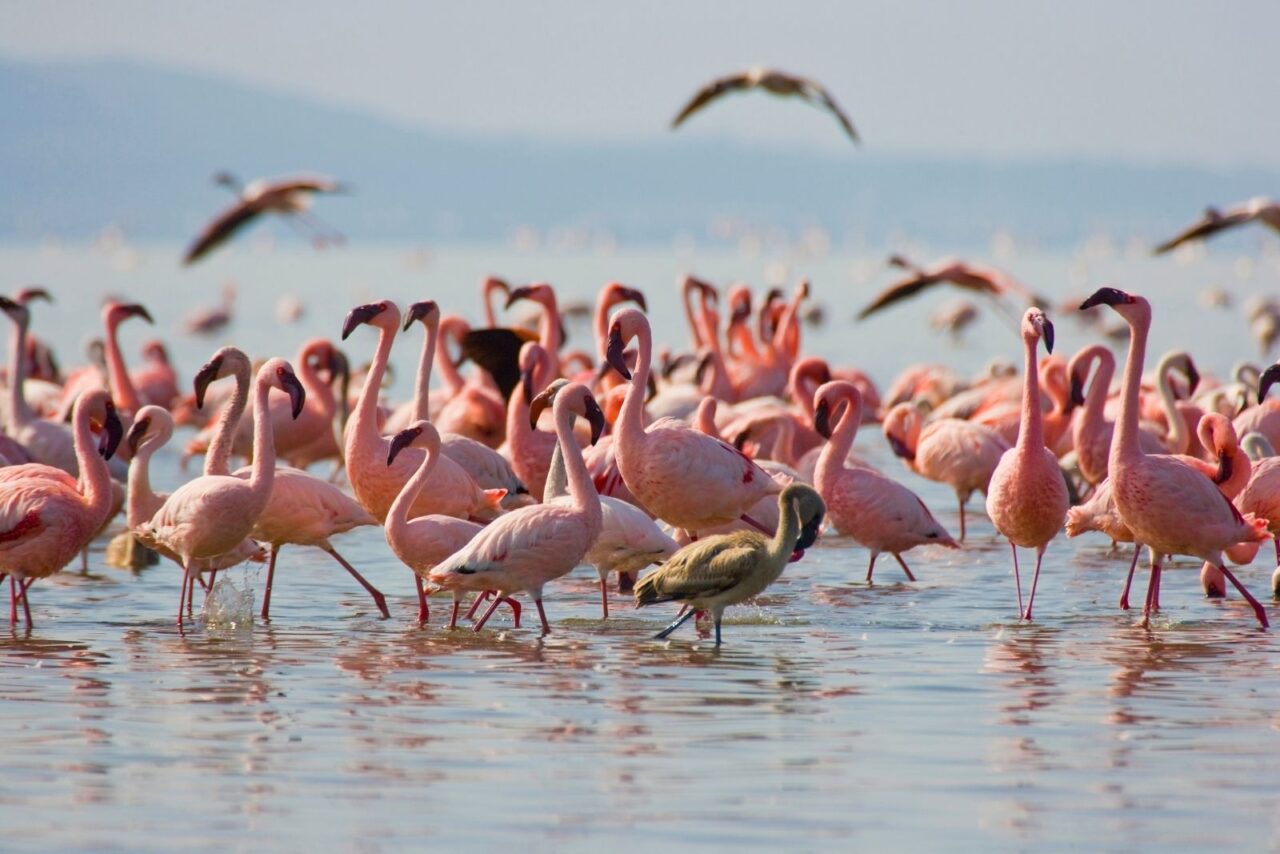
Spotting pink flamingos at Lake Nakuru is highly likely, though numbers fluctuate, making sightings of large flocks a variable rather than a guarantee in 2026. While traditionally a "must-visit" for millions of lesser flamingos, changing water levels sometimes cause them to move to nearby lakes like Bogoria or Elementaita
29-days-kenya-birding-safari-extravaganza
2-days-lake-nakuru-national-park-and-lake-naivasha-combined-kenya-safari-tour
4-days-budget-masai-mara-safari-and-lake-nakuru-holiday-vacation
4-days-masai-mara-and-lake-nakuru-kenya-safari-tour-package
Key Information for Flamingo Spotting at Lake Nakuru on Kenya birding safari
1. Best Time to Visit (2026)
While flamingos are present in Kenya's Rift Valley lakes year-round, the "best" time to visit in 2026 to see massive congregations and the iconic "pink blanket" effect is heavily dependent on the dry seasons. The peak seasons are July to October and December to March. During these months, the weather is mostly dry and sunny, causing the water levels in the soda lakes to recede, which increases the alkalinity and stimulates the growth of algae—the primary food source for Lesser and Greater flamingos.
Visiting during these dry months offers the highest likelihood of seeing hundreds of thousands of birds feeding along the shores. Specifically, the post-short-rains period of January to February is often ideal, as the ecosystem rejuvenates, providing abundant food. Conversely, the wet seasons—typically April to June and October to November—bring higher rainfall, which raises the lake levels and dilutes the water's alkalinity, prompting the flamingos to move to more suitable, smaller, and saltier feeding spots. However, even in the wet season, the scenic beauty of the national parks makes it an enjoyable visit, though flamingo numbers may be lower.
2. Best Viewing Times
For the most spectacular and active viewing experience in 2026, planning your trip for early morning and late afternoon is essential. The best time of day is generally 06:00 AM – 09:00 AM, which allows visitors to see the birds feeding along the lakeshores when the light is perfect for photography. Arriving early is also a tactical advantage to avoid the crowds and potential eCitizen verification delays at the Lake Nakuru National Park gates.
Alternatively, the late afternoon from 4:00 PM – 6:30 PM is equally rewarding, as the cooling temperatures encourage the birds to socialize. During these golden hours, the low angle of the sun enhances the pink hues of the flamingos against the water and sky, creating breathtaking photographic opportunities. While mid-day is hotter, it still offers a chance to see large flocks taking flight and filling the sky with streaks of pink, according to Bongo Trips. Early morning visits also increase the chances of seeing them while other wildlife, such as rhinos, are nearby, as highlighted by Kenya Experience.
3. Visibility and Environmental Factors
The density of flamingo populations at Lake Nakuru in 2026 is highly volatile and directly impacted by environmental factors, particularly increased water levels from heavy rains, as noted by Africa Is a Country. A significant rise in water levels reduces the alkalinity of the soda lake, which disrupts the algae production and forces the flamingos to abandon the area in search of food.
As of early 2026, many of the Rift Valley lakes are experiencing increased water levels compared to previous years, often due to high rainfall and siltation, which makes the shoreline less accessible, according to Nature Kenya. This means the formerly dense, pink-fringed shores may be less frequent, with birds dispersing more than in previous decades. Researchers from Big3Africa advise that unexpected weather changes, such as early rains, can immediately trigger this migratory behavior, making it crucial to check on the most recent, up-to-date reports before planning a specific viewing trip.
4. Alternative Spots (When Numbers are Low)
If flamingo numbers are low at Lake Nakuru in 2026, alternative nearby locations often hold the key to seeing the birds. Lake Bogoria National Reserve is generally the best alternative and is often considered the "Flamingo Capital" in 2026 due to its ability to maintain its high alkalinity during dry spells, attracting millions of birds, as stated by Turkana Wildlife Safaris.
Another excellent option is Lake Elementaita, located less than 40 minutes from Lake Nakuru, which is known for a more serene experience within the Soysambu Conservancy. It has increasingly become a "Smart Money" spot for bird enthusiasts looking for a quiet, intimate viewing experience when Nakuru is crowded or, as hinted by Hilmuhks, if the birds have moved due to rising waters. For those near Nairobi, Lake Magadi is also a popular alternative during the dry season, as mentioned by Wildsprings.
1. Are there still flamingos at Lake Nakuru in 2026?
As of 2026, flamingos remain a cornerstone of the Kenya birding safari experience at Lake Nakuru, though the landscape has shifted significantly over the last decade. Historically, Lake Nakuru was the undisputed "pink heart" of the Rift Valley. Today, while you will almost certainly see flamingos, the "carpet of pink" is more dynamic. Environmental changes, specifically the rising water levels of the Rift Valley lakes, have altered the lake's chemistry. When the water level rises, the alkalinity drops, which can reduce the abundance of the flamingos' primary food source. However, Lake Nakuru’s management and its status as a protected sanctuary ensure it remains a critical habitat. In 2026, travelers can expect to see thousands of birds, though they may be clustered in specific pockets of the lake where the water remains shallow and saline enough to support feeding. It is no longer a static display but a moving, living ecosystem that rewards the patient birder.
2. What is the best time of year to see flamingos in Lake Nakuru?
Timing is everything for a successful Kenya birding safari. The dry season, spanning from July to October, is generally considered the peak window for flamingo viewing. During these months, evaporation exceeds rainfall, causing the lake’s water levels to recede. As the water becomes shallower, the concentration of cyanobacteria (blue-green algae) increases, creating a feast that draws flamingos in high concentrations. Additionally, the dry season makes the shoreline more accessible for safari vehicles, allowing for better vantage points. A secondary window occurs in January and February. While flamingos are nomadic and follow the food, these dry periods offer the most stability for travelers. Conversely, the "long rains" of April and May can cause the birds to disperse to other soda lakes like Bogoria or Natron, as the diluted water at Nakuru becomes less ideal for their specialized feeding habits.
3. Are there flamingos all year round?
Yes, flamingos are considered year-round residents of the Rift Valley, and Lake Nakuru almost always hosts a population of these iconic birds. However, the density of the population is what fluctuates. On a Kenya birding safari, you are never "guaranteed" a specific number because flamingos are highly nomadic. They do not migrate in the traditional sense (north to south) but rather move between the chain of alkaline lakes in East Africa based on local conditions. If Lake Nakuru has a healthy algae bloom, they stay; if the water becomes too deep or too fresh due to heavy rains, they fly—often at night—to a different lake. Because Lake Nakuru is a permanent water body and a protected National Park, there is almost always a "base" population present, making it a reliable stop on any birding itinerary regardless of the month.
4. What kind of flamingos are found here?
During a Kenya birding safari at Lake Nakuru, you will encounter two distinct species: the Lesser Flamingo (Phoeniconaias minor) and the Greater Flamingo (Phoenicopterus roseus). The Lesser Flamingo is the star of the show; it is smaller, possesses a much deeper pink plumage, and has a dark, carmine-colored bill. They are specialized feeders that filter microscopic algae from the water. The Greater Flamingo is significantly taller, with a paler, almost white body and a pink bill with a black tip. Unlike their smaller cousins, Greater flamingos have a more varied diet, including small crustaceans and mollusks which they dig out of the mud. Seeing the two species side-by-side provides a fantastic lesson in niche partitioning, as they occupy the same lake but utilize different food sources and water depths.
5. Why do the flamingos turn the lake pink?
The phenomenon of the "pink lake" is one of the most sought-after sights on a Kenya birding safari. The color is not inherent to the birds' feathers from birth; flamingos are actually born gray. The vibrant pink hue is a result of their diet, which is rich in carotenoid pigments. Lake Nakuru is a "soda lake," meaning it has high concentrations of carbonates and chlorides. These harsh, alkaline conditions are the perfect breeding ground for Spirulina platensis, a blue-green algae. As the flamingos consume massive quantities of this algae, their bodies metabolize the pigments, depositing them in their feathers and skin. A brighter pink flamingo is generally a sign of a well-fed, healthy bird. When thousands gather in the shallows, their collective plumage reflects off the water, creating the illusion that the lake itself has turned pink.
6. How close can I get to the flamingos?
Proximity is a common question for photographers on a Kenya birding safari. While Lake Nakuru National Park allows for excellent viewing, it is important to remember that flamingos are incredibly skittish. If a human or a vehicle approaches too quickly, the entire flock may take flight in a "pink cloud"—a beautiful sight, but one that drains the birds of vital energy. Most viewing is done from the safety of a safari vehicle along the lake-shore tracks. In certain designated areas, you may be allowed to step out of the vehicle, but you must maintain a respectful distance. To get the best "close-up" experience without disturbing the wildlife, a high-quality pair of binoculars or a camera with a 400mm+ telephoto lens is essential. This allows you to observe their intricate "dancing" and filter-feeding behaviors without causing a stampede.
7. Does rain affect flamingo sightings?
Rain is the primary driver of flamingo movement across East Africa and a key factor to consider for your Kenya birding safari. Heavy rainfall has two main effects on Lake Nakuru. First, it physically raises the water level, which can flood the shallow shorelines where Lesser flamingos prefer to feed. Second, and more importantly, the influx of freshwater dilutes the lake's salinity. Spirulina algae requires a very specific, highly alkaline environment to thrive. When the water becomes too fresh, the algae dies off, and the flamingos—facing starvation—will relocate to more favorable lakes like Lake Bogoria. Therefore, a particularly wet year might result in lower flamingo counts at Nakuru, while a dry year usually concentrates them in spectacular numbers as the lake shrinks.
8. Can I see them from my car?
One of the advantages of Lake Nakuru for a Kenya birding safari is its excellent infrastructure. The park features a well-maintained network of roads that hug the shoreline. Because the terrain around the lake is relatively flat and open, you can often see massive swathes of pink from several kilometers away. Many of the most iconic "lake-level" photos are taken directly from the roof hatch of a 4x4 safari vehicle. Driving slowly along the eastern and southern shorelines usually provides the best opportunities to see the birds at eye level. This vehicle-based viewing also acts as a "blind," allowing you to get much closer to the birds than you could on foot, as they are habituated to the presence of safari cars and do not view them as predators.
9. What is the best time of day for viewing?
For the ultimate Kenya birding safari experience, early morning is unrivaled. As the sun rises over the Rift Valley escarpment, the light is soft and golden, which accentuates the pink tones of the flamingos without the harsh glare of the midday sun. Furthermore, the air is typically still in the morning, leading to glassy lake surfaces that create perfect reflections of the birds. Behaviorally, flamingos are very active in the cool morning hours, often engaging in synchronized group displays or "marching." By midday, the heat can cause atmospheric haze (heat shimmer), making long-distance photography difficult. A late afternoon drive, roughly two hours before sunset, is the second-best option, offering a "golden hour" glow that makes for stunning silhouettes as the birds settle in for the night.
10. What other birds can I see besides flamingos?
While flamingos are the "poster birds" of the park, a Kenya birding safari here reveals a massive diversity of over 450 species. Lake Nakuru is equally famous for its Great White Pelicans, which often fish in the deeper sections of the lake in organized flotillas. Along the muddy fringes, you will find a variety of waders, including Black-winged Stilts, Avocets, and various Sandpipers. The yellow-barked acacia forests surrounding the lake are home to the African Fish Eagle, whose haunting cry is the "soundtrack of Africa." You might also spot the Verreaux’s Eagle, Goliath Herons, and the colorful Hamerkop. The park’s mix of lake, woodland, and grassland habitats makes it one of the most bird-dense locations in the world, ensuring that your checklist will be full even if the flamingos are having a "quiet" day.
11. Are the flamingos at Lake Nakuru endangered?
The Lesser Flamingo is currently classified as "Near Threatened" by the IUCN, which adds a layer of conservation importance to any Kenya birding safari. Their survival is precarious because they are hyper-specialized. They rely on a very small number of specific alkaline lakes in East Africa for feeding and only a few locations (primarily Lake Natron in Tanzania) for breeding. Any disruption to these lakes—such as industrial pollution, soda ash mining, or extreme climate-driven water level changes—can have a devastating impact on the entire global population. By visiting Lake Nakuru, travelers contribute to the park fees that fund the protection of this habitat. Seeing them in the wild serves as a poignant reminder of the fragility of specialized ecosystems and the need for trans-boundary conservation efforts.
12. What is the "greatest bird spectacle"?
The phrase "the greatest bird spectacle on earth" was famously used by the renowned American ornithologist Roger Tory Peterson to describe the sight of over a million flamingos at Lake Nakuru. During his visits, the lake was often so crowded with birds that the water was invisible, replaced by a pulsing, shifting mass of pink feathers. While environmental changes in the 21st century mean that million-plus gatherings are less frequent at Nakuru specifically, the "spectacle" still exists within the Rift Valley system. On a modern Kenya birding safari, the term still applies to the sheer scale and sensory overload of the event—the constant low chatter of thousands of birds, the smell of the alkaline water, and the breathtaking sight of a flock taking to the sky simultaneously.
13. Are there other things to see in the park?
While it is a premier destination for a Kenya birding safari, Lake Nakuru National Park is also a world-class big-game destination. It is perhaps the best place in Kenya to see both Black and White Rhinos in a single drive, as it serves as a highly protected rhino sanctuary. The park is also famous for its population of Rothschild’s Giraffes, which were translocated here for their safety. Predators are well-represented too; the park has a healthy population of lions and is known for its "tree-climbing" leopards that frequent the acacia groves. Large herds of Cape Buffalo, waterbucks, and zebras roam the Naishi Plains. This combination of rare mammals and spectacular birdlife makes Nakuru a "compact" safari experience where you can see the majority of the "Big Five" alongside the pink flamingos.
14. Is Lake Elementaita nearby to see them too?
Yes, Lake Elementaita is a vital "sister lake" to Nakuru and is often included in a comprehensive Kenya birding safari. Located only about 30 kilometers away, Elementaita is smaller, shallower, and often more serene, as it lacks the high volume of day-trippers. Because it is so close, the flamingos frequently commute between Nakuru and Elementaita. If you find that Nakuru's water levels are a bit high, Elementaita might be the perfect alternative, offering closer walking access to the shoreline in certain private conservancies (like Soysambu). Elementaita is also a critical breeding site for Great White Pelicans, making it a dual-purpose stop for birders looking to see both the pink flamingos and the massive nesting colonies of pelicans on the lake’s rocky islands.
15. Will a safari guarantee a view of millions?
In the world of wildlife, "guarantees" are rare, and this applies to the millions of flamingos on a Kenya birding safari. While the historic photos showing millions of birds are real, the 2026 reality is one of fluctuation. You are virtually guaranteed to see flamingos, and you will likely see them in the thousands—which is still a staggering sight. However, the "millions" usually occur when conditions across the entire Rift Valley are perfect, concentrating the birds into one spot. Instead of focusing solely on the number, seasoned birders look for the quality of the experience: the courtship dances, the flight patterns, and the diversity of the species. Whether you see ten thousand or one million, the sight of flamingos at Lake Nakuru remains one of nature’s most beautiful and surreal displays.
Booking Kenya birding safari at lake Nakuru with us Roads of Adventure safaris
Book a tailored birding safari at Lake Nakuru National Park with Roads of Adventure Safaris to witness thousands of flamingos, diverse bird species, and rhinos. Packages include expert birding guides, 4x4 transport, and accommodation ranging from luxury lodges to budget camps. The best time for birding is November–April
