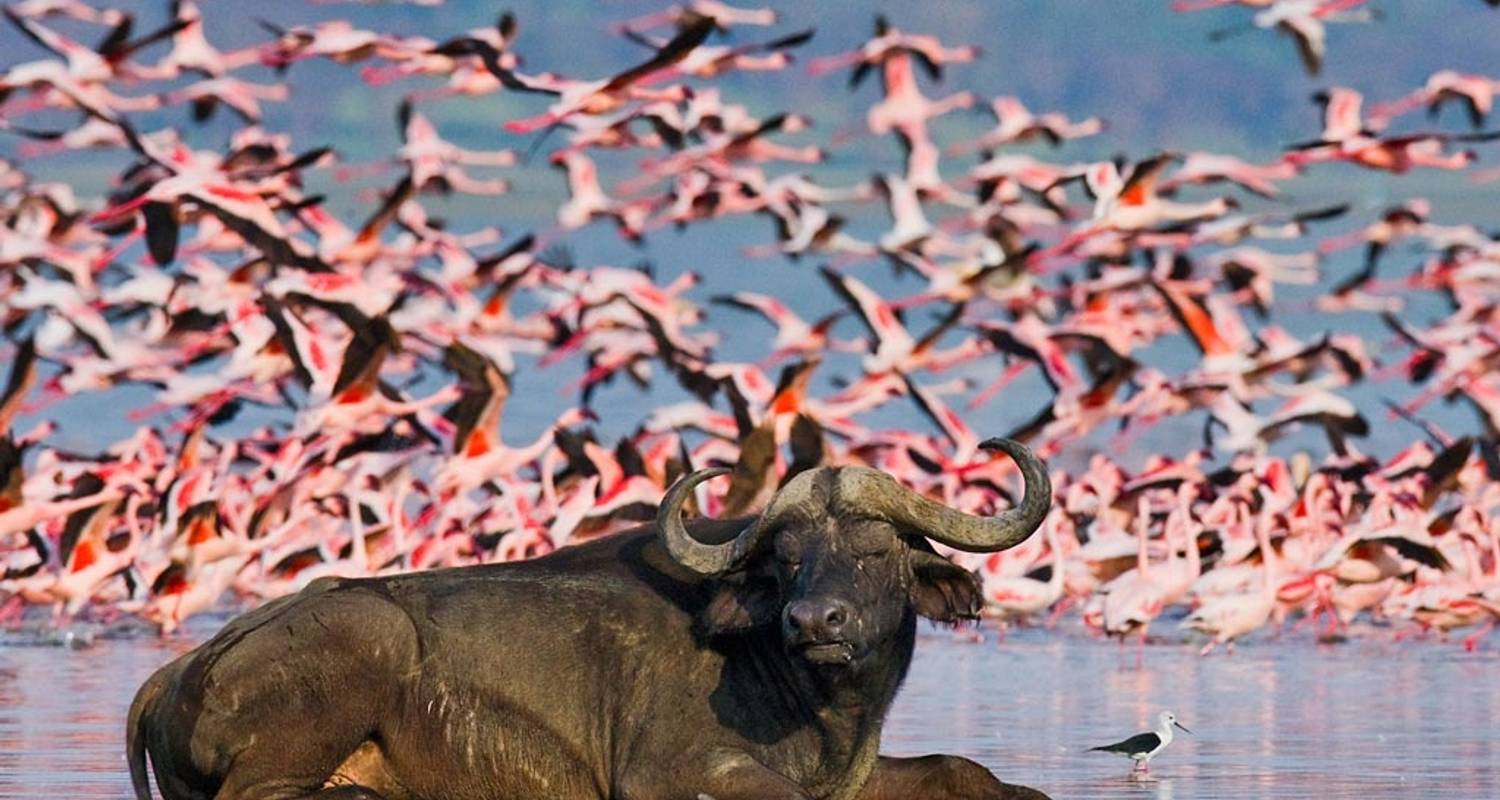
Lake Nakuru National Park is a premier Kenyan birding destination, renowned for its massive flamingo populations (both Lesser and Greater) and over 450 recorded bird species. Located in the Rift Valley, this alkaline lake and surrounding acacia woodlands offer spectacular viewing of waterbirds, including pelicans, storks, and fish eagles, alongside rhinos and Rothschild giraffes.
Key Birding Highlights at Lake Nakuru
Flamingos
The defining image of a Kenya birding safari is arguably the shimmering pink "fringe" created by hundreds of thousands of flamingos lining the shores of Lake Nakuru. These birds are divided into two species: the Lesser Flamingo and the Greater Flamingo. The Lesser Flamingo is the more numerous of the two, distinguished by its deep red bill and smaller stature. They are specialized filter feeders, consuming microscopic blue-green algae (Arthrospira fusiformis) that thrives in the lake's caustic, soda-rich waters.
The Greater Flamingo is taller, paler, and possesses a black-tipped pink bill; it feeds on small crustaceans and insect larvae found in the mud. It is important for travelers to note that flamingo populations are nomadic and fluctuate based on the lake's water levels and alkalinity. If the water becomes too deep or too fresh, the algae dies off, and the flocks may move to nearby Lake Bogoria or Lake Elementaita. However, when conditions are right, the sheer density of these birds is breathtaking, turning the shoreline into a pulsing, vocal mass of pink that can be seen from the surrounding "Out-of-Africa" lookouts.
Diverse Species
While the flamingos take the headlines, a Kenya birding safari at Lake Nakuru offers an incredible checklist of over 450 recorded species. The lake's ecosystem supports a massive population of Great White Pelicans and Pink-backed Pelicans, which can often be seen in synchronized fishing groups. Along the muddy inlets, you will find an array of storks, most notably the Yellow-billed Stork, as well as the elegant Pied Avocet and Black-winged Stilt.
The freshwater inflows at the northern end of the lake attract a variety of ducks, including the Cape Teal, Hottentot Teal, and Northern Shoveler. High above, the African Fish Eagle is a constant presence, its iconic haunting cry echoing across the water. The park is also an excellent place to spot various raptors, such as the Augur Buzzard and the Long-crested Eagle. Because the park is relatively compact, the "species-per-hour" rate is exceptionally high, making it a favorite for photographers who want to capture a wide variety of birds in a single day without extensive travel.
Habitat Variety
The success of a Kenya birding safari in this park is due to its diverse terrestrial habitats that surround the water. The yellow-fever acacia (Vachellia xanthophloea) woodlands are home to the Arrow-marked Babbler, African Hoopoe, and the Narina Trogon. These woodlands provide essential nesting sites and shade for a multitude of passerines.
To the east, the Lion Hill cliffs and rocky escarpments offer a completely different set of species, such as the Mocking Cliff-Chat and various swifts. Perhaps most unique is the forest of Euphorbia candelabrum—tall, cactus-like trees that create a prehistoric atmosphere. These forests are frequented by the Grey-backed Fiscal and various sunbirds that flit between the blooms. Along the seasonal watercourses, you can find several species of Kingfishers, including the Giant, Pied, and Malachite varieties. This mosaic of water, forest, and rock ensures that even when the flamingos are fewer in number, the "land birding" remains some of the best in East Africa.
Best Time to Visit
To maximize your sightings on a Kenya birding safari, timing is crucial. While Lake Nakuru is a productive year-round destination due to its resident populations, the period from November to April is the undisputed peak. This coincides with the arrival of Palearctic migrants from Europe and North Africa. During these months, the resident count is bolstered by millions of visiting waders, terns, and warblers, significantly increasing the biodiversity of the park.
Furthermore, this period often sees the "short rains" in November and December, which causes the vegetation to flush green and triggers breeding activity. Resident birds become more vocal as they establish territories and search for mates, making them easier to locate by sound. The air is generally clearer after the rains, providing better visibility for long-distance spotting across the lake. If you are a "lister" looking to maximize your species count, the presence of both northern migrants and breeding residents makes this window the most rewarding time for a visit.
Best Time for Flamingos
If the primary goal of your Kenya birding safari is to witness the maximum concentration of flamingos, the dry-hot season, particularly January and February, is typically the best window. During these months, the lack of significant rainfall causes the lake's water levels to recede through evaporation. As the water level drops, the concentration of salt and minerals increases, creating the "perfect soup" for the rapid growth of the blue-green algae that Lesser Flamingos crave.
The receding shoreline also exposes the mudflats where Greater Flamingos feed, concentrating the birds into a smaller area and providing spectacular viewing opportunities. These months offer the most stable weather, with clear blue skies providing a sharp contrast to the pink birds—perfect for high-end wildlife photography. However, it is always wise to check local reports just before travel, as Rift Valley water levels can be unpredictable. When the "hot season" alignment is perfect, the sight of hundreds of thousands of birds taking flight simultaneously is a highlight that defines the entire Kenyan safari experience.
1. What makes Lake Nakuru a "Birdwatcher's Paradise"?
Lake Nakuru National Park is a premier birding destination, often referred to as a birdwatcher's paradise because it holds Ramsar Site status and is an Important Bird Area (IBA). It boasts over 450 species of birds, both endemic and migratory, making it one of the most biodiverse places in Kenya. The shallow, alkaline soda lake supports massive concentrations of cyanophyte algae (Spirulina), which attracts millions of flamingos, creating a famous "pink sea" panorama. Beyond the lake, the park offers diverse habitats, including acacia woodlands, euphorbia forests, and bushy grasslands, which serve as crucial feeding, nesting, and shelter areas for a vast range of avian species.
2. Can I still see flamingos at Lake Nakuru in 2026?
Yes, you can still see flamingos at Lake Nakuru in 2026, though their numbers and locations fluctuate due to changing water levels. Recent years have shown that increased water levels due to climate change dilute the lake’s alkalinity, forcing flamingos to migrate temporarily to other lakes like Bogoria or Natron. However, the southern mudflats near the Naishi area have become a primary, reliable feeding ground where flamingo congregations are still spotted. While numbers may not reach the historic millions every single day, the flamboyant pink spectacle remains a major feature of the park, along with large colonies of Pelicans.
3. What is the best time of year for birding at Lake Nakuru?
Birding in Lake Nakuru National Park is possible year-round, but the best time for birding safaris is generally during the dry season, particularly from July to October, and also January to February. During these months, the lake's water levels are lower, concentrating the birds along the shorelines, which improves visibility and photography opportunities. Additionally, the dry season allows for easier access through the park's road network. Migratory birds from Europe and North Africa are most abundant between October and March, making that a top period for spotting rare, visiting species.
4. Which bird species can I expect to see besides flamingos?
While flamingos are the highlight, Lake Nakuru is home to over 400 other bird species, including the massive Great White Pelican, which feeds along the lake's shores. Key birding sightings include African Fish Eagles, Marabou Storks, Goliath Herons, Cormorants, and Hamerkops. Woodland species include the Red-capped Lark, Shining Sunbird, Long-tailed Widowbird, and various kingfishers. The park is particularly known for hosting threatened species like the Madagascar Pond-Heron, Pallid Harrier, Greater Spotted Eagle, and the Grey-crested Helmet-shrike.
5. What is the best time of day for a birding safari?
The best time of day for birding at Lake Nakuru National Park is early morning, between 6:00 a.m. and 11:00 a.m., when birds are leaving their nests to search for food. This is the most rewarding time to spot a wide variety of species active along the lake's shores and in the surrounding woodlands. Evening is also a productive time to watch birds return to their nests. These times offer optimal light for photography, especially when capturing the birds against the backdrop of the sunrise or sunset, and it is also when predators are active.
6. Where are the best birding spots within the park?
The most productive birding spots in Lake Nakuru National Park are concentrated along the lake shore itself, particularly the mudflats in the southern Naishi area. The Baboon Cliff, situated along the eastern shore, is an excellent high-vantage point for scanning the water for flamingos and pelicans. The fever tree forests (Acacia woodlands) are fantastic for birding, as well as the areas surrounding the Makalia Waterfall. The rocky rocky terrain also offers a chance to see species like the Klipspringer or Rock Hyrax, with birds often seen hovering over the rocky ridges.
7. How many days should I spend for a proper birding trip?
For a comprehensive birding experience, it is recommended to spend at least one to two nights in the park. While many visitors do a day trip from Nairobi, staying overnight allows you to explore the diverse habitats thoroughly, including morning and evening game drives when birds are most active. A two-day stay allows birders to venture into the deeper acacia woodlands and visit the Makalia Falls area, rather than just sticking to the main lakefront road, thus maximizing their species count without feeling rushed.
8. What other wildlife can I see while birding?
Lake Nakuru National Park is unique because it combines birding with exceptional Big Five viewing opportunities, including 4 of the Big 5—lions, leopards, buffaloes, and white/black rhinos. The park is one of the most successful rhino sanctuaries in Kenya, so rhino sightings are quite common. You will also see large herds of waterbuck, Burchell's zebras, impalas, baboons, and Rothschild's giraffes. Predators like leopards are often found hanging in the woods or resting in the Acacia branches, particularly in the "Ghost Forest" area.
9. What should I pack for a birding safari to Lake Nakuru?
Essential items for a birding safari at Lake Nakuru include high-quality binoculars, a camera with a good telephoto lens (zoom capacity) for capturing the birds without disturbing them, and a comprehensive field guide to East African birds. Pack lightweight, neutral-colored clothing that blends with the environment, comfortable walking shoes for short guided walks, and a light jacket for cooler mornings and evenings. Sunscreen, a wide-brimmed hat, insect repellent, and a reusable water bottle are crucial to remain comfortable during long game drives in the sun.
10. Can I do a guided bird walk in the park?
Yes, guided bird walks are possible, offering a more intimate and up-close opportunity to study species behavior compared to viewing from a car. These walks are conducted by experienced rangers and guides who can identify obscure species, locate nesting sites, and share insights into the delicate park ecosystem. While most birding is done from vehicles, walking on the shores and in the woodland areas allows birders to hear calls and find smaller species hidden in the undergrowth. It is advisable to book these guided experiences in advance through the Kenya Wildlife Service (KWS).
11. Is Lake Nakuru National Park family-friendly?
Yes, Lake Nakuru National Park is one of the most family-friendly and accessible safari parks in Kenya. It is quite compact, meaning you can see a large variety of wildlife and birds without spending all day driving, which is ideal for children. The park's main attractions—the lake shore, Baboon Cliff, and the Rhino Sanctuary—are easily reachable. Lodges inside the park offer comfortable amenities, and the high likelihood of seeing flamingos, rhinos, and lions in a single day makes it exciting for all ages.
12. Are there any restrictions on photography in the park?
Photography is welcomed and encouraged at Lake Nakuru National Park, but there are strict rules against the use of drones, which are prohibited to prevent wildlife disturbance. Visitors are required to remain within their vehicles during game drives to ensure safety, although you may stand near the car at designated viewpoints like the Baboon Cliff. It is essential to be respectful of wildlife, maintaining a reasonable distance from animals and birds. Using a long lens for bird photography is recommended, as it allows you to capture detailed shots from inside the vehicle.
13. What is the accommodation like inside the park?
Accommodation options inside the park range from luxury tented camps to cozy lodges that offer stunning views of the lake. Popular choices include the Lake Nakuru Lodge, Sarova Lion Hill Game Lodge, and Lake Nakuru Sopa Lodge. Staying inside the park is highly recommended for birders because it allows for early access to the lakeside before the day-trip crowds arrive. For those on a tighter budget, many affordable guesthouses and hotels are located just outside the park gates in Nakuru Town.
14. What are the park entry fees?
Entry fees for Lake Nakuru National Park vary based on residency status and are updated periodically by the Kenya Wildlife Service (KWS). Generally, non-resident adults can expect fees around $60, while non-resident children pay around $35, with significantly lower rates for Kenyan citizens and residents. It is highly recommended to check the current rates on the official KWS website or through a reliable tour operator before planning your visit, as these fees are subject to change.
15. How do I get to Lake Nakuru National Park?
Lake Nakuru National Park is easily accessible by road, situated only 165 km northwest of Nairobi, which is roughly a 3–4-hour drive on the Nairobi-Nakuru highway. Most visitors take this scenic route, which passes through the Rift Valley landscapes. The main gate is just a 10-minute drive from the city of Nakuru. Alternatively, you can access the park through the Lanet gate or the Nderit gate, which are commonly used for entering after visiting nearby parks like Maasai Mara. There is also an airstrip (Naishi) for those wishing to fly in.
Booking Kenya birding safari in lake Nakuru with us Roads of Adventure safaris
Book your ultimate birding safari to Lake Nakuru National Park with Roads of Adventure Safaris. Experience the breathtaking spectacle of thousands of pink flamingos and diverse bird species in this renowned Ramsar site. Our tailored packages include expert birding guides, prime game drives to see rhino and leopard, and comfortable transportation, ensuring an unforgettable journey through the Great Rift Valley. Explore Baboon Cliff for panoramic views and enjoy superior wildlife viewing. Book with us to experience the best birdwatching adventures and Kenya's vibrant wildlife. Contact Roads of Adventure Safaris today to secure your specialized birding itinerary
