A 6-day Uganda gorilla trekking tour typically combines trekking with savannah game drives and cultural experiences, starting and ending in Entebbe. Key activities include trekking mountain gorillas in Bwindi Impenetrable National Park, game drives in Queen Elizabeth or Lake Mburo National Park, boat cruises, and visiting the Batwa community
6-days-best-of-murchison-and-kidepo-uganda-safari-via-ziwa
6-days-safari-in-uganda-gorilla-trekking-and-chimpanzee-tracking
6-days-classic-uganda-rwanda-primate-and-wildlife-safari
6-days-uganda-primate-safari-and-wildlife-experience
6-days-budget-uganda-wildlife-safari-holiday-vacation
6-days-double-gorilla-trekking-uganda-and-rwanda-side
1. Mountain Gorilla Trekking (Bwindi/Mgahinga)
The crown jewel of a Ugandan safari is the encounter with mountain gorillas in the dense, ancient forests of Bwindi Impenetrable or Mgahinga Gorilla National Park. This experience is more than a wildlife viewing; it is a profound journey into the habitat of a species that shares roughly $98\%$ of human DNA. The adventure begins at dawn with a briefing at the park headquarters, where trackers and guides provide essential rules for the trek. Depending on the location of the habituated gorilla family, the hike can range from two to six hours, traversing steep ridges and thick undergrowth.
Once the family is located, the "one-hour clock" begins. Standing just meters away from a massive silverback—who can weigh up to $200\text{ kg}$—is a humbling experience. You may witness the gentle social structures of the troop: mothers grooming their infants, juveniles somersaulting through the foliage, and the silverback maintaining a watchful, protective presence. The $\$800$ permit fee directly supports the round-the-clock protection of these primates, a strategy that has successfully moved mountain gorillas from "critically endangered" to "endangered." The silence of the forest, broken only by the sound of breaking bamboo and the gorillas' low grunts, creates an atmosphere of primordial wonder. It is a physical and emotional highlight that often serves as the soul of the entire six-day journey.
2. Chimpanzee Tracking (Kibale Forest)
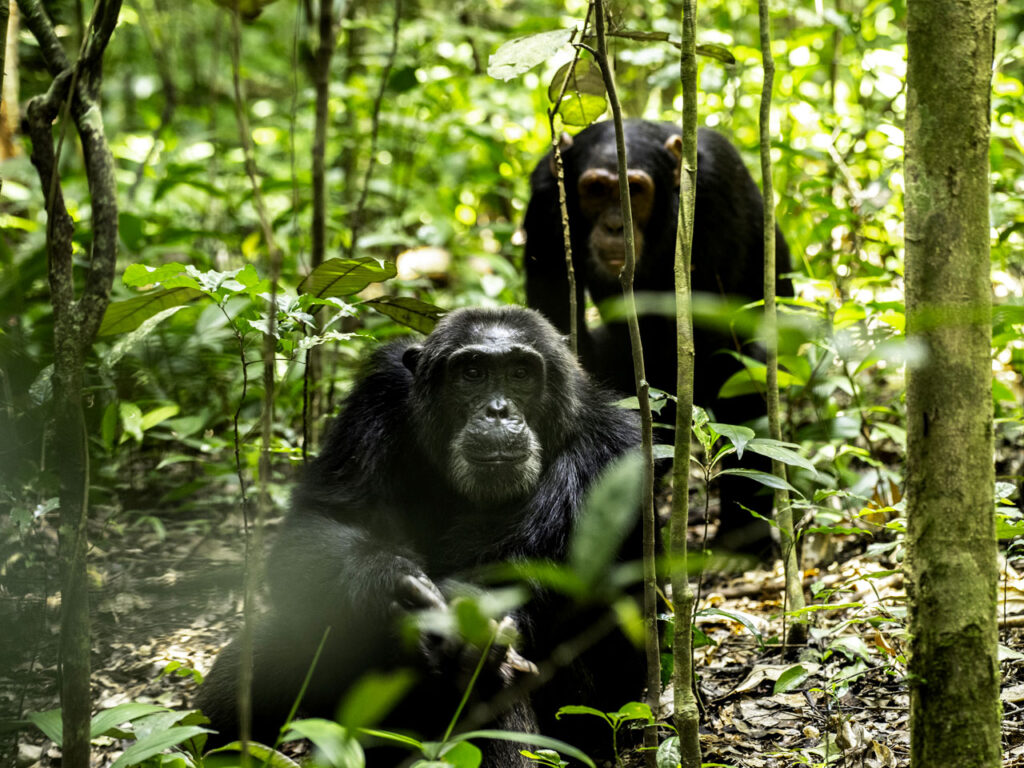
Kibale National Park is widely recognized as the "Primate Capital of the World," boasting the highest density and diversity of primates in Africa. The top activity here is chimpanzee tracking, which offers a high-energy contrast to the more somber gorilla encounter. Chimpanzees are highly vocal and incredibly mobile; trackers often follow the echoes of their "pant-hoots"—a series of rising screams—that ripple through the 12-meter-high canopy. The trek through the moist evergreen forest is relatively flat compared to Bwindi, making it accessible for a wider range of fitness levels.
Once a community is found, visitors spend one hour observing their complex social hierarchies and human-like behaviors. You might see them using tools to extract insects, hunting in coordinated groups, or engaging in intense grooming sessions to reinforce social bonds. Following the morning trek, many itineraries include a walk through the Bigodi Wetland Sanctuary. This community-run initiative is a birdwatcher’s paradise, famously home to the Great Blue Turaco and several other primate species like the Red Colobus and L’Hoest’s monkeys. The combination of the raw, wild energy of the chimpanzees and the serene, biodiversity-rich wetland walk provides a comprehensive look at Uganda's equatorial ecosystem.
3. Game Drives (Queen Elizabeth/Lake Mburo)
Game drives are the quintessential African safari experience, and a six-day Uganda tour typically explores the vast savannahs of Queen Elizabeth or Lake Mburo National Park. In Queen Elizabeth’s Kasenyi Plains, the landscape is a mosaic of crater lakes and open grasslands, home to the "Big Four" (elephants, buffaloes, lions, and leopards). An early morning drive is the best time to catch predators like lions and hyenas returning from a night of hunting, while herds of Uganda Kob graze in the soft morning light. The park’s backdrop of the Rwenzori "Mountains of the Moon" makes every sighting spectacular.
Alternatively, a stop at Lake Mburo National Park offers a different variety of wildlife. As the smallest of Uganda’s savannah parks, it is the best place to see large numbers of Burchell’s zebras and impalas, which are not found in the western parks. The lack of elephants here allows for a more "intimate" savannah feel, and the park is one of the few places where you can enjoy a walking safari or a night game drive to spot elusive nocturnal creatures like leopards and bushbabies. Whether navigating the rugged tracks of the north or the peaceful plains of the south, these game drives ensure that your primate-focused tour is balanced with the classic grandeur of Africa’s large mammals.
4. Boat Cruises (Kazinga Channel)
One of the most relaxing yet wildlife-dense activities on the itinerary is a boat cruise along the Kazinga Channel in Queen Elizabeth National Park. This $32text km} $ natural waterway connects Lake Edward and Lake George, acting as a massive oasis for the park’s residents. As the boat glides near the shoreline, you are treated to a front-row seat to one of the world's highest concentrations of hippos. Huge pods of these "river giants" huff and splash in the water, while massive Nile crocodiles bask on the muddy banks with their mouths agape to regulate their body temperature.
The channel is also a magnet for thirsty land animals. It is common to see herds of elephants and buffaloes coming down to the water’s edge to drink and bathe, often just a few meters from the boat. For bird enthusiasts, the Kazinga Channel is unparalleled; the banks are lined with hundreds of species, including the African Fish Eagle, Pelicans, and colorful Kingfishers. The two-hour cruise offers a unique "water-level" perspective that land-based game drives cannot match. Watching a sunset over the water while an elephant family crosses a nearby swamp is a quintessential Rwandan moment, providing a serene break from the bumpy roads of the savannah.
5. Tree-Climbing Lions Tracking (Ishasha)
Deep in the southern Ishasha sector of Queen Elizabeth National Park lies one of the most peculiar wildlife spectacles in the world: lions that spend their days lounging in trees. While most lions stay on the ground, the prides in Ishasha have developed the rare habit of climbing large Sycamore Fig and Acacia trees. Theories suggest they do this to escape the heat of the ground, avoid tsetse flies, or gain a better vantage point to spot prey like the Uganda Kob grazing in the distant plains.
Tracking these "arboreal kings" requires a keen eye and a specialized 4x4 vehicle to navigate the remote, less-traveled tracks of the sector. Spotting a whole pride—including heavy adult males with thick manes—draped lazily over thick tree branches is a sight that challenges every classic safari stereotype. Because Ishasha is more remote and less crowded than the northern sectors, the experience feels incredibly wild and exclusive. The landscape here is distinct, featuring wide-open savannahs dotted with ancient, sprawling trees that look like something out of a prehistoric era. Including the Ishasha sector in your six-day tour adds a layer of rarity and intrigue that is found in only one other place on Earth (Lake Manyara in Tanzania).
6. Cultural Experiences (Batwa Pygmies)
To understand the forests of Uganda, one must meet their original inhabitants: the Batwa pygmies. For thousands of years, the Batwa lived as hunter-gatherers in the forests of Bwindi and Mgahinga, coexisting harmoniously with the mountain gorillas. However, when the parks were established in the 1990s, the Batwa were evicted to protect the ecosystem. Today, cultural tours like the "Batwa Trail" or the "Batwa Cultural Experience" allow these communities to share their ancestral heritage while earning a sustainable living through tourism.
During the experience, Batwa guides lead you back into the forest (or a community-owned forest patch) to demonstrate how they once lived. You will learn how they harvested wild honey, used forest plants for medicine, and constructed temporary shelters from leaves and branches. The demonstrations of their traditional hunting techniques with bows and arrows are both educational and interactive. The visit usually culminates in a powerful performance of traditional music and dance, which tells stories of their history and spiritual connection to the forest. This experience is vital for any traveler, as it provides the necessary human context to the conservation efforts in the region, highlighting the complex relationship between indigenous people, land, and wildlife.
7. Scenery & Stops (Equator & Mpambire Drums)
The long drives between Uganda’s national parks are made memorable by iconic roadside stops that offer a taste of local life and geography. The most famous is the Equator crossing in Kayabwe. Here, you can stand with one foot in the Northern Hemisphere and the other in the Southern Hemisphere. It is a popular spot for the "water flow" demonstration, which purports to show the Coriolis effect—how water drains in different directions on either side of the line. The site is also a hub for high-quality Ugandan crafts and a great place for a coffee break and the quintessential "Equator photo."
Another fascinating stop is the Mpambire Drum Makers' Village. Known as the home of the royal drum makers, this community has been crafting traditional instruments for generations. You can watch artisans skillfully carve drum shells from the "Omuvule" tree and stretch cowhides over them using simple, ancient tools. Beyond drums, the roadside stalls are filled with hand-woven baskets, mats, and stools, offering a perfect opportunity to support local craftsmanship directly. These stops serve as more than just "bathroom breaks"; they allow travelers to stretch their legs and engage with the vibrant, everyday culture of Uganda, making the journey across the "Land of a Thousand Hills" as rewarding as the destinations themselves.
6-Day Uganda Gorilla & Primate Odyssey
Uganda, the "Pearl of Africa," offers a rare sanctuary for those seeking a profound connection with the wild. This 6-day expedition is meticulously crafted to showcase the country’s most iconic landscapes, from the misty, ancient canopies of Bwindi Impenetrable National Park to the lush primate capital of Kibale Forest. You will venture deep into the heart of the Albertine Rift, where over half of the world’s remaining mountain gorillas reside.
The journey transcends simple wildlife viewing; it is a sensory immersion into diverse ecosystems. You will track chimpanzees through sun-dappled forests, witness tree-climbing lions in the Savannah, and navigate the hippo-filled Kazinga Channel. Each day presents a new chapter of adventure, blending raw wilderness with the warmth of Ugandan hospitality. This safari is more than a tour—it is a conservation journey that supports local communities and ensures the survival of these majestic "gentle giants" for generations to come.
Day 1: Arrival and The Journey West
Your adventure begins with a warm welcome in Entebbe or Kampala. After a briefing, you head southwest, crossing the Equator for a classic photo opportunity. The drive unfolds through the "Switzerland of Africa," characterized by terraced hills and vibrant trading centers. You'll stop in Mbarara for a traditional lunch before ascending into the highlands. As the air cools and the vegetation becomes denser, you arrive at the edge of the forest. The evening is spent relaxing at your lodge, listening to the nocturnal symphony of the jungle as you prepare for the transformative days ahead.
Day 2: The Primate Capital – Kibale Forest
Wake up to the sounds of the jungle for an early transfer to Kibale National Park. Kibale is world-renowned for hosting the highest density of primates in Africa. After a safety briefing, you’ll enter the forest with expert rangers to track Chimpanzees. Observing our closest cousins as they swing through the canopy, hunt, and socialize is a visceral experience. In the afternoon, explore the Bigodi Wetland Sanctuary. This community-led initiative is a birder’s paradise and offers sightings of the Great Blue Turaco and various monkey species, providing a perfect balance of primate and birdlife.
Day 3: Savannah Secrets – Queen Elizabeth Park
You transition from the dense forest to the sprawling Savannah of Queen Elizabeth National Park. The morning features a game drive across the Kasenyi Plains, where you may spot elephants, Cape buffalo, and the elusive leopard. In the afternoon, you’ll embark on a boat cruise along the Kazinga Channel. This natural waterway connecting Lake Edward and Lake George serves as a massive oasis. You will drift past pods of wallowing hippos, massive Nile crocodiles, and hundreds of bird species, providing some of the best close-up wildlife photography opportunities in all of Uganda.
Day 4: The Search for Tree-Climbing Lions
As you head further south toward Bwindi, you pass through the Ishasha Sector of Queen Elizabeth Park. This remote region is famous for its unique population of tree-climbing lions, often found lounging in the sturdy branches of ancient fig trees to escape the heat and insects. It is a surreal sight that few other parks can offer. After a picnic lunch amidst the wild landscape, you continue your journey into the Kigezi Highlands. The scenery shifts to dramatic mountain vistas as you reach the gorilla sanctuary, settling in for a night of anticipation.
Day 5: The Gorilla Trek – A Life-Changing Encounter
This is the pinnacle of your safari. After an early breakfast, you head to the park headquarters for a briefing on gorilla etiquette. Guided by expert trackers, you will trek through the dense, tangled undergrowth of Bwindi Impenetrable Forest. The hike can be challenging, but the reward is incomparable: one hour spent in the presence of a habituated gorilla family. Watching a silverback protect his troop while infants tumble through the vines is a silent, sacred experience. You’ll return to the lodge with a trekking certificate and memories that will last a lifetime.
Day 6: Lake Bunyonyi and Departure
On your final day, enjoy a scenic drive to Lake Bunyonyi, the "Lake of Small Birds" and one of the deepest crater lakes in Africa. Its 29 emerald islands and mist-covered waters offer a tranquil setting to reflect on your journey. Take a dugout canoe ride or a short nature walk before starting the return leg to Entebbe or Kampala. You’ll stop for lunch along the way, arriving in the evening for your flight or hotel drop-off, carrying with you the spirit of the Pearl of Africa.
1. What is the best time for a 6-day Uganda gorilla trekking tour?
Timing is everything when venturing into the tropical rainforests of East Africa. While Uganda is a year-round destination due to its equatorial climate, the dry seasons—from June to September and December to February—are widely considered the gold standard for trekking. During these months, the dense undergrowth of Bwindi Impenetrable Forest and Kibale National Park is less saturated, making the steep, narrow trails significantly safer and easier to navigate. Footing is more secure, and the risk of slipping on muddy slopes is greatly reduced.
Beyond footwork, the dry season offers superior wildlife viewing across the entire 6-day circuit. In Queen Elizabeth National Park, the Savannah thins out, and animals congregate around permanent water sources like the Kazinga Channel, providing spectacular sightings of elephants, buffalo, and hippos. Conversely, the "wet" months of March to May and October to November bring heavy rains. While these periods offer lush, vibrant scenery and potentially lower lodging rates, the trekking can become a grueling test of endurance. The gorillas also tend to move to lower altitudes during the rains to find food, which can sometimes shorten the trek, but the overall discomfort of persistent rain often outweighs this benefit.
2. What should I pack for a Uganda gorilla trekking tour?
Packing for a primate safari requires a "function over fashion" mindset. The most critical item is a pair of waterproof, broken-in hiking boots with excellent ankle support. The terrain is unforgiving to sneakers or sandals. To protect against stinging nettles, thorny bushes, and biting insects, you should wear long-sleeved shirts and long trousers. A popular "pro tip" among safari experts is to tuck your trousers into your socks to prevent safari ants from crawling up your legs during the trek.
A high-quality lightweight rain jacket is non-negotiable; even in the dry season, the rainforest can live up to its name at a moment's notice. Essential accessories include gardening gloves—which allow you to grab onto thorny branches or vines for support without getting scratched—a wide-brimmed hat, and high-SPF sunscreen. For your electronics, bring extra camera batteries and waterproof dry bags to protect your gear from humidity and sudden downpours. Lastly, ensure you have a sturdy daypack to carry your packed lunch and at least two liters of water, as hydration is vital during the physical exertion of the climb.
3. How hard is the hiking during a 6-day Uganda gorilla trekking tour?
Gorilla trekking is a physically demanding activity that should not be underestimated. Bwindi's elevation ranges from 1,160m to over 2,600m above sea level, meaning the air is thinner and the slopes are steeper than many expect. Depending on where the assigned gorilla family spent the previous night, a trek can last anywhere from two to six hours. You are not walking on manicured trails; instead, you are navigating through thick ferns, ancient vines, and tangled undergrowth.
The "Impenetrable" forest lives up to its name, and rangers often have to use machetes to clear a path. While you don't need to be an elite athlete, a moderate level of fitness and experience walking on uneven surfaces will significantly enhance your enjoyment. If you are concerned about the physical toll, you can hire a porter (see Section 10) who can provide a steady hand through the most difficult sections. Preparing with some light cardio or hiking in the weeks leading up to your tour will ensure you arrive at the gorilla encounter with enough energy to truly appreciate the moment.
4. How many people are allowed per group on a Uganda gorilla trekking tour?
To ensure the long-term health and psychological well-being of the mountain gorillas, the Uganda Wildlife Authority (UWA) enforces a strict limit of eight people per group. This "Rule of Eight" serves two primary purposes: it prevents the gorillas from becoming overwhelmed or agitated by a large human presence and minimizes the risk of cross-species disease transmission. By limiting the number of visitors, the park maintains a controlled environment that feels more like a nature study than a tourist attraction.
From a visitor’s perspective, this small group size creates a profound sense of intimacy and exclusivity. The silence of the forest is amplified when there are only a few people present, allowing you to hear the subtle sounds of the jungle—the crunch of bamboo being chewed, the low grunts of the silverback, or the rustle of leaves as infants play. This small-group dynamic also ensures that every person has a clear, unobstructed view of the gorillas during the one-hour observation period. This exclusivity is why permits are in such high demand and must be secured months in advance.
5. How much is a gorilla permit for a 6-day Uganda gorilla trekking tour?
As of the 2024–2026 period, a gorilla trekking permit in Uganda costs USD 800 for foreign non-residents. While this may seem like a steep entry fee, it is important to view it as a direct investment in the survival of a species. Decades ago, mountain gorillas were on the brink of extinction; today, their numbers are slowly increasing thanks to the revenue generated by these permits. This money funds round-the-clock protection by armed rangers, specialized veterinary care (the "Gorilla Doctors"), and community development projects.
By paying for a permit, you are directly incentivizing local communities to value the forest as a source of sustainable income rather than clearing it for agriculture or charcoal. It is also worth noting that Uganda remains a highly competitive option compared to neighboring Rwanda, where permits cost USD 1,500. Your Ugandan permit includes park entrance fees, the services of expert ranger-guides, and security details. When you consider that this "investment" ensures the mountain gorillas will be around for future generations, the cost becomes much easier to justify as part of a once-in-a-lifetime experience.
6. How close can I get to the gorillas on a Uganda gorilla trekking tour?
The 7–10 meter (22–30 feet) distance rule is the most important regulation you will follow during your encounter. Because mountain gorillas share approximately 98% of our DNA, they are highly susceptible to human respiratory infections, colds, and digestive illnesses. A common virus that might only give a human a slight cough could potentially be fatal for an entire gorilla troop. Maintaining this distance is the primary way we ensure our presence does not lead to a biological catastrophe for the species.
Maintaining this gap also respects the gorillas’ social boundaries. While habituated gorillas are generally calm and accustomed to humans, they are still powerful wild animals. Staying at the mandated distance ensures the dominant silverback doesn't perceive your presence as a challenge or a threat to his family’s safety. If a curious youngster approaches you—which does happen occasionally—the rangers will instruct you to slowly and quietly back away to re-establish the buffer zone. Respecting this boundary is a small but vital price to pay for the privilege of entering their ancestral home.
7. Can children join a 6-day Uganda gorilla trekking tour?
The minimum age for gorilla trekking in Uganda is 15 years. This policy is strictly enforced by the Uganda Wildlife Authority for several critical reasons. First and foremost is the health of the gorillas; children are statistically more likely to carry "childhood diseases" like mumps, chickenpox, or various flu strains that the gorillas have no natural immunity against. By setting the age at 15, the park minimizes the risk of introducing these highly contagious pathogens into the forest.
Beyond health, there are safety and physical considerations. The unpredictable nature of younger children—such as sudden movements, high-pitched shouting, or running—could inadvertently trigger a defensive or aggressive reaction from a silverback. Furthermore, the physical intensity of trekking through thick jungle for several hours is often too grueling for younger children. For families traveling with kids under 15, many lodges near Bwindi offer supervised nature walks, cultural visits, or "Kids' Clubs" while the adults are in the forest, ensuring everyone has an age-appropriate adventure.
8. Is it possible to see more than just gorillas on this trip?
A 6-day tour is the "Goldilocks" of Uganda itineraries—it is just long enough to see the diverse highlights of the region without feeling rushed. While the gorillas are undoubtedly the headline act, the supporting cast of wildlife and landscapes is equally impressive. Most 6-day itineraries include a visit to Kibale National Park, known as the primate capital of the world. Here, you can trek for Chimpanzees, witnessing their vocal and high-energy social lives in the canopy.
The journey usually continues to Queen Elizabeth National Park, where the Savannah landscape provides a stark contrast to the dense rainforest. You will have the chance to see the famous tree-climbing lions of the Ishasha sector, a rare behavior found in very few lion populations globally. A boat cruise on the Kazinga Channel offers a relaxed way to see hundreds of hippos, massive Nile crocodiles, and thirsty elephants from the safety of the water. This variety ensures that your 6-day tour is a comprehensive "Big Game" and "Great Primate" experience, showcasing the incredible biodiversity that earns Uganda the title "The Pearl of Africa."
9. What is a 6-day Uganda gorilla trekking tour "Habituation Experience"?
For those who feel that one hour with the gorillas is simply not enough, the Gorilla Habituation Experience in the Rushaga sector of Bwindi is a unique alternative. Unlike standard trekking, where you visit gorillas that are already fully accustomed to humans, habituation involves joining researchers as they follow a group that is still in the process of becoming "habituated." This is a slower, more delicate process that requires patience and a deeper interest in primatology.
This specialized experience allows for four hours in the presence of the gorillas. It offers a "behind-the-scenes" look at how researchers identify individual gorillas, document their behavior, and slowly build trust with the troop. The permit for this experience is higher (USD 1,500), but for photographers and wildlife enthusiasts, the extra three hours provide the time needed to capture the perfect lighting and truly observe the intricate social dynamics of the family. It is a more immersive, educational trek that provides a deeper understanding of what it takes to protect these magnificent creatures.
10. Do I need to be a professional hiker for a Uganda gorilla trekking tour?
You do not need to be a professional hiker to enjoy a Uganda gorilla tour, but you should take advantage of the local support system. At every trekking trailhead, local porters are available for hire (usually for a fee of USD 20 plus a tip). Hiring a porter is one of the most impactful ways you can support the local economy directly. Many porters are former poachers who have turned to tourism for their livelihoods, or students using the income to pay for their university tuition.
Beyond carrying your heavy camera gear and water, a porter is an invaluable physical asset. They are accustomed to the terrain and can provide a steady hand on slippery slopes, or even a gentle "push" up the steepest sections of the trail. This support system makes gorilla trekking accessible to travelers in their 60s, 70s, and even 80s. By hiring a porter, you are not only making your own journey easier but also ensuring that the local community sees a direct, tangible benefit from the presence of the gorillas.
11. What is the Batwa cultural trail on a Uganda gorilla trekking tour?
The Batwa Cultural Trail offers a poignant look at the human history of the forest. The Batwa people are the original inhabitants of the Bwindi forest, having lived there as hunter-gatherers for thousands of years. When the forest was gazetted as a national park to protect the gorillas, the Batwa were displaced. This trail is a community-led initiative that allows them to preserve and share their ancient heritage with the world.
This is an interactive experience led by Batwa guides. They will demonstrate how they used to make fire using sticks, which forest plants were used for traditional medicine, and how they constructed shelters from leaves and branches. You might hear their traditional songs and watch dances that have been passed down through generations. This experience provides essential context to your tour, highlighting the complex relationship between conservation and indigenous rights, and showing how modern tourism can help support displaced cultures.
12. Can I use a flash with my camera during a Uganda gorilla trekking tour?
Photography in a dense rainforest is a unique challenge. The light is often dim under the thick canopy, and the dark fur of the gorillas can make focusing difficult. However, the most important rule to remember is that flash photography is strictly prohibited. A sudden, bright flash of light can startle the gorillas or be interpreted by a silverback as a threat, potentially leading to a defensive charge. It is vital to ensure your flash is turned off before you even enter the forest.
To get the best photos, it is recommended to use a camera with good high-ISO performance and a "fast" lens with a wide aperture (such as $f/2.8$ or $f/4$). Because you will be moving through thick brush, a monopod is often more practical than a bulky tripod. Most importantly, remember to put the camera down for a few minutes. Seeing these creatures through your own eyes, without the barrier of a viewfinder, is a much more powerful and emotional way to connect with the experience. The memories you carry in your mind will often outlast the ones on your memory card.
13. What should I do if I get sick before my Uganda gorilla trekking tour?
Uganda’s conservation success is built on a "Health First" policy. If you arrive at the park headquarters with a visible cough, flu, or any other contagious ailment, the park authorities reserve the right to refuse you entry. While this may feel like a harsh disappointment after a long journey, it is a necessary measure to prevent a catastrophic disease outbreak. Mountain gorillas have no natural immunity to many human illnesses, and a simple virus could devastate an entire family.
Travelers are encouraged to monitor their health closely in the weeks leading up to the trip and practice good hygiene. Most tour operators will assist in rescheduling a trek or providing a partial refund if a doctor confirms you are unfit to trek due to a contagious illness. During the encounter, if you need to cough or sneeze, you are required to turn your head away and cover your face with your arm to minimize the spread of aerosols. These strict protocols are the reason why the mountain gorilla population continues to thrive in the face of increasing tourism.
14. What are the best places to stay on a 6-day Uganda gorilla trekking tour?
Accommodation options on a 6-day tour are diverse, ranging from rustic eco-camps to ultra-luxury lodges that rival the best in the world. Bwindi is divided into four main trekking sectors—Buhoma, Ruhija, Nkuringo, and Rushaga. Where you stay will be dictated by which sector your permit is for, as these areas are separated by several hours of mountain driving.
- Buhoma is the most established sector, featuring high-end lodges with spectacular views of the forest canopy.
- Nkuringo and Ruhija offer a more rugged experience at higher altitudes, often providing breathtaking views of the Virunga Volcanoes.
- Rushaga is popular for its high concentration of gorilla families and is the base for the habituation experience.
Regardless of the sector, most lodges are built with local materials and operate on eco-friendly principles, using solar power and rainwater harvesting. Spending your evenings by a fireplace with a view of the "Impenetrable Forest" is the perfect way to reflect on the day's adventure.
15. Is a Uganda gorilla trekking tour safe?
Safety is a top priority for the Ugandan government and the Uganda Wildlife Authority. Every trekking group is accompanied by at least two armed UWA rangers. One ranger typically leads the group, while another follows at the rear. While their primary role is to protect you from potentially aggressive wild animals—such as forest elephants or buffalo—their presence also ensures that the park remains a secure environment for all visitors.
The rangers are highly professional, speak excellent English, and are deeply knowledgeable about the forest’s biology and the gorillas’ behavior. Beyond the forest, Uganda is known for its warm hospitality. By traveling with a reputable tour operator and following the instructions of your guides, a 6-day gorilla tour is not only a safe adventure but one of the most well-organized wildlife experiences on the planet. The combination of expert tracking, armed security, and rigorous health protocols ensures that your journey is as smooth as it is memorable.
Booking 6 Days Rwanda safari with us Roads of Adventure safaris
To book a 6-day Rwanda safari with Roads of Adventure Safaris, you can contact them directly through their official website or by emailing info@roadsofadventuresafaris.com. This operator specializes in mid-range and luxury primate trekking and wildlife tours across Rwanda and East Africa
