20 Most Interesting fun activities to do in Nyungwe forest national park on Safari in Rwanda, Nyungwe Forest National Park is a premier safari destination in southwestern Rwanda, famed for its ancient Afro-montane rainforest and exceptional biodiversity. Visitors can enjoy a mix of primate tracking, canopy exploration, birding, and immersive cultural experiences across this lush, mountainous landscape.
2-days-nyungwe-luxury-fly-in-to-trek-with-chimpanzee
2-days-nyungwe-chimpanzee-tracking-and-canopy-walk
3-days-luxury-honeymoon-chimpanzee-tracking-and-canopy-walk-in-nyungweb
3-days-budget-chimpanzee-tracking-in-nyungwe-forest-park
3-days-nyungwe-chimpanzee-tracking-and-lake-kivu-relaxation
3-days-best-rwanda-canopy-walk-and-nyungwe-chimpanzee-tracking-adventure
3-day-chimpanzee-trekking-tour-package-canopy-and-lake-kivu
4-days-nyungwe-chimpanzee-trekking-canopy-walk-and-lake-kivu-relaxation
Primates & Wildlife
Chimpanzee Tracking
Trekking through the prehistoric forests of Nyungwe to observe habituated chimpanzee communities is one of East Africa’s most profound wildlife encounters. This thrilling adventure takes place either within the main forest block or inside the isolated, dense Cyamudongo forest fragment. The journey begins in the cool, misty dawn as expert trackers follow a trail of nested branches, vocal calls, and discarded fruit.
Once a community is located, you spend an unforgettable hour watching humanity’s closest living relatives swing effortlessly through the high canopy, groom one another on the forest floor, and communicate with booming pant-hoots that shake the trees. Because these primates are highly mobile and the terrain features steep, mud-slick ridges, the trek requires stamina and sturdy hiking boots. It offers a rare look into the complex social structures, raw intelligence, and daily survival strategies of these magnificent, endangered great apes.
Colobus Monkey Trekking
While chimpanzees live in fluid, smaller parties, Nyungwe’s striking Ruwenzori colobus monkeys form some of the largest primate aggregations on the planet. Embarking on a colobus monkey trek takes you deep into the ancient montane forest to locate semi-habituated troops that regularly exceed several hundred individuals. Spotting a mega-troop of these beautiful, acrobatic primates is a breathtaking visual spectacle.
Their distinct, jet-black coats contrast sharply with long, flowing white capes, white whiskers, and magnificent, fluffy tails that catch the soft forest light. You can stand safely below the canopy and watch for hours as dozens of monkeys launch themselves across massive chasms, performing gravity-defying leaps from branch to branch. The sheer energy of the troop—filled with playful juveniles wrestling in the foliage and mothers cradling tiny, completely white infants—creates a lively and endlessly entertaining wildlife dynamic that is a dream for photographers.
Track Other Primates
Beyond chimpanzees and colobus monkeys, Nyungwe is a rich evolutionary sanctuary hosting eleven additional primate species, making it one of Africa’s densest primate habitats. Setting out with a specialized park guide to track these lesser-known species allows you to scan the distinct vertical layers of the rainforest. In the lower bamboo zones and tangled undergrowth, you can seek out the beautiful L'Hoest's monkey, easily identified by its striking white collar and dark coat.
Peering higher into the mid-canopy may reveal the elusive, deeply secretive owl-faced monkey, named for its distinct avian-like facial features and vertical nose stripe. You might also spot large troops of grey-cheeked mangabeys moving through the branches alongside silver monkeys, blue monkeys, and velvet-furred golden monkeys. Tracking these diverse species reveals the complex ways different primates divide the forest's resources, ensuring every step along the trail offers a new discovery.
Canopy & Aerial Adventures
Canopy Walkway
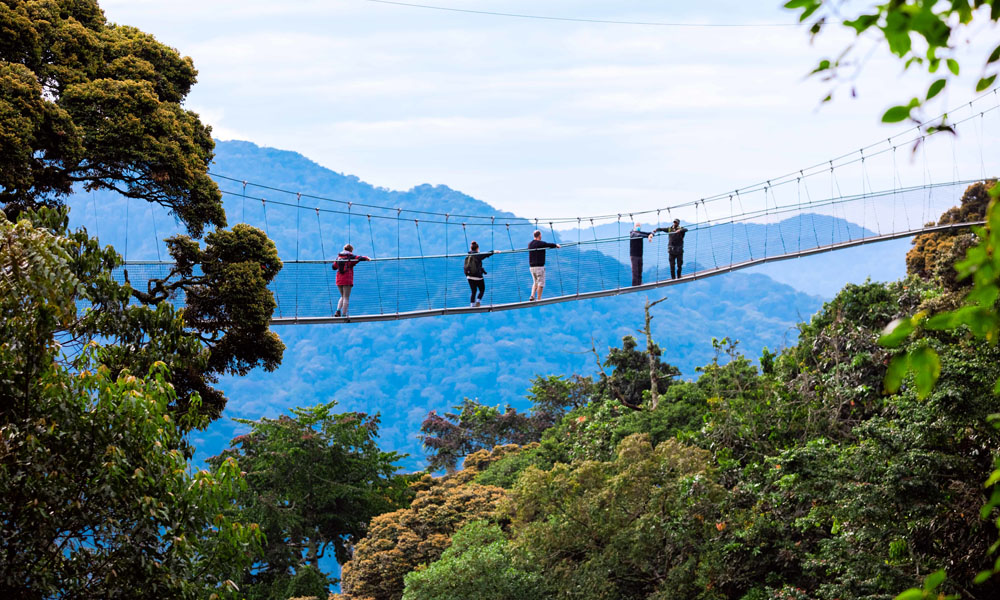
Suspended high above a deep, verdant ravine, Nyungwe’s iconic Canopy Walkway offers an exhilarating, bird's-eye perspective on the ancient rainforest. This engineered suspension bridge stretches 160 meters in length and hangs a thrilling 50 meters above the forest floor, divided into three stable, interconnected sections. The adventure begins with a scenic hike along the Igishigishigi Trail, descending gradually to the launch platform.
As you step onto the narrow walkway, the ground falls away, replaced by an endless, rolling sea of emerald leaves and misty mountain ridges stretching toward the horizon. Walking among the treetops puts you eye-to-eye with colorful birds, rare orchids, and curious primates that rarely descend to the forest floor. The gentle swaying of the bridge, combined with the vastness of the ancient canopy unfolding beneath your boots, creates an adrenaline-fueled rush balanced by a profound, peaceful sense of weightless isolation.
Forest Ziplining
For thrill-seekers looking to inject a high-octane burst of adrenaline into their Rwandan wilderness adventure, the forest zipline course offers an unmatched aerial rush. This custom-engineered course features heavy-duty steel cables strung securely between ancient, sturdy hardwood trees, allowing you to glide effortlessly over the deep valleys of the montane rainforest.
Before clipping onto the line, professional guides fit you with a safety harness and provide a thorough briefing on proper braking techniques and tandem riding. Once you step off the launch platform, you accelerate rapidly, wind rushing past your face as you soar high above the canopy floor. The true magic of the zipline is the sheer sensation of flight, leaving the forest floor behind to slice through the mountain air. It provides a quick, heart-pounding rush that contrasts beautifully with slow forest hiking, delivering panoramic views of distant ridges in a blur of emerald green.
Hiking & Waterfall Trails
Isumo Waterfall Hike
The Isumo Waterfall Hike is an exciting, half-day trek that stands as one of the most popular and rewarding trail experiences in Nyungwe. Spanning roughly 5.3 kilometers, the trail begins by winding through green, manicured tea estates before plunging into the cool, dark embrace of the dense rainforest. As you descend along the damp trail, the terrain becomes rugged, taking you past dense stands of tree ferns, moss-covered logs, and wild banana trees.
The air grows noticeably cooler and more humid as you approach the floor of the steep ravine. Soon, the gentle rustle of leaves is replaced by a thunderous, deep rumble. The trail culminates at a wooden viewing platform directly facing the spectacular Isumo waterfall, where a powerful river plunges 17 meters through a narrow rock chasm into a churning pool below, creating a permanent mist that feeds rare, delicate ferns.
Igishigishigi Trail
The Igishigishigi Trail is a short, manageable, and highly accessible route that serves as the primary gateway for the famous canopy walkway. Stretching just 2.4 kilometers, this loop trail is ideal for travelers seeking a gentle introduction to the forest without the physical strain of full-day trekking. The path is named after the giant tree ferns (Igishigishigi) that dominate this sector, creating a primeval landscape that feels frozen in time.
As you walk along the well-maintained dirt path, your guide will point out colorful wildflowers, structural buttress roots, and small forest birds flitting through the undergrowth. Because the trail follows a high ridge line, it offers beautiful, framed views of the valleys below through clear openings in the foliage. It requires a moderate level of fitness, making it a perfect, family-friendly option that combines light exercise with the high-altitude thrills of the suspension bridge.
Imbaraga Trail
Designed specifically for serious trekkers and endurance enthusiasts, the Imbaraga Trail is a grueling, full-day hike that demands excellent physical fitness and stamina. The word Imbaraga translates directly to "strength" in Kinyarwanda, a fitting name for a steep, 10-kilometer route that continuously ascends and descends across deep forest ridges and valleys.
[Imbaraga Trail Elevation & Highlights]
├── Start ────────► Uwinka Reception Center (High-altitude ridge line)
├── Technical ────► Steep, slick single-track descents into deep ravines
└── Rewards ──────► Tracking past 4 distinct waterfalls through dense canopy
The immense physical effort required to conquer this trail is richly rewarded by its incredible scenery. This unique route takes you past four distinct, spectacular waterfalls rushing through the dense vegetation. Each waterfall features its own unique pool and micro-climate, providing beautiful rest spots where you can wash the red forest mud from your hands and listen to the water echo off the stone walls. It is a raw look into the park’s pristine, untamed interior.
Congo-Nile Divide Trail
The Congo-Nile Divide Trail is the ultimate, multi-day wilderness expedition for backpackers looking to immerse themselves completely in East Africa's geography. This extensive, multi-day trek follows the literal spine of the park—the high ridge line that separates the massive drainage basins of the Nile and Congo river systems. Over several days of demanding hiking, trekkers traverse a diverse mosaic of ecosystems, moving from high-altitude bamboo forests and open heathlands to dark, primary rainforest valleys.
The trail features continuous elevation shifts, testing your physical endurance while offering panoramic, sweeping views of Lake Kivu and the distant, smoky volcanic peaks of the Virunga chain. Sleeping at designated wilderness campsites along the ridge allows you to watch the sunset over the African continent. It is a profound journey of self-discovery that connects you to the ancient trade paths and major geographical features shaping Central Africa.
Kamiranzovu Marsh Trail
The Kamiranzovu Marsh Trail takes you on an intriguing descent into a massive, ancient caldera that forms a high-altitude wetland ecosystem within the heart of the park. Spanning roughly 4 kilometers, this specialized trail features a network of wooden boardwalks that allow you to walk safely over the damp, unstable soils of the swamp. The marsh acts as a giant natural sponge, regulating the water flow for the entire forest and feeding distant river systems.
For botanists and birdwatchers, Kamiranzovu is an absolute paradise. The unique, waterlogged soil chemistry fosters an extraordinary array of rare plant life, including giant swamp orchids, carnivorous sundews, and prehistoric marsh ferns. As you walk through the low canopy, you can listen for the distinct calls of localized swamp-dwelling birds, making this trail an exceptional choice for travelers interested in the park's specialized water ecosystems and unique plant adaptations.
Ngabwe Trail
The Ngabwe Trail is a highly versatile, 4.7-kilometer loop that offers a beautiful escape for hikers seeking a peaceful, uncrowded wilderness experience. Situated near the eastern entrance of the park, this moderate trail winds through a diverse sequence of distinct vegetation zones, moving from secondary forest growth and thick bamboo stands into open, airy heathlands. The trail is designed with relaxation in mind, featuring a beautifully clearing complete with a designated picnic site and a basic wilderness camping ground.
From the high viewing platforms along the route, you can enjoy lovely panoramic views of the surrounding hills and nearby tea plantations. Ngabwe is also highly regarded for its frequent primate sightings; silver monkeys and L'Hoest's monkeys are regularly spotted foraging in the branches along the path, making it an excellent all-around option for a relaxed morning walk combined with a packed bush lunch.
Umugote Trail
The Umugote Trail is a moderate, highly scenic 3.6-kilometer trek that delivers some of the most breathtaking panoramic vistas in the western sector of the park. The path is named after the local Umugote tree, a species known for its dense, dark bark and medicinal leaves. The trail follows a high, narrow ridge line, climbing steadily through pristine montane forest until you emerge onto open viewing clearings.
On clear mornings, the ridge offers spectacular, unobstructed views extending all the way to the blue waters of Lake Kivu and the distant, dramatic mountains of the Democratic Republic of Congo. Beyond the sweeping landscapes, the Umugote trail is an excellent corridor for viewing wildlife. Large troops of colobus monkeys and blue monkeys routinely cross the trail, while the high canopy is filled with vocal hornbills and turacos, making it a favorite for travelers seeking maximum visual reward with moderate physical effort.
Rukuzi Trail
The Rukuzi Trail is a challenging, multi-purpose route that is highly celebrated by primate enthusiasts and birdwatchers alike. This winding path covers roughly 9 kilometers and requires several hours of focused hiking across undulating, sometimes slick forest terrain. The trail is strategically designed to cut through prime chimpanzee foraging territory, making it a frequent alternative route used by park trackers during morning chimpanzee tracking excursions.
Even if you don't encounter a chimp community, the trail is an exceptional birdwatching corridor, cutting through mature, primary forest where fruit-bearing trees attract a high concentration of colorful canopy birds. The demanding physical climbs along the loop are balanced by spectacular, framed clearings that offer sweeping views of the surrounding valleys, providing an immersive wilderness experience that showcases the true, wild essence of Nyungwe’s deep interior forest.
Nature & Birding
Bird Watching
Nyungwe Forest is widely celebrated as one of Africa’s premier birdwatching destinations, functioning as a vital refuge for avian enthusiasts worldwide. The ancient montane forest supports over 300 recorded bird species, including an incredible 29 Albertine Rift endemics—species found nowhere else on earth. Setting out along the forest trails with an expert ornithological guide, equipped with high-quality binoculars, reveals a multi-colored, highly vocal world hidden within the thick foliage.
[Albertine Rift Avian Highlights]
├── Rwenzori Turaco ──► Brilliant crimson wing panels flashing through the canopy
├── Grauer's Warbler ─► Elusive, vocal insect-feeder dwelling in dense bamboo
└── Regal Sunbird ────► Iridescent metallic green and red plumage near wild flowers
Guides scan the high branches to spot the iconic Rwenzori turaco, famous for its brilliant crimson wing panels that flash dramatically during flight. In the dense bamboo, you might hear the elusive Grauer's warbler, while the bright, metallic feathers of the regal sunbird add color to flowering bushes. The morning chorus fills the mist with complex songs, making every birding excursion an unforgettable safari experience.
Butterfly Watching
While the park’s massive mammals and colorful birds often capture the spotlight, Nyungwe’s smaller inhabitants create an equally mesmerizing wildlife display. The park is home to an astonishing population of over 120 recorded butterfly species, a high percentage of which are endemic to the unique micro-climates of the Albertine Rift valley. Walking along the sun-dappled paths and riverbeds during the warm midday hours reveals a fluttering world of color.
Massive forest swallowtails with intricate geometric patterns glide through the clearings, while brilliant blue charaxes dart rapidly between patches of damp soil to mineral-feed. Specialized guides help you identify these delicate insects, explaining their complex lifecycles, their defensive camouflage strategies, and their vital ecological role as primary pollinators within the rainforest. It is a peaceful, fascinating activity that adds a rich layer of appreciation for the intricate, interconnected systems that keep this ancient ecosystem thriving.
Nocturnal Forest Walks
When the sun dips below the western ridges and standard trail operations close, a completely different ecosystem wakes up within the dark rainforest. Joining a guided nocturnal forest walk allows you to explore the jungle after dark, using powerful flashlights to pierce the pitch-black shadows. Walking quietly along the trails, your senses instantly shift, tuning in to the sounds of chirping tree frogs, calling owls, and the rustle of leaves.
Your guide will use specialized spot-lighting techniques to find the bright, reflecting eyes of rare nocturnal primates, including lesser bushbabies and elusive pottos climbing through the branches. The flashlights also reveal slow-moving chameleons sleeping on low twigs, nocturnal tree hyraxes, and fascinating patches of bioluminescent, glowing fungi growing on decaying logs. It is a thrilling sensory adventure that unveils the secretive, nighttime behaviors of the rainforest’s most elusive residents.
Culture & Relaxation
Gisakura Tea Plantation Tour
To fully understand the landscape surrounding Nyungwe, a tour of the emerald-green Gisakura Tea Estate is an absolute priority. These rolling, manicured tea fields hug the steep boundaries of the national park, creating a striking visual contrast where the wild rainforest meets orderly rows of bright green shrubs. Joining a guided tour allows you to walk through the fields alongside local farmers, learning the delicate art of hand-picking the youngest tea leaves.
[The Leaf-to-Cup Tea Process]
Plucking ──► Hand-selecting top two leaves and a bud in the fields
Withering ──► Reducing moisture content on large, ventilated indoor trays
Processing ─► Rolling, fermenting, drying, and grading inside the factory
The experience moves from the fields into the processing factory, where you can watch the traditional withering, rolling, and drying processes that give Rwandan tea its rich flavor. The tour concludes with a premium, guided tea tasting session, letting you sip freshly brewed tea while looking out over the misty hills, providing a relaxing look into the region's agricultural heritage.
Visit the Banda Cultural Village
An authentic Rwandan safari is completely enriched by exploring the rich human history and cultural heritage of the communities living along the forest fringes. Nestled in a valley near the heart of the park, the Banda Cultural Village offers an extraordinary opportunity for genuine cultural exchange. Upon arriving, visitors are greeted with an explosion of color, traditional rhythm, and song as community members perform welcoming dances accompanied by deep, resonant drumming.
During the guided tour, elders demonstrate traditional skills passed down through generations, including the art of weaving baskets, grinding local grains, and processing traditional plant medicines. You can watch local blacksmiths forge iron tools and even participate in the preparation of traditional Rwandan dishes. It is a humbling, eye-opening experience that provides vital tourism revenue directly to the community, fostering local conservation support for the park.
Museum of the Environment
Located just a short drive from the park boundaries on the shores of Lake Kivu in Rusizi, the Museum of the Environment is a world-class educational facility that provides valuable context for your wilderness journey. This modern, multi-story museum features fascinating, interactive exhibits focusing on local ecology, climate change, and renewable energy systems. A highlight of the collection is the traditional medicine section, showcasing a live botanical garden on the roof.
Here, you can learn about the specific leaves, roots, and barks harvested from the region to treat ailments for centuries. The exhibits clearly explain the complex environmental challenges facing the Albertine Rift ecosystem and highlight the intense conservation efforts required to protect Rwanda’s natural heritage. Visiting the museum before or after your forest treks deepens your understanding of the fragile balance between human development and wilderness preservation.
Forest Camping
For adventure purists seeking the ultimate immersive wilderness experience, forest camping offers a thrilling opportunity to spend the night enveloped by the primeval rainforest. Designated, secure wilderness campsites like the Uwinka Ridge camp feature basic facilities, including wooden tent platforms and covered cooking clearings, allowing you to sleep safely under a canopy of stars. As the evening mist rolls over the ridges, campers gather around a crackling campfire to share stories and enjoy a hot meal.
[Uwinka Ridge Camping Experience]
Setting ─────► High-altitude ridge platform completely surrounded by primary forest
Soundscape ──► Tree hyrax calls, distant primate hoots, and morning bird choruses
Atmosphere ──► Crackling campfires, heavy mountain mist, and pristine starry skies
Falling asleep to the raw soundscape of the jungle—the calls of tree hyraxes and the rustle of nearby wildlife—provides a deep connection to nature. Waking up at dawn to watch the sunrise pierce through the heavy mountain mist, surrounded by the first vocal choruses of turacos and hornbills, delivers an unforgettable safari highlight that standard concrete lodges simply cannot replicate.
1. What are the top activities in Nyungwe Forest?
Nyungwe National Park stands as one of Africa’s oldest and most pristine montane rainforests, functioning as a vital biodiversity hotspot that offers a diverse array of immersive eco-tourism experiences. The absolute crown jewel of the park’s activity portfolio is primate tracking, with specialized tracking excursions designed to bring travelers face-to-face with habituated chimpanzee communities and massive mega-troops of acrobatic Ruwenzori colobus monkeys. These primate encounters are beautifully complemented by an extensive network of structured hiking trails that wind through deep ravines, thick bamboo zones, and ancient valleys to reveal spectacular forest waterfalls.
For those seeking an elevated view of the rainforest, the iconic Canopy Walkway provides an unforgettable aerial adventure. Suspended high above a lush ravine, this engineered suspension bridge places you eye-to-eye with the canopy’s unique wildlife. Avian enthusiasts from around the world are drawn to Nyungwe for its world-class birdwatching opportunities, searching for localized endemics along the misty ridges.
[Nyungwe Forest Premium Activity Mix]
├── Aerial Adventures ──► Walking the 160m suspension Canopy Walkway bridge
├── Primate Tracking ───► Early-morning chimpanzee and colobus mega-troop treks
└── Cultural Tourism ───► Guided tea plantation walks and community boma visits
The adventure continues after dark with guided nocturnal forest walks that unveil a secretive, nighttime world of glowing fungi and sleeping chameleons. Beyond the park's boundaries, travelers can transition from the wild jungle to manicured cultural landscapes by embarking on guided tea plantation tours or participating in traditional community experiences at the Banda Cultural Village. Whether your primary focus is high-octane physical trekking, slow-paced botanical exploration, or authentic cultural exchange with the communities bordering the forest, Nyungwe delivers a deeply rewarding, multi-layered safari destination that showcases the very best of Rwanda’s natural heritage.
2. Can I track chimpanzees in Nyungwe?
Yes, chimpanzee tracking is the flagship wildlife attraction in Nyungwe National Park, offering travelers a profound opportunity to observe humanity’s closest living relatives in their natural habitat. The park serves as a critical sanctuary for a significant population of eastern chimpanzees (Pan troglodytes schweinfurthii), with two primary communities carefully habituated for sustainable tourism. The first community resides within the main, continuous block of the Nyungwe forest, accessible from the Cyamudongo or Uwinka sectors, while the second, highly successful community lives within the isolated Cyamudongo forest fragment located just a short drive outside the main park boundaries.
Tracking operations begin in the cool, pre-dawn mist at approximately 5:00 AM, where guests gather at designated park reception centers for a vital safety and behavioral briefing. Advanced teams of park trackers depart even earlier, moving silently through the deep jungle to locate the exact trees where the chimpanzees built their nests the previous evening.
[Chimpanzee Tracking Operations]
├── 05:00 AM ──► Rendezvous at park center for safety & tracking briefing
├── 05:30 AM ──► Vehicle transfer to trailheads in Cyamudongo or Uwinka
└── 06:00 AM ──► Deep forest trek guided by real-time tracker radio communication
Once the trackers locate the community by listening for their vocalizations, they radio your guide to direct your path. The ensuing trek can be physically demanding, requiring hikers to navigate steep, mud-slick single tracks and dense vegetation.
When you successfully catch up with the community, you are permitted one unforgettable hour of viewing from a safe distance. Watching the chimpanzees swing effortlessly through the canopy, groom one another on the forest floor, and communicate with booming pant-hoots that echo across the valley is a heart-pounding spectacle that reveals the raw power, intelligence, and complex social bonds of these magnificent great apes.
3. What is the Canopy Walkway?
The Canopy Walkway in Nyungwe National Park is one of East Africa’s most celebrated pieces of eco-tourism infrastructure, offering an exhilarating, high-altitude perspective on the ancient montane rainforest. Custom-engineered and opened to the public to provide a non-intrusive way to explore the upper layers of the forest, this spectacular suspension bridge stretches an impressive 160 meters in length and hangs at a thrilling height of 70 meters directly above a steep, verdant wilderness ravine. The walkway is divided into three stable, interconnected metallic sections, anchored securely to massive hardwood trees and rocky outcrops on either side of the valley.
The journey to the walkway begins at the Uwinka Reception Center, where travelers embark on a guided hike along the scenic Igishigishigi Trail. This 2.4-kilometer path descends gradually through ancient tree ferns and moss-covered valleys, providing an excellent warm-up walk before reaching the bridge’s main launch platform.
As you step onto the narrow walkway, the forest floor drops away dramatically, replaced by an endless, rolling sea of emerald leaves and misty mountain ridges stretching toward the distant horizon.
[Canopy Walkway Structural Blueprint]
├── Total Length ────► 160 meters divided across 3 stable suspension spans
├── Maximum Height ──► 70 meters hanging directly above a dense river ravine
└── Primary Access ──► Accessed via the 2.4km Igishigishigi loop trail
Walking among the treetops places you directly within the sun-drenched canopy zone, offering close-up encounters with colorful birds, rare epiphytic orchids, and curious primates like blue monkeys that rarely descend to the dark forest floor. The gentle, secure swaying of the bridge combined with the vastness of the primary forest unfolding beneath your boots creates a perfect blend of adrenaline and peaceful isolation.
4. How many primate species live in the park?
Nyungwe National Park is celebrated as one of the richest and most evolutionary significant primate sanctuaries on the entire African continent, proudly hosting an astonishing 13 distinct species of primates within its boundaries. This remarkable diversity represents nearly a quarter of all primate species found in Africa, turning the park into a critical living laboratory for primatologists and an absolute paradise for wildlife enthusiasts. The high concentration of species is made possible by the forest’s dramatic elevation shifts and diverse plant communities, which create unique vertical layers that support different species.
[Nyungwe Canopy Layers]
Upper Canopy (Fruit & Leaves)
* Eastern Chimpanzees
* Ruwenzori Colobus Mega-Troops
│
▼
Mid-Canopy (Insects & Twigs)
* Grey-Cheeked Mangabeys
* Owl-Faced Monkeys
▲
│
▼
Undergrowth & Bamboo (Shoots)
* L'Hoest's Monkeys
* Golden Monkeys
In the highest zones of the upper canopy, eastern chimpanzees swing through the trees alongside the park’s famous Ruwenzori colobus monkeys, which form acrobatic mega-troops exceeding several hundred individuals. Moving into the mid-canopy layers, you can spot large family groups of grey-cheeked mangabeys, silver monkeys, blue monkeys, red-tailed monkeys, and velvet-furred vervet monkeys foraging for fruits and insects.
The dense bamboo zones and tangled undergrowth are home to the beautiful L'Hoest's monkey, easily recognized by its striking white collar and dark coat, as well as the deeply secretive, rare owl-faced monkey, named for its avian-like facial features and vertical nose stripe. The primate list is completed by the park’s elusive nocturnal residents, including lesser bushbabies (galagos) and pottos, which are spotted during guided night walks, demonstrating the incredible evolutionary success of primates in this ancient forest ecosystem.
5. Is bird watching good in Nyungwe?
Absolutely. Nyungwe National Park is recognized by BirdLife International as one of the most important and rewarding birdwatching destinations in Africa, functioning as a vital refuge for avian enthusiasts worldwide. The park’s ancient, primary montane forest supports over 300 recorded bird species, a remarkable number given the high altitude of the terrain. More importantly, Nyungwe hosts an incredible 27 Albertine Rift endemics—species whose global range is strictly confined to the unique mountain chain running along the borders of Rwanda, Uganda, and the Democratic Republic of Congo.
Species Common Name
Scientific Classification
Key Visual Identifiers
Rwenzori Turaco
Gallirex johnstoni
Brilliant crimson wing panels, blue-green body
Shelley's Crimson-wing
Cryptospiza shelleyi
Bright red back and face, extremely rare
Regal Sunbird
Cinnyris regalis
Iridescent metallic green and yellow breast
Grauer's Swamp Warbler
Bradypterus graueri
Small, streaked throat, specialized marsh dweller
Setting out along the forest trails at dawn with a specialized park ornithological guide reveals a multi-colored, highly vocal world hidden within the thick foliage. Guides use specialized call playbacks and directional microphones to help you spot the iconic Rwenzori turaco, famous for its brilliant crimson wing panels that flash dramatically through the green canopy during flight.
In the high, mossy branches, you can seek out the iridescent regal sunbird or the striking handsome francolin. Exploring the wetland zones allows you to look for the endangered Grauer's swamp warbler, while the hyper-elusive Shelley’s crimson-wing remains one of the ultimate targets for birders. The complex morning chorus fills the mountain mist, ensuring that every birding excursion delivers new additions to your checklist.
6. Are there hiking trails in the forest?
Yes, Nyungwe National Park features an exceptional, masterfully maintained network of 13 designated hiking trails, offering over 130 kilometers of walking paths that allow travelers to explore the inner mechanics of the rainforest on foot. These trails are designed to accommodate a wide spectrum of physical fitness levels and schedules, ranging from brief, 1-hour introductory nature loops to grueling, full-day wilderness expeditions. Each trail is named after a defining botanical feature, geographic landmark, or animal resident found along its route, providing an educational narrative for your trek.
For casual walkers or those short on time, trails like the Igishigishigi or the Buhoro loop offer gentle terrain with minimal elevation shifts, focusing on giant tree ferns and rich birdlife near the park headquarters. Hikers seeking a moderate challenge can opt for the Umugote Trail, known for its ridge views stretching to Lake Kivu, or the Rukuzi Trail, which cuts through prime chimpanzee foraging territory.
[Nyungwe Trail Difficulty Spectrum]
├── Easy Loops (1-3 Hours) ─────► Igishigishigi & Buhoro Trails (Ferns & Birds)
├── Moderate Ridges (3-5 Hours) ─► Umugote & Rukuzi Trails (Lake Views & Primates)
└── Strenuous Treks (6-8 Hours) ─► Imbaraga & Congo-Nile Divide (Waterfalls & Peaks)
For endurance enthusiasts, the park offers the challenging Imbaraga Trail, a steep route that takes hikers past four spectacular forest waterfalls, and the ultimate Congo-Nile Divide Trail, a multi-day backpacking trek that follows the high ridge separating Africa’s two largest river basins. Every trail requires the accompaniment of an official park guide, ensuring your safety while enriching your journey with insights into traditional medicinal plants, animal tracking, and forest ecology.
7. What is the Kamiranzovu Waterfall trail?
The Kamiranzovu Waterfall Trail is one of the most dynamic and popular hiking excursions in Nyungwe National Park, taking travelers on an unforgettable journey into a dramatic, prehistoric landscape. This trail is unique because it combines two distinct ecological gems: a trek through the heart of the ancient Kamiranzovu Swamp followed by a descent to a spectacular forest waterfall. The entire route covers roughly 4 kilometers and typically requires 4 to 5 hours of focused hiking, featuring an initial steep descent into a low caldera that traps moisture for the entire ecosystem.
The first phase of the trail utilizes an engineered network of wooden boardwalks that allow you to walk safely over the damp, unstable peat soils of the Kamiranzovu Swamp—the largest high-altitude wetland in the region. This waterlogged environment is an absolute paradise for botanists, fostering an extraordinary array of rare orchids, carnivorous sundew plants, and giant marsh ferns that look frozen in time.
[Kamiranzovu Trail Profile]
├── Terrain ─────► High-altitude wetland boardwalks transitioning to steep ravines
├── Highlight ───► The thundering Kamiranzovu waterfall dropping into a narrow chasm
└── Vegetation ──► Rare swamp orchids, carnivorous sundews, and ancient mosses
As you move past the marsh, the trail shifts into a dense, humid river gorge where the gentle rustle of leaves is gradually replaced by a deep, thunderous roar. The trail culminates at a wooden viewing platform directly facing the spectacular Kamiranzovu Waterfall, where a powerful river plunges dramatically through a narrow rock chasm into a churning pool below. The heavy mist created by the crashing water feeds rare ferns and mosses, providing a cool, atmospheric rest stop before the challenging climb back up the ridge.
8. Can I see Colobus monkeys?
Yes, you can absolutely trek to see the large, habituated troops of Ruwenzori colobus monkeys (Colobus angolensis ruwenzorii) in Nyungwe National Park, which stands as one of the premier locations in the world to observe these unique primates up close. While chimpanzees often capture the main spotlight, colobus monkey trekking is widely considered an equally spectacular and highly entertaining wildlife activity. Nyungwe’s colobus monkeys are unique because they form massive "mega-troops" that regularly exceed 300 to 400 individuals, representing some of the largest primate aggregations ever recorded on earth.
Setting out on a colobus trek with an expert park guide brings you into contact with these beautiful, masterfully coordinated primates. They are easily identified by their striking, glossy jet-black coats, which contrast sharply with long, flowing white capes of fur along their shoulders, white whiskers, and magnificent, fluffy white-tipped tails.
Watching a mega-troop move through the high forest canopy is a breathtaking visual display. You can stand safely on the trail below and look up for hours as dozens of monkeys launch themselves across massive gaps in the trees, performing gravity-defying, acrobatic leaps from branch to branch.
The energy of the troop is continuous; playful juveniles wrestle in the moss-covered branches, dominant males emit deep barking calls to maintain order, and attentive mothers can be seen cradling tiny, completely white infants. The high density of the troop and their habituated nature make this activity an absolute dream for wildlife photographers seeking action frames.
9. Can I go biking in the park?
Yes, biking is an available activity in the Nyungwe forest region, offering active travelers a high-energy, adrenaline-pumping alternative to exploring the mountain terrain purely on foot. Biking within this landscape is a unique adventure, tracing the dramatic outer contours of the national park and taking riders along the spectacular Congo-Nile Trail network that runs parallel to the forest boundaries and the shores of nearby Lake Kivu. Because the terrain features continuous, steep elevation shifts, biking here is physically demanding but rewards riders with sweeping views.
[Nyungwe Forest Biking Logistics]
├── Terrain ─────► Rugged dirt single tracks, steep gravel inclines, and muddy passes
├── Route ───────► Tracing the outer forest contours along the Congo-Nile network
└── Highlights ──► Panoramic vistas of emerald tea estates and distant Lake Kivu
The biking paths wind through a beautiful mosaic of landscapes, moving rapidly from the cool, dark edges of the primary rainforest into rolling, emerald-green tea estates and vibrant rural Rwandan villages. Riding a high-quality mountain bike allows you to cover significantly greater distances than a standard walking safari, slicing through the crisp mountain air while tackling challenging dirt tracks, gravel inclines, and muddy sections.
Along the route, local children often run alongside the bikes, cheering you up the steep hills, providing an authentic layer of community interaction. Biking excursions can be tailored from short, half-day rides to multi-day cycling expeditions complete with overnight stays at community-run campsites, making it an excellent option for fitness enthusiasts looking to test their limits against Rwanda’s "thousand hills."
10. Are there cultural or community tours?
Yes, an authentic safari to Nyungwe National Park is completely enriched by exploring the human history, traditional agricultural life, and cultural heritage of the communities living along the forest fringes. For decades, local communities have transitioned from forest dependency to active partners in conservation. Engaging in cultural tourism tours offers travelers an extraordinary opportunity for genuine cultural exchange while ensuring that vital tourism revenue directly supports local community development and conservation incentives.
One of the most popular cultural excursions is a guided tour of the Gisakura Tea Estate, which hugs the steep boundaries of the national park to create a striking visual contrast where the wild rainforest meets orderly rows of bright green tea shrubs. Walking through the fields alongside local farmers allows you to learn the delicate art of hand-picking the youngest tea leaves before touring the processing factory to witness the withering and drying methods. The tour concludes with a premium tea tasting session, letting you sample some of Rwanda's finest agricultural products.
[Banda Cultural Village Exchange]
├── Traditional Welcomes ──► High-energy drumming, singing, and Intore warrior dances
├── Survival Skills ───────► Demonstrations of traditional basket weaving and iron forging
└── Bush Medicine ─────────► Learning how local elders harvest forest plants for healing
Alternatively, you can visit the Banda Cultural Village, nestled in a valley near the heart of the park. Here, visitors are greeted with high-energy drumming and traditional songs. Local elders demonstrate traditional skills passed down through generations, including basket weaving, iron forging, and the preparation of local foods, providing an eye-opening look into traditional Rwandan life.
11. Can I hike Mount Bigugu?
Yes, climbing Mount Bigugu is an absolute priority for serious mountaineers, endurance hikers, and birdwatchers looking to conquer the ultimate physical challenge within Nyungwe National Park. Standing at an impressive elevation of approximately 2,950 meters (9,678 feet) above sea level, Mount Bigugu is the absolute highest peak inside the national park boundaries. Hiking this rugged mountain offers a strenuous, full-day expedition that tests your stamina while taking you through a fascinating sequence of distinct, altitude-dependent vegetation zones.
The trail covers roughly 7 kilometers to the summit and requires 6 to 8 hours of focused, physically demanding hiking. The path starts steeply, winding through dense primary montane forest before transitioning into thick stands of bamboo. As you ascend higher past the 2,500-meter mark, the tall canopy gives way to an eerie, beautiful alpine heathland dominated by giant lobelias, rare wildflowers, and moss-draped heather trees that feel completely removed from the tropical world below.
[Mount Bigugu Elevation Track]
2,950m ──► Summit Platform (Panoramic vistas of Lake Kivu & Virunga Volcanoes)
2,500m ──► Alpine Heathland (Giant lobelias, moss-covered heather trees)
2,000m ──► Bamboo & Primary Montane Forest (Start of the steep single-track ascent)
The peak is also highly regarded as a prime birdwatching corridor, hosting several rare high-altitude species like the red-collared mountain babbler. Reaching the summit platform rewards hikers with sweeping, panoramic views on clear days. You can look out across the entire rolling expanse of the Nyungwe canopy, see the blue waters of Lake Kivu in the distance, and even spot the smoky volcanic peaks of the Virunga chain along the northern horizon, providing a profound sense of accomplishment.
12. Are night walks allowed?
While general, unescorted wandering after dark is strictly prohibited inside the park to protect visitor safety and preserve the natural hunting rhythms of wild predators, you can easily arrange official, guided nocturnal forest walks through the park management. These specialized night tours offer a thrilling, high-yield sensory shift, allowing you to leave your lodge after dinner and step into the pitch-black shadows of the rainforest with an expert park naturalist armed with powerful, specialized spotlights.
When the sun dips below the western ridges, an entirely different wildlife ecosystem wakes up within the jungle. Walking quietly along the damp trails, your hearing becomes sharp, tuning in to a complex soundscape filled with the clicking of tree frogs, the calling of owls, and the eerie, vibrating shrieks of tree hyraxes echoing through the canopy. Your guide will use expert spot-lighting techniques to find the bright, reflecting eyes of rare nocturnal primates, including lesser bushbabies (galagos) and elusive pottos moving slowly through the high branches.
[Nocturnal Forest Walk Finder]
├── Reflective Eyes ──► Spotting lesser bushbabies and pottos climbing the canopy
├── Camouflage ───────► Finding three-horned chameleons sleeping on low twigs
└── Bioluminescence ──► Tracking glowing patches of natural fungi on decaying wood
The flashlights also reveal fascinating smaller creatures that are masterfully camouflaged or hidden during the day. You can regularly spot rare three-horned chameleons resting motionlessly on low branches, massive forest moths, and unique nocturnal birds.
Furthermore, turning off your flashlights for a moment reveals beautiful patches of bioluminescent, glowing fungi growing on decaying logs along the forest floor, casting a natural light that underscores the mystery of the rainforest after dark.
13. What should I pack for these activities?
Packing for an expedition to Nyungwe National Park requires careful preparation, as the environment is a high-altitude, tropical montane rainforest where weather conditions can shift rapidly from hot, humid sunshine to heavy, driving downpours within a matter of minutes. The golden rule of packing for Nyungwe is prioritizing durable, waterproof, and protective gear designed to handle long hours navigating steep, mud-slick terrain while protecting you from biting insects and thorny vegetation.
[The Nyungwe Gear Blueprint]
├── Footwear ────► Sturdy, ankle-high waterproof hiking boots with deep tread patterns
├── Protection ──► Gore-Tex rain jacket, long-sleeved layers, and tough gardening gloves
└── Essentials ──► Deet-based insect repellent, 2L water capacity, and dry bags for cameras
First and foremost, invest in a pair of high-quality, ankle-high waterproof hiking boots featuring deep tread patterns to provide traction on slippery slopes. Pair these with durable gaiters to prevent mud and biting ants from entering your boots. Your wardrobe should focus on lightweight, long-sleeved shirts and long trousers to shield your skin from stinging nettles and insects; tucking your pants into your socks is a standard safari practice here.
Pack a premium, breathable rain jacket (such as Gore-Tex) and a warm fleece layer, as temperatures drop rapidly during early morning tracking sessions. A pair of tough, simple gardening gloves is highly recommended for chimpanzee tracking, allowing you to grab onto wet vines and muddy branches for support without getting stung or cut. Finally, carry a lightweight backpack containing a dry bag to protect your camera gear, high-strength insect repellent containing DEET, and a minimum of two liters of drinking water to maintain hydration on the steep trails.
14. Do I need to book activities in advance?
Yes, booking all activities in advance is an absolute necessity when planning a safari to Nyungwe National Park. Unlike traditional savanna parks where visitors can simply arrive at the gate and purchase entry permits on the fly, Nyungwe operates under a strict, sustainable eco-tourism management system that caps daily visitor numbers for its most iconic attractions. This strict regulation ensures that the park’s habituated primate communities are protected from over-exposure and stress, while preserving an exclusive, uncrowded experience for travelers on the trails.
Permits for flagship activities—most notably Chimpanzee Tracking and the Canopy Walkway—are highly sought after and limited to a small number of participants per day. During the peak dry season months, these permits routinely sell out six to twelve months in advance. Attempting to book these excursions upon arrival at the park will almost certainly result in disappointment, forcing you to miss out on the park's star attractions.
[Permit Booking Channels]
Option A: Direct booking via the official Visit Rwanda online platform (Irembo)
Option B: Full-service booking managed by your registered East African tour operator
To secure your permits, you can either book directly through the official government portal (Visit Rwanda via the Irembo platform) or have your registered tour operator handle the logistical bookings as part of a comprehensive safari package. Advanced booking also allows the park authorities to properly allocate expert guides and trackers across the different sectors, ensuring a seamless arrival. Once your permits are paid for and confirmed, you will receive official digital vouchers that must be presented alongside your passport at the Uwinka or Gisakura reception centers on the day of your activity.
15. What is the best time of year to visit?
While Nyungwe National Park is a pristine, year-round destination where wildlife and primates are permanently resident, the optimal time of year to visit is during the region's two distinct dry seasons: the long dry season stretching from June to September and the shorter dry season from December to February. These dry windows are widely considered the ideal periods for primate tracking and mountain climbing, as rainfall is significantly lower, making the forest's steep, single-track trails far less slippery and much easier to safely navigate.
During the dry months, the clear skies and abundance of sunshine create comfortable conditions for long hours of physical exertion on trails like Mount Bigugu or the Imbaraga loop. Furthermore, the lower humidity levels and clear atmosphere provide optimal lighting conditions for wildlife photography, allowing you to capture crisp, sharp frames of chimpanzees or colobus monkeys without dealing with heavy fog or lens fogging.
[Nyungwe Seasonal Guide]
├── Dry Seasons (Jun-Sep & Dec-Feb) ──► Best for easy hiking, clear photos, less trail mud
└── Wet Seasons (Mar-May & Oct-Nov) ──► Best for chimpanzee foraging, orchids, and birds
However, the wet or "green" seasons—stretching from March to May and October to November—should not be dismissed out of hand by savvy travelers. Rainforest downpours cause fruit trees to ripen abundantly throughout the lower valleys, meaning that chimpanzee communities find a high volume of food close to the main trailheads.
During the wet months, trackers can often locate the chimps significantly faster, reducing the physical hiking time required. The rainy season also represents the absolute peak period for the forest's plant life, causing rare orchids to bloom in spectacular fashion across the Kamiranzovu swamp, while keeping the park's waterfalls rushing at their maximum, thundering capacities.
Booking Nyungwe activities with us Roads of Adventure safaris
Booking your Nyungwe Forest National Park activities with Roads of Adventure Safaris is easy. They specialize in tailoring primate and nature experiences. You can coordinate your chimpanzee trekking and canopy walks directly through their SafariBookings Profile or by reaching out to them via email or their official contact channels.
