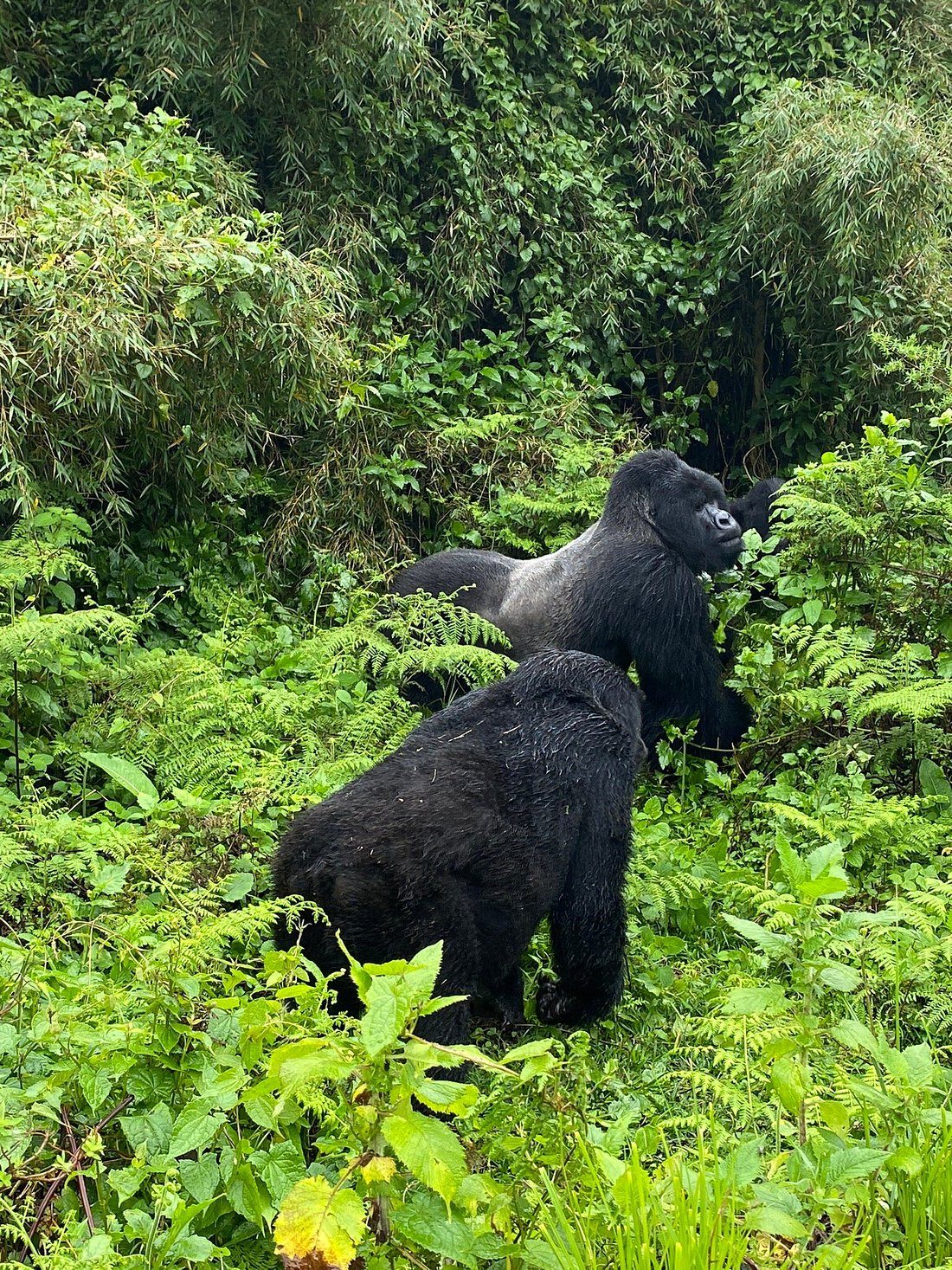
Chimpanzee tracking in Kalinzu Forest Park offers a 95% chance of encountering habituated chimpanzees, usually involving a 30-minute to 4-hour hike through hilly terrain, guided by experts. Expect a 6:00 AM briefing, a 1-hour viewing limit of the chimps, and potential sightings of other primates and birds, with fees at $50 per person.
4-days-budget-queen-elizabeth-park-and-chimpanzee-tracking-in-kalinzu-forest
2-days-best-chimpanzee-tracking-in-kibale-forest-park-tour-package
3-days-trips-to-queen-elizabeth-national-park-for-chimpanzee-tracking-in-kyambura-gorge
3-days-chimpanzee-tracking-to-kibale-forest-national-park
4-days-queen-elizabeth-national-park-and-kyambura-gorge-chimpanzee-tracking
4-days-kibale-forest-chimpanzee-tracking-and-queen-elizabeth-national-park
4-days-chimpanzee-tracking-in-lake-mburo-national-park-and-lake-mburo-safari
4-days-kibale-forest-chimpanzee-tracking-and-queen-elizabeth-national-park
4-days-murchison-falls-and-chimpanzee-tracking-in-budongo-forest
5-days-uganda-big-five-safari-and-chimpanzee-tracking-in-kibale-forest-park
6-days-jinja-white-water-rafting-gorilla-trekking-and-chimpanzee-tracking-adventure
6-days-budget-uganda-safari-and-gorilla-trekking
7-days-perfect-uganda-primate-safari-itinerary
8-days-exclusive-gorilla-trekking-chimpanzee-and-big-five
9-days-luxury-gorilla-and-uganda-safari-tour-package
1. Briefing & Guided Trek
The journey begins at the park headquarters with a mandatory briefing, usually around 7:00 AM or 8:00 AM. During this time, lead rangers explain the history of the habituated troops and the ecological importance of the forest. You are assigned to a small group of no more than eight people to ensure a low-impact visit. Following the briefing, you enter the forest led by an armed ranger. These rangers are the "eyes and ears" of the woods; they are expertly trained in tracking by identifying fresh nests, knuckle prints, and discarded fruit remains.
The trek itself is a masterclass in forest ecology. As you move through the undergrowth, your ranger will point out ancient tree species, rare butterflies, and the subtle "highways" used by the forest’s residents. Because chimpanzees are wide-ranging, the rangers use a network of trackers who head into the forest even earlier than the tourists. These trackers communicate via radio, ensuring that the trek has a very high success rate. The anticipation builds with every step, especially when the first distant "pant-hoot" vocalization echoes through the valleys, signaling that the troop is nearby and active.
2. Chimpanzee Interaction
Once you locate the troop, the "clock starts," and you are granted one hour of observation. This hour is rarely quiet. Chimpanzees are highly social and energetic, meaning you might witness a wide array of behaviors. You may see them lounging on the forest floor for a grooming session, which is vital for their social bonding, or you might look up to see them performing incredible acrobatic feats 30 meters above in the canopy as they search for figs.
If you are lucky, you might witness the intense coordination of a hunt or the boisterous display of an alpha male asserting his dominance by drumming on the buttress roots of a mahogany tree. The sound is thunderous and serves as a reminder of their immense physical strength. Because they share roughly 98% of our DNA, their gestures—a pat on the back, a playful tickle, or a stern look from a mother to her infant—are hauntingly familiar. This hour is not just about watching animals; it is about witnessing a complex, non-human society in its most raw and unscripted form.
3. Duration & Difficulty
A chimpanzee trek is an unpredictable endeavor that can last anywhere from 30 minutes to 4 hours, depending on where the chimps nested the previous night and how fast they are moving in search of food. While some groups are found just a short walk from the trailhead, others may lead you deep into the heart of the forest. This requires a moderate level of fitness.
The terrain in prime locations like Kibale (Uganda) or Nyungwe (Rwanda) is characterized by rolling hills and dense secondary growth. Trails can be steep, and because these are rainforests, they are frequently muddy and slippery. You should be prepared to "bushwhack" occasionally when the chimps move off the main paths. The pace is generally dictated by the group's slowest member, but the rangers will keep you moving to ensure you don't lose the troop. It is a physical challenge that adds to the sense of accomplishment once you finally come face-to-face with the chimps, making the sweat and effort part of the essential safari narrative.
4. Other Wildlife & Nature
While the chimpanzees are the primary draw, the forests they inhabit are some of the most biodiverse places on Earth. During your trek, you are essentially walking through a multi-story "primate city." It is very common to encounter other species, such as the Red-tailed Monkey, the shaggy Black-and-white Colobus, or the Grey-cheeked Mangabey. In Kibale specifically, you might even cross paths with the rare L'Hoest's Monkey or see signs of the elusive forest elephants.
The botanical diversity is equally staggering. You will walk beneath towering hardwoods that have stood for centuries, draped in lianas and adorned with epiphytic orchids. The forest floor is a carpet of ferns and mosses, teeming with colorful forest birds like the Great Blue Turaco or various hornbills. For many, the "secondary" sightings are just as rewarding as the main event. The forest is a sensory explosion where every rustle in the leaves could be a rare bird or a small forest antelope (duiker) darting into the shadows.
5. Rules & Restrictions
To protect both the primates and the visitors, strict rules are enforced. The minimum age is 12 years old (though this can vary by 1–2 years depending on the specific park’s regulations). This is because children may carry common childhood diseases that could be fatal to chimps, and they may be less likely to follow the silence protocols required. You must maintain a distance of 7–8 meters at all times. While the chimps may occasionally approach you, the rangers will ask you to step back to prevent the transmission of human respiratory illnesses.
Noise must be kept to a minimum; loud talking can stress the animals and cause them to move away or behave aggressively. Flash photography is strictly prohibited, as the sudden burst of light can blind or frighten the primates, potentially provoking a charge. Additionally, you are not allowed to eat or drink near the chimpanzees to prevent the risk of food snatching and the spread of germs. Following these rules ensures that the habituation process remains successful and that these incredible creatures continue to thrive in an environment where they feel safe enough to ignore human observers.
1. What is the minimum age to track chimpanzees in Kalinzu Forest?
The age limit for chimpanzee trekking is a critical conservation policy designed to protect both the primates and the younger visitors. In Kalinzu Forest Reserve, the official minimum age is generally 12 years old, though some regional wildlife regulations occasionally cite 15 to align with more stringent national park standards. This age floor is strictly enforced primarily due to health and safety concerns. Chimpanzees share approximately 98% of their DNA with humans, making them highly susceptible to human childhood diseases, such as mumps, measles, and common respiratory infections, which can be fatal to a wild population.
Furthermore, the trekking experience requires a level of emotional maturity and physical discipline. Children must be able to remain quiet and calm when a large male chimpanzee performs a vocal "pant-hoot" or beats on the buttress roots of a tree, which can be quite intimidating. Younger children might react with screams or sudden movements, which the chimpanzees could interpret as a threat or a challenge, potentially provoking an aggressive response. By the age of 12, most children have the physical stamina to handle the uneven forest floor and the impulse control necessary to follow the "no-noise" and "no-pointing" rules. This ensures the habituation of the chimps remains intact and the experience remains a peaceful observation rather than a stressful encounter for the animals.
2. How long do tracking sessions last in Kalinzu Forest Reserve?
The duration of a chimpanzee trek in Kalinzu is inherently unpredictable, typically ranging from 30 minutes to 4 hours. Unlike a zoo where animals are confined, the chimpanzees in Kalinzu are wild and free-ranging within their 137-square-kilometer habitat. The length of your journey depends entirely on where the chimpanzees decided to "nest" the previous night and how far they have traveled in search of food by the time you enter the forest.
In the early morning, trackers head out to locate the troop based on where they were last seen at dusk. If the chimps are feeding on fruit trees near the forest edge or the visitor center, your trek might be a short, pleasant stroll of less than an hour. However, if fruit is scarce in the lower elevations, the troop may move deep into the thickets or higher up the ridges. Travelers should be prepared for a "moderate" physical challenge. The clock only starts ticking the "one-hour" observation limit once you have physically made contact with the group. Therefore, the total time spent in the forest includes the hike to find them, the hour of interaction, and the hike back to the base. It is this variability that makes the "hunt" so rewarding; the longer you spend navigating the ferns and mahogany trees, the more satisfying the eventual sighting feels.
3. What time do the chimpanzee treks begin at Kalinzu Forest?
Timing is everything when it comes to observing primates, and in Kalinzu, the day begins early. Tracking sessions typically start with a mandatory briefing at 8:00 AM at the visitor center. This briefing is essential as it covers the "rules of the forest," the history of the Kalinzu chimpanzee communities, and safety protocols. Following the briefing, you are assigned a ranger and head into the canopy.
Starting early is strategic. Chimpanzees are most active in the morning hours when they descend from their nests to feed. This is when they are most vocal, making it easier for rangers to track them by sound. The forest air is also cooler at this time, making the hike more comfortable for visitors. During the morning hours, you are more likely to witness the social "chaos" of the troop—younger chimps playing while adults forage for figs. For those who cannot make the morning session, Kalinzu is unique in that it frequently offers an afternoon session, usually starting around 2:00 PM. However, the morning remains the preferred choice for most enthusiasts, as the light is better for photography and the primates are generally more energetic before the midday heat encourages them to lounge in the higher, shaded branches where they are harder to see.
4. Are the chimpanzees in Kalinzu habituated for visitors to see?
Yes, Kalinzu Forest is home to approximately 70 habituated chimpanzees, making it one of the most reliable places in Uganda for successful sightings. "Habituation" is a long-term process, often taking several years, where researchers and rangers spend time near the chimps every day until the animals perceive humans as a neutral, non-threatening part of their environment. This allows you to stand just meters away while they continue their daily lives—grooming, nursing, and even hunting—without them fleeing in fear.
Kalinzu is particularly famous among primatologists because its habituation program was initially supported by Japanese researchers. Today, the forest boasts a high success rate for sightings, often rivaling the more expensive Kibale National Park. Because the chimps are so well-accustomed to human presence, they often spend significant time on the ground rather than staying exclusively in the high canopy. This provides visitors with the "face-to-face" eye contact that makes primate trekking so moving. While there are over 300 chimpanzees in the forest in total, only the habituated communities are visited by tourists. This ensures that the majority of the forest remains a true wilderness while providing a sustainable way for tourism to fund the protection of the entire ecosystem.
5. How much does a chimpanzee tracking permit cost in Kalinzu?
One of the primary reasons travelers choose Kalinzu Forest is its incredible value. As of 2026, a chimpanzee tracking permit costs $130 for foreign non-residents and $65 for foreign residents (with valid work permits). For Ugandan citizens and East African residents, the cost is even lower, usually around RWF 25,000–50,000 (or the equivalent in UGX).
When you compare this to the $250+ price tag at Kibale National Park, Kalinzu offers a world-class primate experience for nearly half the price. This fee is inclusive of the park entrance and the services of a highly trained ranger-guide who leads the trek. The affordability of Kalinzu does not mean a lower-quality experience; in fact, many visitors prefer it because it feels less "commercialized" and more intimate. The revenue generated from these permits is a vital lifeline for the forest. It pays the salaries of the rangers who patrol against illegal logging and poaching, and it funds community projects in the surrounding tea-growing villages. By keeping the price accessible, Kalinzu encourages a broader range of travelers to contribute to the conservation of the Eastern Chimpanzee, ensuring that the forest remains a protected sanctuary rather than being converted into agricultural land.
6. How many people can go on a Kalinzu chimpanzee trek?
To ensure the welfare of the primates and the quality of the tourist experience, group sizes are strictly limited. Only six people are allowed to track a specific chimpanzee community per session. This "Rule of Six" is a cornerstone of sustainable primate tourism. Keeping groups small minimizes the stress on the chimps; a large, noisy crowd could easily agitate the troop or cause the alpha male to become defensive.
From a visitor’s perspective, the small group size is a massive advantage. It allows for a much more intimate interaction where everyone can clearly hear the ranger’s explanations and get an unobstructed view for photography. In a group of six, the trek feels like a private expedition through the jungle rather than a guided tour. It also allows the ranger to move more quietly and efficiently through the underbrush, increasing the chances of "surprising" the chimps in a natural state. If there are more than six visitors at the center, the groups are split up to track different habituated troops in different areas of the forest. This management strategy ensures that no single group of chimpanzees is overwhelmed by human presence, maintaining the delicate balance between tourism revenue and wildlife conservation.
7. What should I pack for chimpanzee trekking in Kalinzu Forest?
Proper gear is the difference between a life-changing adventure and a miserable hike. Kalinzu is a tropical rainforest located at a high altitude, meaning it is often damp, humid, and surprisingly cool under the canopy.
- Clothing: You must wear long trousers and long-sleeved shirts. This isn't just for the weather; the forest is full of stinging nettles, thorny vines, and "safari ants." Tucking your trousers into your socks is a pro-tip to prevent ants from climbing up your legs.
- Footwear: Sturdy, waterproof hiking boots with good grip are non-negotiable. The trails in Kalinzu are often leaf-littered and can be very slippery after a morning mist or rain.
- Rain Gear: Always pack a lightweight, breathable rain poncho or jacket. In a rainforest, a downpour can happen in minutes, even during the "dry" season.
- Accessories: Bring a pair of binoculars for spotting chimps in the high branches. A waterproof bag for your camera equipment is also essential.
- Supplies: Carry at least one liter of water and a few energy-dense snacks. While the trek might be short, the humidity can be draining, and you’ll want to stay hydrated. Finally, don't forget insect repellent with DEET to keep the mosquitoes and biting flies at bay.
8. Will I see other wildlife in Kalinzu Forest while tracking?
While the chimpanzees are the stars of the show, Kalinzu Forest is a "primate paradise" that hosts a supporting cast of several other species. As you move through the various layers of the forest, you are highly likely to encounter Black-and-white Colobus monkeys, which are easily identified by their flowing white tails and "skunk-like" coloring. You might also spot the playful Red-tailed monkeys and the Blue monkeys darting through the mid-canopy.
Beyond primates, the forest is home to over 370 bird species, making it a haven for ornithologists. Keep an eye out for the Great Blue Turaco, a massive, colorful bird that looks almost prehistoric. The forest also shelters various species of butterflies (over 250 species), colorful chameleons, and forest hogs. Occasionally, lucky trekkers might see signs of the elusive Blue duiker (a small antelope) or hear the distant trumpeting of forest elephants that sometimes migrate through the corridor connecting Kalinzu to the neighboring Queen Elizabeth National Park. This high level of biodiversity means that even during the "trekking" phase of your journey, there is never a dull moment; every rustle in the leaves represents another piece of the complex, ancient ecosystem that makes Kalinzu so special.
9. Can I find a tracking guide at the Kalinzu visitor center?
Yes, you do not need to bring your own guide to Kalinzu; the forest provides experienced park rangers who lead every trek. These guides are stationed at the visitor center and are included in the price of your permit. They are the essential link between the visitor and the wildlife.
These rangers are more than just navigators; many have spent decades working in this specific forest. They can identify birds by their calls, explain the medicinal properties of the trees, and, most importantly, they understand the "language" of the chimpanzees. They can tell by a specific scream whether the troop is excited about a food find or if there is an internal conflict brewing. They also carry a radio to communicate with the advance trackers who are already deep in the woods, ensuring your trek is as efficient as possible. Having a ranger also ensures your safety; while chimpanzees are generally peaceful toward visitors, they are powerful wild animals, and the ranger knows how to read their body language to keep the group at a safe and respectful distance. Their passion for conservation is often the highlight of the trip, as they share stories of individual chimps they have known for years.
10. What is the best time of year to visit Kalinzu Forest?
Kalinzu is a rainforest, so rain is a possibility on any day of the year. However, for the most comfortable experience, the Dry Seasons are the best times to visit. These fall between June to September and December to February. During these months, the forest floor is less muddy, the trails are easier to navigate, and there are fewer mosquitoes.
The dry season also offers a strategic advantage for wildlife viewing. When it is dry, the chimpanzees tend to spend more time on the ground or in lower branches where the fruit is easier to reach, and the lack of dense mist makes for much better photography. However, the Wet Season (March to May and October to November) has its own charm. The forest is incredibly lush and vibrant, and many plants are in bloom. Because food is more abundant during the rains, the chimps don't have to travel as far to find a meal, often resulting in shorter trekking times. If you choose to visit during the wet season, you will also find fewer other tourists, giving you an even more private and quiet experience. Just be sure to bring high-quality waterproof gear and prepare for a bit more "mud-sliding" on the hilly sections of the trail.
11. How long can you stay with the chimps in Kalinzu?
Once your guide makes visual contact with the chimpanzee troop, you are allowed exactly one hour of observation. This "one-hour rule" is a standard practice across all primate trekking destinations in Africa, including those for gorillas and golden monkeys. It is designed to minimize the impact of human presence on the animals' natural behavior.
An hour might sound short, but in the presence of chimpanzees, it is an incredibly dense and rewarding window of time. Because chimps are so active, an hour allows you to see them engage in a variety of activities—you might witness the first 20 minutes of a grooming session, followed by a sudden burst of energy as the troop moves to a new tree, and end with the quiet sight of a mother nursing her infant. The rangers are very strict about this time limit; when the 60 minutes are up, the group must quietly withdraw. This ensures that the chimps do not become "over-habituated" or stressed by constant human observation, which is vital for their long-term health and the success of the tourism program. Most visitors find that the intensity of the hour makes it feel much longer, leaving them with a lifetime of memories
12. Is it possible to track chimpanzees in the afternoon in Kalinzu?
Yes, Kalinzu is one of the few places that offers both a morning and an afternoon tracking session. While the morning session at 8:00 AM is the most popular, the afternoon session (usually starting around 2:00 PM) is an excellent option for travelers who are driving in from other parts of Uganda, such as Lake Mburo or Mbarara, and cannot arrive early enough for the dawn start.
The afternoon session offers a different atmosphere. The forest is often warmer, and the light filtering through the canopy is softer, which can be beautiful for photography. The chimpanzees may be slightly less "explosive" in their energy than they are in the morning, often spending the afternoon hours in a more relaxed, social state. However, the success rate for afternoon tracking remains very high. It is also a great "Plan B" for those who might have missed the chimps in the morning due to heavy rain or an unusually mobile troop. Choosing the afternoon session often means even fewer people in the forest, providing a sense of solitude that is hard to find in the more famous national parks. Regardless of which session you choose, the expert trackers will work just as hard to ensure you find the troop.
13. Are walking sticks provided for the trekking in Kalinzu?
Yes, hiking sticks are often provided at the visitor center, and you should absolutely take one. Even if you are an experienced hiker, the terrain in Kalinzu can be deceptively challenging. The forest is set on hilly ground, and the combination of steep inclines and a floor covered in wet leaves or slick mud makes for a slippery journey.
A walking stick provides essential stability. It helps you navigate the "step-and-slide" sections of the trail and gives you an extra point of contact when crossing small forest streams or stepping over fallen logs. It also helps you clear away stinging nettles or check the stability of the ground before you commit to a step. Most of these sticks are simple, locally made wooden poles, but they are incredibly effective. Using a stick also reduces the strain on your knees during the descents, which can be quite steep. If you have your own high-tech collapsible trekking poles, feel free to bring them, but for most visitors, the "forest-provided" sticks are more than sufficient to get the job done.
14. How far should I stay from the chimpanzees in Kalinzu?
For the safety of the animals and the visitors, you are required to maintain a distance of at least 8 meters (about 26 feet) from the chimpanzees at all times. This rule is primarily a health protocol. Because we are so closely related to chimps, we can easily pass respiratory diseases, colds, or even the flu to them. Keeping this distance acts as a "buffer zone" to prevent the spread of airborne pathogens.
Maintaining distance also respects the chimpanzees' personal space. While they are habituated and won't usually run away, they are still powerful wild animals with five times the strength of a human. Getting too close could be interpreted as a threat or a challenge to their territory, especially if an alpha male is nearby. If the chimpanzees move toward you—which they sometimes do out of curiosity—your ranger will instruct you to slowly and quietly step back to maintain the gap. By following this rule, you ensure that the chimpanzees remain relaxed and that the encounter remains a peaceful observation of nature rather than a stressful intrusion. It also allows you to see their "natural" behavior; they are much more likely to ignore you and go about their business if they don't feel crowded.
15. Can I use a flash camera while photographing Kalinzu chimpanzees?
No, flash photography is strictly prohibited during chimpanzee trekking. This rule is absolute and applies to all primate encounters in Africa. There are several reasons for this. First, a sudden burst of bright light in the dim environment of the forest canopy can be extremely startling to the animals. It can cause them to panic, flee, or in some cases, become aggressive toward the source of the light.
Second, consistent flash photography can cause long-term eye damage to the primates, especially infants whose eyes are still developing. It also ruins the "habituation" of the group; the goal is for the chimps to find humans boring and neutral. A flashing light is anything but boring. To get the best shots in the low light of the forest, you should set your camera to a high ISO and use a wide aperture (a low f-stop number). Most modern smartphones have a "night mode" or "portrait mode" that works well without a flash. If you are using a professional camera, a fast lens (like an f/2.8) is highly recommended. Remember, the goal of the trek is to witness these creatures in their natural state, and no photo is worth risking the stress or safety of the animals.
Booking chimpanzee tracking in Kalinzu forest with us Roads of Adventure safaris
Booking chimpanzee tracking in Kalinzu Forest with Roads of Adventure Safaris allows you to experience a 95% chance of encountering wild chimpanzees. We provide comprehensive packages, including permits and transportation, ensuring a 1-hour viewing experience with these primates in their natural habitat.
