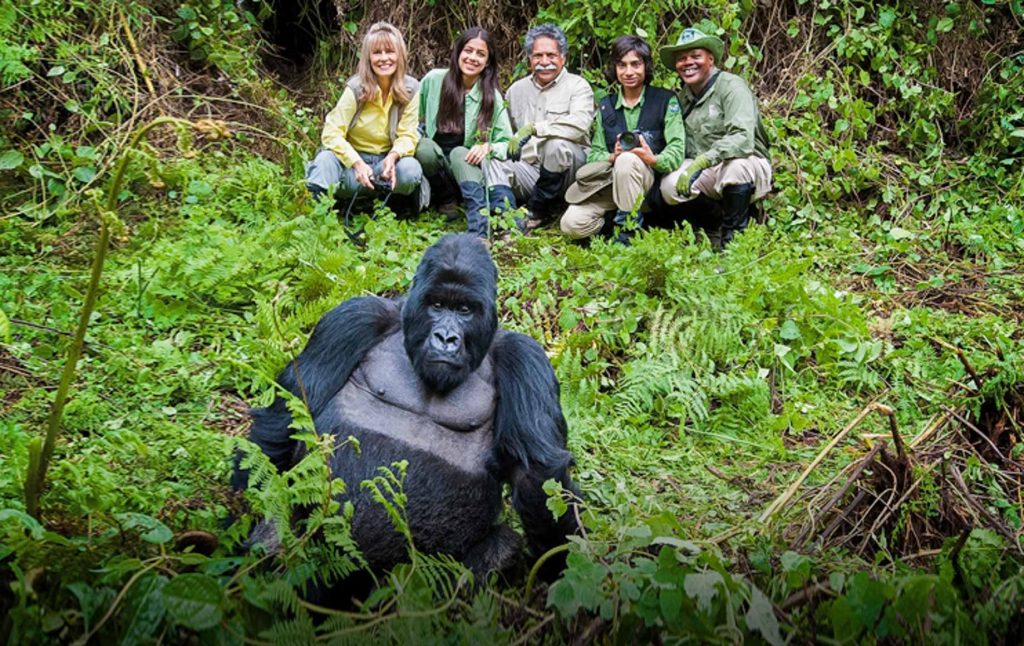
On a 14-day Uganda safari, you can choose between standard gorilla trekking (one hour with gorillas) or gorilla habituation (four hours) in Bwindi Impenetrable National Park or Mgahinga Gorilla National Park, with permit costs at $800+. These trips often combine with tracking chimps in Kibale, wildlife in Queen Elizabeth/Murchison Falls, and scenic tours of Lake Bunyonyi.
14-days-family-uganda-safari-holiday-vacation-escape
14-days-uganda-and-rwanda-safari-tour-itinerary
14-days-classic-uganda-birding-safari-expedition
14-days-complete-uganda-safari-tour-and-primate-safari-experience
14-days-uganda-primate-safari-and-jinja-white-water-rafting
14-days-best-africa-big-five-safari-in-uganda-and-best-gorilla-trekking-adventure
14-days-luxury-uganda-primate-safari-holiday
Bwindi Impenetrable National Park: The Prime Destination
Bwindi is a UNESCO World Heritage site and home to over half of the world's remaining mountain gorillas. The park is uniquely divided into four distinct trekking sectors: Buhoma (North), Ruhija (East), Rushaga (South), and Nkuringo (Southwest). Together, these sectors host approximately 19 habituated gorilla families available for tourism. Buhoma, the oldest sector, is favored for its relatively flatter terrain, making it the top choice for elderly trekkers or those seeking a less strenuous hike. Nkuringo and Rushaga, while more physically demanding due to their steep ridges and deep valleys, offer some of the most spectacular views of the Virunga Volcanoes. For 2026, a standard gorilla permit in Bwindi costs $800 for foreign non-residents, which includes park entry, armed ranger-guides, and exactly one hour of observation once the family is located. With a 99% sighting success rate, Bwindi provides the most reliable opportunity globally to witness the complex social structures of a gorilla troop in their ancient, primary forest home.
Mgahinga Gorilla National Park: Where Gold Meets Silver
Mgahinga is Uganda's smallest national park but offers a strikingly different atmosphere, situated on the slopes of three extinct volcanoes: Mount Gahinga, Mount Muhabura, and Mount Sabyinyo. The park is home to the Nyakagezi gorilla family, a group known for its stable presence and high number of silverbacks. Mgahinga is famously marketed as the place where "gold meets silver" because it is the only park in Uganda where mountain gorillas coexist with the rare and endemic golden monkeys. This allows travelers to do "double trekking"—tracking gorillas one day and the playful, bamboo-dwelling golden monkeys the next. Unlike the dense, "impenetrable" thickets of Bwindi, Mgahinga features vast bamboo forests that offer more open vistas and potentially clearer photography. Because there is only one habituated group here, only eight permits are issued per day, providing a more exclusive and tranquil experience for those looking to avoid the larger trekking groups often found in Bwindi's busier sectors.
Gorilla Habituation Experience: The Deep Dive
For the most immersive wildlife encounter on the continent, Uganda offers the Gorilla Habituation Experience, exclusively available in the Rushaga and Nkuringo sectors of southern Bwindi. Unlike a standard trek where the gorillas are already fully accustomed to humans, this experience involves visiting a "semi-habituated" family that is still being trained by researchers to tolerate human presence. The primary benefit is the time: you spend four hours with the gorillas instead of one. This extended window allows you to witness the full cycle of their daily lives, from grooming and foraging to the playful antics of juveniles and the protective posturing of the silverback. You are accompanied by UWA researchers and trackers, providing a masterclass in primatology as they explain the subtle vocalizations and body language of the troop. As of 2026, this elite experience costs $1,500 per permit and is limited to only four visitors per family per day, making it the most exclusive and profound way to contribute to and witness the ongoing conservation story of the mountain gorilla.
14-Day Uganda Safari
The 14-Day Uganda Safari is the ultimate "Grand Circuit" expedition, meticulously designed to showcase the full spectrum of the "Pearl of Africa." This comprehensive journey bridges the gap between the thundering savannas of the north and the ancient, misty rainforests of the south. Over two weeks, you will experience the visceral power of Murchison Falls, the primate-rich corridors of Kibale Forest, and the iconic plains of Queen Elizabeth National Park. The itinerary reaches its emotional peak with mountain gorilla trekking in Bwindi before offering a tranquil retreat at Lake Bunyonyi. This is more than a wildlife tour; it is a deep immersion into a land where the East African savanna meets the West African jungle. Guided by experts and staying in hand-picked lodges, travelers will discover a seamless narrative of conservation, community, and untamed natural beauty, ensuring every bucket-list encounter—from the "Big Five" to the Great Apes—is checked with grace, depth, and a relaxed, immersive pace.
Days 1–3: Arrival, Rhinos, and Murchison Falls
Your journey begins with a departure from the city, heading north toward the legendary Murchison Falls. The first major milestone is the Ziwa Rhino Sanctuary, the only place in Uganda where you can track southern white rhinos on foot. This intimate encounter allows you to stand just meters from these prehistoric giants, completing the first of your "Big Five" checklist. Continuing to Murchison Falls National Park, you enter a landscape dominated by the Victoria Nile. The following days are spent on the northern bank, where sunrise game drives reveal massive herds of elephants, buffaloes, and the endangered Rothschild’s giraffe. Predators like lions and leopards are frequently spotted among the Borassus palms. A primary highlight is the afternoon launch cruise to the base of the falls, where the entire Nile is forced through a seven-meter gap. The sight of hippos and crocodiles against the backdrop of the world’s most powerful waterfall provides a high-octane introduction to the "Pearl of Africa."
Days 4–5: Kibale National Park and Bigodi Wetland
Moving south, the savanna gives way to the lush, tropical rainforest of Kibale National Park, famously known as the "Primate Capital of the World." This park hosts 13 different primate species, but the undisputed draw is the population of over 1,500 chimpanzees. You will engage in an expert-led trek to locate a habituated family, witnessing their complex social interactions, deafening "pant-hoot" calls, and high-speed canopy movements. After the intensity of the forest, the itinerary transitions to the Bigodi Wetland Sanctuary. This community-run project is a model for sustainable tourism, offering a 3-hour boardwalk trek through a swamp rich in biodiversity. Here, you can spot the Great Blue Turaco and various monkey species, such as the Red Colobus and Grey-cheeked Mangabey. This segment of the tour highlights the transition from the dry northern plains to the humid, vocal, and incredibly dense ecosystems of the Albertine Rift.
Days 6–8: Queen Elizabeth National Park and the Ishasha Sector
Next, you enter Queen Elizabeth National Park, a UNESCO Biosphere Reserve featuring volcanic crater lakes and sprawling savannas. Morning game drives in the Kasenyi Plains focus on lion prides and the iconic Uganda kob. A boat cruise on the Kazinga Channel offers an aquatic safari experience where you can see one of the world's highest concentrations of hippos alongside elephants cooling off at the water's edge. The journey then takes a specialized turn toward the remote Ishasha Sector in the park's southern reaches. This area is world-renowned for its tree-climbing lions, which lounge in ancient fig trees to escape the midday heat. Finding these felines draped across the branches is a rare wildlife phenomenon found in only two places globally. These three days provide a comprehensive look at savanna life before you ascend into the high-altitude forests of the south for your primate finale.
Days 9–10: Bwindi Gorilla Trekking and Lake Bunyonyi
The emotional heart of the safari takes place in Bwindi Impenetrable National Park. Under the guidance of UWA rangers, you will trek through ancient, misty vegetation to find one of the world's remaining mountain gorilla families. Spending an hour with a 400-pound silverback and his troop is a profound, life-altering experience that remains the peak of African wildlife travel. After the physical demands of the trek, you will transfer to Lake Bunyonyi for a period of relaxation. Known as the "Place of Little Birds," this bilharzia-free lake is dotted with 29 islands and surrounded by steep, terraced hills. You can spend your time canoeing in a traditional dugout, visiting island communities, or simply soaking in the temperate climate. It is the perfect scenic "buffer," allowing you to decompress and process the magnitude of the gorilla encounter before beginning the journey back toward the capital.
Days 11–14: Lake Mburo National Park and Departure
The final leg of the safari brings you to Lake Mburo National Park, a compact savanna jewel that serves as a gentle conclusion to the trip. Unlike the larger parks, Mburo is the only place in southern Uganda to see plains zebras and impalas. Because the park lacks elephants and lions, it is one of the few places where you can enjoy a guided walking safari, allowing you to experience the bush from an "on-foot" perspective. You might also take a final boat trip to spot the rare African Finfoot. On the final day, you begin the drive back to Entebbe, pausing at the Uganda Equator line in Kayabwe. Here, you can perform the water drainage experiment and take the classic "two hemispheres" photograph. The loop concludes back at the airport, ending a 14-day odyssey that successfully delivered every major wildlife, primate, and cultural highlight Uganda has to offer.
What are the main options for gorilla trekking on a 14-day Africa Uganda safari trip?
There are two primary ways to engage with mountain gorillas: Standard Gorilla Trekking and the Gorilla Habituation Experience. Standard trekking is the most popular choice, allowing a group of eight tourists to spend exactly one hour with a fully habituated gorilla family once they are located. This is available in both Bwindi Impenetrable and Mgahinga Gorilla National Parks.
The Habituation Experience is a more immersive, four-hour encounter available exclusively in the southern sectors of Bwindi (Rushaga and Nkuringo). During this session, you accompany researchers and rangers who are in the process of training a wild gorilla group to become used to human presence. While more expensive, it offers a deeper look at gorilla behavior and the conservation science behind their protection. On a 14-day trip, many travelers opt for one of each to see the difference in group dynamics.
Which national parks are available for trekking on a 14-day Africa Uganda safari trip?
Uganda has two sanctuaries for mountain gorillas: Bwindi Impenetrable National Park and Mgahinga Gorilla National Park. Bwindi is a UNESCO World Heritage site and home to roughly half of the world's remaining mountain gorilla population. It is divided into four sectors: Buhoma, Ruhija, Rushaga, and Nkuringo.
Mgahinga is part of the larger Virunga Conservation Area, shared with Rwanda and the DR Congo. It features three extinct volcanoes (Gahinga, Muhabura, and Sabinyo) and usually has one large habituated family, the Nyakagezi group. While Bwindi offers a dense forest experience, Mgahinga provides a more open, bamboo-forest landscape with the added benefit of being the only place in Uganda where you can also track Golden Monkeys.
What is the cost of a permit on a 14-day Africa Uganda safari trip?
As of late 2024 and heading into 2025, the Uganda Wildlife Authority (UWA) has set the price for a standard gorilla trekking permit at USD 800 for Foreign Non-Residents. For Foreign Residents (those with a valid work permit in East Africa), the cost is USD 700, and for East African Citizens, it is UGX 300,000.
The Gorilla Habituation Experience permit is significantly higher, priced at USD 1,500. While these costs may seem steep, they are essential for conservation. The revenue funds the salaries of forest rangers who prevent poaching, pays for veterinary teams (the "Gorilla Doctors"), and supports community development projects around the parks to ensure that local people benefit from the presence of the gorillas.
Can I do two gorilla treks on a 14-day Africa Uganda safari trip?
Absolutely, and an extended 14-day itinerary is the perfect timeframe to do so. Many enthusiasts choose to trek twice to see different family structures—for example, one group might have multiple silverbacks, while another might have several infants.
Commonly, travelers will book one trek in the northern sector (Buhoma) for its classic forest feel and a second trek in the southern sector or in Mgahinga for the volcanic scenery. Doing two treks also acts as an "insurance policy" against poor weather or a difficult hike on the first day, ensuring you have a second opportunity to get the perfect photograph or simply enjoy the presence of the Great Apes.
Which sector of Bwindi is best to stay in on a 14-day Africa Uganda safari trip?
The choice depends on your physical fitness and interests. Buhoma (North) is the most developed sector with many luxury lodges; it generally offers "easier" treks because the terrain is slightly less steep. Rushaga (South) is the best for those interested in the Habituation Experience and has the highest number of habituated families.
Nkuringo (South) is famous for its breathtaking views of the Virunga volcanoes but is known for having the most physically demanding hikes. Ruhija (East) sits at a higher altitude and is a favorite for birdwatchers. On a long safari, staying in two different sectors allows you to experience the vastness of the "Impenetrable" forest from different angles.
How far in advance should I book permits on a 14-day Africa Uganda safari trip?
It is highly recommended to book your permits 6 to 12 months in advance, especially if you plan to travel during the peak dry seasons (June–August and December–February). Because only eight people are allowed to visit a specific gorilla family per day, there are a limited number of "tickets" available globally.
During the peak months, permits sell out completely. Booking early also ensures you get a permit for the specific sector where your lodge is located. If you wait until the last minute, you might find a permit available in a sector that is a 3-hour drive away from your accommodation, requiring a very early and stressful morning transit.
What is the difference between trekking and habituation on a 14-day Africa Uganda safari trip?
The primary difference is the time spent and the nature of the interaction. Standard trekking is a tourism activity where you visit a group that is already "civilized" and comfortable with humans. You stay for one hour, and the gorillas often continue their grooming or napping as if you aren't there.
Habituation is an educational and conservation-focused activity. You spend four hours with a group that is still learning to trust humans. These gorillas might be more active or shy, and you will learn from researchers how they identify individuals by "nose prints" and how they monitor the health of the troop. It is a more rugged, less "polished" experience that appeals to serious wildlife enthusiasts.
Is it possible to track gorillas in Rwanda during a 14-day Africa Uganda safari trip?
Yes, a cross-border safari is quite common. You can start in Uganda to visit Murchison Falls and Kibale, then cross the border at Cyanika or Katuna to trek in Volcanoes National Park, Rwanda.
Rwanda's permits are more expensive (USD 1,500 for a standard trek), but the park is located only 2.5 hours from the airport in Kigali, making it very accessible. Combining the two countries allows you to compare the experience of trekking in Bwindi’s ancient rainforest versus the high-altitude bamboo forests of the Virungas.
What is the best time of year to schedule a 14-day Africa Uganda safari trip for trekking?
The dry seasons (June to August and December to February) are the best times for trekking. During these months, the forest trails are less muddy and slippery, making the hike more manageable. Additionally, there is less thick mist, which allows for better photography.
However, the "emerald" or rainy seasons (March–May and September–November) have their own advantages. Permits are sometimes easier to obtain, and the gorillas often stay at lower altitudes where food is more abundant, potentially making the trek shorter. Lush greenery also provides a beautiful, vibrant backdrop for your photos.
What is the age limit for tracking gorillas on a 14-day Africa Uganda safari trip?
The official minimum age for gorilla trekking in Uganda is 15 years. This rule is strictly enforced to protect the gorillas from childhood diseases (to which they have no immunity) and because the trek requires a level of physical stamina and emotional maturity to remain calm when a silverback approaches.
In very rare cases, the Uganda Wildlife Authority may grant an exception if a child is nearly 15 and shows significant physical fitness, or if the trek is expected to be very short. However, families traveling with younger children usually arrange for a child-minder at the lodge while the adults go trekking.
What should I wear to trek on a 14-day Africa Uganda safari trip?
The key to a successful trek is layering. You should wear long-sleeved shirts and long trousers (tucked into socks) to protect against "safari ants" and stinging nettles. Sturdy, waterproof hiking boots with good grip are essential for the steep, often muddy slopes.
Additionally, bring gardening gloves to help you grab onto branches and vines without getting scratched. A lightweight rain jacket is a must, as it can rain at any time in the rainforest. A wide-brimmed hat and polarized sunglasses help with the sun during the segments of the hike through open clearings.
What are the chances of seeing gorillas on a 14-day Africa Uganda safari trip?
The success rate for seeing mountain gorillas in Uganda is over 99%. This is because "advance trackers" head into the forest at daybreak to find where the gorillas nested the night before. They then follow the trail of broken branches and dung until they locate the group.
Once the gorillas are found, the trackers radio the location to your ranger guide. While the hike to reach them can take anywhere from 30 minutes to 6 hours depending on where they moved, you are almost guaranteed to see them. If, in the extremely rare event, they are not found, UWA typically offers a second trek or a partial refund.
Can individuals with disabilities take part on a 14-day Africa Uganda safari trip?
Yes, Uganda is very inclusive when it comes to gorilla trekking. For those with limited mobility or physical disabilities, "sedan chairs" or bamboo stretchers (locally known as the "helicopter") are available for hire.
A team of about 8 to 12 local porters will carry the guest through the forest to the location of the gorillas and back. This service usually costs between USD 300 and USD 500, but it ensures that the experience is accessible to everyone regardless of age or physical ability. It also provides meaningful employment to the local community members.
What is included in the briefing before trekking on a 14-day Africa Uganda safari trip?
Before you enter the forest, you must attend a mandatory briefing at the park headquarters around 7:30 AM. Rangers explain the Rules of Engagement: you must maintain a distance of at least 8 to 10 meters, keep your voice low, and never use flash photography, which can agitate the silverback.
They also cover health protocols—if you are feeling ill (even with a common cold), you should volunteer to stay behind, as human germs can be fatal to gorillas. Finally, you are assigned to a specific gorilla family based on your fitness level and given the opportunity to hire a porter to carry your backpack.
Is it better to fly or drive to the parks on a 14-day Africa Uganda safari trip?
For a 14-day trip, a combination is often best. Driving from Kampala to Bwindi takes about 9–10 hours, which is long but offers a look at the "Switzerland of Africa" with its terraced hills and local markets.
If you prefer comfort over road travel, you can take a scheduled domestic flight (AeroLink or Bar Aviation) from Entebbe to Kihihi or Kisoro airstrips, which takes only 60–90 minutes. Many luxury itineraries fly one way to save time and drive the other way to experience the countryside. This allows more time for other activities like visiting the Batwa communities or relaxing by Lake Bunyonyi.
Booking 14 Days Uganda safari with us Roads of Adventure safaris
Booking a 14-day Uganda safari with Roads of Adventure Safaris involves contacting them via email (info@roadsofadventuresafaris.com), phone/WhatsApp (+256 701041637), or their website to customize itineraries, including permits for gorillas/chimps and 4x4 transport. A 30% deposit secures the booking, with the balance due 60 days before departure.
