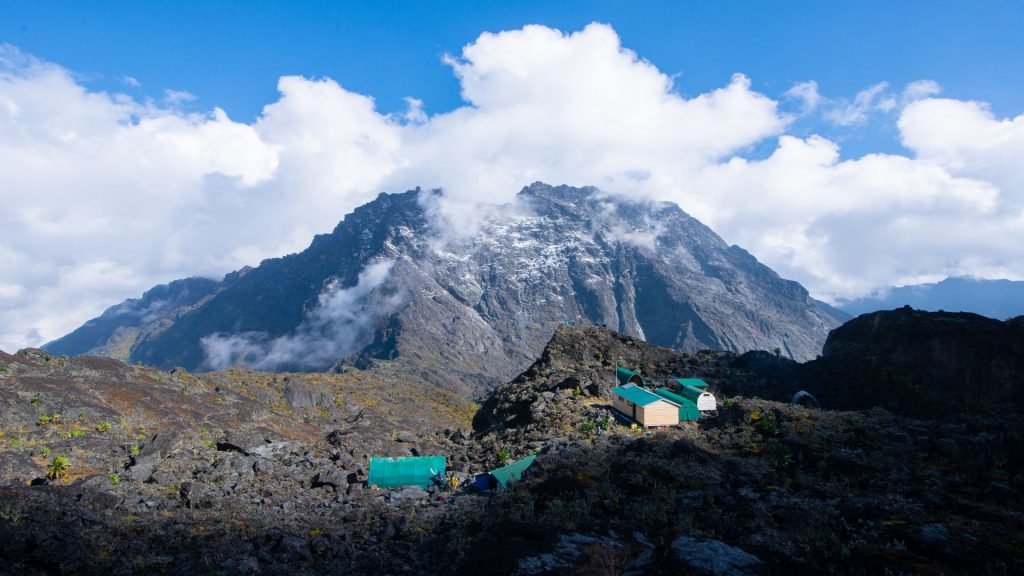
To train successfully for a Rwenzori Mountains climb, you must focus on building endurance, leg strength, and cardiovascular capacity over a structured 3 to 4-month preparation window. Unlike other African peaks, the Rwenzori range demands navigating deep mud, steep wooden bogs, vertical ladders, and slick rock surfaces for 5 to 9 hours a day. If you are targeting the highest point, Margherita Peak (5,109m), you will also encounter alpine glaciers that require basic rope work and crampon use
15-days-rwenzori-hiking-safari-and-mountain-gorilla-trekking-vacation
11-days-best-rwenzori-mountain-hike-to-margherita-peak
7-days-mountain-rwenzori-mountain-climbing-active-adventure-to-margherita-peak
5-days-rwenzori-hike-to-either-mountain-sepeke-baker-or-luig-di-savoia
2-days-rwenzori-trek-to-nyabitaba-camp
1. Cardiovascular Endurance (3–4 Days/Week)
Building a robust aerobic engine is the single most critical factor for surviving and enjoying the Rwenzori Mountains. The range’s extreme elevation—culminating at Margherita Peak ( )—means your body must become exceptionally efficient at utilizing limited oxygen. Low-intensity, steady-state (LISS) cardio trains your heart to pump more blood per beat and multiplies the mitochondria in your muscles, allowing you to sustain physical effort for hours without redlining into anaerobic exhaustion.
The cornerstone of this pillar is the weekly long hike. Dedicating 4 to 6 hours to continuous movement teaches your body to tap into fat stores for fuel and conditions your musculoskeletal system for the sheer volume of a mountain expedition. If you cannot access trails every weekend, replace them with extended, low-resistance sessions on a cycling trainer or an elliptical machine. Complement these massive weekend blocks with 30- to 45-minute sessions of swimming, cycling, or brisk running mid-week. These shorter bouts maintain your baseline conditioning and promote active recovery without overtaxing your joints.
To elevate your aerobic preparation, integrate strict nasal breathing into your easy cardio sessions. Breathing exclusively through your nose naturally restricts airflow, forcing your respiratory system to adapt to higher carbon dioxide tolerance and mimicking the sensation of exercising in thin mountain air. It acts as a natural governor, ensuring you stay within your true aerobic zone rather than pushing into a pace that will burn you out prematurely. On a mountain where the air pressure drops significantly with every thousand meters of ascent, a highly developed, oxygen-efficient cardiovascular system is your greatest asset against acute mountain sickness (AMS) and chronic fatigue.
2. Strength and Joint Stability (2 Days/Week)
The Rwenzori range is notorious for its brutal, unforgiving terrain. Unlike heavily groomed volcanic peaks like Kilimanjaro, the Rwenzori routes throw a chaotic mix of knee-deep mud bogs, slippery tree roots, and slick, moss-covered wooden boardwalks at trekkers. This chaotic underfooting demands exceptional single-leg strength and reactive joint stability. Standard bilateral exercises like traditional barbell squats are excellent for raw power, but they fail to replicate the unstable, unilateral demands of balancing on a wet log with a heavy pack.
Your strength routine should heavily feature weighted step-ups. By stepping onto a high bench while wearing a weighted backpack, you directly simulate the mechanics of climbing steep mountain steps. This movement targets the quadriceps, glutes, and hamstrings dynamically, building the muscular endurance required for thousands of vertical meters. Supplement this with single-leg lunges and Bulgarian split squats to correct strength imbalances between your legs, ensuring that a weak side doesn't overcompensate and lead to overuse injuries like patellar tendonitis.
Equally vital is dedicated balance and proprioception work. Spending time on unstable surfaces, such as a Bosu ball or a foam balance pad, forces the tiny stabilizing muscles around your ankles and knees to fire rapidly to keep you upright. This training strengthens the ligaments and sharpens your nervous system’s reaction time. When you inevitably slip on a muddy Rwenzori trail, your well-conditioned ankles will instantly adapt and stabilize, preventing a debilitating sprain or tear. Protecting your joints through targeted stability work is what keeps you moving forward when the trail turns into a slippery obstacle course.
3. Progressive Vertical & Pack Loading
Climbing the Rwenzori Mountains is an exercise in gravity defiance. You are not just moving your body weight across horizontal distances; you are lifting yourself, your gear, and your clothing up thousands of meters of vertical gain. This puts immense, sustained pressure on your spine, shoulders, and lower back. To prevent debilitating fatigue or injury during the trek, you must progressively condition your body to handle both the vertical accumulation and the deadweight of your equipment.
Begin your training hikes early with a modest backpack weight of 3–5 kg. This allows your traps, core, and lower back to adapt to the pressure of the straps without compromising your posture. Gradually increase this load by 1–2 kg each week, aiming to comfortably carry 10–12 kg by the peak of your training cycle. To supplement this when outdoor trails aren't accessible, seek out local stadium stairs or a gym StairMaster. Aiming for a target of roughly 700 steps within a 30-minute window provides a concentrated dose of vertical conditioning, forcing your calves and quadriceps to adapt to the relentless upward grind.
Never view trekking poles as optional gear; they are a fundamental component of your training toolkit. Incorporating poles into your regular workouts teaches you to engage your upper body, effectively distributing a portion of your weight away from your lower joints. On the steep, jarring descents through the Rwenzori's rocky sections, trekking poles act as crucial shock absorbers, reducing the impact on your knees by up to 25%. Mastering the rhythm of your poles during training ensures they become a natural extension of your body on the mountain.
4. Back-to-Back Simulations
The true physical and psychological crucible of the Rwenzori is the cumulative toll of consecutive trekking days. It is relatively easy to complete a grueling 6-hour hike, go home, and rest for a week. It is an entirely different challenge to wake up at dawn, damp and shivering, to face another 6 hours of steep climbing on legs that are already deeply fatigued from the day before. Back-to-back simulations break through the illusion of single-day fitness to build true expedition endurance.
Approximately six weeks before your departure, begin scheduling multi-day weekend blocks. For example, execute a demanding 5-hour hike on Saturday, followed immediately by a 4-hour hike on Sunday. This sequence forces your body to perform when its glycogen stores are partially depleted and your muscles are stiff. It teaches your metabolism to recover rapidly overnight and trains your mind to accept discomfort as a temporary baseline. These blocks expose any flaws in your nutrition, hydration, and gear choices before you set foot in Uganda.
Furthermore, these simulations are the ultimate crucible for mental resilience. The Rwenzori is famous for its wet, cold, and unpredictable microclimates, featuring vast, saturated bogs. If it rains during your training weekend, do not cancel your hike; embrace it. Intentionally training in poor weather conditions—experiencing what it feels like to have wet feet, damp gear, and a cold face while maintaining your pace—strips away the shock value of the mountain's harsh climate. Developing the mental fortitude to push through physical misery at home ensures that when you encounter a freezing downpour at  , you will meet it with calm, stoic resolve.
What is my current fitness level, and how much time do I have until the climb?
Your baseline fitness and timeline dictate the structure of your preparation. If you can currently run a 5K without stopping or hike for 3 hours with a light pack, a standard 12-to-16-week training block will suffice. This allows ample time to progressively overload your muscles and cardiovascular system without risking burnout. However, if you are starting from a sedentary baseline or recovering from an injury, you will need an extended conditioning period of 20 to 24 weeks. This longer window ensures you can safely build a foundational aerobic base and joint resilience before introducing heavy pack loads and steep vertical volume.
Which Rwenzori route have I booked, and what is the daily distance and elevation gain?
The route you book drastically alters your daily physical output. The classic 7-day Central Circuit, managed by RMS, features a more gradual ascent through the valley but exposes you to notorious, deep mud bogs early on. The 8-day or 9-day Kilembe Trail, managed by RTS, is physically more demanding; it approaches the peaks via a steeper, narrower ridge line that requires significantly higher daily elevation gains and losses. Knowing your route allows you to tailor your training: Central Circuit prep should emphasize deep stability and balance, while Kilembe prep requires a heavier focus on relentless vertical endurance and calf power.
What specific weight will I need to carry in my daypack?
On the mountain, a porter will likely carry your main duffel, but you are responsible for your daypack. This pack will hold your layers, waterproofs, water (2–3 liters), camera, and lunch, typically weighing between 6 and 9 kg. You must not wait until day one of the trek to experience this load. Training with a pack that matches or slightly exceeds your target weight conditions your traps, shoulders, and lower back to the constant downward pull, preventing premature fatigue and spinal soreness during the actual climb.
How can I build targeted leg strength to protect my joints during the long, steep descents?
While climbing builds your lungs, descending ruins your joints. Coming down the steep, slick slopes of the Rwenzoris subjects your knees and ankles to eccentric muscle contractions, which cause the most severe muscle damage and soreness. To protect your joints, you must prioritize eccentric lower-body exercises. Weighted box step-downs, eccentric squats (lowering down over 4 seconds), and walking lunges actively strengthen the quadriceps tendons and calves. This conditioning builds a muscular "brake system," shielding your knees from the jarring impact of thousands of downward steps.
What types of cardiovascular exercises should I prioritize?
To build an efficient aerobic base for high altitude, prioritize activities that simulate continuous, vertical climbing. Gym-based machines like the StairMaster, incline treadmill walking (setting the grade to 10–15%), and low-cadence, high-resistance cycling are highly effective. These movements mimic the exact biomechanical strains of mountain trekking. They force your heart to pump blood against gravity while teaching your legs to flush out lactic acid during sustained, low-speed efforts, making them far superior to flat-ground running.
How can I simulate the varying, rugged terrain of the Rwenzoris?
The Rwenzori trails are a chaotic maze of uneven rocks, slippery roots, and deep mud. Gym floors cannot prepare you for this. To simulate this rugged terrain, take your training off the pavement. Hike along rocky shorelines, dry creek beds, or paths filled with loose gravel and sand. Walking on shifty, unpredictable surfaces forces your nervous system to rapidly fire your smaller stabilizing muscles, strengthening your ankles and teaching your body to maintain equilibrium despite sudden shifts underfoot.
Do I have access to local hiking trails with significant elevation gain?
There is no true substitute for real-world outdoor hiking. While gym equipment can build raw capacity, outdoor trails train your spatial awareness, stride variability, and mental pacing. Navigating actual elevation changes teaches you how to save energy on steep inclines and how to place your feet safely on descents. If you lack local mountains, find the highest outdoor structures available—such as multi-story parking garages, stadium bleachers, or steep highway overpasses—to break the monotony of indoor training.
Should I include back-to-back training days in my routine?
Back-to-back training days are mandatory for expedition success. The hardest part of the Rwenzori is waking up on Day 4 to hike through a bog on legs that are already thoroughly exhausted. Scheduling long hikes on both Saturday and Sunday forces your body to adapt to cumulative fatigue. This teaches your muscles to clear metabolic waste efficiently overnight and builds the profound psychological resilience required to lace up your wet boots and push forward every single morning.
How do I safely train for high-altitude conditions when I live at sea level?
You cannot perfectly replicate  of altitude at sea level, but you can prepare your respiratory system. Hypoxic training masks do not change atmospheric pressure, but they do strengthen your inspiratory muscles by restricting airflow. A more effective strategy is high-intensity aerobic intervals (HIIT) alongside extended zone 2 training. Maximizing your VO2 max and aerobic efficiency at sea level gives you a larger physiological buffer, meaning your body will require less relative effort to function when oxygen availability drops.
How do I train for the use of mountaineering equipment?
If you are targeting Margherita Peak, you will cross glaciers that require technical gear. You must practice walking in heavy, stiff, B2 or B3-rated mountaineering boots well before the trip to avoid debilitating blisters. If possible, practice stepping into crampons and walking on snow, ice, or even soft grass to get used to the altered, wider gait. Additionally, familiarize yourself with basic rope teams and handling ascenders (Jumars) while wearing thick, waterproof gloves.
What core and upper-body conditioning do I need?
A powerful core is the anchor that stabilizes your entire body when navigating slippery boardwalks or deep mud. Incorporate planks, bird-dogs, and suitcase carries to build a rigid trunk that resists rotational forces from a heavy pack. Furthermore, do not neglect upper-body strength. Relentlessly pushing off trekking poles for 6 to 8 hours a day requires strong shoulders, triceps, and lats. Lat pulldowns and overhead presses ensure your upper body can actively relieve your legs of weight.
What is my nutrition and hydration strategy for the climb?
Your training hikes must double as a testing ground for your digestive system. High altitude suppresses appetite, yet your body will burn thousands of calories daily. Practice consuming easily digestible, calorie-dense foods—like energy gels, nuts, and dried fruit—while moving. Simultaneously, develop a strict hydration rhythm, aiming to drink 4–5 liters of water daily on the mountain. Training your stomach to process fuel and electrolytes under physical duress prevents gastrointestinal distress and energy crashes on summit night.
Booking Rwenzori climb with us Roads of Adventure safaris
To book your customized Rwenzori expedition with Roads of Adventure Safaris, you can choose from various tailored itineraries, including the classic 8-day Central Circuit hike or multi-day gorilla and chimpanzee trekking add-ons. Booking directly with their specialized team ensures you secure all necessary national park permits, experienced mountain guides, porters, and equipment. To finalize your booking, please provide your exact travel dates, your preferred trail or peak—such as conquering Margherita Peak or taking a shorter hike to John Matte camp—the total number of people in your trekking group, and whether you want to include a wildlife safari. Pricing and availability will vary based on your group size and specific trail choices.
