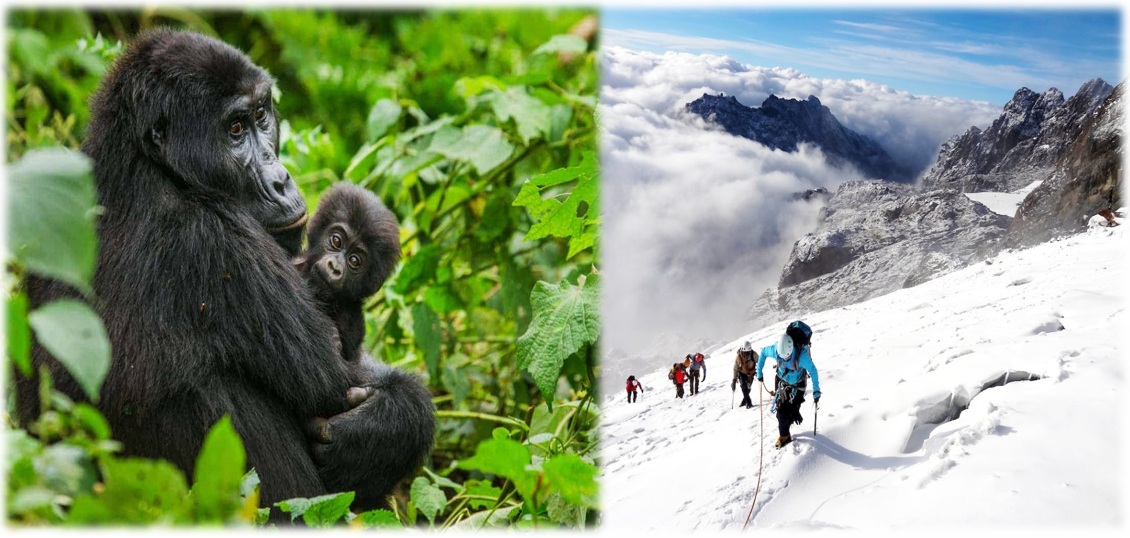
Uganda has 16 national parks. This includes the 10 traditional parks—managed by the Uganda Wildlife Authority—and six newly gazetted parks upgraded from former forest and wildlife reserves (Katonga, Toro, Kyambura, Bukaleba, Kigezi, and Echuya).
14-days-uganda-and-rwanda-safari-tour-itinerary
14-days-luxury-uganda-primate-safari-holiday
14-days-uganda-primate-safari-and-jinja-white-water-rafting
14-days-classic-uganda-birding-safari-expedition
14-days-best-africa-big-five-safari-in-uganda-and-best-gorilla-trekking-adventure
20-days-uganda-birding-safari-wildlife-gorilla-and-chimpanzee-tracking
20-days-uganda-birding-safari-to-uganda-national-park
20-days-uganda-safari-holiday-tour-package-itinerary
19-days-best-photography-uganda-birding-safari-and-wildlife-adventure
19-days-incredible-uganda-safari-tour-big-five-chimpanzees-and-mountain-gorillas
18-days-best-of-uganda-safari-holiday-vacation-to-all-best-parks
17-days-uganda-honeymoon-safari-holiday-tour
17-days-uganda-birding-safari-itinerary
17-days-best-safari-in-uganda-ending-in-kigali-rwanda
16-days-ultimate-uganda-safari-to-rwanda-safari-tour-package-combo
16-days-best-of-uganda-birding-safari-holiday-extravaganza
7-day-ultimate-uganda-primate-safari-chimpanzees-and-game-drives
6-days-best-gorilla-trekking-and-safari-uganda-parks
What are the 10 Traditional national parks in Uganda
Uganda is home to exactly 10 traditional national parks managed by the Uganda Wildlife Authority. Ranging from dense primate-filled jungles to vast sweeping savannas and snow-capped mountains, these parks offer incredible biodiversity across the country
The 10 Traditional National Parks of Uganda
1. Bwindi Impenetrable National Park
Tucked away in the rugged highlands of southwestern Uganda, Bwindi Impenetrable National Park covers 321 square kilometers of ancient, mist-covered rainforest. Designated a UNESCO World Heritage site in 1994, Bwindi is world-renowned for sheltering approximately 459 mountain gorillas—nearly half of the entire global population of around 1,063 individuals. The park is managed across four distinct administrative sectors: Buhoma in the north, Ruhija in the east, and Rushaga and Nkuringo in the south. Reaching Bwindi involves an 8 to 9-hour drive from Kampala (roughly 470 kilometers via the Masaka–Mbarara highway) or a 1-hour scheduled flight from Entebbe International Airport to Kisoro or Kihihi airstrips.
Trekking here requires a permit issued by the Uganda Wildlife Authority (UWA) for $800 per foreign non-resident. On the day of your trek, armed UWA rangers and experienced trackers lead small groups of up to 8 visitors through thick tangles of bamboo and mimulopsis trees. Depending on where the habituated gorilla family slept the night before, your hike can take anywhere from 2 to 7 hours across steep elevations ranging between 1,160 and 2,607 meters above sea level. Once located, you are granted strictly 1 hour to observe the silverback and his troop. Beyond mountain gorillas, Bwindi protects 120 mammal species—including elusive forest elephants and L'Hoest's monkeys—and over 350 bird species, including 23 endemic to the Albertine Rift Valley, such as the African green broadbill.
2. Murchison Falls National Park
Spanning 3,890 square kilometers across the districts of Masindi, Nwoya, Kiryandongo, and Buliisa, Murchison Falls is Uganda’s oldest (established in 1952) and largest national park. Located roughly 305 kilometers northwest of Kampala—a comfortable 5 to 6-hour drive through Luweero and Masindi—the park is bisected east-to-west by the historic Victoria Nile. The park’s absolute highlight is the thunderous Murchison Falls, where the river narrows dramatically into a 7-meter rocky gorge before plunging 43 meters into the "Devil’s Cauldron," creating a permanent mist and roaring spray that can be heard from miles away.
Game drives along the northern bank’s Buligi circuit offer spectacular wildlife viewing across rolling savannahs. Visitors frequently spot large herds of Rothschild's giraffes, Jackson's hartebeests, Cape buffaloes, and African bush elephants, along with lions and leopards. A favorite highlight is the 3-hour round-trip boat cruise from Paraa Jetty to the base of the falls, which passes giant Nile crocodiles basking on the banks and dense pods of hippos. You can also opt for a steep 45-minute hike from the boat landing up to the Top of the Falls for breathtaking aerial viewpoints. For birdwatchers, the Delta area where the Nile meets Lake Albert is one of the best locations in Africa to spot the prehistoric-looking shoebill stork.
3. Queen Elizabeth National Park
Spreading over 1,978 square kilometers in western Uganda, Queen Elizabeth National Park sits dramatically on the floor of the Albertine Rift Valley, framed by the snow-capped Rwenzori Mountains to the north. Located approximately 380 kilometers from Kampala (a 6 to 7-hour drive via Fort Portal or Mbarara), it is Uganda's most frequently visited savannah park. Its varied habitats encompass open savannah grasslands, acacia woodlands, freshwater lakes, and over 70 volcanic crater lakes, such as the scenic Katwe explosion craters, where local communities have harvested salt for centuries using traditional methods.
The park is famous for the Kazinga Channel, a 32-kilometer natural waterway connecting Lake George and Lake Edward. A 2-hour UWA boat launch along the channel provides front-row views of waterbucks, buffaloes, and elephants bathing along the shore, alongside one of the highest concentrations of hippos in Africa. In the southern Ishasha sector, visitors drive through fig tree-lined tracks searching for the famous tree-climbing lions resting high in the branches during the heat of the afternoon. In the eastern part of the park lies Kyambura Gorge—a 100-meter-deep sunken rainforest known as the "Valley of Apes"—where travelers can track a habituated family of chimpanzees. Queen Elizabeth boasts an astounding checklist of 95 mammal species and more than 600 bird species, including the African skimmer, martial eagle, and papyrus gonolek.
4. Kibale National Park
Widely recognized as the "Primate Capital of the World," Kibale National Park covers 795 square kilometers of lush, moist evergreen rainforest in western Uganda. Situated near the charming town of Fort Portal, Kibale is roughly 310 kilometers from Kampala, taking about 5 hours by road via the smooth Mubende highway. The park is renowned for harboring the highest density and diversity of primates in East Africa, featuring 13 distinct species, including a thriving population of over 1,500 wild chimpanzees.
Chimpanzee tracking excursions depart twice daily from the Kanyanchu Visitor Centre at 8:00 AM and 2:00 PM. Led by expert UWA guides, these 2 to 4-hour forest walks boast a success rate of over 90% for locating habituated chimp communities as they forage, groom, and vocalize throughout the high canopy. Chimpanzee tracking permits cost $250 for foreign non-residents, while those seeking a deeper experience can opt for the full-day Chimpanzee Habituation Experience (CHAE) for $300. As you walk through the forest, you will also spot red colobus monkeys, L'Hoest's monkeys, black-and-white colobus, and grey-cheeked mangabeys. Adjacent to the park lies the community-run Bigodi Wetland Sanctuary, where a 3-hour boardwalk tour offers exceptional birdwatching for the vibrant Great Blue Turaco alongside 200 other bird species.
5. Kidepo Valley National Park
Tucked away in the far northeastern corner of Uganda in the Karamoja region, Kidepo Valley National Park covers 1,442 square kilometers of rugged, semi-arid savannah framed by the Mount Morungole range. Because it lies roughly 520 kilometers from Kampala, driving takes between 10 and 12 hours via Gulu and Kitgum; consequently, many luxury travelers prefer a 2-hour charter flight from Entebbe directly to the Apoka Airstrip. Kidepo is widely celebrated for offering one of the most authentic, untouched wilderness experiences in Africa, completely free from heavy safari crowds.
The park is defined by two primary river valleys: the Narus Valley and the Kidepo Valley. The Narus Valley retains water year-round, making it the primary hub for game drives. Here, massive herds of Cape buffaloes—sometimes numbering up to 4,000 individuals in a single herd—gather alongside elephants, Rothschild's giraffes, zebras, Jackson's hartebeests, and oribis. Predators thrive in high numbers; dense prides of lions regularly lounge on the flat granite kopjes dotting the valley, while leopards and spotted hyenas stalk prey in the grasslands. Kidepo is also the only national park in Uganda where you can spot cheetahs, ostriches, secretary birds, and bat-eared foxes. Cultural visits to the nearby Karamojong manyattas (traditional homesteads) or hikes to meet the endangered Ik tribe on Mount Morungole add a rich human layer to this northern adventure.
6. Lake Mburo National Park
At just 370 square kilometers, Lake Mburo National Park is Uganda’s smallest savannah park, but its convenient location makes it a highly popular stopover. Situated in Kiruhura District, it lies just 240 kilometers southwest of Kampala—a straightforward 3.5 to 4-hour drive along the main Masaka–Mbarara highway. The park is centered around Lake Mburo, which forms part of a 50-kilometer-long wetland system comprising 13 lakes connected by papyrus swamps.
Lake Mburo is distinguished as the only national park in southern Uganda with wild impalas, Burchell's zebras, and topis, and it hosts a re-introduced population of Rothschild's giraffes brought from Murchison Falls. Because the park has no lions and few dangerous large predators, UWA allows unique active safari experiences that are rare elsewhere in Uganda. Visitors can embark on 2-hour guided walking safaris with an armed ranger, mountain bike through acacia-dotted hills, or take horseback safaris organized by local lodges. A 2-hour boat cruise on Lake Mburo reveals wallowing hippos, large Nile crocodiles, and excellent waterbird sightings, including the African finfoot, pied kingfishers, and fish eagles. Night game drives are also exceptionally rewarding here, offering high chances of spotting elusive nocturnal animals like leopards, bushbabies, and porcupines.
7. Rwenzori Mountains National Park
Encompassing 996 square kilometers along Uganda's western border with the Democratic Republic of Congo, Rwenzori Mountains National Park protects the legendary "Mountains of the Moon." Gazetted in 1991 and named a UNESCO World Heritage site in 1994, this non-volcanic mountain range features Mount Stanley, home to Margherita Peak—Africa’s third-highest point at 5,109 meters above sea level. Located near Kasese town, the park trailhead at Kilembe or Nyakalengija is roughly a 6-hour drive (340 kilometers) from Kampala.
The park is famous among global mountaineers for its challenging, multi-day high-altitude trekking routes, such as the 7-day Central Circuit or the 8-day Kilembe Trail. Unlike volcanic peaks like Kilimanjaro, the Rwenzoris are characterized by steep, rugged terrain, dramatic boggy valleys, and rapid elevation changes. Climbers ascend through five distinct vegetation zones: montane forest, bamboo forest, heather/rapanea zone, alpine zone filled with surreal giant groundsels and lobelias, and finally the snow-and-ice glacial zone near the summit. The park also protects 70 mammal species—including forest elephants, Rwenzori L'Hoest's monkeys, and the rare three-horned chameleon—along with 217 bird species. For non-climbers, guided 1-day nature walks through the lower Bakonzo village communities and forest foothills offer rich cultural and botanical insights.
8. Mount Elgon National Park
Located on the eastern border shared with Kenya near Mbale town, Mount Elgon National Park covers 1,121 square kilometers centered around an extinct shield volcano. Mount Elgon once stood as Africa’s tallest mountain before millennia of erosion reduced its highest point, Wagagai Peak, to 4,321 meters above sea level. Driving from Kampala to Mbale takes approximately 4 to 5 hours across 235 kilometers via Jinja and Iganga. The park's defining feature is its intact volcanic caldera, which spans roughly 8 kilometers in diameter—one of the largest intact calderas in the world.
Mount Elgon offers fantastic, less-crowded highland trekking compared to East Africa's higher peaks. Popular multi-day hikes include the 4-day Sasa Trail starting from Budadiri, or the scenic Sipi Trail. Trekkers pass through bamboo forests and alpine moorlands dotted with wild everlasting flowers before reaching the caldera floor and warm geothermal springs. A major attraction on the mountain's lower slopes is Kitum Cave, where wild elephants historically ventured deep into the dark basalt chambers to dig for mineral salts with their tusks. Just outside the park boundary lie the famous Sipi Falls—a series of three breathtaking waterfalls tumbling down 100-meter basalt cliffs—where visitors enjoy guided coffee plantation tours, abseiling, and scenic nature walks.
9. Mgahinga Gorilla National Park
Spanning just 33.7 square kilometers in the extreme southwestern corner of Uganda, Mgahinga is the country's smallest national park. Located in Kisoro District, about 490 kilometers from Kampala (a 9 to 10-hour drive), Mgahinga forms part of the greater Virunga Conservation Area, bordering Volcanoes National Park in Rwanda and Virunga National Park in the DRC. The park encompasses three extinct conical volcanoes: Mount Muhavura (4,127m), Mount Gahinga (3,474m), and Mount Sabyinyo (3,669m).
Mgahinga operates under the local motto "Where Gold Meets Silver," highlighting its two resident primate stars: endangered golden monkeys and mountain gorillas. The park is home to the habituated Nyakagezi gorilla family, known for its high concentration of silverbacks living peacefully within one group. Gorilla trekking permits cost $800, while golden monkey tracking permits cost $100. Golden monkey habituation treks are also available, allowing visitors to spend 4 hours observing these playful, bamboo-loving primates. Beyond primate tracking, Mgahinga offers thrilling 1-day mountain climbs. Summiting Mount Sabyinyo takes roughly 8 hours round-trip, taking hikers up steep wooden ladders to a peak where you can physically stand in Uganda, Rwanda, and the DRC simultaneously. Visitors can also take the Batwa Trail, a cultural hike guided by indigenous Batwa elders who demonstrate traditional rainforest hunting, gathering, and fire-making skills inside the sacred Garama Cave.
10. Semuliki National Park
Nestled on the isolated floor of the Albertine Rift Valley in Bundibugyo District, Semuliki National Park covers 220 square kilometers of lowland tropical rainforest. Reaching Semuliki takes about 6 hours from Kampala (roughly 380 kilometers), driving past Fort Portal and winding down the dramatic northern slopes of the Rwenzori range. Semuliki represents an easterly spillover of the vast Ituri Forest of the Congo Basin, making its flora and fauna distinct from any other national park in East Africa.
The park's most famous attraction is the Sempaya Hot Springs. Situated inside a palm forest, the site features two geothermal springs: the male spring (Kiteza), featuring a 12-meter-wide steaming pool, and the boiling female spring (Nyasimbi), where groundwater surges out of a rocky vent at temperatures exceeding 100°C. UWA guides demonstrate the water's intensity by boiling eggs and plantains in the bubbling spring, which cook thoroughly in under 10 minutes. Semuliki is an absolute haven for birdwatchers, harboring over 400 bird species—including 35 Central African riverine species found nowhere else in Uganda, such as the piping hornbill, Congo serpent eagle, and Nkulengu rail. Guided nature walks along the Kirumia Trail offer deep immersion into this dense, wild jungle ecosystem.
6 new gazette national parks in Uganda
The elevation of these six former forest and wildlife reserves into fully protected national parks under the Uganda Wildlife Authority (UWA) significantly expands Uganda's conservation landscape. Each newly gazetted park protects a critical ecological niche and vital migratory corridor:
1. Katonga National Park
Located along the Katonga River basin in central-western Uganda (Kyenjojo and Kamwenge districts), this ~207  park consists primarily of papyrus swamps, seasonal wetlands, and riverine woodlands. It serves as a vital hydrological sanctuary and holds Uganda's largest population of the elusive Sitatunga (swamp-dwelling antelope), along with bushbucks, river otters, hippos, and over 300 bird species, including the rare shoebill stork. Popular activities include peaceful canoe safaris and guided wetland walks.
2. Toro National Park
Spanning roughly 542 in the shadow of the Rwenzori Mountains near Lake Albert (Ntoroko and Kabarole districts), this park upgraded the former Toro-Semliki Game Reserve. It protects sweeping savannah grasslands, acacia woodlands, and wetland river systems that serve as a historic corridor for Uganda Kob migrations. Wildlife includes elephants, lions, hyenas, giant forest hogs, and over 400 bird species.
3. Kyambura National Park
Covering about 157 in Rubirizi District, this park encompasses the dramatic, 100-meter-deep Kyambura Gorge—often referred to as the "Valley of Apes". Situated right alongside Queen Elizabeth National Park, its dense, underground rainforest protects a isolated population of habituated chimpanzees, red-tailed monkeys, black-and-white colobus, and over 340 tropical bird species.
4. Bukaleba National Park
Situated in Mayuge District along the eastern shores of Lake Victoria (roughly 30 km from Jinja), this ~97 park transitions former forest plantations back into protected lakeside wilderness. It protects critical aquatic habitats for hippos, Nile crocodiles, and otters, alongside terrestrial woodlands home to vervet monkeys, colobus monkeys, and over 200 waterbird species. It offers boat safaris and eco-walks close to Jinja's adventure tourism circuit.
5. Kigezi National Park
Located in southwestern Uganda near Rukungiri and Kanungu districts, Kigezi covers a key savannah-woodland corridor linking Queen Elizabeth National Park with the southern rainforests. Upgraded from the Kigezi Wildlife Reserve, its status as a national park safeguards a crucial seasonal migration path for African bush elephants, buffaloes, and antelopes moving through the Albertine Rift Valley ecosystem.
6. Echuya National Park
Perched high in the Kigezi Highlands (Kisoro and Rubanda districts) near Lake Bunyonyi, Echuya covers ~34 of montane bamboo and high-altitude rainforest. Situated between 2,270 and 2,750 meters above sea level, it protects the high-altitude Muchuya Swamp and harbors over 150 bird species—including rare Albertine Rift endemics like Grauer's swamp warbler and the Rwenzori turaco. It also offers cultural treks led by indigenous Batwa community guides.
Here are 10 questions explicitly relating and comparing Uganda’s 10 traditional (old) national parks with the 6 newly gazetted national parks. Each question is strictly between 7 and 10 words, followed by a detailed 200-word response.
How do old and new parks expand Uganda's conservation network?
Uganda’s national park system expanded from 10 traditional national parks to 16 total protected areas following the formal gazetting of six former reserves. For decades, traditional parks like Murchison Falls, Queen Elizabeth, Bwindi Impenetrable, and Kibale served as the core pillars of Uganda's wildlife conservation and tourism economy. These established reserves protected world-famous species, including mountain gorillas, habituated chimpanzees, tree-climbing lions, and massive elephant herds roaming open savannahs. However, isolated traditional parks left critical wildlife migration corridors and sensitive wetland ecosystems vulnerable to surrounding human encroachment.
The addition of six newly gazetted parks—Katonga, Toro, Kyambura, Bukaleba, Kigezi, and Echuya—significantly strengthens this conservation framework. Rather than acting as standalone tourist hubs, the new parks physically and ecologically connect traditional reserves across the Albertine Rift Valley and Lake Victoria basin. For example, Kigezi National Park safeguards a vital seasonal corridor connecting Queen Elizabeth National Park with southern forests, while Kyambura formalizes protection around the gorge adjacent to Queen Elizabeth. Together, the 10 traditional parks and six new additions create an integrated, nationwide ecosystem shield under the management of the Uganda Wildlife Authority (UWA), guaranteeing long-term protection for the country's unparalleled biodiversity.
Where are primates found across traditional and newly gazetted parks?
Primate conservation in Uganda spans both established traditional parks and newly gazetted reserves, creating an extensive sanctuary network across western Uganda. Traditional parks have long been world-renowned for primate tracking: Kibale National Park shelters over 1,500 chimpanzees alongside 12 other primate species; Bwindi Impenetrable and Mgahinga Gorilla national parks protect nearly half of the world's mountain gorillas; and Mgahinga also safeguards endangered golden monkeys. Meanwhile, Queen Elizabeth and Semuliki national parks protect chimpanzees, colobus monkeys, and baboons within their forest pockets.
The six newly gazetted parks significantly enhance primate protection by safeguarding neighboring populations and vital forest refuges. Kyambura National Park protects a famous, habituated community of chimpanzees, red-tailed monkeys, and black-and-white colobus monkeys inside the 100-meter-deep Kyambura Gorge adjacent to Queen Elizabeth. Echuya National Park protects high-altitude bamboo and montane forest habitats near Bwindi and Mgahinga, providing vital secondary canopy cover for highland species. Additionally, Bukaleba National Park along Lake Victoria protects vervet and colobus monkeys in lakeside woodlands, while Toro National Park protects primate populations along the Rwenzori foothills. Together, these old and new parks solidify Uganda’s reputation as Africa’s ultimate primate tracking destination.
How do new parks connect corridors between traditional savannah reserves?
Wildlife migration corridors are essential for maintaining healthy genetic diversity among large mammals, and Uganda's new national parks directly address this need by linking traditional savannah reserves. Traditional savannah parks—such as Queen Elizabeth, Murchison Falls, Lake Mburo, and Kidepo Valley—host large populations of African bush elephants, Cape buffaloes, lions, and antelopes. However, as human settlements and agricultural farms expanded between these traditional boundaries, animals faced increasing habitat fragmentation and human-wildlife conflict while moving along historic seasonal routes.
The gazetting of new national parks creates permanent, legally protected ecological bridges between these older strongholds. Kigezi National Park serves as a prime example, acting as a protected savannah-woodland corridor that links Queen Elizabeth National Park with southern forest ecosystems, allowing elephants and buffaloes to migrate safely without entering human farmlands. Similarly, Toro National Park safeguards the historic migration route for Uganda Kobs and elephants moving between the Rwenzori region and Lake Albert, complementing the savannahs of Murchison Falls and Queen Elizabeth. By converting former reserves into fully protected national parks, Uganda ensures that large mammals can navigate freely between traditional strongholds and newly secured habitats.
What birdlife thrives in Uganda's traditional and newly gazetted parks?
Uganda is one of Africa’s premier birding destinations, harboring over 1,000 recorded bird species distributed across both its 10 traditional parks and six new additions. Traditional parks offer legendary birding spots: Semuliki National Park contains over 400 species, including 35 Central African Ituri Forest endemics; Queen Elizabeth boasts over 600 species around the Kazinga Channel; and Bwindi Impenetrable protects 23 Albertine Rift endemics, including the rare African green broadbill. Murchison Falls and Lake Mburo are equally famous for aquatic species and the elusive, prehistoric-looking shoebill stork.
The six newly gazetted national parks complement these traditional birding sites by protecting distinct micro-habitats. Echuya National Park, perched high in the Kigezi Highlands, safeguards the Muchuya Swamp and harbors rare high-altitude Albertine Rift endemics like Grauer's swamp warbler and the Rwenzori turaco. Katonga National Park protects extensive papyrus swamps along the Katonga River basin, offering pristine nesting grounds for shoebill storks, papyrus yellow warblers, and over 300 wetland species. Meanwhile, Bukaleba National Park protects over 200 waterbird species along the Lake Victoria shoreline. Combined, these traditional and new parks offer birdwatchers an unrivaled variety of aquatic, savannah, and montane habitats.
How do aquatic habitats differ in traditional versus new parks?
Aquatic ecosystems play a central role in both traditional and newly gazetted Ugandan national parks, though they feature distinct geographic scales and recreational experiences. Traditional parks contain massive, globally famous water bodies and hydrological features. Murchison Falls National Park is bisected by the Victoria Nile plunging through a 7-meter gorge; Queen Elizabeth National Park features the 32-kilometer Kazinga Channel connecting Lake George and Lake Edward; Semuliki hosts the boiling Sempaya Hot Springs; and Lake Mburo centers on a network of 13 interconnected wetland lakes.
In contrast, the six newly gazetted national parks protect smaller, highly specialized aquatic environments and critical catchment basins. Katonga National Park covers ~207 of seasonal papyrus swamps and riverine wetlands, serving as a vital hydrological filter along the Katonga River. Bukaleba National Park (~97 ) protects delicate shoreline wetlands and aquatic habitats for hippos, Nile crocodiles, and otters along Lake Victoria near Jinja. Echuya National Park protects the high-altitude Muchuya Swamp nestled within montane bamboo forests at over 2,200 meters elevation. While traditional parks offer large-scale launch cruises and river safaris, the new parks preserve crucial wetland headwaters and quiet canoe routes.
Which old and new parks lie within the Albertine Rift?
The Albertine Rift—the western branch of the East African Rift System—is one of Africa's most biodiverse regions, shaping the topography of several traditional and new national parks in Uganda. Among the 10 traditional parks, Queen Elizabeth, Bwindi Impenetrable, Rwenzori Mountains, Kibale, and Semuliki lie directly within or along the edges of the Albertine Rift Valley. This dramatic geological landscape features towering volcanic peaks, deep rift floor basins, rift valley lakes like Lake Edward and Lake Albert, and steep elevation drops that foster extraordinary species endemicity.
The six newly gazetted national parks further fortify protection across this Albertine Rift gradient. Kyambura National Park encompasses the dramatic, 100-meter-deep Kyambura Gorge carved directly into the Albertine Rift floor alongside Queen Elizabeth. Toro National Park sits in the rift floor shadow of the Rwenzori Mountains near Lake Albert, protecting acacia woodlands and wetlands. Kigezi National Park safeguards a key Albertine Rift migration slope linking valley savannahs to high forests, while Echuya National Park protects high-altitude rift montane bamboo in the Kigezi Highlands. Together, these traditional and new parks protect a continuous, elevation-spanning cross-section of the Albertine Rift Valley.
How do old and new parks support indigenous Batwa culture?
Indigenous Batwa communities—the original hunter-gatherer forest dwellers of southwestern Uganda—have deep cultural connections to both traditional mountain parks and newly gazetted highland reserves. When traditional parks like Bwindi Impenetrable and Mgahinga Gorilla were gazetted in the early 1990s to protect endangered mountain gorillas, the Batwa were evicted from their ancestral forest homes. To preserve their heritage and generate income, the Uganda Wildlife Authority (UWA) and local partners established community-led cultural initiatives, such as the famous Batwa Trail in Mgahinga and community walks around Bwindi, where elders demonstrate traditional forest hunting, herbal medicine, and fire-making.
The newly gazetted Echuya National Park plays an equally vital role in preserving Batwa cultural identity. Echuya’s montane bamboo forests and Muchuya Swamp have historically been a central habitat and resource collection area for the Batwa living in Kisoro and Rubanda districts. Under its new national park status, Echuya emphasizes community-based eco-tourism, allowing Batwa cultural guides to lead visitors on authentic highland forest treks. By integrating Batwa cultural preservation into tourism frameworks across both traditional (Mgahinga, Bwindi) and new (Echuya) parks, Uganda helps sustain indigenous traditions while fostering community conservation stewardship.
How do old and new mountain parks protect highland forests?
Highland forest conservation in Uganda relies on a combination of established high-altitude traditional parks and newly gazetted montane reserves. Traditional mountain parks safeguard some of East Africa's highest and most rugged terrain: Rwenzori Mountains National Park protects snow-capped glacial peaks reaching 5,109 meters at Margherita Peak; Mount Elgon National Park encompasses a massive extinct shield volcano with an 8-kilometer caldera on the Kenyan border; and Mgahinga Gorilla National Park covers three conical Virunga volcanoes with dense bamboo belts.
Newly gazetted parks like Echuya National Park strengthen this high-altitude ecological defense. Perched between 2,270 and 2,750 meters above sea level in the Kigezi Highlands near Lake Bunyonyi, Echuya protects ~34 of dense montane bamboo and high-altitude rainforest, including the ecologically fragile Muchuya Swamp. While traditional mountain parks like Rwenzori and Mount Elgon feature dramatic multi-day mountaineering trails through alpine moorlands, Echuya provides critical protection for lower-tier montane bamboo zones that act as vital water catchments and carbon sinks. Together, these old and new mountain parks safeguard Uganda’s freshwater towers and prevent soil erosion across surrounding steep agricultural slopes.
What management differences exist between traditional and newly gazetted parks?
Managing Uganda’s national parks involves distinct operational strategies when comparing the 10 traditional parks to the six newly gazetted areas. Traditional parks like Murchison Falls, Queen Elizabeth, Bwindi, and Kibale possess fully developed tourism infrastructure, including established park headquarters, paved access roads, well-maintained game drive tracks, luxury safari lodges, and designated UWA ranger visitor centers. These parks generate significant revenue through high-volume gorilla permits, park entry fees, and boat launch cruises, which help fund conservation operations nationwide.
In contrast, the six newly gazetted parks—Katonga, Toro, Kyambura, Bukaleba, Kigezi, and Echuya—are transitioning from their former status as forest and wildlife reserves into fully developed national parks. Management priorities for these newer parks focus heavily on boundary demarcation, habitat restoration (such as transitioning commercial tree plantations back to natural forest in Bukaleba), establishing law enforcement patrols against poaching, and developing low-impact eco-tourism infrastructure like walking trails and canoe landings. While traditional parks cater to mainstream, high-capacity safari circuits, the newly upgraded parks offer off-the-beaten-track, community-centered conservation experiences requiring adaptive management by the Uganda Wildlife Authority.
How do safari activities compare between traditional and new parks?
Safari experiences in Uganda differ significantly between the 10 traditional national parks and the six newly gazetted protected areas, offering travelers a complementary mix of classic game viewing and intimate wilderness adventures. Traditional parks are tailored for iconic, high-bucket-list African safaris: visitors enjoy motorized 4x4 game drives to spot big cats, gorilla and chimpanzee trekking, high-capacity riverboat cruises along Murchison Falls or the Kazinga Channel, and multi-day alpine mountain climbs in the Rwenzoris.
Conversely, the six newly gazetted parks offer quieter, low-impact, active eco-tourism activities that focus on specialized habitats. At Katonga National Park, travelers embark on peaceful canoe safaris and guided wetland walks through papyrus swamps to spot sitatunga antelopes. Bukaleba National Park offers lakeside eco-walks and boat excursions near Jinja, while Kyambura National Park provides immersive chimpanzee tracking inside a sunken subterranean rainforest gorge. Echuya National Park focuses on high-altitude birding walks and Batwa cultural treks through montane bamboo. Combining traditional big-game safari drives with the tranquil, walk-based activities of the new parks creates a well-rounded and immersive Ugandan itinerary.
When is the best time to visit Uganda national parks
The best time to visit Uganda's national parks is during the two primary dry seasons: December to February and June to September. During these dry months, vegetation is less dense, making wildlife easier to spot on game drives across savannah parks like Murchison Falls and Queen Elizabeth. Additionally, forest trails in gorilla and chimpanzee sanctuaries—such as Bwindi Impenetrable and Kibale—are drier and significantly less slippery, offering ideal hiking conditions. While the rainy seasons (March–May and October–November) bring mud, they offer lush green scenery, fewer crowds, discounted rates, and excellent birdwatching with migratory species present.
Where to stay in Uganda national parks
Uganda’s national parks offer diverse accommodation options catering to every budget and style:
- Luxury Lodges: High-end safari lodges and intimate boutique camps—such as Sanctuary Gorilla Forest Camp in Bwindi, Paraa Safari Lodge in Murchison Falls, or Clouds Mountain Gorilla Lodge—provide private decks, fine dining, and prime wilderness locations.
- Mid-Range Accommodation: Comfortable eco-lodges and tented camps—like Elephant Hab Lodge in Queen Elizabeth or Kibale Forest Camp—offer en-suite rooms, hot showers, and authentic safari ambiance.
- Budget & Eco-Camps: Budget travelers can stay in community-run guesthouses, public campsites, or basic safari tents managed by the Uganda Wildlife Authority (UWA) within park boundaries.
Booking visit to Uganda national parks with us Roads of Adventure safaris
Booking your Uganda national park journey with Roads of Adventure Safaris ensures a seamlessly organized, expert-guided gorilla and wildlife experience. Specializing in custom primate tracking and overland safari itineraries across East Africa, they handle all logistical details—including securing official UWA gorilla and chimpanzee permits, reserving top lodge options, and arranging transportation in specialized 4WD pop-up safari Land Cruisers. Whether you are planning a classic Big Five safari through Murchison Falls, a trek into Bwindi's mist-covered rainforests, or an exploration of Uganda's newly gazetted national parks, working with local experts guarantees a safe, immersive, and unforgettable African adventure.
