Uganda offers an unbeatable, high-value wildlife encounter. At $800 for foreign non-residents, a standard permit grants an immersive one-hour window with mountain gorillas in either Bwindi Impenetrable National Park or Mgahinga Gorilla National Park. To put this value into perspective, Rwanda charges a steep $1,500 for the exact same duration. Choosing Uganda means you save $700 per person right out of the gate. For a couple, those savings instantly cover the costs of a mid-range safari vehicle or multiple nights of comfortable lodging.
Furthermore, Uganda expands your options with an exclusive four-hour habituation experience in Bwindi's Rushaga sector for $1,500. This matches Rwanda’s base price but quadruples your actual time spent on the ground with these gentle giants. Because Uganda's vast, rugged terrain naturally demands longer treks, your permit inherently provides an extended, authentic journey through a dense, pristine rainforest. Ultimately, it delivers far more adventure, time, and memories for every dollar spent.
14-days-uganda-and-rwanda-safari-tour-itinerary
14-days-luxury-uganda-primate-safari-holiday
14-days-uganda-primate-safari-and-jinja-white-water-rafting
14-days-classic-uganda-birding-safari-expedition
14-days-best-africa-big-five-safari-in-uganda-and-best-gorilla-trekking-adventure
20-days-uganda-birding-safari-wildlife-gorilla-and-chimpanzee-tracking
20-days-uganda-birding-safari-to-uganda-national-park
20-days-uganda-safari-holiday-tour-package-itinerary
19-days-best-photography-uganda-birding-safari-and-wildlife-adventure
19-days-incredible-uganda-safari-tour-big-five-chimpanzees-and-mountain-gorillas
18-days-best-of-uganda-safari-holiday-vacation-to-all-best-parks
17-days-uganda-honeymoon-safari-holiday-tour
17-days-uganda-birding-safari-itinerary
17-days-best-safari-in-uganda-ending-in-kigali-rwanda
16-days-ultimate-uganda-safari-to-rwanda-safari-tour-package-combo
16-days-best-of-uganda-birding-safari-holiday-extravaganza
7-day-ultimate-uganda-primate-safari-chimpanzees-and-game-drives
6-days-best-gorilla-trekking-and-safari-uganda-parks
The Primate Capital (Kibale National Park)
If you are planning the ultimate Uganda safari, Kibale National Park is an absolute mandatory stop. Lovingly dubbed the primate capital of the world, this lush, deep-green rainforest acts as a vibrant haven for thirteen different primate species. Most notably, it serves as a secure home to a thriving community of over 1,500 chimpanzees. Walking through Kibale feels less like a structured tour and more like stepping straight into a living, breathing nature documentary. As you trek beneath the ancient canopy, the forest floor vibrates with life. You will hear the distant, rising crescendo of chimpanzee pant-hoots echoing through the trees long before you see them. Suddenly, you are standing just meters away from a family group grooming each other, playing, or effortlessly swinging through the branches. Beyond our closest wild cousins, a single look upward reveals a bustling canopy filled with rare Central African monkeys, including the acrobatic red colobus and L'Hoest's monkeys. It is a wildly immersive experience that completely redefines what a close-encounter wildlife safari can be.
The Nile Begins Here (Jinja & Murchison Falls)
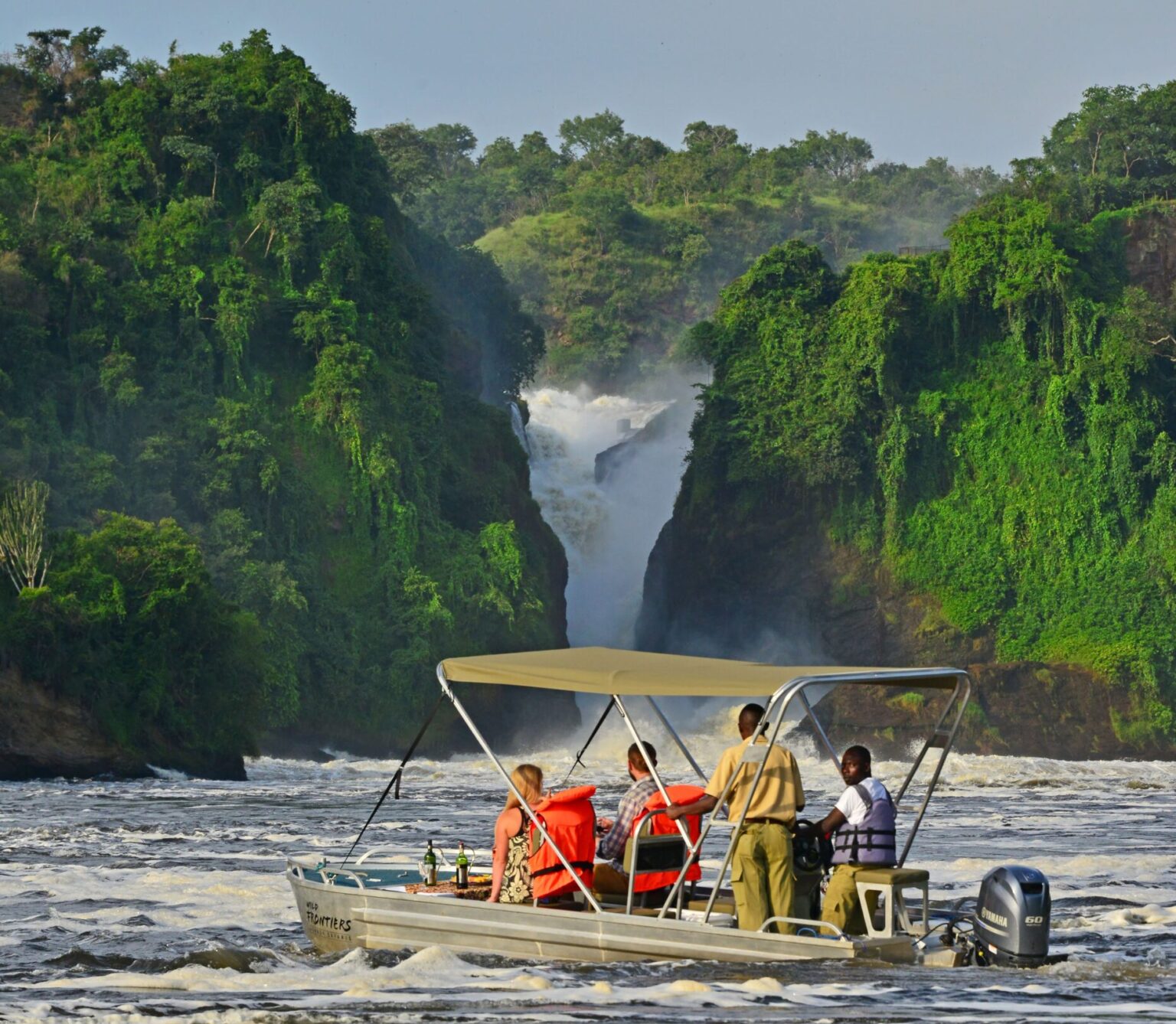
Water defines the dramatic landscapes of East Africa, and on a Uganda safari, you get to witness the continent's most legendary river at its absolute wildest. The journey begins quietly in Jinja, where you can take a peaceful boat cruise to the official geographic source of the White Nile as it flows out of Lake Victoria. However, the river’s true, raw power reveals itself further north at Murchison Falls National Park. Here, the massive Nile is violently compressed into a impossibly narrow, seven-meter canyon. The sheer hydraulic pressure forces the water to crash down forty-three meters with a deafening roar that you can feel vibrating right in your chest. The mist from the falls creates permanent rainbows in the air, framing a spectacular theater of wildlife below. Taking a boat safari to the base of the falls brings you face-to-face with massive pods of yawning hippos, giant Nile crocodiles basking on the banks, and herds of elephants coming down to drink. It is a breathtaking masterclass in the raw power of the natural world.
Tree-Climbing Lions (Ishasha Sector)
When most people envision big cats on a Uganda safari, they picture them stealthily stalking through the golden, knee-high savannah grass. However, heading to the remote Ishasha sector in the southern reaches of Queen Elizabeth National Park completely flips that expectation on its head. In this specific region, the local lion prides have developed a highly unusual, fascinating habit: they spend their afternoons lounging high up in the sturdy branches of old sycamore figs and sprawling acacia trees. Safaris here turn into a thrilling game of spotting massive tawny paws and swinging tails dangling from the canopy. Researchers believe these big cats take to the trees for a few practical reasons: to catch a cool breeze away from the scorching ground heat and to escape the relentless, biting tsetse flies. Watching a full-grown, four-hundred-pound lion effortlessly balance on a tree branch like an oversized housecat is a surreal, unforgettable sight that you won't find anywhere else in the world.
A Birdwatcher's Dream (Shoebill Storks & Beyond)
You do not have to be a hardcore birder to be utterly captivated by the avian life on a Uganda safari. Despite being a relatively compact country, Uganda boasts an astonishingly dense population of over 1,000 recorded bird species—which accounts for roughly half of all the bird life found across the entire African continent. The undisputed crown jewel for travelers is the prehistoric-looking Shoebill stork. Tracking this bizarre, ancient bird takes you deep into peaceful, papyrus-fringed wetlands like the Mabamba Swamp. Gliding silently through the narrow water channels in a wooden dugout canoe, you suddenly come across this massive, five-foot-tall bird standing completely motionless, staring intently into the water with its giant, shoe-shaped beak. Alongside the iconic Shoebill, the country's diverse landscapes are constantly alive with the vibrant colors of Great Blue Turacos, elegant Crested Cranes, and dazzling sunbirds. It turns every single game drive and nature walk into a visually stunning, multi-colored spectacle.
Snow at the Equator (Rwenzori Mountains)
Geographically, the equator conjures up mental images of intense tropical heat, dense jungles, and sun-baked savannahs. Yet, a Uganda safari offers the mind-bending opportunity to stand directly on the equator while gazing up at jagged, permanently snow-capped mountain peaks. Known poetically as the "Mountains of the Moon," the Rwenzori Mountains reach staggering heights of over 5,100 meters. This dramatic alpine wonderland features massive, glittering glaciers, emerald-green moss forests, and surreal, giant lobelia plants that look like they belong on a distant alien planet. Hiking the lower slopes or embarking on a multi-day mountaineering expedition reveals a completely different side of East Africa. The crisp, cool mountain air and mist-shrouded valleys offer a striking, beautiful contrast to the warm, classic savannah plains found just a short drive below. It stands as a powerful testament to the incredible, unmatched geographical diversity packed into this one beautiful country.
The "Rolex" Street Snack (A Taste of Local Culture)
No authentic Uganda safari is truly complete without diving headfirst into the local culinary culture, and nothing represents the heart of Ugandan street food quite like the famous "Rolex." The playful name comes from a quick local slurring of "rolled eggs." This beloved, ubiquitous roadside staple consists of a fresh, hot vegetable omelet—typically cracked and fried with finely chopped cabbage, tomatoes, and onions—skillfully rolled up inside a warm, flaky, pan-fried chapati flatbread. Prepared right in front of you on a custom-made charcoal tires-and-rim grill, it is the ultimate, comforting fuel for a long day of travel. It is hot, savory, incredibly satisfying, and costs just a fraction of a dollar. Grabbing a fresh Rolex from a roadside vendor between game drives isn't just a delicious snack; it is an authentic, wonderful way to connect directly with the warm hospitality and everyday life of the vibrant Ugandan people.
Did you know mountain gorillas live in Bwindi Impenetrable National Park?
Yes, they absolutely do, and standing just feet away from them is one of the most profoundly moving wildlife encounters on the planet. Tucked away in southwestern Uganda, Bwindi Impenetrable National Park lives up to its name with its steep ridges, dense tangles of giant ferns, and ancient trees shrouded in mist. This prehistoric forest shelters roughly half of the world’s remaining endangered mountain gorilla population.
When you set out on a trek here, you aren't just taking a walk; you are following expert trackers and rangers deep into a wild jungle, listening for the cracking of branches or low grunts ahead. The moment you finally clear the dense foliage and lock eyes with a silverback, time entirely stands still. Seeing the sheer size of the dominant male, watching mothers gently groom their infants, and observing toddlers clumsily tumble over vines feels incredibly human. It is an intimate, raw experience that stays with you forever, knowing you are sharing a brief moment in time with a species that sits right on the edge of survival.
Where can you find rare tree-climbing safari lions?
To catch a glimpse of these gravity-defying big cats, you need to head straight to the remote Ishasha sector in the southern part of Queen Elizabeth National Park. While lions across Africa are famously ground-dwelling predators, the prides in Ishasha have developed a highly unique, generations-old habit of scaling massive sycamore fig and acacia trees to spend their afternoons dangling from the branches.
Driving through this rolling savannah, your eyes will constantly scan the canopy instead of the grass. Seeing a massive, four-hundred-pound lion effortlessly balanced on a thick branch—sleeping off a meal with its paws swinging in the breeze—is both surreal and beautiful. Wildlife biologists believe they take to the trees for a few very practical reasons: to catch a cooling breeze above the sweltering ground and to escape the irritating, biting tsetse flies that thrive in the lower grasses. It is a striking display of natural adaptation and a spectacular, bucket-list sight that completely upends everything you think you know about classic African big cat behavior.
Which national park is the primate capital of Africa? Kibale National Park
Without a doubt, that crown belongs exclusively to Kibale National Park. This magnificent, lush rainforest ecosystem boasts the highest density and diversity of primates found anywhere on the African continent. Kibale is home to an astonishing thirteen different primate species, but the undisputed stars of the show are its thriving population of over 1,500 wild chimpanzees.
Tracking chimpanzees here is an exhilarating, sensory-rich adventure. Long before you actually spot them, the entire forest canopy vibrates with their explosive, echoing pant-hoot calls and the loud thumping of tree trunks. Once you catch up to a habituated troop, you are treated to a front-row seat to their complex social lives. You will watch them intricately groom one another, bicker over territory, display immense intelligence, and leap effortlessly through the high branches. If you look up into the surrounding trees, you are also highly likely to spot acrobatic red colobus monkeys, L'Hoest's monkeys, and grey-cheeked mangabeys, making the entire park feel like a bustling, wild metropolis in the trees.
Does the legendary River Nile begin its journey here?
It certainly does. The historic, epic journey of the White Nile—the longest river in the world—officially begins its northward march to the Mediterranean Sea right from the edge of Lake Victoria in Jinja, Uganda. Standing at the source, you can witness the exact spot where the lake’s waters begin to funnel into a powerful, northward-rushing river current.
While the river starts with peaceful scenery in Jinja, it transforms into an exhibition of raw, untamed power as it flows north through Murchison Falls National Park. Here, the massive Nile is violently squeezed through a tiny, seven-meter fracture in the Earth's crust, plunging forty-three meters down into the devil's cauldron below with a deafening roar. Exploring the Nile by boat or standing at the top of the falls allows you to feel the earth literally vibrate beneath your feet from the sheer hydraulic pressure. The riverbanks are permanently alive with massive Nile crocodiles, bathing elephants, and schools of hippos, offering a classic African river safari experience that perfectly blends historic geography with immense natural drama.
How many incredible bird species can you spot nationwide?
Uganda is an absolute paradise for bird lovers, boasting an incredible checklist of over 1,000 recorded bird species nationwide. To put that into perspective, this compact country—roughly the size of Great Britain—is home to more than half of all the bird species found across the entire African continent and about ten percent of the world's total population.
The incredible variety of habitats, ranging from pristine tropical rainforests and vast savannahs to high-altitude alpine zones and expansive wetlands, means you will spot vibrant new species everywhere you look. The ultimate prize for many travelers is the iconic, prehistoric-looking Shoebill stork. Tracking this massive, five-foot-tall bird requires gliding silently through papyrus-lined waterways, like the Mabamba Swamp, in a traditional wooden canoe. Seeing one stand completely frozen in the water, staring intently for fish with its massive, shoe-shaped bill, feels like stepping back into the dinosaur age. Beyond the Shoebill, your safari will be filled with the bright colors of Great Blue Turacos, dazzling sunbirds, and elegant Crested Cranes.
Which Park has massive schools of hippos splashing freely? Queen Elizabeth National Park
For an unforgettable, up-close look at massive numbers of hippos, Queen Elizabeth National Park is the absolute place to be. Specifically, the famous Kazinga Channel—a natural, thirty-two-kilometer waterway that links Lake Edward and Lake George—holds one of the highest concentrations of hippos found anywhere on Earth.
Taking a slow, afternoon boat cruise down this calm channel brings you right into the middle of their watery world. The river is literally packed with massive, bubbling schools of hippos huffing, yawning, and spraying water into the air. You will hear their deep, guttural honking echoes bouncing off the water long before your boat draws near. From the safety of the watercraft, you can watch these multi-ton animals playfully splash, submerge themselves to escape the midday sun, and protectively look after their tiny calves. Because the channel draws a massive array of other wildlife, your hippo-watching cruise will be framed by giant Nile crocodiles lounging on the banks, elephants coming down to drink, and hundreds of colorful waterbirds feeding along the shoreline.
Can you see giant Rothschild giraffes in the wild?
Yes, you absolutely can, and seeing these elegant, towering giants moving gracefully across the golden savannah plains is a true highlight of any safari. Uganda is one of the very best strongholds for the endangered Rothschild’s giraffe, which is easily distinguished by its unique white "stockings" that run all the way down its legs without any spot patterns, and its lighter, beautifully defined coat.
The best place to witness them in large numbers is north of the river in Murchison Falls National Park, where massive herds freely roam the open, palm-dotted grasslands. Watching a family of giraffes glide across the landscape, effortlessly browsing on the thorny tops of acacia trees with their long, blue-grey tongues, is pure poetry in motion. Thanks to dedicated conservation efforts over recent years, groups have also been successfully reintroduced to places like Kidepo Valley National Park and Lake Mburo National Park. Seeing them standing tall against a dramatic African sunrise is an iconic, unforgettable image that perfectly captures the wild, timeless essence of the country's wilderness.
Which tiny reserve offers amazing walking and biking safaris? Lake Mburo National Park
That would be Lake Mburo National Park, an absolute hidden gem of a reserve. While it is one of Uganda's smallest savannah parks, it offers a completely unique and refreshing way to experience the African bush because it is free from dangerous predators like elephants and lions. This safety allows the park to specialize in thrilling, intimate walking safaris and mountain biking adventures.
Instead of being confined to a traditional closed vehicle, you can step out onto the earth and explore the landscape on foot or on two wheels alongside an armed park ranger. Walking quietly through the acacia woodlands, you can feel the morning dew on the grass and get incredibly close to massive herds of impalas, topis, zebras, and buffaloes. Feeling your heart race as you bike past a herd of zebras running parallel to your path is an exhilarating, active connection to nature that you simply cannot get from a car window. It is a peaceful, slow-paced safari experience that lets you appreciate the smaller tracks, sights, and sounds of the wild up close.
Are there snow-capped peaks right near the equator here?
It sounds like a geographical paradox, but it is entirely true. Right along the equator in western Uganda sit the spectacular Rwenzori Mountains, famously known as the "Mountains of the Moon." Rising to towering heights of over 5,100 meters at Mount Stanley's Margherita Peak, this dramatic, jagged mountain range is permanently snow-capped and features massive, glittering glaciers.
While the equatorial lowlands below are warm and tropical, the high-altitude world of the Rwenzoris is a misty, cold, and utterly surreal alpine wonderland. Hiking these slopes takes you through eerie, beautiful moss-draped forests and valleys filled with giant lobelias and groundsels that look like they belong on a distant planet. Whether you are an experienced mountaineer aiming to tackle the challenging, icy glaciers of the peaks or a casual trekker exploring the lower valleys and rushing rivers, the presence of permanent snow right on the equator is a powerful testament to the breathtaking geographical diversity packed into this beautiful country.
What is the traditional fast-food wrap eaten during safaris?
No authentic journey through the country is complete without trying a "Rolex," the ultimate, beloved Ugandan street food wrap. The name has absolutely nothing to do with luxury Swiss watches; rather, it comes from the quick, local pronunciation of "rolled eggs." It is a ubiquitous, comforting snack that you can find being made fresh on almost every street corner and roadside stop.
A standard Rolex starts with a couple of eggs cracked onto a hot, custom charcoal grill, mixed with finely chopped cabbage, onions, tomatoes, and a pinch of salt to create a flavorful omelet. Once the omelet is perfectly fried, the vendor places a warm, flaky, pan-fried chapati flatbread directly on top of it, expertly rolls the whole thing up into a tight, handheld wrap, and serves it to you piping hot. It is savory, incredibly satisfying, and the ultimate, affordable comfort food to fuel a long day of travel between game drives. Eating a fresh Rolex on the go is a delicious, fun way to experience local culture firsthand.
Booking Uganda safaris with us Roads of Adventure safaris
Booking your dream getaway with us at Roads of Adventure Safaris is a completely seamless, stress-free experience tailored exactly to your unique budget and travel style. We specialize in crafting unforgettable mid-range and luxury custom itineraries across Uganda, Kenya, and Tanzania, with prices typically ranging from $300 to $1,000 per person, per day.
Getting started is simple. First, select an itinerary that speaks to you, whether it’s a quick 3-day gorilla trek, a 6-day primate and wildlife tour, or our ultimate 16-day Pearl of Africa unlimited adventure. Because highly sought-after gorilla and chimpanzee trekking permits sell out fast, we recommend booking 9 to 12 months in advance for peak seasons. Once you're ready, you can easily secure your dates with a 30% deposit, with the remaining balance due 60 days before we set off on our journey together.
