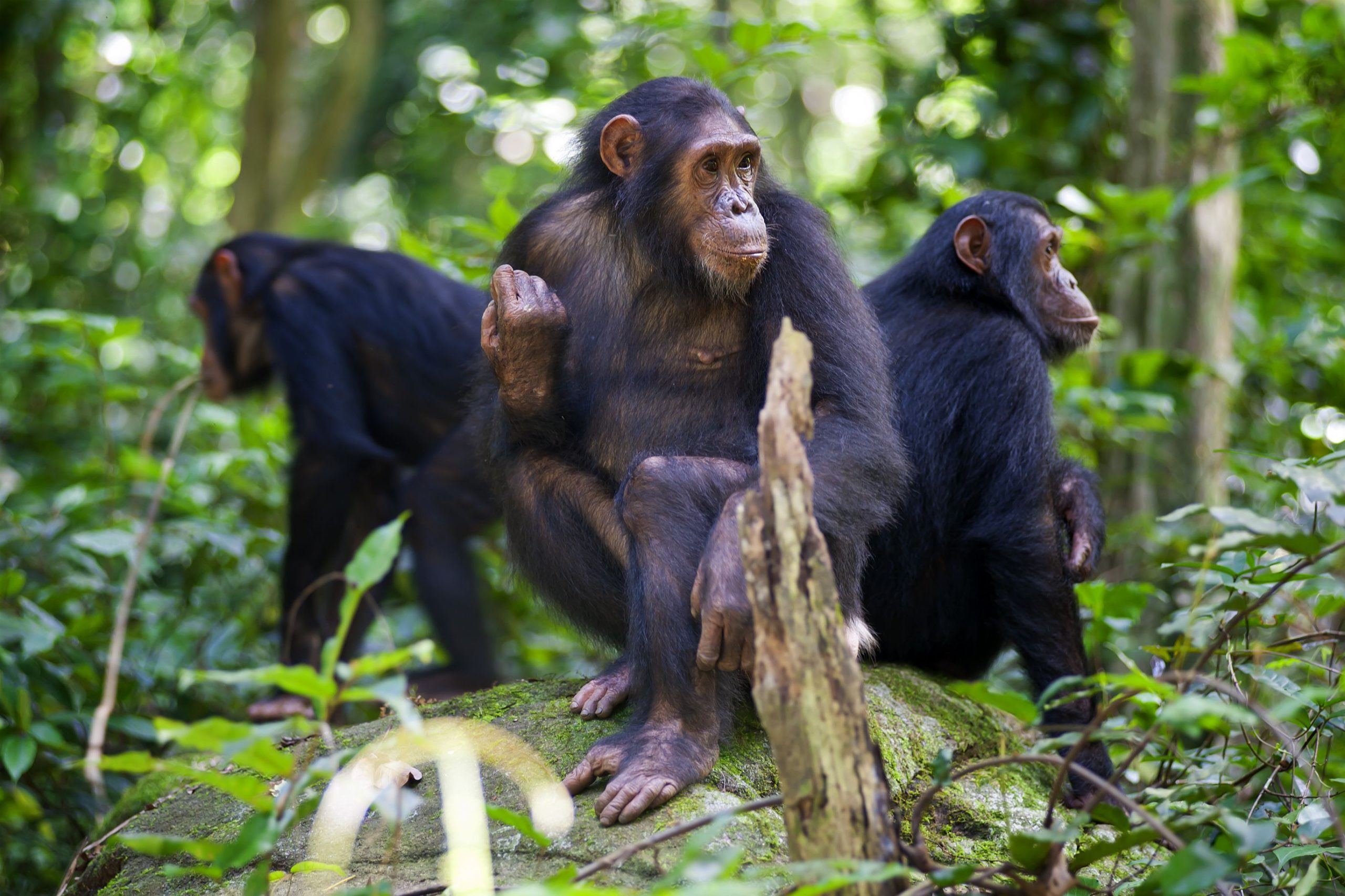
Nestled in the Bushenyi district of western Uganda, Kalinzu Central Forest Reserve is a premier destination for primate tracking. Home to an estimated 230 to 350 wild chimpanzees, with about 50 fully habituated for tourism, the reserve boasts a remarkable success rate for close-up encounters.
The tracking adventure requires physical fitness as it involves a 2 to 4-hour hike through dense, tropical terrain. You can experience this activity year-round, with the optimal times for drier, less slippery trails falling in the dry seasons from June to September and December to February.
Before setting off on trails like the Valley Trail or Waterfall Trail, guides brief trekkers on rules to protect the endangered Pan troglodytes Schweinfurth. Protocols strictly limit groups to 6 people per chimp community and require maintaining an 8-meter distance to avoid disease transmission. Once the tracking team spots a troop, visitors are allowed exactly one hour to quietly observe the chimps feeding, playing, and grooming in their natural habitat
4-days-budget-queen-elizabeth-park-and-chimpanzee-tracking-in-kalinzu-forest 14-days-uganda-and-rwanda-safari-tour-itinerary
14-days-luxury-uganda-primate-safari-holiday
14-days-uganda-primate-safari-and-jinja-white-water-rafting
14-days-classic-uganda-birding-safari-expedition
14-days-best-africa-big-five-safari-in-uganda-and-best-gorilla-trekking-adventure
20-days-uganda-birding-safari-wildlife-gorilla-and-chimpanzee-tracking
20-days-uganda-birding-safari-to-uganda-national-park
20-days-uganda-safari-holiday-tour-package-itinerary
19-days-best-photography-uganda-birding-safari-and-wildlife-adventure
19-days-incredible-uganda-safari-tour-big-five-chimpanzees-and-mountain-gorillas
18-days-best-of-uganda-safari-holiday-vacation-to-all-best-parks
17-days-uganda-honeymoon-safari-holiday-tour
17-days-uganda-birding-safari-itinerary
17-days-best-safari-in-uganda-ending-in-kigali-rwanda
16-days-ultimate-uganda-safari-to-rwanda-safari-tour-package-combo
16-days-best-of-uganda-birding-safari-holiday-extravaganza
7-day-ultimate-uganda-primate-safari-chimpanzees-and-game-drives
6-days-best-gorilla-trekking-and-safari-uganda-parks
Where is Kalinzu Forest Reserve Located?
Kalinzu Central Forest Reserve sits in southwestern Uganda's Bushenyi District, set along the floor of the Albertine Rift Valley. Covering 137 square kilometers at an average altitude of 1,400 meters above sea level, the reserve acts as a crucial transition zone where lowland evergreen rainforest meets cooler montane woodland.
It sits roughly 370 kilometers west of Kampala, directly bordering the Maramagambo Forest on the southern and western edges of Queen Elizabeth National Park. Because no fences divide these areas, wildlife moves freely across both ecosystems. High-altitude tea plantations line the forest's northern boundary along the Bushenyi highlands.
Kalinzu is positioned about 40 kilometers south of the Ishasha sector—famous for its tree-climbing lions—and roughly 55 kilometers south of the Kazinga Channel. The main National Forestry Authority (NFA) reception center and headquarters sit right along the paved Mbarara-Kasese highway in the trading center of Komunjunju, making the park headquarters simple to locate.
How to Get to Kalinzu Forest Reserve
Kalinzu is straightforward to reach using either road transport or domestic air routes.
By Road:
Driving from Kampala takes six to seven hours in a 4x4 or private vehicle along a smooth, fully paved highway that passes through Masaka, Mbarara, and Bushenyi, crossing the equator at Kayabwe along the way. The turnoff to the NFA visitor center sits directly on the main highway at Komunjunju, so you won't need to navigate rough secondary roads just to reach the morning briefing point. Public buses running from Kampala toward Kihihi or Bwindi via Bushenyi can also drop passengers right at the main gate.
By Air:
For a faster journey, domestic scheduled and charter flights depart Entebbe International Airport for Mweya Airstrip or Kasese Airstrip near Queen Elizabeth National Park. Flight time ranges between 60 and 75 minutes. From either airstrip, a 1.5-hour drive (50 to 65 kilometers) south along the highway brings you directly to the forest headquarters.
Why Choose Kalinzu Forest Reserve for Chimpanzee Tracking?
Kalinzu stands out as one of Uganda's most rewarding chimpanzee tracking locations due to its high sighting rates, low permit prices, and uncrowded trails.
The reserve harbors a healthy population of roughly 320 eastern chimpanzees. Two groups have been habituated over the years: one community of 50 to 70 individuals designated for visitor tracking, and a second group dedicated to long-term scientific research. This careful habituation gives visitors a tracking success rate above 85%.
It is also one of the most affordable places in the country to trek primates. Permits issued by the National Forestry Authority cost $50 USD for international non-residents—a fraction of the cost found in higher-profile parks like Kibale.
To protect the wildlife and preserve the quality of the experience, tracking groups are capped at eight people per session. Because total visitor numbers remain relatively low, forest walks feel unhurried and intimate. Beyond the primates, Kalinzu's dense canopy supports rich biodiversity, including 400 tree species, 378 bird species, and 410 butterfly species.
What is Kalinzu Forest Reserve's size and geographic location?
Kalinzu Central Forest Reserve spans approximately 137 square kilometers in western Uganda, primarily within Bushenyi District. It lies at coordinates 0°25'S 30°05'E along the Albertine Rift Valley, bordering Queen Elizabeth National Park and Maramagambo Forest. The reserve features an average altitude of 1,400 meters above sea level. This unique elevation creates a transitional habitat between lowland evergreen and montane forest ecosystems. Rainfall averages 1,150 millimeters annually, sustaining dense canopy structures, secondary forests, and savanna grasslands. The forest is managed by the National Forestry Authority (NFA), which enforces conservation boundaries and eco-tourism initiatives. Kalinzu serves as a critical ecological corridor for wildlife migrating between the Rwenzori region and southern savanna ecosystems. The geographical terrain consists of undulating hills, deep valleys, and river streams that feed local agricultural water tables.
How many primate species inhabit the Kalinzu Forest ecosystem?
Kalinzu Forest houses six distinct primate species, making it a high-density destination for primate research and eco-tourism. The dominant species is the eastern chimpanzee (Pan troglodytes schweinfurthii), with a population exceeding 300 individuals. Two groups are habituated for human contact: one for tourism and another for scientific research by Japanese primatologists. Other resident primates include the black-and-white colobus (Colobus guereza), l'Hoest's monkey (Allochrocebus lhoesti), blue monkey (Cercopithecus mitis), red-tailed monkey (Cercopithecus ascanius), and vervet monkey (Chlorocebus pygerythrus). Nocturnal primates like galagos (bushbabies) and pottos also populate the canopy. Primate distribution depends heavily on fruit availability, Ficus tree density, and canopy continuity. Habitat fragmentation outside reserve boundaries poses the main threat to these primate populations. Conservation efforts focus on protecting fruit-bearing tree species and preventing illegal poaching or snare placement within their primary territories.
What chimpanzee populations and habituation groups exist in Kalinzu?
Kalinzu Forest protects an estimated 320 chimpanzees (Pan troglodytes schweinfurthii). The National Forestry Authority (NFA), alongside international researchers, has successfully habituated two distinct communities. The tourism habituation group comprises approximately 50 to 70 individuals, accustomed to daily human presence for tracking activities. The research group, monitored continuously for decades, provides critical data on chimpanzee social structures, dietary habits, and tool usage. Chimpanzee tracking success rates in Kalinzu exceed 85%, attributed to the forest's size and localized food sources. The chimpanzees rely heavily on figs, leaves, bark, and occasional small mammals for sustenance. Nesting occurs nightly in high forest canopies, with new nests constructed daily from branches and foliage. Human interactions are strictly regulated; trackers must maintain a minimum distance of eight meters to prevent disease transmission and behavioral disruption.
What are the specific chimpanzee tracking guidelines and permits?
Chimpanzee tracking in Kalinzu Forest requires official permits issued by the National Forestry Authority (NFA). The minimum age requirement for trackers is 15 years. Group sizes are strictly limited to a maximum of eight tourists per tracking group to minimize ecological impact. Tracking sessions commence daily at 08:00 hours and 14:00 hours from the forest headquarters. Standard permits cost approximately $50 USD for international non-residents, making Kalinzu a cost-effective alternative to Kibale National Park. The tracking duration ranges between three to four hours, depending on primate movement and location. Once trackers locate the chimpanzee community, the viewing time is strictly capped at 60 minutes. Mandatory rules include a minimum distance of eight meters, a ban on flash photography, and a prohibition on eating or drinking near primates. Anyone showing signs of communicable illness, such as flu or coughing, is barred from entering the forest.
What bird species diversity can birdwatchers find in Kalinzu?
Kalinzu Forest holds classification as an Important Bird Area (IBA), supporting over 378 recorded bird species. The forest's canopy levels and Albertine Rift location attract both forest-dependent and migratory avian species. Key highlights include the Great Blue Turaco, Black-and-white Casqued Hornbill, Ross's Turaco, and the elusive African Finfoot. Special attention is given to Albertine Rift endemics like the Regal Sunbird, Blue-headed Sunbird, and Strange Weaver. The forest undergrowth protects species like the White-starred Robin, Scaly-breasted Illadopsis, and various greenbuls. Birdwatching excursions utilize specialized forest trails, notably the Waterfall Trail and the Valley Trail, which offer optimal visibility. Peak birding seasons align with the rainy seasons from March to May and September to November, coinciding with breeding periods and fruit abundance. Migratory birds from Europe and northern Africa arrive between November and April, increasing temporary species diversity across the reserve's microhabitats.
What butterfly and moth populations are documented in the reserve?
Kalinzu Forest boasts an exceptional insect biodiversity profile, featuring over 410 documented species of butterflies and moths. This high concentration makes it one of Uganda's premier entomological research sites. Prominent butterfly families include Nymphalidae, Papilionidae, and Pieridae. Species such as the African Giant Swallowtail (Papilio antimachus) and various Charaxes species populate the forest floor and sunlit clearings. Moths include large Emperor moths (Saturniidae) and Hawk moths (Sphingidae), which play critical roles in nocturnal pollination. The high diversity of Lepidoptera is directly linked to the forest's 400 plant species, providing specific larval host plants and nectar sources. Butterflies are most active during warm, sunny mornings, particularly after rainfall when they gather at mud puddles to extract essential minerals. Forest trails provide access to distinct microclimates, from damp valley bottoms to ridges, each supporting unique insect communities.
What tree and plant species define the forest composition?
Kalinzu Forest comprises over 400 recorded tree species and numerous herbaceous plants, classifying it as a mixed tropical high forest. The flora exhibits a transition between lowland and montane vegetation. Dominant tree species include Parinari excelsa, Celtis africana, Prunus africana, and various Ficus (fig) species. Prunus africana holds significant medicinal value and commercial protection status due to overexploitation elsewhere. The forest structure features a multi-layered canopy reaching heights up to 45 meters, alongside a dense understory of shrubs, ferns, and lianas. Epiphytic orchids, mosses, and lichens blanket tree trunks, thriving in the high-humidity microclimate. Parinari excelsa acts as a climax indicator species, marking mature, undisturbed sections of the forest. The dense vegetation regulates local microclimates and serves as the primary food matrix for the reserve's herbivores, frugivorous birds, and primate populations.
What mammalian fauna exists beyond primates in Kalinzu?
Beyond its famous primate populations, Kalinzu Forest supports a diverse array of terrestrial and arboreal mammals. Documented species include forest elephants (Loxodonta cyclotis), which occasionally migrate via corridors linking to Queen Elizabeth National Park. Buffalos (Syncerus caffer), bushpigs (Potamochoerus larvatus), giant forest hogs (Hylochoerus meinertzhageni), and several duiker species populate the undergrowth. Carnivores are represented by leopards (Panthera pardus), golden cats (Caracal aurata), servals, and multiple mongoose species. Arboreal mammals include tree pangolins, flying squirrels, and various tree hyraxes whose nocturnal calls characterize the forest night. The dense forest canopy and thick ground cover make large mammal sightings rare, requiring track identification and camera traps for monitoring. This mammalian diversity relies entirely on the continuous forest matrix and functional ecological corridors connecting Kalinzu to surrounding protected zones.
What are the specific hiking trails available within Kalinzu?
Kalinzu Forest features four primary, well-maintained hiking trails designed for varying fitness levels and interest profiles. The Valley Trail spans 3.5 kilometers, taking roughly two hours, and loops along a valley ridge with excellent views of the canopy. The Waterfall Trail covers 11 kilometers, requiring four to five hours, and leads hikers to a spectacular Kilyantama waterfall over rugged terrain. The River Trail is a 2.5-kilometer path focusing on riverine forest dynamics and semi-aquatic ecology, taking around one hour. The Palm Trail is a relatively flat 5-kilometer walk, requiring two hours, known for unique palm species and traditional medicinal plants. All trails originate from the NFA reception center and require an armed ranger guide. The trails serve multiple functions: tourist hiking, birdwatching access, scientific monitoring paths, and law enforcement patrol routes against illegal forest activities.
How does Kalinzu Eco Lodge incorporate solar power technology?
Kalinzu Eco Lodge utilizes an off-grid solar photovoltaic (PV) system to satisfy 100% of its electrical energy requirements. The system features a centralized solar array comprising high-efficiency monocrystalline solar panels mounted to maximize sunlight absorption. Energy storage is handled by a dedicated bank of deep-cycle lithium-ion batteries, ensuring stable power delivery during nocturnal hours and overcast conditions. The lodge utilizes low-wattage Light Emitting Diode (LED) fixtures exclusively throughout its guest cottages, main lounge, and service areas to minimize power draw. Inverters convert direct current (DC) generated by the panels into alternating current (AC) for standard guest charging stations. Water heating leverages independent solar thermal collectors installed on cottage roofs, utilizing thermosiphon principles to supply hot water to showers without drawing from the electrical grid. This solar setup eliminates carbon emissions associated with diesel generators.
What architectural materials and design principles define the lodge?
Kalinzu Eco Lodge is constructed using low-impact, sustainable architectural principles designed to blend into the forest fringe. The primary structural components utilize locally sourced timber, sustainable bamboo, and natural stone extracted from authorized regional quarries. Roofs are engineered with local thatch materials, providing superior thermal insulation and acoustic dampening during heavy tropical rainstorms. Elevated wooden platforms form the foundation of the 13 cottages, minimizing soil compaction, protecting ground vegetation, and allowing natural water drainage beneath structures. Large, strategically placed glass windows and open-sided verandas maximize natural ventilation, reducing the need for mechanical cooling systems. The layout preserves existing mature trees, avoiding clearing operations during the construction phase. Interior spaces feature handcrafted furniture made by local artisans using legally salvaged wood, ensuring a minimal carbon footprint and reflecting traditional Ugandan design aesthetics.
How does the lodge manage water conservation and wastewater?
Water resource management at Kalinzu Eco Lodge relies on rainwater harvesting and strict conservation protocols. The lodge features extensive roof gutter systems that channel rainwater into large, food-grade polyethylene storage tanks equipped with multi-stage filtration systems. For guest consumption and utility use, gravity-fed delivery systems minimize mechanical pumping energy requirements. Low-flow showerheads and aerated water faucets are installed across all 13 cottages, reducing water consumption by an estimated 30% compared to standard fixtures. Wastewater treatment utilizes an eco-friendly three-stage septic system and constructed wetlands (reed beds). Blackwater and greywater are separated at the source; greywater undergoes natural biological filtration through specific aquatic plants before safely recharging the local water table. The lodge prohibits synthetic chemical cleaners, mandating biodegradable, non-toxic detergents to protect the surrounding soil biology and preventing contamination of nearby forest streams.
What waste management and plastic reduction policies are in place?
Kalinzu Eco Lodge enforces a strict zero-single-use-plastic policy across its property and operations. Guests are provided with purified drinking water in reusable glass bottles or stainless-steel carafes, eliminating plastic bottle waste completely. Solid waste is segregated at the source into clearly marked bins for organic matter, recyclables, and non-recyclables. Organic waste is processed on-site using ventilated composting bins, generating nutrient-rich fertilizer for the lodge’s organic vegetable gardens. Non-biodegradable recyclables, including glass, aluminum cans, and cardboard packaging, are compressed and transported to certified recycling facilities in Mbarara or Kampala. Supply chains are optimized to prioritize bulk purchasing, reducing individual packaging waste significantly. Staff receive regular training on waste reduction protocols, and educational signage informs guests on minimizing their personal garbage footprint during their stay at the lodge.
What are the cottage types, capacities, and interior layouts?
Kalinzu Eco Lodge features 13 custom-built cottages categorized into three distinct configurations: Deluxe Single Cottages, Twin/Double Cottages, and Family Suites. Single and Double cottages accommodate one to two guests, featuring spacious king-size or twin beds draped in premium mosquito netting. Family Suites feature two independent bedrooms, a shared central living area, and can accommodate up to four adults comfortably. Every cottage is built on an elevated wooden deck, terminating in a private veranda furnished with safari chairs overlooking the Kalinzu Forest canopy. The interior layout prioritizes open space, incorporating en-suite bathrooms equipped with flush toilets, twin vanities, and stone-walled walk-in showers. In-room amenities include electronic safes, solar-powered charging stations for electronics, and writing desks. The design omits televisions and radios to maintain an authentic wilderness environment, focusing guest attention on natural auditory surroundings.
Where is Kalinzu Eco Lodge located relative to Kampala?
Kalinzu Eco Lodge is situated approximately 370 kilometers west of Uganda’s capital city, Kampala. The geographic coordinates place the lodge at the periphery of the Kalinzu Central Forest Reserve in Bushenyi District. Traveling by road involves a scenic journey along the fully tarmacked Kampala-Masaka-Mbarara-Bushenyi highway, averaging a six-hour driving duration under normal traffic conditions. The route crosses the equator monument at Kayabwe, offering a key geographic landmark. The lodge's position is strategically located for multi-destination western safari circuits, sitting just 40 kilometers from the Ishasha sector of Queen Elizabeth National Park. This location allows seamless travel transitions between primate tracking in Kalinzu and savanna game drives or boat safaris along the Kazinga Channel, optimizing regional travel itineraries for international tourists.
How does Kalinzu Eco Lodge interact with local communities?
Kalinzu Eco Lodge operates on a community-inclusive business model designed to distribute tourism revenue into the surrounding Bushenyi District. Over 80% of the lodge’s permanent staff, including housekeeping, culinary teams, and maintenance crews, are recruited directly from adjacent villages. The lodge operates a local purchasing policy, sourcing fresh produce, poultry, and dairy from nearby smallholder farmers, boosting the local agricultural economy. Furthermore, the lodge provides a dedicated retail platform within its gift shop for local craft cooperatives, allowing women’s groups to sell handmade baskets, carvings, and textiles directly to international visitors. A percentage of accommodation revenue is funneled into community development projects, focusing on clean water access and funding local primary education infrastructure, establishing a tangible link between forest conservation and community welfare.
What is the National Environment Management Authority (NEMA) approval status?
Kalinzu Eco Lodge holds full environmental compliance certification from Uganda's National Environment Management Authority (NEMA). Prior to breaking ground, the developers commissioned a comprehensive Environmental Impact Assessment (EIA) conducted by certified environmental practitioners. The assessment evaluated potential impacts on forest hydrology, soil stability, wildlife migratory paths, and local community dynamics. NEMA’s approval was granted based on the lodge's adherence to stringent mitigation frameworks, including low-impact construction footprints, off-grid utility reliance, and advanced wastewater filtration designs. Regular environmental audits are performed by NFA and NEMA officers to ensure ongoing compliance with national ecological standards. This formal certification guarantees that the lodge operates legally within the sensitive buffer zone of the Kalinzu Central Forest Reserve without degrading the primary ecosystem.
What are the seasonal weather patterns and best times to visit?
Kalinzu Forest experiences a tropical rainforest climate characterized by two distinct rainy seasons and two dry seasons annually. The primary dry seasons occur from June to August and December to February, representing the optimal periods for chimpanzee tracking and hiking. During these months, forest trails are less muddy, reducing terrain difficulty, and sunny weather improves wildlife visibility. The heavy rainy seasons occur from March to May and September to November. While rains can disrupt daily tracking schedules, these wet months correspond with peak fruit ripening, causing chimpanzees to feed lower in the canopy, often shortening tracking times. Birdwatching is highly productive during the rainy periods due to breeding activity and migratory influxes. Average daily temperatures remain stable year-round, ranging from daytime highs of 25°C to evening lows of 15°C.
What dining, culinary offerings, and meal plans are available?
The culinary department at Kalinzu Eco Lodge operates on a full-board meal plan framework, covering breakfast, lunch, and dinner for all residents. The kitchen prepares a fusion of international cuisine and traditional Ugandan dishes, utilizing organic ingredients harvested daily from the lodge's garden and local farms. Breakfast features a selection of fresh tropical fruits, locally grown Arabica coffee, tea, eggs, and freshly baked pastries. Lunches and dinners are served as structured three-course menus, offering vegetarian, vegan, and gluten-free alternatives to accommodate diverse dietary requirements. The main dining dining area features an open-air architecture design, providing panoramic views of the forest canopy during meals. Packed lunch boxes are custom-prepared for guests embarking on extended chimpanzee tracking or full-day hiking excursions within the reserve, ensuring proper nutrition during field activities.
What infinity pool and outdoor leisure facilities are on site?
Kalinzu Eco Lodge features a custom-engineered outdoor infinity swimming pool situated on the edge of the property ridge. The pool’s design creates a seamless visual transition between the water's surface and the pristine canopy of the Kalinzu Forest Reserve below. The pool utilizes a modern, low-chemical filtration system to minimize environmental impacts on local insect and bird populations that visit the area. Surrounding the pool is an expansive wooden sun deck equipped with loungers, sun umbrellas, and a dedicated pool-side lounge area serving refreshments. This facility provides a dedicated relaxation zone for guests returning from strenuous forest hikes or chimpanzee tracking excursions. The pool area is strategically oriented westward, offering unobstructed views of regional sunsets over the Albertine Rift landscape, making it a central aesthetic feature of the lodge property.
What is the historical background of Kalinzu Forest Reserve?
Kalinzu Forest Reserve was formally gazetted as a protected central forest reserve in 1932 under British colonial administration. Initially, management focused on sustainable timber extraction, targeting valuable hardwood species like Entandrophragma and Khaya (mahogany). In the late 20th century, management paradigms shifted from commercial logging toward ecosystem conservation and scientific research. In the early 1990s, Japanese researchers from Kyoto University established a permanent research station, initiating long-term habituation and study of the forest's chimpanzee populations. Tourism infrastructure was officially introduced in the late 1990s under the management of the National Forestry Authority (NFA) to generate sustainable conservation revenue. Today, the historical logging tracks have been transformed into eco-tourism hiking trails, and the reserve stands as a model for successful collaborative management between state authorities, international researchers, and eco-tourism developers.
How is security and guest safety managed at the lodge?
Guest safety and security at Kalinzu Eco Lodge are managed through integrated protocols involving state authorities and private security infrastructure. The lodge perimeter features continuous monitoring by trained security personnel operating 24-hour patrols across guest zones and service areas. Because the lodge borders a state forest reserve containing large mammals, all walking excursions outside the immediate lodge clearings require an armed ranger guide from the National Forestry Authority (NFA) or Uganda Wildlife Authority (UWA). Cottages are equipped with secure locking mechanisms, electronic deposit safes for valuables, and direct communication lines to the central reception office. Fire safety installations include strategically positioned fire extinguishers, smoke detectors, and clearly demarcated emergency assembly points. The lodge maintains a comprehensive first-aid station and clear emergency evacuation protocols linking to advanced medical facilities in Mbarara town.
What are the transport options for accessing Kalinzu Eco Lodge?
Accessing Kalinzu Eco Lodge can be achieved via road transport or scheduled domestic aviation networks. Most international travelers utilize 4x4 safari vehicles, departing from Entebbe International Airport or Kampala via the Mbarara-Bushenyi highway. The road journey offers high-quality tarmac infrastructure up to the forest turnoff, making it accessible year-round. Alternatively, travelers can opt for domestic charter or scheduled flights operated by aviation companies like Aerolink Uganda. Flights depart from Entebbe and land at the nearby Kasese Airstrip or Mweya Airstrip inside Queen Elizabeth National Park, both located approximately a 1.5-hour drive from the lodge. From these airstrips, private airport transfer vehicles transport guests directly to the lodge. The lodge features secure, on-site parking facilities for self-drive travelers and safari tour operator vehicles.
What research and conservation partnerships are active in Kalinzu?
Kalinzu Forest Reserve hosts several long-term research and conservation partnerships that inform its management strategies. The primary scientific partnership is with Japanese primatologists from institutions like Kyoto University, who have conducted continuous chimpanzee behavioral research since 1992. The National Forestry Authority (NFA) collaborates with these research teams to monitor forest health, track animal population dynamics, and combat illegal poaching activities. Kalinzu Eco Lodge actively participates in these initiatives by funding local forest patrols, hosting visiting researchers, and sharing ecological data collected on its property borders. Educational outreach programs, co-funded by tourism revenue, operate in local schools to educate youth on the economic and ecological benefits of forest conservation, reducing human-wildlife conflicts and preventing agricultural encroachment along the reserve boundaries.
How does Kalinzu compare to Kibale National Park for chimpanzee tracking?
Kalinzu Forest Reserve offers a distinct alternative to Kibale National Park for chimpanzee tracking experiences in Uganda. While Kibale contains a larger total chimp population and higher overall habituated group counts, Kalinzu offers a significantly more exclusive, low-density tracking environment. Kibale allows large numbers of tourists daily across multiple groups, whereas Kalinzu's tracking permits are limited, minimizing trail congestion. Cost efficiency is a major differentiating factor; Kalinzu chimpanzee permits cost around $50 USD, substantially less than Kibale’s permits, which exceed $200 USD, making Kalinzu highly attractive to budget-conscious and mid-range safari travelers. Terrain-wise, Kalinzu features steeper ridges and denser undergrowth compared to the flatter terrain of Kibale, presenting a more physically demanding hike that appeals to adventure-oriented tourists seeking an authentic, less commercialized wilderness experience.
What check-in protocols, payment methods, and booking policies apply?
Kalinzu Eco Lodge enforces standard hospitality check-in policies, with check-in commencing at 14:00 hours and check-out mandated by 10:00 hours to facilitate room cleaning. Advanced reservations are required, particularly during peak safari months (June-August, December-February), and can be completed via the lodge’s online portal or authorized tour operators. Payment methods accepted include major international credit/debit cards (Visa and Mastercard) processed through secure payment gateways, electronic bank wire transfers, and cash payments in US Dollars (issued after 2013) or Uganda Shillings. The booking cancellation policy dictates a full refund minus administrative fees for cancellations made 60 days prior to arrival, a 50% refund for cancellations within 30-59 days, and zero refund for cancellations occurring under 30 days from the scheduled arrival date.
Booking Chimpanzee tracking in Kalinzu forest Reserev with us Roads of Adventure safaris
Booking your chimpanzee tracking experience in the Kalinzu Forest Reserve with Roads of Adventure Safaris offers a highly rewarding, budget-friendly wildlife adventure. Kalinzu Forest boasts an impressive 95% tracking success rate, making it one of the premier locations in Uganda to view habituated chimpanzees up close
