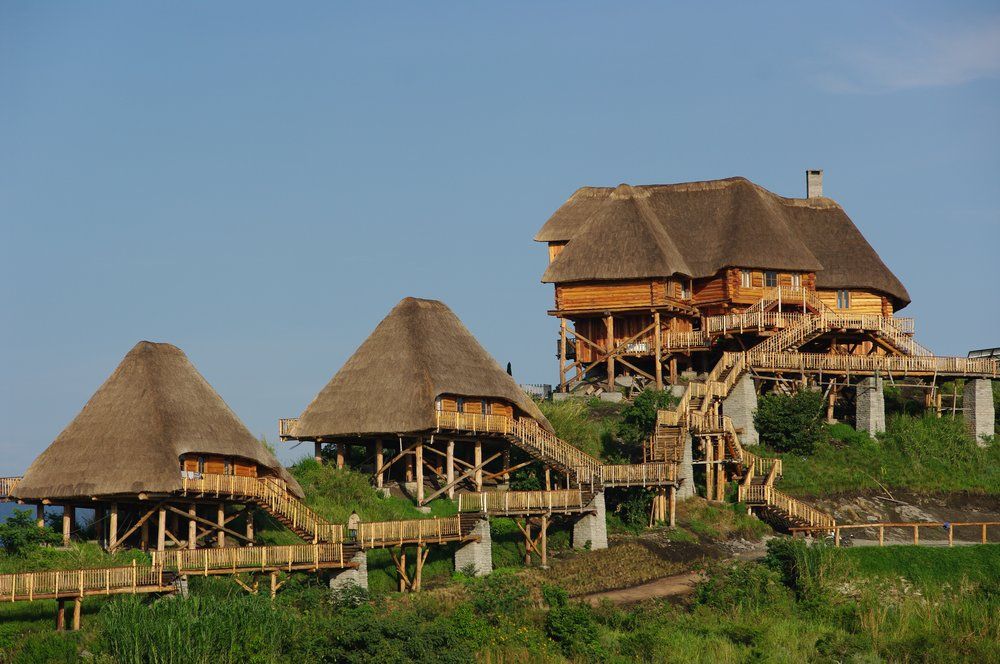
The 9 Days Uganda luxury safari gorilla and chimpanzee tracking itinerary traverses the ecological landscapes of western Uganda. Beginning with a 300-kilometer drive lasting six hours from Entebbe to Fort Portal, travelers reach Kibale National Park, a prime tropical moist forest home to 13 primate species. The expedition advances south into Queen Elizabeth National Park along the Kazinga Channel, where hippos and African buffaloes gather alongside 600 recorded bird species, including the African skimmer. Continuing through the southern Ishasha sector, visitors observe distinct tree-climbing lions resting in native fig trees before ascending into Bwindi Impenetrable National Park, a UNESCO World Heritage site harboring Eastern Mountain gorillas. The journey finishes at Lake Bunyonyi before returning 410 kilometers across the equator to Entebbe. Premier accommodations include Kyaninga Lodge, Kyambura Gorge Lodge, and Sanctuary Gorilla Forest Camp.
Detailed Itinerary
Day 1: Arrival in Entebbe/Kampala & Transfer to Fort Portal / Kibale
Upon arrival at Entebbe International Airport, meet your private guide and board a luxury 4x4 Land Cruiser. Begin the 310-kilometer overland transfer west toward Fort Portal, a driving duration of roughly six hours along the Mubende highway. The route crosses lush agrarian countryside, rolling hills, and expansive commercial tea estates before reaching the volcanic crater region. Arrive at Kyaninga Lodge, an exclusive timber property situated on the rim of Lake Kyaninga facing the Rwenzori Mountains. After checking into your private cottage, spend the late afternoon embarking on a guided two-hour walk around the crater rim. Along the forested slopes, look for resident black-and-white colobus monkeys and bird species such as the Great Blue Turaco, Black-and-white Casqued Hornbill, and Ross's Turaco. Return to the lodge for dinner overlooking the volcanic lake. Enjoy a restful evening surrounded by tranquil forest soundscapes.
Day 2: Chimpanzee Tracking in Kibale Forest & Bigodi Wetland Walk
Drive 35 kilometers south from the lodge to Kanyanchu Visitor Centre in Kibale National Park for a 7:30 AM ranger briefing. Accompanied by armed Uganda Wildlife Authority rangers, trek into the tropical rainforest to track a habituated troop of wild chimpanzees (Pan troglodytes). The trek lasts between two and four hours depending on primate movement. Observe the troop feeding, grooming, and communicating in the forest canopy. In the afternoon, transfer 10 kilometers to the Bigodi Wetland Sanctuary, a community-run conservation area in the Magombe Swamp. Take a three-hour guided boardwalk walk across papyrus habitat. This wetland protects eight primate species, including red colobus and L'Hoest's monkeys, alongside 200 bird species. Spot key avian wildlife such as the rare Papyrus Gonolek, Yellow-spotted Barbet, White-spotted Flufftail, and Great Blue Turaco before returning to Primate Lodge for overnight relaxation in your luxury forest suite.
Day 3: Transfer to Queen Elizabeth National Park & Evening Game Drive
Depart Kibale National Park after breakfast for a scenic 120-kilometer drive south toward Queen Elizabeth National Park, requiring roughly three hours. Travel along the Rwenzori mountain foothills, passing local banana plantations and crossing the equator at Kikorongo. Check into the high-end Kyambura Gorge Lodge, positioned on the rim of a sunken tropical forest ravine. After lunch and a short rest, embark on a three-hour late afternoon game drive through the Kasenyi plains sector within the northern park area. Driven in an open safari vehicle, search for Uganda kob herds, African bush elephants, Cape buffaloes, side-striped jackals, and lions hunting across open savannah grassland. Bird watchers can spot martial eagles, brown snake eagles, and African wattled lapwings. Return to the lodge at dusk for fine dining and views over the Kyambura gorge. Relax by the infinity pool under the clear African night.
Day 4: Kasenyi Morning Game Drive & Kazinga Channel Boat Cruise
Begin the morning at 6:30 AM with a three-hour game drive through the Kasenyi tracking circuit. Track nocturnal predators returning from night hunts, including spotted hyenas and leopards, alongside herds of defassa waterbucks and giant forest hogs. Return to the lodge for a warm mid-morning breakfast. At 2:00 PM, transfer to Mweya peninsula to board a private luxury launch boat for a two-hour water safari along the 32-kilometer Kazinga Channel, which connects Lake George and Lake Edward. Sail past dense pods of hippos and Nile crocodiles sunning on riverbanks. African bush elephants frequently gather at the water edge to drink and bathe. Bird watching along the channel yields sightings of the African skimmer, pink-backed pelican, saddle-billed stork, grey-headed gull, and African fish eagle. Head back to Kyambura Gorge Lodge for dinner and evening drinks overlooking the wilderness expanse below.
Day 5: Ishasha Sector Tree-Climbing Lions & Transfer to Bwindi
Check out of the lodge and drive 100 kilometers south toward the Ishasha sector of Queen Elizabeth National Park, a travel duration of two and a half hours. Conduct a two-hour game drive through Ishasha's riverine forests and open savannah to spot famous tree-climbing lions resting on horizontal branches of sycamore fig (Ficus sycomorus) and acacia trees. Watch for large herds of topi, Uganda kob, and bushbucks grazing nearby. Afterwards, continue the journey 80 kilometers south toward Bwindi Impenetrable National Park, driving another two and a half hours into the misty highlands of southwestern Uganda. Reach the northern Buhoma sector and check into Sanctuary Gorilla Forest Camp, an exclusive luxury lodge located inside the national park boundaries. Spend the evening resting while observing forest birds such as the Black Bee-eater, Western Bronze-naped Pigeon, and African Broadbill near the lodge grounds.
Day 6: Mountain Gorilla Trekking in Bwindi Impenetrable Forest
Report to the Buhoma ranger station at 7:30 AM for a safety briefing by Uganda Wildlife Authority lead rangers. Enter Bwindi's dense montane forest to track habituated mountain gorillas (Gorilla beringei beringei). Hiking durations range from two to six hours over rugged, foliage-covered terrain between 1,160 and 2,600 meters in elevation. Upon locating the assigned gorilla family—such as the Rushegura or Habinyanja group—observe the silverback, females, and juveniles for one permitted hour as they feed on bamboo shoots and wild celery. Professional porters assist with equipment across steep slopes. While trekking through the primeval forest canopy, look for endemic Albertine Rift bird species including the African Green Broadbill, Handsome Francolin, and Rwenzori Batis. Return to Sanctuary Gorilla Forest Camp in the late afternoon for a hot bath, complimentary massage, and gourmet dinner. Share safari memories around the cozy evening campfire.
Day 7: Transfer to Lake Bunyonyi & Dugout Canoe Excursion
Depart Bwindi Impenetrable National Park after breakfast and drive 110 kilometers southeast to Lake Bunyonyi near Kabale, taking approximately three hours through terraced Kigezi highlands. Arrive at Birdnest Resort, a luxury lakeside establishment positioned directly on the shores of Africa's second-deepest freshwater body at 1,962 meters altitude. After checking into your lake-view room, embark on a two-hour afternoon excursion in a traditional wooden dugout canoe across the calm waters. Explore several of Lake Bunyonyi's 29 islands, including Akampene (Punishment Island) and historic Bwama Island. The surrounding reed beds and highland terraced slopes support rich birdlife, earning the name Lake of Little Birds. Spot wildlife including the Pied Kingfisher, Malachite Kingfisher, African Harrier-Hawk, African Fish Eagle, and Levailant's Cuckoo. Return to the resort terrace for dinner featuring fresh local crayfish and peaceful lake vistas. Rest comfortably in your tranquil lakeside room.
Day 8: Scenic Return Drive to Entebbe via the Equator Line
Begin the long return journey from Lake Bunyonyi to Entebbe, covering 410 kilometers with an estimated driving duration of eight hours. Travel northeast along the Kabale-Mbarara highway, descending from southern highlands into rolling cattle corridors. Pause in Mbarara at the Igongo Cultural Centre for a high-end buffet lunch featuring regional Ugandan dishes. Continue east through Masaka district to Kayabwe, stopping at the official Uganda Equator monument line at 0 degrees latitude. Spend one hour taking photos, participating in water drainage demonstrations illustrating the Coriolis effect, and visiting curated craft galleries. Continue driving through Mpigi district before arriving in Entebbe by late afternoon. Check into Hotel No.5 Entebbe for dinner and overnight accommodations. Along the roadside marshlands during the drive, look for avian species like the Long-crested Eagle, Marabou Stork, and Eastern Grey Plantain-eater. Relax at the boutique hotel gardens tonight.
Day 9: Optional Entebbe Botanical Walk & International Departure Flight
Enjoy a relaxed morning breakfast at Hotel No.5 in Entebbe. Depending on your international flight schedule, take an optional two-hour guided walk through the historic Entebbe Botanical Gardens on the northern shores of Lake Victoria. Established in 1898, these 40-hectare gardens contain mature tropical forest habitat home to wild vervet monkeys, black-and-white colobus, and vibrant birdlife. Avian species spotted here include the African Grey Parrot, Great Blue Turaco, Ross's Turaco, Crowned Hornbill, and Black-headed Weaver. Following the garden tour or leisurely morning at the hotel, your private driver transfers you 5 kilometers to Entebbe International Airport, a driving duration of 15 minutes. Complete customs and check-in procedures for your scheduled international departure flight, marking the end of your western Uganda circuit. Private airport lounge access is arranged prior to boarding your flight back home. Safe travels on your journey home.
What makes tracking chimpanzees in Kibale different from gorilla trekking in Bwindi?
Chimpanzees and mountain gorillas offer completely different trekking dynamics, mostly down to their habitat and behavior. In Kibale National Park, chimpanzees spend a lot of their time high up in the dense canopy, moving fast between fig trees. You'll hear them long before you see them—their loud pant-hoots echo across the forest floor. Tracking them involves quick-paced walking on flatter, established trails while following their calls.
Gorilla trekking in Bwindi Impenetrable Forest is a slower, much more physical undertaking. You are hiking through steep, tangled rainforest with no paved paths, often using a machete to clear thick foliage at altitudes up to 2,600 meters. However, once you locate a gorilla family, the experience feels much more grounded and intimate. Silverbacks and juveniles spend most of their time on the forest floor, resting, grooming, or chewing on bamboo shoots right in front of you. While chimps keep you on your toes with high-energy activity in the trees, gorillas allow you to sit quietly in their presence, making the two experiences wonderfully complementary on a single itinerary.
How physically demanding is mountain gorilla trekking, and how should I prepare?
Gorilla trekking is genuine rainforest hiking, so a baseline level of cardiovascular fitness helps immensely. Bwindi’s terrain involves steep ridges, muddy slopes, slippery tree roots, and dense thickets. Depending on where your assigned gorilla family moved overnight, your trek could last anywhere from 45 minutes to six hours round-trip. The altitude—ranging from 1,160 to 2,600 meters—can also make hiking feel noticeably tougher if you aren't used to high elevation.
You don't need to be an ultra-marathoner, but doing some incline walking or stair-climbing in sturdy boots before your trip makes a huge difference. On the morning of your trek, hiring a local porter at the ranger station is one of the best decisions you can make. For around $20 USD, a porter carries your daypack, offers a steadying hand on slippery climbs, and helps clear paths. It makes the hike far more comfortable while directly supporting the local community surrounding the park. Waterproof hiking boots with good ankle support, thick socks, gardening gloves (for gripping thorny vines), and breathable rain gear are absolute essentials for the trail.
What is the best time of year to undertake this 9-day Uganda safari?
Uganda is a year-round destination thanks to its equatorial location, but the dry seasons—from June to August and December to February—are ideal for primate tracking. During these months, forest trails in Kibale and Bwindi are less muddy and far easier to navigate. Game drives in Queen Elizabeth National Park are also particularly rewarding, as wildlife concentrates around water sources like the Kazinga Channel, making animals easier to spot in shorter grassland.
The rainy seasons—from March to May and September to November—come with their own advantages. The rainforests turn vibrant green, birdwatching reaches its peak with migratory species arriving, and luxury lodges often offer seasonal rates. Rainfall in Uganda rarely lasts all day; it typically comes in heavy afternoon downpours followed by clear skies. If you trek during the wetter months, just pack heavy-duty waterproof gear and gaiters. The gorillas and chimpanzees remain in the forest year-round, so your chances of seeing them stay extremely high regardless of the month you choose.
Why do lions in the Ishasha sector climb trees, and how easy are they to spot?
Lions sleeping high up in sycamore fig and acacia trees is a signature sight of Queen Elizabeth National Park's southern Ishasha sector. Wildlife biologists believe lions adapted this behavior for two practical reasons: to catch cool breezes away from the hot savannah floor, and to escape the annoying bites of tsetse flies and insects hiding in the lower grass. It also gives them a elevated vantage point to spot grazing herds of topi and Uganda kob.
While Ishasha is famous for this behavior, spotting them up in the branches isn't guaranteed every single day. Lions are wild animals that move freely across a vast landscape, and they generally head up into the canopy during the hotter mid-day hours to rest. Your guide will search known "lion trees" along the circuit, looking out for hanging tails or golden fur against the dark green leaves. Pairing a morning drive through the sector with an experienced driver-guide who tracks local pride movements gives you the best chance of witnessing this behavior.
What kind of luxury accommodations can I expect along this route?
Luxury safari lodges in Uganda focus on low-impact, high-end hospitality blended directly into natural surroundings. Rather than giant high-rise hotels, you’ll stay at boutique eco-lodges, secluded forest camps, and intimate timber cottages that host only a small number of guests at a time. Properties like Kyaninga Lodge feature handcrafted log chalets perched right on the edge of a volcanic crater lake, offering uninterrupted views toward the Rwenzori Mountains.
Inside national park borders, places like Sanctuary Gorilla Forest Camp provide luxury canvas tents equipped with deep soaking tubs, private decks, and personal butler service. It is not uncommon for wild monkeys or even gorilla families to wander right through the camp lawns. Down at Kyambura Gorge Lodge, restored coffee storehouses have been turned into contemporary stone cottages overlooking a deep forest ravine. You can expect multi-course meals featuring local organic ingredients, plunge pools, spa treatments after long hikes, and firepits where guests gather under the stars to swap stories after game drives.
What bird species should birdwatching enthusiasts look out for on this circuit?
Western Uganda is one of Africa’s premier birding regions, harboring over 600 species across savannahs, swamps, and montane rainforests. In Kibale Forest and the adjacent Bigodi Wetland Sanctuary, keep your binoculars ready for the Great Blue Turaco—a striking blue and yellow bird—alongside the rare Papyrus Gonolek, Yellow-spotted Barbet, and Ross's Turaco. The papyrus channels are also home to elusive aquatic species like the White-spotted Flufftail.
When you reach the Kazinga Channel in Queen Elizabeth National Park, a boat safari offers close encounters with waterbirds. You'll see thousands of pink-backed pelicans, saddle-billed storks, grey-headed gulls, and African fish eagles scanning the water from riverside perches. The channel is also one of the best places to spot the African Skimmer skimming the water's surface. Finally, in the ancient canopy of Bwindi Impenetrable Forest, you enter Albertine Rift endemic territory. Look out for high-altitude specialties like the African Green Broadbill, Handsome Francolin, and Rwenzori Batis along the trail.
How are gorilla permits managed, and what rules protect the primates during visits?
To safeguard endangered mountain gorillas from human diseases and stress, the Uganda Wildlife Authority strictly regulates forest visits. Permits cost $800 USD per person (as of recent rates) and must be secured well in advance, as only eight visitors are allowed per gorilla family each day. Your time with the gorillas is strictly limited to one hour once you locate them, minimizing disturbance to their natural daily routines.
Before heading into the forest, rangers walk you through clear safety protocols. You must maintain a minimum distance of seven meters (about 23 feet) from the animals at all times. If a curious youngster approaches you, you are instructed to step back slowly. Wearing face masks during the observation hour is mandatory to prevent transmitting human respiratory illnesses, to which gorillas are highly susceptible. Anyone showing signs of flu, cold, or communicable illness on the morning of the trek will not be allowed to enter the forest, protecting the health of these rare primates.
What long drives are involved in this itinerary, and how comfortable is the travel?
Overland travel is a significant part of this 9-day circuit, as you cover roughly 1,000 kilometers across varied terrain. The longest stretches are Day 1 from Entebbe to Fort Portal (about 310 km, taking six hours) and Day 8 from Lake Bunyonyi back to Entebbe (around 410 km, taking eight hours). While roads between major towns are paved, roads leading into national parks consist of rough dirt and gravel tracks that can get bumpy.
To keep travel comfortable, luxury safaris use customized 4x4 Toyota Land Cruisers fitted with pop-up roofs for game viewing, air conditioning, charging ports for cameras, and onboard refrigerators stocked with cold drinks. The drives themselves offer a rich window into rural Ugandan life, passing vibrant roadside markets, terraced hillsides, tea plantations, and longhorn Ankole cattle herds. Your guide schedules regular stops for coffee, fresh fruit, photo opportunities at scenic viewpoints, and a relaxing lunch at cultural stops like the Equator monument line.
Is Lake Bunyonyi safe for swimming and canoeing, and what makes it unique?
Lake Bunyonyi is widely considered one of Uganda's safest and most relaxing natural lakes. Unlike many large African bodies of water, Bunyonyi is completely free of hippos, Nile crocodiles, and bilharzia parasites, making its cool fresh waters safe for swimming. At an altitude of nearly 2,000 meters, it is Africa's second-deepest lake, surrounded by steep green hillsides neatly terraced for farming by the local Bakiga people.
Exploring the lake by traditional wooden dugout canoe or motorized boat reveals 29 distinct islands, each with its own history. Your guide will share local stories, such as the history of Akampene (Punishment Island), where unmarried pregnant women were once abandoned, or Bwama Island, which served as a leper asylum in the 1920s. Today, the lake lives up to its name—Bunyonyi means "place of little birds"—making a quiet morning paddle across the glassy water surrounded by kingfishers and weavers the perfect way to unwind after tough forest hikes.
How does taking this luxury safari directly benefit local conservation and communities?
Choosing to visit Uganda's national parks directly funds the survival of these delicate ecosystems. A significant portion of your gorilla and chimpanzee permit fees goes directly to the Uganda Wildlife Authority to pay for park ranger salaries, anti-poaching patrols, and veterinary care teams like Gorilla Doctors. Additionally, Ugandan law mandates that 20% of all park entrance fees are redistributed back to surrounding communities to build local schools, health clinics, and clean water access.
Luxury lodges also play a major role in local development by employing staff from neighboring villages and sourcing fresh produce from local farmers. On your visit to the Bigodi Wetland Sanctuary, for instance, your entry fees directly fund a community-run project that protects papyrus swamps while supporting local women's handcraft cooperatives and primary education. By hiring local porters on your forest treks, you provide immediate, fair wages to families living right on the edge of the park, transforming former hunting areas into community-supported conservation zones.
Booking 9 Days Uganda luxury safari gorilla and chimpanzee tracking with us Roads of Adventure safaris
To book your 9 Days Uganda Luxury Gorilla and Chimpanzee Tracking Safari with Roads of Adventure Safaris, you can initiate your reservation directly via the Roads of Adventure Safaris Official Portal.
