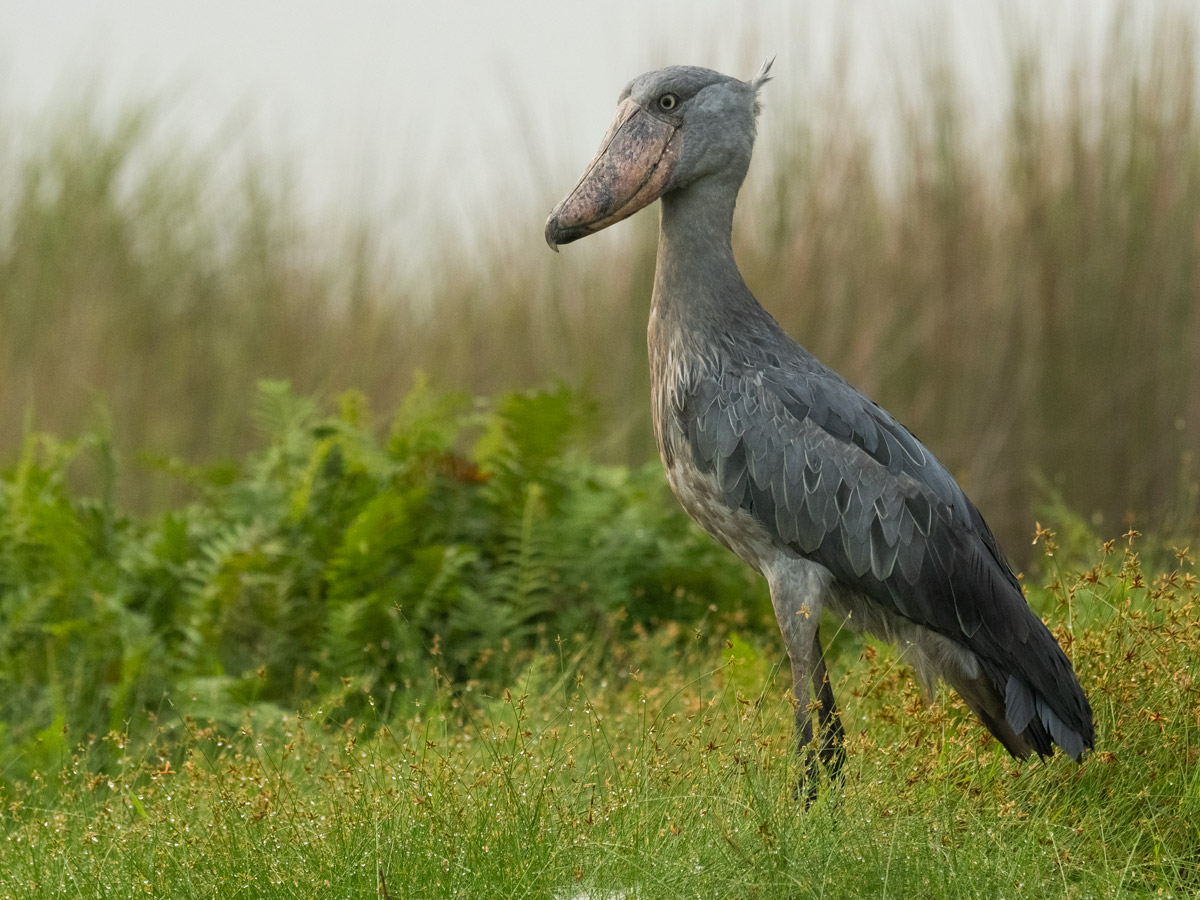
The undisputed single best spot for a Uganda birding safari targeting the iconic Shoebill Stork (Balaeniceps rex) is Mabamba Bay Wetland. Located on the edge of Lake Victoria just 40–50 km west of Entebbe and Kampala, Mabamba offers an unprecedented 85% to 95% sighting success rate on guided morning canoe excursions.
Because the vast papyrus channels are shallow and rich in lungfish—the Shoebill's favorite food—local site guides can maneuver traditional, quiet wooden boats directly into the feeding grounds without startling these pre-historic birds. Other top locations across the country include the Lugogo Swamp inside Ziwa Rhino Sanctuary, the Albert Delta in Murchison Falls National Park, and Makanaga Swamp.
1-day-perfect-mabamba-swamp-shoebill-stork-uganda-birding-safari
5-days-uganda-bird-watching-safari-lake-victoria-shores-and-lake-mburo
30-days-best-uganda-birding-safari-extravaganza-and-wildlife-safari
11-days-uganda-birding-safari-and-primate-experience
20-days-uganda-birding-safari-wildlife-gorilla-and-chimpanzee-tracking
21-days-uganda-birding-safari-extravaganza-to-best-uganda-safari-parks
25-days-complete-uganda-birding-safari-extravaganza-with-wildlife-viewing
Top Shoebill Birding Locations Compared
While Mabamba Swamp remains the most famous springboard for seeing the prehistoric Shoebill, Uganda’s varied wetlands offer unique viewing conditions depending on your itinerary, group size, and travel pace. Below is a deep dive into each of the five top locations.
1. Mabamba Swamp (Near Entebbe / Kampala)
- Sighting Reliability: Highest (80–85%)
- Best Use Case: Quick morning or afternoon excursions, or an easy start/finish to a safari.
Located just across Lake Victoria from Entebbe, Mabamba Swamp is widely regarded as the ultimate site for guaranteed Shoebill sightings. The vast, 2,400-hectare papyrus wetland creates a ideal hunting ecosystem packed with lungfish, the Shoebill's favorite prey. Local, highly skilled site guides navigate narrow water channels in motorized or hand-poled wooden canoes, bringing visitors within close range of these elusive birds without disturbing them. Because of its proximity to Entebbe International Airport, Mabamba is easily added to the beginning or end of any Ugandan trip.
Beyond the Shoebill, Mabamba is an Important Bird Area (IBA) and Ramsar site hosting over 300 bird species. While searching for the "prehistoric giant," birders regularly spot the Papyrus Gonolek, Malachite Kingfisher, Blue-breasted Bee-eater, and African Pygmy Goose. Its high reliability makes it busy on peak days, but early morning departures (around 6:30 AM) ensure quiet, uninterrupted encounters.
2. Makanaga Swamp (Lake Victoria / off Masaka Road)
- Sighting Reliability: High
- Best Use Case: A tranquil, less-crowded alternative with outstanding lighting for bird photography.
Situated slightly further down the Lake Victoria shoreline near Kamengo along the Kampala–Masaka highway, Makanaga Swamp serves as an extension of the broader Mabamba ecosystem. Despite offering equally impressive Shoebill viewing opportunities, it receives far fewer visitors. This makes Makanaga an ideal retreat for serious bird photographers and travelers looking to avoid the morning canoe traffic seen at Mabamba.
What sets Makanaga apart are its expansive mudflats and floating water-lily fields. The lower, open vegetation allows Shoebills to stand fully exposed against low-lying backgrounds, yielding clean, uncluttered camera angles. Gliding through the marshes by motorized canoe, you can often observe Shoebills hunting alongside large flocks of migratory waders, African Jacanas, Spur-winged Geese, and Black-winged Terns. It is an easy stop when traveling between Kampala and western safari destinations like Lake Mburo or Bwindi.
3. Ziwa Rhino Sanctuary / Lugogo Swamp (Nakasongola)
- Sighting Reliability: Very High
- Best Use Case: Combining a sunrise Shoebill canoe trek with on-foot Southern White Rhino tracking.
The Lugogo Swamp, running along the boundary of the Ziwa Rhino Sanctuary, is one of Central Uganda’s finest hidden birding gems. The sanctuary offers early morning canoe excursions along a 10-kilometer stretch of papyrus wetland where resident Shoebills actively hunt in the shallow channels. Sighting success here is remarkably high during the dry months when water levels recede, concentrating fish into small channels.
The main advantage of birding at Lugogo Swamp is the ability to pair two bucket-list wildlife encounters in a single morning. After completing a 6:00 AM Shoebill canoe safari as the sun rises over the swamp, visitors can step onto dry ground to track wild Southern White Rhinos on foot with sanctuary rangers. Located directly along the highway to Murchison Falls, Ziwa serves as an ideal overnight break to double up on rare species before heading further north.
4. Murchison Falls National Park (Albert Delta)
- Sighting Reliability: Moderate to High (Best in the Dry Season)
- Best Use Case: Spotting Shoebills from a comfortable safari boat while surrounded by classic big game.
In northwestern Uganda, the Albert Delta—where the Victoria Nile flows into Lake Albert within Murchison Falls National Park—provides a stunning, open wetland setting for Shoebills. Unlike the smaller canoe trips in swamp channels, birding the Albert Delta is typically conducted aboard larger, multi-passenger safari boats or private launch vessels drifting downstream along papyrus banks.
While sighting probability is slightly lower here than at Mabamba due to the vastness of the delta, the overall safari atmosphere is unmatched. As you search the papyrus edges for solitary Shoebills, you are routinely surrounded by pods of hippos, massive Nile crocodiles basking on sandbars, and herds of elephants and buffalos coming down to drink. It is the best choice for travelers who want to integrate Shoebill sightings seamlessly into a classic, multi-day savannah and boat cruise itinerary.
5. Lake Mburo National Park (Western Uganda)
- Sighting Reliability: Low / Seasonal
- Best Use Case: A rewarding "bonus" sighting while enjoying an acacia-savannah safari or boat ride.
Lake Mburo National Park is western Uganda’s smallest savannah park, centered around a network of five lakes and dense papyrus swamps. Shoebills reside within the park's eastern wetland fringes, but they are notoriously shy and nomadic here. Sightings typically occur during boat trips departing from the main lakeside jetty, particularly during the dry season when birds move toward open water edges.
Because sighting reliability is lower compared to Mabamba or Ziwa, Lake Mburo should not be chosen as your primary Shoebill destination. However, it excels as a scenic stopover connecting Entebbe to the gorilla parks of Bwindi. Any Shoebill spotted while cruising past African Finfoots, Giant Kingfishers, zebras, and impalas along Lake Mburo’s shores serves as a thrilling safari bonus.
Why is Mabamba Swamp considered the absolute best place to spot a Shoebill?
Mabamba Bay Wetland is a globally recognized Ramsar site and Important Bird Area (IBA) situated on the northern shore of Lake Victoria. Its dense network of papyrus, water lilies, and shallow water channels creates a prime hunting ecosystem for the Shoebill, which feeds primarily on African lungfish and catfish. Unlike deep-water lakes, Mabamba’s shallow marsh allows Shoebills to wade easily while waiting silently to ambush prey. Furthermore, Mabamba is home to a dedicated community of local boat captains and site guides who track individual Shoebill pairs daily. Their intimate knowledge of current nesting and feeding sites means visitors almost always get close, clear views of the bird within a short 2- to 3-hour canoe outing. Its convenient location near Entebbe International Airport also makes it effortless to integrate into any safari itinerary on your arrival or departure day.
What makes the Shoebill Stork such a sought-after bird for safari goers?
The Shoebill is one of the most enigmatic and visually striking birds on the planet. Standing up to 5 feet (150 cm) tall with a massive 7-to-8-foot wingspan, its defining feature is a large, bulbous, shoe-shaped beak fitted with a sharp, hooked nail at the tip. Taxonomically unique, it is the sole living member of the family Balaenicipitidae. Watching a Shoebill hunt is a mesmerizing experience: it stands completely motionless for hours—a strategy known as "freeze and seize"—resembling a gray stone statue before dropping violently into the mud to swallow giant lungfish whole. With an estimated global wild population of fewer than 8,000 individuals, seeing this rare, prehistoric-looking avian giant in its natural African swamp habitat is a true bucket-list triumph for wildlife enthusiasts.
How do you travel to Mabamba Swamp from Entebbe or Kampala?
Reaching Mabamba Swamp from either Entebbe or Kampala is simple and offers two distinct travel routes. The most scenic route from Entebbe involves taking a local boat or vehicle transfer to Nakiwogo Landing Site, followed by a pleasant 45-minute motorized boat crossing across Lake Victoria directly to the Mabamba jetty. Alternatively, you can take an overland drive from Kampala or Entebbe via the Kasanje-Nakawuka road. The drive covers approximately 40 to 50 kilometers and takes 1 to 1.5 hours depending on road conditions and urban traffic. Booking your transfer through a trusted local operator like Roads of Adventure Safaris ensures seamless ground transport, pre-arranged canoe bookings, and a private local birding guide waiting for you upon arrival at the landing site.
Is Ziwa Rhino Sanctuary a good backup location for Shoebill birding?
Yes, the Lugogo Swamp located within Ziwa Rhino Sanctuary in Nakasongola District is an exceptional secondary location for spotting Shoebills. In fact, during dry months when water recedes into concentrated channels, sighting reliability at Lugogo Swamp rivals that of Mabamba. A early morning canoe safari here allows you to search for Shoebills hunting along papyrus fringes as the sun rises over the swamp. The major advantage of Ziwa is efficiency: you can pair an early morning Shoebill boat trek with an afternoon on-foot tracking excursion to see endangered Southern White Rhinos. Because Ziwa sits directly along the main highway connecting Kampala to Murchison Falls National Park, it serves as a natural, action-packed overnight stopover on northbound safari circuits.
What is the Shoebill viewing experience like in Murchison Falls National Park?
In Murchison Falls National Park, Shoebill viewing takes place along the Albert Delta, where the Victoria Nile opens into Lake Albert. Unlike the small wooden canoes used in Mabamba, delta birding is conducted on larger safari launches or private pontoon boats. As you drift slowly downstream along papyrus-lined banks, expert river guides spot solitary Shoebills standing amidst the reeds. While the probability of seeing a Shoebill here is slightly lower than at Mabamba due to the sheer size of the delta system, the surrounding game-viewing backdrop is unmatched. You will frequently watch Shoebills while surrounded by large pods of hippos, massive Nile crocodiles basking on sandbars, and elephants drinking at the water’s edge.
What time of day is best to go out on a Shoebill canoe excursion?
Early morning, specifically between 6:30 AM and 9:00 AM, is by far the best time of day to hunt for Shoebills. During these cooler morning hours, lungfish and catfish surface near the water’s edge to gulp air, prompting Shoebills to move into open channels and lily pads to hunt. The calm morning waters also provide smooth canoeing conditions and beautiful golden light for photography. As heat builds toward midday, fish dive deeper into cooler mud, causing Shoebills to retreat into the shade of dense papyrus beds where they become difficult to spot. A late afternoon trip between 4:00 PM and 6:00 PM is a good secondary window, but early morning remains the golden hour for action.
What is the difference between visiting Mabamba Swamp and Makanaga Swamp?
Makanaga Swamp is situated further down the Lake Victoria coastline near Kamengo and acts as an extension of the broader Mabamba ecosystem. While Mabamba is closer to Entebbe and attracts more visitors, Makanaga offers a quieter, off-the-beaten-path alternative. Makanaga features wider mudflats and extensive fields of floating water lilies rather than tall, enclosed papyrus walls. This open landscape allows photographers to capture Shoebills fully exposed against clean backgrounds without tall reeds obstructing the lens. Sighting reliability at Makanaga is high, making it a fantastic choice for serious bird photographers and travelers seeking an intimate encounter free from other tour boats.
Can you see Shoebills in Lake Mburo National Park?
Yes, Shoebills inhabit the eastern wetland fringes and papyrus bays of Lake Mburo National Park, though sightings here are seasonal and less guaranteed compared to Mabamba or Ziwa. Shoebill excursions in Lake Mburo are conducted via motorized boat trips departing from the main park jetty. The best chances occur during drier months when receding water forces birds out toward the open lake margins. While you shouldn't rely on Lake Mburo as your sole destination for a guaranteed Shoebill tick, any sighting here serves as a thrilling bonus on a park itinerary that includes zebras, impalas, elands, hippos, and over 310 other bird species.
What other bird species can you spot while looking for the Shoebill at Mabamba?
Mabamba Bay Wetland is home to over 300 bird species, making it an extraordinary birding destination even beyond its famous main attraction. While searching for the Shoebill, birders regularly encounter Lake Victoria basin specialists and papyrus endemics such as the striking Papyrus Gonolek, Blue Swallow, White-winged Warbler, Papyrus Yellow Warbler, and Northern Brown-throated Weaver. Waterways are alive with colorful Malachite Kingfishers, Pied Kingfishers, African Pygmy Geese, African Jacanas, Blue-breasted Bee-eaters, Goliath Herons, and Lesser Jacanas trotting across lily pads. Migratory terns and waders also fill open water stretches from November through April.
How long does a typical Shoebill excursion take at Mabamba Swamp?
A standard Shoebill excursion at Mabamba Swamp lasts approximately 2 to 3 hours out on the water. After arriving at the landing site, you board a traditional wooden canoe equipped with an outboard motor and step down into narrow papyrus channels. Your boat captain and local birding guide paddle or motor through key hunting zones where Shoebills were last spotted. Once a Shoebill is located, boats cut their engines and drift quietly, giving you 30 to 45 minutes of peaceful observation and photography time. Factoring in travel time from Entebbe or Kampala, a complete half-day excursion takes around 4 to 5 hours from start to finish.
Is it safe to do a canoe safari in Mabamba Swamp?
Yes, canoe safaris in Mabamba Swamp are safe and well-regulated. The local boat operators are experienced community captains who know the swamp channels and water conditions intimately. The canoes used are sturdy, flat-bottomed wooden boats built specifically for navigating shallow wetland vegetation. All passengers are provided with life jackets prior to boarding. Mabamba Swamp is free of large, aggressive megafauna like hippos or Nile crocodiles, creating a peaceful water safari environment suitable for travelers of all ages, including families and older birders.
What time of year offers the highest chance of seeing Shoebills in Uganda?
You can spot Shoebills in Uganda year-round, but the dry season months—December to February and June to September—offer the highest success rates. During dry periods, water levels across swamps drop, shrinking feeding pools and concentrating lungfish into narrow channels. This forces Shoebills out into open muddy patches where they are easy to spot from boats. Moreover, dry weather ensures trails and landing sites are easy to access. However, even during the rainy seasons (March–May and October–November), sighting rates at Mabamba remain well above 80%.
Do you need to book Mabamba Swamp Shoebill permits in advance?
While there isn't an official restricted "permit" system like mountain gorilla trekking, you must pay community site entry fees and boat hire fees at the Mabamba landing site. Because morning slots fill up quickly during peak travel seasons, booking your excursion in advance through an established operator like Roads of Adventure Safaris is highly recommended. Pre-booking guarantees an assigned private canoe, reserves an experienced top-tier local birding guide, and coordinates seamless vehicle or boat transfers from your hotel, eliminating morning delays at the landing site.
What should you wear for a Shoebill swamp excursion?
Comfortable, practical clothing suited for warm tropical weather and boat travel works best. Wear lightweight, breathable long-sleeved shirts and trousers in neutral earth tones (khaki, tan, or green) to protect against sun exposure and mosquitoes. Choose sturdy, closed-toe footwear like light hiking shoes or rubber-soled sneakers, as landing docks can be muddy or damp. Bring a wide-brimmed sun hat, sunglasses, and high-SPF sunscreen. Rain can develop quickly over Lake Victoria, so packing a lightweight waterproof jacket or rain poncho in your daypack is always a smart move.
What photographic equipment is ideal for capturing Shoebills in the wild?
Shoebills are cooperative photography subjects because they remain still for long periods while hunting. A camera body paired with a telephoto lens in the 100-400mm or 150-600mm range gives you the versatility to frame full-body shots and detailed close-ups of their shoe-shaped bill without crowding the bird. Fast shutter speeds (1/1000s or faster) are helpful to catch sudden, explosive strikes when the bird lunges into the water. A monopod or beanbag can help steady heavy lenses inside canoes, and a waterproof cover protects gear from water spray or sudden tropical rain.
How close can canoes get to a Shoebill without disturbing it?
Local site guides adhere to strict eco-tourism guidelines designed to protect the Shoebill from stress. Canoes typically maintain a respectful distance of 15 to 25 meters. Because Shoebills rely on absolute stillness to surprise lungfish, sudden noises or close approaches can cause them to flush or fly away. Boat captains cut their motors early and quietly paddle or pole the final distance. As long as visitors remain quiet and sit still inside the canoe, Shoebills tolerate human presence calmly, often continuing to hunt unbothered just yards away.
Are there Shoebills in Semuliki National Park or Toro-Semliki Reserve?
Yes, the Toro-Semliki Wildlife Reserve and the southern shores of Lake Albert near Semuliki National Park host resident Shoebill populations. Birding here involves taking a boat trip across Lake Albert from the Ntoroko landing site. This location offers an adventurous, wilderness-style Shoebill search away from mainstream tourist circuits. Combined with Semuliki’s rich West African Guinea-Congo forest biome species, visiting this region yields exceptional rewards for dedicated twitchers aiming to build a massive bird list.
How does community-based tourism support Shoebill conservation at Mabamba?
For decades, Shoebills faced threats from habitat destruction, papyrus harvesting, and hunting by fishermen who viewed the birds as bad luck or competitors for lungfish. The establishment of the Mabamba Wetland Eco-Tourism Association transformed this dynamic. Today, local fishermen work as trained boat captains, site guides, and swamp guardians. Excursion fees directly support village families, schools, and wetland protection initiatives. As a result, former hunters are now the bird's fiercest protectors, ensuring wild Shoebill populations thrive alongside local communities.
Can children or senior travelers join a Shoebill boat safari?
Absolutely. Shoebill boat safaris at Mabamba or Ziwa are low-impact, accessible excursions suitable for travelers of all ages and physical fitness levels. Boarding the canoe requires stepping down from a wooden pier with assistance from boat staff. Once seated, guests relax while the captain handles navigation. There are no long, strenuous hikes involved, making it a perfect option for multi-generational families, senior travelers, or birders with limited mobility who want to experience authentic African wildlife up close.
What is the conservation status of the Shoebill Stork today?
The Shoebill is classified as Vulnerable on the IUCN Red List of Threatened Species, with an estimated global population of only 5,000 to 8,000 individuals. Main threats across Africa include swamp drainage for agriculture, cattle grazing, oil exploration, overfishing, and climate-induced water level fluctuations. Uganda stands as one of the last strongholds for the species thanks to protected Ramsar sites like Mabamba Bay and strict enforcement within national parks like Murchison Falls. Sustainable birding tourism plays a vital role in funding these ongoing habitat conservation efforts.
How do weather conditions like heavy rain impact Shoebill sightings?
Heavy rain makes finding Shoebills more challenging because high water levels cause lungfish to disperse across vast flooded areas rather than remaining in open, shallow channels. Furthermore, heavy downpours reduce visibility and make canoe navigation uncomfortable. However, tropical rains in Uganda typically fall in short, intense bursts—often early in the morning or late afternoon—followed by clear skies. Once the rain stops, Shoebills emerge onto open mudbanks to dry their feathers, presenting excellent viewing opportunities for patient birders.
Can you combine a Shoebill safari with a gorilla trekking trip in Uganda?
Combining a Shoebill safari with mountain gorilla trekking in Bwindi Impenetrable National Park is one of Uganda's most popular travel combinations. Because Mabamba Swamp sits right next to Entebbe International Airport, you can easily conduct your Shoebill canoe safari on Day 1 after landing, or on your final day before flying home. A complete 5- to 7-day itinerary seamlessly links the papyrus wetlands of Lake Victoria with the misty, high-altitude rainforests of Bwindi for an unforgettable wildlife adventure.
What makes the Shoebill's hunting technique unique among waterbirds?
Unlike herons or egrets that wade actively through water, the Shoebill employs an extraordinary "patience-and-power" hunting strategy. It locates prey by standing completely motionless in shallow water for up to an hour, monitoring oxygen-depleted water for lungfish coming up to breathe. When a fish surfaces, the Shoebill performs a sudden, violent "collapse," throwing its entire body forward with its massive bill open. It scoops up the target along with mud and water, uses its sharp bill edges to decapitate large fish, and swallows the prey whole.
Are there any luxury accommodation options near Mabamba Swamp?
Yes, travelers can choose from several excellent accommodation options near Mabamba Swamp and Entebbe. High-end boutique options include Hotel No.5, The Karibu Hotel, and Protea Hotel Entebbe, all located a 45-minute drive or boat ride away. For those who prefer staying directly on the water near the wetland, eco-lodges like Nkima Forest Lodge offer secluded wooden chalets tucked into forest canopy overlooking Mabamba Swamp, providing fantastic forest birding right from your private veranda.
What is the flight or vocalization behavior of the Shoebill?
Shoebills are mostly silent birds, but they communicate during courtship and nesting using a dramatic bill-clattering sound that resembles a loud machine gun bursts or clapping wooden blocks. In flight, they are slow and deliberate, beating their huge wings at a broad rate of roughly 150 flaps per minute. They flap and glide gracefully, soaring on warm air thermals high above wetlands much like storks or pelicans, with their heavy heads tucked back against their shoulders.
Is it possible to see Shoebills at the Uganda Wildlife Education Centre (UWEC)?
Yes, for travelers with tight schedules or layovers in Entebbe, the Uganda Wildlife Education Centre (UWEC)—located just 10 minutes from Entebbe International Airport—is home to rescued Shoebills. While seeing a bird in a natural sanctuary environment is different from spotting one in the wild papyrus channels of Mabamba, UWEC offers guaranteed close-up views and photographic angles that reveal the bird's massive bill and striking physical details.
Why is a local specialized birding guide better than a general driver-guide for Shoebills?
While general driver-guides excel at spotting big game in savannah parks, specialized local birding guides undergo rigorous training in avian taxonomy, calls, and habitat micro-zones. At sites like Mabamba, local bird guides maintain real-time networks with fishermen who report exact Shoebill sightings each morning. Their expert eyes can spot a Shoebill’s gray head hidden in tall papyrus hundreds of yards away, ensuring you don't miss camouflaged birds in dense vegetation.
How many total bird species can a birder see in Uganda on a full trip?
Uganda is widely considered Africa’s ultimate birding destination, boasting over 1,080 recorded species—representing more than 50% of Africa’s total bird diversity within a country the size of Great Britain. On a comprehensive 10- to 14-day birding safari covering Mabamba, Kibale, Bwindi, Queen Elizabeth, and Murchison Falls, dedicated birders routinely log between 350 and 500 unique species, including Albertine Rift endemics, West African forest specialists, and vast migratory flocks.
What tips ensure a respectful and eco-friendly Shoebill encounter?
To ensure your visit protects the Shoebill and its habitat:
- Keep noise to an absolute minimum while inside the canoe.
- Never ask your boat captain to move closer than 15 meters or flush a bird for a flying photo.
- Avoid using flash photography, which can startle nesting or hunting birds.
- Ensure all trash is taken back to dry land.
- Choose a responsible, locally registered operator like Roads of Adventure Safaris that directly supports community guide associations and wetland conservation efforts.
How do you book a complete Uganda birding safari with a Shoebill focus?
Booking a customized birding safari is straightforward when working with a specialized local ground operator. Companies like Roads of Adventure Safaris design tailor-made birding itineraries around your specific travel dates, target bird species lists, and preferred accommodation comfort levels. Their safari packages include private 4x4 transport, expert birding guides, boat charters at Mabamba and Murchison Falls, and seamless permit bookings for national parks, delivering a world-class East African birding adventure.
