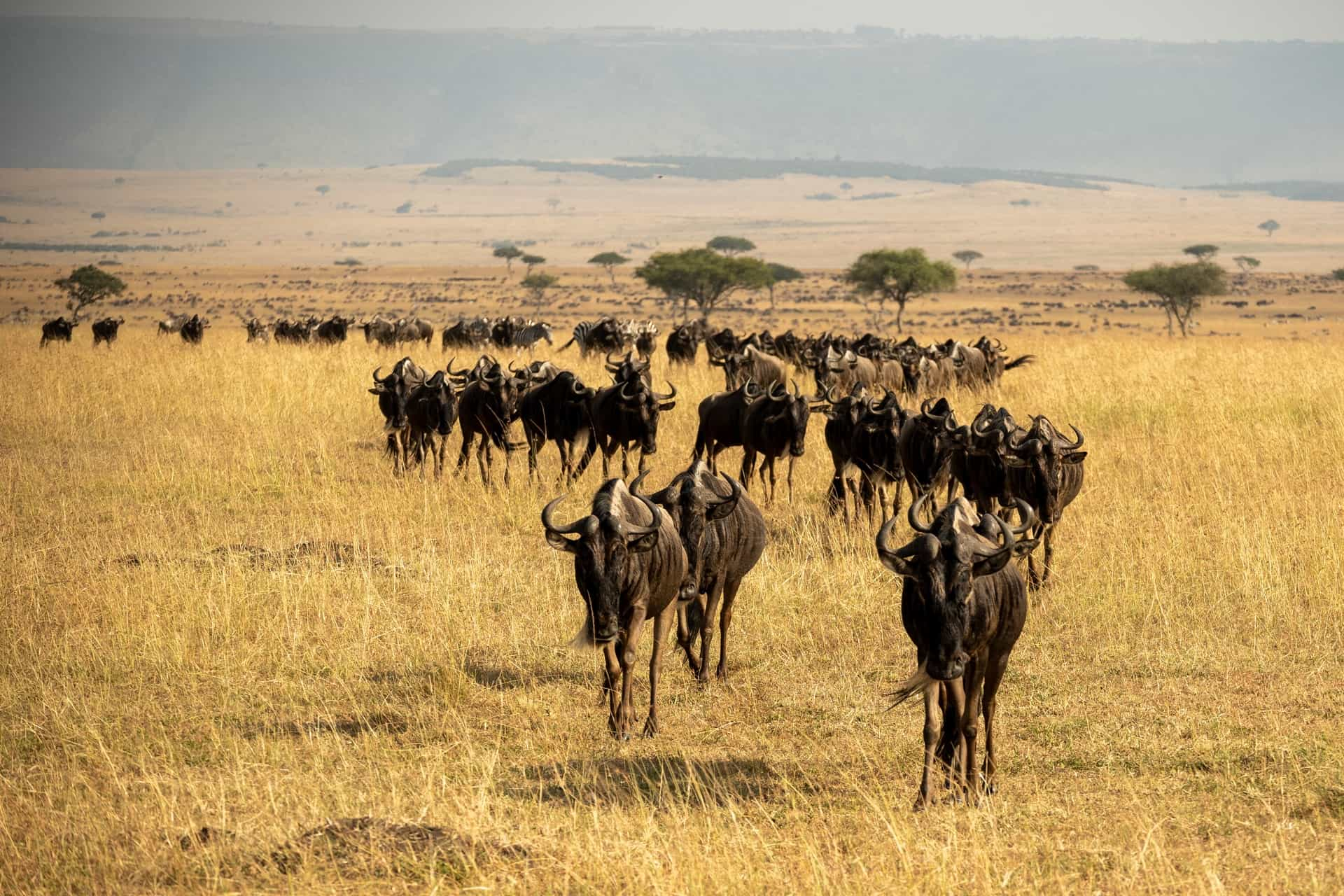
On a Tanzania wildlife safari, you should highly expect to see the "Big Five" (lion, leopard, elephant, buffalo, and rhino), particularly in the Serengeti and Ngorongoro Crater. You will also see massive herds of wildebeest and zebras, along with giraffes, cheetahs, spotted hyenas, hippos, and various antelopes like Thomson’s gazelle.
8-days-great-mara-river-crossing-hadzabe-tribe-and-optional-hot-air-balloon-tanzania-safari
7-days-best-great-wildebeest-migration-safari-in-tanzania
6-days-ndutu-migration-and-tanzania-safari-itinerary
5-days-ultimate-ndutu-migration-calving-season-safari-to-tanzania
4-days-central-serengeti-safari-tour-and-mara-river-crossing-in-northern-serengeti
3-days-southern-serengeti-safari-tour-and-ngorongoro-crater-calving-season-package
Top Animals to Highly Expect on Tanzania wildlife safari
Tanzania is home to the most iconic wildlife concentrations on earth, offering a theater of nature that is both raw and breathtaking. On a Tanzania wildlife safari, the expectation is not just to see animals, but to witness their complex social structures and survival dramas in the wild.
The Big Five
Lion
Tanzania holds roughly 40-50% of the world’s remaining wild lion population, making it the premier destination for pride sightings. On a Tanzania wildlife safari, lions are the apex "social cats," living in family units that can number up to 30 individuals. In the Serengeti, you will often find them draped over granite kopjes (rock outcrops), using the height as a lookout to scan the plains for their next meal. Their social structure is fascinating; while the males provide protection and territorial defense, the lionesses are the primary hunters, using sophisticated flanking maneuvers to take down prey much larger than themselves.
African Elephant
The African Elephant is a cornerstone of the Tanzanian wilderness, particularly in Tarangire National Park, where the landscape is dotted with ancient baobab trees and massive elephant "families." These matriarchal societies are led by the oldest female, whose memory of water sources and migration routes ensures the herd's survival. During your Tanzania wildlife safari, you may witness "tusker" bulls weighing up to 6 tons or young calves shielded between the legs of their mothers. Their role as "ecosystem engineers" is vital; by uprooting trees and digging for water in dry riverbeds, they create habitats and resources for countless other species.
Buffalo
The Cape Buffalo is often described as the most "unpredictable" member of the Big Five. Unlike the sleek predators, the buffalo relies on sheer mass and a formidable "boss" (the thick horn shield across its forehead). In parks like Katavi or the Serengeti, they congregate in "super-herds" that can reach over 1,000 individuals. This collective strength serves as a defense against lions, who are the only predators brave enough to tackle an adult buffalo. Despite their cow-like appearance, they are fiercely territorial and highly protective of their young, making them one of the most respected animals by professional safari guides.
Leopard
The leopard is the "Prince of Darkness," a solitary and highly elusive predator that masters the art of camouflage. On a Tanzania wildlife safari, spotting a leopard usually involves scanning the sturdy branches of acacia or sausage trees, where they haul their kills to keep them safe from hyenas and lions. Their rosette-patterned fur allows them to vanish into the dappled light of riverine forests. Unlike lions, leopards are opportunistic and silent hunters, capable of pouncing with explosive speed. Seeing one in the wild is a true badge of honor for any safari-goer, as it requires a keen eye and often a bit of luck.
Rhinoceros
The Black Rhino is the rarest and most critically endangered member of the Big Five. In Tanzania, the Ngorongoro Crater offers the most reliable "window" into their world, as the enclosed ecosystem provides a safe haven for a small but stable population. These "armored browsers" are solitary and known for their hooked upper lips, which they use to pluck leaves and twigs from dense brush. Because of their scarcity, a rhino sighting is often the emotional highlight of a Tanzania wildlife safari. Rangers and conservationists work around the clock to monitor these prehistoric-looking giants, protecting them from the persistent threat of poaching.
The Great Migration Animals
Wildebeest
The Blue Wildebeest is the "engine" of the Great Migration, a continuous cycle involving over 1.5 million animals moving across the Serengeti-Mara ecosystem. These "gnus" are biologically programmed to follow the rains in search of nitrogen-rich grasses. On a Tanzania wildlife safari, the sheer noise and dust of a passing wildebeest column are sensory overloads you won't forget. They are famous for their "synchronized calving" in the southern Serengeti, where half a million calves are born in a three-week window, providing a high-stakes feast for the region's many predators.
Zebras
Zebras are the constant companions of the wildebeest, moving in tandem during the migration. Their relationship is a classic example of "mutualism"; zebras have excellent eyesight and memory of routes, while wildebeest have a keen sense of smell for water. Furthermore, they eat different parts of the same grass—zebras take the tall, tough upper stems, "mowing" the field for the wildebeest to reach the tender shoots beneath. Their unique stripe patterns act as a visual defense called "motion dazzle," making it difficult for a predator to pick out a single target from a fleeing herd.
Other Highly Visible Wildlife on Tanzania wildlife safari
Giraffes
As the national animal of Tanzania, the Masai Giraffe is a graceful fixture of the savanna. These "gentle giants" can reach heights of 19 feet, allowing them to browse on the high-level acacia thorns that other herbivores cannot reach. During a Tanzania wildlife safari, you might observe "towers" of giraffes moving with a slow, rhythmic gait or males "necking"—a form of ritualized combat where they swing their heavy heads at each other to establish dominance. Their long, prehensile tongues are incredibly tough, easily maneuvering around 3-inch thorns to get to the nutritious leaves.
Spotted Hyenas
Often misunderstood as mere scavengers, the Spotted Hyena is actually one of Africa's most successful and intelligent predators. They live in large, female-dominated "clans" with complex social hierarchies. On a Tanzania wildlife safari, you will hear their eerie, "whooping" calls at night, which can carry for miles across the plains. Hyenas are remarkably efficient hunters, capable of taking down prey as large as zebra, and their powerful jaws can crush bone, allowing them to consume parts of a carcass that other animals leave behind.
Hippos
Hippos are the heavyweights of Tanzania's water bodies, spending up to 16 hours a day submerged to protect their sensitive skin from the tropical sun. You will likely find them in "hippo pools" in the Serengeti or Lake Manyara, snorting and yawning in a display of territorial dominance. Despite their bulky, herbivorous nature, hippos are considered one of Africa’s most dangerous animals, particularly if a boat or person gets between them and the safety of the water. At night, they leave the pools to graze on land, consuming up to 80 pounds of grass in a single evening.
Cheetahs
The cheetah is the speedster of the savanna, capable of reaching 70 mph in short bursts. Unlike the nocturnal-leaning lions and leopards, cheetahs are "diurnal" (daytime) hunters, relying on their incredible vision to spot prey from the top of a termite mound or a fallen tree. On a Tanzania wildlife safari, the open plains of the Serengeti are the best place to find them, as they need wide, flat spaces to execute their high-speed chases. They are slender and aerodynamic, with "semi-retractable" claws that act like running spikes for traction during sharp turns.
Antelopes
The Serengeti is a sea of antelopes, with Thomson’s and Grant’s Gazelles being the most ubiquitous. These agile herbivores are the "fast food" of the savanna, supporting the massive predator populations. You will also encounter the Impala—famous for its spectacular 30-foot leaps—and the massive Eland, which is the largest antelope in the world. Each species has evolved to fill a specific niche; some are "grazers" focused on grass, while others are "browsers" who prefer shrubs, ensuring that the diverse vegetation of Tanzania’s national parks is efficiently utilized.
Nile Crocodiles
Growing up to 16 feet long, the Nile Crocodile is the ancient guardian of Tanzania’s river systems. They are most famous for their role in the "river crossings" of the Great Migration, where they lie in wait for wildebeest and zebra to run the gauntlet of the Mara or Grumeti Rivers. A crocodile can go months without a meal, but during the migration, they take full advantage of the chaos. Witnessing a "snap" of a crocodile's jaws during a crossing is a visceral reminder of the "survival of the fittest" reality that defines every Tanzania wildlife safari.
Best Places to See Wildlife on Tanzania wildlife safari
Serengeti National Park
The Serengeti is the crown jewel of any Tanzania wildlife safari, encompassing nearly 15,000 square kilometers of protected wilderness. It is globally renowned for hosting the highest concentration of large mammals on the planet. The name itself, derived from the Maasai word Siringet, means "the place where the land moves on forever," a fitting description for the vast, golden grasslands that support over 1.5 million wildebeest and hundreds of thousands of zebras and gazelles. This park is the primary stage for the Great Migration, a year-round circular journey that is often described as the greatest wildlife show on earth.
Beyond the migration, the Serengeti is a predator's paradise. The "Big Five" are all present, though it is particularly famous for its lion prides, which are frequently seen resting on granite kopjes—giant rock formations that act as natural lookout towers. The park is divided into several sectors: the Seronera Valley (Central) is famous for leopard sightings along the riverbanks; the Western Corridor is the site of dramatic crocodile-infested river crossings in June and July; and the Northern Serengeti offers the spectacular Mara River crossings from August to October. Whether you are watching a cheetah sprint across the plains or a massive herd of elephants moving toward a watering hole, the Serengeti provides the quintessential African safari experience.
Ngorongoro Crater
The Ngorongoro Crater is often referred to as the "Eighth Wonder of the World" and is a mandatory stop on a northern Tanzania wildlife safari. Formed two million years ago when a massive volcano collapsed, this 600-meter-deep caldera has created a self-sustaining ecosystem that acts as a natural enclosure for approximately 25,000 large animals. It offers perhaps the most reliable wildlife viewing in Africa; because the animals are contained within the 20-kilometer-wide floor, sightings are frequent and close-range. It is one of the few places in the world where you can realistically see all members of the "Big Five" in a single morning drive.
The crater is especially significant for being one of the last remaining refuges for the critically endangered Black Rhino. Seeing these prehistoric giants grazing on the crater floor is a rare privilege. The landscape is a stunning mosaic of short-grass plains, fever tree forests, and the soda waters of Lake Magadi, which is often shimmering with thousands of pink flamingos. While the crater is relatively small compared to the Serengeti, the sheer density of wildlife—including massive "tusker" elephants and highly competitive prides of lions—makes it an intense and visually breathtaking environment. The backdrop of the steep crater walls adds a dramatic, prehistoric aesthetic to every photograph.
Tarangire National Park
Often overshadowed by its more famous neighbors, Tarangire National Park is a hidden gem that offers some of the most unique landscapes on a Tanzania wildlife safari. The park is defined by its iconic, ancient Baobab trees—some of which are over 1,000 years old—and the Tarangire River, which serves as the primary lifeblood for wildlife during the dry season (June to October). During these months, the park experiences a "mini-migration" of its own, as thousands of elephants, wildebeests, and zebras migrate from the surrounding Maasai Steppe to the permanent waters of the river.
Tarangire is most famous for its incredible elephant population; it is not uncommon to see herds of up to 300 individuals gathered in the riverbed. For travelers who find the Serengeti too crowded, Tarangire offers a more rugged and secluded atmosphere. The park is also a haven for birdwatchers, with over 550 species recorded, and it is one of the best places in Tanzania to spot the "dry-country" antelopes like the Fringe-eared Oryx and the long-necked Gerenuk. The combination of the massive baobabs, the red dust of the earth, and the grey giants of the elephant world creates a distinct color palette that is unique to this sector of the northern circuit.
Lake Manyara National Park
Lake Manyara National Park may be smaller in size, but it offers an incredible diversity of habitats squeezed into a narrow strip of land between the Gregory Rift wall and the alkaline Lake Manyara. A Tanzania wildlife safari here begins in a lush, evergreen groundwater forest, where troops of baboons—sometimes numbering in the hundreds—frolic alongside blue monkeys and bushbucks. As the forest opens up into floodplains, you are treated to views of the shimmering lake, which Ernest Hemingway once described as "the loveliest I had seen in Africa."
The park is most famous for its legendary tree-climbing lions. While lions elsewhere generally stay on the ground, the Manyara prides have developed the unique habit of spending their afternoons draped over the branches of acacia trees, likely to escape the heat or the biting insects of the forest floor. In addition to the lions, the lake’s edge is often a sea of pink, thanks to the vast flocks of lesser flamingos that congregate there to feed. The park also supports a healthy population of elephants and giraffes, and the hippo pool at the northern end of the lake provides a great opportunity to see these massive herbivores out of the water during the late afternoon. It is the perfect "introductory" park, offering a gentle but species-rich start to a safari journey.
1. The "Big Five" and Where to Find Them
The "Big Five" is a term originally coined by big-game hunters to describe the five most difficult and dangerous African animals to hunt on foot: the Lion, Leopard, African Elephant, Cape Buffalo, and Rhinoceros. Today, the term has been reclaimed by the tourism industry to represent the "must-see" stars of any safari. In Tanzania, it is absolutely possible to see all five, though it requires visiting specific locations and a bit of luck.
The Ngorongoro Crater is arguably the best place in the world to check off the entire list in a single day. Because the crater floor is a self-contained ecosystem with high animal density, these species are more concentrated than in the vast plains. Serengeti National Park is also a powerhouse for the Big Five, particularly for lions and elephants. While the buffalo is ubiquitous across most parks and elephants are easily found in herds, the rhino is the most elusive due to its endangered status and shy nature. Seeing a leopard requires a keen eye for the trees, but with an experienced guide, the dream of seeing all five is a very realistic goal for a Tanzanian itinerary.
2. The Art of Spotting Leopards
Leopards are the most secretive and solitary of Africa’s large cats. Unlike lions, which live in social prides, leopards are masters of stealth and camouflage. Spotting them in Tanzania is not "easy" in the way spotting a zebra is, but Tanzania offers some of the highest probabilities in Africa.
The Serengeti, particularly the Seronera Valley, is famous for its leopard population. These cats spend much of their day draped over the branches of sausage trees or yellow-barked acacias to stay cool and keep their kills away from hyenas and lions. Tarangire National Park is another excellent location; its massive baobab trees and riverine forests provide the perfect vertical habitat for these spotted hunters. Because they are nocturnal and blend perfectly into the dappled light of the forest, your guide will often look for "telltale" signs, such as a dangling tail or a kill stashed high in the crook of a branch. Patience is the ultimate tool when leopard tracking.
3. Timing the Great Migration
The Great Migration is often called "The Greatest Show on Earth," involving over two million wildebeest, zebras, and gazelles moving in a clockwise circle through the Serengeti-Mara ecosystem. It is a common misconception that this is a single event; in reality, it is a year-round journey driven by the search for water and green grass.
- January–March: The herds are in the southern Serengeti (Ndutu area) for calving season. Over 8,000 wildebeest are born every day, attracting high predator activity.
- April–May: The "long rains" begin, and the herds move northwest toward the Western Corridor.
- June–July: This is the peak of drama. The herds reach the Grumeti and Mara Rivers. The river crossings, where animals must brave crocodile-infested waters and steep banks, are the most sought-after sights for photographers.
- August–October: The herds are typically in the northern Serengeti and Kenya's Maasai Mara.
- November–December: The "short rains" draw the herds back south, completing the cycle.
4. Encountering the King: Lions
Tanzania is home to one of the largest lion populations in the world. In the Serengeti, you aren't just looking for "a lion"—you are entering a landscape where they are the undisputed rulers. Seeing them is nearly guaranteed if you spend a few days in the park.
Lions are highly social, living in prides that can range from a few individuals to over twenty. During the heat of the day, you will most likely find them panting in the shade of a tree or atop a "kopje" (massive granite rock formations) which they use as lookout points. The Ngorongoro Crater also has a very high density of lions, though they are somewhat more habituated to vehicles there. One of the most unique sights in Tanzania is the tree-climbing lions of Lake Manyara National Park. While most lions stay on the ground, these prides have developed a habit of lounging in the branches, likely to escape ground-dwelling insects or catch a breeze.
5. The Speed of the Plains: Cheetahs
While lions rely on brute strength, the cheetah relies on unparalleled speed. Cheetahs are frequently spotted in the Serengeti, but unlike the leopard, they prefer the wide-open, short-grass plains where they can use their 70-mph (112-km/h) sprints to hunt gazelles.
The southern and central Serengeti are prime cheetah territories. Because they are the weakest of the large predators, they are strictly diurnal—hunting during the day to avoid competition with nocturnal lions and hyenas. Seeing a cheetah hunt is a highlight of any safari; they often use termite mounds or the hoods of safari vehicles as vantage points to scan the horizon for prey. Unlike the bulky lion, the cheetah has a slender, "aerodynamic" frame and distinctive "tear marks" running from its eyes to its mouth. These marks help reflect the sun’s glare during high-speed chases.
6. Gentle Giants: The Elephants of Tarangire
While elephants are found in almost all Tanzanian parks, Tarangire National Park is the undisputed "Land of Giants." During the dry season (June to October), the Tarangire River becomes the only permanent water source in the region, drawing thousands of elephants from the surrounding Maasai Steppe.
It is not uncommon to see herds of 300 or more elephants gathering along the riverbanks. Tarangire’s landscape, dominated by ancient, prehistoric-looking Baobab trees, provides a stunning backdrop for these massive mammals. Watching them interact is a lesson in animal intelligence; you will see matriarchs leading their families, young bulls play-fighting, and calves being closely guarded by their aunts. The sheer scale of the elephant population here makes for an intimate experience where you can observe their complex social behaviors from just a few meters away.
7. The Rarity of the Black Rhino
The Black Rhinoceros is the most critically endangered member of the Big Five. Due to decades of poaching, their numbers were decimated across Africa. However, Tanzania has made significant strides in rhino conservation.
The Ngorongoro Crater is the most reliable place to see them. Because the crater acts as a natural enclosure with 600-meter-high walls, the resident rhino population is well-protected and easier to monitor. Even so, they are shy and often stay in the "Lerai Forest" or at the far edges of the salt pans. You will likely need binoculars to see them clearly, as vehicles must stay on designated tracks. Another option is the Mkomazi National Park, which hosts a specific rhino sanctuary. Spotting a rhino is considered a badge of honor for safari-goers, representing a rare glimpse at a prehistoric lineage that is fighting to survive.
8. The Towering Giraffes
The giraffe is the national animal of Tanzania, and for good reason. They are found in abundance across the country, except for inside the Ngorongoro Crater (as the steep walls make it difficult for their long legs to descend).
In Tarangire, Serengeti, and Arusha National Park, you will see the Masai Giraffe, distinguished by its jagged, leaf-like spots. Seeing a giraffe "gallop" is a surreal experience; because of their size, they appear to move in slow motion, even when they are covering ground quickly. They are "browsers," meaning they eat leaves from the tops of trees that other animals can’t reach, using their 18-inch-long prehensile tongues to navigate around sharp acacia thorns. Because they are so tall and have excellent eyesight, they often act as an early-warning system for other herbivores—when a giraffe looks intently in one direction, a predator is likely nearby.
9. The Hippo Pools
Hippos are ubiquitous in Tanzania's freshwater systems. Despite their somewhat comical, bulky appearance, they are one of Africa’s most dangerous animals. You will find them in "pods" of thirty or more, huddled together in rivers and lakes to keep their sensitive skin cool and moist.
The Retima Hippo Pool in the central Serengeti is a must-visit location. Here, hundreds of hippos congregate in a noisy, splashing mass. You can hear them from a distance, making deep "honking" sounds. At Lake Manyara, they occupy the shallow edges of the lake. While they spend their days submerged with only their eyes and ears visible, they emerge at night to graze on land, sometimes traveling several kilometers to find grass. Watching a "yawning" hippo—which is actually a territorial display showing off massive, tusklike teeth—is a quintessential Tanzanian safari moment.
10. The Great Antelope Herds
Tanzania’s plains are home to a staggering variety of antelopes, ranging from the tiny, rabbit-sized Dik-dik to the massive Eland, which can weigh as much as a small car. During the Great Migration, the Wildebeest (Gnu) is the most prominent, characterized by its boxy head and eccentric behavior.
However, the variety extends far beyond the migration. You will see the elegant Impala, known for its incredible leaping ability; the Grant’s and Thomson’s Gazelles, which fill the Serengeti plains; and the water-dependent Waterbuck with its distinctive white ring on its rump. In the bushier areas, you might find the Greater Kudu with its magnificent spiraling horns or the Oryx in more arid regions. These animals are the "engine" of the ecosystem, providing the primary food source for the big cats, and their different grazing habits ensure that the grasslands are maintained in a healthy balance.
11. The Rare African Wild Dog
Also known as "Painted Wolves" due to their unique, mottled coats, African Wild Dogs are among the rarest and most endangered carnivores in the world. They are highly social and are considered the most efficient hunters in Africa, with a success rate of over 80%.
In northern Tanzania, sightings are very rare but occasionally happen in the eastern Serengeti or near Lake Eyasi. However, if you are determined to see them, you should head south to Nyerere National Park (Selous) or Ruaha National Park. These vast, less-visited wilderness areas provide the huge home ranges these dogs require. Unlike lions, which hunt by ambush, wild dogs are endurance hunters, chasing their prey over long distances until it collapses from exhaustion. Seeing a pack of these vocal, energetic animals is a highlight for seasoned safari-enthusiasts, as they represent the "wildest" side of the African bush.
12. Ancient Predators: Nile Crocodiles
Nile Crocodiles are the ultimate survivors, having remained largely unchanged for millions of years. In Tanzania, they reach massive sizes, sometimes exceeding 5 meters (16 feet) in length. They are most famous for their role in the Great Migration river crossings.
In the Mara and Grumeti Rivers, these "living dinosaurs" wait patiently for months for the herds to arrive. They can go for long periods without eating, but when the migration starts, they strike with incredible power. Beyond the drama of the crossing, you can see them sunning themselves on the banks of the Rufiji River in Nyerere National Park or in the Katuma River in Katavi. While they look lethargic on land, they are lightning-fast in the water. Observing a crocodile from the safety of a boat safari offers a chilling but fascinating perspective on one of nature’s most effective apex predators.
13. A Bird Watcher’s Paradise
Tanzania is a world-class destination for ornithologists, boasting over 1,100 species of birds. The diversity of habitats—from soda lakes and mountains to grasslands and swamps—means there is always something new to see.
Lake Manyara and Lake Natron are world-renowned for their Lesser and Greater Flamingos, which can turn the lakes a shimmering pink. In the Serengeti, you will see the Kori Bustard (the world’s heaviest flying bird) and the beautiful Secretary Bird, which hunts snakes on foot. The African Fish Eagle, with its haunting, iconic call, is a common sight near water. For those interested in smaller gems, the variety of Sunbirds, Kingfishers, and Rollers (like the vibrant Lilac-breasted Roller) provides a constant splash of color. Whether you are a dedicated birder or a casual observer, the sheer volume of avian life in Tanzania is breathtaking.
14. The Laughing Hyena
Spotted Hyenas are often misunderstood as mere scavengers, but they are actually highly intelligent, skilled hunters with a complex matriarchal social structure. In Tanzania, they are very common and play a vital role in keeping the ecosystem clean.
The Ngorongoro Crater and Serengeti host large "clans." You will often see them lurking near lion kills, waiting for an opening, or patrolling the plains in the early morning. Their famous "laugh" is actually a sound of excitement or stress, usually heard during a kill or when competing for food. Hyenas have the strongest jaws in the animal kingdom, capable of crushing bone, which allows them to consume parts of a carcass that other predators leave behind. Seeing a clan interact—with the large females in charge—provides a fascinating look at one of the most successful and adaptable carnivores in Africa.
15. Managing Expectations: What You Won't See
A common question from first-time visitors is whether they will see tigers. It is a biological fact that there are no tigers in Africa; they are native only to Asia. However, Tanzania’s "Big Cats"—the Lion, Leopard, and Cheetah—more than make up for their absence.
While you are "guaranteed" to see a vast array of wildlife, remember that a safari is not a zoo. The animals are wild and move freely. You may not see a kill, and you might have to search for hours to find a rhino. However, the beauty of Tanzania lies in this unpredictability. While the "Big Five" get the headlines, the magic often happens in the smaller moments: a dung beetle rolling its prize, the iridescent feathers of a starling, or the silence of a Serengeti sunset. By understanding what is and isn't there, you can appreciate the authentic, raw beauty of the African wilderness exactly as it is.
Booking Tanzania wildlife safari with us Roads of Adventure safaris
Booking a Tanzania wildlife safari with Roads of Adventure Safaris offers tailored, memorable experiences focusing on personalized itineraries, expert local guides, and comfortable, curated accommodations in key locations like the Serengeti and Ngorongoro Crater. They specialize in custom mid-range to luxury tours, handling all logistics including 4x4 transport, permits, and park fees
