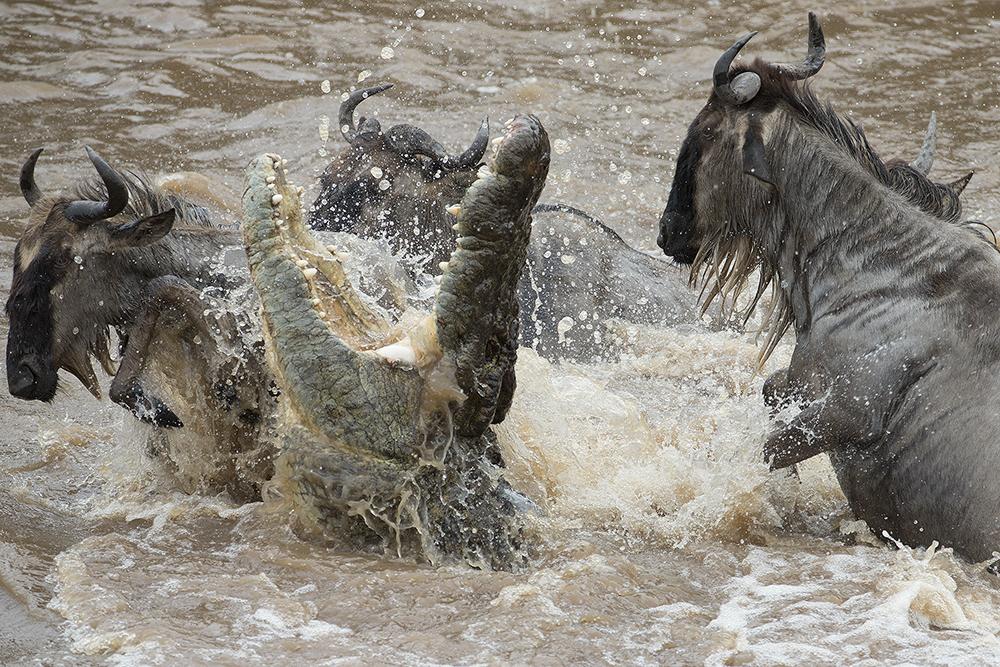
On the Dramatic Mara river crossing, expect a dramatic, chaotic, and unpredictable spectacle, typically between July and October, as thousands of wildebeest and zebras navigate the Mara River's steep banks, strong currents, and Nile crocodiles. The experience requires immense patience, often involving hours of waiting, and brings intense raw-nature scenes of predator-prey battles.
15-days-africa-big-cats-safari-kenya-tanzania-safari-and-zanzibar-beach-holidays
12-days-best-tanzania-and-kenya-safari-combo-itinerary
10-days-ultimate-budget-tanzania-safari-holiday-vacation
9-days-luxury-family-tanzania-safari-in-africa-holiday-vacation
8-days-7-nights-midrange-safari-in-tanzania-northern-circuit-parks
Patience and Uncertainty
When it comes to witnessing the wildebeest crossings at the Mara River, patience and uncertainty are essential companions for safari-goers. Unlike scheduled events, the crossings occur as part of a natural process dictated by the animals' instincts and environmental factors. As herds gather near the riverbanks, they often stall for hours, creating an atmosphere charged with anticipation. Observers may find themselves engaged in prolonged periods of quiet, stationary waiting, as the wildebeests deliberate whether to take the plunge.
These moments can be both thrilling and excruciating, as onlookers quietly hope for action. The reason for the hesitation is multifaceted. The animals assess the safety of the crossing by looking for potential threats, primarily from the Nile crocodiles that lie in wait beneath the surface. Compounding their dilemma is the need to find suitable crossing points—areas with gentle slopes that provide easier access to the water.
For tourists, this means understanding that the crossing is as much about embracing the stillness as it is about witnessing the action. It is ultimately a waiting game, where the payoff is the exhilarating moment you’ve traveled to see, yet the unpredictability can be both challenging and deeply rewarding. The act of simply observing the natural behavior of these incredible creatures becomes part of the safari experience, fostering a connection to the wild that transcends the excitement of a fleeting crossing. Patience, in this context, is not just a virtue; it is a prerequisite for experiencing one of nature's most extraordinary events.
Intense Action
Once the wildebeest herds make the decision to cross the Mara River, the experience shifts dramatically from quiet anticipation to intense action. This phase is characterized by a sudden, loud, and chaotic frenzy as thousands of animals plunge into the water, driven by the instinct to survive and find greener pastures across the river.
The moment they begin the crossing, the atmosphere transforms; the sound of thundering hooves, splashing water, and the frantic bleats of wildebeests fills the air. This intense burst of activity often lasts only minutes to about an hour, but it is packed with drama and urgency. The sheer volume of animals creates a powerful spectacle, as they surge forward, fighting against the strong currents of the river.
This scene is not only visually stunning but also emotionally charged, as observers witness the harsh realities of the animal kingdom. The intensity of the moment can be overwhelming, both for the animals and those watching. As the creatures enter the water, many face peril from the lurking Nile crocodiles that see the crossing as a prime opportunity for a meal.
In these fleeting moments, the dynamics of life and death are laid bare, and the brutal survival struggles of the wildebeests come to the forefront. The crossing encapsulates the essence of migration—raw, unfiltered, and full of life’s unpredictable turns. This brief, chaotic period is what draws many to the Mara, allowing them to witness the triumphs and tragedies of nature in real time.
The Predators
One of the most compelling aspects of the wildebeest migration is the presence of predators, which adds an extra layer of suspense to the river crossings. Giant Nile crocodiles are the primary threat in the water, waiting patiently just beneath the surface for unsuspecting wildebeests to plunge into their territory. Their stealth and powerful jaws pose a significant danger, transforming the crossing from a mere passage into a survival challenge for the wildebeests.
On the riverbanks, other predators like lions and hyenas lie in wait, keenly observing the chaos that unfolds during crossings. They are opportunistic hunters that aim to exploit the vulnerability of weak, young, or panicked animals that may struggle during the tumultuous crossing. The presence of these predators creates a sense of urgency for the wildebeests, as they not only face the risks of drowning in the river's currents but also the very real threat of being captured and killed.
This predatory dynamic adds a raw intensity to the crossing experience, making it a brutal yet compelling spectacle. Observing how the wildebeests react under pressure provides invaluable insights into animal behavior, illustrating the instinctual drive to survive amidst various threats.
The crossing embodies the harsh realities of the natural world, where danger lurks at every turn. Witnessing these intricate relationships between prey and predator enriches the safari experience, reminding visitors of the delicate balance of life in the wild. It transforms the crossings into more than just an event; it becomes a powerful lesson in survival, instinct, and the primal forces that govern wildlife.
High-Volume Tourism
The wildebeest crossings at the Mara River are a top-tier attraction in the world of safari tourism, drawing visitors from across the globe to witness this incredible spectacle. However, this popularity comes with its own set of challenges, particularly regarding high-volume tourism. At popular crossing points, visitors often find themselves sharing the riverbanks with numerous other safari vehicles, creating a bustling atmosphere that can detract from the wild experience.
To truly enjoy the crossing experience, it is essential to book your safari months in advance. High demand, especially during peak migration months like July and August, means that accommodations and tour spots fill up rapidly. Planning ahead not only ensures availability but also improves your chances of securing prime viewing locations by aligning your visit with the timing of the migration.
While the excitement of being part of a lively gathering can be enjoyable, it presents complexities. With multiple vehicles jockeying for the same vantage points, the experience can become competitive rather than contemplative. Furthermore, excessive noise from engines and chatter can disrupt the animals' natural behaviors, necessitating a respectful approach to wildlife viewing.
For those truly invested in experiencing the wildebeest crossings, seeking less crowded alternatives—such as private conservancies—offers the opportunity to witness this spectacular natural event without the distractions of mass tourism. Ultimately, while high-volume tourism may be an unavoidable aspect of the crossing phenomenon, finding ways to enjoy the experience through careful planning and consideration can lead to a more fulfilling adventure in the heart of Africa's wilderness.
Animal Behavior
Understanding animal behavior is essential for maximizing your chances of witnessing a successful wildebeest crossing at the Mara River. The wildebeests are instinctual creatures that exhibit specific behaviors as they approach the riverbanks. One key factor is their preference for crossing points that have less steep banks, which allows for easier access to the water and reduces the risk of injury during the crossing.
As the herds gather near the river, they often exhibit behavior characterized by hesitation and alertness. The wildebeests are easily spooked, prompting them to pause and survey the surroundings. This is where the role of tourists becomes significant; maintaining absolute silence and remaining inside vehicles is crucial to avoid alarming the herd, which can derail their plans to cross. Any sudden movements or loud noises can send the animals retreating back from the river, extending the waiting period for those hoping to witness the crossing.
Understanding their behavior also serves to enhance the experience for tourists. Observing these animals as they assess their environment and interact with one another offers valuable insights into the intricate web of life at play. Tourists can become more than passive observers; they can engage fully with the experience by closely monitoring the animals' reactions.
Overall, respecting the animals and their natural behaviors not only enriches your safari experience but also contributes to the conservation ethos by minimizing human impact. The closer you pay attention to the subtleties of their actions, the more you’ll appreciate the mighty wildebeest migration and all the thrilling unpredictability it entails.
Survival Struggles
The wildebeest crossings at the Mara River are not just a display of animal migration; they are a testament to the survival struggles intrinsic to the natural world. As large herds plunge into the river, the spectacle can quickly turn brutal, offering a frontline view of nature’s raw realities. While the crossings are filled with moments of triumph, they often entail significant risks, especially for weaker or younger members of the herd.
The physical challenges posed by the strong currents can overwhelm many animals, leading to drowning or injury. Young calves, which are still developing their strength and coordination, face even greater peril. Their vulnerability makes them easy targets for predators like Nile crocodiles, which thrive during these chaotic moments. It’s heartbreaking yet natural, as the herd instinctually prioritizes survival while seemingly leaving behind those less able to cope with the demanding environment.
The struggles witnessed during the crossings serve as a powerful reminder of the cycle of life and death that governs the animal kingdom. While many wildebeests succeed in crossing safely, others may not be as fortunate, resulting in tragic yet essential outcomes. This brutality adds a layer of depth to the safari experience, shifting the focus beyond mere observations of beauty to the harsh realities faced by these animals.
Witnessing the survival struggles of the wildebeests at the Mara River resonates deeply with onlookers, instilling a greater appreciation for the complexities of wildlife behavior and the unforgiving nature of survival. It conveys a poignant message about resilience and the relentless drive for survival that characterizes life in the wild, making the crossings an unforgettable part of any safari adventure.
When is the best time to witness a Mara River crossing?
The Great Migration’s river crossings are seasonally concentrated, and the best time to witness them is typically between July and October. During this window the vast herds of wildebeest and zebra move from the southern and central Serengeti northwards toward the Mara ecosystem in search of fresh grazing, with many crossing attempts focused on the Mara River corridor. Mid‑August is often cited as the month with the highest probability of crossings because it frequently aligns with a peak in herd density along the riverbanks; large congregations steadily build in late July and often culminate in intense crossing activity through August. That said, migration timing is not clockwork — local rainfall patterns, grass growth and river conditions shift annually, so the specific dates can vary.
Planning-wise, aim for a stay of several days (four to five or more) in the northern Serengeti (Kogatende) or the Maasai Mara to improve your odds; single-day visits are much riskier for missing the event. August offers the best statistical chance but also the highest demand: lodges and mobile camps book up early and vehicle availability becomes constrained, so advance reservations are essential for peak-season travel. Early morning and late afternoon game drives are often the most productive times for witnessing crossings, as animal movement and light for viewing are favorable.
For photographers and wildlife enthusiasts, August’s dry conditions create dusty, photogenic scenes and better vehicle access. However, some travelers prefer late July to avoid peak crowds or September for continued action with slightly fewer people. The most reliable strategy combines flexible dates, an experienced migration-focused guide or operator who follows real-time herd movements, and sufficient days in the field to allow natural variation in crossing timing. Ultimately, while July–October (with emphasis on August) offers the best statistical chance, successful viewing depends on up-to-the-minute tracking of the herds and patience in the field.
Is a Mara River crossing sighting guaranteed during a safari?
No — witnessing a Mara River crossing can never be guaranteed. The Great Migration involves millions of animals whose large-scale movements are driven primarily by rainfall, grass availability, and complex herd decision-making; these factors vary year to year and even day to day. Because the timing and precise location of crossing attempts are determined by changing environmental cues, unpredictable leader decisions by subgroups, and river conditions, even carefully planned safaris during the traditional peak months can miss a crossing. Operators and guides work hard to maximize chances by using real‑time reports, radio networks, and local knowledge to follow herd movements, but the wild nature of the event means there will always be an element of chance.
To improve your odds, travel in the July–October window (mid‑August often being best), base yourself in migration‑focused camps in Kogatende or the Maasai Mara, and allow multiple days (four to five minimum) for the herd to move into the area during your stay. Mobile camps and flexible itineraries increase responsiveness to sudden herd movements. Also, plan for long days of observation and repositioning: successful sightings often result from patient waiting and rapid movement once a promising herd is located.
It’s important for visitors to adjust expectations: the crossings are among the most spectacular wildlife phenomena on Earth, but they remain a natural event with no guarantees. Embracing uncertainty is part of the safari experience — the many other behaviors, predator interactions, and landscape spectacles you’ll encounter add considerable value even if a crossing does not occur during your visit.
What makes the Mara River crossing so dangerous for the animals?
Mara River crossings pose multiple, simultaneous hazards that together make them among the most perilous events in the lives of migrating ungulates. First, the physical environment: many crossing points have steep, muddy, or slippery banks that make entering and exiting the river treacherous. Once in the water, fast, turbulent currents, variable depths, and submerged channels can separate individuals from their groups and sweep animals downstream. Weak or young animals are particularly vulnerable to exhaustion and drowning.
Second, the concentrated presence of large Nile crocodiles at favored crossing points dramatically increases mortality risk. Crocodiles exploit narrow choke points where animals must slow or crowd, launching powerful ambush strikes that can drag prey below the surface. Even unsuccessful attacks can cause injury, exhaustion, or separation from the herd, which often proves fatal in subsequent exposure or predation.
Third, the sheer density of animals creates stampedes, panic, and chaotic collisions. Herds may surge, fall, or trample weaker members, and animals separated by currents can become isolated targets for terrestrial predators once ashore. Predators such as lions, hyenas and leopards actively exploit the post‑crossing vulnerability of exhausted, injured or disoriented prey on riverbanks and floodplains, increasing mortality beyond immediate river hazards.
Finally, behavioral dynamics amplify danger. Many animals hesitate at the water’s edge; groups look for a leader and any misjudged attempt can precipitate an uncontrolled mass entry. Environmental variability such as sudden floods after rains or higher-than-usual water levels further escalates risk. The crossing is an ecological bottleneck where hydrology, predator strategy and herd behavior intersect, producing intense selection pressure that shapes migration outcomes. While dramatic and often distressing to observe, the crossings are a natural component of the ecosystem’s dynamics and a driver of predator–prey relationships and population processes.
How long does a single Mara River crossing typically last?
The duration of a single Mara River crossing can vary widely. When a crossing begins, the most intense phase — the mass entry of animals and immediate scramble across the main channel — may last only a few minutes to perhaps an hour at a focused crossing point. During that window, hundreds or even thousands of animals may surge across in rapid succession, creating a high‑intensity spectacle that yields the most dramatic photographic and observational opportunities.
However, the broader crossing event often unfolds over a much longer timeframe. Herds do not always cross en masse at a single point; they may attempt multiple crossing points along several kilometers of riverbank, pause to graze or recover on floodplains, or make repeated attempts over many hours or days. As a result, observers may witness intermittent waves of crossings interspersed with long periods of milling, hesitancy and repositioning. In some cases, the overall activity associated with a crossing can span several hours up to a full day, and in other circumstances the local crossing pressure may continue across consecutive days as different subgroups move.
The timing also depends on environmental conditions: low water levels and favorable banks can enable quicker mass crossings, while high flows, strong currents, or heavy crocodile presence can prolong hesitation and extend the duration of localized attempts. From a visitor’s perspective, patience is essential: short, intense bursts of activity can erupt suddenly after long waits, and successful observation often requires flexibility and extended time in the field. Guides typically recommend multi‑day stays to capture not just the brief crossing moments but the extended sequence of herd behavior that surrounds them.
What should I expect to see during the build-up to a Mara River crossing?
The build‑up to a Mara River crossing is an evocative mix of anticipation, tension and behaviour that yields compelling natural theatre long before any animal enters the water. Expect to observe massive assemblages of wildebeest and zebras congregating on the riverbanks and adjacent plains. Groups may pace along the edge, mill aimlessly, or push forward and pull back in waves as leaders test the water and the herd deliberates. These periods can generate thick, dust‑laden air as hooves churn the dry soil; the dust often creates atmospheric effects that look striking at dawn or dusk.
Behaviorally, animals exhibit heightened vigilance: frequent head‑lifting, scanning, nervous foot stamping, and close cluster formations as they assess risk. Some individuals take tentative steps into shallower margins and then retreat, while others test current strength at shallow points. Social dynamics are visible — younger animals stay within protected zones, and some groups follow particular leaders who repeatedly attempt crossings.
Predators frequently capitalize on the assembly, prowling the banks and nearby vegetation. Lions may position themselves to intercept stragglers, hyenas and jackals circle opportunistically, and large raptors hover to pluck vulnerable young or weak animals. In the water, crocodiles lurk around favored entry points, adding an element of underwater ambush that animals can sense and seek to avoid by shifting crossing locations.
From a visitor standpoint, the build‑up is long on suspense and short on predictable outcomes. Expect a mix of patient observation, sudden bursts of urgency, and strategic repositioning by guides to get the best viewing angle. The prelude offers invaluable insights into herd decision‑making, predator strategy and the social fabric of migration — scenes that are as informative and compelling as the eventual crossing itself.
Why do the animals hesitate before a Mara River crossing?
Hesitation at the river’s edge is a complex, adaptive behaviour rooted in survival instincts and social dynamics. For wildebeest and zebras, the decision to cross involves weighing immediate risks — deep water, strong currents, steep banks and crocodile ambushes — against the necessity of reaching fresh grazing and water on the other side. This cost–benefit calculus manifests visibly as hesitation: animals pause, mill, and test the water to minimize the chance of injury or death.
Social structure and leadership play major roles. Herds are composed of many subgroups and family units; crossing often requires the emergence of a confident leader or a tipping point where pressure from the mass behind forces movement. Animals are attuned to the behaviour of others: if a leader makes a successful crossing, many will follow, whereas refusals or failed attempts can cascade into renewed hesitation.
Perception of predation risk also contributes. Wildebeest and zebra can detect predator cues — scent, presence of lions on the bank, or heightened crocodile activity — and factor those into their timing. Additionally, inexperienced young or weakened animals increase group caution. Environmental signals like water depth, flow rate and submerged obstacles are physically tested by a few individuals before a full commitment occurs.
Hesitation is therefore an emergent property of individual risk assessment, social conformity, and environmental reading. It reduces the likelihood of mass disaster by allowing assessment and selection of safer crossing points, but it also creates intense dynamics where prolonged indecision can lead to stampedes or risky rushes when the herd is finally compelled to move.
Which animals besides wildebeest participate in a Mara River crossing?
While wildebeest are the dominant species in the Great Migration and form the majority of animals involved in river crossings, several other species commonly participate in these movements. Plains zebra are the most conspicuous companions; zebras travel alongside wildebeest and their striping and slightly different grazing strategies complement the herd dynamic. The two species often cross together and mutually benefit: zebras’ longer sightlines and different food preferences can help detect danger and indicate suitable crossing points.
Other ungulates sometimes caught up in the movement include Thomson’s and Grant’s gazelles and, less frequently, elands or hartebeest, especially where individual groups get swept along by larger migrations. These smaller antelopes are more sporadic participants but can be present in significant numbers at times.
Birds are integral to the event as well: vultures, marabou storks, and various raptors and scavengers gather to exploit mortality at crossing sites. Aquatic and semi‑aquatic fauna, notably Nile crocodiles, are central actors in the river itself, ambushing prey and influencing crossing dynamics.
Occasionally, solitary animals such as buffalo or even elephant families may be observed in the same general areas if resource needs or migratory detours bring them near crossing sites, but they are not primary participants in the migratory surge. Overall, while wildebeest and zebra dominate the spectacle, crossings can be multi‑species affairs with a diverse supporting cast of herbivores, predators and scavengers integral to the ecology of the event.
What is the best way to photograph a Mara River crossing?
Photographing a Mara River crossing requires preparation, equipment choices, and an ethical mindset. Opt for a camera with a telephoto zoom in the 200–400mm range (or longer) to frame distant action from a safe vehicle distance; a fast telephoto (f/2.8–f/4) helps in lower light and to isolate subjects against messy backgrounds. A mid‑range zoom (24–70mm or 24–105mm) complements wide landscape and vehicle‑interior shots. Use a fast shutter speed (1/1000s or faster) to freeze splashes, leaping animals and crocodile strikes; increase ISO as needed while keeping noise manageable. Continuous‑focus modes (AI Servo/AF‑C) and high frame rates improve your chance of capturing key moments.
Compositionally, prioritize storytelling: wide shots convey the scale of herds and sweeping river vistas, while medium-to-close frames focus on individual drama — a leaping wildebeest, a crocodile lunge, or a struggling animal. Keep vehicles steady with beanbags or monopods, and consider a small gimbal head for smoother panning. Golden hour offers dramatic light, but crossings can happen at any time, so be ready for changing conditions.
Ethics and safety matter: remain inside the vehicle and maintain the recommended distance (guided by local regulations and ethics). Avoid blocking animal paths or maneuvering aggressively for a shot; responsible positioning ensures both animal welfare and the ability of all vehicles to view. Communicate with your guide about anticipated crossing points and keep gear protected from splashes and dust. Finally, patience is essential — successful images often come after long, tense waits and rapid bursts of intense action. Preparation, respectful behavior, and technical readiness together yield the most compelling photographs of this extraordinary natural event.
Are there specific "crossing points" for a Mara River crossing?
Yes — certain stretches of the Mara River are repeatedly used for crossings and are well known to guides and researchers. These crossing points are determined by local topography: places where the river is relatively narrower, has shallower channels, or features more gradual banks tend to be favored. On both sides of the border — in the northern Serengeti (Kogatende area) and in Kenya’s Maasai Mara — experienced guides have identified specific river bends, channels and fords that historically receive frequent crossing attempts.
However, the herd does not use a single fixed point; crossings can shift among multiple spots across the river’s length depending on recent rain patterns, water depth, herd momentum and localized predator pressure. Thus, while some points are consistently productive and popular for viewing, guides often reposition among several known sites as they track herd movement and behavior.
Access to the best crossing points can be influenced by park regulations, private conservancy rules, and road conditions. Some areas offer established viewing lanes or photographic hides, while others require tactical vehicle placement on game tracks. During peak crossing periods, vehicle density can be high at favored sites, which is why experienced guides use networks of reports and local knowledge to find less crowded vantage areas.
In sum, known crossing points provide useful focal areas for planning, but the dynamic nature of the migration means flexibility and real‑time guidance are essential. Working with guides who monitor herd reports and understand micro‑topography maximizes the chance of being at the right crossing spot when the moment arrives.
How many days should I spend in the area to see a Mara River crossing?
To maximize your chances of witnessing a Mara River crossing, plan to spend at least four to five full days in the northern Serengeti (Kogatende area) or the Maasai Mara. The migration’s timing and the precise location of crossings shift with environmental conditions, and multiple days give you the statistical advantage needed to be present when herds move through the river corridors. A single day is rarely sufficient due to the inherent unpredictability of herd movements and the potential need for repositioning.
A 4–5 day stay allows for repeated game drives, early morning and late afternoon stakeouts at likely crossing points, and the flexibility to follow reports of herd congregations. Many safari itineraries for crossing-focused trips run 7–10 days, enabling travel between multiple zones (southern Serengeti, central plains, northern corridor and Maasai Mara) as the herds shift. Longer stays increase the odds of multiple crossing observations and broaden the range of predator–prey interactions and other migration behaviors you might witness.
Also factor in travel logistics: reaching Kogatende or remote Mara conservancies may require charter flights or lengthy road transfers, so buffer days reduce the risk of missing key activity due to delays. Booking with a migration‑focused operator that uses mobile camps or flexible routing further enhances your ability to be where the action is. Ultimately, the more days you can allocate in the migration corridor during the July–October window, the better your chances of seeing the iconic river crossings.
What predator activity can I expect during a Mara River crossing?
Predator activity intensifies around Mara River crossings, creating a multi‑layered theatre of predation. In the river itself, Nile crocodiles are primary actors: they ambush crossing animals in deep channels and narrow choke points, using stealth and explosive lunges to seize prey. On the riverbanks and adjacent floodplains, terrestrial predators ramp up hunting efforts. Lions are often stationed near likely exit points, capitalizing on tired, injured or separated animals. Pride dynamics enable lions to make short‑range ambushes or chase down stragglers.
Hyenas and jackals operate as both opportunistic hunters and scavengers—hyena clans can pursue weakened individuals, and they play a key role in consuming carcasses left by crocodiles or big cats. Leopards are less conspicuous but may exploit peripheral opportunities, especially where shelded vegetation offers stalking cover. Cheetahs, though less central to crossing predation, may hunt in adjacent grasslands where smaller, fragmented groups pass.
Birds of prey and scavengers—vultures, marabou storks and raptors—rapidly converge to capitalize on mortality, providing aerial signals that attract other predators and vehicles. The intense convergence of prey also draws larger carnivores from a wider radius, creating a high density of predators relative to the normal baseline.
From a behavioral standpoint, predators use the crossing’s bottleneck effect to maximize success: crocodiles exploit aquatic ambush, while terrestrial carnivores coordinate or opportunistically target the most vulnerable. This concentration of predator activity contributes significantly to the ecological dynamics of the migration, shaping survival rates and influencing herd movement patterns in subsequent days.
What are the ethical rules for viewing a Mara River crossing?
Ethical viewing is essential to protect both wildlife welfare and the quality of the experience. Key rules include: maintain respectful distances (typically a minimum of 20–30 meters, or as specified by park rules) to avoid stressing animals or interfering with natural behavior; keep noise levels low and avoid sudden movements; never block animal paths to water or cause animals to alter their course because of vehicles; avoid getting out of vehicles in unauthorized locations (walking near crossing sites is generally prohibited); follow your guide’s instructions at all times; and do not feed, touch or attempt to interact with wildlife.
Responsible vehicle positioning is critical: guides should avoid crowding a single animal or group, and multiple vehicles should coordinate to ensure everyone has a view without encroaching on the animals’ space. Use of drones for photography is typically banned or strictly controlled and should never be used without explicit permission from park authorities. Support ethical operators who prioritize animal welfare, follow park regulations, and contribute to community conservation.
Additionally, consider the indirect ethical choices: favor operators who adhere to conservative vehicle limits, engage in anti‑poaching efforts, and respect local communities. When photographing or filming people (e.g., Maasai on the riverbanks), obtain permission and avoid exploitative portrayals. Practicing these ethics ensures the crossing remains a natural event for animals while providing sustainable, meaningful experiences for visitors.
Should I stay in a specific camp to be near a Mara River crossing?
Staying in camps located within migration corridors—mobile tented camps or lodges in the Mara Triangle and Kogatende sector—offers a strategic advantage for rapid access to likely crossing sites. Mobile camps in particular follow herd movements and can position guests close to active areas, maximizing viewing opportunities during peak crossing windows. Lodges and camps with migration‑focused itineraries and experienced guides that maintain real‑time networks of reports can react quickly to herd shifts and navigate guests toward emerging crossing points.
Choosing a location depends on trade-offs: Kogatende is remote and focused on the northern Serengeti crossings, offering proximity to the Mara River’s eastern stretches; the Maasai Mara provides a broader infrastructure, a diversity of camps across conservancies and sometimes easier road access. If you prioritize the crossing above other considerations, opt for camps or mobile operations that explicitly advertise migration proximity and have strong track records of river‑crossing sightings.
However, high demand means these camps fill early and costs can be premium during July–October. Also weigh the value of flexibility: some operators shift guests between camps or combine stays in both Serengeti and Mara to follow the herds. Ultimately, selecting a camp near known crossing routes and booking well in advance increases your chance of being at the right place when the river action unfolds.
What should I pack for a day of waiting for a Mara River crossing?
Comfort and preparedness make long stakeouts more enjoyable. Pack: ample water and electrolyte drinks to stay hydrated; a substantial picnic lunch and snacks if your operator doesn’t provide meals; sun protection including a wide‑brimmed hat, sunglasses and high‑SPF sunscreen; layered clothing for variable temperatures—mornings and evenings can be chilly while midday heats up; a light waterproof jacket in case of sudden showers. Bring quality binoculars (8x–10x) and a spotting scope if you have one for long‑range observation, plus a good telephoto lens for photography. A small, comfortable cushion or seat pad is useful for long hours in vehicles.
Additional useful items: insect repellent, wet wipes, hand sanitizer, spare camera batteries and memory cards, waterproof covers for gear, and a small first‑aid kit for minor issues. Respect local rules on litter: bring a resealable bag for trash. If you have mobility considerations, inform your operator in advance so they can accommodate by choosing appropriate vehicles or planning shorter drives. Finally, patience and appropriate expectations are essential — bring reading material or a notebook for journaling while you wait; much of the crossing’s drama is interspersed with long periods of observation.
How does the water level affect a Mara River crossing?
Water level critically shapes crossing dynamics and animal risk. Lower river levels and shallower channels reduce the physical difficulty of crossing, enabling swifter, more frequent mass movements and often higher success rates with fewer drownings. Animals can traverse more manageable slopes and shallower depths, reducing separation and exhaustion and lowering the effective advantage for ambushing predators.
Conversely, high water levels—driven by recent rains or upstream runoff—make crossings far more hazardous. Fast currents can sweep animals away, submerged obstacles and stronger turbulence increase drowning risk, and steeper banks make embarkation and disembarkation strenuous. High flows often lead to longer hesitancy and fewer successful crossings; when crossings do occur under such conditions, mortality rates (from drowning and crocodile predation) usually rise.
Water level also affects predator strategy and viewing logistics. Flooded banks and broader channels can disperse crossing points and make guide positioning more challenging; crocodiles may concentrate in fewer deep holes, intensifying predation at those spots. For visitors, guides will assess water conditions closely and may avoid encouraging crossings during dangerous flows, prioritizing safety and ethical viewing. Real‑time hydrological awareness is therefore essential for both the welfare of the animals and the quality of the viewing experience.
Booking Tanzania safari to see mara river crossing with us Roads of Adventure safaris
Booking a Tanzania safari with Roads of Adventure Safaris to witness the Mara River crossing offers an immersive experience, primarily between July and October in the Northern Serengeti. Their itineraries typically include full-day game drives in the Kogatende area, following herds from the Central Serengeti through the Ngorongoro Conservation Area, while focusing on the high-drama river crossings filled with crocodiles and intense action.
