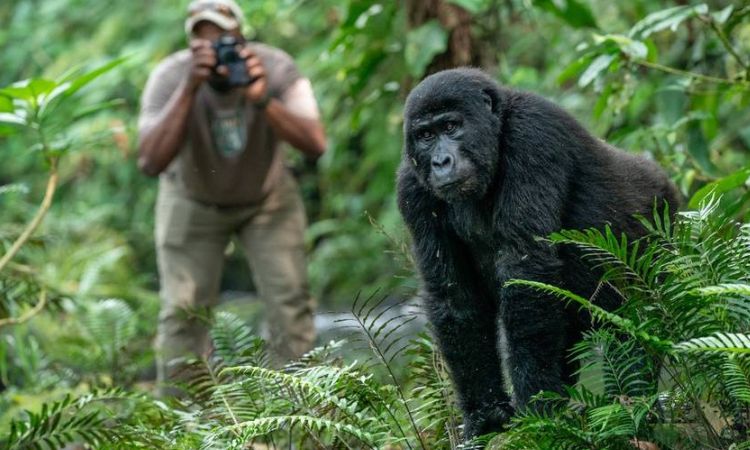
Volcanoes National Park, strictly maintain a 10-meter (32-foot) distance, wear a face mask, and limit your viewing time to exactly one hour. Sick trekkers, or anyone under 15 years old, are strictly prohibited.
12-days-luxury-safari-in-uganda-parks
12-days-best-uganda-rwanda-primate-safaris-and-akagera-big-five-safaris
10-days-uganda-rwanda-primate-safari-vacation-and-game-drive-safari
9-days-best-of-uganda-and-rwanda-combined-tour-package
8-days-luxury-uganda-wildlife-safari-tour-package
7-day-ultimate-uganda-primate-safari-chimpanzees-and-game-drives
6-day-uganda-gorilla-trekking-chimpanzee-wildlife-and-culture
4-days-budget-gorilla-trekking-lake-bunyonyi-and-golden-monkey-tracking
3-days-affordable-uganda-budget-gorilla-trekking-via-kigali
No Touching: Respecting Wild Boundaries
Even though habituated mountain gorillas often appear remarkably gentle and relaxed around humans, they remain massive, exceptionally powerful wild animals. A full-grown silverback gorilla can weigh up to 400 pounds and possesses six to eight times the strength of an average human. Attempting to touch a gorilla breaks a fundamental safety barrier and can easily be interpreted by dominant silverbacks as a direct threat or challenge to their leadership, triggering a aggressive defensive reaction.
This boundary applies just as strictly when curious young gorillas or infants approach you. Younger gorillas are naturally playful and inquisitive, often moving close to investigate human visitors. If a youngster wanders toward your group, the mandatory protocol across Uganda and Rwanda requires you to remain completely still, lower your gaze, and allow the park rangers to gently step in and manage the space. Refraining from physical contact protects you from unpredictable wild animal behavior while ensuring the gorillas do not lose their natural, healthy boundaries around human presence.
Maintain Distance & Mask Up: Biosecurity in the Jungle
Mountain gorillas share roughly 98% of their DNA with humans, making them highly susceptible to human respiratory pathogens. Because these isolated gorilla populations have never developed immunity to common human illnesses, a minor cold virus passed from a tourist can quickly escalate into a fatal respiratory outbreak across an entire gorilla family. To prevent cross-species disease transmission, conservation authorities strictly enforce biosecurity protocols in sanctuaries like Bwindi Impenetrable and Volcanoes National Park.
Visitors must maintain a minimum distance of 10 meters (33 feet) from the gorillas at all times. Additionally, wearing a properly fitted surgical mask or N95 mask is mandatory throughout the direct observation period. Wearing a mask creates an essential physical barrier that catches airborne droplets when breathing, talking, or clearing your throat. Adhering to these simple biosecurity steps ensures that high-value eco-tourism directly supports mountain gorilla conservation without inadvertently exposing these endangered primates to life-threatening human diseases.
Manage Your Health: Preventing Disease Transmission
Maintaining strict health protocols on a gorilla trek goes beyond wearing a mask—it starts with self-monitoring before you even enter the national park. If you wake up on the morning of your trek with symptoms of a communicable illness, such as a cold, flu, fever, or intestinal bug, you must report it to park authorities and abstain from the trek. Authorities in both Uganda and Rwanda prioritize primate health; visitors who voluntarily declare an illness before the trek are typically offered a partial permit refund or assistance in rescheduling their trek.
If you experience a sudden urge to cough or sneeze while standing near a gorilla family, you must immediately turn your head at least 180 degrees away from the primates and cough or sneeze directly into the crook of your elbow or a clean tissue, even while wearing your mask. This immediate reaction prevents micro-droplets from blowing toward the animals. Managing your personal health conscientiously guarantees that your encounter remains entirely safe for the habituated gorilla troops you came to visit.
Silence is Golden: Managing Noise Levels in the Forest
Navigating the dense, high-altitude rainforests requires a quiet, low-impact presence. Mountain gorillas rely heavily on vocalizations and subtle body language to communicate within their social hierarchy, and sudden loud noises can easily startle them. High-pitched screams, loud talking, or shouting—even out of excitement when snapping photos—can cause stress to the troop, leading the dominant silverback to move the family deep into dense cover or display defensive behaviors like chest-beating.
From the moment you step onto the trail until you return to the trailhead, park rangers mandate keeping your voice to a low whisper. When you first encounter the gorilla family, speaking softly helps keep the animals calm and comfortable in your presence. Maintaining a quiet atmosphere also enhances your own safari experience, allowing you to fully absorb the authentic sounds of the jungle—from the gentle crunching of bamboo shoots to the soft, rhythmic grunts of a silverback keeping his family together.
Flash Photography Banned: Protecting Primate Vision
Trekking deep beneath the dense jungle canopy of Bwindi or Volcanoes National Park often presents dim, challenging lighting conditions for photography. However, using flash equipment—including camera pop-up flashes, external speedlights, and even bright smartphone fill lights—is strictly prohibited near mountain gorillas. Sudden, bright bursts of artificial light startle the animals, temporarily blinding them and creating a sense of immediate threat that can provoke an aggressive response from the silverback.
Before entering the forest, rangers double-check that every visitor's flash setting is turned off completely. To capture clear images under low forest light without flash, photographers adjust their camera settings manually: increasing ISO values, using wider lens apertures (such as f/2.8 or lower), and relying on image stabilization systems. Taking photos slowly and deliberately without artificial flashes keeps the gorillas completely relaxed, allowing you to capture authentic, natural behavior without disturbing their routine.
No Eating, Drinking, or Smoking: Keeping Trails Clean
Eating, drinking, or smoking within 200 meters of a mountain gorilla family is strictly banned across all tracking locations. Food scraps, fruit peels, or discarded trash left behind in the forest pose severe health and environmental hazards. Dropped food can attract wild animals or expose gorillas to human bacteria and harmful chemicals, while the smell of human food can tempt curious primates to forage around human groups, disrupting their natural diet of wild leaves, stems, and fruits.
Additionally, smoking near wild animals exposes them to harmful secondhand smoke and creates an immediate fire hazard in dry forest foliage. If you need to drink water or eat a light energy snack during the hike, your guide will designate a safe resting stop along the trail well before you reach the gorillas. Keeping human food and snacks packed securely away ensures the forest ecosystem stays pristine and prevents habituated gorillas from forming unhealthy habits around human food.
Follow the One-Hour Rule: Minimizing Daily Stress
Once your trekking group makes contact with a habituated mountain gorilla family, your time with them is capped at exactly one hour. This strict time limit is grounded in decades of conservation research aimed at balancing eco-tourism revenue with wild animal welfare. Extending human contact beyond 60 minutes increases stress levels within the troop, disrupts their essential daily routines—such as feeding, grooming, and resting—and elevates the risk of disease transmission.
Park rangers closely monitor the clock from the second contact is established. During this hour, you can observe, photograph, and film the family as they go about their natural activities. When your 60 minutes are up, the ranger will quietly prompt the group to pack up gear and retreat slowly down the trail. Respecting this time limit ensures that habituated gorilla families remain wild, stress-free, and healthy for generations to come.
How to React to a Gorilla Charge
While habituated mountain gorillas are generally peaceful, a dominant silverback may occasionally charge. It is almost always a bluff—a theatrical display of strength designed to assert dominance, protect his family, or test your reaction. Understanding how to react in those tense few seconds is critical for your safety and the group's safety.
Do Not Run: Stand Your Ground
When a 400-pound silverback comes hurtling toward you, beating his chest, snapping branches, and roaring, your natural human reflex will be to turn and run. You must resist this urge at all costs.
Gorillas are exceptionally fast in dense jungle terrain. Running immediately triggers their chase instinct, signaling that you are a subordinate threat or an intruder to be tackled. A human cannot outrun a gorilla in the forest. Running elevates a harmless bluff charge into an actual physical collision, where the silverback may knock you over or bite to assert control.
Act Submissive: Lower Your Posture
To de-escalate the tension instantly, you need to communicate non-aggression in gorilla language:
- Crouch down slowly: Drop to your knees or crouch low to the ground to make yourself appear as small and non-threatening as possible.
- Break eye contact immediately: Look down at the ground or toward your feet. Direct, unblinking eye contact is interpreted by primates as a direct challenge to their authority.
- Keep your hands tucked in: Keep your arms close to your body or folded across your chest rather than waving them around.
By lowering your posture and looking away, you signal complete submission, effectively diffusing the silverback's need to demonstrate force.
Stay Calm: Freeze and Trust Your Ranger
Once you have assumed a submissive crouch, freeze and remain completely silent:
- Avoid screaming or vocalizing: High-pitched screams increase the stress levels of the troop and prolong the charge display.
- Let the display play out: In almost every scenario, the silverback will pull up short—often stopping just a few feet away—give a sharp grunt or chest-beat, and then slowly move away once he sees you have yielded.
- Follow your ranger's voice: Your official ranger guide is armed, highly trained in gorilla behavior, and knows the individual personality of that silverback. Listen carefully for quiet, step-by-step instructions (such as soft grunting sounds the rangers use to reassure the gorillas) and do not make any sudden moves until your guide gives the clear signal.
What physical capabilities make a silverback gorilla dangerous despite their habituated nature?
A fully mature silverback mountain gorilla is a marvel of biological strength, weighing anywhere between 350 to 450 pounds and standing over five feet tall when upright. Their muscular density grants them an estimated six to eight times the physical power of an average adult human athlete. Combined with thick bone structures and massive canine teeth designed for tearing tough bamboo, a silverback possesses incredible force.
While conservation efforts by park authorities and ground teams like Roads of Adventure Safaris ensure these gorilla families are habituated to human presence, habituation is not domestication. Habituation simply means the gorillas tolerate human observation without feeling threatened. If a human visitor breaches social boundaries or acts aggressively, a dominant silverback will defend his troop using his raw physical power. Understanding these physical capabilities reinforces why tourists must maintain strict boundaries and follow ranger instructions at all times.
How should a tourist react if an inquisitive young gorilla approaches them on the trail?
Juvenile gorillas and infants are naturally curious, energetic, and playful. As they learn to navigate their forest home in places like Volcanoes National Park or Bwindi Impenetrable, a young gorilla may occasionally break away from its mother and wander down the trail directly toward a group of tourists.
When this happens, the strict protocol managed by guides from Roads of Adventure Safaris is to freeze completely and lower your posture. Do not reach out, pet, or touch the youngster under any circumstances. Even a gentle touch can startle the infant, causing it to cry out in alarm. A distress squeal from a youngster will immediately bring the 400-pound silverback rushing over to eliminate what he perceives as a direct threat to his offspring. Remaining still allows the park rangers to step in smoothly, use soft vocalizations, and gently shepherd the curious youngster back toward its troop.
Why is maintaining a 10-meter distance critical for gorilla health and biosecurity?
Mountain gorillas share approximately 98% of their genetic makeup with humans, which makes them highly susceptible to human illnesses. Because these primates live in isolated high-altitude rainforests, their immune systems have never developed antibodies against common human pathogens, including cold viruses, influenza, and respiratory infections. A simple virus that causes mild symptoms in a tourist can quickly spread through an entire gorilla family with lethal consequences.
To eliminate this cross-species contamination risk, authorities enforce a strict 10-meter (32-foot) buffer zone. This physical space prevents airborne respiratory droplets—released during breathing, talking, or laughing—from reaching the animals. Spacing also reduces psychological stress on the troop, giving the family adequate room to move, feed, and rest without feeling crowded or cornered by human observers.
What role do face masks play during mountain gorilla encounters in Volcanoes National Park?
Following biosecurity updates in high-altitude primate sanctuaries, wearing a properly fitted face mask (such as an N95 or surgical mask) is mandatory during the observation period. Even when maintaining the required 10-meter distance, atmospheric conditions in cold, humid rainforests can carry micro-droplets further than expected.
When trekking with Roads of Adventure Safaris, trekkers put on their masks right before stepping into the immediate vicinity of the gorilla family. The mask forms a vital biological shield, trapping exhalations, coughs, or accidental sneezes before viral particles can escape into the air. This simple preventive measure has proven instrumental in safeguarding endangered mountain gorilla populations from respiratory disease outbreaks, ensuring that eco-tourism continues to support gorilla conservation without compromising their health.
Why must a trekker abstain from gorilla tracking if they wake up feeling ill?
The biological safety of an endangered species always takes priority over a tourist itinerary. If a traveler wakes up with symptoms of a contagious illness—such as a fever, persistent cough, runny nose, or stomach flu—they pose an immediate health threat to the gorilla troop. Passing a human virus to a wild population can devastate years of conservation work in a matter of weeks.
Park authorities in Uganda and Rwanda maintain a clear policy for sick visitors: anyone showing symptoms of a communicable disease is prohibited from entering the forest. To support this policy, travelers who voluntarily declare their illness at the park headquarters before the trek are eligible for permit rescheduling assistance or partial refunds according to official park guidelines. Reputable operators like Roads of Adventure Safaris assist guests in coordinating with park officials to adjust their travel arrangements responsibly.
What is the correct procedure if you get a sudden urge to cough or sneeze while near gorillas?
Despite feeling completely healthy at the start of a hike, cold forest air and physical exertion can sometimes trigger a sudden cough or sneeze while standing near a gorilla family. In those brief seconds, quick action is required to prevent airborne particles from traveling toward the primates.
If you feel a cough or sneeze coming on, you must immediately turn your face completely away from the gorillas—aiming 180 degrees in the opposite direction. Cough or sneeze directly into the crook of your elbow or a thick, clean tissue while keeping your face mask firmly in place. Immediately dispose of any used tissues in a sealed bag inside your daypack. This immediate reaction ensures that no respiratory droplets drift toward the animals, keeping the environment safe.
Why is keeping a low voice mandatory from the trailhead to the gorilla encounter?
Rainforests are acoustic environments where sound travels easily across valleys and through dense undergrowth. Mountain gorillas rely heavily on sound—including deep grunts, chest beats, and vocal rumbles—to communicate within their social group and stay aware of their surroundings. Sudden, loud human noises or high-pitched screams disrupt this natural harmony and trigger immediate anxiety among the troop.
From the moment your trek begins, park rangers and guides from Roads of Adventure Safaris mandate maintaining a quiet whisper. Keeping noise levels low prevents startling the gorillas before you even see them. When you reach the troop, speaking softly keeps the silverback relaxed, allowing the family to continue their natural routines like feeding, playing, and grooming without feeling threatened by loud intruders.
What are the negative consequences of loud noise or shouting during a gorilla encounter?
Uncontrolled noise or sudden shouts—even expressions of excitement when taking photos—can be misinterpreted by mountain gorillas as aggressive behavior. In gorilla social structures, loud vocalizations are often used during territorial disputes or dominance displays. Hearing shouting from a group of humans can cause severe stress to mothers with young infants and provoke protective instincts in the dominant silverback.
If a silverback feels his family is under threat due to loud disturbances, he may react by charging, beating his chest, or herding his family deep into thick, impenetrable brush. This cuts the one-hour viewing window short for everyone. Maintaining absolute quiet preserves a peaceful atmosphere, ensuring the gorillas remain calm and comfortable throughout your visit.
Why is camera flash photography strictly banned during gorilla treks?
The light beneath a dense jungle canopy can be dim, prompting many photographers to rely on artificial lighting. However, using flash equipment—including built-in camera flashes, external speedlights, and mobile phone video lights—is strictly forbidden near wild primates.
A sudden, bright burst of flash light startles gorillas, temporarily blinding them and creating an immediate sense of alarm. To a dominant silverback, a sudden flash can look like an attack, triggering an aggressive defensive charge to protect his group. Before leaving the briefing point, guides from Roads of Adventure Safaris verify that all camera flash settings are completely disabled, ensuring guests rely on natural light and camera settings like higher ISOs and wider apertures.
How can photographers capture sharp images in dim forest light without using a flash?
Capturing clear, high-quality images under the dense canopy of Volcanoes National Park or Bwindi requires adjusting camera settings to low-light conditions rather than relying on artificial light.
Photographers should:
- Increase the camera's ISO setting (typically between ISO 1600 and 6400) to enhance sensor sensitivity.
- Use wide-aperture lenses (such as f/2.8 or f/4) to let in maximum ambient light.
- Enable built-in image stabilization on lenses or camera bodies to reduce motion blur.
- Maintain a steady stance or use a lightweight monopod for support.
These adjustments allow you to take sharp, beautifully exposed photos of mountain gorillas without disturbing the animals or violating park safety rules.
Why is eating, drinking, or smoking prohibited within 200 meters of gorillas?
The 200-meter restriction around mountain gorilla troops is a critical rule designed to maintain forest hygiene and prevent behavioral contamination. Consuming food near wild animals creates severe risks, including the accidental dropping of crumbs, fruit peels, or wrappers that can carry human bacteria, pesticides, or non-native seeds into the ecosystem.
Furthermore, the scent of human food can attract curious gorillas, encouraging them to forage around human groups and disrupting their natural diet of wild bamboo, celery, and fruit. Smoking near primates exposes them to harmful secondhand smoke and poses a fire hazard in dry forest foliage. For these reasons, Roads of Adventure Safaris ensures all snack breaks and hydration stops occur at designated resting points well away from the gorillas.
What are the ecological hazards of leaving trash or food scraps in a gorilla habitat?
Leaving even tiny pieces of litter—such as plastic wrappers, tissue paper, or organic fruit cores—in a protected national park damages the delicate rainforest ecosystem. Organic waste like apple cores or banana peels can introduce foreign diseases, fungal strains, or non-native plant species into the forest floor.
Plastic trash poses an even direct threat: curious primates or other forest wildlife may ingest plastic materials, leading to intestinal blockages, severe illness, or death. Park authorities strictly enforce a "pack-it-in, pack-it-out" policy. Every piece of trash generated during a trek must be stored securely in your daypack and carried back to the park headquarters for proper disposal.
What is the scientific rationale behind the one-hour viewing limit for gorilla treks?
The one-hour viewing limit is grounded in decades of wildlife research and primatological studies. While mountain gorillas in habituated troops are accustomed to human observers, the presence of a human group still introduces a degree of disruption to their natural environment.
Restricting human contact to exactly 60 minutes per day minimizes cumulative stress on the troop. It ensures that the gorillas have ample, uninterrupted time to perform essential daily behaviors—such as foraging for food, grooming one another, caring for infants, and resting. Capping observation time also reduces overall airborne exposure, lowering the risk of disease transmission between tourists and wild primates.
How do park rangers manage timing during a gorilla encounter?
From the moment your trekking group makes initial contact with a mountain gorilla family, the lead park ranger starts a timer. The rangers are responsible for guiding your movement around the family, ensuring everyone maintains a safe distance while taking photos and observing natural behaviors.
Rangers monitor both the clock and the gorillas' behavior throughout the encounter. If the family is on the move, the ranger keeps the group tracking at a respectful distance. When the 60-minute mark arrives, the lead ranger quietly informs the group that time is up, instructing everyone to pack up camera gear and step back slowly. Professional operators like Roads of Adventure Safaris work seamlessly with park rangers to ensure this transition is smooth, calm, and respectful.
What is a "bluff charge," and why do silverbacks perform it?
A bluff charge is a dramatic, vocal display of strength used by dominant silverbacks to assert authority, establish boundaries, or protect their troop from perceived threats. During a bluff charge, a silverback may suddenly roar, slap the ground, snap heavy branches, beat his chest, and charge directly toward a group of observers at high speed.
It is important to realize that in the vast majority of cases, a bluff charge is a theatrical demonstration rather than an intent to inflict harm. The silverback is testing your reaction to see if you will yield or pose a threat. In nearly every instance, if the human group remains calm and submissive, the silverback will pull up short—often stopping just a few feet away—give a heavy grunt, and turn back to his family.
Why is running away from a charging gorilla the most dangerous reaction?
When a 400-pound silverback charges toward you roaring, the human instinct is to turn and run. However, running is the single most dangerous mistake a trekker can make in the rainforest.
Gorillas are adapted to dense, rugged terrain and can move far faster through thick jungle undergrowth than any human. Running away immediately triggers their natural pursuit instinct, signaling that you are an intruder or a subordinate threat fleeing from their authority. A human cannot outrun a gorilla in the forest, and running elevates a harmless bluff charge into an actual physical collision where the silverback may tackle, strike, or bite to establish dominance.
How does crouching down slowly help de-escalate a gorilla charge?
Crouching down low to the ground is a direct way to communicate non-aggression in gorilla body language. In primate social structures, physical height and posture are closely tied to dominance and authority. A tall, upright human standing firm can be seen as an aggressive posture by a dominant silverback.
By dropping smoothly to your knees or crouching down, you instantly make yourself look smaller, lower, and completely non-threatening. This clear physical signal communicates total submission to the silverback, demonstrating that you acknowledge his dominance and have no intention of challenging his authority or harming his troop.
Why is direct eye contact interpreted as an aggressive challenge by silverbacks?
In the animal kingdom—and particularly among social primates like mountain gorillas—unblinking, direct eye contact is a sign of confrontation and challenge. Staring directly into a silverback's eyes signals that you are standing your ground and challenging his dominance over the troop.
When interacting with gorillas or responding to a charge, you should break eye contact immediately. Lower your gaze toward the ground, look at his feet, or turn your head slightly away. Looking down demonstrates respect and submission, effectively diffusing the silverback's defensive stance and allowing him to calm down without feeling forced to defend his status.
What should you do with your hands and arms during a confrontation with a gorilla?
During an intense moment like a silverback charge or a close approach by a young gorilla, hand and arm movements play a key role in conveying non-aggression. Waving your arms, pointing cameras, or making sudden hand gestures can be interpreted as defensive or aggressive actions.
The correct protocol instructed by Roads of Adventure Safaris is to pull your arms in tightly against your chest or keep them tucked close to your body. Keep your hands still and hidden. Tucking your arms in prevents accidental contact, reduces your physical profile, and reinforces your submissive, non-threatening posture until the silverback moves away.
How do park rangers handle a gorilla charge, and what instructions do they give?
Park rangers assigned to gorilla treks are highly trained wildlife professionals who understand gorilla behavior, vocalizations, and individual family dynamics intimately. Rangers carry defensive gear for safety, but their primary tool for managing a charge is expert communication.
When a silverback begins a display, the lead ranger will step forward slightly while keeping the tourist group crouched behind them. The ranger will make low, rhythmic grunting sounds—a specific vocal language that gorillas interpret as a calming, peaceful message. The ranger will whisper firm instructions to the group: "Crouch down," "Do not run," and "Look down." Listening carefully to the ranger's voice and following their precise directions ensures the situation remains safe and controlled.
What is the minimum age requirement for mountain gorilla trekking, and why is it strictly enforced?
Across all gorilla trekking destinations in Uganda and Rwanda, the official minimum age requirement for mountain gorilla tracking is 15 years old. This age limit is strictly enforced at park headquarters during morning briefings, where passports are checked before permits are issued.
The age limit exists for two main reasons: biosecurity and physical safety. Children under 15 are statistically more likely to carry common childhood viral infections (such as measles, mumps, or chickenpox) that can be devastating to primates. Additionally, children may struggle to manage the intense physical demands of a multi-hour hike in steep terrain, and they are less likely to stay calm, silent, and submissive during an unexpected encounter or silverback bluff charge.
What physical fitness preparations are recommended before embarking on a gorilla trek?
Gorilla trekking involves hiking through high-altitude rainforests (ranging from 8,000 to 11,000 feet above sea level) over steep, uneven terrain covered in dense vegetation, mud, and tangled vines. Depending on where the gorilla family is nested, a trek can last anywhere from two to seven hours.
To prepare for a trek with Roads of Adventure Safaris, travelers should focus on leg strength and cardiovascular endurance weeks before departure. Recommended exercises include hill walking, stair climbing, lunges, and cardio workouts while wearing a loaded daypack. Arriving with a good baseline level of fitness makes the trek far more enjoyable and reduces physical fatigue on steep inclines.
Why is hiring a local porter one of the best decisions a trekker can make?
Hiring a local porter at the trailhead is highly recommended for every gorilla trekker, regardless of age or physical fitness level. For a modest fee (typically around $15–$20 USD), a porter carries your daypack, camera equipment, and extra water throughout the hike.
More importantly, porters provide invaluable physical support along the trail—offering a steady hand over slippery mud patches, helping you navigate steep ascents, and clearing tangled vines. From a community standpoint, hiring a porter directly supports local families living around the national park boundaries. It creates immediate economic benefits from wildlife eco-tourism, turning local community members into active partners in mountain gorilla conservation.
What clothing and footwear are essential for a safe gorilla trekking experience?
Navigating dense, high-altitude jungle requires specific gear to protect against nettles, biting insects, sharp foliage, and changing weather conditions.
Essential attire includes:
- Sturdy hiking boots: Waterproof boots with good ankle support and deep tread for gripping muddy trails.
- Long-sleeved shirts and trousers: Lightweight, moisture-wicking fabrics in neutral colors (khaki, green, brown) to protect skin from stinging nettles.
- Gaiters and thick socks: Wearing gaiters prevents mud, ants, and debris from entering your boots.
- Gardening or hiking gloves: Heavy-duty gloves allow you to grab branches, vines, and bamboo for balance without getting cut or stung.
- Waterproof rain jacket: Rainforest weather is unpredictable, making a light rain jacket a must-have in your daypack.
How do park authorities track gorilla family movements each day?
Finding a specific family of wild gorillas in a vast, dense rainforest requires a coordinated two-tier tracking system managed by park authorities in Volcanoes National Park and Bwindi Impenetrable.
Early every morning—hours before tourist groups leave the park headquarters—teams of professional trackers head into the forest. These trackers navigate directly to the location where the gorilla family built their nests and slept the previous night. From those nests, trackers follow fresh trail signs, including broken bamboo shoots, dung, and bent foliage, until they locate the family. The trackers then relay GPS coordinates via radio to the lead rangers guiding tourists, ensuring groups hike directly toward the troop's current position.
What makes the terrain in Volcanoes National Park unique compared to Bwindi Impenetrable?
While both sanctuaries protect mountain gorillas, their topography and vegetation differ significantly. Volcanoes National Park in Rwanda forms part of the Virunga Conservation Area, characterized by steep volcanic slopes covered in dense bamboo zones, giant lobelias, and hypericum forests. The lower altitude trails often lead through open bamboo groves where walking is relatively straightforward, though higher slopes become steep and rocky.
In contrast, Bwindi Impenetrable National Park in Uganda is an ancient, primary rainforest featuring rugged ridges, deep valleys, and thick undergrowth tangled with hardwood trees and climbing vines. Walking in Bwindi often requires rangers to cut paths through dense brush using machetes. Operators like Roads of Adventure Safaris help travelers choose the park and trekking sector that best aligns with their physical preferences and travel plans.
How does rain affect gorilla behavior and trekking conditions in the forest?
Rain is a natural part of life in a tropical rainforest, and treks proceed as scheduled regardless of wet weather. When heavy rain falls, mountain gorillas often slow down their movements, huddling together under dense foliage or thick tree branches to stay warm until the storm passes.
For trekkers, rain turns forest trails into slippery mud channels and reduces visibility beneath the canopy. However, rainy conditions also offer advantages: gorillas tend to stay stationary in low-lying shelter rather than moving quickly across ridges, which can make the actual encounter easier to manage once you reach them. Wearing proper waterproof gear and protecting camera equipment with dry bags ensures you stay comfortable despite wet conditions.
What safety equipment do park rangers carry during a gorilla trek?
Every tourist group entering the forest is accompanied by at least two armed park rangers and experienced field guides. The primary role of the rangers is to ensure the safety of both the visitors and the wildlife.
Rangers carry defensive firearms (typically AK-47 rifles), which are taken into the forest strictly as a safety precaution against potential encounters with unhabituated wild animals, such as wild forest elephants or buffaloes. Rangers never use firearms against habituated gorillas; instead, they rely on their deep understanding of gorilla vocalizations, body language, and submissive grunts to manage gorilla encounters safely and peacefully.
Why are group sizes strictly capped at eight tourists per gorilla family per day?
To protect mountain gorillas from human pressure, conservation authorities enforce a strict limit: a maximum of eight tourists is allowed to visit a single habituated gorilla family per day.
This eight-person cap serves three main purposes:
- Biosecurity: Limiting group size reduces the volume of potential airborne pathogens introduced into the gorillas' immediate environment.
- Stress Reduction: Smaller groups create less noise and movement, keeping the gorillas calm and preventing overcrowding.
- Quality of Experience: An eight-person limit ensures that every trekker gets a clear, unobstructed view of the gorillas for photography and observation without crowding the trail.
How does booking a safari with a licensed operator like Roads of Adventure Safaris ensure safety and compliance?
Navigating the regulations, permit bookings, border crossings, and field safety protocols for gorilla trekking requires expert planning. Partnering with an established local ground operator like Roads of Adventure Safaris ensures your safari is fully compliant with official conservation guidelines.
Licensed operators manage the complex logistics of securing scarce gorilla permits months in advance, arranging reliable 4x4 ground transportation, and providing professional driver-guides who know the terrain intimately. Experienced guides brief guests thoroughly on safety rules, assist at park headquarters, and ensure that every interaction with mountain gorillas is safe, educational, and fully aligned with eco-tourism standards.
