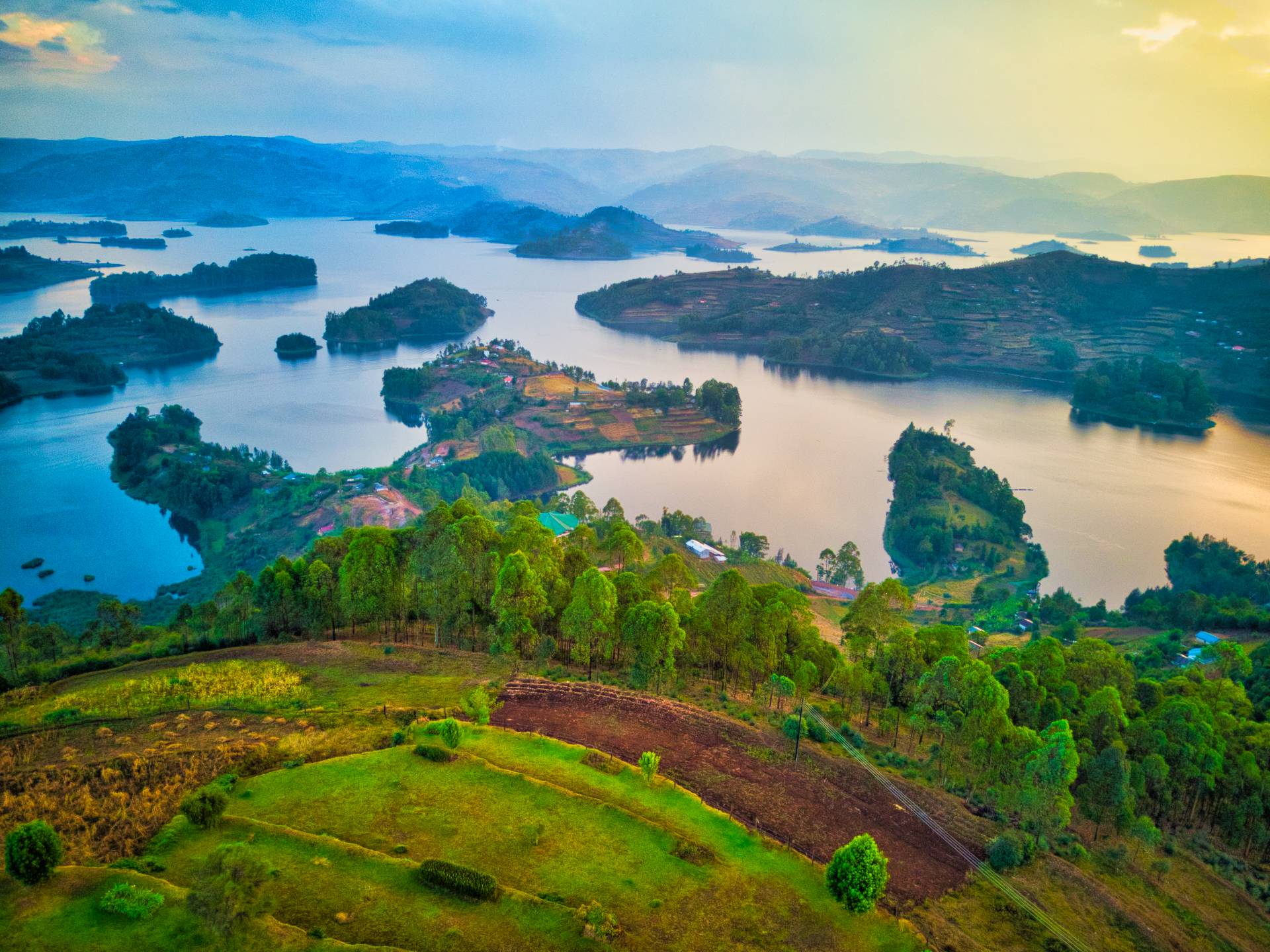
Yes, Lake Bunyonyi is a core feature of a classic 13-day Uganda safari itinerary. Nestled in the Kigezi highlands, Africa’s second-deepest lake provides a tranquil, bilharzia-free sanctuary for relaxation right after demanding mountain gorilla treks in nearby Bwindi Impenetrable National Park. Organised by local ground operator Roads of Adventure Safaris, this 13-day circuit seamlessly integrates Uganda’s top destinations—combining rhino tracking at Ziwa, Murchison Falls, Kibale chimpanzees, Queen Elizabeth’s tree-climbing lions, Bwindi gorillas, Lake Bunyonyi, and Lake Mburo’s savanna game into one complete journey.
12-days-uganda-safari-and-tours-combined-with-zanzibar-beach-vacation
12-days-best-uganda-rwanda-primate-safaris-and-akagera-big-five-safaris
13-days-best-uganda-safari-holiday-vacation-all-inclusive-tour-package
14-days-complete-uganda-safari-tour-and-primate-safari-experience
Why It Fits a 13-Day Route
- Post-Trek Relaxation: A 13-day trip covers a lot of ground—including Murchison Falls, Kibale, and Queen Elizabeth National Park. Travelers use Lake Bunyonyi to unwind after strenuous gorilla or volcano trekking.
- Logical Geography: It sits in southwestern Uganda near Kabale and Kisoro, making it an easy transition either coming from or going to Bwindi or on the way back toward Lake Mburo National Park.
Typical Activities Included
- Dugout Canoeing: Paddling the calm waters to explore the islands.
- Island History Tours: Visiting historical sites like Punishment Island (Akampene).
- Scenic Views: Enjoying the terraced Kigezi highlands, often called the "Switzerland of Africa".
- Safe Swimming: It is one of the few bilharzia-free, hippo-free, and crocodile-free lakes in Uganda
13-Day Classic Uganda Wildlife & Primate Safari
Lake Bunyonyi is a staple highlight of a comprehensive 13-day Uganda safari. Nestled amid the lush Kigezi highlands in southwestern Uganda, this picturesque, island-dotted lake offers the ultimate relaxing stopover after high-altitude gorilla trekking in Bwindi. Handled seamlessly by ground operator Roads of Adventure Safaris, this itinerary integrates white rhino tracking at Ziwa, Murchison Falls, Kibale Forest chimpanzees, Queen Elizabeth savannas, Bwindi gorillas, Lake Bunyonyi, and Lake Mburo zebras into one smooth circuit.
Day 1: Arrival in Entebbe & Airport Transfer
Upon arrival at Entebbe International Airport, you are warmly welcomed by your professional driver-guide from Roads of Adventure Safaris for a short transfer (5 km – 15 km | ~15 to 30 mins) to your hotel, such as Lake Victoria Serena Golf Resort & Spa or Protea Hotel Entebbe (Luxury), The Boma Hotel or 2 Friends Beach Hotel (Mid-range), or Airport Guest House (Budget). After clearing customs and retrieving your luggage, you will receive a comprehensive briefing regarding your upcoming Uganda expedition before spending the rest of the day relaxing near Lake Victoria, organizing your camera gear, enjoying dinner, and getting a good night's rest.
Day 2: Ziwa Rhino Tracking & Murchison Falls
Depart early on a scenic northern drive (~305 km | ~6 to 7 hours) toward Murchison Falls National Park, stopping first at Ziwa Rhino Sanctuary to track wild southern white rhinos on foot with an expert ranger. After lunch nearby, proceed through Masindi to Murchison Falls National Park to witness the Nile River force its massive volume through a narrow seven-meter gorge before checking into your lodge, such as Paraa Safari Lodge or Nile Safari Lodge (Luxury), Pakuba Safari Lodge or Murchison River Lodge (Mid-range), or Red Chilli Rest Camp (Budget) for dinner and overnight.
Day 3: Northern Bank Game Drive & Nile Boat Cruise
Rise at dawn for a game drive across Murchison's northern savanna tracks (~0 km overland transfer) searching for Rothschild giraffes, elephants, lions, buffalos, hartebeests, and leopards before returning to your lodge for breakfast. In the afternoon, embark on a three-hour boat cruise along the Victoria Nile to the base of the falls to observe hippos, Nile crocodiles, and waterbirds, overnighting at Paraa Safari Lodge or Nile Safari Lodge (Luxury), Pakuba Safari Lodge or Murchison River Lodge (Mid-range), or Red Chilli Rest Camp (Budget).
Day 4: Scenic Countryside Transfer to Kibale Forest
Embark on a full-day overland journey (~370 km | ~7 to 8 hours) south to Kibale National Park, driving past the Albertine Rift Valley escarpment, rural villages, and tea plantations with a stop in Fort Portal for lunch and a visit to nearby crater lakes. Continue to your lodge, such as Kyaninga Lodge or Primate Lodge Kibale (Luxury), Turaco Treetops or Chimpanzee Forest Guest House (Mid-range), or Isunga Lodge (Budget) on the edge of the rainforest to prepare for chimpanzee tracking.
Day 5: Chimpanzee Tracking & Bigodi Wetland Sanctuary
Head to Kanyanchu center (~35 km local driving | ~1 hour total) for a safety briefing before tracking wild chimpanzees through Kibale Forest, spending one hour with a habituated family, followed by an afternoon swamp walk through Bigodi Wetland Sanctuary to spot primates and birds like the Great Blue Turaco, returning to Kyaninga Lodge or Primate Lodge Kibale (Luxury), Turaco Treetops or Chimpanzee Forest Guest House (Mid-range), or Isunga Lodge (Budget).
Day 6: Transfer to Queen Elizabeth & Kazinga Channel Boat Cruise
Depart Kibale Forest for Queen Elizabeth National Park (~157 km | ~2.5 to 3 hours), driving past the Rwenzori Mountains and crossing the equator in time for lunch. In the afternoon, enjoy a launch cruise along the 32-kilometer Kazinga Channel to view hippos, crocodiles, and bathing elephants before checking into Mweya Safari Lodge or Kyambura Gorge Lodge (Luxury), Enganzi Game Lodge or Bush Lodge (Mid-range), or Simba Safari Camp (Budget).
Day 7: Kasenyi Savanna Game Drive & Ishasha Sector
Set out at sunrise for an early game drive across the Kasenyi plains (~120 km | ~2 to 3 hours across park sectors) looking for Uganda kobs, lions, and leopards before traveling south to the Ishasha sector to search for famous tree-climbing lions resting in fig trees, staying overnight at Ishasha Wilderness Camp (Luxury), Enjojo Lodge (Mid-range), or Topi Lodge Ishasha (Budget).
Day 8: Scenic Drive to Bwindi Impenetrable Forest
Enjoy a morning game drive in Ishasha before traveling through the terraced Kigezi highlands (~95 km to 130 km | ~3 to 4 hours) to Bwindi Impenetrable National Park, stopping for lunch along the way before checking into your lodge, such as Sanctuary Gorilla Forest Camp or Clouds Mountain Gorilla Lodge (Luxury), Mahogany Springs or Bakiga Lodge (Mid-range), or Buhoma Community Rest Camp (Budget) for a pre-trek briefing.
Day 9: Mountain Gorilla Trekking in Bwindi Forest
Transfer to sector headquarters (~15 to 30 mins local drive) for a ranger briefing before trekking into the rainforest to spend an unforgettable hour observing a family of habituated mountain gorillas, returning to collect your certificate and rest at Sanctuary Gorilla Forest Camp or Clouds Mountain Gorilla Lodge (Luxury), Mahogany Springs or Bakiga Lodge (Mid-range), or Buhoma Community Rest Camp (Budget).
Day 10: Lake Bunyonyi Relaxation & Island Boat Tour
Take a scenic drive through winding mountain roads (~85 km to 110 km | ~2.5 to 3.5 hours) to Lake Bunyonyi for lunch, followed by an afternoon wooden boat cruise to explore Punishment Island (Akampene) and Bushara Island while learning about local history, staying overnight at Birdnest Resort Lake Bunyonyi (Luxury), Bunyonyi Rock Resort or Eco Resort (Mid-range), or Byoona Amagara Island Retreat (Budget).
Day 11: Journey to Lake Mburo National Park
Depart Lake Bunyonyi and drive northeast (~180 km | ~4 to 5 hours) to Lake Mburo National Park, arriving for lunch before heading out on an afternoon game drive or walking safari to view zebras, impalas, and elands, overnighting at Mihingo Lodge or Kigambira Safari Lodge (Luxury), Rwakobo Rock (Mid-range), or Eagle's Nest Camp (Budget).
Day 12: Guided Walking Safari & Lake Mburo Boat Cruise
Begin with a guided morning walking safari alongside an armed ranger (~0 km overland transfer) to get up close to plains game on foot, followed by an afternoon boat cruise on Lake Mburo to see hippos, crocodiles, and African fish eagles, returning for dinner at Mihingo Lodge or Kigambira Safari Lodge (Luxury), Rwakobo Rock (Mid-range), or Eagle's Nest Camp (Budget).
Day 13: Equator Crossing Stopover & Entebbe Departure
Take a final morning game drive as you exit Lake Mburo National Park and drive back toward Entebbe (~240 km | ~4.5 to 5.5 hours), stopping at the Kayabwe Equator marker for lunch, photos, and craft shopping before arriving at Entebbe International Airport for your evening flight home (day rooms available at Airport Guest House or Protea Hotel Entebbe).
Is Lake Bunyonyi part of a typical 13-day Uganda safari itinerary?
Yes, Lake Bunyonyi is a standard inclusion in a classic 13-day Uganda safari itinerary. Positioned in the Kigezi highlands of southwestern Uganda, the lake sits right next to Bwindi Impenetrable National Park. After demanding mountain gorilla treks through dense rainforest, travellers need a peaceful place to rest before embarking on long overland drives back toward Entebbe or east toward Lake Mburo National Park. Lake Bunyonyi serves as the ultimate unwind stop, offering scenery, cool mountain breezes, and calm waters. Including Lake Bunyonyi in a 13-day circuit breaks up the high-intensity trekking schedule with island canoe tours, relaxation, and cultural encounters with local Bakiga communities. Ground operators like Roads of Adventure Safaris consistently feature Lake Bunyonyi to ensure a balanced, comfortable safari experience across Uganda's top highlights.
Why is Lake Bunyonyi strategically positioned on a 13-day safari?
Geographically, Lake Bunyonyi sits just 1 to 2 hours drive from Bwindi Impenetrable Forest sectors such as Rushaga and Nkuringo, and roughly 2.5 hours from Buhoma. In a 13-day Uganda itinerary, travelers traverse a circuit starting in Entebbe, moving north to Murchison Falls, west to Kibale Forest, south to Queen Elizabeth, and into Bwindi. Driving directly from Bwindi to Lake Mburo National Park or Entebbe takes anywhere from 6 to 10 hours on winding mountain roads. Stopping at Lake Bunyonyi breaks this long transit, placing a serene retreat right at the midway point of the southern leg. This geographic placement ensures tourists rest after rigorous hikes before continuing their safari, maximizing comfort without adding unnecessary back-and-forth transit time.
What role does Roads of Adventure Safaris play in organizing this itinerary?
Roads of Adventure Safaris acts as a specialized local ground safari operator based in Kampala, handling all ground logistics for a 13-day Uganda expedition. Organizing a multi-destination safari across remote national parks requires coordination of gorilla and chimpanzee permits, 4x4 safari vehicle transport, park entry fees, and handpicked lodge bookings. Roads of Adventure Safaris designs the routing to ensure optimal driving times, expert driver-guides, and seamless park transitions. By managing logistics directly, they ensure gorilla trekking permits in Bwindi sync perfectly with rest days at Lake Bunyonyi and boat cruises along Murchison Falls or the Kazinga Channel. Their local expertise helps travelers navigate regional border corridors, seasonal road conditions, and customized accommodation preferences across luxury, mid-range, or budget tiers.
How many days are usually spent at Lake Bunyonyi on a 13-day safari?
On a standard 13-day Uganda safari, 1 to 2 nights are dedicated specifically to Lake Bunyonyi. Usually, travelers arrive at the lake in the late morning or early afternoon on Day 10, right after completing their gorilla trek in Bwindi on Day 9 or early Day 10. Spending one full afternoon and overnight—or two nights—gives guests sufficient time to unwind without cutting into time needed for other major parks like Murchison Falls, Kibale, Queen Elizabeth, or Lake Mburo. During this window, travelers enjoy a boat trip to explore the historic islands, relax at their lakeside resort, kayak, or go birdwatching. The timing provides a restful interlude before embarking on the journey toward Lake Mburo and Entebbe.
Is Lake Bunyonyi safe for swimming during a safari stop?
Lake Bunyonyi is widely recognized as one of the very few lakes in East Africa that is completely safe for swimming. Unlike Lake Victoria, Lake Edward, or the Nile River, Lake Bunyonyi is free from bilharzia (schistosomiasis), a parasite common in still freshwater bodies across Africa. Furthermore, the lake contains no dangerous wildlife such as hippos, Nile crocodiles, or carrier snails. Its clear, cool waters make it an inviting spot for tourists looking to take a dip after dusty game drives and humid jungle treks. However, due to its extreme depth—reaching up to 900 meters, making it Africa's second-deepest lake—swimmers are advised to wear life jackets and stay close to designated resort swimming platforms or dock areas.
What makes Lake Bunyonyi visually unique compared to other Ugandan lakes?
Lake Bunyonyi is famous for its landscape, often dubbed the "Switzerland of Africa." It features 29 distinct islands scattered across a body of water framed by steep, terraced green hills. The contrast between the blue water, lush foliage, and terraced Bakiga farmlands creates a picturesque environment unlike the flat savannas of Queen Elizabeth or Murchison Falls. Early mornings at Lake Bunyonyi often bring a blanket of mist hanging low over the islands, creating an ethereal setting as local dugout canoes cut through the water. This combination of high-altitude topography, terraced agriculture, quiet island channels, and cooler temperatures makes Lake Bunyonyi a distinct scenic highlight on any 13-day Ugandan itinerary.
How does gorilla trekking in Bwindi connect directly to a Lake Bunyonyi stay?
Gorilla trekking in Bwindi Impenetrable National Park is physically demanding, involving hours of hiking through thick vegetation, mud, and steep mountain slopes at high altitudes. Once the trek ends on Day 9, travelers are often physically exhausted. Lake Bunyonyi lies just a short, scenic drive from Bwindi's southern and eastern sectors (Rushaga, Nkuringo, and Ruhija). Transferring straight to Lake Bunyonyi allows tourists to transition immediately from intense physical activity to total relaxation. Guests can check into a lakefront lodge, soak in hot showers, enjoy massages, swim, and appreciate the views without the burden of an immediate 8-hour drive back toward central Uganda, making it a natural functional partner to Bwindi.
What key activities can travelers do on Lake Bunyonyi?
Despite its peaceful reputation, Lake Bunyonyi offers several engaging activities for active travelers. The most popular activity is a motorized boat cruise or traditional dugout canoe tour to explore the 29 islands while learning about local folklore. Adventure seekers can try double kayaking, paddleboarding, or swimming in the bilharzia-free water. On land, guided nature walks along the terraced rim offer birdwatching opportunities—Bunyonyi means "place of many little birds"—and panoramic views of the lake. Visitors can also take cultural community tours to meet the local Bakiga people or Batwa pygmies, visit local schools, or hike up to high viewpoints like Arcadia Cottages for sunset photography over the islands.
What is the historical significance of Punishment Island (Akampene)?
Punishment Island, locally known as Akampene, is one of the most famous islands on Lake Bunyonyi due to its dark history. Until the mid-20th century, the local Bakiga people practiced a custom where unmarried girls who became pregnant were taken to this tiny, isolated island and abandoned to starve to death or drown attempting to swim back. The practice was designed to deter premarital sex and uphold family honor. Poor men who could not afford the required bride price for a traditional marriage would sometimes row out to the island to rescue abandoned girls and marry them without paying a dowry. Today, the tiny island is reduced to a few reeds and a single tree, serving as a poignant historical stop during island boat tours.
What bird species can birdwatchers spot around Lake Bunyonyi?
The name "Bunyonyi" translates to "place of many little birds" in the local Rukiga language, reflecting the area's rich avian population. Over 200 species of resident and migratory birds inhabit the lake’s shoreline, papyrus swamps, and forested islands. Birdwatchers on a 13-day safari can easily spot iconic species such as the grey crowned crane (Uganda's national bird), pied kingfishers, malachite kingfishers, African fish eagles, cormorants, weaver birds, and bronze sunbirds. The quiet water channels make canoe birding trips particularly rewarding, allowing enthusiasts to glide silently near papyrus beds to photograph waterbirds up close without engine noise.
What overall route does a 13-day Uganda safari follow?
A classic 13-day Uganda safari follows a western safari loop designed to minimize backtrack driving. Starting at Entebbe or Kampala, the route travels north to Ziwa Rhino Sanctuary and Murchison Falls National Park. From Murchison, it heads south along the Albertine Rift Valley to Kibale Forest National Park, then continues south to Queen Elizabeth National Park. The journey proceeds further south through the Ishasha sector into Bwindi Impenetrable National Park, followed by a short transfer east to Lake Bunyonyi. Leaving Bunyonyi, the circuit heads northeast to Lake Mburo National Park before crossing the equator and returning to Entebbe International Airport for departure.
What happens upon arrival in Entebbe?
On Day 1, guests land at Entebbe International Airport on the shores of Lake Victoria. Your professional driver-guide from Roads of Adventure Safaris greets you at the arrivals terminal and assists with luggage before providing a preliminary safari briefing. Depending on flight arrival times, guests transfer to their hotel in Entebbe or Kampala (15 to 30 minutes drive). The rest of the day is kept open for rest after long-haul travel. Guests can adjust to the time zone, explore the Entebbe Botanical Gardens, walk along the Lake Victoria beaches, or prepare equipment for early departure the next morning.
How is Ziwa Rhino Sanctuary incorporated en route to Murchison Falls?
Day 2 begins with an early morning departure heading north from Kampala/Entebbe toward Murchison Falls National Park (~305 km | 6-7 hours). En route, the safari stops at Ziwa Rhino Sanctuary in Nakasongola District, the only location in Uganda where wild southern white rhinos are protected. Here, guests join an armed ranger for a 1.5-hour foot-tracking exercise to observe these massive mammals at close range in savanna woodlands. After a relaxed lunch near the sanctuary, the drive continues to Murchison Falls, concluding with a visit to the top of the falls where the Nile River explodes through a narrow 7-meter gorge before guests check into their lodge.
What are the highlights of exploring Murchison Falls National Park?
Day 3 is dedicated to exploring Uganda’s largest national park. At dawn, guests embark on a 3- to 4-hour morning game drive across the northern savanna tracks, searching for Rothschild giraffes, elephants, lions, cape buffalos, Jackson’s hartebeests, and leopards. In the afternoon, guests board a 3-hour boat cruise along the Victoria Nile heading toward the base of Murchison Falls. The riverbanks host huge pods of hippos, Nile crocodiles, and drinking game herds. Pausing near the base of the rushing waterfall, guests enjoy prime photo opportunities before returning to their lodge for dinner and evening relaxation.
What can travelers expect during the transfer to Kibale Forest?
Day 4 involves a long, scenic overland transfer (~370 km | 7-8 hours) heading south from Murchison Falls to Kibale National Park. Traveling along the Albertine Rift Valley escarpment, guests pass rural agrarian villages, traditional homesteads, and terraced hillsides. The route stops in Fort Portal town, located beneath the Rwenzori Mountains, for a hot local lunch. Afterward, guests explore the surrounding crater lakes region—a volcanic landscape dotted with emerald lakes and tea plantations—before completing the short drive to Kibale Forest to check in and rest before the next day's chimpanzee tracking.
How is chimpanzee tracking conducted in Kibale Forest?
Day 5 centers on primate tracking in Kibale Forest, home to 13 primate species. The morning begins at Kanyanchu Visitor Center with a safety briefing by Uganda Wildlife Authority rangers. Guided by expert trackers, guests venture into the rainforest canopy, listening for pant-hoots to locate wild chimpanzees. Once found, guests spend one full hour watching them feed, groom, play, and swing through the trees. After lunch, the day continues with a community swamp walk through Bigodi Wetland Sanctuary, a eco-tourism site managed by locals that harbors red colobus monkeys, grey-cheeked mangabeys, and over 200 bird species.
What wildlife experiences await in Queen Elizabeth National Park?
Day 6 takes guests south from Kibale to Queen Elizabeth National Park (~157 km | 2.5-3 hours), driving along the foot of the Rwenzori Mountains and crossing the equator. After checking into the lodge for lunch, travelers head out for an afternoon boat safari along the 32-kilometer Kazinga Channel, which connects Lake George and Lake Edward. This waterway features one of Africa's highest concentrations of hippos, along with Nile crocodiles, herds of bathing elephants, water buffalos, and thousands of resident and migratory waterbirds resting along the mudbanks.
What makes the Ishasha sector's tree-climbing lions special?
Day 7 begins with an early morning game drive across the Kasenyi plains in northern Queen Elizabeth National Park to look for lions, leopards, Uganda kobs, and hyenas. Afterward, the itinerary heads south (~120 km | 2-3 hours) into the park's remote Ishasha sector. Ishasha is famous for its resident tree-climbing lions, a rare behavior found in only a few places in Africa. Guests spend the afternoon searching the sprawling branches of large fig and acacia trees, where these big cats rest to escape the midday ground heat and biting insects.
What is the journey like into Bwindi Impenetrable Forest?
Day 8 transitions the safari from open savanna to mountain rainforest as guests depart Ishasha for Bwindi Impenetrable National Park (~95-130 km | 3-4 hours). The drive passes through the terraced Kigezi highlands, offering views of rural farms, mist-covered valleys, and mountain ridges. After stopping for lunch en route, travelers reach their designated sector of Bwindi (Buhoma, Ruhija, Rushaga, or Nkuringo) in the afternoon. Crisp mountain air and dense jungle canopy mark the environment as guests check into their rainforest lodge, organize gear, and attend an orientation before gorilla trekking day.
What is the mountain gorilla trekking experience like in Bwindi?
Day 9 is the primary highlight of the 13-day itinerary. Rising early, guests gather at park headquarters for a ranger briefing before being assigned to a habituated gorilla family. Accompanied by trackers and armed rangers, guests trek through steep, dense rainforest terrain for 2 to 6 hours depending on where the gorillas nested. Upon finding the family, guests spend one hour standing meters away from the gentle giants, watching silverbacks, females, and juveniles interact. After returning to the trailhead to receive trek certificates, guests head back to their lodge to rest and shower.
How does the transition to Lake Bunyonyi unfold?
Day 10 offers a change of pace as guests take a morning drive (~85-110 km | 2.5-3.5 hours) from Bwindi to Lake Bunyonyi. Arriving around mid-day, guests check into their resort overlooking the water for lunch. In the afternoon, they board a motorized boat or wooden canoe to tour key islands like Punishment Island and Bushara Island while learning about local folklore from community guides. The late afternoon is left open for swimming, kayaking, or enjoying the sunset over the terraced hills, providing physical recovery after gorilla trekking.
What occurs during the transfer to Lake Mburo National Park?
Day 11 carries travelers from the quiet highlands of Lake Bunyonyi northeast toward Lake Mburo National Park (~180 km | 4-5 hours). Arriving at the lodge in time for lunch, guests enter a park dominated by acacia woodlands, open savanna, and wetland lakes. Lake Mburo is distinct from western parks as it hosts species not found elsewhere on the circuit, such as large herds of impala and Burchell's zebras, alongside elands and topis. In the late afternoon, guests embark on a game drive or sunset walking safari to observe plains game.
Why is a walking safari unique in Lake Mburo National Park?
Day 12 starts with a guided walking safari led by an armed park ranger—a rare opportunity in Ugandan national parks. Because Lake Mburo lacks large populations of lions, guests can safely trek across open savanna to observe zebras, impalas, elands, and buffalos up close on foot. After breakfast and afternoon rest at the lodge, guests take a 2-hour boat cruise on Lake Mburo to spot hippos, crocodiles, and waterbirds such as the African fish eagle and elusive shoebill stork, followed by a night game drive to look for leopards and bushbabies.
How does the 13-day safari conclude en route to Entebbe?
Day 13 marks the final leg of the journey (~240 km | 4.5-5.5 hours) from Lake Mburo back to Entebbe International Airport. After a morning game drive as guests exit the park, the vehicle travels along the Mbarara-Masaka highway. The safari stops at the Kayabwe Equator line marker for photos, souvenirs, and a water demonstration illustrating the Coriolis effect in both hemispheres. Following lunch, the drive continues to Entebbe, arriving in the late afternoon for outbound evening flights, bringing the 13-day expedition organized by Roads of Adventure Safaris to a close.
What accommodation tiers are available across this 13-day itinerary?
A 13-day Uganda safari can be tailored across Luxury, Mid-range, and Budget accommodation tiers. Luxury options feature top-end safari lodges such as Nile Safari Lodge in Murchison, Kyaninga Lodge in Kibale, Mweya Safari Lodge in Queen Elizabeth, Sanctuary Gorilla Forest Camp in Bwindi, Birdnest Resort at Lake Bunyonyi, and Mihingo Lodge in Lake Mburo. Mid-range choices include properties like Pakuba Safari Lodge, Turaco Treetops, Bush Lodge, Mahogany Springs, and Rwakobo Rock, which offer private cottages and solid amenities. Budget safaris utilize clean, comfortable camps like Red Chilli Rest Camp, Isunga Lodge, Simba Safari Camp, and Eagle's Nest Camp.
What type of safari vehicle is best for a 13-day Uganda itinerary?
A 4x4 Toyota Land Cruiser with a pop-up roof is the ideal vehicle for a 13-day Uganda safari. Uganda's national park circuits involve long distances over varied terrain, including tarmac highways, gravel roads, rutted savanna tracks, and steep mountain passes around Bwindi and Lake Bunyonyi. A 4x4 Land Cruiser offers high ground clearance, four-wheel-drive capability in muddy conditions, individual window seats, charging ports for camera equipment, an onboard fridge for drinks, and a pop-up roof that opens for 360-degree game viewing and photography during drives.
What permits are required for this 13-day itinerary and how are they secured?
The two major permits required for this 13-day safari are the Gorilla Trekking Permit for Bwindi Impenetrable National Park and the Chimpanzee Tracking Permit for Kibale Forest National Park. As of recent rates, mountain gorilla permits cost $800 USD per person for foreign non-residents, while chimpanzee permits in Kibale cost $250 USD per person. Because demand is high and daily permit numbers per gorilla family are strictly capped, these permits must be booked months in advance through the Uganda Wildlife Authority (UWA) via a licensed local operator like Roads of Adventure Safaris.
What is the best time of year to undertake a 13-day Uganda safari?
The best time for a 13-day Uganda safari is during the dry seasons: June to September and December to February. During these months, trails in Bwindi and Kibale are drier and less slippery, making gorilla and chimpanzee trekking easier. Savanna grasses in Murchison Falls, Queen Elizabeth, and Lake Mburo are shorter, making wildlife easier to spot as animals gather around water holes. However, Uganda is a year-round destination; traveling during the wet seasons (March–May and October–November) offers lower lodge rates, fewer crowds, and green scenery, though rain can make mountain roads slippery.
Is a 13-day itinerary suitable for families or older travelers?
A 13-day itinerary is suitable for active families and older travelers, provided they possess reasonable physical mobility for the trekking days. The inclusion of rest stops like Lake Bunyonyi and boat cruises in Murchison Falls, Kazinga Channel, and Lake Mburo balances the physical demands of gorilla and chimpanzee tracking. Note that Uganda Wildlife Authority rules set a strict minimum age limit of 15 years for gorilla and chimpanzee trekking. Operators like Roads of Adventure Safaris can adjust the pace, select accessible lodge options, and arrange porter support during forest hikes to accommodate mature guests.
How does Lake Bunyonyi enhance the overall value of a 13-day Uganda safari?
Lake Bunyonyi enhances a 13-day Uganda safari by providing scenic variety and a relaxed pace. Uganda safaris can be fast-paced, involving early morning wake-up calls, long drives, and intense jungle hikes. Without a dedicated rest stop, travelers risk fatigue toward the end of their trip. Lake Bunyonyi introduces a tranquil water-and-mountain environment between Bwindi's jungle and Mburo's savannas. It allows guests to absorb their gorilla trekking experience, engage with local culture, photograph island scenery, and recharge, ensuring they complete their 13-day journey refreshed rather than exhausted.
Booking 13 Days Uganda safari with us Roads of Adventure safaris
Booking your 13-day Uganda safari with Roads of Adventure promises an incredible trip through the "Pearl of Africa." You will get to experience unforgettable moments like looking into the eyes of a giant mountain gorilla, tracking playful chimpanzees, and watching the powerful River Nile squeeze through a tiny rock gap at Murchison Falls National Park.
