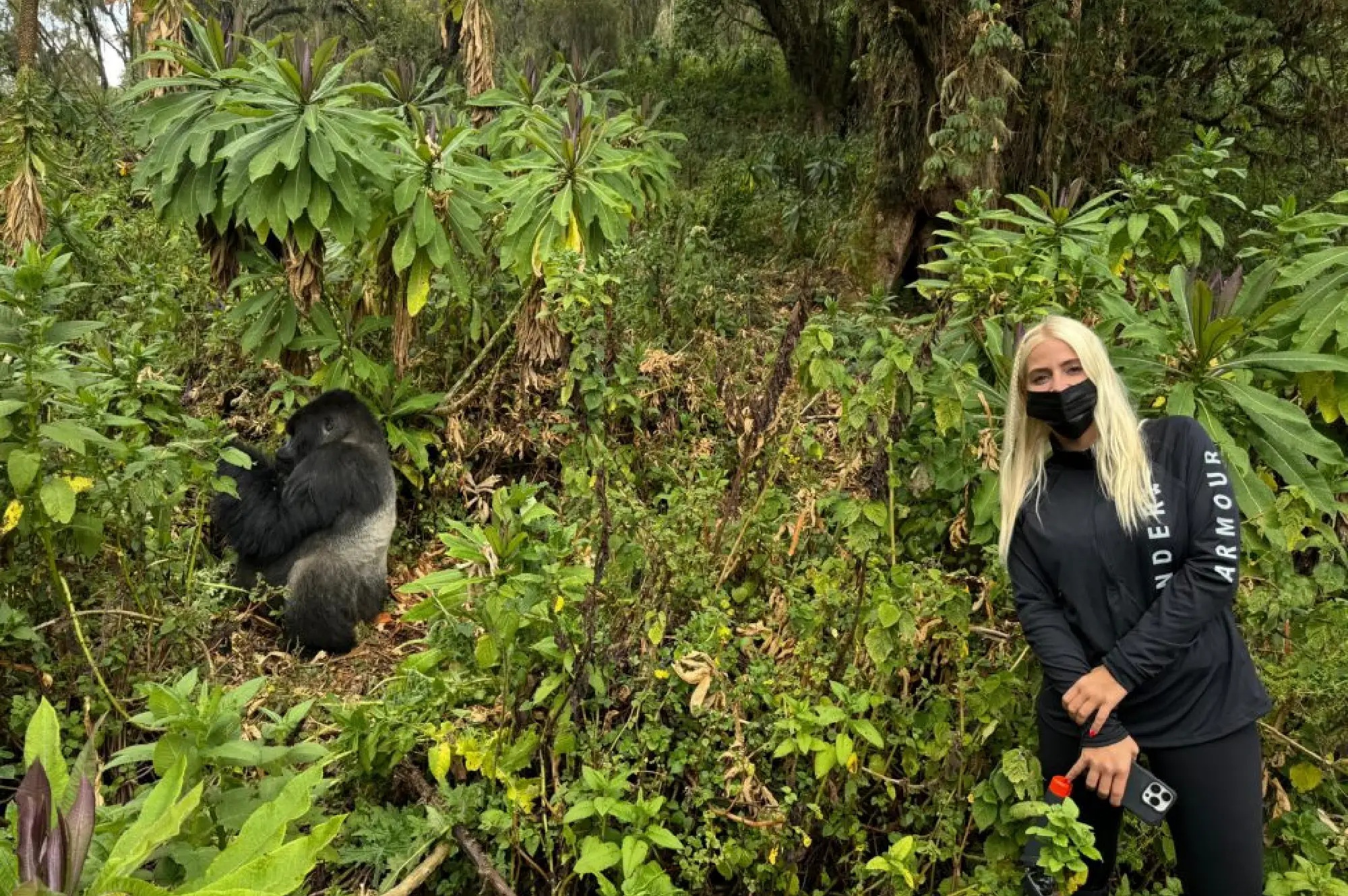
Filming mountain gorillas in Rwanda’s Volcanoes National Park requires a specialized permit costing approximately USD 5,000, in addition to standard trekking permits ($1,500 per person). A refundable security deposit of USD 2,000 is required upon submitting filming copies to the Rwanda Development Board (RDB).
21-days-rwanda-primate-safari-culture-history-and-wildlife-holiday
16-days-exclusive-rwanda-safari-tour-and-gorilla-trekking-tour-package
10-days-rwanda-photography-safari-and-gorilla-trekking-adventure
9-days-rwanda-gorilla-trekking-and-adventure-activities-and-relaxation
8-days-best-of-rwanda-uganda-safari-volcanoes-to-best-uganda-safari-parks
6-days-5-nights-rwanda-midrange-itinerary-nyungwe-volcanoes
Do I need a special permit to film in Volcanoes National Park?
Yes — any professional filming in Volcanoes National Park requires formal authorization from the Rwanda Development Board (RDB). For documentary and commercial shoots this involves obtaining a filming permit (commonly referred to as an RDB filming licence) and meeting the park’s specific conditions for working around wildlife, particularly mountain gorillas. For gorilla-focused projects, the RDB typically distinguishes between standard visitor permits and the higher-level permissions required for professional filming. In practice, production teams should budget for the RDB’s filming fee (the commonly cited industry rate for official documentary/commercial filming has been around $5,000, though this can change), and they will also need to secure all required gorilla permits for access to habituated families. Because each gorilla group visit is limited to a maximum of eight people, production crews that need exclusive filming time often secure all available visitor slots for that trek (eight permits at the published gorilla-permit price). RDB may also require additional documentation such as a detailed shooting plan, equipment list, insurance certificates, proof of health/vaccinations for team members, and environmental mitigation measures. Payment, approval timelines, and any refundable deposits must be confirmed directly with RDB well in advance; documentary shoots commonly begin permit applications many months prior to travel. Finally, the park and RDB will insist on strict adherence to gorilla‑safety protocols during filming (no flash, distance rules, mask use, time limits), and reserve the right to withdraw permission if wildlife welfare is compromised. Always contact RDB and park management early; working through a local production fixer or licensed tour operator experienced with RDB procedures is highly recommended to navigate approvals smoothly.
How much does it cost to film gorillas in Rwanda?
Filming mountain gorillas in Volcanoes National Park is expensive because of layered official fees and operational costs. Production budgets should account for: (a) the RDB filming permit fee — the industry-standard fee for professional documentary/commercial filming has been reported at approximately $5,000, though RDB sets exact rates and they can vary by project type and licensing terms; (b) gorilla permits — since only eight visitors may join a gorilla‑family visit and crews usually secure all eight slots to film exclusively, you must buy eight gorilla permits at the prevailing rate (in Rwanda, a standard gorilla permit has commonly been $1,500 per person), which totals around $12,000; (c) a refundable or conditional deposit — some producers report an additional refundable requirement (for example, a $2,000 refundable deposit tied to submission of a copy of the final film and evidence of compliance with conditions), though the exact amount and conditions must be confirmed with RDB; (d) press accreditation and temporary equipment clearances (small administrative fees apply — see below); and (e) operational ground costs such as local production staff, fixers, permits for drones or additional aerial work (if authorized), porters, vehicle hire, high-end lodge rates for remote locations, security, insurance, and contingency for weather-impacted reshoots. Taken together, official permit-related line items alone can exceed $19,000 (RDB filming fee + eight gorilla permits + refundable deposit), and total shoot costs for even a short, single-day gorilla session can commonly run considerably higher after local logistics, crew travel, equipment insurance, and accommodation are added. Because policy and rates can change, confirm all RDB and park fees with official RDB contacts and secure written approvals and invoices before booking. Working with an experienced local production company or a specialist safari operator who regularly handles media shoots will give you more accurate current pricing and help avoid costly surprises.
Are there fees for foreign media equipment?
Yes. Bringing professional media equipment into Rwanda for filming typically requires clearance from the Rwanda Development Board (RDB) and customs. Production teams should expect to submit a detailed equipment manifest in advance to facilitate temporary import permits and avoid customs delays. RDB or Rwanda’s customs authority may require a temporary importation clearance (often under a carnet or a temporary admission procedure), and individual items such as high-value cameras, lenses, sound gear, and lighting may be listed. While many temporary import schemes do not levy a direct fee if the equipment is re-exported within the allowed timeframe, administrations commonly impose administrative charges and may ask for a refundable deposit or bank guarantee equivalent to a percentage of the gear’s value. For press or broadcast crews, there is typically a requirement to obtain press accreditation or media accreditation; fees for that process vary (commonly a modest amount to several hundred dollars depending on duration and scope). If equipment needs to clear customs at Kigali International Airport, producers should work with a local customs broker or production fixer who can liaise with customs to ensure smooth processing and to address any charges or paperwork requirements. For drone equipment, even when the RDB grants filming authorization, separate clearances from the Rwanda Civil Aviation Authority (RCAA) are mandatory and may come with their own fees and conditions. To minimize risk, prepare a full list of gear, serial numbers, and values; carry proof of ownership; coordinate arrival and clearance windows with RDB and customs; and consider insuring the equipment for transit and local operation. Engaging a local production company experienced with RDB and customs procedures will usually save time and cost.
How many people can join a filming crew?
Rwanda’s Volcanoes National Park enforces strict limits on the number of people allowed to encounter a habituated gorilla family: a maximum of eight visitors per gorilla-family visit. That rule is applied uniformly to tourists and media crews. For production teams needing exclusive or close-up access, the practical implication is that you must secure all eight visitor slots for that trek if you require an uninterrupted filming session with the group. This means the filming crew size physically present during the gorilla encounter is effectively limited to eight people total — which should include any director, camera operator(s), sound operator, producer, and necessary support staff counted as visitors. Note that park rangers and authorized guides accompany each group in addition to the eight visitors; these park staff do not count toward the visitor limit but will be present and will set safety and welfare conditions. Any additional production personnel (assistants, makeup, additional camera operators) who are not part of the eight-person visitor complement would need to remain at the park staging area and cannot enter the gorilla zone. For multi-day shoots, productions often rotate crew members across different tracking days to get the coverage needed while remaining compliant with the eight-person cap. If you anticipate larger numbers of technical staff, equipment porters, or a wider crew footprint, plan to employ porters and local support personnel at the park entrance and base camps rather than during the direct gorilla encounter. Always confirm the composition of your crew with RDB and the park ahead of time, as the park may request names and identification for the eight nominated visitors, and RDB/park staff will expect to see only those people at the trek briefing and in the forest. Working with a local production fixer or licensed safari operator is the usual approach to coordinating crew logistics within the visitor constraints.
How long is the allowed time for filming gorillas?
Time allowed with habituated mountain gorillas in Volcanoes National Park is strictly limited by park regulation: once the gorilla group is located, visitors — including filmmakers — are permitted to spend a single hour (60 minutes) in the presence of the gorillas. This one‑hour rule applies to all visitor groups and is intended to minimize stress on the animals and reduce disease transmission risk. For productions, it means you must plan very carefully to maximize shooting efficiency within that constrained window. Pre‑planning steps that improve productivity during the hour include: (a) detailed shot lists and priority sequences so the most important coverage is captured first; (b) clearly assigned roles to each crew member (operator, sound, second camera, director), plus brief silent hand signals for communication; (c) using lightweight, long‑reach lenses to avoid moving forward and disturbing animals; (d) avoiding use of extraneous gear that could impede movement; and (e) rehearsing equipment set-up and takedown procedures with the crew beforehand. The park’s ranger guide will direct where visitors stand, when to move, and will enforce the 7‑meter/6‑meter distance rules and no‑flash policy; crews must follow these instructions strictly. If your production requires extra filming time with the same family, the usual approach is to book multiple full sets of permits on successive days (subject to availability and RDB approval). However, the one‑hour-per‑visit limit remains in effect for each encounter. Additionally, some productions negotiate private sessions (by booking the full eight-person complement) to reduce interference from other visitors, but these private sessions still adhere to the one-hour exposure rule. Confirm scheduling and any special arrangements with RDB and park authorities well before travel.
Can I use drones for filming?
Drones are tightly controlled and generally prohibited in Volcanoes National Park without explicit, high‑level authorization. Rwanda’s Civil Aviation Authority (RCAA) governs unmanned aerial vehicle operations, and the Rwanda Development Board (RDB) and park management also impose strict rules concerning wildlife disturbance, biosecurity, and visitor safety. For drone usage over the park you will likely need: (a) RCAA permits for aerial operations, including proof of operator competency and insurance; (b) explicit RDB permission for filming in the park that includes approval for aerial capture; and (c) coordination with park rangers regarding approved flight paths, altitudes, times, and safety measures to avoid disturbing wildlife (especially gorillas) or visitors. In practice, park authorities are extremely cautious about drones near habituated gorillas because of the potential for stress, noise, and disease transmission, and approvals are rarely granted for drones flying near primates. If a drone is essential to your shoot, prepare a compelling risk mitigation plan, certify that the operator holds recognized drone‑pilot qualifications, provide proof of comprehensive liability insurance, and offer detailed flight plans that avoid gorilla territories and visitor areas. Even with approvals, operations may be limited to high-altitude B‑roll (landscape shots) away from the gorilla groups and outside sensitive periods (e.g., breeding or habituation activities). Note that uncontrolled or unauthorized drone flights can result in equipment seizure, fines, or revocation of filming privileges. Given the complexity and the likelihood of refusal for close‑range aerials, many productions opt for helicopter/aerial work conducted by licensed operators coordinated through RDB and park management, or they schedule drone flights only outside core park zones where RDB permits allow it.
When is the best time for filming gorillas in Volcanoes National Park?
The optimal time to film gorillas in Volcanoes National Park is during the drier months, when access is easier, forest trails are less muddy, and visibility is generally better. In Rwanda the dry season tends to fall into two main windows: the long dry season from June through September and the shorter dry window in December to February. During these months social groups of mountain gorillas are more likely to be accessible by foot without excessive slogging through mud, and camera crews benefit from improved mobility and slightly higher chances of daytime light penetrating the canopy for usable natural illumination. That said, gorilla behavior is not strictly seasonal — opportunities for meaningful footage exist year‑round. However, filming in the wet seasons (March–May and October–November) brings logistical challenges: soggy trails, thicker vegetation, lower light, and higher risk of weather-related delays. If your creative brief requires vivid forest floor detail, flowing streams, or lush green foliage, the shoulder wet months may be desirable despite the access drawbacks. For scheduling, factor in tourist season peaks — June–September and December–February are high demand for permits and accommodations, so secure permits months in advance. For wildlife behavior, note that infant births can occur outside fixed windows; to capture certain behaviors (e.g., infant play, juvenile interaction), consult rangers or researchers who know the habituated groups’ recent histories. Always plan for flexible shooting days around tracking outcomes since trekking time to find gorillas can vary dramatically. Finally, align your shoot with lodge availability and local support (fixers, porters). In short: prioritize the dry season for logistical ease and better light, but don’t dismiss other months if your story requires lush, dynamic foliage — just budget additional time and contingency.
Is it possible to film during the rainy season?
Yes, filming during the rainy season is possible, but it presents several operational and creative challenges that require specific planning and additional resources. The rainy seasons in the Volcanoes region (typically March–May and October–November) mean trails become muddy and slippery, making access by foot slower and more physically demanding; the time to reach habituated gorilla groups can be longer and less predictable. Heavy canopy reduces natural light, necessitating faster lenses, higher-ISO-capable cameras, and solid low-light stabilization (tripods, monopods, gimbals), though extra lighting is usually impractical in gorilla country because of animal welfare and park rules. Equipment protection is critical: pack rugged waterproof cases for transit, rain covers for cameras and microphones, and silica packets; use weather-sealed camera bodies and lenses where possible; and bring multiple spare batteries (cold and wet conditions drain power faster). Logistically, plan for more ground support — extra porters, covered transport, and flexible accommodation windows. The wet season does have creative advantages: dramatic mist and saturated greens can create striking visuals, water features are more active, and some wildlife behavior (e.g., feeding on fresh shoots) can be seasonally prominent. However, increased humidity raises risks of lens fogging and fungal growth; ensure dry storage and regular gear maintenance. Health and safety considerations are heightened: slippery terrain increases injury risk, and the park may impose stricter movement controls during heavy rain. Permits and park access can still be granted in the wet season, but travel delays are common; build time buffers and contingency days into your schedule. Ultimately, accept that wet-season shoots often require higher operational budgets and greater flexibility, but they can yield uniquely atmospheric footage if you plan carefully.
What equipment is required for gorilla filming?
Filming mountain gorillas requires a strategic gear list focused on mobility, low-light performance, and minimal disturbance. Because crews have only one hour with the gorillas and are limited to eight people per visit, equipment must be lean, reliable, and protected from forest conditions. Key kit includes: (a) camera bodies — 1–2 professional, weather‑sealed cinema or hybrid mirrorless/DSLR cameras with good high‑ISO capability for low-light forest conditions; (b) lenses — a selection that balances reach and portability: a long telephoto (e.g., 100–400mm or 200–600mm) for close-ups from safe distance, a fast medium telephoto (70–200mm f/2.8) for portrait work, and a wide-to-standard zoom (24–70mm) for contextual shots; primes can help in very low light; (c) stabilization — a lightweight monopod is often more practical than a tripod on muddy slopes; a compact gimbal can help for approach shots but may be cumbersome in dense forest; (d) audio — a shotgun mic with a deadcat and a small recorder or wireless lavaliers (used cautiously) for interview material at base camps; on-gorilla audio is not possible and animal welfare prohibits intrusive mics; (e) power — multiple batteries per camera, fast chargers, and power banks; consider a small portable power station for base camps; (f) protection — rain covers, weatherproof camera bags or Pelican cases, lens cleaning kits, and silica desiccants; (g) support accessories — extra memory cards, lens hoods, neutral-density filters for bright breaks, and a compact cleaning kit; (h) lighting — minimal artificial light; onboard and available if needed for interviews in lodges but not for field use around gorillas; (i) health/safety — face masks, disinfectant, and gloves per park health policy; (j) transport gear — a lightweight dolly/shoulder rigs for lodge shoots and collapsible trolleys for porters. For aerials, authorized helicopter operators may be used; drone use is generally restricted. Finally, work with local porters to move heavy gear to the park entrance; keep gorilla encounters as low-impact as possible and follow RDB and park guidance when selecting kit.
What is the minimum age for filming in the park?
The minimum age to participate in gorilla trekking — and therefore to be present during gorilla filming sessions — in Volcanoes National Park is generally 15 years. This age restriction is enforced for visitor safety and wildlife welfare reasons, as trekking can be physically demanding and close contact with humans presents health risks to gorillas. For film productions, this rule means any crew member who intends to be in the forest during the gorilla encounter must meet the minimum‑age requirement and be listed on permit paperwork. If your production includes younger participants (e.g., student filmmakers or family members), they can participate in other aspects of the shoot (interviews, lodge-based coverage, B‑roll) but cannot be among the eight visitors during the gorilla encounter unless they meet the age requirement and any other health conditions stipulated by RDB. In addition to age, park authorities often require that visitors be in good health, have up-to-date vaccinations (including, in past protocols, proof of measles, tetanus, and COVID‑19 vaccination as applicable), and disclose any recent illnesses to reduce disease transmission risk to gorillas. Always confirm the precise age and health requirements with RDB and the park prior to travel since policies are occasionally updated. If minors are essential to your creative concept, plan alternative filming approaches: staged segments away from the gorillas, use of stand-ins aged 15 or older, or secure footage via local crews who meet park criteria.
How do I clear equipment with customs?
Clearing production equipment through Kigali International Airport customs requires preparation and local coordination to avoid costly delays. Best practice is to work with a local production fixer, customs broker, or experienced tour operator who can liaise with RDB and Rwanda Revenue Authority (customs) in advance. Key steps include: (a) prepare a detailed equipment manifest listing every item (make, model, serial number, declared value); (b) obtain or prepare a temporary import carnet (ATA Carnet) if available for your country — this is often the easiest method for temporary import of professional gear; (c) provide proof of return shipping or re-export plans and expected dates; (d) supply any letters of invitation or filming permits issued by RDB and confirmation of bookings or local production contracts; (e) have insurance documents and proof of ownership; (f) if a carnet is not used, be prepared to provide a bank deposit or guarantee covering possible customs duties, which may be refunded on re-export; (g) declare drone equipment, batteries, and high-value items separately, as Rwanda has strict rules on certain gear; (h) schedule arrival windows and meet-and-greet services so a local representative can handle clearance on arrival. Anticipate that customs may request inspection of cases and luggage; remain cooperative and provide documentation. On arrival, avoid moving equipment through the airport without official clearance; doing so can trigger fines. Finally, factor customs clearance time into your arrival schedule and allow buffer days before key shoots. Using a local production company experienced with RDB and customs is the most reliable way to ensure smooth equipment clearance.
Can I use flashlight for photography?
No. Flash photography is prohibited when observing or filming mountain gorillas in Volcanoes National Park. The park’s rules forbid flashes because sudden bright light can startle, stress, or provoke defensive behavior in gorillas. For film and photo crews, this means you must rely on natural light and fast lenses or high-ISO camera settings for low-light forest conditions. Use of continuous LED lighting aimed at gorillas is likewise discouraged and typically not allowed in-forest because it can disturb animals and alter their behavior. For interviews and staged sequences at lodges or in controlled settings, low-impact lighting setups are permissible but must be discussed with park authorities and lodge management and must not be taken into the gorilla encounter. To cope with low light in the forest while respecting the prohibition on flash, prioritize the following: bring fast lenses (wide apertures), cameras with excellent high-ISO performance, stable support (lightweight monopods), and backup batteries. Communications between camera operators should be silent and discreet; use of visual cues and pre-arranged shot orders will help. Remember that park rangers and guides will enforce the no-flash rule — disregard can lead to confiscation of images, revocation of filming privileges, or fines. Always adhere to RDB and park guidance to protect both your crew’s safety and the welfare of the gorillas.
What happens if the gorillas charge?
If a gorilla charges or displays aggressive behavior during an encounter, follow your assigned ranger guide’s instructions immediately — their training and knowledge of gorilla behavior are critical to safety. Common official guidance includes: (a) remain calm and do not run; sudden flight can trigger pursuit or escalate the situation; (b) if you cannot retreat safely, try to lower yourself slightly and make yourself small by bending at the waist and avoiding direct eye contact, which gorillas may interpret as a threat; (c) kneel or crouch down while staying quiet and still; (d) protect your head and neck if a gorilla is approaching rapidly and the ranger advises it; (e) do not shout, gesticulate, or wave equipment; stop filming and lower cameras if instructed; (f) follow ranger commands precisely — rangers carry weapons only for protection against potential large animals (not to harm gorillas) and will direct visitor movement; (g) maintain distance as best as possible and give the animal an escape route; (h) after any defensive behavior by gorillas, follow park procedural debriefs — rangers will document the incident and monitor gorilla health and reactions. For film crews, the single best safety measure is prevention: maintain the required distance, avoid sudden movements, follow guide instructions, keep noise to a minimum, do not attempt to approach or touch gorillas, and ensure all team members are briefed on emergency responses before the trek. If a charge results in injury, follow the park’s emergency medical protocols and seek immediate attention; producers should have evacuation and medical plans in place as part of their shoot risk assessment.
Are there porters to help with equipment?
Yes. Porters are available at Volcanoes National Park to assist with carrying heavy equipment and personal gear from the park entrance to staging areas. Hiring local porters is a common and practical solution for productions transporting cameras, tripods, or other bulky kit across uneven terrain. Porters are typically contracted at the park gate or arranged through your lodge or tour operator; fees are modest but should be confirmed in advance and paid fairly. For production shoots, it’s preferable to coordinate porter allocation ahead of arrival so you have enough hands and avoid delays on the day. Porters are not allowed to join the actual gorilla encounter as paid crew inside the forest unless they are counted among the eight visitors and meet all visitor requirements; however, they can carry kit to the briefing area and help along public trails. Bear in mind that porters are not replacement professional camera assistants: brief them on safe handling of fragile gear, provide appropriate protective cases and straps, and consider hiring more than one porter for particularly heavy or sensitive equipment. Also respect local customs and welfare — pay equitable wages, provide water and appropriate clothing if they will work in rain, and consider tipping for exceptional service. Finally, ensure porters receive any necessary health briefings (e.g., mask use) required by park regulations to mitigate disease transmission risks.
Is there electricity at lodges for charging batteries?
Most mid-range and luxury lodges near Volcanoes National Park provide reliable electricity and generator backup sufficient for charging camera batteries and running production chargers; however, power reliability can vary between properties and more remote camps. When planning a shoot, confirm the lodge’s power infrastructure in advance: ascertain whether they offer 24‑hour mains power, generator schedules, available plug types (and whether you need adaptors), and whether the power supply is stable for sensitive equipment. Some remote and eco‑oriented accommodations operate limited generator hours to reduce environmental impact; in these cases plugs may be available only at scheduled times (e.g., morning and evening). For small crews or equipment-intensive shoots, bring portable charging solutions: high-capacity power banks, multi-voltage battery chargers, and a compact power station (lithium portable generator) that can be recharged where permitted. Ensure any portable power units comply with lodge safety policies and airline regulations for battery transport. Investigate whether lodges can provide dedicated charging lockers or secure storage for batteries overnight. Also factor in the need for DC-to-AC inverters or voltage stabilizers if your chargers require specific voltages. Finally, if you rely on continuous charging (for time-lapse rigs, monitors, etc.), coordinate with lodge management beforehand; they can often make special arrangements for media crews if notified early and compensated for extra generator use.
Booking Rwanda gorilla trekking and filming with us Roads of Adventure safaris
Book an unforgettable Rwanda gorilla trekking and filming safari with Roads of Adventure Safaris in Volcanoes National Park. Experience up-close encounters with mountain gorillas while our expert guides assist with permits, secure, customized transport, and specialized logistics for filming teams. Our 3 to 7-day, private, and flexible itineraries cater to filmmakers and adventurers, offering breathtaking, sustainable experiences among endangered species. Enjoy secure, comfortable lodging and expert, personalized service that makes your, intimate wildlife encounter seamless, and, memorable. Contact us today to start planning your, exclusive Rwanda gorilla trekking and, filming trip!
