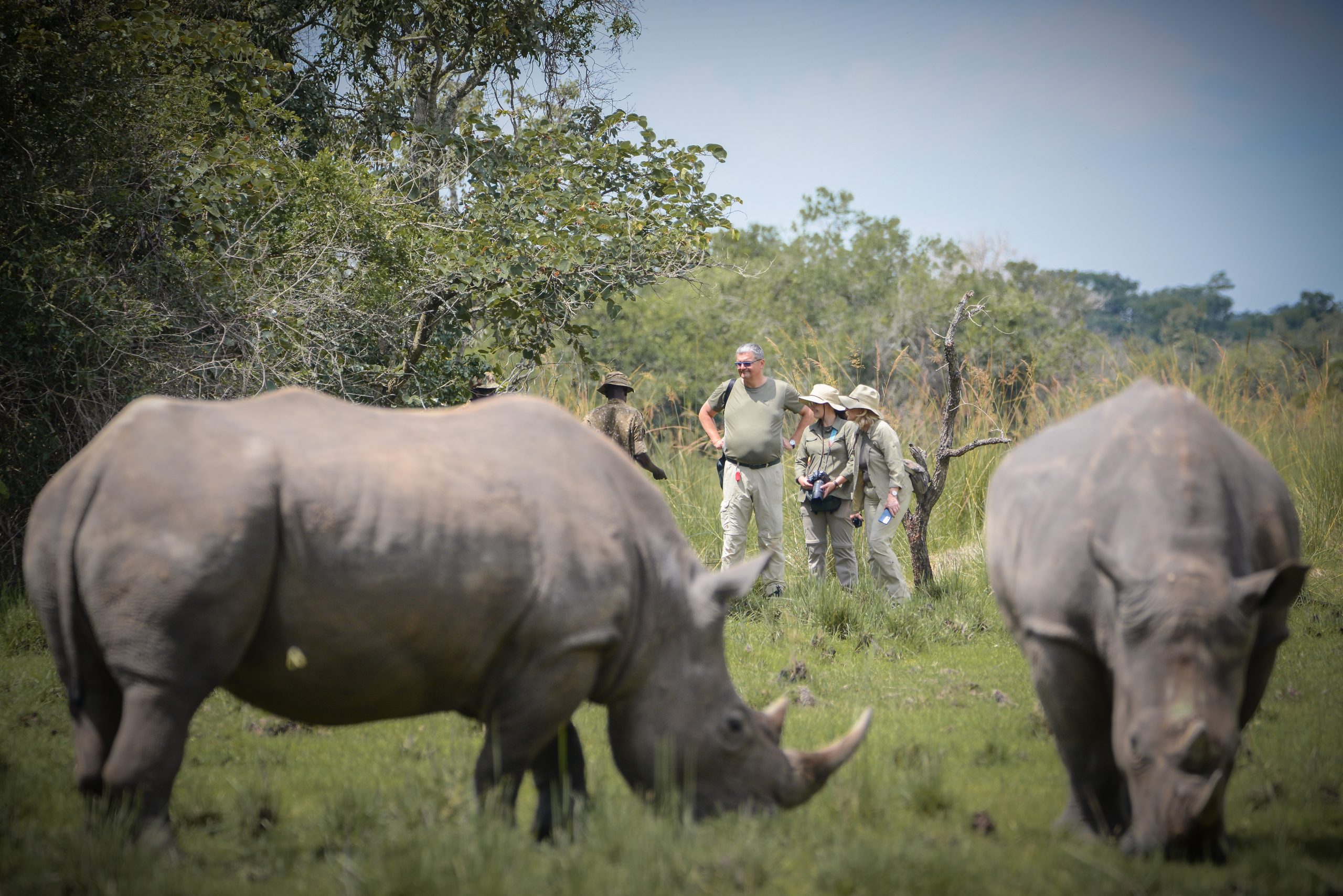
Can you combine rhino tracking at Ziwa with things to do in Murchison Falls? Yes, combining rhino tracking at Ziwa Rhino Sanctuary with activities in Murchison Falls National Park is one of the most popular and logical safari routes in Uganda. Since Ziwa is on the direct route from Kampala/Entebbe to Murchison Falls, it serves as the perfect midway stop to complete your "Big Five" checklist
Popular Uganda safari tour packages to Murchison falls national park
3-days-sports-fishing-murchison-falls-safari
3-days-murchison-falls-national-park-best-uganda-safari-road-trip
3-days-best-honeymoon-uganda-safari-escape-to-murchison-falls-national-park
5-day-best-safaris-to-uganda-kidepo-and-murchison-falls-national-parks
5-days-kidepo-valley-uganda-safari-via-ziwa-rhino-sanctuary
6-days-best-of-murchison-and-kidepo-uganda-safari-via-ziwa
7-days-murchison-falls-uganda-safari-trip-via-ziwa-rhinos-kidepo-valley-and-jinja
7-days-uganda-tour-to-murchison-falls-via-ziwa-kibale-and-queen-elizabeth-national-park
9-days-africa-big-five-safari-in-uganda-safari-parks-and-gorilla-trekking
Key Safari Combination Details
1. White Rhinos (Ziwa Rhino Sanctuary)
Tracking southern white rhinos at Ziwa provides an intimate, adrenaline-filled foot safari found nowhere else in Uganda. Guided by armed rangers, you trek through thick bush and open savanna to locate these multi-ton giants grazing just meters away. Hearing their heavy breathing and chewing as you stand quietly on foot delivers an unparalleled perspective on wildlife conservation. Ziwa was established to breed and reintroduce rhinos back into Uganda's wild parks after local extinction in the 1980s. The experience offers a rare, calm, and grounded encounter that sets an incredible stage before entering Murchison Falls National Park.
2. Lions (Murchison Falls)
The open savannas north of the Victoria Nile in Murchison Falls offer fantastic habitat for apex predators. Early morning game drives along the Buligi, Pakuba, and Queen’s tracks yield the highest chances of spotting lion prides gathering near thickets or sprawling on open tracks before the afternoon heat sets in. You will often see males with full manes guarding their territory or lionesses strategizing around grazing herds of Uganda kob and Jackson's hartebeest. Hearing a lion’s low roar echo across the vast African savanna at dawn remains one of the most memorable moments on a Murchison safari.
3. Leopards (Murchison Falls)
Elusive, masterfully camouflaged, and solitary, leopards require a keen eye and expert tracking to spot in Murchison Falls. They favor dense woodland stretches, riverine forests along the Nile, and big sausage trees where they often haul prey away from scavengers. Early morning or late afternoon game drives provide the optimal window to catch them active, moving through tall grasses or resting high in tree branches. Observing a leopard's effortless grace, piercing yellow eyes, and distinctive rosette-patterned coat against the wild wilderness of Northern Uganda makes finding this notoriously secretive predator an unforgettable highlight.
4. Elephants (Murchison Falls)
Murchison Falls is home to massive populations of African savanna elephants that roam freely between riverbanks and open plains. You can spot large breeding herds—complete with tiny calves—crossing the savanna during game drives or gathering by the hundreds along the Nile during afternoon boat safaris to the base of the falls. Watching these gentle giants wade through water, spray mud to cool off, and tear down acacia branches reveals their complex social bonds and vital ecological role as ecosystem engineers. Their sheer size against the backdrop of the Nile River creates iconic safari imagery.
5. Buffaloes (Murchison Falls)
Cape buffaloes are among the most abundant and formidable large mammals in Murchison Falls National Park. Moving in formidable herds that can number in the hundreds, they dominate the grassy plains north of the river, while solitary older bulls—known locally as "dagga boys"—frequent mud wallows along the riverbanks. Possessing massive fused horn shields (bosses) and intense gazes, buffaloes command immediate respect. You will frequently observe them grazing alongside giraffes and antelopes or cooling off in shallow swamp waters, often accompanied by oxpecker birds picking insects off their thick hides.
Top Things to Combine in Murchison Falls safaris
1. Boat Cruise to the Bottom of the Falls
Cruising upstream along the Victoria Nile to the base of Murchison Falls is the park’s defining signature activity. The 2-to-3-hour calm river launch glides past thousands of yawning hippos, massive Nile crocodiles basking along the sandy banks, and watering herds of elephants, buffaloes, and waterbucks. Birdwatchers are treated to sightings of kingfishers, African fish eagles, and occasionally the rare shoebill stork near the river delta. As you approach the canyon, the calm water yields to churning white foam and rising mist, providing a stunning, front-row view of the river thundering down the Albertine Rift cliff face.
2. Hike to the Top of the Falls
The guided hike to the top of the falls offers a thrilling, sensory-rich perspective on the raw power of nature. Starting from the river landing where the boat drops you off, the trail winds uphill along the edge of the rocky gorge for about 45 minutes to an hour. You will feel the ground vibrate beneath your feet and be sprayed by refreshing mist as the entire Nile River—over 300 cubic meters per second—forces itself through a narrow 7-meter rock gap before plunging 43 meters below. The summit rewards hikers with dramatic photo vantage points and permanent rainbows.
3. Savannah Game Drives
Exploring the open grassland and borassus palm savanna of the park’s northern sector (Buligi area) delivers classical East African game viewing. Conducted in 4x4 safari vehicles during the cool early morning or late afternoon, these drives traverse well-maintained tracks where wildlife congregates. It is the best way to see endangered Nubian (Rothschild's) giraffes, Jackson’s hartebeests, oribis, Uganda kobs, and large elephant herds. Lions and leopards are frequently spotted lounging near thickets or patrolling the plains. The landscape stretches all the way to the shores of Lake Albert, providing picturesque vistas against a backdrop of diverse, roaming wildlife.
4. Chimpanzee Trekking (Budongo Forest)
Located along the southern boundary of the park, Budongo Forest provides an extraordinary transition from open savanna to dense, mahogany-filled tropical rainforest. Home to over 600 chimpanzees, the Kaniyo Pabidi eco-tourism site offers guided trekking experiences to observe habituated wild chimp communities in their natural habitat. As you trek through ancient trees accompanied by ranger guides, you will hear their echoing hoot-calls and drum-like branch thumping long before spotting them. Watching chimps forage, groom, play, and interact high in the canopy or on the forest floor adds an unforgettable primate dimension to a traditional savanna safari.
How far is Ziwa Rhino Sanctuary from Kampala, and how long does the drive take?
Ziwa Rhino Sanctuary sits roughly 176 kilometers (109 miles) north of Kampala along the Kampala-Gulu highway. Under normal traffic conditions, the road trip takes about 3 to 3.5 hours. Leaving Kampala early by 6:00 AM helps you bypass urban congestion in Bwaise and Luweero, allowing a smooth drive through scenic countryside toward Nakasongola District. The highway is fully paved, requiring only a short 7-kilometer turnoff on a well-maintained dirt track at Nakitoma Trading Centre to reach the sanctuary gates.
How far is Ziwa Rhino Sanctuary from Murchison Falls National Park?
From Ziwa to the Kichumbanyobo Southern Gate of Murchison Falls National Park, the distance is approximately 85 to 90 kilometers. The drive takes roughly 1.5 to 2 hours through Masindi Town. If you are heading directly to the northern bank (Paraa area) where most safari lodges and game drive tracks are located, expect an additional 45-minute drive through the lush Mahogany canopy of Budongo Forest. The proximity makes Ziwa an effortless mid-way lunch and activity stopover.
What makes Ziwa the only place in Uganda to see wild rhinos?
During the civil instability and rampant poaching of the 1970s and early 1980s, both northern white and black rhinos were wiped out in Uganda's national parks. In 2005, the Rhino Fund Uganda and Uganda Wildlife Authority established the 70-square-kilometer enclosed Ziwa Rhino Sanctuary. Starting with just six reintroduced southern white rhinos, the breeding project succeeded beyond expectations, growing the herd to over 30 to 40 individuals. Today, it stands as the sole breeding sanctuary aimed at reintroducing rhinos to Murchison Falls and Kidepo Valley.
What actually happens during a rhino tracking walk on foot at Ziwa?
Upon arrival at the sanctuary headquarters, you receive a briefing from a trained ranger before driving to the general area where the rhinos were last spotted. From there, you set out on foot into open bushland. Guided by armed rangers who monitor the herd 24/7, you trek until you are standing just 30 to 50 meters away from these massive creatures. You spend about an hour quietly observing them eat, rest, and interact in their natural habitat.
Is it safe to track wild rhinos on foot without a safari vehicle?
Yes, it is remarkably safe when following ranger instructions. Southern white rhinos are grazers and generally less aggressive than black rhinos. Every tracking group is accompanied by experienced, armed Uganda Wildlife Authority rangers who know individual rhino personalities and body language intimately. Rangers maintain a strict safety perimeter of at least 30 meters, ensure group silent behavior, and carry rifles strictly as a precautionary measure, making foot tracking both thrilling and secure.
What should you pack and wear for foot tracking at Ziwa Rhino Sanctuary?
Because you are walking through thick savanna brush and long grasses, wear sturdy closed-toe hiking shoes or boots and breathable long trousers to protect against thorns and ticks. Neutral-colored clothing (khaki, green, or tan) is recommended so you blend into the environment. Bring a wide-brimmed hat, strong insect repellent, sunblock, a refillable water bottle, and a camera with a decent zoom lens. Avoid bright colors or loud nylon fabrics that make noise as you move.
How much does rhino tracking at Ziwa cost for international visitors?
Rhino tracking permits for foreign non-resident adults cost approximately $50 USD per person. Foreign residents pay around $40 USD, while East African citizens pay 30,000 to 40,000 UGX. Children under 15 enjoy discounted rates around $25 USD. This fee includes sanctuary entrance and the services of the expert armed ranger guide. Compared to gorilla or chimpanzee tracking permits, it represents exceptionally high value on an East African safari.
Why is combining Ziwa and Murchison Falls called the "Big Five" route?
The classic "Big Five" includes the lion, leopard, elephant, Cape buffalo, and rhino. While Murchison Falls National Park shelters thriving populations of lions, leopards, elephants, and buffaloes, it lacks rhinos due to historical poaching. Because Ziwa Rhino Sanctuary sits right on the highway leading to Murchison Falls, combining the two destinations allows travelers to tick off all five iconic African species in a single 2-to-3-day circuit without detouring far.
What is the ideal 3-day itinerary combining Ziwa and Murchison Falls?
On Day 1, depart Kampala at 6:00 AM, track rhinos at Ziwa by 9:30 AM, have lunch, and drive to Murchison Falls for an evening sunset game drive. On Day 2, take a 6:00 AM savanna game drive in the northern sector, followed by an afternoon Victoria Nile boat cruise to the base of Murchison Falls and a hike to the top. On Day 3, do early morning chimpanzee trekking in Budongo Forest before driving back to Kampala.
What time of day is best for tracking rhinos at Ziwa?
Early morning (between 8:00 AM and 10:00 AM) or late afternoon (4:00 PM to 6:00 PM) offer the absolute best tracking conditions. During cool hours, rhinos actively graze across open meadows, making them easier to spot and photograph. During midday heat (12:00 PM to 3:00 PM), rhinos often retreat into dense, shaded thickets to sleep, which can make trekking hotter and slightly longer as you maneuver through brush.
Can you see other wildlife at Ziwa Rhino Sanctuary besides rhinos?
Ziwa is home to over 40 species of mammals and 300 species of birds. While walking or driving through the 70 km² sanctuary, you frequently spot bushbucks, oribis, reedbucks, duikers, vervet monkeys, and black-and-white colobus monkeys. Furthermore, the adjacent Lugogo Swamp is a famous habitat for the rare, prehistoric Shoebill stork, which can be tracked on specialized early morning canoe trips.
Where do you cross the Nile in Murchison Falls, and why does it matter?
Historically, visitors crossed the Victoria Nile using the Paraa vehicle ferry. However, the completion of the modern, permanent Karuma and Paraa bridges eliminated ferry wait times. This upgrade makes travel seamless between southern accommodations or Budongo Forest and the prime wildlife viewing tracks located in the northern sector (Buligi area).
What animals will you see on a northern sector game drive in Murchison Falls?
The northern savanna sector—specifically the Buligi, Pakuba, and Queen's tracks—offers intense concentration of wildlife. You are virtually guaranteed to see hundreds of endangered Rothschild's (Nubian) giraffes, herds of Jackson's hartebeest, Uganda kob, waterbucks, oribis, and Cape buffaloes. Elephant herds are common, while predators like lions, side-striped jackals, hyenas, and secretive leopards are tracked near thickets.
What makes lions in Murchison Falls unique compared to other parks?
Murchison Falls boasts a healthy lion population that thrives on dense prey herds like Uganda kob and warthogs. Predators here are well-adapted to savanna environments intercut with tall borassus palms. During hot mornings, lions frequently climb low-hanging branches of fig trees or rest atop termite mounds to catch cool breezes and survey game, offering phenomenal photography against palm-fringed horizons.
How easy is it to spot leopards in Murchison Falls National Park?
Leopards are naturally solitary and masterfully camouflaged, making them the hardest of the Big Five to find. However, Murchison's northern riverine woodlands and acacia tracks provide high encounter rates. Early morning game drives before sunrise or late afternoon drives yield the highest success, particularly around Pakuba Lodge ruins, where leopards often lounge on ancient stone walls or high up in sausage trees.
What is the Nile boat cruise experience like in Murchison Falls?
The 3-hour launch trip departs twice daily (9:00 AM and 2:00 PM) from Paraa jetty, heading upstream toward the base of Murchison Falls. As the boat glides along the Victoria Nile, you cruise past giant pods of hippos, massive Nile crocodiles basking with open jaws, and elephants drinking at the water's edge. The trip culminates at a safe distance in the foaming gorge face where the river explodes downward.
How difficult is the hike to the top of Murchison Falls?
The guided hike from the river boat landing to the top cliff viewpoint is of moderate difficulty. Lasting roughly 45 to 60 minutes, the trail climbs roughly 120 vertical meters along an unpaved, uneven stone path with occasional steps. While accessible to anyone of basic fitness, high humidity and heat mean carrying plenty of drinking water is mandatory to stay hydrated.
What happens to the River Nile at the top of Murchison Falls?
At Murchison Falls, the world's longest river—spanning over 50 meters wide upstream—is violently compressed into a narrow 7-meter rock canyon. Pushing over 300 cubic meters of water per second through this gorge, the Nile creates staggering hydraulic pressure before plunging 43 meters into the "Devil's Cauldron" below. The resulting mist creates permanent rainbows and reverberating ground vibrations.
Can you see chimpanzees inside Murchison Falls National Park?
Yes, within the greater Murchison Falls Conservation Area lies Budongo Forest Reserve at the park's southern border. Budongo is a mahogany forest boasting over 600 wild chimpanzees. Guided trekking at the Kaniyo Pabidi site allows visitors to spend an hour with a habituated chimp troop, seamlessly combining a primate rainforest experience with open savanna game drives.
How does chimpanzee trekking in Budongo compare to Kibale Forest?
Kibale Forest is Uganda's primary primate capital with a 95%+ sighting success rate. However, Budongo Forest offers a quieter, less crowded trekking experience with a respectable 80–85% success rate. Budongo's flatter terrain and massive mahogany canopy make for walking conditions that are often easier than Kibale, at a lower permit cost ($140–$150 USD vs. Kibale's $250+ USD).
What bird species can you spot on a combined Ziwa and Murchison trip?
This combination covers aquatic, forest, and savanna habitats, yielding over 450 bird species. Highlights include the elusive Shoebill Stork (in Ziwa's Lugogo Swamp and the Nile Delta), Red-throated Bee-eaters nesting in sandstone riverbanks, Abyssinian Ground Hornbills patrolling savanna tracks, Goliath Herons, African Fish Eagles, and Chocolate-backed Kingfishers in Budongo Forest.
What are the current entrance fees for Murchison Falls National Park?
Park entrance fees set by the Uganda Wildlife Authority are $45 USD per 24-hour period for foreign non-resident adults, $35 USD for foreign residents, and 25,000 UGX for East African citizens. Vehicle entry fees apply separately ($150 USD for foreign tour operator 4x4s or 100,000 UGX for Ugandan-registered tour vehicles). Keep in mind that activities like boat cruises ($30 USD) incur extra charges.
What is the difference between Murchison Falls and Karuma Falls?
Murchison Falls is located inside the national park where the Victoria Nile drops 43 meters through a 7-meter gorge. Karuma Falls sits roughly 80 kilometers upstream at the park's northeastern border, featuring a series of cascading white-water rapids extending across several kilometers of riverbed rather than a single massive drop.
When is the best time of year to undertake this safari route?
The best months are during Uganda’s two dry seasons: December through February and June through September. During dry periods, savanna vegetation thins out, making wildlife easier to spot, dirt tracks remain passable, and animals congregate reliably around waterholes and riverbanks. However, the park stays open year-round, with the wet seasons offering lush scenery and vibrant birding.
What type of safari vehicle is best suited for this road trip?
A customized 4x4 safari land cruiser or pop-top safari van is strongly recommended. While the paved highway from Kampala to Nakasongola and Masindi is smooth, internal park roads inside Murchison Falls consist of dirt and murram that can become slippery during rainy spells. The pop-top roof is vital for 360-degree unobstructed views and photography during game drives.
Are there accommodations available at Ziwa Rhino Sanctuary?
Ziwa offers lodging directly on-site, making it convenient for travelers who prefer an overnight stay rather than a brief stopover. Options range from the mid-range Amuka Safari Lodge—featuring cozy wooden chalets nestled in the bush with a swimming pool—to the budget-friendly Ziwa Guest House and well-maintained camping grounds run by the sanctuary.
Where are the best places to stay inside Murchison Falls National Park?
Accommodation spans all budget tiers. Luxury options include Paraa Safari Lodge, Nile Safari Lodge, and Chobe Safari Lodge. Excellent mid-range lodges include Pakuba Safari Lodge, Murchison River Lodge, and Sambiya River Lodge. Budget travelers can choose options like Red Chilli Rest Camp or Fort Murchison, situated conveniently near park gates.
Can you do a hot air balloon safari in Murchison Falls?
Yes, Murchison Falls is one of only two national parks in Uganda offering hot air balloon safaris. Operating in the northern Buligi game trails at dawn, the balloon floats silently over savanna, herds of giraffes, and river systems. The experience lasts approximately one hour and concludes with a bush breakfast cooked out in the open savanna.
Can you substitute driving with a domestic flight to Murchison Falls?
Domestic airline operators run scheduled and charter flights from Entebbe International Airport or Kajjansi Airfield to airstrips inside Murchison Falls, such as Pakuba, Bugungu, or Chobe. Flying takes just 60 minutes, saving a 5-hour drive. However, flying skips Ziwa Rhino Sanctuary, so travelers who fly usually charter a short road transfer back to Ziwa if rhinos are on their wishlist.
Why is this safari combination recommended for families with children?
Unlike gorilla tracking or standard chimpanzee treks that enforce strict minimum age limits of 15 years, Ziwa rhino tracking accepts younger children when accompanied by parents and rangers. Paired with Murchison's gentle boat cruises and easy savanna game viewing, this circuit offers high animal density with manageable travel distances, making it an educational family safari.
Booking Ziwa Rhinos and Murchison falls safari with us Roads of Adventure safaris
Booking a Ziwa Rhino Sanctuary and Murchison Falls safari with Roads of Adventure Safaris can be initiated directly by emailing info@roadsofadventuresafaris.com or via WhatsApp at +256 701041637.
