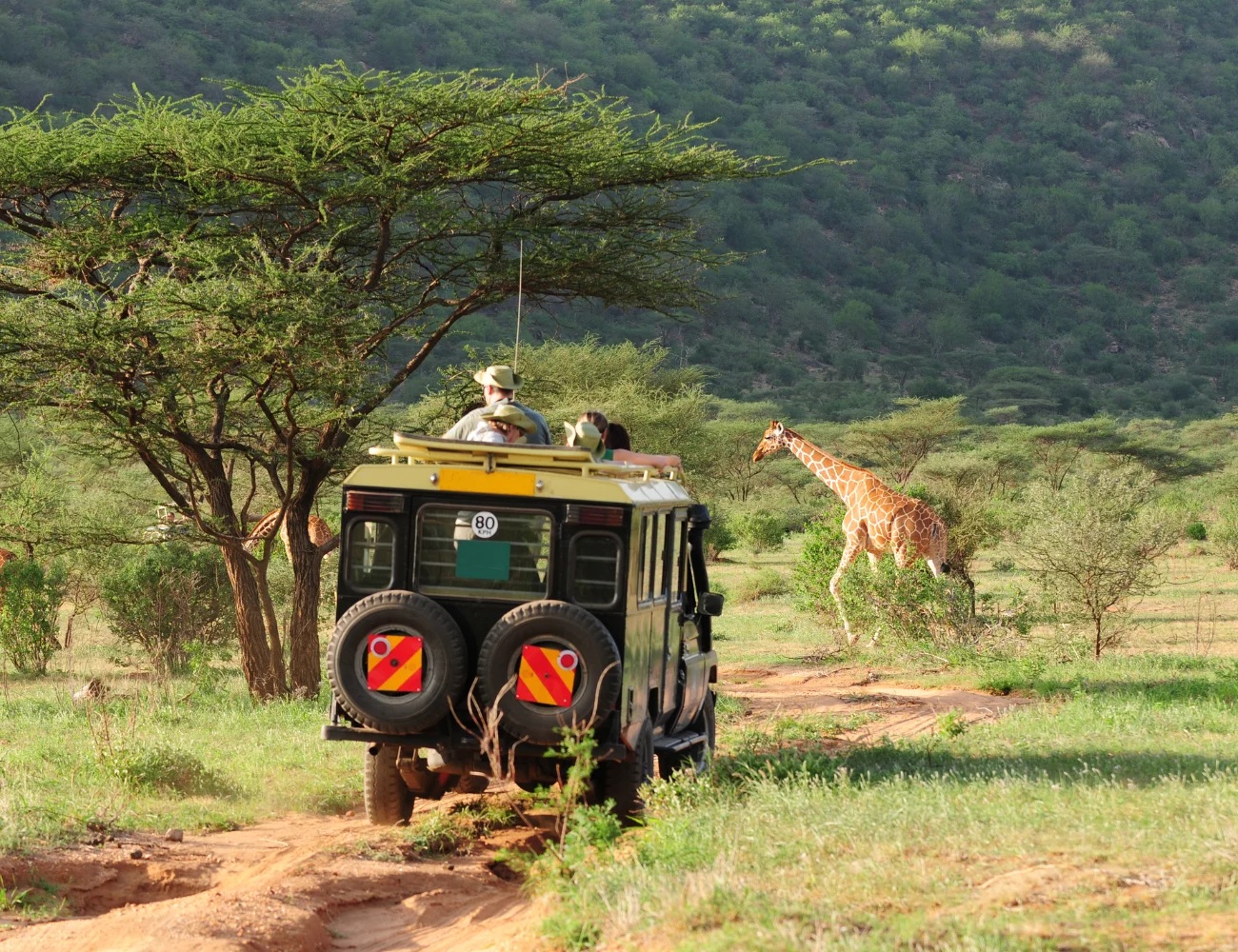
Yes, a 7-day Kenya safari offers an excellent chance to see all the Big Five (lion, leopard, elephant, rhino, and buffalo). By combining top-tier locations like the Masai Mara (lions, leopards, elephants, buffaloes) with Lake Nakuru or Ol Pejeta Conservancy (rhino sanctuaries), you maximize your chances of spotting all five within a week.
Popular 7 Day Kenya safari itineraries
7-days-budget-kenya-safari-holiday-vacation-tour
7-days-amboseli-kenya-and-serengeti-fly-in-tanzania-safari
7-days-masai-mara-safari-tour-and-serengeti-safari-tour-in-kenya-and-tanzania
7-days-best-of-kenya-wildlife-safaris-itinerary
7-days-kenya-wildlife-safari-to-kenya-beach-holiday-at-diani-beach
7-days-ultimate-budget-kenya-tanzania-safari-holiday-vacation
7-days-ultimate-africa-big-cats-kenya-safari-holiday-best-parks
7-days-kenya-honeymoon-safari-holiday-and-vacation-couple-escape
7-days-kenya-family-safari-package-and-zanzibar-beach-holiday-vacation
7-days-best-africa-big-cats-safari-in-kenya
7 Days Kenya big five safari tour
The 7 Days Kenya big five safari tour is the ultimate pilgrimage for wildlife enthusiasts seeking to witness Africa’s most legendary creatures in their natural habitat. This journey is specifically curated to maximize your chances of encountering the "Big Five"—the lion, leopard, elephant, buffalo, and rhino—across Kenya’s most diverse and predator-rich ecosystems. Starting in the shadows of Mount Kilimanjaro in Amboseli, the tour traverses the dramatic landscapes of the Great Rift Valley before culminating in the world-famous Masai Mara National Reserve. Beyond the thrill of the hunt, this safari offers a deep dive into the conservation efforts protecting these iconic species. You will witness the raw power of nature, from massive elephant herds to the silent, golden-eyed stare of a leopard. With expert guiding and strategic pacing, this 7 Days Kenya big five safari tour ensures an unforgettable encounter with the wild heart of the continent, leaving you with a profound appreciation for Africa's majestic biodiversity.
Day 1: Arrival and Nairobi’s Wildlife Heritage
Your adventure begins in Nairobi, the only city in the world with a national park at its doorstep. After a warm welcome, you visit the Sheldrick Wildlife Trust to see the first of your Big Five: the African elephant. Here, you observe orphaned calves being bottle-fed, a touching introduction to the social intelligence of these giants. Later, a visit to the Giraffe Centre allows for an up-close encounter with the endangered Rothschild species. These urban conservation stops provide essential context for the wilder landscapes ahead. After a detailed safari briefing with your guide, you enjoy a welcome dinner, discussing the tracking techniques you’ll use over the coming week. The evening is spent in anticipation of the dawn, as you prepare to leave the city lights for the rugged beauty of the Amboseli plains.
Day 2: Amboseli’s Giants and Kilimanjaro Views
Today, you drive southeast to Amboseli National Park, a premier location for spotting two members of the Big Five: the elephant and the buffalo. The park is world-renowned for its "Big Tuskers"—massive bulls that roam the marshes beneath the snow-capped peak of Mount Kilimanjaro. Your afternoon game drive takes you through the Enkongo Narok swamp, where herds of elephants wade through the lush greenery just meters from your vehicle. You will also encounter large herds of Cape buffalo wallowing in the mud. The open, flat terrain of Amboseli provides some of the best photographic opportunities in Africa, with the mountain providing a theatrical backdrop to the wildlife. As the sun sets, the dust kicked up by the herds creates a golden glow, marking a perfect end to your first full day in the bush.
Day 3: Lake Naivasha and Crescent Island Walk
You depart the slopes of Kilimanjaro for the freshwater shores of Lake Naivasha in the Great Rift Valley. This day offers a change of pace, focusing on the aquatic life that thrives in the valley's lakes. A boat safari brings you within range of grunting hippos and soaring fish eagles. Afterward, you visit Crescent Island for a unique walking safari. Because there are no large predators on the island, you can walk among giraffes, zebras, and waterbucks, gaining a literal "ground-level" perspective of the ecosystem. While the Big Five are absent here, the intimate connection with the plains game is a highlight for many. The evening is spent at a lakeside lodge, where the sound of hippos grazing on the lawn serves as a reminder that the wild is never far away.
Day 4: Lake Nakuru’s Rhino Sanctuary
A short drive leads to Lake Nakuru National Park, a critical sanctuary for the most elusive member of the Big Five: the rhinoceros. Nakuru is one of the few places in Kenya where you are virtually guaranteed sightings of both the square-lipped White Rhino and the more reclusive, hooked-lipped Black Rhino. Your game drive explores the acacia forests and alkaline shores, where you’ll also search for Nakuru’s famous leopards and tree-climbing lions. The park is a fenced stronghold for biodiversity, offering protection to the endangered Rothschild giraffe as well. The sight of a prehistoric-looking rhino grazing against the backdrop of a shimmering lake is a powerful experience. By the end of the day, you will likely have checked four of the Big Five off your list, leaving only the dense Mara to explore.
Day 5: The Grand Entry to Masai Mara
The journey reaches its peak as you head toward the Masai Mara National Reserve, the northern tip of the Serengeti ecosystem. This is the undisputed home of the Big Five, boasting the highest concentration of lions and leopards in Kenya. As you enter the gates, the vast, rolling savannah stretches to the horizon, dotted with thousands of wildebeest and zebras. Your afternoon game drive is an adrenaline-fueled search for predators. You’ll navigate the Mara’s golden grass, looking for the "Big Cats" as they begin their evening patrol. The sheer abundance of life here is staggering; everywhere you look, the circle of life is in motion. You arrive at your luxury tented camp at dusk, falling asleep to the distant roar of lions and the nocturnal rhythm of the African night.
Day 6: Full Day Tracking the Big Five
This dedicated day in the Masai Mara is focused on completing your Big Five checklist and witnessing wildlife action at its peak. With a picnic lunch in the vehicle, you venture deep into the reserve, perhaps toward the Mara River where crocodiles wait for the migration. Your guide uses expert tracking skills to find the elusive leopard hidden in a riverine thicket or a cheetah scanning the plains from a termite mound. You will spend time observing lion prides, witnessing the complex social bonds that make them the kings of the savannah. The day is unhurried, allowing you to stay with a single sighting to observe natural behaviors like hunting or nursing. In the late afternoon, a visit to a Maasai village offers a cultural bridge, showing how humans and the Big Five have coexisted for centuries.
Day 7: Final Sunrise and Return to Nairobi
On your final morning of the 7 Days Kenya big five safari tour, you head out at dawn for one last game drive. The early light is perfect for spotting predators returning from their nightly hunts before the heat of the day sets in. You might catch a glimpse of a hyena clan at their den or a final elephant herd silhouetted against the rising sun. After a celebratory bush breakfast, you begin the journey back to Nairobi. This drive provides a final opportunity to reflect on the incredible biodiversity you have witnessed and the vital importance of protecting these habitats. Arriving in the city in the afternoon, you’ll have a final meal at the famous Carnivore Restaurant before your airport transfer, carrying with you memories of the majestic Big Five and the wild soul of Kenya.
1. Can I realistically see all Big Five in 7 days in Kenya?
Yes, seeing the Big Five in a 7-day window is a highly realistic goal, provided your itinerary is designed with biodiversity in mind. Seven days is considered the "sweet spot" because it allows you to visit at least three different ecosystems. In the world of safari, different animals thrive in different habitats; for example, while elephants and lions are widespread, rhinos require specific protected sanctuaries.
A 7-day trip gives you multiple "bites at the cherry." If you don't spot a leopard on day two in the Mara, you still have five more days of dawn and dusk drives to find one. This duration also allows your guide to spend more time "staking out" specific areas where a sighting has been reported via radio. While no two safaris are the same, the statistical probability of seeing all five over a week-long journey in Kenya is exceptionally high, often exceeding 90% for well-planned routes.
2. Which parks are best for Big Five in 7 days?
To see all five, you must visit parks that cater to the specific needs of the more elusive species. The Masai Mara is the undisputed king for four of the five: lions, leopards, elephants, and buffaloes. Its open plains and riverine forests provide the perfect hunting and grazing grounds for these giants.
However, the rhino is the wildcard. To secure a rhino sighting, you should include Lake Nakuru National Park or Ol Pejeta Conservancy. Lake Nakuru is a fenced sanctuary that has been incredibly successful in breeding both Black and White rhinos. Ol Pejeta, located on the Laikipia Plateau, is the largest black rhino sanctuary in East Africa and the only place in Kenya to see the northern white rhino (now functionally extinct but still present in a highly protected enclosure). By combining the Mara with one of these rhino-heavy conservancies, you create a "Big Five Circuit" that leaves very little to chance.
3. What is the best month to see all five animals?
The peak window for Big Five sightings is the dry season, from June to October. During these months, the vegetation thins out and the grass is shorter, which is crucial for spotting camouflaged predators like leopards. More importantly, water becomes scarce. Animals are forced to congregate around permanent waterholes, rivers, and swamps.
When animals are concentrated in specific areas, your guide can predict their movements with much higher accuracy. This is also the time of the Great Migration in the Masai Mara, which brings over a million wildebeest and zebras into the park. This massive influx of prey keeps the lions and leopards highly active and visible. January and February are also excellent "short dry season" months, offering clear blue skies and great visibility before the long rains arrive in March.
4. Is it possible to see rhinos on this 7-day trip?
Yes, and it is often the highlight of the journey. Because rhinos are critically endangered due to poaching, they are rarely found roaming in completely open, unfenced territories. On a 7-day trip, your best bet is to spend a day in a dedicated sanctuary. Ol Pejeta Conservancy is world-renowned for its rhino conservation; it is one of the few places where you can see rhinos in high numbers against the backdrop of Mount Kenya.
Lake Nakuru is another stellar option. Because the park is relatively small and fenced, the rangers monitor the rhino populations closely. It is common to see white rhinos grazing in open groups near the lake's edge, while the more reclusive black rhinos tend to stay in the thick acacia woodlands. Including at least one of these parks ensures that the "hardest" member of the Big Five is accounted for early in your itinerary.
5. What is the most difficult Big Five animal to spot?
The leopard holds the title of the most elusive Big Five member. Unlike lions, which are social and often lounge in the open, leopards are solitary, shy, and masterfully camouflaged. They spend much of their day sleeping in the high branches of yellow-barked fever trees or tucked away in dense riverine thickets.
Spotting a leopard often requires a "spotter’s eye"—looking for a dangling tail or a flick of an ear amidst the foliage. This is where the 7-day duration becomes vital. It allows for the patience required to track them. Your guide will look for clues, such as the alarm calls of baboons or impalas, which often signal a leopard's presence. While difficult, the Masai Mara has one of the highest leopard densities in Africa, making it the best place in the world to find them if you have the time to wait.
6. Are Buffalo easy to find in Kenyan national parks?
Among the Big Five, the Cape Buffalo is perhaps the easiest to find. They are ubiquitous across almost all of Kenya’s major parks, including the Masai Mara, Amboseli, and Lake Nakuru. Buffaloes are highly social and live in large herds that can number in the hundreds. Their sheer size and dark color make them easy to spot against the golden grass of the savannah.
Despite their common appearance, they are respected by guides as one of the most dangerous animals in the park. Known as "The Black Death," they are famously unpredictable and have no problem standing their ground against lions. Seeing a massive herd of buffaloes moving across the plains is a powerful sight, often accompanied by "cattle egrets" or "oxpeckers" that hitch a ride on their backs to eat ticks and insects.
7. Will I see lions in the Masai Mara in 7 days?
The Masai Mara is arguably the best place on Earth to see lions. It is home to several large and famous prides that have been featured in documentaries like Big Cat Diary. Over a 7-day itinerary, it is not a question of if you will see lions, but how many and in what context.
You are likely to see them in various states: sleeping in the shade during the midday heat, socialising with cubs, or even on a hunt. Because the Mara has such a high density of prey (zebras, wildebeest, and gazelles), the lions do not have to travel far to eat, meaning they remain in relatively stable territories. Your guide will likely find them within the first few hours of entering the reserve. Seven days allows you to observe their complex social dynamics—something you simply cannot appreciate on a shorter trip.
8. Is it safe to see the Big Five in Kenya?
Safari tourism is a highly regulated and professional industry in Kenya. Seeing the Big Five is perfectly safe provided you follow the park rules and your guide’s instructions. You travel in specially designed 4x4 Land Cruisers or Safari Vans with pop-up roofs, which act as a mobile "blind." Animals generally perceive the vehicle as a single, non-threatening object rather than a collection of humans.
Safety is further ensured by the expertise of the Professional Safari Guides. They are trained to read animal body language and know exactly how much space to give a protective elephant mother or a hungry lion. In unfenced camps, Maasai warriors or armed rangers provide security, escorting you to and from your tent after dark. The most dangerous thing on a safari is usually the sun—so remember your sunscreen and stay inside the vehicle at all times unless in a designated "stretch" area.
9. What if I don't see all of them in 7 days?
While 7 days significantly improves your odds, nature is not a zoo, and sightings are never 100% guaranteed. Weather changes, animal migrations, and sheer luck all play a role. For instance, a sudden heavy downpour might cause leopards to retreat further into the bush, or a rhino might choose to stay in a dense thicket for several days.
However, the beauty of a 7-day safari is that even if you miss one of the "Five," you will see thousands of other incredible creatures. You might witness a cheetah chase, a hippo fight, or a rare serval cat. Most travelers find that by the end of the week, the "checklist" becomes less important than the overall immersion in the wild. If you do miss one, it simply provides the perfect excuse to plan your next African adventure!
10. Do I need to visit many parks in 7 days?
Actually, less is more. To maximize Big Five sightings, you shouldn't try to visit five or six different parks in a week. This would involve too much driving and not enough "bush time." Focusing on three major parks—such as Amboseli, Lake Nakuru, and the Masai Mara—is the ideal strategy.
By spending 2 or 3 nights in a single location like the Mara, you allow your guide to "learn" the current movement of the local prides and leopards. Frequent moves mean you are often traveling during the best game-viewing hours (dawn and dusk). A focused 7-day itinerary reduces transit stress and gives you the "patience" required to wait for that elusive leopard to climb down from its tree or for a rhino to emerge from the brush.
11. Are rhinos found in the Masai Mara national reserve?
While the Masai Mara does have a resident population of black rhinos, they are extremely rare and difficult to spot. The Mara is a massive, open ecosystem, and the few rhinos that live there are shy and tend to stay in the thickets of the Mara Triangle or near the dense scrubland of the park's borders.
If your heart is set on seeing a rhino, experts always recommend including a dedicated sanctuary like Ol Pejeta or Lake Nakuru. In these areas, the rhino-to-land ratio is much higher, and the animals are more habituated to vehicles. Relying solely on the Mara for a rhino sighting is a high-risk strategy that often leads to the "Big Four" rather than the "Big Five." Think of the Mara as the place for cats and plains game, and Nakuru/Ol Pejeta as your "rhino insurance."
12. What should I carry to spot the Big Five?
To truly appreciate the Big Five, a few pieces of gear are non-negotiable. First and foremost are high-quality binoculars. While your guide will have a pair, having your own (standard 8x42 is best) allows you to scan the horizon and see the fine details of a leopard’s spots or an elephant’s eyelashes without waiting your turn.
Secondly, a camera with a good optical zoom (at least 300mm) is essential. Modern smartphones are great for landscapes, but they struggle with distant wildlife. Finally, bring a power bank and extra memory cards. You will take far more photos than you anticipate, especially during a lion sighting. Many experts also suggest carrying a small wildlife guidebook to help you identify the different species of antelopes and birds you’ll see between the Big Five encounters.
13. Will the 7-day safari include driving or flying?
Both options have their merits. Driving is the most common way to experience a 7-day safari. It is cost-effective and allows you to see the "real Kenya"—the Great Rift Valley escarpment, bustling local markets, and changing landscapes. It gives you a better sense of the geography and the distance between the different habitats.
However, flying (via domestic "bush flights") is the luxury choice. Flying from Nairobi directly into the Mara or between parks saves you hours of travel on bumpy roads (the "African Massage"). This "Fly-in Safari" model maximizes your actual game-viewing time, potentially adding two extra game drives to your itinerary. Many 7-day tours offer a "hybrid" approach: driving to the closer parks like Nakuru and flying back from the Mara to Nairobi to end the trip on a comfortable, scenic high note.
14. Is a 7-day safari better than shorter tours for Big Five?
Yes, without question. A 3 or 4-day safari is often restricted to a single park, which limits your biodiversity. If you only go to the Mara for three days, you might miss the rhino. If you only go to Amboseli, you might miss the leopard.
A 7-day itinerary allows for the "Triple Crown" of parks, covering the specific habitats required for each of the five animals. Furthermore, a longer tour is less stressful. Wildlife doesn't always perform on cue; a leopard might be hidden on Monday but active on Wednesday. Seven days gives you the "temporal buffer" to wait out bad weather or quiet spells, ensuring that your pursuit of the Big Five is a relaxed and rewarding journey rather than a frantic race against the clock.
15. What is the best way to track leopards in 7 days?
Leopard tracking is an art form. The best way to find them is to focus your efforts on the "Golden Hours"—the hour after sunrise and the hour before sunset. This is when leopards are most likely to be moving, either descending from their daytime trees or beginning their nightly hunt.
Expert guides also look for indirect signs. They listen for the "bark" of a baboon or the "snort" of an impala, which are alarm calls indicating a predator is nearby. They also scan the branches of large acacia and sausage trees for a hanging tail or a kill stashed in the fork of a branch. In a 7-day safari, you have the luxury of returning to the same "leopard-friendly" riverine areas multiple times, which drastically increases your chances of a successful sighting. Patience, expert guiding, and early starts are the three pillars of leopard tracking.
Booking 7 Days Kenya big five safari tour with us Roads of Adventure safaris
Book a 7-Day Kenya Big Five Safari with Roads of Adventure Safaris for an immersive experience tracking lions, leopards, rhinos, elephants, and buffaloes. Typical itineraries, like their Incredible Africa package, feature the Maasai Mara, Lake Nakuru, and other iconic destinations, offering 4x4 game drives and luxury or mid-range accommodation
