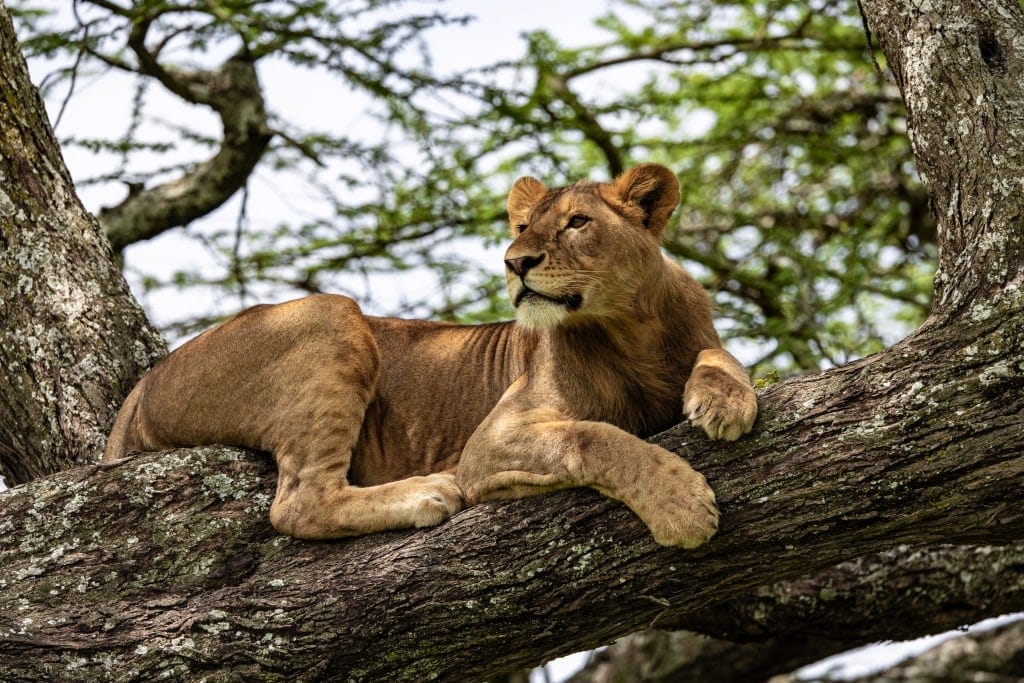
Yes, you can see tree-climbing lions on a 3-day safari to Queen Elizabeth National Park, specifically by visiting the Ishasha sector in the southern part of the park. While sightings are not guaranteed, they are most likely during the dry seasons (June–September, December–February) when the lions climb fig trees to escape heat and flies
3-days-trips-to-queen-elizabeth-national-park-for-chimpanzee-tracking-in-kyambura-gorge
3-days-uganda-safari-itinerary-to-queen-elizabeth-national-park
3-days-budget-queen-elizabeth-park-uganda-wildlife-safari-holiday
3-days-fly-luxury-uganda-safari-to-queen-elizabeth-national-park
Location: The Ishasha Sector
The Ishasha sector is the remote, southern gem of Queen Elizabeth National Park, situated approximately 100 kilometers south of the more frequently visited Mweya Peninsula. This region is geographically distinct, characterized by vast, open savanna dotted with ancient, sprawling fig trees and acacia woodlands. While the northern sectors of the park are famous for their crater lakes and the Kazinga Channel, Ishasha is defined by its wild, off-the-beaten-path atmosphere. It sits near the border of the Democratic Republic of Congo, separated by the Ishasha River, which provides a vital water source for the region's inhabitant wildlife.
The primary draw of this location is the unique behavioral anomaly of its tree-climbing lions. Unlike most lions in Africa that remain on the ground, the prides in Ishasha have developed the habit of climbing high into the branches of sycamore fig trees. Scientists believe they do this to escape the heat of the ground, avoid the irritation of tsetse flies, and gain a better vantage point for spotting prey across the plains. Driving through Ishasha feels like a different world; the tracks are less crowded, and the landscape feels more rugged. To reach this sector from the north, you must navigate a dirt road that winds through the heart of the park, a journey that offers its own mini-game drive. Because of its distance from the main gate, the Ishasha sector remains one of the most exclusive and tranquil spots for a 3-day safari, providing a raw and authentic encounter with the "Kings of the Jungle" in a setting that looks like a scene from a classic nature documentary.
Best Time to Spot: Seasonal Dynamics
Timing is everything when it comes to spotting tree-climbing lions, and the dry seasons (June to August and December to February) are overwhelmingly the best times to visit. During these months, the grass is short and golden, which significantly increases visibility for travelers scanning the horizon for a flick of a tail or a golden coat nestled among the green leaves of a fig tree. More importantly, the heat of the dry season is the primary driver for the lions' arboreal behavior. As the ground temperature rises, the lions seek the cooler, shaded breezes found in the higher branches, making them much easier to locate.
During the dry season, the tracks within the Ishasha sector are also more reliable. The "black cotton" soil found in this part of the park can become notoriously sticky and difficult to navigate during the rainy months, even for the most robust 4x4 vehicles. In contrast, the dry weather ensures that you can cover more ground and spend more time searching the known "lion trees" without the risk of getting stuck. Furthermore, water becomes a scarce resource during these months, forcing other wildlife like kobs and buffaloes to congregate near the Ishasha River and specific water holes. This concentration of prey keeps the lions within a predictable range, as they rarely stray far from their next meal. If you are planning a 3-day trip specifically for photography, the dry season also provides the most stable lighting and clear skies, ensuring that your shots of a lion lounging on a branch are crisp and unobstructed by the heavy foliage common in the wet months.
Itinerary Note: Planning Your Circuit
A critical logistical point for any traveler is ensuring that their 3-day itinerary explicitly includes a game drive in the Ishasha Sector. Many standard "short" safaris to Queen Elizabeth National Park default to the northern Mweya and Kasenyi areas because they are closer to the main entrance and offer the popular boat cruise. However, tree-climbing lions are not found in the northern sectors. If your goal is to see this specific phenomenon, you must coordinate with your tour operator to ensure that Day 2 or Day 3 is dedicated to the southern circuit.
A well-structured 3-day tree-climbing lion safari often involves a "transit" style itinerary. For example, you might spend Day 1 traveling from Kampala and overnighting in the northern sector, then spend Day 2 driving south to Ishasha for a full-day search for the lions before staying at a lodge near the southern gate. Alternatively, some travelers visit Ishasha as they transition toward Bwindi Impenetrable Forest for gorilla trekking. Because the drive from Mweya to Ishasha can take about two to three hours depending on the road conditions and wildlife sightings along the way, it is not a trip that should be rushed. Including Ishasha requires a trade-off; you may have less time for the crater lakes or forest walks in the north, but the reward of seeing a pride of lions draped over a tree limb like domestic cats is a trade-off most wildlife enthusiasts are eager to make. Always double-check your booking to confirm that "Ishasha" is listed as a destination, rather than just "Queen Elizabeth National Park" in general.
Other Wildlife: The Supporting Cast of Ishasha
While the lions are undoubtedly the stars of the show, the Ishasha sector is home to a rich and diverse supporting cast of wildlife that makes every game drive rewarding. The region is particularly known for its massive herds of Cape buffalo, which can often be seen in groups of hundreds, grazing across the savanna. These formidable animals are a constant presence and provide a dramatic sense of scale to the landscape. Alongside them, you will find the Uganda Kob, the park’s most common antelope. Their high numbers are the reason the lions stay so well-fed, and watching the males compete for lekking grounds (breeding territories) is a fascinating behavioral display.
Elephants are also frequent visitors to Ishasha, often seen moving in large family groups toward the Ishasha River to drink. The elephants in this region are known for their impressive tusks and can often be found moving through the thickets that border the open plains. For those with a keen eye, the leopard is also a resident here. While they are far more elusive than the lions, they inhabit the more densely forested areas near the riverbanks. The birdlife is equally impressive, with the martial eagle and various vultures often seen circling above, waiting for the lions to leave a kill. The diversity of Ishasha ensures that even if the lions are being particularly shy on a given day, you will still encounter a "who's who" of African savanna wildlife. The interaction between these species—the nervous grazing of the kobs and the stoic presence of the buffalo—creates a constant tension that makes the Ishasha sector feel like a truly wild and untamed corner of Uganda.
Alternative Viewing: The Kazinga Channel Experience
If logistical constraints or road conditions prevent you from making the long drive south to Ishasha, the 3-day trip still offers a world-class alternative: the Kazinga Channel boat cruise. Located in the central Mweya area, this 40-kilometer natural channel is a sanctuary for an incredible volume of wildlife and serves as the "Plan B" that often becomes a traveler's favorite memory. While you won't see lions in trees here, you will get much closer to the park's aquatic and semi-aquatic inhabitants than you ever could in a vehicle. The channel is famous for having one of the highest concentrations of hippos in the world, and seeing them from a boat provides a unique perspective on their massive size and social dynamics.
In addition to the hippos, the boat cruise offers guaranteed sightings of Nile crocodiles sunning themselves on the banks and large herds of elephants and buffaloes that come down to the water to hydrate and bathe. The birdwatching is arguably the best in East Africa; you can see everything from the African Skimmer and Great White Pelican to the iconic African Fish Eagle. For many, the boat cruise is a more relaxing way to view wildlife, as you glide peacefully along the water without the dust and bumps of a traditional game drive. It is a highly social atmosphere where animals are remarkably unfazed by the presence of the boat, allowing for incredible photography. While it is a different experience from the hunt for tree-climbing lions, the Kazinga Channel ensures that every 3-day safari to Queen Elizabeth National Park is a success, providing a dense and vibrant showcase of Uganda's biodiversity right in the heart of the park.
3-Day Queen Elizabeth National Park Safari
Embark on a captivating three-day expedition to Queen Elizabeth National Park, Uganda’s most iconic savanna destination. Nestled against the jagged backdrop of the Rwenzori Mountains, this park is a mosaic of sprawling plains, sparkling crater lakes, and dense tropical forests. This road trip offers a perfect blend of adventure and serenity, taking you from the bustling streets of Kampala to the heart of the African wilderness. You will stand at the Equator, traverse the wildlife-rich Kasenyi plains, and cruise the world-famous Kazinga Channel. Whether you are tracking the famous tree-climbing lions of Ishasha or marveling at the sheer density of hippos and elephants from a boat, this safari promises an intimate encounter with nature. It is an ideal escape for those seeking to witness the "Pearl of Africa" in its most vibrant form, balancing thrilling sunrise game drives with peaceful scenic vistas and rich cultural history.
Day 1: The Journey to the Rift Valley
Your adventure begins with a scenic westward drive from Kampala. The 6-7 hour journey is punctuated by a mandatory stop at the Equator in Kayabwe for photos and geographical experiments. As you descend into the Albertine Rift Valley, the landscape transforms into lush rolling hills and vast tea plantations. Upon arrival in the park, the evening is dedicated to exploring the dramatic Katwe Explosion Craters, offering panoramic views of the "Mountains of the Moon." You may also visit the ancient Katwe salt works to see traditional mining methods. If timing allows, a short evening game drive offers a first glimpse of elephants and buffaloes silhouetted against the setting sun. This introduction sets a mystical tone for the wilderness experience ahead, providing a beautiful transition from urban life to the raw beauty of the Ugandan savanna.
Day 2: Predators of Kasenyi and the Kazinga Cruise
Day two starts at dawn to catch predators while they are most active. The Kasenyi Plains serve as the primary stage, where the vast savanna plays host to massive herds of Uganda Kob. This high concentration of prey makes it the best spot to witness lions and the elusive leopard on the hunt. After a midday rest, the highlight of the safari awaits: a boat cruise along the Kazinga Channel. This natural waterway boasts one of the world’s highest concentrations of hippos. From the safety of the boat, you will glide past Nile crocodiles, thirsty buffalo herds, and a kaleidoscopic array of birdlife, including kingfishers and fish eagles. The cruise offers unparalleled, close-up photography opportunities, allowing you to witness the park’s social wildlife dynamics from a unique and tranquil aquatic perspective.
Day 3: Primate Walks and the Return Leg
On your final morning, you may choose to delve into the "Underground Forest" of the Kyambura Gorge. This 100-meter-deep tectonic gash is home to a habituated community of chimpanzees. Tracking these primates through the tropical canopy provides a thrilling contrast to the open plains. Alternatively, a walk in the nearby Kalinzu Forest offers another excellent opportunity for primate sightings and birdwatching. Following your morning activity, begin the return journey to Kampala. Reflect on the sightings of the past 48 hours as you climb back out of the Rift Valley, stopping for a local lunch in Mbarara or Masaka. You will arrive back in the capital by evening, carrying memories of roaring lions, playful primates, and the tranquil waters of the channel, marking the successful conclusion of your short but comprehensive Ugandan safari circuit.
Where in Queen Elizabeth Park can I see tree-climbing lions?
The specific location to witness this extraordinary phenomenon is the Ishasha sector, situated in the remote southern reaches of Queen Elizabeth National Park. This area is geographically distinct from the northern plains, characterized by expansive savanna parklands and ancient, sprawling sycamore fig trees and acacia woodlands. While the northern sectors like Kasenyi are famous for their high concentration of kobs and lions, they do not exhibit this climbing behavior. To see the lions, you must travel to the far south of the park near the border of the Democratic Republic of Congo. The Ishasha sector offers a more rugged, off-the-beaten-path experience, where the landscape is dominated by these massive trees that serve as natural "lounges" for the prides. Finding them requires a slow, observant drive through the "lion trees" circuit, where you scan the low-hanging branches for the distinctive golden coats or a dangling tail. It is a sight that feels almost surreal, as these massive predators appear remarkably comfortable and agile while perched several meters above the savanna floor.
Are tree-climbing lions found anywhere else in Uganda?
No, the Ishasha sector is the only location in Uganda where you can find a consistent population of lions that exhibit this specific arboreal behavior. While lions are present in other major parks like Murchison Falls and Kidepo Valley, they remain strictly terrestrial in those regions. Globally, this behavior is extremely rare, with only one other population in Lake Manyara National Park in Tanzania known for consistently climbing trees. This makes Ishasha a site of significant interest for both tourists and researchers. The isolation of this behavior to Ishasha suggests a cultural transmission within the prides here—cubs learn by watching their mothers climb. Because it is not a standard trait for the species, Ishasha holds a prestigious spot on the African safari circuit, offering a unique photographic opportunity that you simply cannot replicate in other Ugandan wilderness areas.
Is a 3-day safari enough to see them?
Yes, a 3-day safari is sufficient to visit the Ishasha sector, but it requires a very deliberate itinerary. Most standard 3-day tours to Queen Elizabeth National Park focus on the Mweya and Kasenyi areas in the north because they are closer to the park gates and the Kazinga Channel. If your goal is to see the tree-climbing lions, you must ensure your tour includes a drive to the southern sector. Typically, a 3-day plan would involve driving from Kampala to the northern sector on Day 1, spending the morning of Day 2 in Ishasha (about a 2–3 hour drive from Mweya), and then returning or proceeding to your next destination on Day 3. While the schedule is tight, it is entirely possible to fit in a dedicated game drive specifically for the lions. However, because sightings are never guaranteed in the wild, the more time you can allocate to the Ishasha sector specifically, the higher your chances of catching them in the trees.
Why do these lions climb trees?
Researchers and local guides have identified three primary reasons for this unusual behavior. First and most importantly, it is an effective way to escape the heat. The ground can become incredibly hot during the Ugandan afternoon, but a few meters up in a breezy fig tree, the temperature is significantly cooler. Secondly, the elevation helps the lions avoid tsetse flies and other biting insects that stay closer to the grass and low-lying shrubs. These pests can be a major irritant to large mammals, and the height of the branches provides a much-needed sanctuary. Lastly, being elevated provides an excellent vantage point. From the branches, lions can scan the vast savanna for herds of Uganda Kob or Topi, allowing them to track the movement of their prey without being seen. It is a clever adaptation that combines comfort with a strategic hunting advantage, even though the actual kill always takes place back on the firm ground.
What is the best time of day to see them?
The most reliable time to spot tree-climbing lions is during the late morning and early afternoon. Unlike other wildlife that you seek out at the crack of dawn, these lions usually climb into the trees as the sun begins to heat up the savanna. Between 10:00 AM and 3:00 PM, when the ground temperature is at its peak, the lions seek out the shade and breezes of the sycamore figs. In the early morning (6:00 AM to 9:00 AM), they are often still on the ground, having spent the night hunting or moving through the tall grass while it was cool. Similarly, as evening approaches and the air cools, they tend to descend to begin their nocturnal activities. Therefore, a midday game drive in Ishasha is actually more productive for this specific sighting than the standard sunrise drive. Observing them during these hours usually reveals a very relaxed pride, with lions draped lazily over thick branches, occasionally shifting to find a more comfortable position.
Are sightings guaranteed?
No, sightings are never guaranteed as these are wild animals moving freely within a massive ecosystem. However, the Ishasha sector is relatively small compared to the entire park, and the lions tend to frequent specific, well-known "lion trees." This predictability increases your chances significantly. To maximize your probability of a sighting, it is highly recommended to stay overnight at a lodge within or near the Ishasha sector. This allows you to conduct multiple game drives—one in the late afternoon of your arrival and another the following morning. The more time you spend patrolling the circuit of fig trees, the more likely you are to find them. Local rangers and guides also share information about recent sightings, which helps in narrowing down which part of the sector the pride is currently occupying. While nature offers no promises, Ishasha remains one of the most reliable places in Africa to see this rare behavior.
What trees do they climb?
The lions in Ishasha have a clear preference for large sycamore fig trees (Ficus sycomorus) and, occasionally, broad-leafed acacia trees. The sycamore fig is ideal for a 200kg predator because it has low-hanging, sturdy, and horizontal branches that can easily support the weight of multiple lions. These trees also provide a dense canopy of large leaves that offer excellent shade from the equator's sun. Unlike thinner acacias found in other parks, the architecture of the Ishasha figs creates a series of natural "platforms" where an entire pride—including cubs and heavy males—can rest simultaneously. During a game drive, your guide will specifically target these massive, lone trees standing in the open savanna. Because these trees are often isolated, they are easy to spot from a distance, and their unique structure is the primary reason this specific population of lions has been able to develop its arboreal lifestyle.
Can I see them on a self-drive safari?
Yes, it is possible to see the tree-climbing lions on a self-drive safari, but it comes with challenges. The tracks in the Ishasha sector can be confusing, and the lions are often well-camouflaged among the green leaves, making them easy to miss if you don't know exactly where to look. For this reason, hiring a local UWA (Uganda Wildlife Authority) ranger or a professional safari guide is highly recommended. These experts have "bush eyes" and are trained to spot the slight movement of a tail or the shape of a paw from a distance. Furthermore, they are in constant radio or phone communication with other rangers, sharing real-time locations of the prides. A guide also provides essential context about the lions' behavior and ensures you stay on the permitted tracks, protecting both you and the environment. While the freedom of a self-drive is appealing, the expertise of a guide significantly increases the efficiency and success of your search.
What other animals are in the Ishasha sector?
While the lions are the headline act, the Ishasha sector is home to a diverse "supporting cast" of wildlife. You are likely to encounter large herds of buffaloes and the iconic elephants of Queen Elizabeth Park, which are frequently seen moving toward the Ishasha River. This sector is also the best place in the park to see the Topi, a fast and elegant antelope with a distinct reddish-brown coat and dark patches on its legs. Large numbers of Uganda Kob are always present, providing the necessary food source for the predators. For those with a lucky eye, the leopard also inhabits the riverine forests of the southern sector, though they are much more elusive than the lions. The birdlife is equally spectacular, with species like the Martial Eagle and various vultures often seen perched in the treetops. The lack of crowds in Ishasha makes these encounters feel more intimate and wilder than in the busier northern sectors.
What is the best time of year to visit Ishasha?
The dry seasons, which run from June to September and December to early March, are the optimal times to visit Ishasha. During these months, the savanna grass is shorter, which makes it much easier to spot the lions in the trees and other wildlife on the plains. More importantly, the dry weather ensures that the park tracks remain navigable. The soil in Ishasha is "black cotton" soil, which becomes extremely muddy and slippery during the rainy seasons (April–May and October–November), making even 4x4 travel difficult. Additionally, the heat of the dry season is what drives the lions into the trees in the first place; during the cooler rainy months, they may spend more time on the ground. For photographers, the dry season offers clear skies and the best light, ensuring your shots of the lions in their leafy perches are as sharp and vibrant as possible.
Do tree-climbing lions hunt from trees?
Contrary to what some might assume, these lions do not hunt from the trees. While leopards are known to drag their kills into branches to protect them from scavengers, lions use trees primarily for resting and thermoregulation. A lion is a heavy, powerful predator that relies on stealth and short bursts of speed on the ground to catch prey. Attempting to leap from a tree to hunt would be inefficient and potentially dangerous for the animal. Instead, they spend the heat of the day lounging aloft, using the height to keep an eye on the movement of kob and buffalo herds across the plains. Once the sun begins to set and the temperature drops, they descend to the ground to begin their active hunting hours. The trees are their "bedrooms" and "observation decks," while the savanna floor remains their primary hunting territory.
Is it safe to watch them?
Watching tree-climbing lions is perfectly safe provided you adhere to standard safari regulations. You must always stay inside your vehicle; lions generally perceive a car as a single, large, non-prey object, but a human stepping out of a car is immediately recognized as a separate entity, which can trigger a defensive or predatory response. It is also important to keep a respectful distance and keep noise levels to a minimum so as not to disturb the animals or cause them to climb down prematurely. Professional guides are trained to read the lions' body language to ensure the vehicle isn't causing stress. Because these lions are used to the presence of safari vehicles, they often remain completely unbothered, allowing you to observe their natural behavior—grooming, sleeping, or playing—from just a few meters away. Following these simple rules ensures a safe experience for both the travelers and the lions.
Do I need a special vehicle?
A 4x4 (four-wheel drive) vehicle is not just recommended; it is practically essential for a trip to the Ishasha sector. While the main roads leading to the park are paved, the internal tracks in the south are rugged and can be unpredictable. During the rainy season, the "black cotton" soil turns into a thick, sticky mud that can trap a two-wheel-drive vehicle almost instantly. Even in the dry season, the tracks can be deeply rutted or sandy. A 4x4 safari vehicle with a pop-up roof is the ideal choice, as it provides the necessary clearance and traction for the terrain while offering an elevated, 360-degree view for spotting lions in the tall fig trees. Most tour operators use customized Land Cruisers or Safari Vans specifically designed for these conditions. If you are planning a self-drive, ensure your vehicle is in top mechanical condition and equipped with a spare tire and recovery gear.
How far is Ishasha from the main Mweya sector?
The Ishasha sector is located about 100 kilometers south of the main Mweya/Kasenyi area. In terms of travel time, you should allow for a 3 to 4-hour drive to transition between the two sectors. The drive itself is effectively a "transit game drive," as the road passes through the heart of the park's wilderness, offering plenty of opportunities to see elephants, buffaloes, and various antelope species along the way. Most 3-day itineraries involve spending the first night in the north and then driving south on the second day. Because of the distance, it is difficult to visit Ishasha as a quick "side trip" from Mweya; it is much better to plan it as a dedicated leg of your journey. Many travelers visit Ishasha as they exit Queen Elizabeth Park heading south toward Bwindi Impenetrable Forest for gorilla trekking, making it a perfect mid-way highlight.
What else is included in a 3-day safari?
Beyond the search for tree-climbing lions, a comprehensive 3-day safari in Queen Elizabeth Park includes two other world-class highlights. First is a morning game drive in the Kasenyi Plains (northern sector), which is the best place to see large numbers of Uganda Kob and the park's "ground" lions. Second is the afternoon boat cruise on the Kazinga Channel. This 2-hour boat trip is often the favorite part of the safari, as it brings you incredibly close to massive pods of hippos, Nile crocodiles, and herds of elephants and buffaloes drinking at the water's edge. Some itineraries also include a visit to the Katwe Salt Lake to see traditional salt mining or a walk in the Kyambura Gorge for chimpanzee tracking. By combining the aquatic life of the channel, the classic savanna of Kasenyi, and the unique lions of Ishasha, a 3-day safari provides a complete and diverse overview of Uganda's most famous national park.
Booking 3 days Queen Elizabeth park with us Roads of Adventure safaris
Book a 3-day budget or tailored Queen Elizabeth National Park safari with Roads of Adventure Safaris for an intimate experience featuring tree-climbing lions in Ishasha, a Kazinga Channel boat cruise, and game drives in the Kasenyi plains. The itinerary includes professional guiding, park fees, and transport, with options for comfortable lodging.
