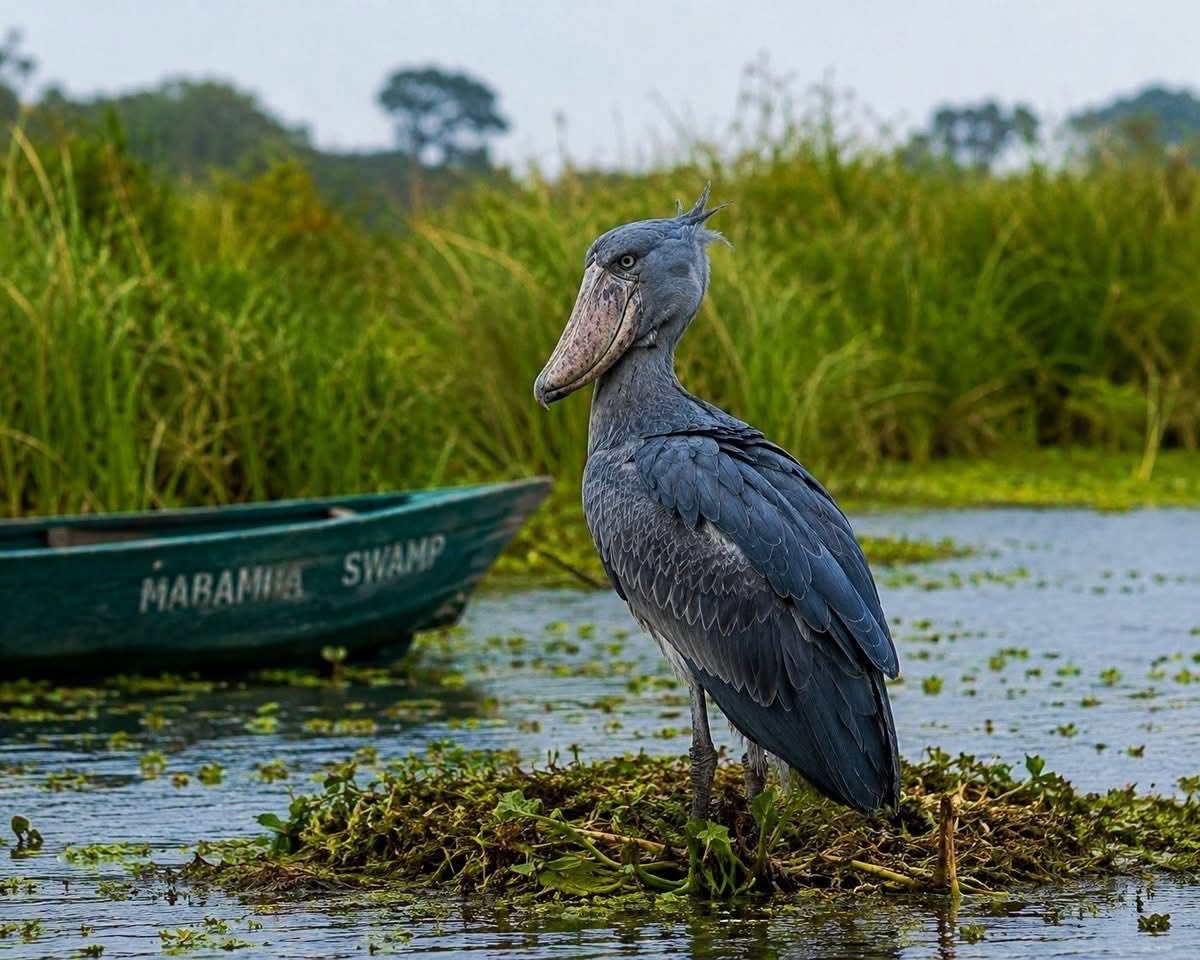
Uganda birding safari packages range from 1-day Shoebill tracking trips to 21-day comprehensive endemic circuits, with over 1,080 recorded bird species across diverse habitats. Most multi-day packages combine specialized ornithological guiding with mountain gorilla trekking and classic savannah game drives
9-days-classic-uganda-birding-safari-tourn
13-days-uganda-birding-safari-and-wildlife
20-days-uganda-birding-safari-to-uganda-national-park
21-days-uganda-birding-safari-extravaganza-to-best-uganda-safari-parks
10-days-best-uganda-birding-safari-and-wildlife-experience
9-days-best-uganda-birding-safari-tour-from-swamps-to-savannah-eastern-route
30-days-best-uganda-birding-safari-extravaganza-and-wildlife-safari
25-days-complete-uganda-birding-safari-extravaganza-with-wildlife-viewing
Popular Uganda Birding Tour Packages
1-Day Mabamba Swamp Shoebill Excursion
If you are short on time or passing through Entebbe, this half-day or full-day outing is the ultimate introduction to a Uganda birding safari. The absolute star of the show is the prehistoric-looking Shoebill stork, which hides among the dense papyrus reeds of the Mabamba Bay Wetland. Guided by local boatmen in traditional wooden canoes, you’ll glide quietly through narrow channels as the morning mist lifts. Beyond the iconic Shoebill, the swamp is teeming with vibrant aquatic life; you can expect to spot the Papyrus Gonolek, African Pygmy Goose, Malachite Kingfisher, and Blue-breasted Bee-eater. Many travelers pair this water safari with a stroll through the nearby Entebbe Botanical Gardens, adding woodland species like the Great Blue Turaco and Ross's Turaco to their day count. It’s a relaxed, incredibly rewarding trip that proves you don't need weeks in the bush to check off bucket-list bird species in the Pearl of Africa.
7-Day Savanna and Primates Birding Safari
Combining classic game drives with rich avian tracking, this week-long Uganda birding safari takes you through Murchison Falls, Kibale Forest, and Queen Elizabeth National Park. You’ll begin along the banks of the Nile River, watching for Abyssinian Ground Hornbills, Goliath Herons, and Red-throated Bee-eaters nestled into river cliffs. Moving into Kibale’s rainforests, the focus shifts to forest canopy specialists like the elusive Green-breasted Pitta alongside troops of wild chimpanzees. Finally, cruising the famous Kazinga Channel in Queen Elizabeth National Park reveals one of the highest concentrations of waterbirds in East Africa, including African Skimmers and White-tailed Larks. This package strikes a sweet spot for travelers who want to blend intense birdwatching with iconic African wildlife safaris, offering over 300 to 400 potential species sightings in just seven days.
14-Day Albertine Rift & Montane Endemics Tour
Designed for dedicated birders seeking rare lifers, this two-week Uganda birding safari focuses heavily on the Albertine Rift endemic species found nowhere else in East Africa. The journey takes you deep into the mist-shrouded montane forests of Bwindi Impenetrable National Park and the unique lowland rainforest of Semuliki National Park. In Bwindi’s high-altitude Ruhija section, you will hunt for the rare African Green Broadbill and Neumann’s Warbler, alongside Gorilla trekking opportunities. Meanwhile, Semuliki offers a taste of West African jungle species, hosting targets like the Black-dwarfed Hornbill and Spot-breasted Ibis. Traveling through varied elevations, this circuit allows birders to systematically check off forest specials, sunbirds, and flycatchers while exploring some of the oldest rainforest ecosystems on the planet.
21-Day Classic "Big Birding" Grand Circuit
For the ultimate birdwatching expedition, the 21-day grand circuit covers every major habitat zone in the country. This comprehensive Uganda birding safari spans from the semi-arid northern savannas of Kidepo Valley to the papyrus fringes of Lake Mburo, the Budongo Forest’s famed "Royal Mile," and the lush Albertine Rift. Experienced bird guides help you navigate rainforest canopies, open grasslands, and riverine wetlands to build a massive trip list that frequently tops 500 to 600 species. Highlights include tracking the Puvel's Illadopsis in Budongo, seeking the African Finfoot on Lake Mburo, and spotting Karamoja Apalis in the remote north. It’s a thrilling, immersive journey across Uganda’s landscapes that offers an unhurried, deep dive into East Africa’s rich ornithological heritage.
Top Birding Hotspots in Uganda
Mabamba Swamp
If you land at Entebbe and want to kick off your Uganda birding safari without driving for hours into the countryside, Mabamba Bay Wetland is your ultimate first stop. Situated right along the edge of Lake Victoria, this sprawling papyrus swamp is world-famous as the premier sanctuary for the elusive, prehistoric-looking Shoebill stork (Balaeniceps rex). You will board traditional wooden dugout canoes (ebitooke lined or engine-powered boats) guided by local fishermen who know every hidden channel in the reeds. As the morning mist lifts over the water, your guide gently navigates through the water lilies until you spot the mighty Bulwe (the local Luganda name for the Shoebill) standing motionless in search of lungfish. Beyond this bucket-list giant, Mabamba is home to over 300 bird species. Keep your binoculars ready for vibrant aquatic life and papyrus specialists, including the glowing Papyrus Gonolek, African Pygmy Goose, Malachite Kingfisher, Blue-breasted Bee-eater, and Swamp Flycatcher. Walking along the swamp edges or gliding through the calm waters offers an incredibly serene, authentic African wetland experience that every visiting birder treasures.
Bwindi Impenetrable National Park
Deep in the misty southwestern highlands, Bwindi Impenetrable National Park is not just a haven for mountain gorillas—it is universally celebrated as Africa’s top forest birding location. A core highlight of any serious Uganda birding safari, this ancient, UNESCO World Heritage-listed montane forest shelters over 350 recorded bird species. Most impressively, Bwindi protects 23 out of the 25 Albertine Rift endemic species found in the region. Birding here requires trekking through lush, dense vegetation (bwindi actually means "a dark, impenetrable place" in the local Runyakitara language). As you navigate the high-altitude trails around Ruhija and the lower valleys of Buhoma, the canopy comes alive with rare lifers. Target species include the critically endangered African Green Broadbill, Neumann’s Warbler, Grauer's Rush Warbler, Handsome Francolin, and the striking Rwenzori Turaco. Surrounded by gigantic fern trees, towering mahogany, and mist rising off the ridges, listening to the calls of sunbirds and flycatchers in Bwindi feels like stepping back into a pristine, primordial world.
Queen Elizabeth National Park
Spanning across the Rift Valley floor with the snow-capped Rwenzori Mountains as its backdrop, Queen Elizabeth National Park boasts one of the highest bird species counts on the entire African continent. For birders on a Uganda birding safari, this park is a paradise, featuring an astonishing checklist of over 600 species spread across diverse habitats—from open acacia savannas and crater lakes to dense hardwood forests and papyrus swamps. The absolute centerpiece of birding here is a boat launch along the natural Kazinga Channel, which connects Lake George and Lake Edward. As you float past pods of wallowing hippos, the banks swarm with waterbirds like African Skimmers, Great White Pelicans, Pink-backed Pelicans, Saddle-billed Storks, and Yellow-billed Storks. Inland, game drives through the Kasenyi plains reveal raptors, Martial Eagles, African White-backed Vultures, and the rare White-tailed Lark. End your evening taking in the golden sunset over the savanna while listening to the distant call of the African Fish Eagle echoing across the water.
Murchison Falls National Park
Where the majestic River Nile forces its way through a narrow 7-meter gorge before plunging into the Devil's Cauldron, Murchison Falls National Park offers a thrilling wild wilderness setting. As Uganda's largest protected area, it is a non-negotiable stop on a Uganda birding safari. The park’s rich mosaic of rolling savanna, riverine woodlands, and sprawling wetlands supports over 450 bird species. One of the most famous avian excursions here is the boat trip downstream toward the Nile Delta at Lake Albert. This quiet river stretch is another prime location to spot the rare Shoebill, along with Goliath Herons, African Darters, and Saddle-billed Storks. On the northern savanna plains, keep an eye out for large ground-dwellers like the Abyssinian Ground Hornbill striding through the tall grass, Northern Carmine Bee-eaters perched on acacia branches, Denham’s Bustards, and Swallow-tailed Bee-eaters. The combination of roaring waterfalls, elephant herds on the banks, and incredible bird density makes Murchison an unforgettable African wilderness adventure.
Kibale Forest National Park
Widely acclaimed as the primate capital of the world for its thriving chimpanzee populations, Kibale Forest National Park is equally a world-class sanctuary for rainforest bird species. Tucked away in western Uganda, Kibale's tall, evergreen tropical rainforest protects over 375 bird species, making it a dream destination for forest species seekers on a Uganda birding safari. The ultimate Holy Grail for birders visiting Kibale is tracking the jewel of the forest floor: the elusive Green-breasted Pitta. Early morning treks guided by expert local naturalists give you the best chance of hearing its distinctive display call and catching a glimpse of its vibrant green, blue, and crimson plumage. As you walk under the dense rainforest canopy, you will also spot canopy species like the Great Blue Turaco, Black-bee-eater, African Gray Parrot, Brown-illadopsis, and various hornbills. Pair your forest walk with a visit to the nearby Bigodi Wetland Sanctuary—a community-run swamp boardwalk teeming with papyrus endemics and primates—for a rich, well-rounded forest birding experience.
What makes a 1-day Mabamba Swamp excursion essential for a Uganda birding safari?
A 1-day Mabamba Swamp excursion provides quick access to one of Africa's most iconic wetland birding experiences. Located on the northern shores of Lake Victoria near Entebbe and Kampala, this RAMSAR-designated site is world-famous as the most reliable sanctuary for the prehistoric Shoebill stork (Balaeniceps rex). Guided by local boatmen in quiet wooden canoes through narrow papyrus channels, birders can approach this elusive, lungfish-hunting giant at close range. Beyond the Shoebill, Mabamba holds over 300 recorded bird species, including papyrus-endemic specialists like the Papyrus Gonolek, Papyrus Yellow Warbler, and Blue-headed Coucal. It serves as the ideal launchpad for any Uganda birding safari.
How many bird species can you expect on a 7-day savanna and primates Uganda birding safari?
On a 7-day savanna and primates Uganda birding safari, birders typically build a checklist of 300 to 500 species depending on the season and weather conditions. Traversing Murchison Falls, Kibale Forest, and Queen Elizabeth National Park, this circuit packs savanna species, rainforest canopy birds, and aquatic species into one week. Highlights include Abyssinian Ground Hornbills in Murchison, Green-breasted Pittas in Kibale, and dense concentrations of waterbirds along the Kazinga Channel.
What key bird targets are included in a 14-day Albertine Rift endemic Uganda birding safari?
A 14-day Albertine Rift endemic Uganda birding safari focuses on high-altitude montane endemics and rare lowland forest species. Key targets in Bwindi Impenetrable National Park include the critically endangered African Green Broadbill, Neumann’s Warbler, Handsome Francolin, and Grauer’s Rush Warbler. In Semuliki National Park, birders target West African Guinea-Congo biome specials such as the Black-dwarf Hornbill, Spot-breasted Ibis, and Congo Serpent Eagle.
What habitats are covered during a 21-day grand circuit Uganda birding safari?
A 21-day grand circuit Uganda birding safari covers virtually every major ecosystem in the country. The route takes birders from the semi-arid savanna plains of Kidepo Valley in the far north to the papyrus swamps of Lake Mburo, the riverine forests along the Nile River, the Budongo Forest’s famous "Royal Mile," and the misty montane rainforests of the Albertine Rift. This broad habitat coverage allows birders to build a massive trip list exceeding 500 to 600 species.
Why is Mabamba Swamp considered the premier site for the Shoebill Stork?
Mabamba Swamp is considered the premier Shoebill location because of its high population density of lungfish—the bird's primary prey—and its extensive papyrus reed networks. The shallow channels allow local motorized or paddled canoes to navigate silently close to feeding Shoebills without disrupting their natural behavior. Sightings here yield a success rate near 100% on morning boat outings.
What makes Bwindi Impenetrable National Park a top destination for an Albertine Rift Uganda birding safari?
Bwindi Impenetrable National Park is recognized as Africa’s top forest birding destination because it shelters over 350 species, including 23 of the 25 Albertine Rift endemics present in Uganda. Its wide elevation gradient (1,160 m to 2,607 m above sea level) supports diverse altitudinal zones ranging from lowland forest to high-altitude montane ecosystems.
Why is Queen Elizabeth National Park famous among birders on a Uganda birding safari?
Queen Elizabeth National Park boasts a species checklist exceeding 600 recorded birds—one of the highest species counts for any national park in Africa. Its position along the Rift Valley floor creates a mosaic of open savanna grasslands, acacia woodlands, crater lakes, papyrus swamps, and tropical hardwood forests, hosting both resident African species and Palearctic migrants.
What unique avian species can you spot in Murchison Falls National Park?
Murchison Falls National Park hosts over 450 bird species across its riverine and savanna habitats. Key avian targets include the Abyssinian Ground Hornbill, Goliath Heron, Red-throated Bee-eater, Northern Carmine Bee-eater, Denham’s Bustard, Swallow-tailed Bee-eater, and Pel’s Fishing Owl near the Nile River Delta.
Why do birders visit Kibale Forest National Park on a Uganda birding safari?
Kibale Forest National Park is famous for housing over 375 bird species and serves as the prime location in East Africa to track the elusive Green-breasted Pitta (Pitta reidii). Guided early morning walks allow birders to locate this colorful ground-dwelling bird during its display period alongside other canopy specials like the Great Blue Turaco and Black-and-white-casqued Hornbill.
What is the total number of recorded bird species in Uganda?
Uganda boasts over 1,080 recorded bird species, representing approximately 50% of Africa's total avian diversity and 11% of the world's total species count in a country roughly the size of Great Britain.
Can you combine gorilla trekking with a Uganda birding safari?
Yes, multi-day itineraries frequently combine mountain gorilla trekking in Bwindi Impenetrable National Park with specialized birdwatching. Birders can trek for gorillas in sectors like Buhoma or Ruhija while logging rare Albertine Rift endemics along the same forest trails.
What is the best time of year for a Uganda birding safari?
While birding in Uganda is rewarding year-round, the peak season runs from November to April, when migratory birds from Europe and Asia arrive in large numbers. Additionally, June to August offers drier forest trails, making forest bird tracking easier.
What papyrus endemic birds can be seen in Mabamba Swamp?
Beside the Shoebill Stork, Mabamba Swamp supports papyrus specialists such as the Papyrus Gonolek, Papyrus Yellow Warbler, White-winged Warbler, Carruther’s Cisticola, and Papyrus Canary.
What makes the Kazinga Channel boat cruise in Queen Elizabeth National Park special for birding?
The 32-kilometer Kazinga Channel connects Lake George and Lake Edward, serving as a natural magnet for thousands of waterbirds. A two-hour boat launch offers close encounters with African Skimmers, Great White Pelicans, Pink-backed Pelicans, Saddle-billed Storks, and African Fish Eagles.
What are Albertine Rift endemics, and why are they significant on a Uganda birding safari?
Albertine Rift endemics are range-restricted bird species found only in the montane forests bordering the Albertine Rift Valley. Out of approximately 40 Albertine endemics, Uganda hosts 24, including the African Green Broadbill, Handsome Francolin, and Rwenzori Turaco.
What specialized equipment should you bring on a Uganda birding safari?
Birders should pack 8x42 or 10x42 waterproof binoculars, a telephoto camera lens (400mm or longer), waterproof hiking boots, muted olive or khaki clothing, lightweight rain gear, and a recognized field guide to East African birds.
Why is the Budongo Forest’s "Royal Mile" famous on multi-day Uganda birding safari tours?
Located within the Budongo Forest Reserve near Murchison Falls, the "Royal Mile" is famous for offering high-density forest canopy birding along a wide, flat forest road. It is one of the best locations to spot Puvel's Illadopsis, Chocolate-backed Kingfisher, and Yellow-spotted Barbet.
How does boat birding differ from forest trekking on a Uganda birding safari?
Boat birding at sites like Mabamba Swamp, the Kazinga Channel, or the Nile Delta allows for easy, close-up views of waterbirds from a stable platform. Forest trekking in locations like Bwindi or Kibale requires active foot tracking through dense vegetation, relying on bird calls to spot canopy and understory species.
Is a local bird guide necessary for a Uganda birding safari?
Yes, hiring a licensed local ornithological guide is essential. Expert guides know species calls by ear, understand micro-habitats, and track cryptic species in dense forest canopies, significantly increasing trip sightings.
What role does Bigodi Wetland Sanctuary play in forest birding near Kibale?
Located right outside Kibale Forest National Park, Bigodi Wetland Sanctuary is a community-managed swamp walk featuring elevated wooden boardwalks. It provides access to papyrus endemics and forest edge birds like the Great Blue Turaco alongside 8 distinct primate species.
Booking Uganda birding safari with us Roads of Adventure safaris
Booking a Uganda birding safari with Roads of Adventure Safaris guarantees an expertly crafted expedition through the Pearl of Africa’s rich avian habitats, guided by seasoned local ornithological experts who know the subtle calls and micro-habitats of over 1,080 recorded species. From tracking the iconic Shoebill Stork in the papyrus channels of Mabamba Swamp to scanning the dense canopy of Bwindi Impenetrable National Park for rare Albertine Rift endemics, our itineraries—ranging from 1-day excursions to comprehensive 21-day grand circuits—are tailored around your specific target list, preferred travel pace, and desired combination of birding, gorilla trekking, and classic savanna wildlife drives. By traveling in our custom 4x4 Land Cruisers with top-tier driver-guides, secure permit handling, and hand-picked eco-lodges, you gain an authentic, seamless, and unhurried birdwatching journey designed to maximize your lifers list.