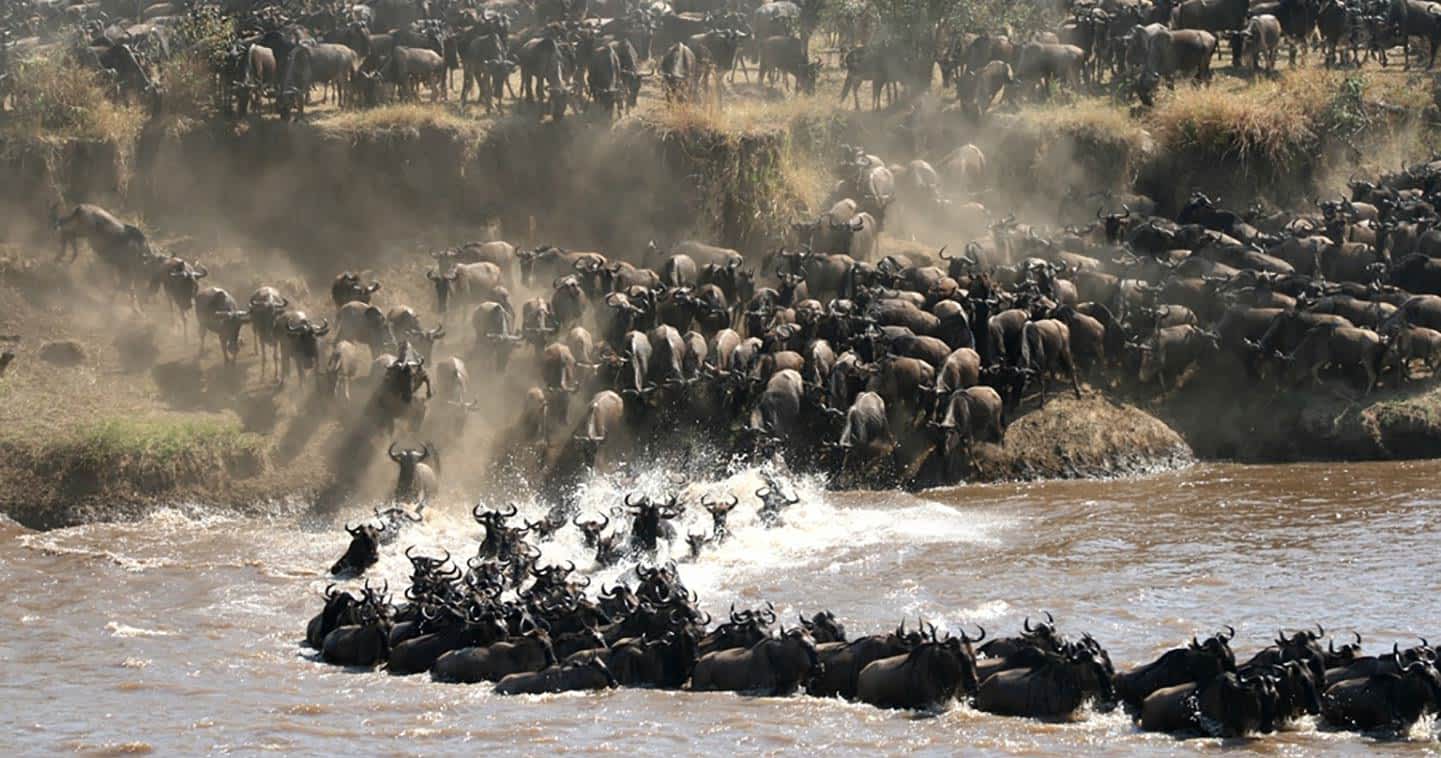
The best time to witness the Wildebeest Migration in the Serengeti is generally from June to October for river crossings and January to February for the calving season. The northern Serengeti (Mara River) features dramatic, high-action crossings from July to October, while the southern Ndutu area offers calving in early in the year.
8-days-great-mara-river-crossing-hadzabe-tribe-and-optional-hot-air-balloon-tanzania-safari
7-days-best-great-wildebeest-migration-safari-in-tanzania
6-days-ndutu-migration-and-tanzania-safari-itinerary
5-days-ultimate-ndutu-migration-calving-season-safari-to-tanzania
4-days-central-serengeti-safari-tour-and-mara-river-crossing-in-northern-serengeti
3-days-southern-serengeti-safari-tour-and-ngorongoro-crater-calving-season-package
1. River Crossings (Northern Serengeti)
Timing: August – October
This is the most iconic and perilous chapter of the migration. Driven by the need to reach the lush grazing grounds of the Maasai Mara in Kenya, the herds congregate in the Northern Serengeti. The primary obstacle is the Mara River, a deep, fast-flowing waterway teeming with Nile crocodiles.
The drama lies in the "anticipation." Thousands of wildebeest may gather on the banks for days, hesitant to commit. When one brave individual finally leaps, a chaotic stampede follows. The danger is twofold: the physical power of the river and the predators lurking within it. Hundreds of animals can perish in a single crossing due to drowning or predation, providing a vital nutrient surge for the river's ecosystem. For travelers, this is the peak of high-stakes wildlife viewing, characterized by dust, noise, and raw survival.
2. Calving Season (Southern Serengeti/Ndutu)
Timing: January – March
In the short-grass plains of the south, the migration enters its most tender phase. Nutrient-rich volcanic soils produce grass high in phosphorus and calcium—perfect for lactating mothers. Over the course of three weeks in February, a synchronized birthing event occurs: roughly 500,000 calves are born, sometimes at a rate of 8,000 per day.
This "predator swamping" strategy ensures that even with heavy losses to lions, cheetahs, and hyenas, the sheer volume of newborns ensures enough will survive to maintain the population. It is a period of high activity; calves are on their feet within minutes, and the plains are alive with the sounds of thousands of animals. While less "violent" than the river crossings, the calving season offers intense predator-prey interactions as big cats take advantage of the vulnerable young.
3. Western Corridor (Grumeti River)
Timing: June – July
As the southern plains dry out, the herds move northwest toward Lake Victoria. The bottleneck here is the Grumeti River. While smaller and less famous than the Mara River, the Grumeti presents its own unique challenges. The river often consists of series of pools rather than a continuous flow, forcing the herds into narrow channels.
The Nile crocodiles here are some of the largest in Africa, having waited nearly a year for this seasonal feast. Because the vegetation in the Western Corridor is denser and the riverbanks are steeper, the crossings feel more intimate and claustrophobic than the wide-scale chaos of the north. This phase is often the most underrated, offering spectacular sightings with fewer crowds than the August peak.
4. The Return South
Timing: November – December
Triggered by the start of the "short rains," the herds begin their rapid descent from the Maasai Mara back toward the Southern Serengeti. This is a journey of replenishment. The wildebeest are moving quickly, covering long distances daily to reach the fresh green shoots emerging in the south.
Unlike the river crossings, this phase is characterized by movement and momentum. The herds often spread out across the eastern and central Serengeti (Seronera), creating vast "sheets" of animals that stretch to the horizon. It is a time of transition; the dust of the dry season is washed away by afternoon thunderstorms, and the landscape turns a vibrant green. For the wildebeest, it is a race to reach the calving grounds before the cycle begins all over again in January.
To honor your request for depth while maintaining the specific structure of your questions, I have expanded on each point. Each entry provides the biological "why" behind the timing and the tactical "how" for your planning.
1. What is the overall best time to see the migration in Tanzania?
While the "best" time is subjective, the window from July to October is widely considered the pinnacle of the Serengeti experience. This is the height of the dry season, a period where the environment itself dictates animal behavior with ruthless precision. As the smaller water holes in the south and central plains vanish, the herds are forced into the far north, where the Mara River remains a permanent water source.
From a photography and viewing perspective, this is the most "dramatic" time. The grass is short and golden, providing little cover for predators and making the massive herds of wildebeest and zebra visible for miles. This is also when you witness the world-famous river crossings. However, "best" also means "busiest." Because this is the most popular time, lodges reach full capacity, and you will share the riverbanks with many other safari vehicles. If you prefer a more solitary experience with vibrant, green landscapes, you might find the "best" time to be the calving season in February.
2. When does the calving season occur?
The calving season is a synchronized biological marvel that takes place in the Southern Serengeti and the Ndutu region (the border of the Serengeti and Ngorongoro Conservation Area) between late December and March. While calves are born throughout this window, the undisputed peak is February. In a staggering display of evolutionary strategy, roughly 500,000 wildebeest are born within a two-to-three-week period.
This synchronization is a survival tactic known as "predator swamping." By producing so many vulnerable young at once, the wildebeest overwhelm the local predator population—lions, hyenas, and cheetahs simply cannot eat them all. The southern plains are chosen for this event because the volcanic soil is exceptionally rich in phosphorus and calcium, minerals essential for lactating mothers and the rapid bone development of the calves. Within minutes of birth, a calf is on its feet and keeping pace with the herd, a necessity in a landscape where danger is ever-present.
3. When is the best time for Mara River crossings?
The most sought-after spectacle—the Mara River crossing—typically occurs from July to October. During these months, the herds are concentrated in the Northern Serengeti’s Kogatende and Lamai regions. The timing is governed by the rains; the wildebeest follow the scent of thunderstorms to reach the greener pastures of the Maasai Mara in Kenya, but to get there, they must run the gauntlet of the river.
Watching a crossing requires immense patience. It is not a scheduled event. A herd might gather by the thousands on a cliff edge, staring at the water for hours or even days. The first animal to leap—the "brave one"—triggers a terrifying, chaotic rush. The "best" time within this window is usually August and September, when the pressure to find food is highest and crossings become more frequent. Because the herds move back and forth across the border based on localized rain, you can often see crossings in both directions during this period.
4. When can I see the migration in the Western Corridor?
The Western Corridor, specifically the area around the Grumeti River, becomes the focal point of the migration from late April through June. This phase occurs as the herds move away from the drying southern plains, heading northwest toward the "fingers" of the Serengeti that stretch toward Lake Victoria.
This region offers a different landscape—densely wooded and riverine—compared to the open southern plains. The Grumeti River crossings are spectacular but often overlooked. While the river is usually shallower than the Mara, it is famous for its "giant" Nile crocodiles, some of the largest on the continent, which have evolved to feast on the annual arrival of the migration. Because this period coincides with the end of the rains and the transition into the dry season, the air is clear, the dust is low, and the tourist numbers are significantly lower than in the August peak.
5. What is the best time for predator action?
If your primary goal is to see big cats in action, the calving season (January to March) is unparalleled. While predators are present year-round, the concentration of vulnerable, clumsy newborns in the southern plains acts as a magnet for every carnivore in the region. Lions, leopards, cheetahs, and spotted hyenas descend upon the Ndutu area to take advantage of the easy kills.
Cheetahs, in particular, thrive on these open plains during the calving season, as the short grass allows them to utilize their speed. It is common to see multiple hunts in a single day. However, it isn't just about the hunt; it’s also a time of abundance for the predators' own young. With food so plentiful, lion prides and cheetah mothers have a higher success rate in raising their cubs. The intensity of life and death is never more visible than during these months, as the circle of life plays out in high definition on the open savanna.
6. Is the migration visible all year round?
A common misconception is that the migration is an "event" that happens and then ends. In reality, it is a continuous, never-ending loop. The 1.5 million wildebeest and 250,000 zebras are in a constant state of motion, covering a circular route of nearly 600 miles through the Serengeti-Mara ecosystem.
The herds are always "somewhere." In January, they are in the south; by May, they are in the west; by August, they are in the north; and by November, they are trekking back south. The migration does not have a "start" or "stop" line; it is a response to the rhythm of the African seasons. While the location changes, the sheer scale of the herds means they are always visible if you are in the right sector of the park. This year-round nature allows for different types of safaris—from the lush, quiet birdwatching of the wet season to the high-drama river crossings of the dry season.
7. When should I visit the Southern Serengeti?
The Southern Serengeti, specifically the Ndutu and Kusini areas, is best visited from December to March. This is when the region transforms from a dry, desolate dust bowl into a vibrant, emerald-green carpet of highly nutritious grass. The herds arrive here following the "short rains" of November, sensing the fresh growth that will support their impending birthing season.
Visiting during this time offers a unique "wide-angle" perspective of the migration. Unlike the river crossings where animals are bunched together in panic, the southern plains allow the herds to spread out. You can stand on a ridge and see wildebeest from horizon to horizon—a literal sea of life. It is also the best time for birding, as migratory species from Europe and North Africa are present. The weather is generally warm with occasional afternoon thundershowers, which clear the air for stunning, high-contrast photography.
8. When should I visit the Northern Serengeti?
To witness the migration in the Northern Serengeti (Kogatende and the Lamai Wedge), you must time your visit between July and October. For the rest of the year, this area is relatively quiet (though still home to excellent resident big cats). But during these four months, it becomes the most exciting wildlife destination on Earth.
The North is characterized by rolling hills, granite kopjes, and the winding Mara River. Because the herds are concentrated here by the lack of water elsewhere, the density of wildlife is staggering. This is the only place and time where you can see the "mega-herds" before they fragment. The infrastructure in the North is geared toward this season, with many high-end mobile camps appearing specifically to track the river movements. If you want the classic "National Geographic" experience of dust, crocodiles, and thousands of animals plunging into a river, the North in September is your destination.
9. When should I visit the Central Serengeti?
The Central Serengeti (Seronera) is the heart of the park and is unique because it is a "transition zone." The best time to see the migration here is during the shoulder seasons: April to May (as they move west and north) and November to December (as they return south).
However, Seronera is the only part of the Serengeti that is a superb year-round destination. Because it has permanent water sources (the Seronera River), it supports a massive population of "resident" wildlife that doesn't migrate. It is famously known as the "Leopard Capital of the World" due to the high density of leopards living in the sausage trees along the riverbanks. Even if the main migration herds have moved on, you are almost guaranteed to see lions, leopards, and cheetahs here, making it a vital stop on any safari itinerary regardless of the month.
10. What is the migration like during the rainy season?
The "long rains" occur in April and May, and while many travelers avoid this time, it is a period of profound beauty. The migration is usually moving through the Central and Western Serengeti during these months. The plains are lush, the air is free of dust, and the colors are incredibly vivid—deep greens and dramatic, dark-blue storm clouds.
The "rainy season" does not mean it rains all day; typically, there is a heavy downpour in the afternoon followed by sunshine. The main challenge is logistics; some roads become impassable "black cotton" mud, and certain mobile camps close down. However, the rewards are significant: the parks are empty of other tourists, and the lodges offer their lowest rates of the year. If you are an experienced traveler looking for a more intimate, "wild" Africa and don't mind a bit of mud, the rainy season migration is a spectacular secret.
11. Is June a good time for the migration?
June is an exceptional transitional month and is often considered one of the best times to visit for those who want a balance of good weather and great wildlife. As the rains end, the herds begin moving in earnest from the Central Serengeti into the Western Corridor. This is when they encounter the first major water obstacle: the Grumeti River.
In June, the "rut" (mating season) is usually in full swing. The plains are filled with the constant, low-frequency grunting of male wildebeest as they compete for territory and mates. It is a loud, high-energy period. The weather is also cooling down, leading into the "winter" months of July and August, meaning early morning drives are crisp and comfortable. Because the "peak" season hasn't fully started, you can often find better availability at lodges while still seeing massive herd movements and the early river crossings.
12. When do the herds start moving back south?
The southward journey usually begins in late October or November. After spending several months grazing in the North and the Maasai Mara, the herds sense the arrival of the "short rains" in the Southern Serengeti. They begin a rapid, purposeful trek through the eastern and central sections of the park.
Unlike the northward journey, which is a slow graze, the return south is often a fast-paced march. The wildebeest can cover long distances in a single day, seemingly driven by an internal compass toward the nutrient-rich birthing grounds. This is a time of "sheets" of animals—vast columns that can be miles long. By December, the first herds are reaching the Ndutu plains, ready to begin the cycle of life again. For visitors, this is a great time to be in the Central or Eastern Serengeti (Namiri Plains) to catch the herds as they pass through.
13. How far in advance should I book?
For the Great Migration, the rule is: the earlier, the better. It is highly recommended to book 12 to 18 months in advance, especially if you plan to visit during the peak months of July to October or the calving season in February.
The Serengeti has a strict limit on the number of beds available in certain regions to prevent over-tourism. The best-located lodges and the small, intimate "mobile" camps (which only have 6–10 tents) sell out over a year in advance. If you wait until six months before your trip, you may find that the lodges closest to the river crossings or the calving grounds are completely full, forcing you to stay further away and spend more time driving to reach the action. Early booking also allows you to secure better rates on international flights and ensures you get the most experienced guides.
14. Do I need to be in Kenya to see the migration?
A common misconception is that you must go to the Maasai Mara in Kenya to see the migration. In reality, the migration spends about 80–90% of the year in Tanzania. The herds only cross into Kenya for a few months (typically August to October), and even then, a large portion of the herd often stays on the Tanzanian side of the Mara River.
Tanzania’s Serengeti is also significantly larger than Kenya’s Maasai Mara (about 5,700 square miles vs. 580 square miles). This means that in Tanzania, you have a much wider variety of landscapes and "phases" of the migration to see—from the calving in the south to the Grumeti in the west. You can witness the spectacular Mara River crossings perfectly from the Tanzanian side (Kogatende). In fact, many safari-goers prefer the Tanzanian side because the Northern Serengeti is more remote and often feels less crowded than the more accessible Maasai Mara.
15. Is it guaranteed to see a crossing?
No matter how well you plan, a river crossing is never guaranteed. Wildlife behavior is inherently unpredictable. You might sit by the river for six hours watching a herd of 10,000 wildebeest graze on the bank, only for them to decide at the last minute not to cross because a crocodile surfaced or a vulture flew overhead.
The key to seeing a crossing is patience and time. This is why experts recommend staying in the Northern Serengeti for at least 3 to 4 days. If you only spend one day in the area, your chances are hit-or-miss. If you spend four days, your probability of witnessing a crossing increase dramatically. It is also important to have a guide who understands "herd mentality"—someone who can read the subtle signs of an impending crossing so you can be in position without spooking the animals. Even if you don't see a crossing, the sheer scale of the herds in the North is a world-class experience in its own right.
Booking Wildebeest migration with us Roads of Adventure safaris
Booking a Wildebeest Migration safari with Roads of Adventure Safaris focuses on witnessing the annual movement of over 1.5 million wildebeest and zebras across the Serengeti (Tanzania) and Masai Mara (Kenya). They offer customized, expert-guided, and, in some cases, luxury-focused itineraries, including 6-day Big Five and Migration packages
