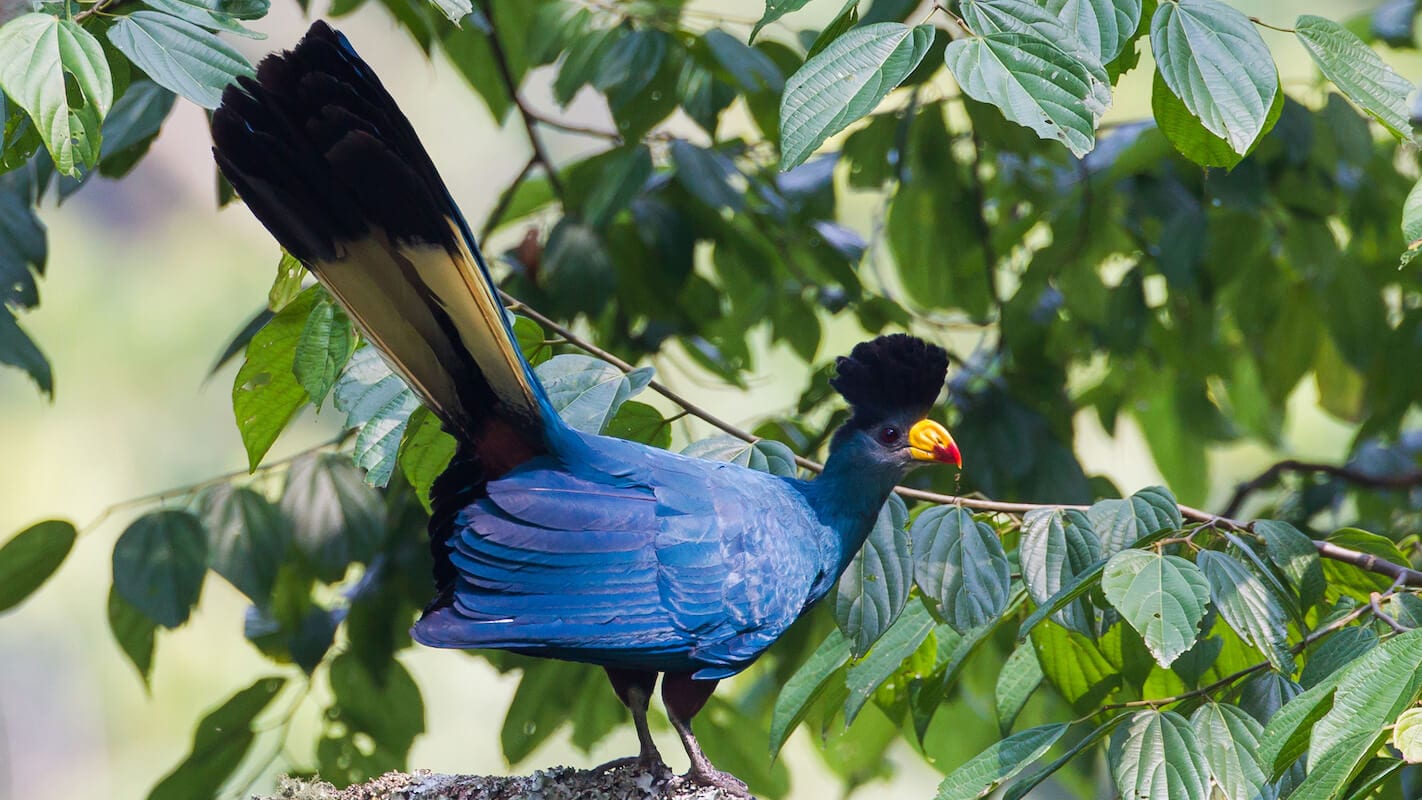
A 5-day safari combines the open wetland ecosystem of the Mabamba Swamp with the dense, primary rainforest of Kibale National Park. You will have the opportunity to spot the rare Shoebill Stork as well as hundreds of Albertine Rift endemic and forest bird species
Tour highlights for 5-day bird watching in Uganda
Spot iconic Shoebill
Track prehistoric stork
Explore papyrus channels
Find rare Pitta
See blue Turacos
Hike Kibale rainforest
Track wild chimpanzees
Walk Bigodi boardwalks
Observe waterbird congregations
Log endemic species
Day by day 5-day bird watching in Uganda
Day 1: Arrival and Transfer to Entebbe
Your premier 5-day bird watching safari in Uganda begins the moment you touch down at Entebbe International Airport, a peninsula jutting into Lake Victoria. After clearing customs, you will meet your expert guide and transfer to your nearby hotel to unpack and refresh.
If your flight arrives early, we immediately maximize your trip with an introductory excursion to the historic Entebbe Botanical Gardens. Established in 1898, these sprawling lakeshore gardens feature a magnificent mix of indigenous tropical forest canopy and open lawns. Walking beneath the giant mahogany trees provides an exceptional welcome package to East African birding.
Within just a few hours, you can tick off spectacular resident species including the massive Black-and-white-shriked Hornbill, the iridescent Orange-tufted Sunbird, Ross’s Turaco, and the iconic Great Blue Turaco. Overhead, African Fish Eagles fill the air with their haunting calls, offering a perfect, low-intensity prelude to your upcoming wilderness expeditions.
Day 2: Mabamba Swamp Shoebill Excursion
We launch this elite bird watching safari in Uganda with an early morning journey to the legendary Mabamba Bay Wetland. Arriving at the swamp’s edge, you will board a stable, traditional motorized wooden canoe specifically designed to slide seamlessly through the dense papyrus maze.
The primary target today is the prehistoric, vulnerable Shoebill Stork. Working in tandem with local fishermen, your specialized guide will navigate the narrow, lily-choked channels to track these solitary giants as they stand motionless, hunting lungfish in the shallow waters.
While scanning for the Shoebill, the rich wetland ecosystem keeps your binoculars busy. The marsh vegetation is alive with dazzling waterbirds. You can expect to spot the vibrant Papyrus Gonolek, Lesser Jacana, Blue-breasted Bee-eater, Malachite Kingfisher, and the secretive White-backed Duck. After a thrilling morning on the water, we return to the mainland and prepare for tomorrow's journey westward toward the Albertine Rift.
Day 3: Journey to Kibale National Park
Today, you embark on a highly scenic 300-kilometer drive from central Uganda to the lush western highlands. The 5-to-6-hour journey winds through a beautiful rolling landscape of terraced hills, vibrant local markets, and vast, emerald-green tea plantations.
Far from a simple transfer, this route is treated as an active part of your bird watching safari in Uganda. We make several strategic birding stops at roadside papyrus swamps and forest patches along the Mityana and Mubende corridors to scout for open-country and woodland species.
As we approach Fort Portal town, the dramatic silhouette of the Rwenzori Mountains rises on the horizon, guiding us toward the ancient fringes of Kibale National Park. Upon arrival, you will check into your lodge, which is nested directly against the primary rainforest wall. As dusk settles, you can enjoy a relaxing dinner listening to the evening chorus of forest nightjars, tree hyraxes, and owls.
Day 4: Kibale Forest Birding and Bigodi Swamp Walk
This day represents a major pinnacle for forest listing. Before dawn breaks, you will enter the deep, humid interior of Kibale National Park with a specialized park guide. Kibale protects over 375 bird species, and our early morning mission is to locate the rare, beautifully colored Green-breasted Pitta. Finding this elusive ground-dweller requires sitting quietly in the dark understory, waiting for its brief morning display flight over the leaf litter.
In the afternoon, your bird watching safari in Uganda shifts to the community-run Bigodi Wetland Sanctuary. Navigating an excellent wooden boardwalk system built over the marsh, you will explore a vital corridor rich in edge-forest and wetland specialists. Bigodi is famous for its high concentration of the spectacular Great Blue Turaco. Walking here easily yields views of the Papyrus Yellow Warbler, Black-billed Turaco, Shining-blue Kingfisher, Hairy-breasted Barbet, and a variety of colorful forest weavers and sunbirds.
Day 5: Morning Birding and Return to Kampala/Entebbe
On your final morning, you can customize your experience to round out your itinerary. You may choose a final, slow-paced bird walk along the sunny forest edges, which are highly productive for spotting busy canopy flocks, honeyguides, and double-toothed barbets. Alternatively, you can opt to track Kibale’s famous habituated chimpanzee troops, watching these incredible primates forage while keeping an eye out for any forest raptors soaring above the clearings.
Following an early lunch at the lodge, you will pack your gear and begin the return drive back across the countryside to Kampala or Entebbe. Your guide will ensure a smooth arrival at the airport in time for your evening check-in and international departure flight. You will return home with a deeply enriched life list, memories of a prehistoric stork, and unforgettable highlights from an elite bird watching safari in Uganda.
1. Why is a 5-day duration perfectly optimized for combining Mabamba Swamp and Kibale Forest?
A 5-day itinerary is exceptionally efficient because it minimizes transit exhaustion while concentrating your time on two of the most distinct, high-yield habitats in the country. A standard bird watching safari in Uganda often involves weeks of driving to cover the entire country, but this specific 5-day setup slices away the fluff. It allows an avitourist to masterfully bridge a vast, open freshwater wetland ecosystem at Lake Victoria with a mid-altitude primary tropical rainforest block in the Albertine Rift.
Because Mabamba is located immediately adjacent to Entebbe International Airport, it can be tackled seamlessly on Day 2 without requiring an intensive domestic transfer. This leaves a solid, uninterrupted three days to dive deep into Kibale Forest National Park and its surrounding wetland extensions.
You spend virtually no time "waiting" for birding opportunities; your binoculars are active within two hours of arrival on Day 1 at the Entebbe shores, and you remain immersed in diverse ecosystems right until your departure check-in on Day 5. For travelers with limited time, or for serious listers wanting to target Africa's two most elusive flagship species—the Shoebill Stork and the Green-breasted Pitta—this exact 5-day blueprint eliminates long, unproductive travel days and maximizes your time in front of active feeding flocks.
2. What makes the Shoebill tracking experience in Mabamba Swamp completely unique on this 5-day tour?
The Shoebill (Balaeniceps rex) tracking excursion on Day 2 of this safari stands out because it is a highly specialized, quiet marine operation that contrasts sharply with the interior forest walking trails you will encounter later in Kibale. Mabamba Bay is a vast, 2,400-hectare Ramsar site consisting of a complex labyrinth of narrow channels choked with papyrus reeds, miscanthus grass, and water lilies.
The tracking is done using small, stable, motorized wooden canoes operated by local community boat captains who have spent their entire lives studying the movements of the swamp. Once you navigate away from the Nakiwogo landing site, the boat captains cut the engines and use long poles to silently push through the narrowest paths.
This silence is critical: the Shoebill is a solitary, patient hunter that stands completely frozen for hours, waiting for lungfish or catfish to surface in the shallow, muddy glades. The thrill of turning a tight papyrus corner and suddenly seeing a prehistoric, five-foot-tall bird with a massive, bulbous, razor-sharp shoe-shaped bill just meters away is unparalleled. Because these local guides work together in real-time, your 5-day safari offers a remarkably high 90% success rate for finding this species, providing a breathtaking, high-impact start to your wildlife checklist before you even head toward the western rainforests.
3. How does the geographical transit on Day 3 serve as an active birding transition?
Day 3 of this 5-day bird watching safari in Uganda involves a 300-kilometer road transfer from the central Lake Victoria basin to the western highlands of Fort Portal. While a standard tour might treat this 5-to-6-hour drive simply as a transit day, an elite birding itinerary transforms the highway corridor via Mityana and Mubende into an active, shifting laboratory of ecological change.
As you leave the humid, low-lying Victoria basin, the elevation steadily rises, causing a complete transformation in the surrounding plant and bird communities. Your expert guide will plan strategic stops along roadside wetlands, cultivation edges, and remnant forest patches.
These brief stops allow you to step out and quickly log open-country, woodland, and agricultural edge specialists that are absent from both the deep interior of Kibale and the thick papyrus of Mabamba. You will scan the skies and telephone wires for the striking Long-crested Eagle, Lizard Buzzard, and Blue-breasted Bee-eater.
As the road approaches the tea-growing region of Fort Portal, the air cools dramatically, and you will begin to encounter your first mid-altitude forest edge birds, such as the raucous Black-and-white-casqued Hornbill and Ross's Turaco. This ensures that Day 3 is a highly productive listing day that bridges your aquatic wetland entries with the upcoming tropical rainforest blocks.
4. What is the precise methodology required to spot the Green-breasted Pitta in Kibale Forest on Day 4?
The Green-breasted Pitta (Pitta reichenowi) is notoriously regarded as one of the ultimate, most secretive forest prizes on a bird watching safari in Uganda. On Day 4, finding this vibrant, ground-dwelling jewel requires a precise, highly disciplined pre-dawn methodology managed by an armed Uganda Wildlife Authority specialist park ranger.
You must gather at the Kanyunchu Visitor's Centre by 6:00 AM, entering the pitch-black rainforest understory with headlamps before the forest truly wakes up. The pitta is masterfully camouflaged with its leaf-green back, black face mask, and bright red vent, making it virtually invisible once it is sitting silently on the dark forest floor.
The entire tracking strategy relies on listening closely for the male's brief, mechanical breeding display. During its peak display months, the male pitta will leap up onto a low, mossy branch or fallen log and perform a sudden, explosive wing-flap that creates a distinctive, low, structural "brrrp" vibration whistle that cuts through the dawn air.
Your birding group must move in total silence, walking softly over damp leaves to pinpoint the exact location of that sound. Once the ranger locates the display perch, you sit perfectly still, training your binoculars on the forest floor. Spotting this legendary bird as the first rays of morning light pierce the primary mahogany canopy is an intense, high-reward highlight that requires the specialized focus this 5-day itinerary provides.
5. How does Bigodi Wetland Sanctuary complement the interior forest birding of Kibale on Day 4?
While the morning of Day 4 is spent inside the dense, shaded canopy of Kibale Forest, the afternoon shifts to the sun-drenched, open edges of the Bigodi Wetland Sanctuary. This transition is crucial because interior rainforest birding can be incredibly challenging due to thick foliage, but Bigodi offers a wide-open, high-visibility wetland-fringe environment.
Bigodi is a community-run conservation area consisting of an extensive papyrus marsh bordered by lush riverine forest, acting as a vital wildlife corridor for birds moving out of the main national park. Walking along Bigodi's well-maintained 4.5-kilometer wooden boardwalk system gives you an unobstructed window into the mid-tier and canopy layers.
The sanctuary is affectionately nicknamed the "Home of the Great Blue Turaco" because of its astonishing density of these giant, bright blue and yellow birds; it is common to see small groups of them crashing clumsily through the wild fruit trees along the swamp trail.
Furthermore, Bigodi allows you to easily target localized papyrus specialties that require more light to observe clearly than the deep forest allows. Here, you can smoothly cross off the brilliant Papyrus Gonolek, Papyrus Yellow Warbler, White-winged Warbler, Shining-blue Kingfisher, and the striking Hairy-breasted Barbet, making it the perfect, high-yield balance to the morning's intense forest tracking.
6. What specialized camera gear and settings are mandatory for this specific 5-day itinerary?
A bird watching safari in Uganda that combines Mabamba Swamp and Kibale Forest presents two completely opposite, extreme lighting challenges that require smart camera preparation. In Mabamba Swamp, you are exposed to harsh, wide-open equatorial sunlight reflecting intensely off open water and light-colored water lilies.
For the Shoebill Stork, a high-quality telephoto lens ranging from 400mm to 600mm is essential. Because you are shooting from a moving, floating wooden canoe, a heavy tripod is unusable; you must rely on a flexible monopod or a high-performance lens image-stabilization system. Keep your shutter speeds fast (at least 1/1250s) to counteract both the boat's rocking motion and the sudden, explosive lunges of the hunting Shoebill.
Conversely, once you step inside Kibale Forest, you are plunged into a dark, low-contrast, multi-layered environment where the thick primary canopy blocks out up to 90% of natural daylight. To capture fast-moving forest flocks or the secretive Green-breasted Pitta on the dark forest floor, you must push your camera's ISO settings high, often between 3200 and 6400, to maintain a fast enough shutter speed to prevent motion blur.
A fast telephoto lens with a wide maximum aperture of f/2.8 or f/4 is incredibly valuable here. Switch your camera's autofocus to single-point mode to ensure your lens locks directly onto a bird's eye through tiny gaps in the thick branches, rather than getting confused by foreground leaves.
7. How do seasonal rainfall variations impact birding success in Mabamba and Kibale across these 5 days?
Understanding Uganda's equatorial weather seasons is vital for timing this 5-day birding loop perfectly. Uganda features two distinct dry seasons (December to February and June to August) and two wet seasons (March to May and September to November).
During the dry months, the trails in Kibale Forest are relatively firm, making the early morning pre-dawn search for the Green-breasted Pitta significantly easier and more comfortable underfoot. The vegetation is slightly thinner, which greatly improves your visibility when scanning for fast-moving canopy flocks.
However, many expert birding guides actually prefer the shoulder and wet seasons for a focused bird watching safari in Uganda. The rainy months spark the main fruiting season inside Kibale, which triggers intense bird activity as resident species don their striking, vibrant breeding plumages.
Furthermore, the period from November to April brings a massive influx of Palearctic migratory species fleeing the harsh European and Asian winters, substantially boosting your overall species count.
In Mabamba Swamp, seasonal variations cause water levels to fluctuate. High water levels during the rainy months allow the motorized canoes to easily penetrate deep into the remote back-channels where Shoebills nest, whereas extreme dry spells can dry out the shallower fringes, forcing you to navigate further out into the open bay.
8. What are the top five mid-tier and canopy forest targets to watch for in Kibale besides the pitta?
While the Green-breasted Pitta commands the most attention in Kibale Forest, this 395-square-kilometer national park protects over 375 bird species, making its mid-tier and high canopy layers an absolute goldmine for serious listers. As you walk along the main Kanyanchu chimpanzee trails on Day 4, you should keep your binoculars trained upward to scan for specialized forest families.
First among these is the spectacular Black-bee-eater (Merops gularis), a striking bird with deep black plumage, a vibrant scarlet throat, and neon-blue streaks that sits quietly on high, dead branches to hunt flying insects.
Second is the Purple-breasted Sunbird, a stunning Albertine Rift indicator that feeds on flowering forest vines.
Third, listen for the loud, heavy wing-flaps of the White-thighed Hornbill (Bycanistes albotibialis); these massive, intelligent birds travel in noisy family groups through the highest fruiting fig trees.
Fourth is the secretive Narina Trogon, a master of camouflage that sits motionless in the mid-tier, showing a metallic emerald-green back that blends perfectly with the leaves until it turns to reveal a brilliant, blood-red breast.
Finally, look out for the Yellow-billed Barbet, which can be easily located by tracking its repetitive, hooting calls coming from old wood cavities. These species form the core of Kibale's diverse canopy community, ensuring non-stop action between your primate encounters.
9. How does this 5-day itinerary allow birders to effortlessly experience Uganda's world-famous primate tracking?
One of the greatest highlights of this short 5-day bird watching safari in Uganda is that the absolute best birding hotspot in western Uganda overlaps perfectly with the "Primate Capital of East Africa". Kibale Forest National Park protects an astonishing density of 13 distinct primate species, including a population of over 1,500 wild chimpanzees.
On Day 5, the itinerary is designed with flexibility, allowing you to seamlessly opt for a morning chimpanzee tracking permit without sacrificing your birding goals. As you hike through the primary forest with a specialized chimpanzee guide to locate a habituated community, you are walking along the exact same trails where rare forest birds reside.
While you sit and watch a chimpanzee family grooming, playing, and feeding on the forest floor, your birding instincts remain fully engaged. Forest raptors, such as the powerful Ayres's Hawk-Eagle or the African Crowned Eagle, frequently soar across the open canopy gaps created by the moving chimpanzees.
Furthermore, tracking the chimps allows you to view mixed feeding flocks of monkeys, including the endangered Red Colobus and Guereza Colobus, which actively flush out forest insects from the branches, triggering a feeding frenzy for drongos, flycatchers, and illadopsises right in front of your eyes.
10. What are the key bird-identification vocalizations you must study before arriving in Uganda for this tour?
In a dense, multi-layered tropical rainforest like Kibale, over 70% of bird identification is done by ear long before a bird is ever seen through a lens. Before arriving for your bird watching safari in Uganda, studying the key vocalizations of our flagship species will dramatically increase your tracking speed and appreciation of the wilderness.
For your morning in Mabamba Swamp, familiarize yourself with the deep, hollow, wooden clapping sound of the Shoebill. While generally silent, during courtship or nesting encounters, they clatter their massive bills together, producing a loud, rhythmic sound that echoes through the papyrus reeds like a distant machine gun.
Once you arrive in Kibale, the forest soundscape can be initially overwhelming. You must learn to distinguish the call of the Great Blue Turaco—a loud, resonant, rolling "kok-kok-kok-kok" that dominates the canopy mornings.
Crucially, memorize the breeding call of the Green-breasted Pitta, which is a singular, sharp, explosive liquid whistle followed by that rapid wing-clap vibration. Also, listen for the distinct, repetitive, high-pitched "kwee-kwee-kwee" of the African Emerald Cuckoo, and the low, mournful, dual-toned hoot of the African Wood Owl echoing during dusk walks around your lodge. Mastering these signature sounds allows you to work seamlessly with your guide to pick out rare targets from the background noise.
11. What critical packing items and clothing are mandatory for the specific terrain of Mabamba and Kibale?
The distinct landscapes of a 5-day aquatic and rainforest safari require highly specific, practical packing choices to protect your body and gear. For your Day 2 canoe excursion in Mabamba Swamp, the open water means you face intense, direct equatorial UV radiation and wind. A wide-brimmed safari hat with a chin strap, high-SPF reef-safe sunscreen, and high-quality polarized sunglasses are mandatory to cut down the water glare when scanning the papyrus lines.
When you transition to Kibale Forest on Day 4, the terrain shifts to damp, muddy, and uneven rainforest tracking loops. You must pack sturdy, waterproof hiking boots with deep tread rubber soles to prevent slipping on wet roots and steep mud slopes.
Long-sleeved safari shirts and durable trousers in earthy, neutral tones (tan, khaki, or green) are essential to protect your skin from stinging nettles and biting insects like safari ants.
Crucially, pack high-quality gaiters or long socks that you can tuck your trousers directly into; this simple trick prevents ground-dwelling ants from crawling up your legs while you sit motionless tracking the Green-breasted Pitta.
Finally, a lightweight, breathable, completely waterproof rain jacket is a non-negotiable item, as sudden tropical downpours can occur at any hour inside the Albertine Rift cloud forests.
12. How does the Entebbe Botanical Gardens on Day 1 serve as the ultimate introductory birding classroom?
Landing directly from an international flight into a new continent's birdlife can feel incredibly overwhelming, which is why utilizing the Entebbe Botanical Gardens on Day 1 is an invaluable tactical choice. Located on the shores of Lake Victoria just a 15-minute drive from the airport, these beautiful gardens offer a spacious, open landscape that combines towering, old-growth rainforest trees with clean lawns and open water vistas.
This open architecture acts as a perfect introductory classroom for a bird watching safari in Uganda. In a dense jungle like Kibale, birds are often hidden by thick foliage, but in the botanical gardens, the very same families sit out in the open on low, manicured branches.
This allows you to easily calibrate your binoculars and master the basic field marks of classic African bird families. Within a relaxed two-hour stroll, you can comfortably observe magnificent species like the Great Blue Turaco, Ross's Turaco, and the raucous Black-and-white-casqued Hornbill sitting out in clear, bright sunlight.
You will get crystal-clear views of nesting colonies of Vieillot's Black Weavers and Golden-backed Weavers, while scanning the lake margins for the Pink-backed Pelican and the Malachite Kingfisher. It builds your birding confidence and checks off common species early, leaving you fully focused on tracking down rare specialties later.
13. What nocturnal birding opportunities exist on this 5-day itinerary around Kibale Forest?
Your bird listing does not stop when the sun goes down; this 5-day bird watching safari in Uganda offers spectacular opportunities to explore the mysterious world of nocturnal forest birds. The fringes of Kibale Forest National Park and the garden compounds of your bordering wilderness lodges are highly productive zones for night birding.
On the evenings of Day 3 and Day 4, after a relaxing dinner, you can join your expert guide for a focused night walk along the forest trails or lodge perimeters using powerful, red-filtered spotlights. Red filters are essential because they allow you to locate nocturnal eyeshine without blinding or distressing the birds.
The primary, highly sought-after target here is the African Wood Owl (Strix woodfordii), a beautiful, heavily barred owl that hunts beetles and small rodents from low branches along the forest paths.
With patience and vocal playback techniques, you can also target the cryptic Swamp Nightjar around the damp valley clearings, and the Fiery-necked Nightjar, famous for its beautiful, lifting nocturnal whistle that embodies the sound of the African night.
Keep your eyes trained on the thick mid-tier branches to spot the rare African Scops-Owl and the majestic Verreaux's Eagle-Owl. These evening excursions provide a thrilling, atmospheric dimension to your trip, allowing you to log specialized nocturnal species that daytime birders miss completely.
14. How does community-led eco-tourism directly safeguard the bird habitats of Mabamba and Bigodi?
A critical, deeply rewarding element of this specific 5-day itinerary is that your presence directly funds and sustains successful community-led conservation frameworks. Both Mabamba Bay Wetland and Bigodi Wetland Sanctuary are internationally celebrated models of community eco-tourism. Historically, local communities viewed these swamps as obstacles or sources of agricultural land, leading to destructive papyrus burning, draining for dairy farming, and the hunting of rare birds like the Shoebill due to local superstitions.
Today, through organized community associations, the local fishermen and villagers have been extensively trained as professional birding guides and boat captains. When you pay for a motorized canoe in Mabamba or buy a walking permit in Bigodi, 100% of that revenue stays within the local sub-counties, directly funding community schools, clean water boreholes, and local healthcare clinics.
This direct economic link transforms the local perspective: a living Shoebill or a thriving family of Great Blue Turacos becomes an invaluable community asset that provides long-term, sustainable livelihoods. By choosing this targeted 5-day loop, your bird watching safari in Uganda actively incentivizes the preservation of these delicate wetland ecosystems, ensuring they remain permanently protected from agricultural destruction.
15. What are the key Kingfisher species you can expect to log across this 5-day water and forest loop?
Uganda is an absolute paradise for the kingfisher family (Alcedinidae), and this 5-day itinerary is uniquely positioned to deliver an exceptional clean sweep of both aquatic and terrestrial forest kingfishers. Because you are seamlessly bridging the open marshes of Lake Victoria with the damp rainforest streams of the Albertine Rift, you will watch these birds employ completely different hunting strategies.
In the open papyrus channels of Mabamba Swamp on Day 2, you will easily spot the ubiquitous Pied Kingfisher (Ceryle rudis), famous for its dramatic ability to hover perfectly still in mid-air over open water before diving straight down to spear small fish. Sitting along the lower reeds, you will find the tiny, jewel-like Malachite Kingfisher, showing off its brilliant neon-blue back and metallic orange breast.
Once you transit to Kibale Forest and the Bigodi boardwalks on Day 4, the kingfisher community shifts to highly specialized forest dwellers that hunt lizards, frogs, and large insects from the shaded understory. Here, you will search for the magnificent Shining-blue Kingfisher patrolling the slow-moving forest streams, and the incredibly tiny, secretive African Dwarf Kingfisher, a stunning bird with a solid coral-red bill and deep violet ear patches that sits completely motionless on low forest vines. Logging these diverse species showcases the incredible evolutionary adaptation of Uganda's birdlife across this short, high-impact safari.
Booking 5 days birding safari in Uganda with us Roads of Adventure safaris
Booking your 5-day birding safari with Roads of Adventure Safaris offers an incredible opportunity to explore Uganda’s premier birding hotspots, like the Mabamba Swamp and Lake Mburo. You'll travel with an expert guide to spot iconic species like the Shoebill Stork
