20 Top things to do in Semuliki national park on Uganda safari tour, Semuliki National Park, situated in the remote western arm of the East African Rift Valley, is an exceptional extension of the Congo Basin forest. It offers a unique blend of birding, distinct cultural encounters, geothermal marvels, and prime savannah wildlife viewing across the Toro-Semuliki Wildlife Reserve.
3-days-semuliki-national-park-and-hot-springs-uganda-safari-vacation
4-days-queen-elizabeth-park-semuliki-national-park-uganda-safari-tour
5-days-best-of-semuliki-amabere-caves-queen-elizabeth-safari-in-uganda
🌋 Geothermal Wonders: Sempaya Hot Springs
1. Explore the Female Hot Spring (Nyasimbi)
The journey to the female hot spring, locally known as Nyasimbi, is one of the most visually stunning highlights of a Uganda safari in Semuliki National Park. The trail leads you through a lush, primary tropical forest blanketed in structural oil palms and wild vegetation. As you approach the site, the air thickens with sulfurous steam, signaling the immense tectonic activity occurring deep within the Albertine Rift Valley floor.
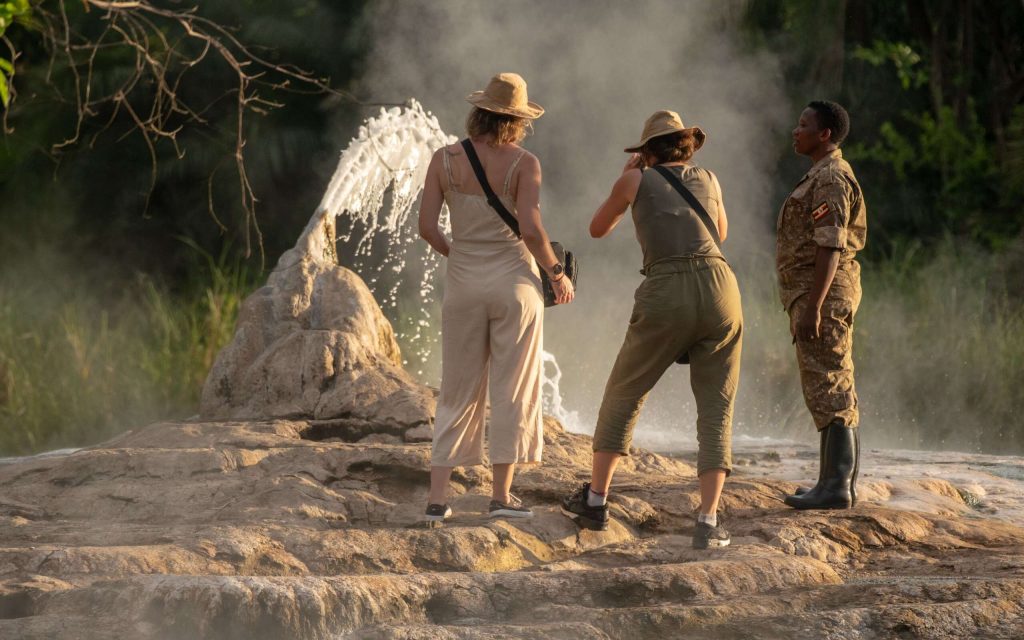
Nyasimbi is an active geyser that forcefully spouts boiling water up to two meters into the air. The water emerges from the earth at temperatures exceeding 100°C, creating a dramatic display of bubbling power and continuous white clouds of steam. Surrounding the geyser, mineral deposits have formed unique, colorful rock encrustations in shades of orange, white, and sulfur-yellow.
For the indigenous local communities, this spring holds profound spiritual importance. Local folklore suggests that the female spring houses the spirit of an ancestral woman who vanished into the steaming earth, making it a sacred site where women come to perform rituals, pray for fertility, or seek blessings for a safe childbirth. Visitors can safely stand on wooden boardwalks erected around the perimeter, allowing for close-up photographs and a sensory experience of the earth’s raw geothermal power. The sound of the rushing water, combined with the eerie beauty of the rising steam against the dense green jungle backdrop, makes Nyasimbi an unforgettable geographical marvel.
2. Explore the Male Hot Spring (Bitende)
A separate, scenic trek through the forest leads travelers to the male hot spring, known natively as Bitende. Unlike the dramatic, spouting geyser of the female spring, Bitende presents itself as a massive, open cauldron of intensely boiling water. The trail to this spring cuts through a broader, more open landscape that transitions into a swampy clearing surrounded by dense reeds and ancient volcanic soils.
Measuring roughly 12 meters in diameter, Bitende resembles a giant, bubbling laboratory beaker hidden in the jungle. The surface of the pool is in constant motion, with large gas bubbles bursting forth from the subterranean magma chambers below. The geological history here is fascinating; the water is heated deep in the Earth's crust by residual volcanic activity associated with the formation of the East African Rift System.
Culturally, the Bambuti and Batwa people recognize Bitende as the resting place of their male ancestral spirits. Historically, community elders would make pilgrimages to this specific pool to offer sacrifices, seek guidance before hunting expeditions, or perform cleansing ceremonies to ward off bad luck. The sheer scale of the pool, combined with the constant rumbling sound of boiling water from the deep underground reservoirs, gives the location a powerful, almost mystical ambiance. Walking along the designated pathways around Bitende offers a stark reminder of the dynamic geological forces that continue to reshape the African continent.
3. Boil Eggs and Snacks
One of the most engaging and interactive experiences during a Uganda safari in Semuliki is the opportunity to cook a meal using the earth's natural energy. The extreme temperatures of the Sempaya geothermal waters create an outdoor kitchen where the water is continuously boiling at over 100°C, making it functional for preparing light snacks.
Before heading out on the trail, park guides encourage visitors to bring along raw eggs, sweet plantains, or matooke (local green bananas). At designated safe spots along the hot spring channels, special baskets or strings are used to lower the food directly into the scalding, mineral-rich currents. Because the water is well past the boiling point, a raw egg cooks to a perfect hard-boiled state in less than ten minutes, while plantains soften quickly in the geothermal heat.
This activity is not just a fun novelty; it serves as a practical demonstration of geothermal energy in action. While the food cooks, guides explain the chemical composition of the water, which contains high levels of sodium, calcium, chloride, and sulfate. Despite the strong smell of sulfur in the air, the shells of the eggs and the thick skins of the plantains protect the inner food, leaving it completely clean, safe, and delicious to eat on the spot. Enjoying a hot snack cooked entirely by the Earth amidst the sounds of the surrounding jungle is a classic Semuliki tradition.
4. Spot Primates en Route
The walk to the Sempaya hot springs is much more than a geological excursion; it doubles as an intimate primate viewing experience within an ancient forest canopy. Because Semuliki National Park represents an ecological extension of the vast Ituri Forest of the Democratic Republic of Congo, it boasts an incredible diversity of primates that are easily spotted along the forest trails.
As you navigate the shaded paths, you will want to keep your eyes trained on the mid-to-upper canopy. The trees are home to vibrant troops of red-tailed monkeys, easily recognizable by their bright white nose spots and coppery-red tails as they leap acrobatically between branches. Sharing the canopy are black-and-white colobus monkeys, which look like elegant old men with long, flowing white capes and tails, contrasting sharply against the green foliage.
You are also highly likely to encounter the grey-cheeked mangabey, a shaggy, dark-furred monkey known for its distinct vocalizations and expressive facial features. The presence of these primates fills the forest with a lively chorus of barks, chatters, and crashing branches. Walking slowly and quietly with an experienced guide allows you to observe their complex social behaviors, from mothers grooming their infants to dominant males keeping watch for predators. This rich primate interaction adds a thrilling layer of classic wildlife viewing to your walk before you even reach the steaming hot springs.
5. View the Bwamba Maternity Tree
Deep within the forest along the Sempaya trail stands a living monument of immense historical and cultural significance: the Bwamba Maternity Tree. This towering, ancient fig tree (Ficus species) features a massive, buttressed root system that forms natural, cave-like alcoves at its base, creating an imposing architectural presence in the jungle.
For generations, this sacred tree served as a natural labor ward for the indigenous Bambuti and Batwa people. When a pregnant woman was ready to give birth, she would be escorted to this specific tree by traditional birth attendants and female elders. The hollows between the giant root flutes provided privacy, shelter from the elements, and a deep spiritual connection to the earth during childbirth. It was believed that the spirits inhabiting the tree would grant strength to the mother, protect the newborn child from evil spirits, and ensure a healthy lineage for the clan.
Today, the Bwamba Maternity Tree remains a revered cultural site. Even though modern healthcare facilities are now accessible, local people still visit the tree to leave small tokens of appreciation, pay respect to their ancestors, or pray for blessings related to family and fertility. Standing before this ancient giant, visitors can marvel at its sheer botanical scale while appreciating how closely intertwined indigenous African cultures are with the natural forest environment.
🦁 Wildlife Viewing
6. Morning Game Drives
To experience the classic savannah aspect of a Uganda safari, travelers venture into the open landscapes of the Toro-Semuliki Wildlife Reserve for morning game drives. As the sun rises over the Rwenzori Mountains, casting golden light across the acacia woodlands and expansive grasslands, the wilderness wakes up with activity.
The cool morning hours are prime time for spotting the reserve’s diverse residents. The plains are heavily populated by the Uganda kob, a beautiful reddish-brown antelope that serves as a national symbol. You will often see males defending their breeding territories, known as leks, with dramatic displays of horn-clashing. Moving through the tall grass, small herds of forest elephants—which are smaller and hairier than their savannah cousins—can be seen feeding alongside massive Cape buffaloes.
Look closely around the waterholes, and you will spot waterbucks with their shaggy coats and distinct white ring markings on their rumps. Morning is also when predators are most active before the heat of the day forces them into hiding; sharp-eyed guides can often locate lions resting under bushes or side-striped jackals trotting through the grass. The landscape itself, characterized by a mix of Borassus palm trees and open savanna, offers sweeping views that make morning exploration a visual feast for photographers and wildlife enthusiasts alike.
7. Night Game Drives
While standard national parks close their gates at dusk, the Toro-Semuliki Wildlife Reserve is famous for offering guided night game drives. Equipped with powerful spotlight torches operated by experienced rangers, visitors head out into the dark savannah to witness a completely different ecosystem come to life.
As the spotlight scans the darkness, the reflecting eyes of nocturnal animals pierce through the bush. The ultimate prize of a night drive is spotting the elusive leopard, a stealthy predator that uses the cover of darkness to stalk Uganda kobs and other prey. You are also highly likely to encounter the white-tailed mongoose, a large, active hunter that scurries through the undergrowth searching for insects, reptiles, and small rodents.
Up in the branches of the acacia trees, the spotlights often catch the glowing, oversized eyes of bush babies (galagos). These tiny primates are famous for their remarkable jumping abilities, leaping effortlessly between branches like furry acrobats. The night air is filled with the deep hoots of owls, the distant laughs of hyenas, and the chirping of crickets, creating an immersive sensory experience. A night drive reveals the secret, nocturnal behaviors of African wildlife that remain completely hidden during the day, making it an essential add-on for any adventurous safari itinerary.
8. Pygmy Hippo Tracking
Semuliki National Park and its surrounding waterways hold a secret that cannot be found anywhere else in East Africa: the presence of the rare, semi-aquatic pygmy hippopotamus (Choeropsis liberiensis). Unlike the common hippopotamus, which is massive and highly gregarious, the pygmy hippo is a reclusive, solitary creature that is significantly smaller, weighing only a fraction of its larger cousin's mass.
Tracking these elusive mammals requires exploring the dense riverine forests, muddy marshes, and hidden channels where the Semuliki River slows down. Pygmy hippos are heavily adapted to forest life; they spend their days submerged in muddy wallows or hiding inside dense bank vegetation to keep their skin moist. Because they are primarily nocturnal and exceptionally shy, finding them requires patience, a quiet approach, and the expertise of local trackers who understand their footprints and feeding trails.
Spotting a pygmy hippo in the wild is a true bucket-list achievement for wildlife enthusiasts, as their primary populations are restricted to the deeply threatened rainforests of West Africa. Seeing one here highlights the unique position of Semuliki as an ecological bridge to the Congo Basin, providing a rare sanctuary for a species that is otherwise shrouded in biological mystery.
9. Spot Nocturnal Birds
For avid birdwatchers, a night safari in Semuliki offers an exciting opportunity to check off rare, nocturnal avian species that are rarely seen in daylight. When darkness falls, the forest edges and riverine woodlands echo with unique calls, guiding researchers and travelers toward hidden feathered treasures.
The primary target during these night excursions is the African Wood Owl, a medium-sized bird with a beautifully patterned brown plumage and a distinct, rounded head lacking ear tufts. These owls can often be spotted sitting quietly on low branches, using their exceptional hearing and large eyes to scan the forest floor for mice and large insects. Another highly sought-after nocturnal resident is the Buff-spotted Flufftail. This tiny, secretive rail is notoriously difficult to see during the day because it stays hidden deep within dense, damp undergrowth, but its spooky, long-drawn wailing call at night betrays its location.
Guided by a ranger using a soft spotlight, birders can quietly track these calls to catch a rare glimpse of these elusive birds. The experience of standing still in the African night, listening to the intricate vocalizations of owls and flufftails while watching them interact in their natural habitat, adds an exclusive, scientific depth to a traditional birding safari.
🦅 Bird Watching (East Africa's Premier Birding Haven)
10. Track the Shoebill Stork
For birders worldwide, a Uganda safari is incomplete without a pilgrimage to see the legendary Shoebill Stork (Balaeniceps rex). Semuliki provides a premier setting for this quest, centered around a boat launch where the Semuliki River flows into the southern shores of Lake Albert.
Boarding a local watercraft, travelers navigate through extensive fields of papyrus reeds and floating water lilies. The Shoebill is a massive, prehistoric-looking bird that stands up to five feet tall, defined by its enormous, shoe-shaped beak with a sharp, hooked curved tip. This specialized bill is an evolutionary marvel, designed for lunging into shallow, oxygen-depleted waters to snatch lungfish, catfish, and even baby crocodiles.
The bird's hunting strategy relies on absolute stillness; a Shoebill can stand motionless like a gray statue for hours, waiting for the perfect moment to strike. Watching this giant bird suddenly burst into motion, or seeing it spread its massive wingspan to take flight over the marshlands, feels like stepping back into the dinosaur era. The pristine wetlands of Lake Albert offer some of the highest statistical chances of spotting this vulnerable species, making the boat excursion an essential highlight for nature lovers.
11. Hike the Kirumia Trail
The Kirumia Trail is widely celebrated as the ultimate birding highway in East Africa. Stretching 13 kilometers through the heart of Semuliki’s dense rainforest, this trail is a dream destination for serious birders looking to spot species associated with the vast Central African Congo Basin biome.
Hiking this trail is a full-day commitment that requires sturdy boots, binoculars, and a deep appreciation for tropical ecology. The trail follows an old path used by local communities, winding through varying forest strata, from damp swamp forests to towering ironwood canopies. Because the forest is so dense, birding here is as much about listening as it is about looking.
An expert guide can identify the subtle calls of rare species like the African Piculet, the Lyre-tailed Honeyguide, or the Congo Serpent Eagle. The trail’s unique positioning allows birdwatchers to see species that simply do not exist anywhere else in East Uganda, making every bend in the path an opportunity for a lifelist discovery. Along the way, the forest floor is often littered with unique fallen fruits, giant fungi, and ancient creeping vines, creating an immersive jungle atmosphere that makes the 13-kilometer trek feel like an authentic scientific expedition.
12. Search for Hornbills
Among the most charismatic and vocal architectural fixtures of Semuliki’s forest canopy are the hornbills. The park serves as a major refuge for these large, dynamic birds, which are easily recognized by their massive, curved bills often topped with an ornamental structure called a casque.
A walk through the forest boardwalks will quickly introduce you to several distinct hornbill species. The Piping Hornbill is common, filling the air with its loud, repetitive, nasal calls as small family groups fly between fruit-bearing fig trees. If you look closely into the darker, denser sections of the mid-canopy, you might spot the Black Dwarf Hornbill or the Red-billed Dwarf Hornbill, both of which are much smaller and more reclusive, requiring a patient eye to find.
The crown jewel of the family here is the White-crested Hornbill, an unmistakable bird with a striking white crest of feathers on its head that contrasts elegantly against its dark body plumage. This species exhibits fascinating behaviors, often following monkey troops through the trees to catch insects that are stirred up by the primates' movement. Watching these birds navigate the canopy with their heavy, rhythmic wingbeats and complex social structures is a highlight of Semuliki's avian scenery.
13. Spot the Great Blue Turaco
If there is one bird that embodies the vibrant, exotic beauty of Semuliki’s rainforest canopy, it is the Great Blue Turaco (Corythaeola cristata). This massive bird stands nearly 30 inches tall, making it the largest of all turaco species and a favorite target for wildlife photographers.
Spotting a Great Blue Turaco is made easier by its social nature and its loud, resonating calls. They travel in small family groups, moving through the very tops of the tallest forest trees. When you locate them through your binoculars, their coloration is breathtaking: a deep, shimmering turquoise-blue body, a thick yellow bill tipped with bright red, and a prominent, velvety black crest raised high on their head.
The real spectacle occurs when they decide to move from one tree to another. They run along heavy branches with squirrel-like agility before launching into the air, revealing brilliant flashes of yellow and green on their under-tail feathers. Watching a group of these magnificent, colorful birds glide gracefully across a clearing against the backdrop of a misty jungle canopy is a cinematic experience that highlights the incredible, untouched biodiversity of Uganda's forest reserves.
14. Find the Yellow-throated Nicator
For dedicated birders, finding the Yellow-throated Nicator (Nicator vireo) is a badge of honor. This enigmatic, medium-sized songbird is a classic representative of the West African jungle ecosystem, and Semuliki is one of the few accessible places in East Africa where it can be reliably tracked.
The challenge of spotting the Yellow-throated Nicator lies in its preferred habitat and behavior. It is a master of camouflage, spending almost all of its time hidden deep within dense thickets, tangled vines, and the mid-canopy undergrowth. Its plumage—composed of olive-green upperparts and a soft yellowish throat and belly—blends perfectly with the dappled sunlight filtering through the forest leaves.
To find one, guides rely heavily on its vocalizations. The bird possesses a rich, beautiful, and surprisingly loud song consisting of melodic whistles and chattering notes that echo through the quiet forest. When it sings, it often remains completely still, forcing birdwatchers to meticulously scan every branch and leaf cluster. The moment your binoculars finally focus on this vibrant, elusive singer hidden in the green foliage is immensely rewarding, offering a true taste of high-stakes tropical birdwatching.
🥾 Hiking and Nature Walks
15. Hike the Red Monkey Trail
For travelers who want to combine physical exercise with rare wildlife viewing, hiking the Red Monkey Trail is a fantastic option. This established nature trail follows the park’s eastern boundary, taking hikers through a diverse range of forest ecosystems before terminating near the banks of the historic Semuliki River.
The trail gets its name from its primary wildlife attraction: the chance to spot rare and localized primates. While red-tailed monkeys and colobus monkeys are common, the ultimate goal along this route is to catch a glimpse of the De Brazza's monkey (Cercopithecus neglectus). This highly distinctive primate is known for its elegant appearance, featuring a bright orange, crescent-shaped brow, a white muzzle, and a long, white beard that gives it a wise, grandfatherly look.
De Brazza's monkeys are exceptionally shy and are known to freeze completely when they detect human presence, blending into the shadows of the riverine vegetation. Hiking this trail requires a quiet, observant approach, walking slowly over fallen leaves while scanning the branches near the water's edge. Even if the De Brazza's monkey remains hidden, the trail offers beautiful views of ancient trees, wild ginger fields, and the soothing sounds of the nearby river.
16. Butterfly Spotting
While large mammals and colorful birds often grab the headlines, Semuliki National Park holds an equally impressive secret beneath the canopy: it is home to over 400 distinct species of butterflies. This represents nearly 80 percent of all butterfly species found in Uganda, making the park an international hotspot for entomologists and macro-photographers.
As you walk along the riverine forests and damp swamp trails, you are instantly surrounded by swirling clouds of color. The high humidity and abundance of flowering plants create an ideal breeding ground for these delicate insects. Among the most striking varieties are the massive Swallowtails, which flutter gracefully through the air with bold patterns of yellow, blue, and black.
Down on the damp forest floor, groups of vibrant forest charaxes and map butterflies gather on muddy patches to extract essential minerals from the soil, creating living carpets of iridescent blues, emerald greens, and deep oranges. Walking with a knowledgeable guide reveals the fascinating ecological roles these insects play, from vital pollination duties to serving as indicators of a healthy forest ecosystem. The sheer volume and diversity of butterflies transforming the sunny trail clearances into living art galleries adds a magical, whimsical dimension to a standard nature walk.
17. Riverline Forest Walks
The meandering banks of the Semuliki River offer one of the most ecologically fascinating hikes in the region. Winding its way along the border between Uganda and the Democratic Republic of Congo, the river acts as a dynamic boundary where two distinct ecological worlds collide.
A riverline forest walk allows travelers to witness a dramatic transition in landscape. You start in the open, sun-drenched savannahs of the rift valley floor, characterized by golden grasses and scattered acacia trees. As you approach the river, the vegetation undergoes a complete transformation; the trees grow taller, their branches intertwining to form a dense, shaded canopy, and the air becomes cool and humid. Suddenly, you find yourself walking through a lush Congo Basin jungle, surrounded by giant African mahogany trees, oil palms, and massive strangler figs.
The river itself is a powerful sight, its muddy brown waters rushing past sandbanks where hippos wallow and Nile crocodiles bask in the sun. The walk provides an excellent vantage point for spotting water-loving birds like the African Finfoot and Kingfishers darting across the water. Experiencing these distinct biomes transition into one another within a single afternoon hike showcases the incredible geographical uniqueness of Semuliki.
🥁 Cultural and Community Experiences
18. Meet the Bambuti Pygmies
A Uganda safari to Semuliki offers a rare opportunity to engage with one of the continent's most ancient and culturally distinct indigenous societies: the Bambuti Pygmies. Historically, these hunter-gatherers lived deep within the Ituri rainforest, existing in perfect harmony with the forest ecosystem for thousands of years.
Visiting a Bambuti community near the park boundaries is a profound, eye-opening experience. Because of modern conservation laws and shifting regional borders, the Bambuti have had to adapt to life outside the deep forest, yet they retain a wealth of ancient knowledge. They are structurally smaller in stature—an evolutionary adaptation that allowed their ancestors to move effortlessly through dense jungle undergrowth.
During a structured cultural visit, community elders welcome travelers and share insights into their traditional way of life. They explain their deep understanding of forest ecology, showing how they historically sourced everything they needed, from natural medicines made from tree bark to building materials for temporary leaf-huts. Engaging with the Bambuti allows visitors to look beyond wildlife viewing and gain a deep, respectful appreciation for the human history that has shaped these ancient African forests.
19. Cultural Dance Performances
Music and dance are the lifeblood of the Batwa and Bambuti communities, serving as the primary medium for preserving their history, celebrating milestones, and passing down cultural values through generations. Experiencing a traditional live performance is a highlight of any community tour.
The performance begins with the rhythmic beating of traditional hide drums, accompanied by melodic wooden flutes and the synchronized clapping of community members. The dances are highly energetic and expressive, featuring intricate footwork and body movements that mimic the natural world around them. For example, certain dances replicate the movements of forest animals like monkeys or eagles, while others depict the stealthy steps of a hunter tracking prey through the bush.
As the performers sing in their native dialects, their voices harmonize to create hauntingly beautiful melodies that echo the spirit of the ancient forest. Between dances, elders step forward to engage in oral storytelling, translating the meanings of the songs, which often detail historical migrations, heroic hunting trips, or lessons about respecting nature. Visitors are frequently invited to join in the dance steps, turning the performance into a joyous, shared celebration of human connection.
20. Craft Making and Hunting Demos
To truly understand the practical survival skills of the indigenous forest people, visitors can participate in hands-on demonstrations of traditional hunting techniques and craftsmanship. These interactive sessions reveal the ingenuity required to thrive in a pristine rainforest environment using only raw natural materials.
The hunting demonstration is a fascinating showcase of skill and precision. Elders demonstrate how they traditionally crafted and used compact wooden bows and arrows, which were perfectly suited for navigating tight jungle spaces where long weapons would get tangled in vines. They demonstrate tracking techniques, explain how they historically extracted natural poisons from specific forest plants to coat their arrowheads, and show how they set ingenious string traps to catch small game.
Following the hunting display, local artisans showcase their craft-making skills. Visitors can watch women transform wild palm fronds, banana fibers, and local seeds into beautifully woven baskets, mats, and colorful jewelry. Participating in these demonstrations or purchasing these handmade crafts provides a sustainable source of income directly to the indigenous community. This ensures their ancient artistic traditions continue to be valued and preserved well into the future.
1. What are the top things to do in Semuliki National Park?
A Uganda safari to Semuliki National Park delivers a uniquely diverse travel itinerary because it sits at the intersection of East African savannah and the dense, prehistoric rainforests of the Central African Congo Basin. The absolute centerpiece of any excursion here is a trek to the Sempaya Hot Springs. These remarkable geothermal vents feature an active geyser that spouts scalding water and dramatic plumes of steam high into the air, offering a visceral look at the tectonic forces shaping the Albertine Rift Valley floor.
Beyond the springs, Semuliki is a legendary haven for bird watching, drawing global enthusiasts eager to cross rare Guinea-Congo biome bird species off their life lists. For primate lovers, the park and its surrounding habitats protect an incredible variety of species. Travelers can embark on guided nature walks through the ancient, shaded forest floor to track wild chimpanzees or look out for acrobatic monkeys navigating the high canopy.
Transitioning from the dense jungle into the open, grassy plains of the adjacent Toro-Semuliki Wildlife Reserve, visitors can enjoy classic savannah game drives. These drives provide opportunities to spot unique forest-savannah hybrid elephants, massive Cape buffaloes, and elegant antelopes. As darkness falls, the reserve opens up for rare night game drives to hunt for nocturnal predators.
Finally, no trip to Semuliki is complete without a rich cultural and community experience. Spending time with the indigenous Batwa and Bambuti Pygmies allows you to learn about ancient hunter-gatherer survival skills, traditional medicine, and vibrant storytelling dances. Whether you are cruising down the historic Semuliki River or hiking deep forest trails, the park offers an unparalleled mix of geology, wildlife, and indigenous human heritage.
2. What is special about the Sempaya Hot Springs?
The Sempaya Hot Springs are a spectacular geological masterpiece and serve as the iconic landmark of Semuliki National Park. Fueled by subterranean magma chambers associated with the active East African Rift System, these natural springs reach blistering temperatures well over 100°C (). What makes Sempaya truly captivating is that it features two distinct, highly active geothermal sites traditionally classified as the male and female hot springs, each carrying immense cultural and spiritual significance for the local indigenous people.
The female hot spring, known natively as Nyasimbi, is the more dramatic of the two. It features an active, boiling geyser that forcefully erupts, spouting scalding mineral water and thick clouds of white steam up to two meters into the air. The surrounding rock structures are coated in striking, colorful mineral deposits of sulfur yellow, orange, and manganese white.
A scenic trail through a lush palm forest leads to the male hot spring, called Bitende. This site presents a contrasting landscape, featuring a massive, wide-open pool measuring roughly 12 meters in diameter that constantly bubbles and rumbles like a giant volcanic cauldron.
For the local Batwa and Bambuti communities, these springs are revered as sacred shrines housing ancestral spirits. Historically, elders performed rituals and offered sacrifices here to pray for fertility or successful hunts. For safari visitors, the springs offer a fun, interactive science experiment. Guides encourage travelers to bring raw eggs, sweet plantains, or matooke (green bananas) to submerge directly into the scalding waters. Because of the intense geothermal heat, the food cooks to a perfect edible state in less than ten minutes, providing a memorable, nature-cooked snack.
3. Can I see chimpanzees in Semuliki?
Yes, you can absolutely see chimpanzees when visiting this region, but it is important to understand the specific geography of the excursion. While Semuliki National Park contains a dense jungle habitat that supports wild chimpanzees, organized primate tracking primarily takes place in the adjacent Toro-Semuliki Wildlife Reserve, specifically within the lush gallery forests of the Mugiri River basin. This distinction is highly beneficial for travelers looking for an intimate, exclusive, and off-the-beaten-path primate tracking experience far away from the heavy crowds found in more mainstream tracking destinations.
The chimpanzee population in the Mugiri forest has been habituated over many years by researchers, allowing visitors to quietly approach and observe them in their natural habitat. Tracking chimpanzees here offers a fascinating ecological perspective, as these communities have adapted to a unique environment where dense riverine forest meets dry, open savannah. This ecosystem layout often forces the chimpanzees to move across open ground between forest patches, providing rare, unobstructed views of them walking upright on two legs—a behavior less frequently observed in deep, continuous rainforests.
The trek itself is an adventurous journey guided by experienced park rangers who track the apes' fresh knuckle prints, discarded fruit peels, and loud, echoing pant-hoot vocalizations that pierce the forest canopy. Because group sizes are kept strictly limited, your encounter with these highly intelligent primates feels incredibly personal. Watching a habituated family groom one another, mothers care for infants, and playful juveniles swing through the branches offers a profound highlight to your Uganda safari itinerary.
4. Why is Semuliki called a "Birder’s Haven"?
Semuliki National Park has earned its legendary reputation as East Africa's premier birding haven due to its unique geographical positioning. The park represents the absolute easternmost edge of the vast West African Guinea-Congo biome rainforest. Because of this, Semuliki protects an astounding 441 recorded bird species, including roughly 35 Central African specialist species that cannot be found anywhere else in Uganda, making it a mandatory pilgrimage site for serious birdwatchers worldwide.
The diversity of avian life here is dizzying. Walking along the forest trails, the air is filled with the calls of iconic species such as the Great Blue Turaco, a massive turquoise-blue bird with a prominent black crest, and a striking variety of hornbills, including the Piping, Black Dwarf, and White-crested Hornbills. Deep within the dense undergrowth, patient birders can search for elusive camouflaged songbirds like the Yellow-throated Nicator, the African Piculet, and the hauntingly vocal Nkulengu Rail.
The birding adventure extends beyond the forest canopy to the wetlands where the Semuliki River empties into the southern shores of Lake Albert. Here, travelers can embark on a boat safari to track the ultimate avian prize: the rare and prehistoric-looking Shoebill Stork. This giant, grey bird stands up to five feet tall and features an enormous, shoe-shaped bill used to hunt lungfish in the papyrus marshes. Whether you are exploring the deep jungle canopy along the famous Kirumia Trail or scanning the reed-lined shores of the lake, Semuliki offers world-class birding opportunities that yield incredible life-list discoveries at every turn.
5. Are there savannah game drives available?
Yes, classic savannah game drives are a fantastic component of a trip to this region, taking place within the beautiful Toro-Semuliki Wildlife Reserve, which borders the main national park. This reserve features a sweeping landscape of open, golden grasslands, seasonal wetland marshes, and acacia woodlands framed by the dramatic backdrop of the Rwenzori Mountains and the Congolese blue hills, offering a stunning setting for big-game viewing.
Morning game drives are highly rewarding as the wilderness wakes up in the cool dawn light. The savannah plains are home to a thriving population of the Uganda kob, a beautiful, golden-brown antelope that serves as a proud national symbol. As you navigate the network of game tracks, you can easily spot small herds of forest-savannah hybrid elephants—which are smaller and exhibit distinct behaviors compared to pure bush elephants—alongside massive Cape buffaloes, shaggy waterbucks, warthogs, and common duikers.
What truly sets this destination apart from many standard national parks is the availability of guided night game drives. Venturing out into the dark savannah with an armed ranger operating a powerful spotlight torch reveals a completely hidden nocturnal ecosystem. The reflecting eyes of the African bush pierce the darkness, giving travelers a high statistical chance of spotting elusive leopards out on the hunt. You are also likely to encounter white-tailed mongooses scurrying through the brush, side-striped jackals, and adorable, wide-eyed bush babies leaping acrobatically through the branches of acacia trees. This blend of day and night drives ensures a comprehensive wildlife viewing experience.
6. What is the Batwa Cultural Experience?
The Batwa and Bambuti Cultural Experience in Semuliki is a profound journey into human history, offering travelers an intimate encounter with one of the oldest surviving indigenous cultures on the African continent. Historically, these indigenous people lived as nomadic hunter-gatherers deep within the dense Ituri rainforest, which stretches across the Democratic Republic of Congo and into western Uganda. They lived in perfect, sustainable harmony with the forest ecosystem for thousands of years, relying on the jungle for food, shelter, and medicine.
During a structured cultural visit to a community near the park boundary, elders welcome visitors into their lives to share their ancestral wisdom. Because they are structurally smaller in stature—an evolutionary adaptation perfect for moving quickly through dense jungle undergrowth—their physical presence alone tells a story of forest adaptation. Elders demonstrate how they traditionally crafted compact wooden bows and arrows, set ingenious string traps to catch small wild game, and harvested wild honey from high tree hollows.
You will also learn about their deep ethnobotanical knowledge, as guides point out specific leaves, roots, and tree barks used to cure ailments ranging from stomach aches to snakebites. The experience concludes with an emotional performance of traditional music and storytelling dances. Accompanied by hide drums and wooden flutes, the community performs energetic dances that mimic forest animals and celebrate successful historical hunts. Participating in this cultural exchange provides vital financial support directly to the community, helping them preserve their unique heritage, language, and artistic traditions for future generations.
7. Can I go on guided nature and forest walks?
Yes, guided nature and forest walks are among the most rewarding ways to immerse yourself in the ancient wilderness of Semuliki National Park. Walking on foot allows you to escape the confines of a safari vehicle and experience the sights, sounds, and scents of a true Central African jungle ecosystem up close. The park features an excellent network of well-maintained hiking trails designed to accommodate various fitness levels and interests.
The most famous route for serious hikers and birdwatchers is the Kirumia Trail. This challenging 13-kilometer trail cuts directly through the heart of the primary rainforest, winding its way down to the banks of the meandering Semuliki River. Hiking this trail is a full-day immersion where you walk beneath giant African mahogany trees, ancient ironwood trees, and sweeping strangler figs. Along the way, your armed ranger guide will help you spot various primates, including black-and-white colobus monkeys and grey-cheeked mangabeys, while identifying the calls of rare Congo-biome birds.
For a shorter but equally enriching walk, the Red Monkey Trail follows the park's eastern boundary. This trail offers a high probability of spotting the rare and shy De Brazza's monkey, a primate known for its distinct white beard and orange brow, which lives in the thick riverine vegetation. Smaller forest walks lead visitors to the Sempaya Hot Springs or along swamp boardwalks where you can spot some of the park’s 400+ vibrant butterfly species. Every footstep on these walks reveals intricate details of tropical ecology, from giant columns of foraging driver ants to wild ginger flowers blooming on the forest floor.
8. Is there a boat cruise available?
Yes, water-based safaris are an exceptional and highly scenic activity available to travelers visiting the Semuliki region. These aquatic excursions take place on two distinct water bodies: the historic Semuliki River and the southern waters of Lake Albert, both of which offer a unique vantage point for wildlife viewing and bird watching that you cannot get from a traditional land-based vehicle.
The Semuliki River is a powerful, muddy waterway that twists and turns along the floor of the rift valley, forming the official international boundary between Uganda and the Democratic Republic of Congo. A boat ride down this river is an adventurous experience, as you float between two nations flanked by dense, overhanging jungle foliage. From the safety of the boat, you can observe large pods of hippos wallowing in the deep channels, massive Nile crocodiles basking lazily on the muddy sandbanks, and a variety of waterbirds, such as kingfishers and the elusive African Finfoot, darting across the water’s surface.
Alternatively, travelers can take a motorized boat cruise out onto the wetlands of Lake Albert. This excursion is specifically tailored for birdwatchers whose primary goal is to locate the legendary Shoebill Stork. Navigating through extensive fields of floating papyrus reeds and water lilies, the boat allows you to get remarkably close to these giant, prehistoric birds as they stand completely motionless, waiting to snatch lungfish with their massive, shoe-shaped beaks. The lake cruise also rewards visitors with stunning views of the northern extension of the Rwenzori mountain range plunging directly into the rift valley waters.
9. What kind of wildlife will I see besides chimpanzees?
Because Semuliki National Park serves as an ecological bridge where West African rainforest transitions into East African savannah, it boasts an incredibly unique species list that features animals rarely seen together anywhere else. This intersection creates an exceptional opportunity for wildlife viewing across varying habitats, from deep jungle canopies to wide-open grassy plains.
Within the forested sections of the park, primates dominate the landscape. As you look into the tree canopy, you will easily spot large troops of red-tailed monkeys with their distinct coppery tails, elegant black-and-white colobus monkeys, and shaggy grey-cheeked mangabeys. If fortune smiles upon you along the riverbanks, you might catch a rare glimpse of the beautifully marked De Brazza's monkey. The forest floor is home to secretive forest elephants—which are smaller and hairier than their savannah relatives—and forest buffaloes, which exhibit a distinct reddish coat.
Moving into the adjacent Toro-Semuliki Wildlife Reserve, the wildlife changes dramatically to classic African savannah species. Here, the plains are heavily populated by thousands of Uganda kobs, alongside stately waterbucks, bushbucks, warthogs, and common duikers. Large predators are present as well; guided day and night drives offer opportunities to spot lions, side-striped jackals, and elusive leopards.
The reserve’s hidden waterways also shelter one of the region's greatest biological mysteries: the rare, solitary, and nocturnal pygmy hippopotamus. Add in giant Nile crocodiles, pods of common hippos, and an abundance of unique reptiles and butterflies, and Semuliki stands out as an incredibly well-rounded wildlife sanctuary.
10. When is the best time to visit Semuliki National Park?
While Semuliki National Park is open to visitors all year round, the absolute best time to plan your Uganda safari to this remote destination is during the dry seasons. The region experiences two distinct dry windows: the primary dry season runs from June to September, and a shorter dry spell occurs from December to early February. Choosing to visit during these specific months significantly enhances the overall quality, comfort, and success of your travel activities.
During the dry months, rainfall is minimal, which has a major impact on the park's infrastructure and trail conditions. The hiking paths—such as the 13km Kirumia Trail—become significantly drier, less muddy, and much safer to navigate on foot. Furthermore, the undergrowth thins out, which drastically improves visibility for spotting primates in the trees and rare birds hiding in the mid-canopy.
In the neighboring Toro-Semuliki Wildlife Reserve, the dry season causes water holes to shrink, forcing savannah wildlife like elephants, buffaloes, and kobs to concentrate around predictable water sources, making them much easier to locate during day and night game drives.
Conversely, visiting during the wet seasons (March to May and October to November) brings heavy tropical downpours. The Semuliki River can burst its banks, causing boardwalks and roads to flood, which can occasionally make the hot springs inaccessible. However, for hardcore birdwatchers, the wet season has an appeal: it coincides with the flowering of forest plants and an abundance of insects, attracting numerous migratory bird species and filling the jungle with spectacular breeding plumage and vocalizations.
11. What should I pack for a Semuliki safari?
Packing correctly for a safari to Semuliki National Park requires careful preparation because the environment is characterized by a hot, highly humid tropical rainforest climate that transitions into an open, sun-drenched savannah. To stay comfortable, safe, and fully prepared for all activities, your packing list must balance protection from elements like insects and rain with breathable comfort.
First and foremost, high-quality footwear is essential. You will need sturdy, waterproof hiking boots with excellent ankle support and deep grip soles to navigate the muddy, uneven forest trails and slippery boardwalks around the hot springs. Pair these with long, moisture-wicking socks that you can tuck your trousers into to protect against biting safari ants on the forest floor. Clothing should be lightweight, breathable, and selected in neutral tones like khaki, green, or tan; avoid bright colors, and leave blue or black clothing behind, as these colors are known to actively attract biting tsetse flies. Long-sleeved shirts and long trousers are mandatory to shield your skin from stinging nettles, sharp thorns, and mosquitoes.
Because Semuliki is a rainforest, a lightweight, packable waterproof rain jacket should always be in your daypack, alongside a high-SPF sunscreen, a wide-brimmed hat, and a pair of polarized sunglasses for open savannah drives. A premium, insect repellent containing DEET is non-negotiable to keep mosquitoes and flies at bay. Finally, do not forget your gear: a high-quality pair of binoculars is absolutely vital for spotting rare canopy birds and distant primates, and a reliable waterproof dry bag will keep your camera, phone, and extra batteries safe from unexpected tropical downpours.
12. Where can I stay when visiting the park?
Accommodation options around Semuliki National Park and the adjacent Toro-Semuliki Wildlife Reserve cater perfectly to various travel styles, budgets, and comfort levels. Whether you are looking for a high-end luxury lodge hidden in the wilderness or a budget-friendly campsite close to nature, the region provides excellent bases for your daily adventures.
For travelers seeking top-tier luxury and classic safari romance, Semliki Safari Lodge is the premier choice. Located within the Toro-Semuliki Wildlife Reserve, this iconic lodge features spacious, thatched-roof canvas tents elevated on wooden platforms. Each tent is beautifully furnished with en-suite bathrooms, private verandas, and plush bedding, offering stunning views of the Mugiri riverine forest. The lodge features a main lounge, a swimming pool to cool off after a humid forest hike, and fine dining that blends international cuisine with fresh local ingredients. Another excellent mid-range to luxury option is Ntoroko Game Lodge, situated right on the scenic shores of Lake Albert, making it perfect for those prioritizing boat cruises and Shoebill stork tracking.
For budget-conscious travelers, independent backpackers, and campers, the Uganda Wildlife Authority (UWA) operates clean and affordable facilities directly near the park headquarters at Bumaga. Here, visitors can rent simple budget bandas (cabins) or make use of designated campsites surrounded by towering forest trees. These sites provide basic amenities like running water, shared pit latrines, and campfire areas where you can sit beneath the stars and listen to the nighttime chorus of the jungle. Booking your accommodation in advance is highly recommended to ensure a seamless wilderness experience.
13. How do I get to Semuliki National Park?
Semuliki National Park is located in the remote western corner of Uganda, within the Bundibugyo District, sitting snugly against the international border with the Democratic Republic of Congo. Despite its remote, wild feel, the park is highly accessible from Uganda’s capital city, Kampala, and can be reached using two primary modes of transport: an adventurous road trip or a quick domestic charter flight.
The most common and highly scenic route is by road from Kampala. The journey takes travelers westward via the well-tarmacked highway through Mityana, Mubende, and into the tourism hub of Fort Portal town. This first leg takes about 4 to 5 hours, winding through rolling green hills and extensive tea plantations. From Fort Portal, you embark on the final, spectacular leg of the drive: a 2-to-3-hour journey that snakes down the steep, winding escarpment of the Rwenzori Mountains into the floor of the Albertine Rift Valley. This drive offers breathtaking, panoramic views of the vast Congo basin forests stretching out into the horizon. The entire road trip takes roughly 6 to 7 hours, making it a full but incredibly visual travel day.
For travelers who have limited time or prefer to avoid long drives, domestic flight options are readily available. You can book a scheduled or charter domestic flight from Entebbe International Airport or Kajansi Airstrip to the nearby Kasese Airstrip or the Semuliki Airstrip located within the wildlife reserve. These flights take just about an hour, showcasing beautiful aerial views of Uganda’s landscape. Upon landing, a safari vehicle will meet you to transfer you directly to your lodge, allowing you to begin your wilderness exploration immediately.
14. Are night walks allowed in the park?
Yes, night walks are fully permitted and are highly celebrated as one of the most unique and thrilling activities available in this region. While standard nature walks conclude at sunset, Semuliki’s distinct ecosystem layout allows adventurous travelers to venture into the deep jungle or the adjacent wildlife reserve after dark, accompanied at all times by highly experienced, armed park ranger guides.
A night walk completely transforms your perception of the rainforest. Armed with powerful spotlight torches, you step onto the trails as a completely different ecosystem wakes up. The primary objective of a night walk through the forest canopy is to catch a glimpse of rare, nocturnal primates. Rangers are experts at scanning the branches to locate the glowing, reflective eyes of the Potto—a slow-moving, nocturnal primate related to lemurs—as well as various species of bush babies (galagos), which can be seen leaping acrobatically between trees like tiny furry ghosts.
The night air is also filled with a completely different acoustic symphony compared to the daytime. Birdwatchers can look and listen for elusive nocturnal avian species, such as the African Wood Owl resting on low branches or the highly secretive Buff-spotted Flufftail calling from the damp undergrowth. Walking silently through the dark jungle, hearing the rustle of leaves, the deep hoots of owls, and the distant calls of tree hyraxes creates an unforgettable, spine-tingling sensory experience. It provides a rare look into the secret, nocturnal behaviors of African wildlife that remain completely hidden from daytime visitors.
15. Can I combine a Semuliki safari with other parks?
Absolutely. Combining a Semuliki safari with other national parks is highly recommended and incredibly easy to execute due to Semuliki's strategic location along Western Uganda’s famous tourism circuit. Western Uganda contains the country's highest concentration of world-class wildlife reserves, allowing travelers to design a comprehensive itinerary that transitions seamlessly from one unique ecosystem to another with minimal travel time.
A classic safari combination starts just an hour away in Kibale Forest National Park, globally recognized as the "Primate Capital of the World." After exploring the hot springs and unique Congo-biome birds of Semuliki, you can head to Kibale for a world-class chimpanzee habituation experience, tracking some of the park's 1,500 wild chimps through a dense, beautiful forest canopy.
From Kibale, your itinerary can head south into Queen Elizabeth National Park. This transition takes you from deep jungles into classic East African savannah plains. At Queen Elizabeth, you can enjoy boat cruises along the famous Kazinga Channel to see massive pods of hippos and elephants bathing, and embark on game drives through the Ishasha sector to spot the legendary, rare tree-climbing lions resting in giant fig trees.
If you wish to extend the adventure further south, the circuit flows naturally into Bwindi Impenetrable National Park for the ultimate grand finale: mountain gorilla trekking. Combining Semuliki with these neighboring parks creates an ultimate travel itinerary that showcases the absolute best of Uganda's biodiversity, covering geothermal wonders, savannah big game, rare birds, and profound encounters with Africa's great apes.
Booking Uganda safari to semuliki with us Roads of Adventure safaris
Booking a Uganda safari to Semuliki with Roads of Adventure Safaris offers a personalized way to explore the park's renowned hot springs, diverse primates, and vibrant birdlife. You can customize everything from budget to luxury, with daily costs ranging from $125 to $1,500 depending on your chosen lodges and travel style.
