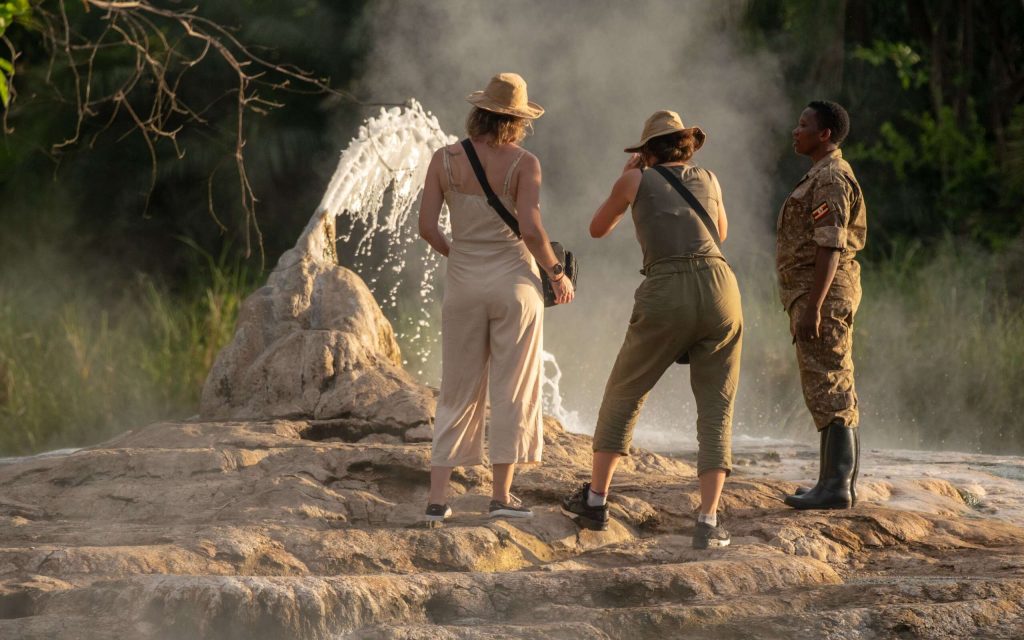
The 5-Days Best of Semuliki, Amabere Caves & Queen Elizabeth Safari in Uganda is a carefully designed itinerary that combines cultural heritage, geothermal marvels, and classic savanna game viewing. Your journey begins in Kampala and winds through the scenic landscape of western Uganda, leading you first to Fort Portal. This regional tourism hub serves as your base for exploring the ancient cultural sites and the unique Albertine Rift environment. Throughout this 5-Days Best of Semuliki, Amabere Caves & Queen Elizabeth Safari in Uganda, travelers encounter a massive variety of ecosystems, from the steaming, prehistoric hot springs of Semuliki to the crater lakes and wildlife-rich plains of Queen Elizabeth National Park. This expedition balances targeted nature walks with vehicle-based game drives and boat river circuits. Choosing the 5-Days Best of Semuliki, Amabere Caves & Queen Elizabeth Safari in Uganda guarantees a thorough introduction to the natural diversity and local traditions of the country.
Tour highlights
- Day 1: Travel from Kampala to Fort Portal & Explore Amabere Caves
- Day 2: Day Excursion to Semuliki National Park & Sempaya Hot Springs
- Day 3: Journey to Queen Elizabeth National Park & Katwe Salt Works
- Day 4: Morning Game Drive in Kasenyi Plains & Kazinga Channel Boat Cruise
- Day 5: Return Journey to Kampala via the Equator Crossing
Day by day 5-Days Best of Semuliki, Amabere Caves & Queen Elizabeth Safari in Uganda
Day 1: Travel from Kampala to Fort Portal & Explore Amabere Caves
Your 5-Days Best of Semuliki, Amabere Caves & Queen Elizabeth Safari in Uganda starts with an early morning departure from your residence in Kampala. You will head west through Mityana and Mubende, driving past green tea plantations and rural homesteads. You will stop in Fort Portal town for a local lunch before proceeding to the historic Amabere Ga Nyinamwiru Caves. A local site guide will walk you through the moss-covered stalactites and stalagmites while sharing the ancestral folklore of the Tooro Kingdom. You will learn about the ancient breast-like formations and see the nearby cold waterfalls that drop into the valley below. Afterward, you will hike up the nearby hills to view the surrounding volcanic crater lakes that mark this landscape. In the evening, you will check into your selected hotel in Fort Portal for dinner and rest.
Day 2: Day Excursion to Semuliki National Park & Sempaya Hot Springs
After breakfast, you will drive through the winding roads of the northern Rwenzori foothills to reach Semuliki National Park. This park protects an extension of the massive Ituri rainforest from the Democratic Republic of Congo. You will join a park ranger for a guided forest walk to visit the famous Sempaya Hot Springs. At the female spring, known locally as Nyasimbi, water bubbles out of the ground at temperatures exceeding 100 degrees Celsius. You can witness this geothermal activity firsthand by boiling eggs or plantains in the natural waters. The forest trails also offer regular sightings of primates, including black-and-white colobus monkeys and grey-cheeked mangabeys, alongside unique central African bird species. After lunch, you will explore the nearby Bambuti pygmy community to observe their traditional lifestyle before returning to Fort Portal for your overnight stay.
Day 3: Journey to Queen Elizabeth National Park & Katwe Salt Works
You will check out of your lodge and travel south toward Queen Elizabeth National Park. This drive offers views of the Rwenzori mountain ranges on clear days. You will enter the park and check into your savanna lodge in time for lunch. In the afternoon, your guide will take you to visit the Katwe Salt Lake, a traditional mining site where locals have extracted salt using manual methods for centuries. You will observe the dividing salt pans and learn about the intense evaporation process that supplies salt to neighboring regions. Later, you will take an evening game drive through the craters area, looking out for herds of elephants and buffaloes feeding along the ridges. You will return to your lodge at sunset for dinner and a quiet evening.
Day 4: Morning Game Drive in Kasenyi Plains & Kazinga Channel Boat Cruise
This day focuses heavily on the classic savanna wildlife of the 5-Days Best of Semuliki, Amabere Caves & Queen Elizabeth Safari in Uganda. You will head out at dawn to the Kasenyi plains, an open savanna area known as a primary breeding ground for the Uganda Kob. This high concentration of antelope attracts predators, giving you a chance to spot lions, hyenas, and occasionally leopards. You will also see large herds of cape buffaloes, elephants, and waterbucks moving through the tall grass. After lunch at the lodge, you will transfer to the Mweya jetty for a two-hour boat cruise along the Kazinga Channel. This waterway links Lake George and Lake Edward and features one of the highest concentrations of hippopotamuses in Africa, along with large Nile crocodiles and numerous migratory waterbirds.
Day 5: Return Journey to Kampala via the Equator Crossing
On the final day of your 5-Days Best of Semuliki, Amabere Caves & Queen Elizabeth Safari in Uganda, you will have a relaxed breakfast before packing your bags. You will depart the park and begin your return trip to Kampala, traveling through the towns of Bushenyi and Mbarara. You will stop at a designated restaurant in Mbarara City for a traditional lunch. Afterward, the journey continues to the Kayabwe Equator crossing point. Here, you can stand in both the Northern and Southern Hemispheres simultaneously and watch the classic water drainage demonstration that highlights the Coriolis effect. You can also browse the local craft markets for souvenirs and art pieces. Your driver-guide will then complete the drive to Kampala, dropping you off at your hotel or the airport by late afternoon
1. What is the standard 5-day itinerary?
The standard 5-day itinerary is a highly efficient route that connects the cultural center of Fort Portal, the ancient rainforest of Semuliki, and the diverse savannas of Queen Elizabeth National Park.
On Day 1, your safari starts with an early departure from Kampala or Entebbe. The drive takes you westward through a landscape of green rolling hills and vast tea estates. You will arrive in Fort Portal town by early afternoon for lunch. Afterward, you will explore the Amabere ga Nyina Mwiru Caves to see the natural stalactites and hike the surrounding volcanic crater hills for panoramic views of the countryside.
Day 2 shifts toward the geothermal wonders of Semuliki National Park. You will take a morning nature walk through the forest to explore the steaming Sempaya Hot Springs, learning about the local geography and primate life along the trail. By afternoon, you will leave Semuliki and drive south along the foothills of the Rwenzori Mountains, arriving at your lodge in Queen Elizabeth National Park by evening.
Day 3 is dedicated to the northern sector of Queen Elizabeth National Park. Your morning begins with a game drive across the Kasenyi Plains to track lions, elephants, and herds of cape buffaloes. In the afternoon, you will transfer to the Mweya peninsula for a two-hour boat cruise along the Kazinga Channel, which reveals massive numbers of hippos and waterbirds.
Day 4 takes you to the southern Ishasha Sector of the park. This area is famous for its tree-climbing lions, which rest in the branches of fig trees during the heat of the day. You will spend the day exploring this unique habitat before settling into a nearby savanna lodge.
Day 5 concludes with chimpanzee tracking in the deep forested canyon of Kyambura Gorge or the nearby Kalinzu Forest. After spending an hour observing the primates, you will begin your return journey to Kampala, stopping at the Equator crossing for a brief break.
2. What are the Amabere ga Nyina Mwiru Caves?
The Amabere ga Nyina Mwiru Caves are a unique geographical and cultural site located just a few kilometers outside of Fort Portal town. Scientifically, these caves are a natural formation resulting from the slow erosion of limestone over thousands of years. This process has created a network of impressive stalactites and stalagmites. Water rich in calcium carbonate continuously drips from the ceiling of the caves, forming long, breast-like structures that give the site its name. The constant moisture feeds a thick layer of green moss and ferns, creating a primeval atmosphere. A cold, clear waterfall cascades directly over the entrance of the cave complex, cooling the air and feeding into a small stream that flows through the valley floor.
Culturally, the site is deeply woven into the historical folklore of the Tooro and Bunyoro Kingdoms. According to local oral traditions, "Amabere ga Nyina Mwiru" translates directly to "The Breasts of Nyina Mwiru." Legend states that Nyina Mwiru was the beautiful daughter of a local king named Bukuku. To prevent her from marrying and fulfilling a prophecy that her child would overthrow him, the king cut off her breasts and hid her away in these caves. However, she was still found by a prince and gave birth to Ndahura, who eventually grew up to fulfill the prophecy and become the first leader of the historic Batembuzi dynasty. Local guides escort you through the paths, using flashlights to illuminate the rock formations while contrasting the scientific reality of calcium carbonate deposits with the vibrant cultural legends that have been passed down through generations.
3. What makes Semuliki National Park unique?
Semuliki National Park is one of Uganda's most distinct conservation areas because it represents the easternmost extension of the massive Ituri rainforest, which stretches across the border from the Democratic Republic of Congo. This creates a unique biological bridge where Central African flora and fauna spill over into East Africa. The park is a lowland tropical forest characterized by dense ironwood canopies, swampy boardwalks, and a humid environment that supports an incredible diversity of species not found anywhere else in East Africa. For birdwatchers, Semuliki is an unmatched destination, harboring over 400 bird species, including central African highlights like the hornbill family, the Congo serpent eagle, and the Nkulengu rail.
The primary structural highlight of Semuliki is the Sempaya Hot Springs. These geothermal features are a direct result of the tectonic forces shaping the Albertine Rift Valley. The springs are split into two main viewing areas connected by forest trails. The "male" spring, known as Bintente, sits in a lush swampy clearing and features a wide pool of bubbling, mineral-rich water. The "female" spring, known as Nyasimbi, is a highly active geyser where boiling water shoots out of the earth, creating a permanent cloud of sulfuric steam. The water temperatures here regularly exceed 100 degrees Celsius. Visitors can interact with this geothermal energy by placing fresh eggs or green plantains into the pools, watching them cook completely within a matter of minutes. The surrounding forest walks also offer great opportunities to see specialized primates, such as the de Brazza's monkey, dent's mona monkey, and central African red colobus.
4. What wildlife will I see in Queen Elizabeth National Park?
Queen Elizabeth National Park features a remarkable variety of landscapes, including open savannas, thick acacia woodlands, volcanic crater lakes, and extensive wetlands. Because of this structural diversity, the park supports more than 95 mammal species and over 600 bird species, making it a premier destination for traditional game viewing. When exploring the northern Kasenyi Plains, you will navigate through open grasslands that serve as the main breeding grounds for thousands of Uganda Kob. This high density of prey attracts large predators, meaning you have an excellent chance of spotting prides of lions, solitary leopards, and spotted hyenas tracking their targets. The plains are also home to massive herds of Cape buffaloes, side-striped jackals, and large herds of savanna elephants moving between the hills.
When you transition to the Kazinga Channel for a boat circuit, the wildlife viewing changes completely. This natural 32-kilometer waterway connects Lake George and Lake Edward, drawing animals from across the park to its banks. You will cruise past thousands of hippopotamuses wallowing in the shallows to keep cool. Huge Nile crocodiles line the muddy shores, basking in the sun alongside herds of elephants and buffaloes that come down to drink and bathe in the afternoons. If you travel south into the remote Ishasha Sector, the wildlife shifts again. This specific area is world-renowned for its population of tree-climbing lions. Unlike most lions that stay on the ground, the individuals in Ishasha spend their afternoons draped over the branches of massive sycamore fig trees and albizia trees to escape the ground heat and avoid biting insects.
5. Can I go chimpanzee trekking on this itinerary?
Yes, chimpanzee tracking can be seamlessly integrated into this 5-day itinerary, usually occurring on the final morning of the safari before you make the journey back to Kampala. There are two primary locations near Queen Elizabeth National Park where this activity takes place, and your choice depends on permit availability and your preference for terrain. The first location is the Kyambura Gorge, which is located directly within the park boundaries. Kyambura is often called the "Valley of Apes" because it is a deep, 100-meter forested canyon carved right into the middle of the flat savanna. Walking down into the gorge feels like entering a completely different world, with a rushing river and a dense tropical canopy that provides a home for a habituated community of chimpanzees.
The second highly popular option is the Kalinzu Central Forest Reserve, located just outside the park's eastern boundary on the Escarpment. Kalinzu is a large, contiguous forest that boasts a very high success rate for locating chimpanzees due to its large population of primates. Whichever location you utilize, the trekking experience involves hiking through forest trails with an experienced Uganda Wildlife Authority ranger. You will listen for the loud pant-hoots and clapping sounds of the chimpanzees moving through the treetops. Once you locate the community, you are permitted exactly one hour to watch them feed, groom, play, and interact on the forest floor or high in the branches. Along with chimpanzees, these forests are home to other primates, such as blue monkeys, red-tailed monkeys, and olive baboons, making it a rich primatology experience.
6. Do I need to book my permits in advance?
Securing your permits well in advance is an absolute necessity when planning this safari, particularly for the chimpanzee tracking portion of the trip. The Uganda Wildlife Authority limits the number of people allowed to track chimpanzees each day to protect the health of the primates and prevent overcrowding in their natural habitats. Because of these strict daily caps and the immense popularity of primate tourism in Uganda, permits often sell out months ahead of time, especially during the peak travel months. Attempting to book a primate permit on arrival is highly risky and almost always results in disappointment or significant delays to your travel schedule.
Working with a registered local tour operator or booking directly through the Uganda Wildlife Authority ensures that your permits are secured for the exact date and location required. When you pay for a permit, the funds lock in your specific tracking slot and contribute directly to the conservation of the forest reserves, ranger salaries, and community development projects surrounding the parks. It is also important to note that entry fees for Queen Elizabeth National Park and Semuliki National Park must be paid and cleared prior to entry. Having all permits and park receipts printed and compiled by your guide before you leave Kampala prevents administrative delays at the park gates, allowing you to focus entirely on your game drives, boat cruises, and nature walks.
7. What is the best time of year to take this safari?
The overall success of your safari depends heavily on the seasons, and the best times to visit western Uganda are during the two distinct dry seasons: December to February and June to September. During these months, rainfall is minimal, which has a direct, positive impact on wildlife viewing. In Queen Elizabeth National Park, the dry weather causes seasonal water holes in the deep bush to dry up, forcing animals like elephants, buffaloes, and antelopes to gather in high concentrations along permanent water sources like the Kazinga Channel. Furthermore, the savanna grasses are much shorter during the dry season, significantly improving your visibility for spotting predators like lions and leopards during your game drives.
The dry season is equally critical for the hiking and tracking portions of your itinerary. The trails leading down into the Kyambura Gorge, through the Kalinzu Forest, and around the Amabere Caves can become exceptionally muddy, slick, and steep after heavy rains. Dry weather keeps the footing stable and reduces the physical difficulty of the walks. It also makes the forest walks in Semuliki far more comfortable, as the forest floor can sometimes flood during high rainfall months. However, the rainy seasons (March to May and October to November) do have their advantages, such as lush green landscapes, excellent birdwatching as migratory species arrive, and less crowded parks. If you choose to travel in the wet season, you must be prepared for afternoon downpours and changing road conditions.
8. Is this safari suitable for children?
This safari can be adapted for families, but there are important age restrictions and logistical factors to consider before booking. The most critical rule involves chimpanzee tracking in Kyambura Gorge or Kalinzu Forest, where the minimum age limit set by the Uganda Wildlife Authority is 15 years old. This age limit is strictly enforced to protect both the children and the chimpanzees, as young children may carry common human illnesses that can easily spread to primates, or they may panic and run if a chimpanzee makes a sudden vocalization or display, which can trigger an aggressive reaction from the animals.
If you are traveling with children under the age of 15, you can still enjoy the majority of this itinerary by modifying the primate tracking day. While older family members are tracking chimpanzees, younger children can participate in guided forest edge walks, educational birdwatching tours, or local community crafts workshops. The open vehicle game drives in the Kasenyi Plains and the boat cruise along the Kazinga Channel are completely open to children of all ages and are highly educational, offering close-up views of large mammals from the safety of a vehicle or boat. When traveling with children, it is also recommended to choose lodges with swimming pools to give them a place to burn off energy between long drives, and to plan for extra snacks and stops during the road transfers.
9. What kind of vehicle do I need?
A reliable 4x4 safari vehicle is a mandatory requirement for completing this specific itinerary successfully and safely. Western Uganda features a mix of well-paved highways and rugged, unpaved dirt tracks. While the main road from Kampala to Fort Portal is smooth asphalt, the roads leading into Semuliki National Park can be steep and winding as they descend the rift valley wall. More importantly, the internal tracks within Queen Elizabeth National Park, especially the remote tracks of the Ishasha Sector, consist entirely of dirt and clay that can quickly turn into thick, slick mud during unexpected rainfall. A standard two-wheel-drive vehicle will easily get stuck in these conditions, disrupting your schedule.
The two primary choices for this safari are a customized 4x4 Toyota Land Cruiser or a 4x4 safari minivan. Both options are specifically modified for wildlife viewing, featuring a pop-up roof design that allows you to stand safely within the vehicle during game drives to get clear, unobstructed views and take photographs of the wildlife. These vehicles are also built with heavy-duty suspension systems to handle the corrugated corrugated dirt roads, and they carry essential recovery gear, including high-lift jacks, spades, and dual spare tires. When hiring a vehicle, ensuring it comes with a professional driver-guide who knows the mechanical quirks of the vehicle and possesses extensive experience navigating rough African terrain adds an invaluable layer of safety and comfort to your journey.
10. How long is the drive from Kampala?
The road network connecting Kampala to the attractions of western Uganda involves significant driving distances, requiring a clear understanding of travel times to manage your daily expectations. The initial drive on Day 1 from Kampala to Fort Portal town spans roughly 300 kilometers and takes between 4 to 5 hours of continuous driving. This time can fluctuate based on traffic conditions leaving the busy capital and the number of stops you make along the way for fuel or leg stretches. The route is highly scenic, taking you through rural towns, agricultural farming belts, and the expansive tea estates that border the Tooro Kingdom.
Once you are in the western region, the short daily transfers still require careful timing. The drive from Fort Portal town down into the Semuliki National Park valley takes about 1.5 hours each way due to the steep, winding nature of the road down the Rwenzori escarpment. The journey from Fort Portal south to Queen Elizabeth National Park takes approximately 2 to 3 hours, depending on the exact location of your savanna lodge. Finally, the long return drive on Day 5 from Queen Elizabeth National Park back to Kampala via the Mbarara highway covers over 400 kilometers and typically takes 6 to 7 hours. Because of these long stretches on the road, departures are scheduled for early morning, and safari vehicles are designed with large windows and comfortable seating to ensure the travel remains enjoyable.
11. What should I pack for this safari?
Packing correctly for a multi-destination Ugandan safari requires preparing for both hot savanna plains and humid, wet rainforest environments. For clothing, lightweight, breathable, and neutral-colored items are ideal. Khaki, green, and tan shades blend into the environment and do not attract tsetse flies, which are known to be drawn to bright blue and dark black clothing. Long-sleeved shirts and long pants are essential for your forest walks in Semuliki and chimpanzee tracking, as they protect your skin from sharp thorns, stinging nettles, and biting insects. A high-quality, lightweight rain jacket should always be packed in your daypack, as tropical rain can occur unexpectedly at any time of year.
Footwear is another critical component. You will need broken-in hiking boots with deep rubber treading to provide stable traction on the slippery, muddy paths around the Amabere Caves and inside the forested gorges. For game drives and time spent around the lodge, a light pair of sneakers or sport sandals is sufficient. Protection from the sun is vital, so remember to pack a wide-brimmed hat, polarized sunglasses, and a reef-safe sunscreen. You will also need a high-concentration insect repellent containing DEET to guard against mosquitoes and flies. Finally, bring a good pair of binoculars to spot birds and distant predators, a camera with a telephoto lens for wildlife photography, and a durable water bottle to stay hydrated during your outdoor excursions.
12. Are there safety risks with the wildlife?
Safaris inherently involve traveling through wild habitats where animals move freely without fences, meaning potential safety risks do exist if proper protocols are ignored. However, when you adhere to park regulations and follow the guidance of your professional crew, safaris are incredibly safe. During game drives in Queen Elizabeth National Park, you are required to remain completely inside your safari vehicle at all times. Savanna predators like lions and leopards view a vehicle as a single, large object rather than individual prey, but if you step out of the car, that illusion is broken, which can provoke defensive or predatory behavior from the animals.
When participating in walking excursions, such as visiting the Sempaya Hot Springs or tracking chimpanzees, you will never enter the forest alone. You are always accompanied by armed, highly trained Uganda Wildlife Authority rangers who understand animal behavior thoroughly. Rangers track wind directions, look for fresh footprints, and listen to alarm calls to keep a safe distance from large mammals like forest elephants or buffaloes. When spending time with habituated chimpanzees, you are required to maintain a minimum distance of 10 meters and keep your voice low to avoid stressing the primates. Following these simple instructions ensures that your interactions with Uganda's diverse wildlife remain safe, respectful, and highly rewarding for everyone involved.
13. What are the accommodations like?
The accommodation infrastructure along this safari route is well-developed and caters to a wide spectrum of travel preferences, split generally into budget, mid-range, and luxury tiers. Budget accommodations usually consist of simple, clean safari tents, wooden bandas, or community campsites. These options provide basic shared or private bathroom facilities, mosquito netting, and simple local meals, making them perfect for travelers who prioritize functionality and cost-efficiency. Mid-range accommodations are the most popular choice, offering comfortable, private en-suite cottages or permanent tented camps. These properties feature reliable hot water showers, solar power for charging devices, on-site restaurants serving international cuisine, and beautiful views of the surrounding crater lakes or savanna plains.
Luxury lodges offer an immersive, high-end experience in spectacular locations, such as perched high on the edge of the Kyambura Gorge or overlooking the Kazinga Channel. These properties feature expansive private decks, plunge pools, fine dining experiences, and exceptional personalized service. Most luxury lodges are built using sustainable eco-designs, relying heavily on solar energy arrays and rainwater harvesting systems while avoiding single-use plastics to minimize their ecological footprint. Regardless of the tier you select, the hospitality across Uganda is famously warm and welcoming, with local staff ready to assist with laundry services, early morning wake-up coffee, and campfire setups where you can sit and share stories under the stars at the end of each day.
14. Should I tip my guides and porters?
Tipping is a well-established custom within the Ugandan tourism industry, and while it is entirely discretionary, it is highly appreciated as a direct way to reward excellent service. For your primary safari driver-guide, who stays with you throughout the entire 5-day journey, a standard tipping guideline is roughly $15 to $20 USD per day, presented in a single envelope at the very end of the safari. This tip recognizes their multi-tasking role as a driver, wildlife tracker, mechanical coordinator, and cultural ambassador who ensures your trip runs smoothly from start to finish.
For localized activities, tipping individual site experts helps support the communities living directly adjacent to the conservation areas. For the local guides at the Amabere Caves, boat captains on the Kazinga Channel, or the armed rangers escorting you through Semuliki and chimpanzee forests, a tip of $10 to $15 USD per group is customary. If you choose to hire a local porter for your chimpanzee trek—which is highly recommended to help carry your heavy camera gear and provide a steady hand on steep trails—the standard payment is a fixed fee of around $15 to $20 USD, and adding a small tip on top of that for exceptional help is a great gesture. When tipping, it is best to use clean, un-torn US dollar bills printed after 2013, or the equivalent value in Uganda Shillings.
15. Do I need a visa to enter Uganda?
Yes, the vast majority of international travelers require a visa to enter Uganda legally. Uganda has completely transitioned to an online immigration system, meaning you must apply and pay for your visa prior to your departure using the official Uganda Electronic Visa/Permit Application System website. You cannot rely on getting a visa at the border post or airport on arrival without pre-approval. The application process requires you to upload digital copies of your passport data page (valid for at least six months beyond your travel dates), a recent passport-size photograph, a yellow fever vaccination certificate, and your confirmed travel itinerary or flight details.
For travelers who are strictly visiting Uganda on this 5-day safari, a standard single-entry tourist visa costs $50 USD and is typically processed within a few working days. However, if your travel plans include combining this Ugandan safari with visits to neighboring countries like Rwanda or Kenya, you should apply for the East African Tourist Visa instead. This specialized multi-country visa costs $100 USD and allows you to travel freely between Uganda, Rwanda, and Kenya for up to 90 days without having to pay for individual entry visas at each border. Whichever visa you choose, ensure you print out your approved electronic travel authorization letter and carry it alongside your physical passport to present to the immigration officers upon arrival.
.
Booking 5 Days safari in Uganda with us Roads of Adventure safaris
To book your 5-day Uganda safari with Roads of Adventure Safaris, you can contact their team directly via phone at +256 701041637 or email info@roadsofadventuresafaris.com. Their office is based in Seguku, Kampala
