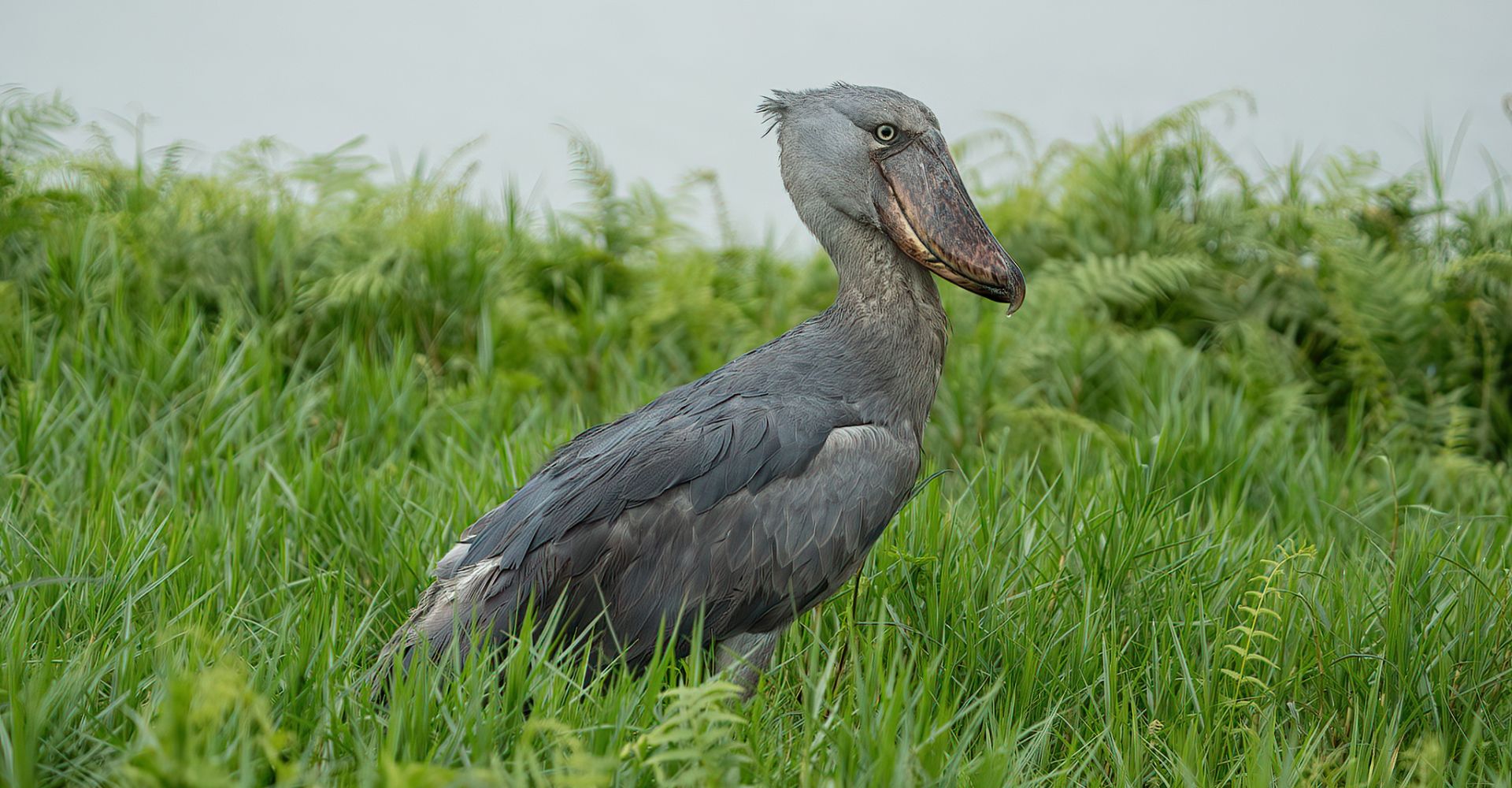
The best places to see the prehistoric shoebill in Uganda are the Mabamba Swamp near Entebbe, Murchison Falls National Park (Nile Delta), and Ziwa Rhino Sanctuary. Early morning canoe trips at Mabamba are the most popular, providing frequent sightings of this elusive, vulnerable species.
30-days-best-uganda-birding-safari-extravaganza-and-wildlife-safari
25-days-complete-uganda-birding-safari-extravaganza-with-wildlife-viewing
22-days-best-uganda-primate-and-birding-safari-adventure
21-days-uganda-birding-safari-extravaganza-to-best-uganda-safari-parks
20-days-uganda-birding-safari-wildlife-gorilla-and-chimpanzee-tracking
20-days-uganda-birding-safari-to-uganda-national-park
19-days-best-photography-uganda-birding-safari-and-wildlife-adventure
8-days-best-uganda-birding-safari-and-wildlife-watching-tour-package
7-days-best-uganda-birding-safari-tour
5-days-uganda-bird-watching-safari-lake-victoria-shores-and-lake-mburo
Mabamba Bay Wetland
Mabamba Bay is arguably the most famous and reliable location in the world for spotting the prehistoric-looking Shoebill Stork ($Balaeniceps$ $rex$). Located on the northern shores of Lake Victoria, a short distance from Entebbe and Kampala, this expansive wetland is a designated RAMSAR site and an "Important Bird Area." The ecosystem consists of thick papyrus reeds and water lilies, providing the perfect camouflage for the Shoebill as it stands motionless for hours, waiting to strike at lungfish—its favorite prey.
The experience at Mabamba is unique because it is conducted entirely by traditional wooden canoe. Expert local guides, many of whom are members of the Mabamba Wetland Women’s Group or local conservation associations, navigate the narrow water channels in the early morning. Morning excursions are highly recommended, as the birds are most active when they move to their "hunting" spots before the heat of the day. Because the bird is habituated to the presence of quiet canoes, photographers can often get remarkably close, capturing the bird's distinctive "clog-shaped" bill and intense, amber-eyed gaze. With a sighting success rate exceeding 90%, Mabamba is the essential starting point for any birding itinerary in Uganda.
Murchison Falls National Park
In the vast wilderness of Murchison Falls National Park, the Shoebill finds its sanctuary in the Nile Delta, where the Victoria Nile flows into Lake Albert. This area is a complex maze of papyrus islands and floating vegetation, creating a rich breeding and hunting ground. Unlike the small-scale canoe trips at Mabamba, tracking the Shoebill here is typically done via a scheduled boat safari or a private delta cruise. These trips offer a spectacular perspective, as you glide past massive pods of hippos and sunbathing Nile crocodiles while scanning the reed beds for the bird's unmistakable grey silhouette.
The best time for Shoebill sightings in Murchison is during the dry season (January to March) when the water levels recede, forcing the birds to congregate in the remaining permanent pools of the delta. The sight of a Shoebill in Murchison is often framed by the park’s dramatic landscapes—the shimmering water of the delta against the backdrop of the Blue Mountains in the Congo. Because the delta is also a magnet for other rare species like the Pel’s Fishing Owl and the Saddle-billed Stork, it offers a high-impact birding experience that perfectly complements a traditional "Big Five" savannah safari.
Ziwa Rhino Sanctuary
While primarily known as the only place in Uganda to see southern white rhinos in the wild, the Ziwa Rhino Sanctuary has quietly become one of the most successful Shoebill tracking destinations. The sanctuary is home to the Lugogo Swamp, a vast and pristine wetland that supports a healthy population of these rare birds. What makes Ziwa unique is the intimacy of the experience; the sanctuary offers guided canoe treks specifically tailored for birders, often led by rangers who monitor the birds' nesting and feeding patterns daily.
The canoe trips at Ziwa usually begin at dawn, providing a serene and hauntingly beautiful atmosphere as the mist rises off the swamp. Because the sanctuary is a protected area with limited human traffic, the Shoebills here are often very relaxed. It is not uncommon to see multiple individuals during a single four-hour excursion. This location is a perfect "halfway stop" for travelers driving between Kampala and Murchison Falls. Combining the thrill of tracking rhinos on foot in the morning with a quiet Shoebill canoe trek in the afternoon makes Ziwa a multifaceted highlight of any Ugandan circuit.
Semuliki National Park
For the adventurous birder seeking a more remote and "wild" encounter, Semuliki National Park offers a truly off-the-beaten-path experience. The park is situated in the remote Bwamba County, where the eastern edge of the Ituri Forest from the Congo meets the Ugandan plains. The Shoebill is typically found in the marshy areas bordering Lake Albert, particularly near the southern end of the lake. Accessing these spots often involves a combination of 4x4 driving and boat trips from the nearby Semliki Safari Lodge or local fishing villages.
The environment in Semuliki is unique because it represents an extension of the Central African jungle. The birding here is world-class, with over 440 species recorded, many of which are "Congo Basin" specialties found nowhere else in East Africa. While sightings of the Shoebill here may require more patience and travel time than at Mabamba, the reward is an encounter in an environment that feels completely untouched by modern tourism. The backdrop of the soaring Rwenzori Mountains and the proximity to the Sempaya Hot Springs make Semuliki a destination for those who want to see the Shoebill in its most primitive and isolated habitat.
Lake Mburo National Park
Lake Mburo National Park is the smallest of Uganda’s savannah parks, but its diverse landscape of acacia woodlands and five separate lakes makes it a surprising haven for water birds. The Shoebill is an occasional but prized resident here, most frequently spotted along the swampy, papyrus-fringed shores of Lake Mburo itself. The best way to find the bird is during the park’s scheduled boat rides, which depart from the lakeside jetty near the park headquarters.
While the Shoebill in Lake Mburo is more elusive than in Mabamba or Ziwa, the boat trip provides a wealth of other sightings, including African Finfoots, Malachite Kingfishers, and Great White Pelicans. Because the park is located conveniently along the highway to the gorilla forests of the west, it is a popular stopover. The "bonus" of a Shoebill sighting here is that it often occurs alongside the park’s famous hippos and the impalas and zebras that come down to the water’s edge to drink. For travelers who have missed the bird elsewhere, a boat trip on Lake Mburo offers a final, scenic chance to tick this bucket-list species off their list.
Ishasha Sector (Queen Elizabeth National Park)
The Ishasha Sector in the southern part of Queen Elizabeth National Park is famous for its tree-climbing lions, but birders know it as a critical habitat for the Shoebill. The birds are found in the marshy floodplains and swamps near Lake Edward, where the Ntungwe River enters the lake. This area provides a vast, undisturbed ecosystem where the storks can hunt lungfish away from the main tourist tracks.
What makes Shoebill tracking in Ishasha special is the combination of experiences. You can spend the morning searching the massive fig trees for lions and the afternoon exploring the wetland edges for the Shoebill. The marshes here are also home to a variety of other large water birds, including the Goliath Heron and the Black-headed Heron. Because Ishasha is the main transit point between Queen Elizabeth and Bwindi Impenetrable National Park, it is an easy location to include in a primate and wildlife safari. Standing on the shores of Lake Edward, looking across toward the Democratic Republic of Congo with a Shoebill in your binoculars, is an experience that captures the true, rugged spirit of the Albertine Rift.
What is the best time of year to see shoebill storks in Uganda?
The dry seasons, specifically from January to March and June to September, are considered the absolute best times for Shoebill sightings in Uganda. During these periods, the water levels in the vast wetlands and papyrus swamps recede. This reduction in water volume forces the fish—particularly the lungfish—into smaller, more concentrated pools. Consequently, the Shoebill, a patient and strategic hunter, congregates in these predictable areas to feed. For a traveler, this means the birds are much easier to locate, as they are less likely to be hidden deep within the "impenetrable" sections of the papyrus during the height of the dry months.
Furthermore, the dry season makes the logistics of birding much more comfortable. Navigation through narrow swamp channels in traditional wooden canoes is more reliable when not hampered by heavy tropical downpours. The light is also generally better for photography during these months, offering clear, golden-hour opportunities to capture the bird's prehistoric profile. While Uganda’s "Emerald Season" (the rains) offers lush scenery, the density of vegetation can make spotting this master of camouflage more of a challenge. Therefore, if the Shoebill is the primary goal of your safari, aiming for the dry windows ensures the highest probability of success across sites like Mabamba, Ziwa, and Murchison Falls.
Where in Uganda is the most reliable place to see the shoebill stork?
Mabamba Bay Wetland, located on the edge of Lake Victoria near Entebbe, is widely recognized as the most accessible and reliable location in the world to see the Shoebill Stork. Its proximity to Entebbe International Airport makes it a perfect first or last stop on any Ugandan itinerary. What makes Mabamba the "gold standard" for Shoebill tracking is the high concentration of birds—estimated at over 12 individuals—within a relatively compact area of papyrus and water lilies. The local community has also developed a sophisticated network of specialized birding guides who monitor the birds daily, resulting in a sighting success rate of over 95%.
The experience at Mabamba is intimate; you explore the narrow, winding channels in a motorized wooden canoe, allowing you to get remarkably close to the birds without disturbing them. Because the Shoebill is a "stand-and-wait" predator, it often remains motionless for long periods, providing photographers with incredible "statue-like" poses against the vibrant green of the marsh. Beyond the Shoebill, the bay is an Important Bird Area (IBA), meaning your search for the "King Whalehead" is often soundtracked by the calls of Malachite Kingfishers and African Jacanas, making it a comprehensive and high-impact birding experience.
Is it possible to see the shoebill stork in Murchison Falls National Park?
Yes, Murchison Falls National Park is one of the premier locations for Shoebill sightings, specifically within the Nile Delta area. This is the point where the Victoria Nile empties into Lake Albert, creating a vast maze of papyrus islands and floating vegetation. This delta is a critical habitat for the Shoebill, offering an abundance of lungfish and a secluded environment away from heavy human activity. In Murchison, the tracking experience is typically enjoyed via a boat safari that heads downstream toward the lake, providing a spectacular perspective of the riverine landscape.
The Nile Delta is especially productive during the dry season, as the shrinking water levels reveal the muddy banks where the storks prefer to hunt. Seeing a Shoebill in Murchison is often part of a much larger wildlife spectacle; it is not uncommon to spot the bird standing near a pod of wallowing hippos or a massive Nile crocodile basking on the shore. For travelers who want to combine "Big Five" game drives with elite birding, Murchison Falls offers a unique opportunity to see the Shoebill in a truly wild, expansive savannah-meets-wetland setting that feels entirely different from the canoe-based excursions near Entebbe.
How do you access the Mabamba Swamp for a shoebill birding excursion?
Accessing the Mabamba Swamp is an adventure in itself, involving a transition from the bustling areas near the capital to the quiet, watery world of Lake Victoria. Most visitors start their journey from Entebbe, where they take a scenic ferry or boat ride across the lake to the Mabamba landing site. Alternatively, one can drive from Entebbe or Kampala, which takes about 1 to 1.5 hours depending on traffic and road conditions. Once you reach the edge of the wetland, the transition to the "search phase" begins.
The only effective way to navigate the swamp is by using traditional, motorized wooden canoes. These boats are specifically designed to be narrow enough to slip through the dense papyrus channels and stable enough for photographers to stand or sit with heavy lenses. The local community manages these excursions, and your boat will be steered by a specialized guide who knows the "secret" clearings where the Shoebills are most likely to be found. This low-impact method of travel is essential; it allows for a quiet approach, ensuring that the birds remain relaxed and in situ while you observe them from just a few meters away.
What is the best time of day to find the shoebill in Mabamba?
The early morning hours, specifically between 6:30 AM and 9:00 AM, are the "golden window" for Shoebill sightings in Mabamba. There are several biological and practical reasons for this. Firstly, Shoebills are most active in the morning when they move from their nighttime roosting spots to their preferred "hunting platforms" in the swamp. This movement makes them easier for guides to spot. Secondly, the birds are primary hunters of lungfish, which often come to the surface for air more frequently in the cool, early hours.
From a photography standpoint, the morning light is soft and directional, illuminating the bird’s grey plumage and large bill without the harsh shadows of the midday sun. Practically, the temperatures in the swamp are much more pleasant in the early morning; by midday, the heat on the open water can be intense, and the birds often retreat deeper into the thick papyrus for shade, making them much harder to locate. Arriving early also ensures you are one of the first boats in the channels, providing a quieter, more exclusive experience before other birding groups arrive.
How long does a typical shoebill viewing trip take at Mabamba Swamp?
A typical Shoebill excursion at Mabamba is generally a half-day trip, lasting between 3 and 4 hours. This includes the time spent navigating from the landing site into the heart of the wetland, the period spent searching the various channels, and the time allocated for observing and photographing the birds once found. Because the success rate at Mabamba is so high, guides can often locate a bird within the first hour, leaving plenty of time for a relaxed, high-quality encounter.
For the most dedicated birders, the trip can be extended into a full-day session, allowing for an exploration of the wider bay to see other specialized species like the Papyrus Gonolek or the Lesser Jacana. However, for most travelers, the 4-hour morning window is perfect. It allows you to return to Entebbe or Kampala by lunchtime, making it an easy "add-on" for those with a tight schedule or those who are just beginning their larger Uganda safari circuit. The efficiency of the Mabamba community guides ensures that even a short visit can result in one of the most memorable wildlife encounters of your life.
Are there shoebill storks found in Ziwa Rhino Sanctuary in Uganda?
Yes, Ziwa Rhino Sanctuary is one of Uganda’s hidden gems for Shoebill tracking. While the sanctuary was primarily established for the reintroduction of the southern white rhino, its territory includes the Lugogo Swamp, a vast and pristine wetland that has become a sanctuary for a healthy and resident population of Shoebills. Because the sanctuary is a protected area with restricted access, the Shoebills here are remarkably undisturbed and can often be seen in their most natural, relaxed state.
The sanctuary offers guided canoe treks specifically for birders. These are often led by rangers who have intimate knowledge of the swamp’s ecology. Sightings in the Lugogo Swamp are very reliable, and it is not uncommon to see multiple birds during a single session. Combining a morning rhino trek on foot with an afternoon Shoebill canoe trip makes Ziwa one of the most diverse conservation sites in the country. For many, the quietness of Ziwa provides a more "private" birding experience compared to the more popular Mabamba, making it a favorite for serious ornithologists seeking solitude and high-quality sightings.
What does a shoebill stork eat when it is hunting in the swamps?
The Shoebill is a specialized, patient carnivore with a diet that is perfectly adapted to its wetland environment. Its absolute favorite prey is the Marbled Lungfish ($Protopterus$ $aethiopicus$). These fish are often found in the oxygen-poor waters of the papyrus swamps and must occasionally come to the surface to breathe, which is exactly when the Shoebill strikes. The bird’s massive, hook-tipped bill is designed to clamp down on the slippery fish with incredible force, often decapitating the prey instantly to ensure it cannot escape.
Beyond lungfish, the Shoebill is an opportunistic hunter. It will eat frogs, water snakes, young monitor lizards, and even baby crocodiles if the opportunity arises. It has also been known to consume smaller birds and rodents. The hunting style of the Shoebill is legendary; it can stand perfectly still for hours—looking like a grey statue—waiting for a ripple in the water. When it finally strikes, it performs a "collapse" move, lunging forward with its entire body weight to pin the prey against the swamp floor. This high-energy strike, following hours of total stillness, is one of the most dramatic displays of predatory behavior in the avian world.
Can I see the shoebill stork in Lake Mburo National Park in Uganda?
Yes, Lake Mburo National Park is an excellent, though sometimes underrated, location for Shoebill sightings. While the park is famous for its zebras and impalas, it is also home to a significant amount of wetland habitat along the shores of Lake Mburo and its surrounding swamps. The Shoebill is a resident here, though it is more elusive than at Mabamba. The best way to see the bird is by taking the scheduled boat safari that departs from the lakeside jetty.
During the boat ride, you cruise along the papyrus-fringed edges of the lake, which is the prime territory for the stork. While a sighting here is never guaranteed, it is often a "bonus" for those enjoying the hippos and African Finfoots that Lake Mburo is famous for. Because the park is located conveniently along the main highway to the gorilla forests of the west, it provides a final, scenic opportunity for travelers to tick the Shoebill off their list. The park’s diverse birdlife—over 350 species—means that even if the Shoebill remains hidden, the water-based safari remains a highlight of the visit.
How many shoebill storks are estimated to be living in Uganda today?
Uganda is considered one of the most important strongholds for the Shoebill Stork, with an estimated population of approximately 1,000 individuals. While the global population is estimated to be between 3,300 and 5,300, Uganda’s vast and relatively well-protected wetland systems—including the shores of Lake Victoria, the Nile Delta, and the various RAMSAR sites—provide the ideal environment for the species to persist.
However, these numbers are a subject of constant monitoring by conservationists. The Shoebill is a slow-breeding bird, often laying two eggs but usually only successfully raising one chick. This low reproductive rate makes the population highly sensitive to environmental changes. In Uganda, the primary threats to these 1,000 birds are habitat loss due to wetland drainage for agriculture and illegal trade. The good news is that "birding tourism" has turned the Shoebill into a valuable economic asset for local communities, particularly in Mabamba, which has led to increased local protection of the birds and their nesting sites. This community-led conservation is the most promising factor in ensuring Uganda's population remains stable.
Do I need to hire a local guide to see the shoebill in Mabamba?
Yes, hiring a local guide is absolutely essential for a successful and responsible Shoebill excursion in Mabamba. The wetland is a complex, 100-square-kilometer maze of shifting papyrus and narrow water channels. Without a guide who understands the current water levels and the birds' preferred daily "feeding stations," you would likely spend hours wandering the swamp without ever seeing the stork. These guides are often former fishermen who have transitioned into tourism, bringing with them a lifetime of knowledge about the lake’s ecology.
Beyond the logistics of navigation, local guides act as conservation guardians. They understand the "7-meter rule"—keeping a respectful distance so the bird does not feel threatened or forced to fly away. They are also skilled at spotting the bird’s subtle grey silhouette against the dense reeds, something that is incredibly difficult for the untrained eye. By hiring a local guide, you are also directly supporting the local economy, which provides the community with a powerful incentive to protect the swamp and its "prehistoric" inhabitants from poaching or habitat destruction. It is a win-win for both the traveler and the ecosystem.
Is it safe to go on a boat trip to find the shoebill?
Yes, boat trips to find the Shoebill are generally very safe, provided you follow the standard procedures and go with authorized local operators. In places like Mabamba and Ziwa, the wooden canoes are operated by experienced boatmen who navigate these waters daily. The motorized engines are well-maintained, and the guides are trained in water safety. Most operators provide life jackets, which are mandatory for all passengers before leaving the landing site.
The water in these wetlands is typically shallow and calm, so there is no risk of large waves or heavy currents. The primary "safety" consideration is more about the environment: the sun can be intense on the open water, so sunblock and a hat are essential. Additionally, while the swamps are home to wildlife like hippos (especially in Murchison Falls), the guides are experts at keeping a safe distance. By choosing a reputable tour operator and following your guide’s instructions, the search for the Shoebill is a peaceful, low-risk, and deeply rewarding experience suitable for travelers of all ages.
Do shoebill storks often fly during the day, or do they sit still?
The Shoebill is famous for its near-total stillness. In the birding world, they are often compared to statues because they can stand perfectly motionless for hours. This "sit-and-wait" predatory strategy is essential for their survival; they wait for the exact moment a lungfish surfaces for air before launching a high-speed strike. For a tourist, this behavior is a blessing, as it allows for long, uninterrupted observation and provides photographers with a stable, albeit intense, subject.
While they are mostly stationary during their hunting hours, Shoebills do fly, primarily to move between different feeding grounds or to return to their nighttime roosts. They have a massive wingspan (up to 2.5 meters) and a slow, heavy wingbeat that is reminiscent of a prehistoric pterosaur. They are also known to "soar" on thermals during the heat of the midday sun, spiraling high into the sky to stay cool or to survey their territory. Seeing a Shoebill in flight is a rare and spectacular sight, but for the majority of your encounter, you will likely be captivated by the bird’s unblinking, "statue-like" presence in the reeds.
What other bird species can I see while looking for the shoebill stork?
While the Shoebill is the undisputed star of the show, Uganda’s wetlands are teeming with a diverse array of other avian species. In Mabamba Bay alone, you can see over 300 species. During your search, you are almost guaranteed to see the vibrant Malachite Kingfisher and the Pied Kingfisher darting over the water. The lily pads are often covered with African Jacanas (also known as "Lily-trotters") and their smaller relatives, the Lesser Jacanas.
If you are lucky, you might spot the elusive Papyrus Gonolek, a stunning bird with a vibrant red breast that lives deep within the reeds. Other common sightings include the African Open-billed Stork, African Marsh Harrier, Blue-breasted Bee-eater, and the Great White Pelican. The swamps are also home to various herons, such as the Purple Heron and the Squacco Heron. For birders, the "Shoebill search" is never just about one bird; it is a multi-layered journey through one of the most bird-rich environments on the planet, where every turn in the channel reveals a new splash of color or a unique call.
Are shoebill storks found in Semuliki National Park in Western Uganda?
Yes, Semuliki National Park is a known, albeit more remote, location for Shoebill sightings. The birds are occasionally spotted in the marshy areas bordering Lake Albert, particularly near the southern end of the lake where the environment is dominated by papyrus and thick grasses. Because Semuliki is an extension of the great Ituri Forest of the Congo, the habitat is incredibly wild and receives fewer visitors than the central wetlands, offering a more "rugged" birding experience.
Tracking a Shoebill in Semuliki usually involves a boat trip onto Lake Albert. While sightings here are less frequent than at Mabamba—due to the vastness of the area and the density of the vegetation—the birds that are found here are truly wild and unhabituated. Semuliki is a haven for Central African bird species, so a search for the Shoebill here is often combined with sightings of other "Congo-biome" specialties like the Nkulengu Rail or various hornbills. For the adventurous traveler who wants to see the Shoebill in a landscape that feels like a prehistoric frontier, Semuliki is a fascinating and rewarding destination.
Why is the shoebill stork called a "prehistoric-looking" bird by many birders?
The Shoebill is often described as "prehistoric" because its physical appearance is strikingly different from most modern birds, evoking images of ancient, extinct lineages. Its most defining feature is its massive, bulbous, shoe-shaped bill, which ends in a sharp, hooked nail. This bill, combined with the bird’s large, yellow, unblinking eyes and its "death-stare" expression, gives it an almost reptilian quality. Its grey, archaic plumage and its habit of standing perfectly still like a museum exhibit only add to the "lost-in-time" aura.
Taxonomically, the Shoebill is a bit of an enigma. While it was traditionally grouped with storks, modern DNA analysis suggests it is more closely related to pelicans or herons. Its slow, heavy flight and its massive wingspan (reaching up to 2.5 meters) further contribute to the feeling that you are looking at a living fossil—a remnant of the era when pterosaurs ruled the skies. For birders, seeing a Shoebill is like witnessing a "missing link" in avian evolution, a bird that has remained largely unchanged for millions of years, perfectly adapted to the primeval swamps of East Africa.
Is a specialized camera required to photograph the shoebill stork in the swamps?
While you don't need "professional-grade" equipment to get a great shot, a camera with a good zoom lens (at least 300mm to 600mm) is highly recommended. Although guides at Mabamba can get you remarkably close to the birds, you still want to maintain a respectful distance (usually around 7 to 10 meters) to ensure the bird stays relaxed. A zoom lens allows you to capture the incredible details of the bird’s "shoe" bill, its intense amber eyes, and the textures of its grey feathers without encroaching on its space.
Because the boat is often moving slightly on the water, a lens with Image Stabilization (IS) is very helpful for keeping your shots sharp. If you are using a smartphone, you can still get excellent photos, but you may want to consider a "clip-on" telephoto lens or use a pair of binoculars for a "digiscoping" effect. It is also important to have a high-speed memory card, as the Shoebill’s strike—when it finally moves—is incredibly fast and requires "burst mode" to capture. Regardless of your gear, the Shoebill’s habit of standing perfectly still for long periods makes it one of the most "cooperative" subjects in the world of wildlife photography.
Can I see the shoebill stork during a canoe ride in the afternoon?
Yes, it is certainly possible to see the Shoebill in the afternoon, although the morning remains the preferred time for most guides and birders. Shoebills are resident in their territories, so they don't leave the swamp during the day. However, their behavior changes as the sun gets higher. In the late morning and early afternoon, when the heat is at its peak, the birds often retreat from the open "hunting platforms" into the deep shade of the thick papyrus to stay cool, making them significantly harder for guides to locate.
That said, a late afternoon trip (between 4:00 PM and 6:30 PM) can also be very productive. As the temperature drops, the birds often re-emerge to feed one last time before sunset. The light during the "golden hour" just before dusk can be spectacular for photography, casting a warm glow over the marsh. If you are a casual observer or have a schedule that doesn't permit a 6:00 AM start, an afternoon trip is still a very worthwhile experience with a high chance of success, especially at reliable spots like Mabamba Bay.
How close can you get to the shoebill stork during a boat trip?
One of the reasons Mabamba Bay is so popular is that the Shoebills there are remarkably habituated to the presence of quiet, wooden canoes. Guides can often navigate to within 7 to 10 meters (20 to 30 feet) of the bird. At this distance, the bird is usually completely relaxed, often continuing to scan the water for lungfish or even preening its feathers while you watch. This proximity allows for an incredibly intimate encounter where you can see the bird's individual eyelashes and the subtle movements of its bill.
However, the "golden rule" of Shoebill tracking is to never push the bird. If the stork shows signs of stress—such as repeatedly stretching its neck, clicking its bill, or shifting its weight—the guide will immediately back the boat away. The goal is to be a "silent observer" rather than a disturbance. Maintaining a respectful distance ensures that the bird stays in its hunting spot, allowing you (and the groups that follow) to enjoy a long, high-quality viewing experience without forcing the animal to waste energy by flying away.
Is the shoebill stork, often seen in Uganda, considered an endangered bird species?
The Shoebill Stork is currently classified as Vulnerable on the IUCN Red List, which is a step below "Endangered" but still indicates a high risk of extinction in the wild. The global population is estimated to be declining, with fewer than 5,300 individuals remaining across its entire range in East and Central Africa. In Uganda, while the population is relatively stable at around 1,000 birds, the species remains under constant threat from habitat destruction, illegal wildlife trade (for zoos and private collectors), and human disturbance.
The significance of the "Vulnerable" status is that it triggers international protection and conservation funding. In Uganda, the Shoebill has become a flagship species for wetland conservation. Because it is so highly sought after by tourists, it has become more "valuable" alive than as bushmeat or as a pet. This economic value has led to the protection of entire ecosystems like Mabamba Bay, which in turn protects hundreds of other species. While the Shoebill’s future is not yet secure, the rise of responsible birding tourism in Uganda is currently the most effective tool in preventing this prehistoric giant from moving onto the "Endangered" list.
Booking Uganda birding safari with us Roads of Adventure safaris
Book your unforgettable Uganda birding safari with Roads of Adventure Safaris, specializing in tailored, expert-led tours (5–30 days) to prime locations like Mabamba Swamp and Bwindi. They offer professional guidance for spotting over 1,065 species, including the Shoebill, plus gorilla and chimpanzee tracking.
