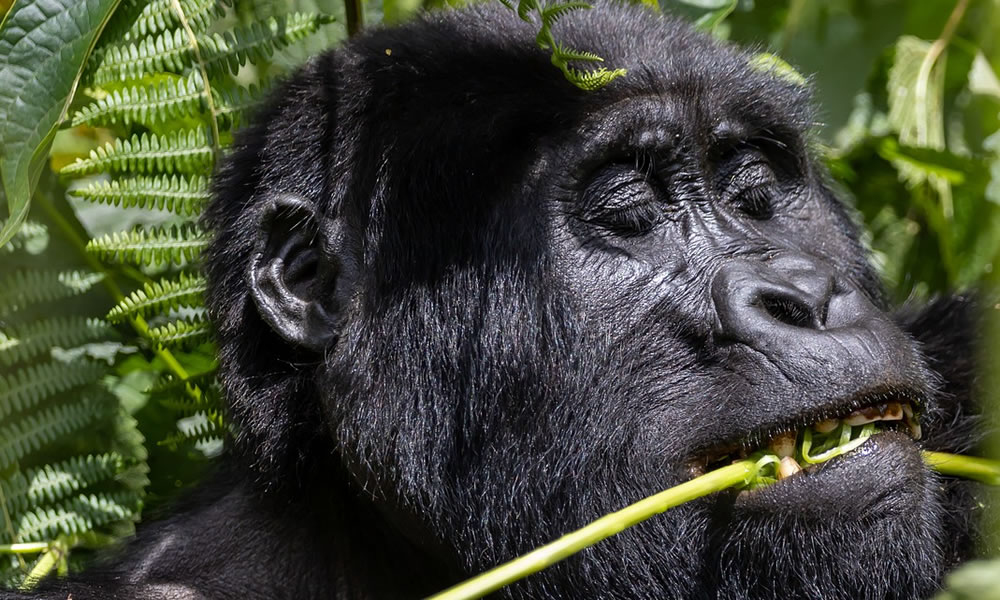
Mountain gorilla trekking in Mgahinga Gorilla National Park involves a scenic, sometimes strenuous 3 to 6-hour hike through lush bamboo forests. You will track the park's sole resident group—the Nyakagyezi family—and spend one hour observing these majestic primates in their natural habitat
1. The Nyakagyezi Gorilla Family
Mgahinga Gorilla National Park features a unique primate dynamic: it is home to just one single habituated mountain gorilla family, known as the Nyakagyezi group. For many years, this family was famous among safari circles for its migratory behavior, frequently crossing the fluid, unseen borders of the Virunga Massif into Rwanda’s Volcanoes National Park or the Democratic Republic of Congo’s Virunga National Park. However, for over a decade now, the group has permanently settled on the Ugandan side, making Mgahinga an incredibly stable and highly sought-after destination for tracking.
What makes the Nyakagyezi family truly spectacular to observe is its rare and fascinating structural composition. While most mountain gorilla families are strictly dominated by a single, undisputed silverback who fiercely guards his position, the Nyakagyezi group is renowned for having multiple silverbacks living in relative harmony. The group is currently led by the dominant silverback, Mark, who manages the family’s daily movements with a calm but firm authority. He is supported and assisted by his brother, Mafia, and their retired father, Bugingo, who remarkably still stays with the group as an elder statesman rather than being completely ousted into isolation.
Because Mgahinga is Uganda’s smallest national park, spanning just 33.7 square kilometers, this family roams a compact, self-contained volcanic terrain. Watching them interact offers a rare masterclass in primate politics. You can witness how multiple mature males co-exist, sharing the responsibility of protecting the females and playful juveniles without the constant, violent clashes seen in other groups. This unique, multi-silverback dynamic creates a deeply captivating viewing experience, as the sheer physical presence of several 400-pound silverbacks moving together through the bamboo zone is nothing short of breathtaking.
2. The Dynamic Duration of the Trek
The time spent actively searching for the mountain gorillas in Mgahinga is a thrilling exercise in wild unpredictability, typically taking anywhere from 30 minutes to over 4 hours. Because the Nyakagyezi group lives in a completely unfenced, wild mountain ecosystem, their exact location changes every single day based on their appetite, weather patterns, and internal family dynamics. On a lucky morning, the family might be found feeding on succulent bamboo shoots just past the park boundary, resulting in a short, relatively easy walk from the briefing point.
However, trackers must always be mentally and physically prepared for a much longer, more demanding journey. If the gorillas decide to venture higher up the steep, dramatic slopes of the Virunga volcanoes in search of specific seasonal delicacies, like wild celery or hypericum berries, the trek can easily turn into an all-day alpine expedition. Mountain gorillas can travel significant distances overnight, climbing through dense hypericeous zones and thick tangled undergrowth where rangers must actively slash paths using machetes.
The tracking process is highly coordinated. Long before you depart from the park headquarters, an advanced team of expert UWA trackers sets off into the forest at the break of dawn. They hike directly to the exact location where the gorillas built their woven vegetation nests the previous evening. Once they locate the nests, they follow the fresh footprints, broken branches, and dung piles to locate the family in real-time. They then communicate via radio with your guiding team, directing your group along the most efficient route. This seamless blend of traditional tracking expertise and modern communication ensures a near-perfect success rate.
3. The Golden Hour of Encounter
Locating the Nyakagyezi family marks the transition into "The Golden Hour"—a strict, globally mandated sixty-minute window of direct observation that is designed to balance visitor awe with rigorous wildlife conservation. This sixty-minute limit is a non-negotiable international standard across all mountain gorilla habitats. It is deliberately engineered to prevent the gorillas from experiencing chronic stress, avoiding behavioral disruption, and drastically reducing the risk of cross-species disease transmission from human visitors.
During these sixty minutes, the forest around you feels entirely electric. You are permitted to quietly shadow the family as they go about their natural mid-day routines. Mountain gorillas are highly peaceful, gentle giants, and because they are completely habituated to human presence, they will look right through you, treating your presence with a calm, indifferent neutrality. You might witness a massive silverback lounging on a bed of vines, systematically stripping the outer bark off a wild branch with his teeth, while nearby, a mother gently cradles and grooms her tiny, big-eyed infant.
The hour moves incredibly fast as you capture photographs and observe their deeply human-like expressions, fingernails, and social interactions. Your guides will quietly point out individual personalities and interpret their subtle vocalizations, such as the deep, contented guttural rumbles that signal the family feels safe and relaxed. When the sixty minutes conclude, the guides will firmly instruct the group to step back and begin the return hike. This short but profound window leaves a lasting impression, offering an unparalleled look into the private life of one of the world's most endangered primates.
4. Navigating Volcanic Hikes and Terrain
Tracking gorillas in Mgahinga is a distinctly alpine experience defined by the dramatic geography of the Albertine Rift. The park is situated high in the clouds, with tracking altitudes ranging from 2,227 meters to over 3,000 meters above sea level. The entire protected area encompasses the steep, dramatic slopes of three majestic, extinct Virunga Volcanoes: Mount Muhabura, Mount Gahinga, and Mount Sabyinyo. Consequently, the terrain is rugged, uneven, and physically demanding.
The trails are not manicured footpaths; instead, you will be navigating a dynamic wilderness of thick bamboo forests, dense montane moorland, and slick volcanic rock. The ground underfoot is frequently muddy, soft, and riddled with hidden holes, exposed roots, and slippery volcanic clay that can challenge even the most experienced hikers. Furthermore, the high altitude means the air is significantly thinner, which speeds up physical fatigue and leaves you catching your breath much faster than you would at lower elevations.
The vegetation zones change noticeably as you climb higher up the volcanoes. You will start in the lower regeneration zones before pushing into the thick, dark bamboo forests where the stalks grow tightly together, requiring careful maneuvering. The weather plays a massive role in the terrain's difficulty; a sudden montane downpour can instantly transform a dry slope into a slick mud slide. Walking here requires a slow, rhythmic, and intentional pace, focusing entirely on your balance and secure foot placement with every single step you take.
5. Physical Preparation and the Value of Porters
To fully enjoy the rugged slopes of Mgahinga, a moderate to high level of physical cardiovascular fitness is strongly recommended. Prior to your trip, preparing your body with regular stair-climbing, hill walking, or leg-strengthening exercises like squats and lunges will pay massive dividends. Being in good physical shape ensures that you can focus your mind on the spectacular scenery and wildlife, rather than struggling with physical exhaustion or muscle strain on the steep volcanic inclines.
One of the best operational decisions you can make at the trailhead is to hire a local porter. Available at the Ntebeko park gate for a standard fee of around $15 to $20, porters are members of the surrounding local communities, often including reformed poachers who now rely on tourism for sustainable livelihoods. Hiring a porter provides a direct, highly impactful economic benefit to the families living right along the park boundaries, fostering a positive local relationship with gorilla conservation.
Physically, a porter is an absolute lifesaver on the mountain. They will carry your heavy daypack containing your water, snacks, and heavy camera gear, leaving you completely unburdened to focus on your balance and photography. More importantly, porters possess an intimate, lifelong familiarity with this specific terrain. During steep, muddy ascents or tricky descents over wet volcanic rock, they will provide a steady, reassuring hand or pull you up challenging sections, ensuring you stay safely on your feet throughout the entire trek.
6. Selecting Footwear and Sturdy Gear
The foundation of a successful and comfortable gorilla trek in Mgahinga lies entirely in your choice of footwear. Because you will be hiking off-trail through slick volcanic mud, scrambling over wet, mossy logs, and climbing steep slopes, standard running shoes, sneakers, or lightweight trail runners are highly inadequate and unsafe. You absolutely require a pair of high-quality, sturdy hiking boots that offer deep rubber lugs for maximum traction and solid ankle support to prevent painful twists on uneven ground.
It is critically important that your hiking boots are fully waterproof and thoroughly broken-in well before you arrive in Uganda. Brand new boots worn for the first time on the volcanoes are a guaranteed recipe for painful friction blisters that can ruin your tracking experience. The waterproof membrane is essential because the montane forest floor is perpetually damp, covered in wet leaf litter, dew-heavy grasses, and deep mud puddles that will quickly soak through standard mesh footwear.
Pair your boots with high-performance, moisture-wicking synthetic or merino wool hiking socks to protect your feet from friction. For added protection, consider wearing a pair of durable, waterproof canvas trail gaiters. Gaiters wrap securely around your lower leg, bridging the gap between your boots and trousers. This completely prevents thick mud, biting insects, safari ants, and sharp volcanic gravel from slipping inside your boots, keeping your feet completely dry, clean, and comfortable through the toughest sections of the mountain.
7. Protective Clothing for the Jungle
Dressing appropriately for the dense montane forests of the Virunga volcanoes is all about creating a protective barrier between your skin and a highly defensive ecosystem. The primary adversary on these slopes is the ubiquitous stinging nettle (Urtica dioica), a plant covered in tiny, fragile hairs that inject irritating chemicals into the skin upon contact, causing an instant, intense burning rash that can last for hours. To guard against this, long clothing is mandatory.
You should wear durable, long-sleeved shirts and full-length safari trousers made from thick, tightly woven synthetic materials. Avoid thin leggings or tight cotton fabrics, as stinging nettles and sharp thorns can easily pierce right through them. Your shirt should feature a collar that can be flipped up to protect your neck from low-hanging branches and dropping insects. A classic and highly effective technique used by safari guides is to tuck your trousers directly into your long hiking socks, preventing safari ants and crawling ticks from migrating up your legs.
Additionally, carrying a pair of thick, durable gardening gloves is an indispensable insider secret. During the trek, the terrain will frequently require you to grab onto passing vines, bamboo stalks, and bushes to stabilize your balance on steep, muddy inclines. Many of these plants are covered in micro-thorns or stinging hairs. A solid pair of gloves allows you to confidently grasp the surrounding vegetation for support without any fear of piercing your hands or sustaining painful stings.
8. Preparing for Unpredictable Montane Weather
The weather in Mgahinga Gorilla National Park is defined by its extreme, rapid, and highly unpredictable volatility, a direct result of its high altitude and unique volcanic topography. It is common to experience bright, hot sunshine, dense mountain mist, and a heavy tropical downpour all within a single afternoon. You should never rely on a clear blue morning sky as an indicator of how the rest of the day will unfold; the mountains create their own microclimates instantly.
To stay comfortable, you must pack a high-quality, lightweight, and fully waterproof rain jacket or heavy-duty poncho directly in your daypack. This rain gear should be highly breathable to prevent you from overheating while hiking up steep inclines. Avoid cheap plastic ponchos, which tear instantly when caught on sharp jungle thorns. When a montane storm rolls in, the temperature can drop rapidly within minutes, making a water-resistant windbreaker layer essential to protect against hypothermia.
A versatile hat is equally important for weather protection. Bring a wide-brimmed safari hat to shield your face and eyes from the intense equatorial sun during open ridge walks, or a lightweight baseball cap that can easily fit underneath your rain jacket hood. Because the weather changes so fast, dressing in versatile layers is the ultimate strategy. This allows you to quickly peel off layers when laboring up a sunny ridge, or bundle up when the cold mountain mist rolls down from the volcanic summits.
9. Essential Backpack Supplies and Hydration
When venturing out into the rugged terrain of Mgahinga, your daypack functions as your personal mobile survival kit, and its contents must be kept entirely dry. You should utilize a durable, waterproof backpack, or line the interior of a standard pack with a heavy-duty dry bag or thick trash liner. This ensures that your expensive camera gear, spare clothing, and personal items remain perfectly dry even during a sustained equatorial downpour.
The most critical supply you will carry is drinking water. The combination of high altitude, steep climbing, and humid forest air causes rapid dehydration through sweating, even if you do not feel intensely hot. You must bring at least 2 to 3 liters of clean drinking water per person. Relying on small single-use plastic bottles is highly discouraged; instead, utilize a durable, insulated water reservoir (like a CamelBak) or heavy-duty reusable bottles that can withstand being knocked against volcanic rocks.
Alongside water, pack a selection of high-energy, nutrient-dense snacks to maintain your stamina during the trek. The physical exertion of mountain hiking burns calories rapidly. Ideal snacks include dried fruits, raw nuts, trail mix, energy bars, and dark chocolate, which provide quick bursts of glucose and sustained energy without taking up significant space or adding excessive weight to your pack. Your guiding team will allocate short, structured rest breaks along the way, allowing you to hydrate and refuel before pushing further up the slopes.
10. Crucial Accessories for Health and Optics
Beyond your clothing and footwear, a few small, well-chosen accessories will significantly elevate your comfort, safety, and visual experience on the slopes of the Virungas. First and foremost is a premium insect repellent. While tsetse flies are less common in the high-altitude volcanic forests compared to the lower savannahs, mosquitoes, midges, and biting flies are present, making a reliable repellent essential for preventing irritating bites throughout your trek.
Sun protection is equally vital, despite the shaded forest canopy. Because Mgahinga sits at a high altitude right near the equator, the sun's ultraviolet rays are incredibly intense. Apply a high-SPF, broad-spectrum sunscreen to your face, neck, and hands before setting off, and carry a protective lip balm to prevent chapping in the crisp, cool mountain air. Additionally, packing a small personal first-aid kit containing blister pads, antiseptic wipes, and adhesive bandages is highly recommended for handling minor trail scrapes.
For viewing the park’s spectacular biodiversity, a lightweight pair of waterproof binoculars (ideally 8x32 or 8x42) is an absolute game-changer. Mgahinga is a premier birding destination, home to several rare Albertine Rift endemics like the stunning Regal Sunbird and the Rwenzori Turaco. Binoculars allow you to clearly spot these vibrant birds high in the canopy during tracking lulls. They also allow you to scan distant ridges for a glimpse of the rare and endangered golden monkeys that share this unique volcanic ecosystem.
11. The Pre-Trek Ranger Briefing
Your gorilla tracking experience officially commences promptly at 8:00 AM at the Ntebeko Gate, the main administrative headquarters of Mgahinga Gorilla National Park. Arriving early is essential, as the mandatory pre-trek briefing is a critical component of the day’s logistics. During this gathering, Uganda Wildlife Authority park rangers will register your permits, check your passports to verify age compliance, and organize trekkers into small, intimate groups of no more than eight people per gorilla family.
The ranger briefing is designed to prepare you thoroughly for the journey ahead, covering safety protocols, forest ecology, and tracking etiquette. The rangers will provide an overview of the current status of the Nyakagyezi family, explaining their estimated location based on the early morning scouting reports. They will detail exactly how to behave when standing before the gorillas, ensuring that every visitor understands how to move, speak, and respond to the animals' behavior safely.
This briefing is also the moment where the park's guiding team assesses the physical capabilities of the trekkers, ensuring that anyone requiring additional assistance is paired with a porter. The atmosphere at Ntebeko in the morning is filled with palpable excitement as travelers from around the world gather around the maps. Listening closely to the rangers during this session is vital; their deep expertise, stories, and safety instructions lay the groundwork for a smooth, respectful, and profoundly rewarding encounter in the jungle.
12. Strict Rules for Primate Preservation
To protect the mountain gorillas from extinction, the Uganda Wildlife Authority enforces a strict code of conduct that all trekkers must follow. The most critical rule is maintaining a mandatory minimum distance of 7 meters (about 23 feet) from the gorillas at all times. This boundary is vital because humans and gorillas are genetically almost identical, making these endangered primates highly vulnerable to human respiratory viruses, common colds, influenza, and scabies, which can quickly wipe out an entire wild family.
If a curious juvenile or an imposing silverback intentionally approaches you, you must remain completely still and follow your guide's instructions to slowly step back, allowing the animal to maintain its path. Wearing a surgical face mask is mandatory when standing in the presence of the gorillas to prevent any aerosol transmission of germs. If you feel sick, have a cough, or are suffering from a contagious illness on the morning of the trek, you must volunteer to step down; your permit will be rescheduled or refunded in accordance with conservation policies.
While observing the family, flash photography is strictly prohibited. The sudden, intense burst of artificial light can blind, startle, or anger a gorilla, potentially triggering a defensive charge from a protective silverback. Keep your voice down to a low, respectful whisper to avoid agitating the troop. Finally, eating, drinking, or leaving any form of trash in the forest is completely banned, ensuring the ecosystem remains entirely pristine and free from habituating the wildlife to human food.
13. Age Restrictions and Conservation Ethics
The Uganda Wildlife Authority enforces a strict minimum age limit for mountain gorilla tracking: all participants must be 15 years of age or older. This age restriction is non-negotiable and strictly checked via passport verification during the morning registration at Ntebeko Gate. The rule serves two critical primary purposes: disease control and physical safety. Children are immunologically more likely to carry common childhood communicable illnesses, like measles or chickenpox, which could be catastrophic if introduced to a wild primate population.
1. How difficult is the terrain during gorilla trekking in Mgahinga?
The terrain in Mgahinga Gorilla National Park is famously rugged, physically demanding, and distinctly volcanic. Trekking here means navigating the steep slopes of three extinct Virunga Volcanoes: Mount Muhabura, Mount Gahinga, and Mount Sabinyo. Elevation begins at roughly 2,200 meters and climbs steeply through dense, tangled vegetation, loose volcanic soils, and slick fields of giant bamboo.
Trekkers must expect a true wilderness challenge rather than a manicured trail walk. The ground is frequently wet, covered in thick moss, and crisscrossed by hidden roots and fallen bamboo stalks that require careful stepping. Unlike flatter savannah walks, the vertical gains here demand cardiovascular endurance and stable footing.
The weather adds another layer of complexity; sudden equatorial downpours can instantly turn steep paths into slippery mud chutes. Tracking the gorillas might lead you straight up an incline or force you to forge a path through raw, trackless undergrowth where park rangers must clear a trail using machetes.
Understanding this topography helps you pace yourself appropriately. It is a highly dynamic environment where every step requires focus, but the dramatic topography also opens up staggering, mist-shrouded vistas across the border regions of Uganda, Rwanda, and the Democratic Republic of Congo. Preparing for a mix of steep mountain ridges, bamboo forests, and unpredictable footing ensures you manage your energy levels effectively throughout the trek.
2. Which habituated gorilla group will I track in Mgahinga Gorilla National Park?
Mgahinga Gorilla National Park is home to just one habituated mountain gorilla family open for tourism: the famous Nyakagezi group. This makes the trekking dynamics here incredibly distinct compared to Bwindi Impenetrable National Park, which hosts dozens of families across multiple sectors.
Historically, the Nyakagezi family was known for its migratory behavior, frequently crossing international borders into Rwanda’s Volcanoes National Park or the Virunga National Park in the DRC. However, for many years now, the group has permanently settled on the Ugandan side within Mgahinga, establishing a stable home range that makes tracking them highly reliable.
The Nyakagezi group is particularly fascinating to observe because of its unique multi-male social structure. Typically, a gorilla family is dominated by a single silverback, but this group features a rare dynamic where multiple silverbacks co-exist under the leadership of the dominant male.
Watching the subtle interactions, shared responsibilities, and complex hierarchy among these massive males is a highlight for wildlife enthusiasts. Because there is only one group, a maximum of eight gorilla permits are issued per day for the entire park. This creates an exceptionally exclusive, intimate, and quiet atmosphere at the Ntebeko visitor center, completely free from the large crowds and bustling logistics found in busier trekking hubs.
3. What does a typical gorilla trekking itinerary look like on the day of the trek?
Your gorilla trekking day begins early at the Ntebeko Visitor Center, the main gateway into Mgahinga Gorilla National Park. Trekkers are expected to arrive by 7:00 AM for registration, where park officials verify permits and passports. Shortly after, an essential pre-trek briefing is conducted by senior park rangers. This briefing covers the history of the Nyakagezi group, the park's volcanic topography, safety protocols, and vital conservation guidelines designed to protect both humans and gorillas.
By 8:30 AM, you hit the trail. The trek begins at the park boundary, quickly transitioning from community farmlands into the dramatic bamboo zone. The duration of the hike is completely unpredictable; it can take anywhere from one hour to six hours depending on where the gorillas nested the previous night.
Advanced trackers enter the forest at dawn to locate the family’s fresh tracks and radio their coordinates back to your lead guide, streamlining your route through the dense forest. Once the group is located, you drop your daypacks and walking sticks with the porters and approach quietly.
You are permitted exactly one hour of face-to-face contact with the Nyakagezi family, observing them feed, play, and rest. After this captivating hour concludes, you trek back out of the forest to the park headquarters, where a small graduation ceremony takes place, and you are awarded a personalized trekking certificate to celebrate the expedition.
4. How much time will I spend with the mountain gorillas once we locate them?
Once your guiding team successfully locates the Nyakagezi family, you are granted exactly one hour of direct observation. This sixty-minute rule is strictly enforced by the Uganda Wildlife Authority across all national parks to minimize human impact on these endangered primates.
Because mountain gorillas share roughly 98% of their DNA with humans, they are highly susceptible to human respiratory illnesses and common pathogens. Limiting our presence to an hour reduces their exposure to stress and potential cross-species disease transmission, keeping the habituated group healthy and wild.
Though one hour might sound brief after a demanding hike, it is an incredibly dense, profound, and visually overwhelming experience. Time seems to distort as you stand just meters away from these gentle giants.
Your guides will instruct you to keep your daypacks, food, and walking sticks behind at a designated clearing nearby so nothing distracts from the encounter or accidentally alarms the silverbacks. You will spend the hour moving quietly alongside the group as they go about their morning routine—whether that involves peeling bamboo shoots, grooming one another in the sun, or watching energetic juveniles tumble through the vines.
Rangers keep a precise track of the clock, giving you gentle reminders at the halfway point and five minutes before departure. It is highly recommended to put your camera down for at least ten minutes of this window simply to absorb the raw sounds of the forest and lock eyes with a silverback without a lens in the way.
5. What are the essential rules and guidelines for gorilla tracking in Mgahinga?
The rules governing gorilla trekking in Mgahinga are designed with a primary focus on conservation, animal welfare, and visitor safety. Before stepping into the forest, you must understand that anyone showing signs of infectious illness, such as a common cold, flu, coughing, or stomach bugs, will not be permitted to trek.
When you encounter the Nyakagezi group, a strict minimum distance of 7 meters (roughly 23 feet) must be maintained at all times. Even if a curious juvenile gorilla approaches you, you are instructed to slowly and quietly step back to preserve this protective boundary.
During the one-hour encounter, visitors must speak in whispers and avoid any sudden, erratic movements or loud exclamations that could be interpreted as a threat by the dominant silverbacks. Flash photography is strictly forbidden under all circumstances, as the bright, sudden light can startle the gorillas and trigger a defensive charge.
Smoking, drinking, or eating within 200 meters of the primates is banned to prevent food scraps from attracting the animals or introducing foreign bacteria into their habitat. If you need to sneeze or cough while near the gorillas, you must turn your head away and fully cover your nose and mouth to mitigate the risk of airborne transmission. Finally, leave absolutely no trash behind; every wrapper, plastic bottle, or piece of organic waste must be carried back out to keep the volcanic ecosystem pristine.
6. How should I dress and what gear should I pack for the Mgahinga terrain?
Dressing correctly for Mgahinga’s specific environment can make or break your trekking experience. The baseline strategy is layering, as early mornings at high altitude are biting cold, while the intense physical exertion of hiking up volcanoes will quickly heat your body up.
You need a sturdy pair of waterproof hiking boots with deep tread and excellent ankle support to navigate slick mud, steep volcanic slopes, and loose rock. Pair these with thick, moisture-wicking socks to prevent blisters over hours of walking.
Long pants and a long-sleeved shirt made of lightweight, quick-dry material are mandatory to protect your skin from stinging nettles, sharp branches, and biting insects. A common, highly practical insider tip is to tuck your trousers directly into your socks; this acts as an impenetrable barrier against safari ants on the forest floor.
Heavy-duty, waterproof gardening gloves are incredibly useful, allowing you to confidently grab onto thorny vines, wet branches, and muddy banks for balance without injuring your hands. Bring a lightweight, breathable rain jacket or poncho in your daypack, as downpours occur regularly regardless of the season.
A wide-brimmed hat, UV-blocking sunglasses, and reef-safe sunscreen protect against intense high-altitude equatorial sun, while a high-DEET insect repellent keeps pesky bugs at bay. Avoid bright neon colors or military camouflage; instead, stick to neutral earth tones like green, khaki, and brown to blend into the canopy seamlessly.
7. What is the role of a porter, and should I hire one at Mgahinga?
Hiring a porter at the Mgahinga park headquarters before your trek is highly recommended, regardless of your personal fitness level or how light you believe your daypack is. Porters are local community members, many of whom live in the villages bordering the national park.
For a standard fee (typically around $20 to $25 USD plus an optional tip), a porter will carry your heavy daypack containing your camera gear, rain layers, and packed lunch, completely freeing you to focus entirely on your balance, footing, and breathing during the steep volcanic climb.
Beyond simply carrying gear, porters offer invaluable physical assistance along the trail. They are intimately familiar with the slippery terrain and will offer a steady, stabilizing hand to pull you up muddy embankments, guide your steps over slick roots, or help you navigate steep, trackless ridges.
From a community standpoint, hiring a porter is one of the most direct, impactful ways to practice responsible tourism. Many porters are reformed poachers or young individuals who rely on this direct income to pay for school fees, support agricultural households, and feed their families.
By choosing to employ them, you inject financial resources directly into the local economy surrounding the park. This economic benefit creates a powerful, tangible incentive for the community to actively protect Mgahinga’s forests and defend the mountain gorillas from poaching or habitat encroachment, turning local residents into passionate stakeholders in wildlife conservation.
8. What is the minimum age requirement and fitness level for the trek?
To participate in mountain gorilla trekking within Mgahinga Gorilla National Park, the Uganda Wildlife Authority enforces a strict minimum age limit of 15 years. This age restriction is strictly enforced primarily because children are more likely to carry common childhood diseases like chickenpox, measles, or mumps, which can be catastrophic to gorilla populations.
Additionally, a certain level of emotional maturity is required; children are more prone to panicking, shouting, or running if a large silverback beats his chest or makes an unexpected movement, behaviors that could trigger an aggressive reaction from the family.
In terms of physical fitness, Mgahinga requires a moderate to high level of stamina. Unlike some sectors of Bwindi where flat walking paths exist along valley floors, Mgahinga’s trails start at a high base altitude where the air is noticeably thinner, making cardiovascular exertion much tougher.
You do not need to be an elite marathon runner, but you should be capable of hiking uphill continuously for several hours over uneven, unpredictable terrain. If you have pre-existing knee issues, asthma, or heart conditions, the steep slopes will amplify these challenges.
It is highly advisable to prepare in the weeks leading up to your trip by doing incline walking, stair climbing, or trail hiking in your broken-in boots. Rest assured, the park guides pace the group according to the slowest trekker, and no one is ever left behind in the forest.
9. How do I obtain a gorilla trekking permit for Mgahinga, and what does it cost?
Securing a gorilla trekking permit is the single most critical step in planning your expedition to Mgahinga. Because the park features only one habituated family, only eight permits are available per calendar day, making them some of the most exclusive wildlife passes in the world.
As of current tracking regulations, a gorilla permit for foreign non-residents costs $800 USD, foreign residents pay $700 USD, and East African Community citizens pay 300,000 UGX. This permit grants you park entry, professional armed ranger guides, trackers, and the unforgettable one hour with the Nyakagezi family.
Due to the extremely limited daily supply, permits must be booked months in advance, particularly if you plan to travel during the peak dry seasons of June to August or December to February. Permits can be purchased directly through the Uganda Wildlife Authority (UWA) offices in Kampala, but the most seamless method is booking through a licensed, reputable tour operator.
A local operator can easily navigate the real-time availability, handle the bank transfers, and secure your specific dates as part of a broader safari package. It is vital to note that gorilla permits are strictly non-refundable and tied directly to your passport details. Upon arrival at Ntebeko, your physical passport must match the details registered on the permit exactly, or you will be denied entry into the forest.
10. When is the best time of year to go gorilla trekking in Mgahinga?
Gorilla trekking in Mgahinga Gorilla National Park is an all-year-world activity, but the experience shifts dramatically between the dry and wet seasons. The absolute best windows to trek are during the primary dry seasons: from June to August and from December to February.
During these months, rainfall is significantly lower, meaning the forest floor is less muddy, mountain trails are more stable, and the overall hiking conditions are far more manageable. Vegetation is slightly less dense during these dry periods, which can occasionally improve visibility for photography when observing the Nyakagezi group.
Conversely, the wet seasons run from March to May and September to November. Trekking during the rainy months brings a heavy, atmospheric mist that blankets the volcanoes, creating an incredibly raw and beautiful landscape.
A major benefit of the wet season is that mountain gorillas often choose to forage on the lower slopes of the volcanoes, as young, succulent bamboo shoots—a prized delicacy for the Nyakagezi family—sprout in abundance at these lower altitudes. This can mean significantly shorter trekking times from the park headquarters.
Furthermore, during the rainy season, luxury lodges often lower their rates, and the park is exceptionally quiet, offering an ultra-exclusive feel. However, you must be prepared for relentless rain, slick mud, and demanding footholds, making high-quality waterproof gear and robust physical stamina absolutely non-negotiable.
11. What kind of weather and altitude changes should I expect during the trek?
Mgahinga Gorilla National Park is defined by its high-altitude, Afro-montane environment, which creates a highly unpredictable alpine climate. The park sits at an elevation ranging from 2,227 meters to over 4,127 meters at the volcanic peaks.
Your gorilla trek will typically take place between 2,300 and 3,000 meters. At this altitude, the air is noticeably thinner and crisper, meaning your lungs will work significantly harder, and dehydration can set in much faster than at sea level. Drinking plenty of water before and during the trek is vital.
The weather here is notoriously volatile and famously called "four seasons in a single day." Mornings at the Ntebeko Visitor Center are consistently damp, overcast, and chilly, with temperatures often hovering around 10°C (50°F). As you climb and the equatorial sun breaks through the clouds, temperatures can rapidly warm up to around 25°C (77°F), causing you to sweat under your layers.
However, cloud cover can roll over the peaks instantly, causing temperatures to plunge again within minutes. Rain can fall at any hour of any day, regardless of whether it is officially the dry or wet season. This constant fluctuation means your daypack must always contain a waterproof shell, even if the morning sky appears perfectly clear when you set off.
12. Is gorilla trekking in Mgahinga safe regarding wildlife and security?
Safety is treated with the utmost seriousness by the Uganda Wildlife Authority and park management teams. From a security standpoint, Mgahinga is heavily protected. Every trekking group is accompanied by at least two armed park rangers—one leading the line and one bringing up the rear.
These rangers work closely with environmental security teams to monitor the borders and ensure the entire national park remains perfectly safe for international travelers. The presence of firearms is standard protocol across East Africa to protect against wild, unhabituated animals, rather than human threats.
From a wildlife perspective, mountain gorillas are habituated, meaning they have undergone a multi-year process to get used to the peaceful presence of humans. They do not view tourists as a threat or a food source.
While they are massive, powerful wild animals capable of incredible strength, they are fundamentally gentle and peaceful if respected. Your guides understand gorilla behavior perfectly and will constantly read their body language.
If a silverback beats his chest, vocalizes loudly, or makes a mock charge, your guide will instruct you to remain completely still, drop your gaze, and crouch down to show submission. Following these instructions guarantees your safety. Other park wildlife, such as forest elephants or buffaloes, are avoided entirely by the trackers who scout the trails well ahead of your arrival.
13. How does gorilla trekking in Mgahinga compare to Bwindi?
While both parks offer exceptional mountain gorilla encounters in southwestern Uganda, the experience in Mgahinga is structurally and visually distinct from Bwindi Impenetrable National Park. Bwindi is vast, ancient, and covered in a dense, tangled canopy of primordial rainforest with steep ridges and deep valleys.
Mgahinga, by contrast, is Uganda’s smallest national park and is characterized by its dramatic volcanic landscape. The vegetation here is dominated by vast, open bamboo zones, which generally offer more open space and better light for clear photography compared to Bwindi's thick understory.
Logistically, Bwindi features four distinct tracking sectors scattered hours apart, housing over twenty habituated gorilla families. This means Bwindi handles hundreds of tourists daily, creating a busier atmosphere.
Mgahinga has only the single Nyakagezi family, restricting the park to just eight gorilla visitors per day. This layout gives Mgahinga an unmatched air of exclusivity and peace. The tracking experience at Mgahinga feels like a personalized mountain expedition rather than a mainstream tourist activity.
Additionally, because Mgahinga’s bamboo forest is concentrated at lower volcanic tiers, the walking trails can occasionally be more direct and less winding than the trackless, vertical descents down Bwindi’s steep ridges, though the high starting altitude of Mgahinga still poses a serious physical test for your lungs.
14. What other unique wildlife and activities can I experience in Mgahinga?
Mgahinga’s unique ecosystem makes it an exceptional destination for a multi-day itinerary extending far beyond gorilla trekking. The park is famously the only place in Uganda where you can trek to see endangered golden gorillas (golden monkeys).
These vibrant, hyperactive primates live exclusively in the bamboo zones of the Virunga Volcanoes. Golden monkey tracking is an excellent, high-energy complement to your gorilla trek, requiring a similar hike but offering a completely different photographic dynamic as they leap nimbly through the bamboo canopy.
For keen hikers, the park offers three challenging, full-day volcano climbs up Mount Sabinyo, Mount Gahinga, and Mount Muhabura. Climbing Sabinyo is a traveler favorite, involving a series of hand-built wooden ladders affixed to narrow ridges, culminating at a peak where you stand simultaneously in Uganda, Rwanda, and the DRC.
Mgahinga is also a premier bird-watching hotspot, home to over 180 avian species, including highly sought-after Albertine Rift endemics like the gorgeous Rwenzori Turaco. Finally, cultural immersion is deeply integrated here through the Batwa Trail. This guided walk is led by the indigenous Batwa pygmies, the original hunter-gatherers of the forest, who demonstrate their traditional survival skills, medicinal plant usage, and ancient history before they were relocated for conservation efforts.
15. Where should I stay when tracking gorillas in Mgahinga Gorilla National Park?
Accommodation options around Mgahinga cater beautifully to a wide spectrum of travel styles, budgets, and comfort levels. Because all treks depart promptly at 7:00 AM from the Ntebeko Visitor Center, choosing a lodge located close to the park boundary or within the nearby town of Kisoro is critical to avoid stressful early morning drives on bumpy mountain roads.
For luxury travelers, exceptional properties like Mount Gahinga Lodge sit directly at the edge of the park entrance. This high-end lodge features luxury stone bandas that blend seamlessly into the volcanic landscape, offering private fireplaces to ward off the crisp mountain chill, complimentary massage treatments for tired muscles post-trek, and direct private footpaths to the briefing center.
Mid-range options include beautifully situated properties like Travelers Rest Hotel in Kisoro—a historic hotel famously used by pioneering primatologist Dian Fossey in the 1960s and 1970s—or Mutanda Lake Resort, which offers stunning wooden chalets perched directly on the shores of Lake Mutanda with panoramic views of the volcanoes.
Budget conscious trekkers can easily find clean, welcoming options such as Amajambere Iwacu Community Camp located right at the park gate, providing simple cabins and camping spaces that funnel accommodation revenue directly into community development projects.
Booking gorilla trekking in Mgahingah gorilla park with us Roads of Adventure safaris
To book a gorilla trekking safari in Mgahinga Gorilla National Park, contact Roads of Adventure Safaris directly to customize your trip. They handle all logistics, including securing crucial gorilla permits (roughly \(\$800\) each) from the Uganda Wildlife Authority (UWA)
