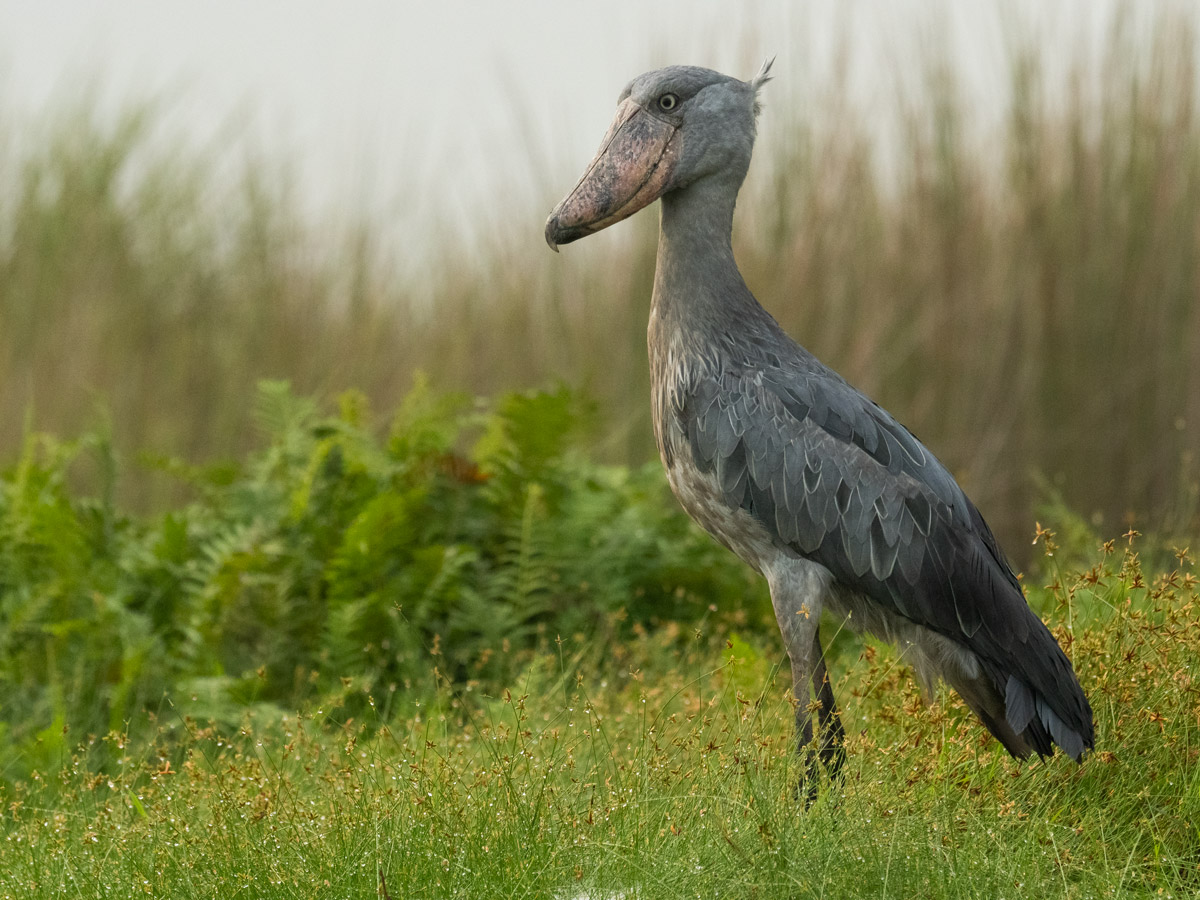
Bwindi Impenetrable National Park is a premier African birding destination, protecting 350 to 360 total bird species. Crucially, it harbors 23 of the 24 restricted-range Albertine Rift endemics found in Uganda, making it an exceptional location for specialized mountain forest birding
1-day-perfect-mabamba-swamp-shoebill-stork-uganda-birding-safari
5-days-uganda-bird-watching-safari-lake-victoria-shores-and-lake-mburo
30-days-best-uganda-birding-safari-extravaganza-and-wildlife-safari
11-days-uganda-birding-safari-and-primate-experience
20-days-uganda-birding-safari-wildlife-gorilla-and-chimpanzee-tracking
21-days-uganda-birding-safari-extravaganza-to-best-uganda-safari-parks
25-days-complete-uganda-birding-safari-extravaganza-with-wildlife-viewing
Top Albertine Rift Endemics in Bwindi
African Green Broadbill: A striking neon-green bird with a blue throat patch, highly prized in the Ruhija sector.
Rwenzori Turaco: A brilliant red, blue, and green turaco often spotted flipping through the canopy.
Grauer's Swamp Warbler: A specialized skulker residing in the park's damp thickets and marshy areas.
Shelley's Crimsonwing: A rare and elusive forest finch that frequent clearings and forest edges.
Handsome Francolin: A secretive forest-floor dweller best heard or spotted on early morning trails.
Other Notable Regional Endemics
- Yellow-eyed Black Flycatcher
- Rwenzori Batis
- Blue-headed Sunbird
- Purple-breasted Sunbird
- Kivu Ground Thrush
What makes Bwindi a global hotspot for endemic bird species?
Bwindi’s extraordinary biodiversity stems from its ancient age—dating back over 25,000 years—and its massive altitudinal span from 1,160m to nearly 2,600m above sea level. This creates diverse micro-habitats ranging from lowland forest to high-altitude bamboo and montane swamps. These sheltered microclimates served as an ecological refuge during ice ages, allowing unique species to evolve in isolation across the Albertine Rift.
What is the single most sought-after bird in Bwindi?
Without a doubt, it is the African Green Broadbill (Pseudocalyptomena graueri), also known as Grauer’s Broadbill. This vulnerable, dumpy bright-green bird with a powder-blue throat is notoriously local. Bwindi’s high-altitude Mubwindi Swamp is one of the only reliable places on Earth to catch a glimpse of it.
Can you spot Shelley’s Crimsonwing in Bwindi?
Yes, though it is one of Africa’s absolute "holy grail" species. The Shelley’s Crimsonwing is a striking crimson-and-olive finch that inhabits dense bamboo tangles and forest edge undergrowth. Because it is globally threatened and extremely skittish, sightings are rare and cherished by birders.
What is the Handsome Francolin, and where can you see it?
The Handsome Francolin is a colorful ground-dwelling gamebird endemic to the Albertine Rift. Recognizable by its rich rufous feather patterning and bright red bare skin around the eyes, it is frequently heard calling at dawn along the mountain forest trails in Bwindi's higher Ruhija sector.
Why is the Mubwindi Swamp Trail so legendary for birders?
Located in the higher-elevation Ruhija sector, the 4km trail down to Mubwindi Swamp is arguably the single best birding trail in Africa. It harbors almost all of Bwindi's high-altitude endemics, including the African Green Broadbill, Grauer’s Rush Warbler, and Archer’s Robin-Chat.
What sunbird endemics inhabit Bwindi?
Bwindi hosts several stunning endemic sunbirds, including the Regal Sunbird (with brilliant red and yellow chest patches), the Blue-headed Sunbird (known for its iridescent crown), and the large Purple-breasted Sunbird. They are commonly seen feeding on flowering canopy mistletoes and forest edge blossoms.
What is unique about Neumann’s Warbler?
Also known as the Short-tailed Warbler, this diminutive, terrestrial warbler skulks in the forest floor's dense mossy undergrowth. It has a disproportionately loud, distinctive ringing call that betrays its location long before its tiny, nearly tailless body is spotted among the root buttresses.
Which flycatchers in Bwindi are Albertine Rift endemics?
Two notable endemic flycatchers are the Yellow-eyed Black Flycatcher and the globally vulnerable Chapin’s Flycatcher. While the former frequents high-canopy perches in Ruhija, Chapin’s Flycatcher prefers the mid-story of mature forest zones.
How do you spot the Kivu Ground Thrush in Bwindi?
The Kivu Ground Thrush is an elusive understory specialist with rich orange underparts and bold white wing bars. Finding it requires patience, slow walking, and sharp eyes along damp, shaded forest paths early in the morning when it turns over leaf litter for invertebrates.
What role does the Archer’s Robin-Chat play in the forest canopy?
The Archer’s Robin-Chat is a bird of high-altitude forest undergrowth. With its deep rufous underparts and white eyebrow, it is an extraordinary vocal mimic, filling the cool mountain mornings in Ruhija with complex, melodic songs that imitate dozens of other forest sounds.
Are there any endemic Apalis species in Bwindi?
Yes, Bwindi shelters three key endemic apalises: the Rwenzori Apalis, the Black-collared Apalis, and the Mountain Masked Apalis. These small, hyperactive insectivores move through middle and upper forest canopies, often leading mixed-species feeding flocks.
What is Grauer’s Rush Warbler and where does it live?
The Grauer’s Rush Warbler (or Grauer’s Swamp Warbler) is an Endangered, dark brown, secretive warbler strictly bound to high-altitude highland bogs. In Bwindi, it is almost exclusively seen among the sedges and tall rushes inside Mubwindi Swamp.
Is the Ruwenzori Batis found in Bwindi?
Yes! Despite its name pointing to the neighboring Ruwenzori range, the Ruwenzori Batis is widespread in Bwindi’s montane zones. The male displays a crisp black-and-white chest band, while the female has a distinctive broad chestnut breast band.
What makes the Strange Weaver so special?
The Strange Weaver breaks the mold of typical bright yellow African weavers. Endemic to the Albertine Rift, the male sports an olive-green body with a rich chest face mask and orange-brown chest wash. They are typically found in forest vines and bamboo edges.
How many Albertine Rift endemics are found in Uganda total vs. Bwindi?
Uganda hosts 24 Albertine Rift endemic bird species in total. Remarkably, 23 of these 24 species are recorded inside Bwindi Impenetrable National Park, making it the single most efficient stop on any Uganda birding itinerary.
What is the Red-throated Alethe and where is it seen?
The Red-throated Alethe is a robin-like forest thrush with an orange-red throat patch and striking white underparts. It frequently follows army ant swarms on the forest floor, snatching up insects flushed out by the moving ant columns.
Can you see Turacos while birding in Bwindi?
While the famous Rwenzori Turaco is mostly associated with high-altitude bamboo zones, Bwindi is home to the stunning Black-billed Turaco and the massive, colorful Great Blue Turaco. Their crimson wing feathers flash dramatically as they glide between canopy trees.
What is the Dwarf Honeyguide and why is it tricky to find?
The Dwarf Honeyguide is the smallest of all honeyguides and an Albertine Rift specialty. It spends its time high in tree tops, making a quiet, repetitive song. Because it doesn't lead humans to honey like its larger cousins, spotting it requires sharp binocular scans of dead canopy branches.
How does elevation affect birding sectors inside Bwindi?
Bwindi is divided into four main sectors: Ruhija (high elevation, home to Mubwindi Swamp and cold-loving endemics), Buhoma (lower elevation, excellent for Guinea-Congo biome species and lower-altitude endemics), and Nkuringo/Rushaga (mid-to-high elevation with steep ridge trails).
What is the Red-faced Woodland Warbler?
The Red-faced Woodland Warbler is a small leaf-warbler with a rufous-red face mask and yellowish wing bars. It is one of the most common endemic voices in Bwindi’s high canopy, constantly flitting through foliage in search of tiny caterpillars and bugs.
What non-endemic bird highlights complement the endemics in Bwindi?
Beyond endemics, you’ll see spectacular species like the African Emerald Cuckoo, Bar-tailed Trogon, Black Bee-eater, Cassin’s Hawk-Eagle, and multiple species of Hornbills and Barbets filling the forest canopy.
What is the best month of the year for a Bwindi birding safari?
The prime months are during the drier seasons from June to August and December to February, when trails are less muddy and forest walking is easier. However, March to May and September to November align with breeding seasons when birds are most vocal, though rain gear is essential.
Do bird watchers need specialized local site guides in Bwindi?
Absolutely. Bwindi’s dense canopy and thick understory make birding primarily call-based. Local park rangers and specialized community bird guides know every territory, call, and nesting site by heart, drastically increasing your chance of spotting secretive endemics.
How many bird species can an experienced birder log in a single day in Bwindi?
An experienced birder led by a skilled local guide can reasonably log 60 to 100 species in a full day, especially along rich routes like the Mubwindi Swamp trail or the Buhoma Waterfall trail.
Is gorilla trekking compatible with a birding safari in Bwindi?
Yes, they complement each other perfectly! Many birders dedicate early mornings to gorilla tracking—often picking up forest species along the trail—and spend the afternoons or dedicated extra days on specialized birding walks.
What clothing and gear are essential for birding in Bwindi?
Essential gear includes waterproof hiking boots with ankle support, light rain jacket, lightweight layered clothes in neutral tones (greens/khakis), insect repellent, a wide-brimmed hat, sturdy walking sticks, and 8x42 or 10x42 waterproof binoculars.
Why are mixed-species feeding flocks so important when birding Bwindi?
In dense rainforests, birds often form large "bird waves" or mixed feeding flocks. A quiet stretch of forest can suddenly explode with 15–20 different species—warblers, apalises, flycatchers, and sunbirds—moving through the canopy together to flush out insects.
How difficult are the birding trails in Bwindi physical-wise?
Trails vary from moderate walks along forest roads (Buhoma side) to strenuous hikes with steep descents and climbs (such as the drop into Mubwindi Swamp in Ruhija). A reasonable level of hiking fitness makes the experience far more enjoyable.
What conservation threats do Bwindi's endemic birds face?
Although Bwindi is a protected UNESCO World Heritage site, surrounding human population density creates pressure from edge habitat encroachment, climate change shifting montane vegetation zones, and localized microclimate drying.
How long should you spend in Bwindi on a dedicated birding trip?
To comfortably cover both low-elevation (Buhoma) and high-elevation (Ruhija) zones and secure sightings of core endemics like the African Green Broadbill, plan to spend at least 3 to 4 full days dedicated to birding in Bwindi
Booking Uganda birding safari with us Roads of Adventure safaris
Book your custom birding safari in Uganda with Roads of Adventure Safaris. Tailored packages range from 7 to 20 days, focusing on prime locations like Mabamba Swamp, Murchison Falls, and Bwindi Impenetrable Forest to spot iconic species like the Shoebill Stork and Albertine Rift endemics
