Uganda is a premier birding destination offering over 1,000 species, with top spots including Mabamba Swamp for the rare Shoebill, Bwindi Impenetrable National Park for Albertine Rift endemics, and Queen Elizabeth National Park for high-density savannah and water birds. Other top sites include Kibale Forest, Murchison Falls, and Semuliki National Park.
Most popular Uganda birding tour packages
25-days-complete-uganda-birding-safari-extravaganza-with-wildlife-viewing
22-days-best-uganda-primate-and-birding-safari-adventure
21-days-uganda-birding-safari-extravaganza-to-best-uganda-safari-parks
20-days-uganda-birding-safari-to-uganda-national-park
20-days-uganda-birding-safari-wildlife-gorilla-and-chimpanzee-tracking
14-days-classic-uganda-birding-safari-expedition
12-days-uganda-birding-tour-looking-for-rift-valley-endemic-birds-west-circuit
10-days-best-uganda-birding-safari-and-wildlife-experience
Top 10 Birding Destinations in Uganda
1. Mabamba Bay Wetland
Located on the edge of Lake Victoria near Entebbe, Mabamba is the most reliable site in the world for the prehistoric-looking Shoebill ($Balaeniceps$ $rex$). This Ramsar site is a vast papyrus swamp best explored by traditional dugout canoe. As you navigate the narrow channels, you aren't just looking for the Shoebill; the wetland is a haven for the Lesser Jacana, Papyrus Gonolek, and the Blue-breasted Bee-eater.
The Shoebill is often found standing motionless for hours, waiting to strike at lungfish. Aside from the "King of the Swamp," keep an eye out for the African Marsh Harrier and the Malachite Kingfisher. The best time to visit is early morning when the air is cool and the birds are actively fishing. The community-led conservation here ensures that local fishermen act as expert guides, knowing every secret nook where the Shoebills hide.
2. Bwindi Impenetrable National Park
While famous for gorillas, Bwindi is a "Mecca" for birders due to its high concentration of Albertine Rift Endemics—species found only in this specific mountain range. The park hosts 23 of Uganda’s 24 rift endemics. The star of the show is the African Green Broadbill, a small, vibrant bird that is notoriously difficult to spot but breeds in the Ruhija sector.
Birding here involves trekking through ancient, steep rainforests. You’ll likely encounter the Regal Sunbird, with its brilliant iridescent plumage, and the Bar-tailed Trogon. The "Mubwindi Swamp" trail is essential for serious listers, offering chances at the Grauer's Broadbill and Grauer's Swamp Warbler. The sheer verticality of the forest means you are often looking into the canopy from one ridge and down into it from another, providing unique viewing angles.
3. Queen Elizabeth National Park
This park holds the record for the highest bird count in Uganda, with over 600 species. Its diverse ecosystems—ranging from savanna and craters to the lush Maramagambo Forest—allow for an incredible variety. The Kazinga Channel is the highlight; a boat safari here brings you face-to-face with the African Skimmer, which flies low over the water, "skimming" for fish with its elongated lower mandible.
In the Kasenyi plains, you can spot the massive Martial Eagle and the Black-bellied Bustard strutting through the grass. The park is also a vital stopover for Palearctic migrants. Near the salt lakes, you might see Greater and Lesser Flamingos seasonally. It is a place where you can check off water birds, raptors, and woodland species all in a single afternoon.
4. Murchison Falls National Park
Uganda's largest park offers a dramatic backdrop for birding where the Victoria Nile explodes through a narrow gorge. The riverbanks and the delta at Lake Albert are prime territory for the Shoebill, but the savanna attracts the Abyssinian Ground Hornbill, which looks like a turkey-sized raptor walking the plains.
As you cruise toward the base of the falls, look for the Rock Pratincole perched on the spray-drenched boulders. The northern savanna is home to the Secretary Bird and Denham’s Bustard, while the riverine thickets host the Red-throated Bee-eater, which nests in colonies along the sandy banks. The variety here is staggering, blending water-dependent species with dry-country specialists.
5. Kibale Forest National Park & Bigodi Wetland
Kibale is the "Primate Capital of the World," but for birders, it’s all about the Green-breasted Pitta. This elusive bird is the "Holy Grail" of forest birding, known for its stunning colors and secretive "display" hop on the forest floor. Birding here requires patience and a sharp ear for the pitta's low whistle.
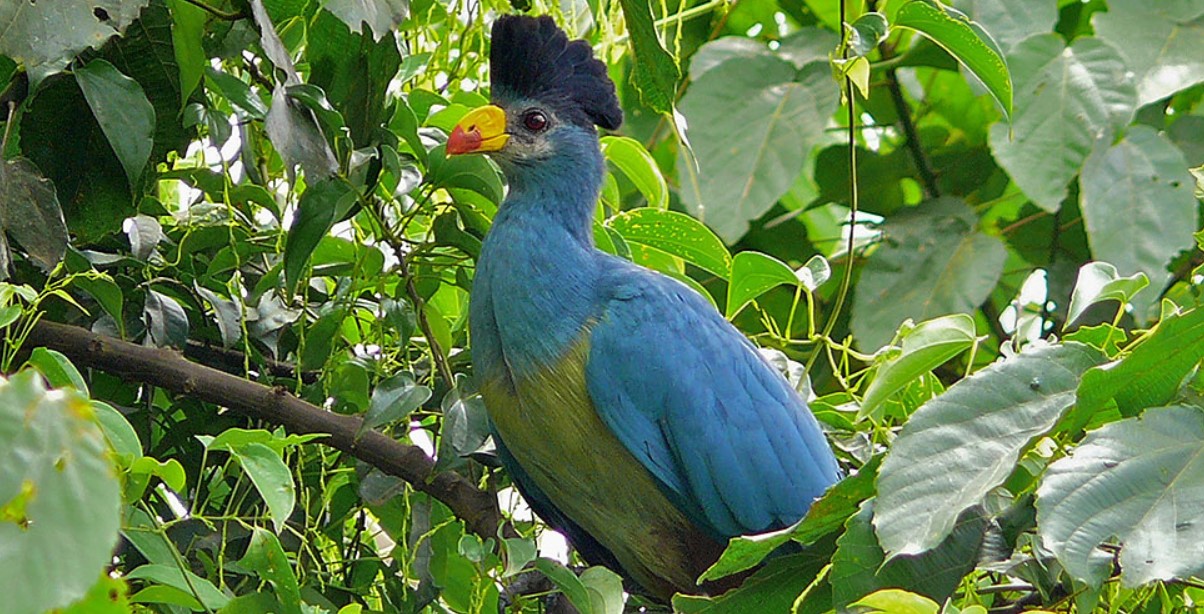
Adjacent to the forest is the Bigodi Wetland Sanctuary, a community-run project that is arguably the best spot for the Great Blue Turaco—a massive, colorful bird that is surprisingly social. You’ll also find the Yellow-spotted Barbet and the Black-and-white Casqued Hornbill. The mix of dense canopy and open wetland makes Kibale a balanced destination for seeing both forest specialists and papyrus dwellers.
6. Semuliki National Park
Semuliki is unique because it represents the easternmost extension of the Ituri Forest (Congo Basin). Consequently, it hosts dozens of "Congo-biome" species found nowhere else in East Africa. If you want to see the Red-billed Dwarf Hornbill, Piping Hornbill, or the Great Central African Blue-malkoha, this is the only place.
The park is famous for its "Hot Springs," but birders focus on the Kirumia Trail. This trail winds through lowland tropical forest where you can find the Nkulengu Rail (often heard at dawn) and the Lyre-tailed Honeyguide. It is a wild, humid, and dense environment that rewards those looking for rare, West African-influenced avian biodiversity.
7. Lake Mburo National Park
As the smallest savanna park in Uganda, Lake Mburo is exceptionally accessible and offers species not easily seen in the west. It is the best place to find the African Finfoot, a shy, low-slung water bird often seen paddling near the muddy banks of the lake.
The park’s acacia woodlands are home to the Red-faced Barbet (an endemic restricted to this region) and the Green Wood-hoopoe. Because there are fewer large predators (like lions), walking safaris are common here, allowing birders to get much closer to species like the Rufous-bellied Heron and the Brown-chested Wattled Plover. It is the perfect "starter" park for a birding circuit.
8. Mgahinga Gorilla National Park
Located in the clouds at the border of Rwanda and the DRC, Mgahinga offers high-altitude birding on the slopes of the Virunga Volcanoes. The bamboo forest zone is the place to find the Rwenzori Turaco, a bird so colorful it looks painted.
The park is also excellent for various sunbirds, including the Blue-headed Sunbird and the Regal Sunbird, which feed on the flowering lobelias. The hike can be strenuous, but the reward is seeing species that have adapted to the thin, cold air of the mountains. Look out for the Handsome Francolin and the Archer's Robin-Chat darting through the undergrowth.
9. Budongo Forest Reserve (Royal Mile)
Part of the Murchison Falls conservation area, Budongo contains the legendary "Royal Mile." This is a wide, flat forest road originally cleared for a king’s visit, now serving as one of the best forest birding trails in Africa. The wide clearing allows for excellent visibility of the canopy and mid-storey.
Key targets here include the Chocolate-backed Kingfisher, White-thighed Hornbill, and the rare Nahan's Partridge. The forest is also home to the Blue-breasted Kingfisher and various Illadopses. Because the trail is flat, it is much easier to spend an entire day here compared to the steep slopes of Bwindi or Rwenzori, making it a favorite for photographers.
10. Rwenzori Mountains National Park
The "Mountains of the Moon" offer a challenging but rewarding birding experience. With 19 Albertine Rift endemics, it is a biodiversity hotspot. In the lower forest zones, you'll find the Rwenzori Batis and the Strange Weaver.
As you climb higher into the alpine zones, you might spot the Bearded Vulture (Lammergeier) soaring over the jagged peaks. One of the most specialized birds here is the Scarlet-tufted Malachite Sunbird, which is found only at high altitudes where it feeds on giant lobelias. Birding here is as much about the dramatic, mist-shrouded scenery as it is about the rare feathered inhabitants.
Essential Birding Information
Best Time to Visit: Birding is great year-round, but the best times are during the dry seasons (June–September and December–February) when trails are accessible and food is abundant.
Migratory Season: November to April is best to see migrating birds from Europe and North Africa.
Top Habitats: Uganda offers a unique blend of Albertine Rift Mountains, Congo Basin forests, and East African Savannah
Top Species to Spot
Shoebill: Mabamba Swamp.
African Green Broadbill: Bwindi Impenetrable National Park.
Green-breasted Pitta: Kibale Forest.
African Skimmer: Queen Elizabeth National Park.
Rwenzori Turaco: Mgahinga & Rwenzori Mountains.
Flamingos: Queen Elizabeth National Park (Crater Lakes)
1. Why is Uganda ranked as a top birding destination in Africa?
Uganda’s status as a birding powerhouse is due to its unique position as an ecotone—a transition zone where several massive ecosystems overlap. It is the only place on the continent where the expansive East African Savanna meets the dense West African Guinean-Congolian Rainforest, all while being influenced by the vast wetlands of Lake Victoria and the high-altitude peaks of the Albertine Rift. This "ecological cocktail" creates a mosaic of habitats that supports over 1,000 bird species, which is roughly 50% of all birds found in Africa and 10% of the global population.
The sheer density of species means birders can see a vast array of birds without traveling huge distances. For example, you can spend the morning in a tropical rainforest looking for the African Pitta and the afternoon on a savanna plain watching Martial Eagles. Furthermore, the country's varied altitudes—from the low-lying Semuliki Valley to the snow-capped Rwenzori Mountains—create stratified niches for specialized species. The presence of the Albertine Rift Endemics adds a layer of exclusivity; these are birds that survived the last ice age in mountain refugia and exist nowhere else. This combination of high species count, unique endemics, and accessible habitats makes Uganda a peerless destination for both casual watchers and serious "listers."
2. What are the top birding destinations in Uganda?
Uganda offers a diverse circuit that covers every major biome. For forest birding, Bwindi Impenetrable National Park is the crown jewel, offering rare montane species and Albertine Rift endemics. If you are looking for sheer volume, Queen Elizabeth National Park holds the record with over 600 species, ranging from waterbirds to savanna raptors. For those chasing the "big" targets, Murchison Falls National Park provides a mix of riverine and savanna species, including the iconic Shoebill and the Abyssinian Ground Hornbill.
Other essential stops include the Mabamba Swamps near Entebbe, which is world-renowned for its reliable Shoebill sightings via traditional canoe. Kibale National Park is the primary site for forest specials like the Green-breasted Pitta, while Semuliki National Park offers a taste of Central African birdlife. For those willing to head into the remote north, Kidepo Valley National Park provides a rugged, arid landscape home to ostriches and dry-country specialists. Each of these destinations offers a different "piece of the puzzle," and a well-planned itinerary will typically touch at least five of these locations to ensure a representative sample of Uganda's avian wealth.
3. When is the best time to visit for a birding safari in Uganda?
While birding in Uganda is productive year-round, the dry seasons—from December to February and June to September—are generally considered the best times. During these months, the weather is more predictable, and the forest trails are less muddy and easier to navigate. Birds are also more active and vocal during these periods, as many species use the dry season for breeding and courtship displays. The clear skies also provide better lighting for photography and easier spotting in the high forest canopies.
However, the "migratory season" from November to April adds another layer of excitement. During this window, Uganda hosts millions of Palearctic migrants from Europe and North Africa. This is the only time you can see northern species like the Willow Warbler or European Bee-eater alongside resident African tropical birds. The rains (typically March–May and October–November) can make travel more challenging, but they also trigger the "green season," where the landscape is lush, and many birds are in their vibrant breeding plumage. Therefore, the "best" time depends on your priorities: the dry season for ease of travel and endemics, or the shoulder months for a higher total species count including migrants.
4. Where is the best place to spot the elusive Shoebill Stork?
The Shoebill ($Balaeniceps$ $rex$) is the most sought-after bird in Uganda. The most reliable and accessible place to see it is the Mabamba Bay Wetland on the shores of Lake Victoria. This Ramsar site is managed by the local community, and guides use small canoes to navigate the narrow papyrus channels. Because the Shoebill is a "sit-and-wait" predator, it often stays motionless for hours, allowing for incredible close-up views and photography once located. The early morning is the best time, as the birds are often found fishing for lungfish in the shallow waters.
Another prime location is the Nile Delta within Murchison Falls National Park. A boat trip down the Victoria Nile toward the shores of Lake Albert often yields sightings of Shoebills standing amidst the reeds. For those looking for a more terrestrial experience, the Ziwa Rhino Sanctuary also hosts a small population in its swamps, where they can sometimes be seen during canoe trips. While the Shoebill is rare and classified as vulnerable, Uganda's network of protected wetlands makes it the best country in the world to secure a sighting of this prehistoric-looking bird.
5. Which destination is best for Albertine Rift Endemics?
For birders focused on high-value endemics, Bwindi Impenetrable National Park is the undisputed champion. The park is home to 23 of the 24 Albertine Rift endemics found in Uganda. The "holy grail" here is the African Green Broadbill, which is mostly found in the Ruhija sector. Other key endemics include the Shelley's Crimsonwing, Dwarf Honeyguide, and the stunning Regal Sunbird. The park's varied elevation—from 1,160m to 2,607m—allows for a high turnover of species as you move through different forest zones.
Mgahinga Gorilla National Park is also an excellent supplement for endemics, particularly those that prefer bamboo and high-altitude habitats, such as the Rwenzori Turaco and the Rwenzori Double-collared Sunbird. Because these endemics are restricted to this specific mountain range (shared with Rwanda and the DRC), the conservation of these Ugandan forests is critical. Birding for endemics in Bwindi often requires steep hikes and high levels of patience, but the reward is seeing some of the rarest and most geographically restricted birds on the planet.
6. What makes Kibale National Park special for birders?
Kibale National Park is famous as a primate research hub, but for birders, it represents the pinnacle of tropical forest birding. It hosts over 350 species, but it is specifically famous for the Green-breasted Pitta. This bird is notoriously difficult to see due to its secretive nature and preference for the dark forest floor. However, during its display season (typically June to August), it can be found performing its unique "jumping" display on low branches, making Kibale one of the few places on Earth where this bird is regularly recorded.
Beyond the Pitta, Kibale is a hotspot for "forest specials" like the Black Bee-eater, Western Nicator, and the Yellow-spotted Barbet. The park is also unique because of its proximity to the Bigodi Wetland Sanctuary. This community-run wetland serves as an "edge habitat" where forest species meet swamp specialists. It is one of the best places in Uganda to see the Great Blue Turaco and various species of Papyrus Gonolek. This combination of deep forest and accessible wetland makes Kibale a highly productive location for both high-canopy dwellers and elusive swamp birds.
7. Where can I find Congo biome species in Uganda?
To see species typically found in the massive rainforests of Central Africa, you must visit Semuliki National Park. Located in the remote Bundibugyo district, Semuliki is an eastern extension of the Ituri Forest from the Democratic Republic of Congo. It is the only place in East Africa where many Guinea-Congo biome species reach their eastern limit. This has earned it the nickname "Africa's Amazon."
Walking the Kirumia Trail in Semuliki allows birders to check off species that are virtually impossible to find elsewhere in the region. Highlights include the Red-billed Dwarf Hornbill, Piping Hornbill, Black-casqued Wattled Hornbill, and the Yellow-throated Nicator. You may also find the Crested Guinea-fowl and the Maxwell's Black Weaver. The environment is hot, humid, and dense, reflecting the lowland rainforests of the Congo Basin. Because it is less visited than other parks, Semuliki offers a raw, wild birding experience that feels like a true expedition into the heart of the continent.
8. Is birding good in Queen Elizabeth National Park?
Absolutely. Queen Elizabeth National Park (QENP) is often cited as having the highest bird diversity of any protected area in Africa, with a checklist exceeding 600 species. This is largely due to its incredible variety of habitats: sprawling savanna, humid rainforests (Maramagambo), freshwater lakes, saline crater lakes, and the massive Kazinga Channel. The park acts as a magnet for both residents and migrants.
The Kazinga Channel boat safari is arguably the most effortless and productive birding experience in the country. From the water, you can see hundreds of African Skimmers, Pink-backed Pelicans, and Yellow-billed Storks nesting or fishing along the banks. In the southern Ishasha sector, you can find the Lappet-faced Vulture and Martial Eagle perched in fig trees. For forest specialists, the Maramagambo Forest provides sightings of the Black Bee-eater and Blue-throated Roller. Whether you are a beginner or an expert, QENP provides a "high-density" experience where you can see a significant percentage of Uganda's birds in a relatively short timeframe.
9. What special birds can be found in Lake Mburo National Park?
Lake Mburo National Park is a small but vital link in the Ugandan birding circuit. It is the best place to find acacia woodland species that are absent from the more forested western parks. The "star" attraction here is the Red-faced Barbet, a regional endemic that is very restricted in its range. The park is also famous for the African Finfoot, which is best spotted by taking a boat trip on Lake Mburo; they are often seen skulking under overhanging vegetation along the water's edge.
The park's mixture of wetlands and woodlands also supports the White-winged Warbler, Emerald-spotted Wood-dove, and the Green Wood-hoopoe. Because Lake Mburo does not have large numbers of dangerous predators like lions, it is one of the few places where you can engage in birding on foot. Walking safaris allow for a much quieter, more intimate approach to species like the Rufous-bellied Heron and the Tabora Cisticola. Its proximity to the highway between Kampala and Bwindi makes it an essential and highly rewarding "pit stop" for any birding itinerary.
10. What is the best area for arid area species?
For birds that thrive in dry, semi-arid environments, you must head to the far northeast to Kidepo Valley National Park. Bordering South Sudan and Kenya, this park is a dramatic landscape of craggy mountains and vast savanna plains. It contains over 50 species that are found nowhere else in Uganda, many of which are shared with the drylands of Ethiopia and Somalia.
The Common Ostrich is a major highlight here, as Kidepo is the only place in Uganda where they occur naturally. Other key targets include the Karamoja Apalis, a rare and localized warbler, and the Abyssinian Scimitarbill. You can also find the Rose-ringed Parakeet, Fox Kestrel, and a variety of colorful shrikes and bustards. The birding here feels distinct from the rest of the country; it is more "Somali-Masai" in character. While the journey to Kidepo is long, the reward is a "clean sweep" of dry-country birds that you simply won't see in the lush south or west.
11. What is the "Royal Mile" in Budongo Forest?
The "Royal Mile" is perhaps the most famous birding trail in all of Africa. Located in the Budongo Forest Reserve (part of the Murchison Falls conservation area), it is a wide, flat stretch of road that was historically maintained for the King of Bunyoro to hunt and walk. For birders, the wide clearing provides a "window" into the dense canopy of a tropical mahogany forest, which is usually very difficult to see into.
This trail is legendary for its ease of birding and high success rate with rare species. It is the best place to see the Chocolate-backed Kingfisher, which often perches motionless in the mid-storey. Other targets include the White-thighed Hornbill, African Dwarf Kingfisher, and the Blue-breasted Kingfisher. The forest is also home to several species of Illadopsis and the rare Nahan's Partridge. Because the terrain is flat and the visibility is high, birders can spend hours slowly walking the mile, picking up dozens of forest specialists that would be hidden in the denser parts of the woods.
12. Do I need specialized equipment for birding in Uganda?
Yes, having the right gear can make the difference between seeing a "blurry brown bird" and a "vibrant Great Blue Turaco." A high-quality pair of binoculars is the most important tool. Most experts recommend 8×42 or 10×42 binoculars; they offer the best balance of magnification and light gathering, which is crucial in the dark understory of forests like Bwindi or Kibale. A waterproof pair is highly recommended due to the frequent tropical showers.
For those interested in documentation, a camera with a significant zoom (at least 400mm–600mm equivalent) is necessary, as many forest birds stay high in the canopy. A birding field guide specifically for East Africa (such as "The Birds of East Africa" by Terry Stevenson and John Fanshawe) is indispensable for on-the-spot identification. Additionally, since much of Uganda's birding involves walking through wetlands or thick forests, sturdy waterproof boots and lightweight, neutral-colored clothing are essential. Some birders also bring a laser pointer (to help guides point out birds in thick foliage) and a portable recording device to capture bird calls, though your guide will often handle the audio part.
13. Are guided birding tours necessary?
While you can certainly see many birds on your own, hiring a local expert birding guide is strongly recommended for a successful safari. Uganda’s birds are often highly localized and secretive. An expert guide knows the specific territories of rare birds like the Green-breasted Pitta or the Shoebill. They can also identify hundreds of species by call alone, which is the only way to find many of the "hidden" forest birds that rarely show themselves in the open.
Local guides also understand the behavior of the birds—knowing exactly what time they feed, what trees they prefer, and how they react to human presence. This significantly increases your sightings and reduces the time wasted searching empty bushes. Furthermore, birding in Uganda often involves navigating remote areas or community-managed wetlands like Mabamba, where local knowledge is essential for logistics. Most professional birding guides in Uganda are highly trained and passionate, often doubling as conservationists who help protect the very habitats you are visiting.
14. What are some of the most sought-after birds in Uganda?
The "Big Five" of Ugandan birding starts with the Shoebill Stork, a bird that looks more like a dinosaur than a modern avian. Following closely is the Green-breasted Pitta, the colorful "jewel" of the Kibale forest floor. For those visiting the Albertine Rift, the African Green Broadbill is the ultimate prize due to its rarity and beautiful lime-green plumage.
Other major targets include the Great Blue Turaco, which is famous for its massive size and striking blue, yellow, and red colors. The Rwenzori Turaco is another favorite for its incredible "painted" appearance. In the dry north, the Karamoja Apalis is a top priority for serious listers. Beyond these, birds like the Black Bee-eater, Chocolate-backed Kingfisher, and various Sunbirds (like the Regal and Scarlet-tufted Malachite) are highly prized for their beauty. Whether it’s because of their rarity, their prehistoric appearance, or their brilliant colors, these species represent the "gold standard" of a Ugandan birding checklist.
15. How long should a comprehensive birding safari in Uganda last?
A truly comprehensive birding trip that covers the major hotspots (Mabamba, Murchison Falls, Kibale, Queen Elizabeth, and Bwindi) typically requires 15 to 20 days. This duration allows for several days in each location, which is necessary because forest birding can be slow; you might need two or three mornings to find a specific target like the Green-breasted Pitta. It also accounts for the travel time between parks, which involves driving through beautiful but sometimes rugged terrain.
If you are on a tighter schedule, a 7 to 10-day trip is possible but will require you to be more selective. A popular shorter route focuses on the "Entebbe-Kibale-Bwindi" triangle, which hits the Shoebill, the Pitta, and the Albertine Rift endemics. However, to include the remote Semuliki for Congo species or Kidepo for arid species, you definitely need the full three-week window. Regardless of the length, Uganda's high species density ensures that even a short trip will be incredibly productive, often yielding over 200–300 species in just a week.
Booking Uganda birding safari with us Roads of Adventure safaris
Roads of Adventure Safaris is a Kampala-based tour operator specializing in tailored birdwatching journeys across Uganda, ranging from 5 to 28 days. They focus on expert-guided tours covering over 1,065 species, with key destinations including Mabamba Swamp for the Shoebill, Bwindi Impenetrable National Park for Albertine Rift endemics, and Murchison Falls National Park
