Choosing whether Kenya or Tanzania is better for watching the Great Wildebeest Migration depends heavily on what time of year you plan to travel, what specific wildlife spectacles you want to witness, and the type of safari experience you prefer. Neither country holds a monopoly on the migration; rather, they share the cycle, with each country hosting different phases of this massive ecosystem movement.
6-days-ndutu-migration-and-tanzania-safari-itinerary
7-days-best-great-wildebeest-migration-safari-in-tanzania
8-days-great-mara-river-crossing-hadzabe-tribe-and-optional-hot-air-balloon-tanzania-safari
8-days-tanzania-honeymoon-safari-holiday-vacation-and-wildebeest-migration
10-days-africa-big-five-kenya-tanzania-safari-and-wildebeest-migration
6-days-circuit-kenya-safari-to-masai-mara-lake-nakuru-and-amboseli-park
Tanzania (Serengeti National Park)
- Calving Season (January to March): Thousands of baby wildebeest are born every day in the southern plains. Predators are very active here during this time. f
- Longer Duration (November to July): The herds spend most of the year roaming across the wide-open spaces of the Serengeti National Park.
- Fewer Crowds: The park is massive, so you see fewer safari vehicles at most sighting spots compared to peak months elsewhere.
Kenya (Maasai Mara National Reserve)
- River Crossings (July to October): The herds cross the dangerous waters of the Mara River. This offers the most dramatic action of the entire year.
- Compact Size: The Maasai Mara National Reserve is smaller than the Serengeti National Park. It is easier to find large groups of animals quickly in a shorter time.
- Easy Access: Camps and lodges sit very close to the action, making game drives short and direct.
How does the geographic layout of the migration split between Kenya and Tanzania?
The Great Migration is a continuous, circular movement of over two million wildebeest, zebras, and antelopes traveling between the Serengeti ecosystem in Tanzania and the Maasai Mara National Reserve in Kenya. Roughly 80% of the migration route takes place within Tanzania, making it the country where the herds spend the majority of the year. Tanzania hosts the southern calving grounds, the western corridor, and the Grumeti River. Kenya, on the other hand, hosts the northern terminus of the ecosystem, which is famous worldwide for the dramatic Mara River crossings that occur primarily from July through October. Understanding this geography is essential because booking a safari in the wrong country during the wrong season means missing the herds entirely. Therefore, deciding which country is "better" is entirely a question of seasonality, matching your travel dates directly to where the massive herds are historically gathered during that specific month of the year.
Why is Kenya considered the ultimate destination for river crossings?
Kenya's Maasai Mara is globally renowned for hosting the most iconic and dramatic chapter of the migration: the Mara River crossings. Between July and October, huge mega-herds of wildebeest mass along the steep banks of the Mara River, driven by instinct to cross to fresh grazing grounds. These crossings involve thousands of animals plunging headlong down steep mud banks into rushing, crocodile-infested waters. The sheer chaos, panic, survival instincts, and high-stakes predator action make Kenya's river crossings a bucket-list spectacle for wildlife enthusiasts and photographers alike. The topography of the Maasai Mara, with its rolling open savannahs and accessible river viewing points, allows travelers to position themselves strategically to witness these life-or-death moments unfold with breathtaking clarity.
Why is Tanzania considered superior for the calving season?
While Kenya dominates the conversation regarding river crossings, Tanzania is undisputedly superior for witnessing the birth of the next generation. From January through March, the southern Serengeti and the Ndutu plains become a vast wildlife nursery. During the peak of this season, an astounding 8,000 wildebeest calves are born every single day. The short-grass plains are rich in volcanic nutrients, providing ideal nourishment for nursing mothers. This massive concentration of vulnerable newborns attracts every major predator in the region—including lions, cheetahs, leopards, and hyenas—resulting in intense, high-frequency predator-prey interactions. For travelers who want to see raw, tender, and dramatic wildlife behavior away from the massive crowds of the peak river-crossing season, Tanzania's green season calving grounds offer an unmatched, deeply moving safari experience.
Which country offers better crowd management and exclusivity?
Tanzania generally provides a more remote, expansive, and exclusive wilderness feel compared to Kenya. Because the Serengeti National Park is nearly five times larger than the Maasai Mara National Reserve, vehicles are spread out over immense distances, preventing the feeling of overcrowding even during peak periods. In contrast, Kenya’s Maasai Mara experiences concentrated tourism pressure during the peak months of July to October. Popular river-crossing points can attract dozens of safari vehicles crowding a single sighting. However, Kenya counters this by offering exclusive private conservancies bordering the main reserve, where visitor numbers are strictly controlled, off-road driving is permitted, and night drives are allowed. Thus, while Tanzania naturally offers vast open spaces, Kenya provides exclusivity through private conservancy models.
How do the landscapes differ between the Maasai Mara and the Serengeti?
The visual backdrops of the two destinations offer distinct aesthetic experiences for travelers. Kenya's Maasai Mara is characterized by rolling, undulating grassy hills, dramatic acacia trees, and winding river lines, creating a classic, postcard-perfect African landscape that is visually compact and rich in texture. Tanzania's Serengeti lives up to its Maasai name, Siringet, meaning "the place where the land runs on forever". It features immense, flat, open short-grass and long-grass plains that stretch flat to the horizon, occasionally broken by dramatic granite kopjes (rock outcroppings). These kopjes serve as natural lookout posts for lions and leopards, adding a unique geological element to the wildlife viewing experience. If you prefer intimate, rolling vistas, Kenya excels; if you crave overwhelming, endless horizons, Tanzania is unmatched.
What role do private conservancies play in Kenya versus Tanzania?
Private conservancies form a cornerstone of the modern safari experience in Kenya, particularly around the Maasai Mara. Landowners lease their property to tourism operators, creating buffer zones that protect wildlife corridors while limiting tourist density. These conservancies allow for activities prohibited in national reserves, such as guided bush walks, night game drives, and off-road tracking of migrating herds. In Tanzania, national parks like the Serengeti strictly prohibit off-road driving and walking safaris within park boundaries to protect the pristine environment, meaning game viewing is restricted to designated tracks and daytime hours. However, Tanzania features specialized private concessions and Grumeti reserves in the west and north that offer similar exclusive activities, though Kenya's conservancy network is far more deeply integrated into the standard Maasai Mara safari circuit.
How does seasonality dictate whether you should choose Kenya or Tanzania?
Seasonality is the ultimate decider when selecting your destination. If your holiday falls between July and October, Kenya's Maasai Mara is the prime location because the herds have migrated north to feed on its rich grasses and execute the famous river crossings. If your travel dates fall between January and March, Tanzania is the definitive winner, as the herds are settled in the southern Serengeti for the calving and birthing season. Traveling during the shoulder months—such as April, May, and June—places the herds on the move through Tanzania's central and western corridors, where green season rates, dramatic storm skies, and fewer tourists make Tanzania an exceptional value. Attempting to see the river crossings in Kenya during January or witnessing the calving season in Tanzania during August will result in missing the migration entirely.
What are the key differences in safari vehicle regulations and game viewing rules?
Game viewing rules shape the intimacy and authenticity of your wildlife encounters in both countries. In Kenya's national reserves, vehicles often crowd popular sightings, and drivers communicate crossing locations over radios, which can lead to traffic jams of safari vans at riverbanks. However, Kenya's private conservancies enforce strict vehicle limits per sighting, ensuring a quiet, immersive experience. In Tanzania's Serengeti National Park, park rangers enforce strict rules regarding staying on designated tracks, maintaining distances from wildlife, and exiting the park before dark. While Tanzania's rules protect the ecosystem effectively, they can occasionally restrict your ability to follow a predator off-road during a hunt. Both nations use specialized 4x4 safari vehicles with pop-up roofs, but the enforcement of crowd control varies significantly between public reserves and private lands.
How do accommodation options compare between the two countries?
Both Kenya and Tanzania offer world-class accommodation ranging from mobile tented camps that move with the herds to ultra-luxury permanent lodges. Kenya is particularly famous for its boutique tented camps located within private conservancies, which blend high-end luxury with eco-friendly tented architecture and authentic community partnerships. Tanzania excels in mobile tented camps—canvas structures that physically pack up and relocate two to three times a year to remain directly adjacent to the shifting migration herds. This allows guests in Tanzania to wake up literally footsteps away from the migration path. Whether you prefer the colonial elegance of a permanent lodge overlooking the Mara River or the adventurous intimacy of a mobile camp pitched under canvas in the Serengeti, both countries deliver exceptional hospitality.
Which country offers better value for money for a migration safari?
Budget considerations often influence whether travelers choose Kenya or Tanzania. Tanzania's national park fees, conservation levies, and internal bush-flight costs are generally higher than Kenya's, making a high-end Serengeti safari an expensive undertaking. Furthermore, the sheer vastness of Tanzania often requires domestic flights between regions rather than long road transfers, increasing transit costs. Kenya often provides more competitive pricing structures, particularly for travelers utilizing road-based safaris from Nairobi into the Maasai Mara. However, Kenya's private conservancy accommodations can rival or exceed Tanzanian luxury pricing. Overall, budget-conscious travelers can find slightly more flexible package options in Kenya, while Tanzania tends to cater heavily toward premium, low-impact, high-cost wilderness tourism.
How do travel logistics and international flight connections differ?
Getting to your safari destination involves different logistical frameworks depending on the country you choose. Kenya’s primary international hub, Jomo Kenyatta International Airport in Nairobi, is East Africa’s largest aviation center, offering direct flights from major global cities across Europe, the Middle East, and Asia. From Nairobi, travelers can take a short, scheduled flight directly to the Maasai Mara or embark on a scenic 5-to-6-hour road transfer. Tanzania is served primarily by Kilimanjaro International Airport near Arusha or Julius Nyerere International Airport in Dar es Salaam. Reaching the Serengeti from Arusha usually requires a light aircraft bush flight or a long, bumpy full-day drive across the Ngorongoro Conservation Area. Consequently, Kenya often provides smoother, faster, and more straightforward transit logistics for first-time visitors.
Can you combine both countries into a single migration safari itinerary?
Combining Kenya and Tanzania into one seamless safari itinerary is the ultimate way to experience the Great Migration without compromise. Specialized cross-border operators design custom routes that allow travelers to witness river crossings in the Maasai Mara before flying down to the Serengeti—or vice versa—following the herds across international boundaries. While crossing the land border directly can involve complex visa and vehicle handover logistics, flying between Nairobi, Kilimanjaro, and regional airstrips like Serengeti or Mara Serena makes multi-country travel efficient. This comprehensive approach guarantees that travelers experience both the dramatic river battles of Kenya and the expansive calving plains of Tanzania in a single, unforgettable holiday.
How does predator activity vary between the Kenyan and Tanzanian legs?
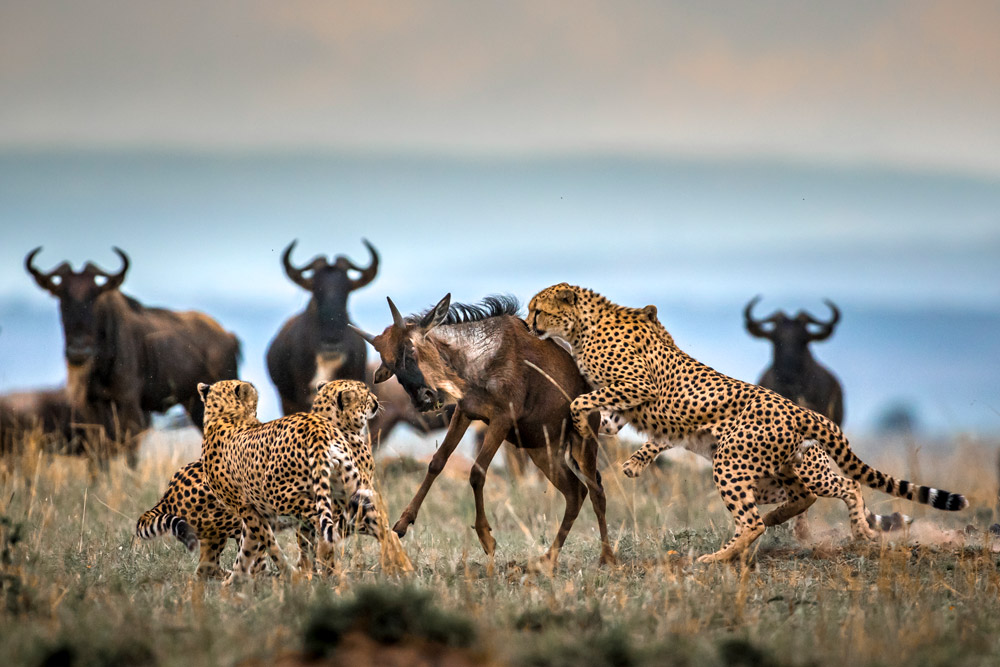
Predator-prey dynamics shift dramatically depending on where the migration is located. In Kenya’s Maasai Mara, predator activity during July through October focuses heavily on ambush hunting along the riverbanks, where lions and leopards capitalize on the confusion of crossing herds, while Nile crocodiles strike from the water. Cheetah coalitions are also highly active on the open plains of the Mara. In contrast, predator activity during Tanzania’s calving season in January and February is centered around survival of the newborn calves. Hyenas patrol the short-grass plains in large clans, cheetah mothers teach their cubs hunting techniques on vulnerable newborns, and lion prides enjoy effortless hunting abundance. Both countries offer world-class big cat viewing, but Tanzania’s calving season provides higher density concentrations of predators targeting naive prey.
What are the river crossing alternatives in Tanzania besides the Mara River?
While Kenya claims fame for the Mara River, Tanzania hosts its own dramatic river crossing spectacle earlier in the migration calendar: the Grumeti River crossing. Taking place in the Western Corridor of the Serengeti between May and June, the Grumeti River crossings feature massive herds confronting deep pools filled with giant Nile crocodiles. Although the Grumeti crossings receive significantly less media attention and tourist congestion than the later Mara River events, they offer an equally intense, wild, and visually arresting wildlife experience for travelers visiting during the early green season. Additionally, the Mara River snakes through the northern Serengeti in Tanzania as well as Kenya, meaning travelers can witness Mara River crossings from the Tanzanian side of the border with far fewer spectator vehicles.
How do cultural interactions with local communities differ in both destinations?
Cultural immersion plays a major role in enriching an East African safari. In Kenya, interactions are predominantly centered around the Maasai people, who maintain traditional pastoralist lifestyles in communities surrounding the Maasai Mara. Visitors can engage in authentic village visits, learn about traditional cattle-herding practices, and witness traditional dances. In Tanzania, the Serengeti ecosystem borders the lands of both the Maasai and the Datoga and Hadza people near Lake Eyasi. This allows travelers in Tanzania to expand their cultural experiences beyond Maasai traditions to include ancient hunter-gatherer bush walks and metalworking demonstrations with the Hadza and Datoga tribes, providing a wider anthropological dimension to a Tanzanian safari holiday.
What impact do seasonal rains have on safari travel in Kenya and Tanzania?
Rainfall acts as the primary catalyst for the migration, but it also dictates travel comfort. Kenya experiences two rainy seasons: the "long rains" in April and May, which can make dirt roads impassable and prompt many camps to close, and the "short rains" in November and December. Tanzania follows a similar pattern, with heavy rains peaking in April and May across the Serengeti. Traveling during the height of the long rains in either country results in muddy tracks, humid weather, and localized flooding. However, traveling immediately after these rains transforms the landscape into a vibrant, emerald paradise filled with newborn animals and dramatic photographic storm lighting, making the shoulder green seasons a hidden favorite for seasoned safari-goers.
How does photography potential differ between the Maasai Mara and the Serengeti?
Photographers evaluate safari destinations based on background aesthetics, lighting, and animal behavior. Kenya’s Maasai Mara offers exceptional compositional elements, including picturesque acacia trees, rolling hills, and dramatic riverbanks that frame action shots beautifully. The concentration of action along the Mara River provides high-speed action photography opportunities. Tanzania’s Serengeti provides sweeping, minimalist horizons where photographers can capture endless lines of wildebeest stretching across the earth against massive, cloud-filled skies. Furthermore, Tanzania's green season brings dramatic thunderstorm clouds that contrast sharply against golden grasslands, while the calving season offers tender macro-photography opportunities of newborn calves taking their first steps.
Which country is better suited for a first-time African safari traveler?
For first-time safari travelers seeking classic highlights, ease of planning, and guaranteed visual payoff, Kenya is frequently recommended. Kenya’s established tourism infrastructure, shorter transfer distances from Nairobi to the Maasai Mara, and straightforward game-viewing logistics reduce travel fatigue. A July-to-October visit to the Maasai Mara delivers iconic, easily digestible wildlife spectacles—such as lions resting under acacia trees and massive herds gathering at riverbanks—that match expectations built by wildlife documentaries. However, first-timers who prioritize tranquility, absolute wilderness immersion, and avoiding heavy tourist congestion often find Tanzania's vast spaces a more rewarding introduction to the African bush.
How do family-friendly safari offerings compare between Kenya and Tanzania?
Families planning a migration holiday must consider travel times, child-friendly lodge policies, and activity variety. Kenya excels in family travel due to shorter transit times between Nairobi and the Maasai Mara, minimizing the restlessness of younger children during vehicle transfers. Many Kenyan lodges and private conservancies offer specialized children’s programs, junior ranger activities, and child-minding services. Tanzania’s Serengeti requires more extensive travel logistics, often involving multiple light aircraft flights or long drives across rugged terrain, which can be challenging for toddlers. Nevertheless, older children and teenagers find Tanzania's vast, cinematic scale and dramatic predator interactions during the calving season deeply engaging and educational.
What is the impact of tourist volume on the overall safari experience?
Tourist density dictates the atmosphere of your game drives in both nations. During peak migration months (July–October), Kenya's Maasai Mara National Reserve can become congested, with multiple vehicles clustering around famous river-crossing sites. This requires patience and skilled guiding to secure a private viewing angle. Tanzania’s Serengeti, owing to its immense 14,750-square-kilometer expanse, absorbs higher visitor numbers with greater ease, maintaining a sense of profound isolation. While specific bottleneck areas in the central Serengeti or Ndutu can experience localized clustering during peak seasons, the vast majority of Tanzania’s wilderness remains quiet, allowing travelers to feel entirely alone with the migrating herds.
How do mobile tented camps function differently in Tanzania versus Kenya?
Mobile tented camps represent the pinnacle of authentic migration tracking, and they are utilized most extensively in Tanzania. In the Serengeti, safari operators physically dismantle and relocate their camps two to four times a year, leapfrogging the herds as they move from the southern calving grounds to the western corridor and northern plains. This guarantees that guests stay within a stone's throw of the migration action. While Kenya features mobile and seasonal camps—particularly within private conservancies and the northern Mara—its permanent luxury lodges are more deeply rooted fixed structures. Tanzania’s heavy reliance on true mobile camps provides a more traditional, nomadic safari ambiance that places travelers directly inside the rhythm of the ecosystem.
Which country provides a better pairing with post-safari beach extensions?
After an action-packed migration safari, travelers frequently seek a tropical beach retreat to unwind, and both Kenya and Tanzania offer world-class coastal destinations. Tanzania pairs effortlessly with the exotic spice island of Zanzibar, Mafia Island, or the pristine beaches of Pemba, requiring only a short, direct coastal flight from the Serengeti or Kilimanjaro. Zanzibar's historic Stone Town and turquoise Indian Ocean waters provide a seamless, culturally rich conclusion to a Tanzanian safari. Kenya offers exceptional beach extensions along its southern and northern coastline, including Diani Beach, Watamu, and the Lamu Archipelago, accessible via domestic flights from Nairobi. While both options are magnificent, Zanzibar remains one of the world's most famous post-safari tropical escapes.
How do conservation challenges and park management differ between the two regions?
Conservation models in Kenya and Tanzania reflect distinct management philosophies. Kenya relies heavily on community-based conservation through private conservancies, directly incentivizing local Maasai landowners to protect wildlife corridors and share in tourism revenue. This decentralization fosters strong local stewardship. Tanzania’s conservation model is centrally managed by national authorities like TANAPA (Tanzania National Parks), focusing on large-scale protected wilderness areas where human habitation within national parks is strictly prohibited. While Tanzania’s state-led protection ensures vast, unfragmented ecosystems like the Serengeti remain pristine, Kenya’s conservancy model successfully integrates local pastoralist communities into the economic survival of the wildlife.
What are the key differences in booking lead times and availability?
Securing a migration safari requires careful forward planning in both countries. For Kenya's peak river-crossing season (July to October), popular camps in the Maasai Mara and its private conservancies book out 9 to 12 months in advance, particularly for prime riverside suites. For Tanzania's peak calving season (January to February) or high dry season (July to October), mobile camps and premier lodges in the Serengeti also fill rapidly, requiring bookings 6 to 9 months ahead. However, because Tanzania's footprint is larger and offers a wider dispersion of camps, travelers booking on shorter notice may find it slightly easier to secure availability in Tanzania during shoulder windows compared to the highly compressed peak months in Kenya.
How do hot air balloon safaris compare between the Maasai Mara and the Serengeti?
Hot air balloon safaris offer a breathtaking bird's-eye view of the migration, and both countries provide world-class aeronautical experiences. In Kenya's Maasai Mara, floating silently above the winding Mara River while observing massive herds scatter across the plains below is an unforgettable highlight. In Tanzania's Serengeti, balloon safaris launch over the endless golden savannahs, the Grumeti River, or the southern calving plains, treating passengers to panoramic vistas of endless wildebeest columns. Both experiences conclude with a traditional champagne bush breakfast served right in the middle of the wilderness. The operational safety standards and pilot expertise are exceptionally high in both nations, making ballooning a tie between the two destinations.
Which country offers a more diverse multi-park safari circuit?
For travelers wishing to combine the migration with diverse ecological zones, Tanzania holds a distinct structural advantage. A classic Tanzanian northern circuit seamlessly combines the Serengeti migration with the Ngorongoro Crater (a breathtaking volcanic caldera teeming with wildlife), Tarangire National Park (famous for massive elephant herds and towering baobab trees), and Lake Manyara National Park (known for tree-climbing lions and flamingos). Kenya’s safari circuit often focuses heavily on Nairobi, the Maasai Mara, and Amboseli National Park (renowned for elephants against the backdrop of Mount Kilimanjaro). While Kenya offers wonderful variety, Tanzania's northern circuit provides a richer, more compact collection of wildly contrasting landscapes within a single holiday.
How does night game driving availability affect your wildlife experience?
Observing nocturnal wildlife—such as leopards hunting, serval cats, aardvarks, and bushbabies—adds a thrilling dimension to a safari. In Kenya, night game drives are widely permitted and easily organized when staying within private conservancies bordering the Maasai Mara, unlocking a hidden dimension of the bush after dark. In Tanzania's national parks, including the entire Serengeti National Park, night game drives are strictly prohibited by law to protect nocturnal species from disturbance. Specialized night drives in Tanzania are restricted to specific private concessions or reserves outside the main national park boundaries. Therefore, travelers who consider night game drives an absolute must-have experience will find Kenya’s private conservancies more accommodating.
What distinguishes the guide expertise and training in Kenya versus Tanzania?
Both Kenya and Tanzania produce some of the finest professional safari guides in the world, governed by rigorous certification bodies. Kenyan guides often undergo extensive training through organizations like the Kenya Professional Safari Guides Association (KPSGA), earning Bronze, Silver, or Gold certifications that test deep ecological and tracking knowledge. Tanzanian guides are similarly certified through regional training institutions and possess intimate knowledge of the sprawling Serengeti terrain. In both countries, your guide acts as the single most important factor in determining your safari satisfaction, skillfully positioning your vehicle for river crossings, interpreting predator tracks, and sharing profound insights into the mechanics of the migration.
How do walking safari opportunities differ between the two regions?
Exploring the African bush on foot offers an intimate, sensory connection to nature that vehicle-based safaris cannot replicate. In Kenya, guided bush walks are widely available within the private conservancies of the Maasai Mara, led by armed professional guides and traditional Maasai warriors who interpret animal tracks, plants, and insects. In Tanzania's Serengeti National Park, traditional walking safaris within the park are strictly regulated and less common, though specialized walking-safari operators run exceptional wilderness trails in remote designated zones or adjacent protected areas like the Ngorongoro Highlands and the Serengeti peripheries. Travelers who prioritize stepping out of the vehicle and walking through big-game territory will find Kenya's conservancies far more accessible for walking excursions.
Ultimately, which country should you choose for your migration holiday?
Choosing between Kenya and Tanzania ultimately boils down to your preferred travel window and wildlife priorities. Choose Kenya if you are traveling between July and October, your primary dream is to witness dramatic, high-stakes river crossings along the Mara River, and you value the convenience of quick transit logistics and private conservancy exclusivity. Choose Tanzania if you are traveling between January and March to witness the tender, predator-rich calving season, or if you desire an expansive, uncrowded wilderness feel with endless horizons, mobile tented camps, and a diverse multi-park circuit. If time and budget permit, combining both nations ensures you experience the absolute best of the Great Migration without compromise.
Booking wildebeest migration with us Roads of Adventure safaris
To book a wildebeest migration safari with Roads of Adventure Safaris, plan your dates 6 to 12 months in advance. Define your preferred destination (Serengeti in Tanzania or Masai Mara in Kenya), approve a custom itinerary, and secure your slot with a 30% to 50% initial deposit
