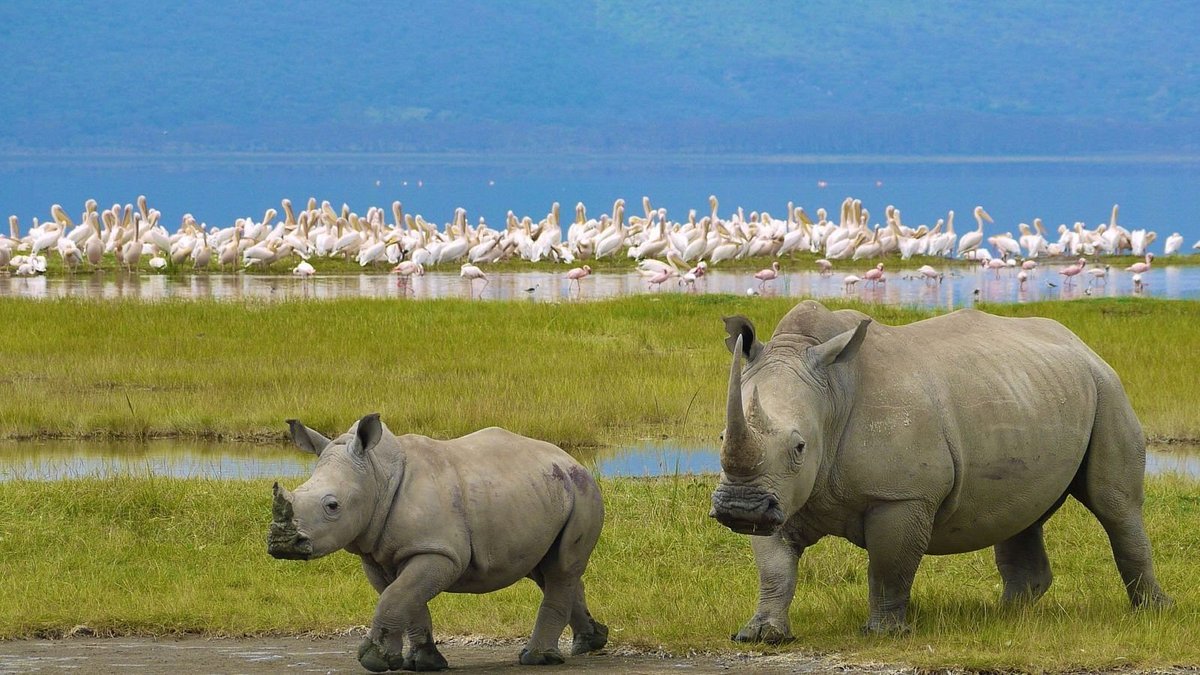
While no wildlife sighting is 100% guaranteed, seeing White Rhinos at Lake Nakuru National Park is almost guaranteed. As one of Kenya’s premier, fenced rhino sanctuaries, the park hosts a high density of both White and Black rhinos, offering some of the most reliable viewing opportunities in East Africa, often with many spotted in a single drive
29-days-kenya-birding-safari-extravaganza
2-days-lake-nakuru-national-park-and-lake-naivasha-combined-kenya-safari-tour
4-days-budget-masai-mara-safari-and-lake-nakuru-holiday-vacation
4-days-masai-mara-and-lake-nakuru-kenya-safari-tour-package
Why Rhino Sightings are Reliable at Lake Nakuru
High Population Density
The sheer concentration of animals is the primary reason sightings are so frequent. The park currently hosts over 150 rhinos within its relatively small 188 km² area. This population is skewed heavily toward the Southern White Rhino, which accounts for approximately 80% of the residents.
The density is a result of decades of successful conservation; the park serves as a "breeding ground" used to restock other national parks across East Africa. Because White Rhinos are semi-social, they often hang out in groups called "crashes," making them much more conspicuous than the solitary and elusive Black Rhino. This high population-to-land ratio effectively ensures that visitors rarely leave the park without a successful encounter.
Open Habitats
The landscape of Lake Nakuru significantly favors visibility. Unlike the thick, tangled brush preferred by browsing Black Rhinos, White Rhinos are grazers that act as the "lawn mowers of the wild". They spend the majority of their daylight hours in open grasslands and along the flat, accessible southern lakeshore.
These wide-open spaces mean there are few places for such massive animals to hide. Their physical adaptations also play a role: their heads naturally face downward to feed on short grass, keeping them in plain view within the park's savannah woodlands and bushy grasslands. For photographers and safari-goers, this environment provides the clear lines of sight and golden lighting necessary for high-quality wildlife viewing.
Established Sanctuary
As Kenya's first official rhino sanctuary, Lake Nakuru has a long history of intensive protection and management. The park is fully fenced, creating a secure "rhino safe haven" where animals cannot wander off into unprotected territories as they might in vast, open systems like the Masai Mara.
Over years of strictly regulated tourism, the rhinos have become habituated to safari vehicles. They generally perceive vehicles as non-threatening, allowing for the remarkably close-range viewing.This combination of physical containment and behavioral habituation transforms a typical "search" for wildlife into a highly predictable and safe experience for visitors.
Would you like to see a list of reputable safari operators that offer dedicated rhino-tracking excursions at Lake Nakuru?
Key Information for 2026
- Best Viewing Spots: In 2026, the rising water levels of Lake Nakuru have altered rhino movements, making the, southern grasslands specific safe zones where these giants are typically found.
- Best Time to Visit: The dry season generally offers the best visibility for wildlife spotting.
1. Is it guaranteed to see white rhinos at Lake Nakuru?
While the word "guaranteed" is rarely used by professional guides on a Kenya wildlife safari, Lake Nakuru is as close as you can get to a sure thing. Wildlife sightings are subject to the whims of nature, weather, and animal behavior. However, because the park is a relatively small, fully fenced sanctuary, the animals have nowhere to "hide" in the way they might in the massive expanse of the Serengeti or Tsavo.
The success rate for seeing white rhinos here is estimated between 95% and 99%. Unlike the shy black rhino, white rhinos are social and prefer the open vistas near the lake’s edge. If you spend a full day traversing the park’s circuits, the question usually isn't if you will see them, but how many you will encounter. This reliability makes it a vital stop for photographers and first-time safari-goers who have "seeing a rhino" at the top of their bucket list.
2. Why is Lake Nakuru so good for rhino sightings?
The secret to the park's success lies in its design. Spanning roughly 188 square kilometers, Lake Nakuru National Park was the first place in Kenya to be established as a rhino sanctuary in the 1980s. On a typical Kenya wildlife safari, you might drive for days in larger parks without seeing a rhino because they are heavily poached and naturally elusive. In Nakuru, the entire perimeter is secured with an electric fence.
This fencing serves two purposes: it keeps poachers out and keeps the rhinos within a manageable area for the Kenya Wildlife Service (KWS) to monitor. With over 150 rhinos living in such a compact space, the population density is incredibly high. Rangers track these animals daily, meaning guides often have real-time information on where the "crashes" (groups of rhinos) are located, ensuring guests get the most out of their time.
3. Which type of rhino is easier to spot?
On your Kenya wildlife safari, you will likely find that white rhinos are much more "cooperative" for photos than their black counterparts. The difference is primarily down to their diet and temperament. White rhinos are grazers; they have wide, square lips designed for mowing down grass. This means they spend most of their time in the open savannah and along the flat floodplains of the lake where visibility is excellent.
In contrast, black rhinos are browsers. They use their hooked upper lips to pull leaves from thickets and thorny bushes. They are also notoriously more aggressive and solitary, often retreating into dense forest at the first sound of an engine. While Nakuru is one of the best places on earth to see black rhinos, you will almost certainly spot a white rhino first simply because they "hang out" in the open.
4. How many white rhinos are in Lake Nakuru?
Lake Nakuru holds one of the most significant rhino populations in East Africa. While the exact numbers fluctuate due to births and transfers to other parks, the sanctuary consistently hosts over 150 individuals. The majority of these are white rhinos, which were originally introduced from South Africa to help bolster Kenya’s dwindling numbers.
The success of the breeding program here is a highlight of the Kenya wildlife safari conservation story. Because the habitat is ideal—rich in minerals and surrounded by lush grasslands—the rhinos here are healthy and have a high birth rate. Seeing mothers with calves is a common sight, which provides a heartwarming look at the future of this species and a testament to the park's intense protection efforts.
5. Where in the park are white rhinos found?
Geography plays a huge role in your Kenya wildlife safari sightings. Historically, rhinos could be found all around the lake, but recent environmental changes have shifted their patterns. Currently, the southern end of the park is the "place to be." The southern grasslands offer the expansive, flat grazing areas that white rhinos love.
Specifically, areas around the Makalia Falls and the plains leading toward the southern Naishi gate are hotspots. The western causeway, where the land meets the alkaline waters of the lake, also provides a stunning backdrop where you can often see rhinos grazing alongside buffalo and zebra. Your guide will typically head south immediately upon entering the park to maximize your viewing time in these high-traffic zones.
6. How long do I need to stay to see a rhino?
Time management is key on a Kenya wildlife safari. Because of the high density of animals in Nakuru, a single, well-planned full-day game drive (from 6:30 AM to 6:00 PM) is usually more than enough to spot multiple rhinos. However, nature can be unpredictable. If you arrive mid-day when the sun is high, the rhinos might be tucked away under the shade of acacia trees.
For the best experience, a 2-day (one night) stay is ideal. This allows for an evening game drive on the day of arrival and a "golden hour" morning drive the following day. Staying overnight inside or just outside the park gives you the advantage of being on the tracks the moment the gates open, which is when the rhinos are most active and the light is perfect for photography.
7. What is the best time of day to see white rhinos?
Like most mammals on a Kenya wildlife safari, rhinos are most active during the cooler parts of the day. The "magic hours" are from 6:30 AM to 9:00 AM and again from 4:00 PM until sunset. During these times, the temperature is mild, and the rhinos are busy grazing to fill their massive stomachs.
During the heat of the afternoon (12:00 PM to 3:00 PM), rhinos tend to become "grey boulders." They will find a thicket or a large acacia tree and lie down to sleep, often disappearing into the shadows. If you are on a day trip from Nairobi, try to arrive as early as possible. If you find yourself in the park at noon, use that time to visit the Baboon Cliff lookout or the waterfalls while the rhinos take their midday nap.
8. Will I see both black and white rhinos?
Seeing both species is the "Grand Slam" of a Kenya wildlife safari at Lake Nakuru. It is one of the few places in the world where both species coexist in the same ecosystem. While you are almost certain to see white rhinos, spotting a black rhino requires a bit more luck and a sharp-eyed guide.
Usually, you will find the white rhinos on the plains and then head into the more forested areas, like the Acacia Forest or the Euphorbia Forest, to look for the black rhinos. Because the black rhino is more temperamental, sightings are often brief as they tend to trot away into the bush. However, seeing them both in one day allows you to truly appreciate the physical differences—especially the lip shape and the overall "bulk" of the white rhino compared to the smaller, sturdier black rhino.
9. Are the rhinos dangerous to approach?
Safety is the number one rule on a Kenya wildlife safari. Despite their somewhat sluggish appearance, rhinos are incredibly fast and can charge at speeds of up to 50 km/h (30 mph). White rhinos are generally more placid than black rhinos, but they are still wild animals with poor eyesight and a keen sense of smell. If they feel crowded or threatened, they will defend themselves.
In Lake Nakuru, you are required to stay inside your vehicle at all times, except at designated "out of vehicle" points like the Baboon Cliff or Makalia Falls. The rhinos in the park are "habituated" to the sound and sight of safari Landcruisers, meaning they usually ignore the cars. However, your driver will always maintain a respectful distance and keep the engine ready just in case a mother rhino decides you’re getting too close to her calf.
10. Do I need a guide to see rhinos?
While Lake Nakuru is a self-drive friendly park, hiring a professional guide will exponentially increase the quality of your Kenya wildlife safari. Professional guides are part of a local network; they talk to each other via radio and WhatsApp, sharing the locations of recent sightings. If a black rhino—which is notoriously hard to find—is spotted near the forest edge, your guide will know within minutes.
Furthermore, a guide understands animal behavior. They can spot a flick of an ear in the tall grass that an untrained eye would miss. They also provide context, explaining the conservation history of the park and the specific challenges these rhinos face. If you want to move beyond just "seeing" a rhino and actually "understanding" them, a guide is an indispensable asset.
11. Are rhinos active in the rain?
Rain can change the dynamic of your Kenya wildlife safari quite a bit. Rhinos don't mind the rain—in fact, they often enjoy the cool down. However, heavy rain can make them harder to find. When it pours, rhinos often move away from the open, muddy lakeshore and retreat into the denser woodland or the higher ground where the drainage is better.
The rain also makes the grass grow taller, which provides more camouflage. On the plus side, the rain washes the dust off their hides, making them look dark and dramatic for photos. The park roads can get slippery, but most are well-maintained. If you find yourself in Nakuru during a downpour, stay patient; the period immediately after the rain stops is often the most active time for wildlife.
12. Is it better to visit during the dry season?
For the absolute best visibility on a Kenya wildlife safari, the dry seasons (June to October and January to February) are preferred. During these months, the vegetation thins out and the grass is short, leaving the rhinos with nowhere to hide. Because water becomes scarce in the surrounding hills, animals are forced to congregate closer to the permanent water sources around the lake.
The dry season also ensures that all park tracks are accessible. In the wet season, some of the lower-lying paths near the lake can become flooded or bogged down. However, the "green season" (November and April-May) has its own charm—the park is lush, the dust is gone, and the birdlife is spectacular, even if the rhinos are a bit more tucked away in the greenery.
13. Will the rising lake water affect my chances?
In recent years, Lake Nakuru has experienced a significant rise in water levels, which has permanently altered the park's landscape. Many of the old acacia forests near the shore have been submerged, creating "ghost trees" standing in the water. This has shifted the rhino habitats. Previously, they spent more time in the northern areas, but the flooding has pushed them toward the southern sanctuaries.
On your Kenya wildlife safari, you’ll notice that the "lake shore" isn't where it used to be. However, this hasn't necessarily made rhinos harder to see; it has simply moved them. The rhinos have adapted well to the new boundaries, and the concentration of wildlife in the remaining dry areas is actually higher than before, often making sightings even more frequent in the southern half of the park.
14. How many white rhinos can I see in one drive?
One of the most thrilling parts of a Kenya wildlife safari in Nakuru is the sheer volume of rhinos. In other parks, seeing one rhino is a victory. In Nakuru, it is common to see a "crash" of five or six white rhinos grazing together. On a truly successful day, guests have reported seeing upwards of 15 to 20 different individuals across the park.
White rhinos are social, unlike the solitary black rhino, so they are often found in family groups. Seeing a line of these massive animals walking across the plains against the backdrop of thousands of pink flamingos (if they are in season) is one of the most iconic images in all of Africa. The high numbers here allow you to spend time observing their social interactions, which is a rare luxury.
15. Are there other Big Five animals to see while looking for rhinos?
While the rhino is the star of the show, a Kenya wildlife safari at Lake Nakuru offers much more. You have a very good chance of seeing four of the "Big Five." The park is famous for its leopard sightings, particularly in the fever trees near the lake. Large herds of Cape Buffalo are everywhere, and there are several lion prides that patrol the grasslands.
The only member of the Big Five missing is the elephant. Because the park is fully fenced and relatively small, it cannot support the massive food requirements and migratory patterns of elephants. However, you can see the rare Rothschild’s Giraffe, which was relocated here for protection, along with hippos, waterbucks, and hundreds of species of birds. It is a complete wildlife experience, even without the elephants.
Booking Kenya wildlife safari to lake Nakuru with us Roads of Adventure safaris
Booking a Kenya wildlife safari to Lake Nakuru with Roads of Adventure Safaris offers tailored, mid-range to budget-friendly experiences, specializing in 4–10-day itineraries that often include rhinos and flamingo sightings alongside Masai Mara and Amboseli. They provide private or group tours, 4x4 vehicles, and expert guides for a seamless experience
