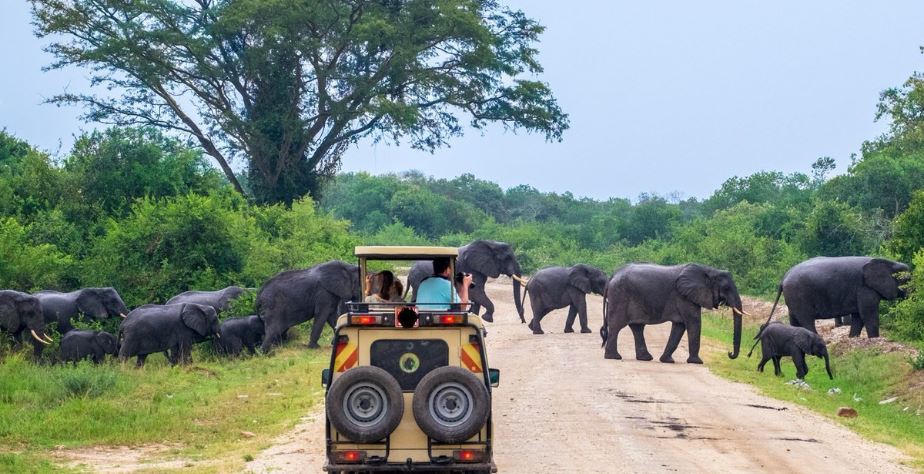
To get to Queen Elizabeth National Park from Kampala, take a 410 km road trip (6–8 hours) via the Masaka-Mbarara-Bushenyi route, or take a 1-hour domestic flight from Entebbe to the local Kasese or Mweya airstrips. Most safari operators arrange private 4x4 transport, which includes exciting wildlife and scenic stopovers along the way
Most popular tour packages to Queen Elizabeth national park
3-days-trips-to-queen-elizabeth-national-park-for-chimpanzee-tracking-in-kyambura-gorge
3-days-uganda-safari-itinerary-to-queen-elizabeth-national-park
3-days-budget-queen-elizabeth-park-uganda-wildlife-safari-holiday
3-days-fly-luxury-uganda-safari-to-queen-elizabeth-national-park
2-days-affordable-budget-uganda-safari-to-queen-elizabeth-national-park
2-days-quick-escape-to-queen-elizabeth-park-safari-holiday
1. By Road (Private Safari Vehicle)
Opting for a private 4x4 vehicle is the quintessential way to experience a Uganda safari. It transforms a simple transit day into a dynamic, flexible road trip where you dictate the pace, stop for wildlife photos, and absorb the changing local landscapes. The journey from Kampala to the park takes roughly 6 to 7 hours, and travelers typically choose between two highly rewarding paths.
The Southern Route
The classic route takes you southwest from Kampala via the Masaka-Mbarara highway, entering through the Katunguru Gate. This highway is famous for its excellent tourist milestones. You can stop at the Uganda Equator line in Kayabwe for a classic photo opportunity and geographical experiment, followed by a traditional lunch stop at the Igongo Cultural Centre to taste local Ankole dishes. This drive also gives you a brief, distant glimpse of the rolling hills near Lake Mburo National Park.
The Northern Scenic Route
Alternatively, heading northwest through Mubende and Fort Portal delivers a completely different visual feast. You will weave through lush, undulating tea plantations under the shadow of the spectacular Rwenzori Mountains. This route is standard practice for travelers combining their savannah safari with chimpanzee trekking in Kibale National Park, making it a seamless multi-destination itinerary.
Peer Tip: The internal tracks of Queen Elizabeth National Park can get deeply rutted or muddy during the rainy seasons. A sturdy 4x4 vehicle with good ground clearance is not just a recommendation—it is essential for a smooth game drive.
2. By Air (Scheduled or Chartered Flights)
For travelers operating on a tight timeline, or those who prefer to skip a long day on the road, a flying Uganda safari is the ultimate upgrade. Flying compresses a 7-hour drive into a scenic 60- to 90-minute flight, saving your energy entirely for the wilderness.
Premium Airstrips
Domestic aviation operators like Aerolink Uganda and Bar Aviation run daily scheduled flights out of Entebbe International Airport or Kajjansi Airfield. Depending on where you are staying, you can land at:
- Mweya Airstrip: Placed directly on the Mweya Peninsula inside the park—perfect for immediate access to Kazinga Channel boat cruises.
- Kasese Airstrip: Located just outside the park boundaries, requiring a brief 30-minute road transfer to the gates.
Beyond saving time, the flight doubles as an aerial tour of western Uganda. Looking out the window rewards you with bird's-eye views of Lake Victoria, sprawling agricultural grids, and the sudden drop of the Albertine Rift Valley floor.
Baggage Warning: Keep in mind that these domestic flights utilize small, light aircraft (like the Cessna Caravan). They enforce a strict luggage limit of 15 kg (33 lbs) per passenger, and require all gear to be packed in soft-sided duffel bags to fit inside the aircraft's cargo pods.
3. By Public Bus (Budget Travelers)
Taking a public bus is the most adventurous and economical way to execute a Uganda safari. It is a raw, immersive travel experience that embeds you directly into local life, making it a favorite path for backpackers and independent budget travelers.
Navigating the Route
Every morning, large 59-seater public buses operated by companies like Link Bus depart from the chaotic, energetic bus terminals in downtown Kampala. Tickets are incredibly inexpensive, and the route generally heads toward major regional hubs like Kasese, Bushenyi, or directly past the park's trading centers like Katunguru and Kikorongo junction.
Key Logistical Realities
While a bus keeps your expenses remarkably low, it does require a trade-off in time and comfort. The journey takes longer due to frequent stops to pick up passengers and drop off cargo along the highway. Furthermore, buses only stick to the main paved highways—they will not drop you off at a remote safari lodge deep in the savannah.
Once you disembark at a nearby town or junction, you will need to independently navigate the final leg of your trip. This involves negotiating fares with local boda-bodas (motorcycle taxis) or hiring a private "special hire" taxi to transfer you and your luggage safely into your park accommodation.
Planning a Uganda safari to Queen Elizabeth National Park (QENP) is an exciting venture, but managing the logistics of getting there from Kampala requires careful thought.
Here are 10 critical preparation questions answered, with each response directly linked to your transit strategy from the capital city.
Which entry gate should I use based on my road route from Kampala?
The gate you choose to enter Queen Elizabeth National Park depends entirely on the highway route you take out of Kampala. If you choose the classic southwest highway via Masaka and Mbarara, your primary point of entry will be the Katunguru Gate. This gate sits centrally along the main paved highway, crossing the Kazinga Channel, and provides instant access to the Mweya Peninsula and the northern game viewing tracks. It is the most logical gate for travelers arriving via the southern route after stopping at the Equator.
Conversely, if you take the northern scenic route from Kampala through Mubende and Fort Portal, you will approach the park from the north. In this scenario, you will enter via the Kabatoro Gate or pass through the northern foothills near Kasese. This path is ideal if your itinerary includes an immediate chimpanzee trek in the Kyambura Gorge or Kibale Forest before settling into your central lodge.
If your primary goal on your Uganda safari is to see the famous tree-climbing lions in the southern Ishasha sector, you will bypass the northern gates entirely. You will drive further south through Rukungiri and Kihihi, entering the park through the Ishasha Gate. Matching your Kampala route to the correct gate prevents hours of unnecessary driving on bumpy internal park tracks at the end of a long travel day.
How do domestic flight baggage limits affect my packing list when leaving Kampala?
If you choose to skip the 7-hour drive and opt for a flying Uganda safari, your transit choice dictates exactly what you can pack. Domestic scheduled airlines, such as Aerolink Uganda, fly daily from Entebbe International Airport or Kajjansi Airfield near Kampala to Kasese and Mweya airstrips. Because these operators utilize small, light aircraft like the Cessna Caravan, they strictly enforce a maximum luggage limit of 15 kg (33 lbs) per passenger.
This strict weight ceiling means you must pack efficiently. Heavy, hard-shelled suitcases are banned because they cannot deform to fit into the aircraft’s narrow under-fuselage cargo pods. Instead, you must use soft-sided duffel bags. When packing in Kampala, prioritize lightweight, breathable safari clothing, a compact pair of binoculars, your camera gear, and essential medications.
For travelers who have extensive luggage because they are combining their safari with a longer international business trip, logistics must be arranged ahead of time. You can coordinate with your tour operator to have your main, heavy suitcases transferred by road in a private safari vehicle from Kampala to the park. Alternatively, you can store your excess baggage securely at your hotel in Kampala or Entebbe, flying to the park with only your lightweight safari duffel.
What vehicle type is required if I choose to drive from Kampala myself?
Choosing to drive from Kampala to Queen Elizabeth National Park requires renting a specific class of vehicle. While the primary highways connecting Kampala to western regional hubs like Mbarara, Bushenyi, and Kasese are fully paved and smooth, the internal infrastructure of the park is entirely different. Once you deviate from the main tarmac roads to explore the Kasenyi plains or the Ishasha sector on your Uganda safari, you will encounter unpaved, rough dirt tracks.
Therefore, a 4x4 vehicle with excellent ground clearance—such as a customized Toyota Land Cruiser or a robust Toyota RAV4—is non-negotiable. Standard 2WD saloon cars or sedans are entirely unsuitable; they risk getting stuck in deep mud during sudden downpours or scraping their undercarriages on rocky terrain. A proper 4x4 safari vehicle also features a pop-up roof or large sliding windows, which are essential for unobstructed wildlife viewing and photography once you arrive.
Before turning the key in Kampala, you must inspect the vehicle thoroughly. Ensure it is equipped with two functional spare tires, a high-lift jack, a wheel spanner, and jumper cables. The long drive across the Ugandan countryside can be demanding on mechanical components, and being self-sufficient ensures that a minor tire puncture on the highway does not derail your entire safari itinerary.
How long does the road journey take, and where are the best places to stop?
Driving from Kampala to Queen Elizabeth National Park is a full-day commitment, typically taking between 6 to 7 hours of continuous driving. However, rushing through the journey misses out on some of the best cultural experiences western Uganda has to offer. The total travel time naturally expands to 8 or 9 hours once you factor in strategic rest stops, which are highly recommended to prevent driver fatigue.
If you travel via the southwest highway, your first major milestone is the Uganda Equator crossing in Kayabwe, located about 72 kilometers outside Kampala. This is a perfect spot to stretch your legs, take photos across the northern and southern hemispheres, and grab a quick coffee. Continuing onward, the next logical stop for a substantial lunch break is the Igongo Cultural Centre just before Mbarara city. Here, you can enjoy a buffet of local dishes and tour the cultural museum to learn about the history of the Ankole kingdom.
If you select the northern scenic route via Fort Portal, your drive will wind through miles of vibrant green tea plantations. The best stop along this route is Fort Portal tourism city, where you can have lunch against the backdrop of the Rwenzori Mountains. Whichever path you choose, planning these stops transforms a tiring transit day into an engaging, multi-layered highlight of your Uganda safari.
Can I combine a chimpanzee trekking excursion with my journey from Kampala?
Yes, your choice of route from Kampala can seamlessly integrate a world-class primate excursion into your itinerary before you even reach the savannah. Travelers looking to maximize their Uganda safari frequently utilize the northern route through Mubende and Fort Portal for this exact reason. This specific highway runs directly along the boundaries of Kibale National Park, universally recognized as the primate capital of East Africa.
By breaking the journey from Kampala into two parts, you can spend your first night at a lodge near the Kibale forest. The following morning, you can participate in an early chimpanzee tracking experience. Once the trek concludes at midday, you can jump back into your safari vehicle and drive a short 2- to 3-hour stretch southward to enter Queen Elizabeth National Park just in time for an evening game drive or a relaxing sundowner.
Alternatively, if you take the southern highway from Kampala, you can target the habituated chimpanzees living inside Queen Elizabeth National Park itself, specifically within the dramatic underground forest of the Kyambura Gorge. This deep tectonic rift sits on the eastern edge of the park. Approaching from the south allows you to drive straight to the gorge viewpoint upon your arrival, blending your transit day perfectly with an immediate wildlife adventure.
What are the logistical challenges of using a public bus from Kampala?
For budget-conscious backpackers, taking a public bus from Kampala is a highly affordable way to travel, but it introduces distinct logistical hurdles. Large public buses, such as those run by Link Bus Services, depart daily from the crowded bus terminals in central Kampala. While the ticket prices are a fraction of the cost of a private vehicle or a domestic flight, the journey demands high flexibility and patience.
The first major challenge is time predictability. Public buses do not operate on strict, immutable timetables; they often wait at the terminal until every seat is sold before departing. Along the way, the bus stops frequently at various trading centers to drop off passengers and unload commercial cargo, stretching the transit time well beyond the standard 7 hours. Furthermore, these large buses are legally confined to the main paved national highways. They will drop you off at regional urban hubs like Kasese or Bushenyi, or at the Katunguru trading center on the park's edge.
The most critical hurdle occurs after you step off the bus. National Park entry gates and safari lodges are situated miles away from these highway drop-off points. You will find yourself stranded with your luggage unless you have pre-arranged private transport. To reach your final lodge inside the park, you must negotiate on-the-spot with local motorcycle taxi operators (boda-bodas) or hire an expensive local "special hire" taxi car, which requires strong bargaining skills.
How should I schedule my departure from Kampala to maximize wildlife viewing?
Timing your departure from Kampala is a critical variable that dictates how much wildlife you see on your very first day. If you are driving, the golden rule of a road-based Uganda safari is to leave Kampala no later than 6:00 AM. Departing at dawn allows you to beat the notorious morning traffic congestion out of the city center and maximizes your daylight hours on the road.
By clearing Kampala early and maintaining a steady pace, you can complete the drive and arrive at the park gates by 1:30 PM or 2:00 PM. This timing is perfect because it allows you to check into your lodge, eat lunch, unpack, and head out for a late afternoon game drive around 4:00 PM. The late afternoon is a prime time for wildlife viewing, as the intense midday heat dissipates and predators like leopards and lions begin to stir from the shade to hunt.
If you are flying, scheduling is equally important but much easier to manage. Scheduled morning flights from Entebbe typically land at Mweya or Kasese by 11:00 AM. This gives you a relaxed midday window to settle into your accommodation. You can then comfortably line up a 2:00 PM boat cruise along the Kazinga Channel, where you will immediately see massive pods of hippos, Nile crocodiles, and herds of elephants drinking by the water's edge.
What permits, fees, and documentation must I prepare before leaving Kampala?
Entering Queen Elizabeth National Park requires paying specific statutory fees regulated by the Uganda Wildlife Authority (UWA). You should ideally settle these financial arrangements while you are still in Kampala to avoid long administrative delays at the park gates. The standard conservation fee is $40 USD per adult per day for foreign non-residents, $30 USD for foreign residents, and UGX 20,000 for East African citizens.
Crucially, you must also pay a vehicle entry fee to bring your car inside the park boundaries. For a standard Ugandan-registered 4x4 tour vehicle or SUV, this fee is UGX 30,000 per day. If you are a foreign resident living in Uganda, you must present a valid work permit or residency card at the gate to qualify for the discounted resident rates.
Furthermore, if you intend to track chimpanzees in Kyambura Gorge ($200 USD per permit) or participate in an experiential lion tracking research drive ($500 USD per permit), these limited permits must be paid for and secured in advance at the central UWA headquarters in Kampala. Under UWA's strict booking rules, reservation holds are no longer permitted, meaning permits are only guaranteed upon full, immediate payment. Carrying printed copies of your UWA payment receipts and your passport is essential for a hassle-free entry.
How do seasonal weather patterns affect road conditions from Kampala?
Uganda’s distinct seasonal weather patterns greatly impact highway travel and park navigation. The country experiences two dry seasons (June to September and January to February) and two wet seasons (March to May and October to November). Understanding these cycles before you depart Kampala determines the difficulty of your drive and the predictability of your itinerary.
During the dry seasons, the road journey from Kampala is straightforward and highly reliable. The paved highways are clear, and the dirt tracks within the park dry out into hard, dusty surfaces. This makes driving easy, though it does generate significant dust. This is widely considered the best time for a Uganda safari because wildlife concentrates heavily around permanent water sources like the Kazinga Channel, making animals highly visible.
During the wet seasons, the initial highway drive from Kampala remains smooth because the asphalt roads are well-maintained. However, the moment you transition onto the unpaved tracks inside the park, the terrain changes dramatically. Black cotton soils turn into thick, slick mud, and seasonal rivers can occasionally flood low-lying crossings. If you choose to travel during these wet months, a heavy-duty 4x4 vehicle with a skilled driver is absolutely mandatory to prevent getting bogged down in remote sectors of the park.
How can I ensure reliable communication and navigation along the route?
Maintaining constant communication and reliable navigation is vital when driving through rural areas from Kampala to western Uganda. While the main routes are well-signed, mobile network coverage can fluctuate significantly as you cross different districts and descend into the deep valleys of the Great Rift cream.
Before leaving Kampala, it is highly recommended to buy a local SIM card from one of Uganda’s major telecommunications networks, such as MTN or Airtel. You can easily purchase and register a SIM card at Entebbe Airport or downtown Kampala using your passport. Make sure to load a generous mobile data bundle and pre-purchase airtime. Having a functional local line allows you to stay in direct contact with your safari lodge and call for emergency assistance if your vehicle breaks down along the highway.
For navigation, digital tools are incredibly helpful, but you should not rely entirely on a live cellular connection. Download comprehensive offline maps of western Uganda on Google Maps or Maps.me while you still have access to high-speed internet in Kampala. This guarantees you can track your location and navigate junctions accurately, even when driving through remote areas with no cellular reception. Additionally, carrying a physical road map of Uganda serves as an excellent, foolproof backup for your journey.
Booking Uganda safari to Queen Elizabeth national park with us Roads of Adventure safaris
Book a 3 to 4-day all-inclusive Roads of Adventure Safaris trip to Queen Elizabeth National Park. Packages typically feature 4x4 transport from Kampala, Kazinga Channel boat cruises, and game drives. Costs range from $600 to $900 per person depending on group size and accommodation
