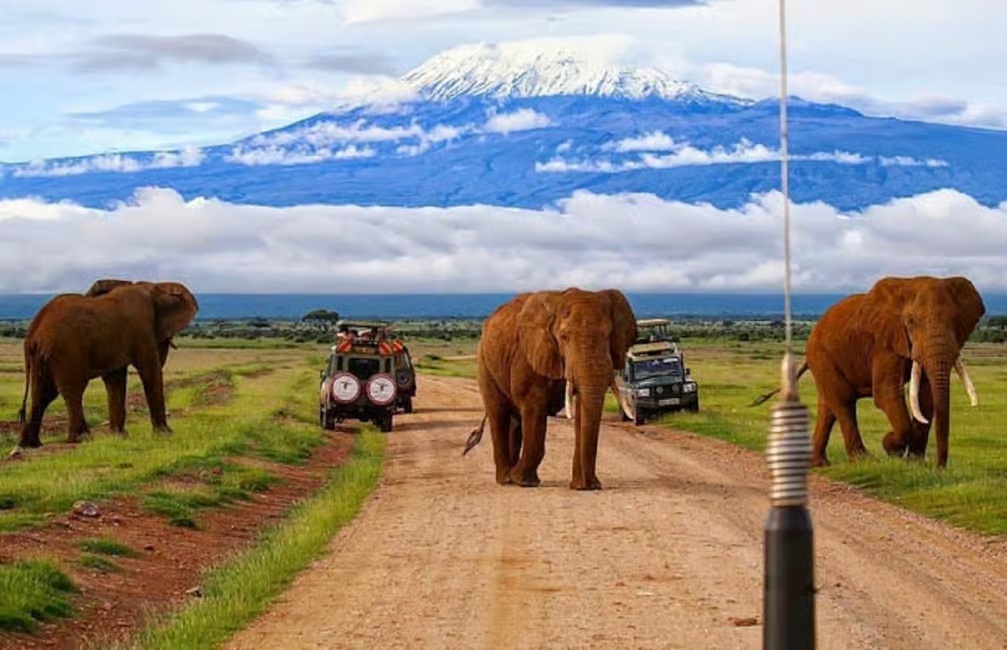
You can travel from Nairobi to Amboseli National Park by road (4 to 5 hours) or by air (45 minutes). Most Kenya tours feature a guided 4x4 safari vehicle from your Nairobi hotel along the Mombasa Road (A109) and into the park via the Emali Gate.
2-days-best-amboseli-safari-in-kenya
3-days-best-amboseli-tour-package
4-days-luxury-amboseli-national-park-from-nairobi
5-days-best-of-amboseli-tsavo-and-mombasa-beach-holidays
6-days-5-nights-midrange-kenya-wildlife-safari-vacation
6-days-luxury-safari-to-kenya-best-parks
7-days-budget-kenya-safari-holiday-vacation-tour
7-days-amboseli-kenya-and-serengeti-fly-in-tanzania-safari
1. By Private Safari Vehicle (Most Popular)
For most adventurers, hitting the tarmac in a dedicated 4x4 safari vehicle—like a rugged Toyota Land Cruiser or a customized safari van—is the quintessential Kenyan experience. The standard route covers roughly 230 kilometers. You will head southeast out of Nairobi along the busy, fully paved Mombasa Road (A109), cruising past industrial hubs and open savannahs. After a drive of about 2.5 hours, you will reach the dusty transit town of Emali. Here, you leave the highway and branch south onto the C102 road (the Emali–Loitokitok route).
The transition from smooth tarmac to the rough, unpaved gravel tracks of the Maasai heartland begins near Kimana town. This bumpy final 17-kilometer stretch is where your 4x4 proves its worth before you roll through the Kimana Gate. The entire journey takes 4 to 4.5 hours. Alternatively, the scenic Namanga route along the A104 highway takes about 5.5 hours. It skirts the Tanzania border, letting you enter the park from the west through the Meshanani Gate. This is a fantastic option if you want to catch early glimpses of Mount Kilimanjaro rising over the acacia trees.
2. By Domestic Flight (Fastest)
If you prefer to bypass the dusty highways and maximize your time in the wild, flying is an absolute game-changer. Daily scheduled flights depart from Nairobi’s bustling domestic hub, Wilson Airport (WIL), and land directly inside the park at the Amboseli Airstrip within a swift 40 to 45 minutes. Established regional carriers like Safarilink Aviation, Airkenya Express, and Fly ALS operate regular morning and afternoon services on this popular bush route.
An insider tip for this flight: try to secure a window seat on the left side of the aircraft when departing Nairobi. On a clear day, the flight path offers a breathtaking, eye-level aerial view of Mount Kilimanjaro’s snow-capped peak towering over the landscape. However, keep in mind that these light aircraft have a strict baggage limit—typically 15 kilograms (33 pounds) per person, and they require soft-sided duffle bags rather than hard-shell suitcases. Once you land, your pre-booked lodge safari vehicle (arranged through properties like Ol Tukai Lodge or Tortilis Camp) will be waiting at the airstrip to drive you straight into your first game drive.
3. By Public Transport (Budget)
For independent, budget-conscious travelers, navigating the route using Kenya's local transit system is an authentic adventure that costs a fraction of a private drive. The journey begins in Nairobi at the bustling Muthurwa Terminus or the River Road area. From here, you will board a public minibus—locally known as a matatu—heading towards Loitokitok or Mombasa. A matatu ticket to the junction town of Emali typically costs between KES 500 and KES 800 ($4 to $6 USD). Alternatively, you can take the modern Madaraka Express SGR train from the Nairobi Terminus to Emali station for about KES 1,000.
Once you disembark in Emali, you will transition to a local shared taxi (often a Toyota Probox) or a southbound matatu heading to Kimana town for about KES 400 ($3 USD). The final 17-kilometer stretch from Kimana town to the Amboseli park gate is not serviced by public buses. For this last leg, you will need to negotiate a ride on a boda boda (motorcycle taxi) or hire a private local taxi, which usually costs between KES 300 and KES 600. Expect the entire journey to take 6 to 7 hours
How far is Amboseli from Nairobi by road?
The driving distance from central Nairobi to Amboseli National Park is approximately 240 kilometers (about 150 miles) if you travel via the popular Emali route. If you choose the alternative route through the Namanga border town, the distance increases to about 270 kilometers. Most safari operators, like Roads of Adventure Safaris, use these distances to structure their morning departures, aiming to get travelers into the park in time for lunch.
How long does the drive to Amboseli take?
On average, the road trip takes between 4 to 5 hours, depending on Nairobi's infamous traffic. Escaping the city’s exit points along the Mombasa Highway (A109) during rush hour can add 45 minutes to your journey. Once you pass the Athi River industrial zone, the road opens up, allowing for a much smoother and steadier cruise toward the Emali junction.
Is the road to Amboseli fully paved?
Most of the route is smooth, newly resurfaced tarmac highway. However, the final 20-kilometer stretch after you turn off the main road past Kimana town turns into a bumpy, unpaved gravel track. This rough section can become dusty during the dry season or muddy during rains, making a sturdy 4x4 vehicle essential for the final approach to the park gates.
What is the flight distance from Nairobi?
If you choose to fly, the direct aerial distance from Nairobi’s Wilson Airport (WIL) to the Amboseli Airstrip (ASV) is just 154 kilometers (96 miles). Because light aircraft fly in a straight path over the scenic Kapiti Plains, they completely bypass the winding highway traffic. This makes flying the most direct and geographically efficient way to reach the park.
How fast is the flight to Amboseli?
A domestic flight on a regional carrier takes only 35 to 45 minutes to touch down on the park’s tarmac runway. Daily scheduled flights operated by local airlines like Safarilink and Airkenya usually depart Wilson Airport at around 7:30 AM. This means you can be watching giant elephant herds by 9:00 AM, skipping half a day of driving.
Which Park gate is closest to Nairobi?
The closest and most frequently used entry point from Nairobi is the Kimana Gate, located on the park's eastern side. Driving from Nairobi through Emali town leads you directly to this gate, covering a total distance of 240 kilometers. Most luxury lodges, such as Amboseli Serena and Ol Tukai, are highly accessible once you enter through Kimana.
What is the distance via Namanga border?
Taking the southwestern route via the Namanga border town covers a driving distance of roughly 270 kilometers. This scenic road runs along the Nairobi-Arusha highway (A104) and enters the park through the western Meshanani Gate. It takes about 5.5 hours to drive, but it offers magnificent, uninterrupted views of Mount Kilimanjaro as you approach the border.
Can you take a train near Amboseli?
While the Madaraka Express SGR train does not go directly to the park, you can take it from Nairobi Terminus to Emali Station, covering about 120 kilometers. The train ride takes roughly 1.5 hours and costs KES 1,000 ($8 USD) for an economy ticket. From Emali, you will still need to hire a private vehicle or local taxi to cover the remaining 90-kilometer road drive into the park.
How far is Amboseli from Tsavo West?
If you are booking a multi-destination Kenya safari, Amboseli sits approximately 100 kilometers (62 miles) from the border of Tsavo West National Park. The transfer between these two premier parks takes about 2 to 3 hours by road, traveling along the scenic Chyulu Hills path. Combining them is highly popular because of their close proximity and contrasting volcanic landscapes.
Does airline luggage weight affect flight distance?
While weight doesn't change the physical distance of 154 kilometers, it heavily impacts regional flight logistics. The small Cessna Caravan aircraft used by airlines like Airkenya enforce a strict 15-kilogram (33-pound) limit per passenger, requiring soft-sided bags. Heavy, hard-shell suitcases cannot fit in the small baggage pods of these bush planes, so pack light!
Things to do on Kenya tour in Amboseli national park
On a Kenya tour in Amboseli National Park, you can capture iconic photographs of massive elephant herds with the snow-capped Mount Kilimanjaro in the background, embark on guided game drives to spot big cats and prolific birdlife, and visit traditional Maasai villages to experience their unique culture and vibrant dances
Photograph the Mount Kilimanjaro Backdrop
There is a reason professional wildlife photographers and amateur enthusiasts flock to Amboseli with heavy telephoto lenses in hand. The park offers the absolute best vantage point in Africa to capture majestic, free-roaming elephant herds framed against the snow-capped, 5,895-meter (19,341-foot) peak of Mount Kilimanjaro. Even though the iconic mountain actually sits across the border in Tanzania, its massive volcanic dome dominates the Amboseli horizon.
To get that postcard-perfect shot, timing is everything. You will want to set your alarm for a 5:30 AM wake-up call to catch the first light. During the heat of the day, clouds quickly gather around the mountain, completely hiding the snowy peak by mid-morning. Head straight to the famous Observation Hill or the open Sinet Delta. As the golden morning sun hits the snow, a family herd of elephants—often led by a massive, tusked matriarch—will cross the plains, giving you a magical window of about 45 minutes to capture one of the most celebrated wildlife spectacles on earth.
Take Guided Game Drives
Spanning roughly 392 square kilometers, Amboseli National Park might seem compact compared to the massive Serengeti or Tsavo, but its density of wildlife is staggering. Driving through the park’s contrasting landscapes—ranging from dusty, dry lakebeds to lush, green oasis swamps fed by underground meltwater from Mount Kilimanjaro—feels like stepping into a living nature documentary.
Your guided game drive in a pop-up top 4x4 Land Cruiser will reveal a sanctuary hosting over 50 mammal species. While the park is world-famous for its incredibly relaxed elephant populations (some herds number over a hundred strong), keeping your eyes peeled on the savannah can yield sightings of elegant cheetahs scanning the plains from termite mounds, pride of lions resting in the shade of acacia trees, and thousands of zebras and wildebeests. Experienced local guides, often from the local community, know how to track these predators, reading the alarm calls of impalas or the flight patterns of vultures to place you right in the middle of the action.
Interact with the Maasai Community
A trip to Amboseli is never truly complete without appreciating the people who have coexisted with these wild animals for centuries. The local Maasai community lives in manyattas (traditional homesteads built from mud, sticks, and thatch) just outside the park boundaries, in community conservancies like Selenkay or Kimana.
When you book a cultural excursion to a local village, you are invited into their way of life. The experience is incredibly sensory: the vibrant red and blue hues of their shúkàs (traditional blankets), the rhythmic jingling of hand-beaded metal necklaces, and the hypnotic sounds of the adumu—the famous Maasai jumping dance where young warriors (morans) compete to jump the highest to showcase their strength. Beyond the dancing, you will sit down with community elders, tour their homes, and learn about the delicate balance of modern conservation. A portion of your village entry fee (typically around $20 to $30 USD) goes directly into community funds for clean water initiatives and school bursaries.
Go Birdwatching
For bird enthusiasts, Amboseli’s unique water-rich ecosystem is nothing short of a paradise. Despite its arid surroundings, the melting snows of Mount Kilimanjaro filter through the volcanic rock and bubble up within the park to form permanent marshes like the Enkongo Narok and Olokenya Swamps. These lush wetlands attract an astonishing array of birdlife, with over 400 recorded species making the park their home.
Whether you are an avid "twitcher" or a casual observer, spending an afternoon with your binoculars focused on the reeds is incredibly rewarding. You will easily spot massive flocks of bright pink Lesser Flamingos wading in the shallows, alongside elegant Grey Crowned Cranes (Kenya's national bird) performing their elaborate mating dances. Giant Goliath Herons, African Fish Eagles perched high on dead acacia branches, and Great White Pelicans gliding across the water are common sights. The best time for birding is between November and April, when migratory species from Europe and northern Africa arrive, turning the swamps into a chaotic, colorful, and noisy avian haven.
Where to stay on Kenya tour in Amboseli national park
Luxury: Indulge in Eco-Chic Splendor
For a high-end, immersive escape, the private conservancies bordering the park offer unparalleled exclusivity. At Elewana Tortilis Camp, tucked away in its own private corner inside the park, you will sleep in spacious, elegant tents raised on wooden decks, offering legendary, unobstructed views of Mount Kilimanjaro. The camp is fully solar-powered and features a gorgeous swimming pool surrounded by acacia trees.
Just outside the boundary, Satao Elerai Camp sits in the quiet Elerai Conservancy. Here, you can enjoy night game drives and guided bush walks, which are not allowed inside the main park gates. At both locations, expect gourmet multi-course meals, excellent gin-and-tonics served during sunset over the plains, and highly personalized service. These properties run about $500 to $900+ USD per night, depending on the season, making them perfect for honeymooners or milestone celebrations.
Mid-Range: Comfort Meets Epic Views
If you want a solid balance of cozy comfort, great food, and prime location without a massive price tag, mid-range lodges are the sweet spot. A classic favorite is Ol Tukai Lodge, located directly in the heart of the park. Its open-air terrace is famous; you can literally sip a cold Tusker beer by the pool while watching a herd of fifty elephants stroll through the swamp just meters away, with Kilimanjaro towering in the background.
Another fantastic option is Kibo Safari Camp, located just 2 kilometers outside the Kimana Gate. It features massive safari tents under thatched roofs, complete with stone-walled en-suite bathrooms, comfortable beds, and a lovely central bonfire area where guests gather at night to share safari stories. These properties typically cost between $200 and $400 USD per night, offering incredible value and immediate access to early-morning game drives.
Budget: Simple, Authentic, and Affordable
Traveling on a budget does not mean missing out on the magic of Amboseli. Highly rated budget properties like AA Lodge Amboseli (located just 2 kilometers from the Kimana Gate) offer clean, comfortable brick cottages and safari tents alongside a swimming pool and a restaurant. This gives you a touch of resort-style relaxation at a fraction of the cost.
For a more rustic, classic camping experience, places like Kimana Camp or Amboseli Bush Camp offer self-catering options, basic safari tents with private flush toilets, and shared kitchen facilities. Staying at these budget spots costs anywhere from $80 to $150 USD per night. It keeps your costs low while positioning you perfectly to hear the distant roar of lions and the calls of hyenas under a star-filled African sky, with the mighty silhouette of Kilimanjaro standing guard nearby.
Booking Kenya tor to Amboseli national park with us Roads of Adventure safaris
Ready to see Amboseli’s legendary elephants framing Mount Kilimanjaro? Let Roads of Adventure Safaris craft your perfect 2 or 3-day Kenyan getaway. We’ll pick you up from your Nairobi hotel or airport for a scenic 4-to-5-hour road trip (about 240 km via the vibrant Namanga route). Once there, you will marvel at massive elephant herds beneath the snow-capped peak, with park entry fees set at $90 USD per non-resident adult.
