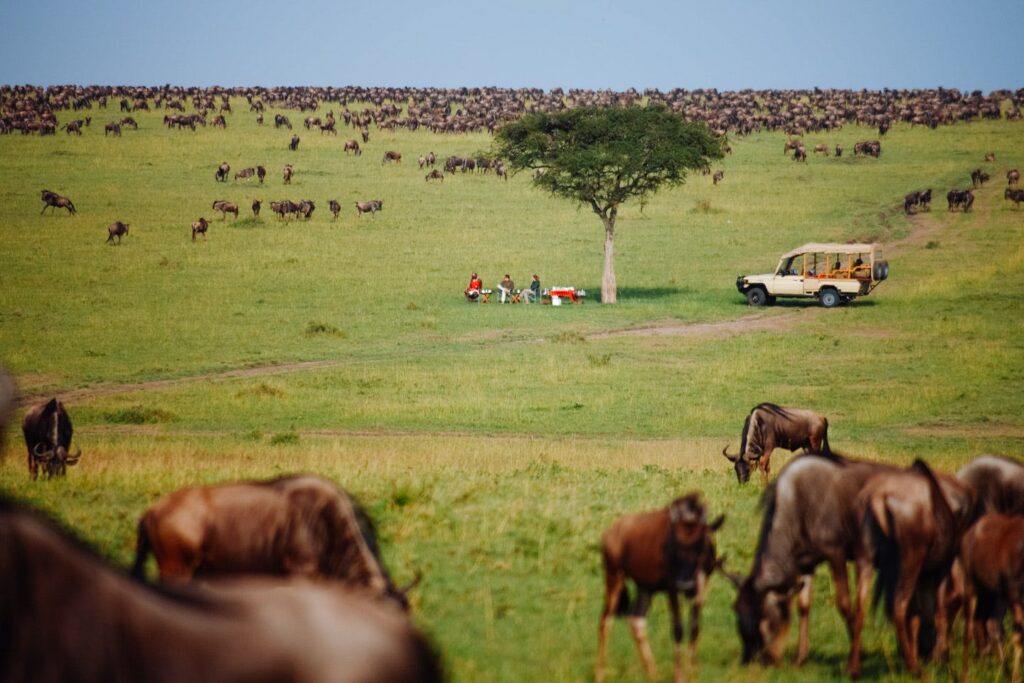
Combining a Serengeti and Ngorongoro Crater safari is the ultimate Tanzanian wildlife experience. The easiest way to do this is by booking a 4- to 5-day overland 4x4 tour starting from Arusha. You’ll drive into the Serengeti for vast plains and predator sightings, then spend a day descending into the Ngorongoro Crater.
3-days-budget-tanzania-to-safari-serengeti-and-ngorongoro
3-days-southern-serengeti-safari-tour-and-ngorongoro-crater-calving-season-package
4-days-budget-tanzania-safari-tour-to-serengeti-ngorongoro-and-tarangire
5-days-tanzania-safari-to-tarangire-serengeti-ngorongoro-and-lake-manyara
4 Days combined Serengeti safari and Ngorongoro crater on safari in Tanzania
The Serengeti and Ngorongoro Crater represent the pinnacle of the African safari experience, offering a breathtaking journey through Tanzania’s most iconic landscapes. This 4-day expedition is meticulously designed to showcase the raw power of the wild, from the "endless plains" of the Serengeti to the prehistoric majesty of the Ngorongoro Crater. You’ll traverse the Great Rift Valley, witnessing one of the highest concentrations of predators on earth and the rare opportunity to see the endangered black rhino in its natural sanctuary.
Whether you are chasing the thunderous hoofbeats of the Great Migration or marveling at a pride of lions lounging under an acacia tree, this 4-days itinerary balances adventure with awe-inspiring scenery. With expert guides navigating the rugged terrain, you will dive deep into ecosystems that have remained unchanged for millennia. Prepare for a soul-stirring encounter with nature that begins in the vibrant hub of Arusha and culminates in the "Eighth Wonder of the World."
Day 1: Arusha to Serengeti
Your adventure begins with a scenic but long drive from Arusha, the gateway to Tanzania’s northern circuit. The 7 to 8-hour journey is a transition through diverse landscapes, passing colorful Maasai villages and the highland forests of the Ngorongoro Conservation Area. Upon reaching the Naabi Hill Gate, the entrance to the Serengeti, the trees vanish, and the vast, golden savannah unfolds before you.
The afternoon is spent on an en-route game drive toward the central Seronera region. Even on this initial drive, your eyes will be glued to the horizon; the Serengeti is home to millions of herbivores and the predators that shadow them. As the sun begins to set, casting a deep orange glow over the plains, you’ll arrive at your lodge or campsite. The sounds of the African night—the distant roar of a lion or the laugh of a hyena—set the stage for the days ahead.
Day 2: Serengeti National Park
Today is dedicated to the legendary Seronera Valley, the heart of the Serengeti. This area is world-renowned for its high density of big cats; it is not uncommon to spot lions, leopards, and cheetahs all in a single morning. The valley’s perennial water sources draw a constant stream of wildlife, ensuring spectacular sightings regardless of the season.
If your visit aligns with the Great Migration, you will witness a living tapestry of over two million wildebeests and zebras stretching to the horizon. Your guide will navigate the network of trails, stopping at "kopjes"—ancient rock outcrops that serve as lookout points for predators. You’ll enjoy a picnic lunch under a lone acacia tree, surrounded by the sights and sounds of the wild. From the delicate grace of a Thompson’s gazelle to the massive presence of an elephant bull, every moment today offers a masterclass in African biodiversity and the circle of life.
Day 3: Serengeti to Ngorongoro
The day starts at dawn for a sunrise game drive, the best time to see predators returning from their nightly hunts or hippos retreating to the safety of the water. The early morning light provides perfect conditions for photography, capturing the dew on the grass and the silhouettes of giraffes against the awakening sky. After a late breakfast, you bid farewell to the Serengeti and begin the 3 to 4-hour drive toward the Ngorongoro Conservation Area.
As you climb out of the plains, the temperature drops and the vegetation turns lush and green. This transit offers a stunning change in geography as you ascend the outer slopes of the volcanic highland. By late afternoon, you will arrive at the crater rim. Standing at the viewpoint, 600 meters above the caldera floor, you’ll see the mist rolling over the edges of this lost world. Dinner is served overlooking one of the most spectacular views on the planet.
Day 4: Ngorongoro Crater Floor
After an early breakfast, you descend the steep, forested walls into the Ngorongoro Crater, a self-contained Eden spanning 260 square kilometers. This collapsed caldera acts as a natural enclosure, hosting nearly 30,000 animals. The star of the show here is the black rhino; this is one of the few places in East Africa where you can reliably spot this critically endangered giant.
The crater floor features a variety of habitats, from the soda waters of Lake Magadi, shimmering with pink flamingos, to the Lerai Forest, where old bull elephants with massive tusks wander. You will spend 5 to 6 hours exploring this high-density wildlife haven, likely completing your "Big Five" checklist. After a final picnic lunch by the hippo pool, you will begin the ascent and the return drive to Arusha. You’ll arrive in the evening, carrying memories of an unparalleled journey through the heart of the Tanzanian wild.
1. Why should I combine these two destinations?
Original Point: Combining them offers the ultimate contrast: the compact, dense, and lush bowl of the Ngorongoro Crater (where you can see the Big Five in a single day) paired with the endless, sweeping plains of the Serengeti, which offer incredible predator action and the Great Wildebeest Migration.
Pairing the Ngorongoro Crater with the Serengeti National Park creates arguably the most diverse and high-impact wildlife itinerary on the planet. The magic lies in the staggering shift in geography, scale, and animal behavior over a relatively short distance. By combining them, you experience two completely different ecosystems that complement each other perfectly, giving you a comprehensive look at East Africa’s natural wonders.
The Ngorongoro Crater is a self-contained volcanic caldera that acts as a natural enclosure for over 25,000 large mammals. Because the crater floor is compact and relatively flat, animal densities are incredibly high. It offers an almost theatrical wildlife viewing experience where you can realistically spot all members of the Big Five—including the highly elusive black rhino—in a single afternoon. The backdrop of the steep, forested crater walls provides a dramatic, intimate setting for photography.
In stark contrast, the Serengeti represents boundless freedom. The name itself derives from the Maasai word Siringet, meaning "endless plains." Here, the horizons stretch forever, and the wildlife must constantly move to survive. The Serengeti offers raw, untamed predator action and plays host to the Great Wildebeest Migration, a massive movement of millions of herbivores. Moving from the enclosed sanctuary of the Crater to the infinite grasslands of the Serengeti provides an exhilarating sense of scale that defines the ultimate African adventure.
2. How far is the Ngorongoro Crater from the Serengeti?
Original Point: The drive from the Ngorongoro Conservation Area (NCA) gate to the Seronera area in the central Serengeti takes about 3 to 4 hours. The journey covers around 140 to 200 kilometers, depending on your exact start and end points.
While the map distance between these two highlights seems relatively short, the physical journey is an immersive travel experience through shifting conservation zones. The drive from the rim of the Ngorongoro Crater down into the heart of the central Serengeti (the Seronera Valley) typically takes between 3 to 4 hours of steady driving. The variation in time and distance depends heavily on the seasonal condition of the roads and the exact locations of your start and end accommodations.
The journey is far from a standard highway drive; it is an unpaved, corrugated gravel and dirt track that can be incredibly dusty during the dry season or muddy and slippery during the rains. The route takes you through the multi-use Ngorongoro Conservation Area, where you will look out the window to see Maasai pastoralists guiding their cattle alongside wild zebras and giraffes. As you pass the Naabi Hill Gate—the official entry point into the Serengeti—the landscape shifts dramatically from rocky, acacia-dotted highlands to the iconic, flat, tree-less grasslands.
Because the entire route is a designated conservation corridor, the transit essentially doubles as a slow, continuous game drive. You are highly likely to spot herds of wildebeest, gazelles, and ostriches running parallel to your vehicle. To ensure comfort during this bumpy transit, professional operators use robust vehicles and schedule the drive for the middle of the day, allowing you to arrive at your next camp just in time for a refreshing afternoon rest.
3. Which should I visit first?
Original Point: It is generally recommended to visit the Ngorongoro Crater first, followed by the Serengeti. This builds anticipation; the Crater is spectacular, but the vast, boundless Serengeti usually feels more climactic.
Structuring your Tanzanian itinerary is an art of managing expectations and building a natural narrative arc for your adventure. Most experienced safari experts strongly recommend starting your journey with the Ngorongoro Crater before heading into the vast expanses of the Serengeti. This specific sequence works best because it builds a steady sense of anticipation, saving the grandest, most untamed wilderness for the grand finale.
Beginning at the Ngorongoro Crater offers an immediate, high-reward introduction to African wildlife. Descending into the caldera feels like entering a natural wonderland where animals are readily visible, allowing you to quickly check off key sightings like rhinos, lions, and old tusker elephants. It is a structured, dense, and breathtakingly beautiful experience that sets a magnificent baseline for your trip. However, because it is a compact space with defined driving tracks, it can occasionally feel busy with other vehicles.
Transitioning from the Crater into the Serengeti feels like a massive release. As the landscape opens up into infinite horizons, the sense of wild exploration amplifies. The Serengeti demands a bit more patience and tracking skills from your guide, making every predator sighting feel deeply earned and exhilarating. Ending your trip surrounded by the immense spaces of the Serengeti, falling asleep to the distant calls of hyenas in an unfenced camp, provides a wild, emotional climax to your safari that stays with you long after you return home.
4. How many days do I need for this combination?
Original Point: The absolute minimum is 3 to 4 days, but a 5 to 6-day trip is ideal. This gives you enough time to explore without feeling rushed, accounting for travel times between the parks.
Time is the most valuable commodity when planning a safari through Tanzania’s northern circuit. While it is logistically possible to compress the Ngorongoro Crater and the Serengeti into a rapid 3 to 4-day itinerary, doing so requires long hours of driving and leaves very little time to actually relax and absorb the environment. To truly appreciate the rhythms of the wild without feeling like you are on a grueling road rally, dedicating 5 to 6 days to this combination is highly recommended.
A well-paced 5 to 6-day itinerary allows for an immersive exploration of both ecosystems. You can spend your first day traveling from Arusha and enjoying the magnificent views from the Ngorongoro Crater rim. Day two can be entirely dedicated to a morning descent into the Crater floor before making the afternoon transit to the Serengeti. This leaves you with three full, uninterrupted days inside the Serengeti to venture deep into different regions, track specific predator prides, or follow the moving paths of the migration herds.
Furthermore, a longer stay protects your investment against the unpredictability of nature. Wildlife does not operate on a fixed schedule; a leopard hidden in a tree or a cheetah hunt might require hours of patient waiting. A 5 to 6-day window ensures that you aren't forced to abandon a spectacular wildlife interaction simply because you have a rigid, long-distance road transit looming on your schedule. It allows for a relaxed pace where you can enjoy mid-day lunches at your lodge and slow sundowners on the plains.
5. What is the best time of year to do this safari?
Original Point: December to March: Best for the calving season in the southern Serengeti and Ndutu areas. June to October: The dry season, which is excellent for predator viewing, tree-climbing lions, and witnessing the dramatic river crossings in the northern Serengeti.
Tanzania is a phenomenal year-round safari destination, but the timing of your visit will completely dictate the weather patterns, landscapes, and specific wildlife behaviors you encounter. The ideal window depends heavily on which natural phenomena you are most eager to witness, with the year divided into two highly distinct peak seasons.
The period from December to March is a magical time characterized by lush, green landscapes and vibrant new life. This is the optimal window to witness the Great Migration’s calving season, which takes place in the southern Serengeti and the Ndutu conservation area. Over a brief few weeks, hundreds of thousands of wildebeest calves are born simultaneously. This abundance of vulnerable young animals naturally draws an incredible concentration of apex predators—lions, cheetahs, and hyenas—resulting in intense, fast-paced wildlife tracking and dramatic predator-prey interactions.
Alternatively, the long dry season from June to October offers an entirely different, classic safari experience. As the water sources dry up across the plains, animals are forced to congregate in dense numbers around permanent rivers and waterholes, making them exceptionally easy to locate. The grass is short, maximizing visibility for photography. This is also the time when the migration moves into the northern Serengeti, setting the stage for the dramatic, heart-pounding river crossings across the crocodile-infested Mara River. For general wildlife viewing and comfortable, cooler weather, this dry window is tough to beat.
6. Do I need a 4x4 vehicle?
Original Point: Yes. All game drives in the Crater and the Serengeti require a proper 4x4 safari vehicle with a pop-up roof for photography. Self-driving is possible but highly discouraged for first-timers; hiring a local driver-guide is highly recommended.
Navigating the rugged terrains of the Ngorongoro Conservation Area and the Serengeti requires a serious, purpose-built 4x4 vehicle. The tracks inside these parks consist of rough dirt, deep sand, volcanic ash, and heavy corrugations that can quickly damage a standard vehicle. The descent and ascent roads of the Ngorongoro Crater are particularly steep and challenging, legally requiring a low-range 4x4 system to safely navigate the sheer drop-offs and switchbacks.
Standard safari vehicles in Tanzania are heavily modified, long-wheelbase Toyota Land Cruisers. These vehicles feature reinforced suspensions, dual fuel tanks, two spare tires, high-clearance chassis, and critically, a customized pop-up roof. This roof design allows you to stand safely inside the vehicle during game drives, providing unobstructed, 360-degree panoramic views of the landscape and excellent stability for steadying long telephoto camera lenses during high-stakes wildlife sightings.
While intrepid travelers can technically rent a 4x4 for a self-drive safari, it is highly discouraged for first-time visitors. Navigating the trackless expanses of the Serengeti requires expert orientation skills, as getting lost or stuck in mud with no cellular signal can be dangerous. Hiring a professional driver-guide transforms your trip. These experts possess years of training in mechanics, animal behavior, and tracking techniques, and they utilize a professional radio network to share real-time locations of rare wildlife, ensuring you don't miss a thing.
7. Can I fly between the two locations instead of driving?
Original Point: Yes. You can fly directly from Arusha or Kilimanjaro to various airstrips inside the Serengeti (like Seronera, Kogatende, or Ndutu) to save time, then take a 4x4 vehicle back through the Ngorongoro Conservation Area, or vice versa.
For travelers who wish to maximize their time in the wilderness and minimize long road transits, utilizing Tanzania’s efficient network of bush planes is an excellent strategy. Regional aviation companies operate daily scheduled flights using dependable turboprop aircraft like the Cessna Caravan. These flights connect the main safari gateways of Arusha Airport (ARK) or Kilimanjaro International Airport (JRO) directly to a network of dirt runways scattered across the Serengeti, including Seronera in the center, Kogatende in the north, and Ndutu in the south.
A brilliant itinerary design involves taking a "fly-one-way, drive-one-way" approach. For instance, you can board a morning flight from Arusha and land in the central Serengeti less than an hour later, completely bypassing the long overland drive. Your dedicated guide and 4x4 safari vehicle will be waiting for you right at the bush airstrip to begin game driving immediately. You can spend a few spectacular days exploring the Serengeti before slowly working your way back overland through the Ngorongoro Conservation Area, stopping to explore the Crater along the way.
Choosing to fly saves immense amounts of energy and eliminates the physical fatigue of long, bumpy road journeys. It allows you to spend your precious holiday hours watching wildlife rather than staring at a dusty track. It is important to note that these light aircraft flights enforce a strict luggage limit of 15 kg (33 lbs) per person, requiring you to pack efficiently in soft-sided duffel bags that can be easily stowed in the aircraft's cargo compartments.
8. How much does a combined safari cost?
Original Point: Private mid-range safaris generally start around $450 to $600 per person, per day. Budget group tours (camping) can lower this to $250 to $350 per person, per day, while luxury lodges can cost $1,000+ per day.
Planning a safari to Ngorongoro and the Serengeti involves understanding a wide range of pricing tiers. Tanzania is a premium destination that deliberately emphasizes low-impact, high-value tourism to protect its pristine environments. The total cost of your safari is determined by your choice of accommodation, whether you opt for a private or shared vehicle, and the steep park conservation fees that are built into every itinerary.
A budget group tour is the most economical entry point, typically costing between $250 and $350 per person, per day. On these trips, you share a 4x4 vehicle with other travelers and spend your nights sleeping in public campsites inside heavy canvas tents, with meals prepared by a camp cook. For a more comfortable, personalized experience, a private mid-range safari ranges from $450 to $600 per person, per day. This option grants you an exclusive vehicle and guide, along with overnight stays in charming permanent tented camps or lodges featuring proper beds, private en-suite bathrooms, and hot showers.
For those seeking ultimate indulgence, the luxury tier starts at $1,000 to over $2,500 per person, per day. This elite bracket grants you access to world-renowned architectural masterpieces perched on the Ngorongoro Crater rim or ultra-exclusive mobile camps tucked into private concessions of the Serengeti. These properties offer fine dining, private plunge pools, inclusive premium wines, and personalized butler services, delivering an unparalleled level of comfort in the middle of the African bush.
9. Are there extra fees for the Ngorongoro Crater?
Original Point: Yes. In addition to the standard Ngorongoro Conservation Area (NCA) entry fee, there is a specific "Crater Service Fee." Additionally, you pay per vehicle for a crater descent/ascent, and these tariffs operate on a strict 24-hour basis.
Budgeting for a Tanzanian safari requires an understanding of the unique fee structure managed by the Ngorongoro Conservation Area Authority (NCAA). Unlike standard national parks where a single entry ticket grants access to the entire reserve, the Ngorongoro Crater is treated as a highly protected, premium zone. To control tourist congestion and fund intensive conservation, the authority levies multiple layers of fees that make a descent into the crater floor one of the most expensive excursions in Africa.
First, every visitor must pay a standard conservation entry fee per person, per 24-hour period just to exist within the broader Ngorongoro Conservation Area highlands. However, the moment your 4x4 safari vehicle turns down the steep descent road to access the actual crater floor, an additional, mandatory "Crater Service Fee" is applied. This substantial fee is charged flat per vehicle for each single descent, meaning entering the crater on two separate days doubles this specific operational cost.
Furthermore, all permits are managed via an electronic payment system and operate on a strict, unyielding 24-hour clock. If your vehicle passes through the main entry gate at 2:00 PM on Day 1, you must completely exit the conservation area by 2:00 PM on Day 2, or you will automatically be charged an entire second day’s worth of per-person and vehicle fees. Reputable tour operators handle all of these complex, fast-changing permit bookings on your behalf, embedding the costs transparently into your overall safari package.
10. What wildlife can I expect to see in the Crater vs. the Serengeti?
Original Point: Ngorongoro Crater: Black rhinos, massive tusked elephants, huge prides of lions, and hippos. Serengeti: Millions of wildebeest and zebras, cheetahs, leopards, and large flocks of ostriches.
While both parks are home to an abundance of African wildlife, the distinct environments of the Ngorongoro Crater and the Serengeti cultivate entirely different wildlife viewing dynamics and species highlights. Understanding what each location excels at allows you to appreciate the unique strengths of both stops on your journey.
The Ngorongoro Crater functions as a rich, mineral-packed basin where wildlife stays resident year-round. It is the premier location on the northern circuit to see the critically endangered black rhino moving across the open plains. The crater is also famous for its incredibly high concentration of apex predators, particularly huge, dark-maned lions that are completely habituated to safari vehicles. You will also encounter ancient, massive bull elephants sporting giant tusks that wander the Lerai Forest, while the main lake and marsh areas are packed with hundreds of snorting hippos.
The Serengeti, by contrast, is defined by the massive scale of its migratory populations. It is the best place on earth to witness the iconic sight of millions of wildebeest and zebras moving as a single, thunderous wave across the land. The infinite flat plains provide the ultimate hunting grounds for the world’s fastest land mammal, the cheetah, which relies on high visibility to sprint after prey. The Serengeti's massive granite rock formations (kopjes) and large riverine trees provide the perfect habitat for secretive leopards and large flocks of common ostriches pacing across the savannah.
11. Is it safe to stay inside the parks?
Original Point: Yes, staying at lodges or tented camps inside or directly on the rim/borders is perfectly safe. Many upscale camps unfenced, meaning animals wander through, but you will always have trained Maasai askaris escorting you at night.
Choosing to stay inside the borders of the Ngorongoro Conservation Area or the Serengeti is a completely safe experience that offers an incredible connection to nature. Whether you choose a solid glass-and-stone luxury lodge perched on the crater rim or an authentic, canvas tented camp nestled deep within a Serengeti acacia grove, these properties are expertly managed to ensure absolute guest safety while preserving the wild integrity of the environment.
Many of the most desirable safari camps are intentionally unfenced. This design allows the ancient wildlife corridors to remain completely uninterrupted, meaning it is entirely common for zebras, elephants, or buffalo to wander quietly between guest tents during the day to graze on the camp grass. While this sounds thrilling, the animals are generally peaceful and completely habituated to the presence of the tents, viewing them as stationary landscape features rather than sources of food or threat.
To ensure total safety after dark, camps employ strict nocturnal protocols. Guests are instructed never to walk alone around the camp grounds after the sun sets. Instead, you will always be escorted to and from the main dining tent by trained Maasai askaris (local night watchmen). Armed with traditional spears or flashlights, these expert woodsmen possess an intimate understanding of animal behavior and can spot a pair of eyes reflecting in the brush from hundreds of yards away, ensuring you are completely protected as you move through the camp.
12. Where should I stay?
Original Point: For Ngorongoro, look at lodges perched on the Crater Rim (e.g., Ngorongoro Serena Safari Lodge or Crater Lodge) for breathtaking views, or in the Karatu area just outside the park for budget options. For the Serengeti, stay in the central Seronera area or at mobile, seasonal tented camps following the migration.
Choosing the right accommodation locations can completely transform your safari experience, balancing travel efficiency with iconic, beautiful views. Both destinations offer distinct accommodation zones tailored to different budgets and travel goals.
For the Ngorongoro portion of your trip, the ultimate premium experience involves staying directly on the Crater Rim. Iconic properties like the Ngorongoro Serena Safari Lodge or the ultra-luxury Ngorongoro Crater Lodge offer world-class rooms with dramatic glass windows looking straight down into the caldera, allowing you to watch the morning mist rise over the crater floor. If you are traveling on a more modest budget, looking at accommodations in the lush farming town of Karatu—located just outside the main gate—offers excellent, high-quality lodges at a fraction of the cost, though it does add a short drive to your morning entry.
When choosing where to stay in the Serengeti, location should be dictated by your travel dates. The central Seronera area is the park's wildlife hub, offering excellent year-round resident game viewing and a wide selection of permanent luxury camps. However, if your primary goal is to witness the Great Migration up close, you should book a stay at a mobile, seasonal tented camp. These clever luxury camps packed up and moved twice a year, setting up in the southern Ndutu region during the green calving months and moving to the northern Kogatende region during the dry river-crossing season to put you right in the center of the action.
13. Do I need to book my permits in advance?
Original Point: Absolutely. Because Tanzania strictly manages daily visitor capacities to protect the environment (especially inside the Ngorongoro Crater), permits and park entry fees must be secured well in advance through your tour operator.
A successful safari through Tanzania’s premier wildlife destinations requires meticulous advance administrative planning. You cannot simply show up at the gates of the Ngorongoro Crater or the Serengeti and purchase an entry ticket at a booth. To protect these fragile wilderness areas from overcrowding and environmental degradation, the government enforces strict daily visitor capacities and utilizes an entirely cashless, pre-booked electronic permit system.
The demand for these permits is incredibly high, particularly for the Ngorongoro Crater. The authority strictly limits the total number of vehicles allowed down onto the crater floor during the morning and afternoon shifts to avoid traffic jams around sensitive wildlife sightings. During the peak dry months or the migration calving season, these limited vehicle slots can sell out months ahead of time. Attempting a last-minute booking can result in missing out on a crater descent entirely.
To secure your entry, all park fees, vehicle permits, and specific conservation tariffs must be processed and paid for in advance through a registered, licensed Tanzanian tour operator. When you book a safari package, your operator registers your passport details, vehicle registration numbers, and precise travel dates with the park databases. This meticulous advance booking system guarantees that your vehicle passes through the entry checkpoints smoothly, allowing you to focus entirely on enjoying the wildlife.
14. Are there any restrictions when visiting the Ngorongoro Crater?
Original Point: Yes. Vehicles are allowed on the crater floor only between specific morning and afternoon hours. Off-road driving is strictly forbidden, and you must use specific, designated descent and ascent roads.
The Ngorongoro Crater is a highly delicate, enclosed ecosystem, and maintaining its ecological balance requires a strict set of operational regulations that all visitors and safari guides must legally follow. These rules ensure that the thousands of animals living inside the caldera can feed, hunt, and raise their young without being disrupted by tourism.
The first major restriction involves timing. Vehicles are permitted on the crater floor only during daylight hours, typically between 6:00 AM and 6:00 PM, with entry slots divided into specific morning and afternoon shifts. To manage traffic safely on the steep, crater walls, the park enforces a strict one-way traffic system. Vehicles must utilize specific, designated tracks for descending into the bowl and entirely separate, dedicated roads for ascending back to the rim, preventing dangerous head-on encounters on the narrow mountain switchbacks.
Once you are down on the crater floor, off-road driving is strictly forbidden. Safari vehicles must stay completely on the established dirt tracks at all times, even if a rare animal sighting occurs a few hundred yards away in the grass. Guides who violate this rule face heavy on-the-spot fines and the suspension of their park licenses. Fortunately, because the vegetation is low and open, wildlife frequently walks right alongside the established tracks, giving you incredible, close-up viewing opportunities without disrupting the landscape.
15. Can I extend this trip to include other areas?
Original Point: Yes! These parks are part of Tanzania's popular "Northern Circuit." You can easily add a day or two in Tarangire National Park (famous for elephants and baobab trees) or Lake Manyara National Park (known for tree-climbing lions).
One of the greatest advantages of planning a safari in northern Tanzania is the close proximity of several world-class national parks, which together form the celebrated "Northern Circuit." If your travel schedule allows, extending your itinerary by just a few days to include neighboring parks adds incredible depth, variety, and unique landscapes to your overall wildlife experience.
A popular extension involves adding a day or two at Tarangire National Park, located just a short drive from Arusha. Tarangire features a stunning landscape dominated by massive, ancient baobab trees and a permanent river system. During the dry season, it boasts the highest concentration of elephants in Tanzania, with herds of several hundred giants frequently seen moving together across the red earth. It offers a wild, rugged atmosphere that provides a spectacular contrast to both the Ngorongoro Crater and the Serengeti.
Alternatively, you can easily integrate a stop at Lake Manyara National Park, nestled directly at the base of the Great Rift Valley escarpment. This park is famous for its lush groundwater forests, massive troops of baboons, and its legendary, unique population of tree-climbing lions that lounge lazily in the branches of mahogany trees. Extending your trip to include these extra stops turns your safari into a comprehensive journey through East Africa's diverse ecosystems, maximizing the value of your flights to Tanzania.
Booking lake Nakuru and Masai mara with us Roads of Adventure safaris
Booking a Lake Nakuru and Masai Mara safari with Roads of Adventure Safaris offers a direct route to two of Kenya's premier wildlife destinations.
