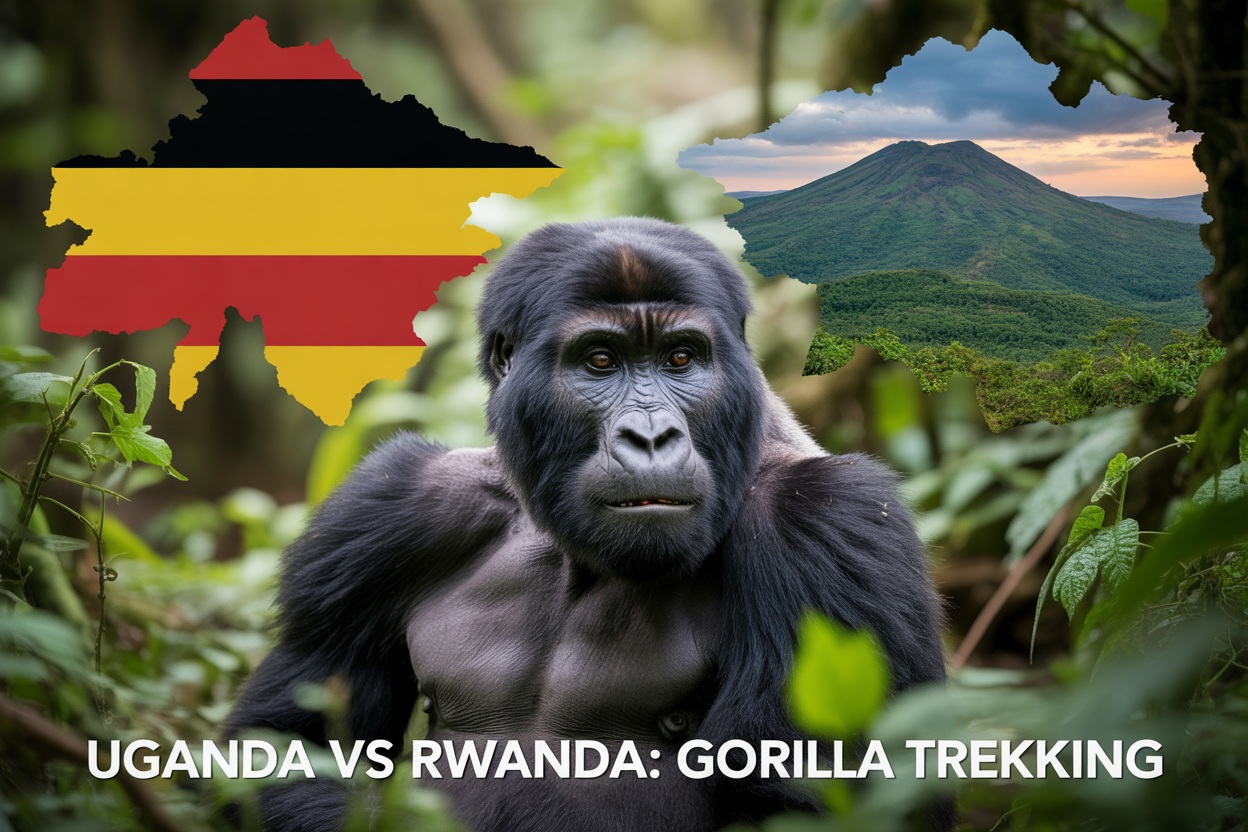
Combine Amboseli and Uganda gorilla trekking by booking a regional flight from Nairobi (WIL or JKIA) to Entebbe (EBB). From Entebbe, take a domestic flight to Bwindi Impenetrable or Mgahinga. A typical 8-to-12-day itinerary includes 2–3 days of game drives under Mt. Kilimanjaro, followed by a 1-day gorilla trek
18-days-exclusive-kenya-tanzania-safari-to-uganda-primate-safari
17-days-east-africa-safari-to-uganda-rwanda-kenya-tanzania-and-zanzibar-beach-holidays
13-days-kenya-tanzania-safari-and-uganda-gorilla-trekking
11-days-gorilla-trekking-and-kenya-safari-in-masai-mara-to-zanzibar-beach-holiday
10-days-kenya-wildlife-safari-and-gorilla-safari-in-uganda
6-days-kenya-masai-mara-and-bwindi-gorilla-trekking-in-uganda-and-lake-bunyonyi
Step 1: Secure Gorilla Permits (Crucial)
Planning a trek to see mountain gorillas is incredibly rewarding, but it requires one non-negotiable first step: securing your permit. Because these gentle giants are strictly protected, the Uganda Wildlife Authority limits daily visitors to ensure the animals' well-being. This means availability is tight, and you will need to lock down your spot three to six months in advance—especially if you are traveling during the dry peak seasons.
Currently, a single gorilla trekking permit in Uganda costs $800. While that might feel like a steep investment upfront, it is important to remember that this fee directly funds habitat conservation, anti-poaching patrols, and community development projects surrounding the parks. You can try to navigate the booking system directly through official government channels, but most travelers find it far easier to let a licensed local tour operator handle the logistics. A good operator won't just secure the permit; they will ensure it aligns perfectly with your tracking sector and lodge location. Getting this paperwork sorted early is the foundation of your entire trip, giving you total peace of mind before you even begin packing your bags.
Step 2: Amboseli National Park (Kenya)
Your wildlife adventure kicks off in Kenya’s legendary Amboseli National Park, a landscape famous for its massive elephant herds and dramatic scenery. Getting there is straightforward: after landing at Jomo Kenyatta International Airport in Nairobi, you can hop into a 4x4 safari vehicle for a scenic four-hour drive through the changing countryside. Alternatively, if you want to maximize your time in the bush, you can catch a quick, comfortable chartered flight from Wilson Airport straight to the Amboseli Airstrip.
Once you arrive, plan to spend two to three days exploring the plains. Amboseli is uniquely beautiful because it pairs premier wildlife viewing with the jaw-dropping backdrop of Mount Kilimanjaro towering just across the border in Tanzania. Watching a family of elephants drift across the dusty savannah beneath Africa’s highest, snow-capped peak is a surreal, postcard-perfect moment you won't soon forget. The park's relatively open terrain and predictable marshes make spotting lions, cheetahs, and vibrant birdlife incredibly rewarding. It is the perfect, high-energy introduction to East Africa's wild side, leaving you deeply connected to the landscape before you head west for your next big encounter.
Step 3: Connecting Kenya to Uganda
Transitioning from the open savannahs of Kenya to the lush, mountainous rainforests of Uganda is where the logistical puzzle comes together. Fortunately, regional travel is highly efficient. You will head back to Nairobi to catch a quick flight over to Entebbe International Airport. Regional carriers like Kenya Airways and Uganda Airlines operate this route daily, and the flight takes just about an hour and fifteen minutes, making it a quick and seamless jump between countries.
Once you touch down in Uganda, you have a big choice to make regarding how you want to reach the southwest corner of the country. If you prefer speed and comfort, you can book a scheduled light aircraft flight from Entebbe to the Kihihi or Kisoro airstrips, dropping you right on the doorstep of the gorilla habitats in under two hours. On the other hand, if you are up for a true African road trip, you can opt for an eight-to-nine-hour overland transfer. While long, the drive is a beautiful journey in itself, taking you through bustling trading centers, rolling tea plantations, and the stunning, terraced hillsides often called the "Switzerland of Africa."
Step 4: Gorilla Trekking (Uganda)
The grand finale of your journey takes you deep into the ancient, misty canopy of either Bwindi Impenetrable National Park or Mgahinga Gorilla National Park. When the big day arrives, you will wake up early, lace up your hiking boots, and head to the park headquarters for an essential safety briefing. From there, paired with expert park rangers and trackers, you will plunge into the dense, tangled rainforest to find one of the habituated mountain gorilla families.
The trek itself is a brilliant adventure. Depending on where the gorillas nested the previous night, you might hike anywhere from one to several hours over steep, muddy ridges and through thick undergrowth. It demands some physical effort, but the moment the rangers pause and gesture into the green foliage, all the fatigue instantly vanishes. You are allowed one unforgettable hour to sit quietly just a few meters away from these magnificent primates. Watching a massive silverback watch you back, while mothers tend to their infants and juveniles wrestle in the vines, is a profoundly emotional, raw experience. It is a rare privilege that redefines your connection to the natural world.
What is the best season to combine these destinations?
Choosing the right time to travel is essential for maximizing your wildlife sightings across both countries. The ideal window to combine Kenya and Uganda runs during the dry seasons from July to October and January to February.
During July and August, for example, you can witness the iconic Great Migration in Kenya's Maasai Mara, where over a million wildebeest brave the Mara River. Simultaneously, these dry months create optimal conditions for gorilla trekking in Uganda’s Bwindi Impenetrable National Park. Because rainfall is minimal, forest trails are less muddy and treacherous, making the steep hike significantly easier. Furthermore, scarce water sources during the dry season force wildlife in places like Amboseli to congregate around permanent marshes, guaranteeing spectacular elephant viewings against a clear view of Mount Kilimanjaro.
Choosing this period ensures you avoid the heavy rains of April and May, which can cause severe road washouts in Uganda and long-lasting tracking delays in the rainforest. Planning around these dry months offers the perfect balance of premier savannah game drives and manageable forest trekking.
Which visa covers travel between Kenya and Uganda?
Navigating immigration is simple if you secure the East Africa Tourist Visa. This single travel document allows multi-country entry into Kenya, Uganda, and Rwanda for a flat fee of $100 USD, valid for up to 90 days.
Without this joint visa, you would be forced to buy separate single-entry visas for each nation. For instance, a standard electronic visa (eVisa) for Kenya costs around $50, and Uganda’s single-entry visa costs another $50. While the monetary cost seems identical, the real value lies in saving time and avoiding bureaucratic headaches. If you exit Kenya to trek gorillas in Uganda and want to fly back out of Nairobi, a standard single-entry visa would expire, forcing you to pay for a costly re-entry visa at the border.
The East Africa Tourist Visa completely eliminates this hassle, allowing you to cross the Entebbe and Nairobi borders seamlessly. You must apply for this visa through the official immigration portal of the specific country you plan to enter first on your itinerary.
3. How do regional flight connections link both countries?
Connecting the vast savannahs of Kenya to the lush rainforests of Uganda is incredibly efficient thanks to robust regional flight paths. The primary aviation hub linking these two destinations is the route between Jomo Kenyatta International Airport (NBO) in Nairobi and Entebbe International Airport (EBB) in Uganda.
Major regional airlines like Kenya Airways and Uganda Airlines operate multiple non-stop flights daily. The actual flight time is a swift 1 hour and 15 minutes. For a seamless itinerary, a traveler can finish a morning game drive in Amboseli, take a quick charter to Nairobi, and board an afternoon regional flight to Entebbe, arriving just in time for dinner by Lake Victoria.
From Entebbe, internal domestic flight operators like Aerolink Uganda offer scheduled light aircraft flights directly to remote bush airstrips like Kihihi or Kisoro. This eliminates the grueling 9-hour overland drive to the gorilla parks. Utilizing these strategic air links transforms what could be a exhausting multi-day overland journey into a smooth, half-day transit, preserving your energy for the physical demands of gorilla tracking.
What packing gear works for savannah and rainforest?
Packing for a combined safari requires preparing for two drastically different environments: the hot, dusty Kenyan plains and the wet, humid Ugandan rainforests. The key is packing versatile, high-performance layers.
For Kenya’s savannahs, light, breathable clothing in neutral tones like khaki and olive green is ideal. You will need a warm fleece jacket for chilly 6:00 AM game drives in Amboseli, which can be peeled off as afternoon temperatures climb. However, this gear will not suffice in Bwindi. For the jungle, you must pack heavy-duty, waterproof hiking boots with excellent ankle support to navigate slippery, root-filled ridges.
Crucially, you need long, thick socks to tuck your trousers into, preventing safari ants from crawling up your legs. Lightweight, waterproof rain jackets and sturdy gardening gloves are also mandatory; the gloves allow you to grab onto thorny vines and stinging nettles for balance without injuring your hands. Bringing a durable, waterproof daypack ensures your expensive camera gear remains completely dry when an unexpected tropical downpour hits mid-trek.
How should safari luggage restrictions impact my packing?
When combining these destinations via light aircraft, you must strictly adhere to rigid luggage limitations. Small domestic planes operating out of Wilson Airport in Nairobi or Entebbe International Airport enforce a strict weight limit of 15 kilograms (33 pounds) per person, which must include your hand luggage.
Furthermore, these airlines require you to use soft-sided duffel bags without rigid frames or wheels. Heavy, hard-shell suitcases simply cannot fit into the narrow, uniquely shaped cargo pods of a Cessna Grand Caravan. If your luggage exceeds these limits, you risk being forced to leave your bags behind or paying expensive freight fees for an extra seat.
To manage this constraint, choose safari lodges that offer complimentary or affordable daily laundry services, allowing you to pack just three to four changes of clothes. If you accumulate souvenirs in Nairobi or Kampala, plan to store your excess baggage safely at your base hotel in Entebbe or Nairobi before hopping onto the domestic bush flights, picking it up before your international flight home.
What health precautions protect travelers in East Africa?
Traveling through East Africa requires proactive medical preparation to ensure you stay healthy throughout your journey. The most critical medical requirement for entering Uganda from Kenya is a valid Yellow Fever Vaccination Certificate, which border officials check closely at Entebbe Airport.
Additionally, both Kenya’s low-lying savannahs and Uganda’s rural areas are high-risk zones for malaria. You must consult a travel clinic well in advance to obtain prescription prophylactic medications, such as Malarone or Doxycycline, and commit to taking them daily. While gorilla parks sit at higher, cooler altitudes where mosquitoes are scarce, the transit zones definitely require protection.
To protect the mountain gorillas, who share roughly 98% of human DNA, strict health protocols are enforced. Gorillas are highly susceptible to human respiratory illnesses; even a common human cold can prove fatal to an entire troop. Travelers are required to wear N95 masks during their hour with the primates and must maintain a strict safety distance of 10 meters (32 feet) to prevent cross-species disease transmission.
How do tracking permits affect itinerary scheduling flexibility?
Gorilla tracking permits completely dictate the structure and flexibility of your entire regional travel itinerary. Because the Uganda Wildlife Authority strictly limits permits to protect the animals, availability is tightly capped, meaning you must secure your $800 permit months before booking flights.
Once issued, your permit is stamped with a specific date and tracking sector (such as Buhoma or Rushaga). This date is completely set in stone; it cannot be rescheduled or refunded due to flight delays, missed connections, or sudden changes in personal plans. This lack of flexibility means you should never schedule your gorilla trek on the exact same day you arrive in Uganda.
An ideal itinerary builds in a safety buffer. For example, you should spend your first night resting at a hotel in Entebbe after flying in from Kenya, and then head to the forest the following day. Designing your trip around the unmovable anchor of the permit date protects your financial investment and prevents a single flight delay from ruining your chance to see the gorillas.
What tipping customs apply across both safari nations?
Tipping is a deeply ingrained custom within the tourism industries of both Kenya and Uganda, serving as a vital supplement to the local incomes of safari staff. While tipping is entirely discretionary, following standard industry benchmarks ensures hard-working crews are fairly compensated.
For your dedicated safari guides who drive you through Amboseli or manage your transfers, a standard tip ranges from $10 to $15 USD per traveler, per day. At luxury lodges, you will typically find a communal "Staff Tip Box" at reception, where contributing $10 to $20 USD per day covers the back-of-house team, including chefs, housekeepers, and security guards.
However, gorilla trekking requires a separate approach. On trekking day, you should tip your head park ranger guide about $20 USD per tracking group, and the trackors who scout the forest ahead about $10 to $15 USD per tracker. Additionally, hiring a local porter at the trailhead for $20 USD to carry your heavy backpack is highly recommended; tipping them an extra $5 USD supports the local community directly.
How do wildlife encounters differ between these countries?
The primary reason to combine Kenya and Uganda is the stark, thrilling contrast between their respective wildlife encounters. Kenya is world-renowned for its classic, wide-open savannah game viewing, characterized by massive volume and predatory action.
In places like Amboseli National Park, you sit comfortably inside an open-top 4x4 vehicle, watching thousands of elephants, prides of lions, and herds of zebras move across vast, unobstructed plains. The viewing is expansive, effortless, and panoramic. Conversely, Uganda offers an intimate, slow-paced, and physically immersive primate encounter.
In Bwindi, you leave the safari vehicle behind completely. You track wildlife on foot, stepping directly into a dense, tangled, and humid rainforest ecosystem. The encounter is deeply focused, culminating in spending one quiet hour observing a single family of mountain gorillas interacting just meters away. Combining these destinations allows you to experience the two ultimate extremes of African travel: the grand, sweeping theater of the East African plains and the raw, breathless magic of a deep-jungle foot trek.
Can travelers combine budget and luxury accommodations smoothly?
Blending different tiers of luxury and budget accommodations is entirely doable and serves as an excellent strategy for managing the overall cost of a multi-destination safari. Because a gorilla permit costs $800 upfront, many travelers choose to balance their budgets elsewhere.
For instance, you can opt for a mid-range tented camp in Kenya, like those just outside Amboseli, which provide comfortable beds, hot showers, and great food without the premium price tag of an ultra-luxury lodge. This allows you to splurge on an upscale, luxury lodge in Uganda, such as those overlooking the misty ridges of Bwindi, where premium amenities and deep baths are incredibly welcome after a exhausting, muddy day of hiking.
When mixing accommodation styles, the key is maintaining operational continuity through your tour operator. Ensure your ground transfers, internal flights, and guiding services remain seamless and high-quality, regardless of whether you are sleeping in a standard canvas tent or a high-end luxury stone cottage. This approach keeps your logistics smooth while optimizing your overall travel budget.
Booking Kenya and Uganda gorilla trekking with us Roads of Adventure safaris
Booking a cross-border expedition from Kenya to Uganda is seamless when you coordinate directly through our team at Roads of Adventure Safaris. Based right here in Kampala, we specialize in blending Kenya’s golden savannah safaris with Uganda’s misty primate treks. Because gorilla permits are highly regulated and capped at $800, we recommend reaching out three to six months in advance so we can lock down your dates and smoothly bundle logistics—including 4x4 transport, regional flights, and park entries—into a custom itinerary. Whether you want to add chimpanzee tracking or upgrade to a four-hour habituation experience, we’ll handle everything; you just need to grab your East Africa Tourist Visa.
