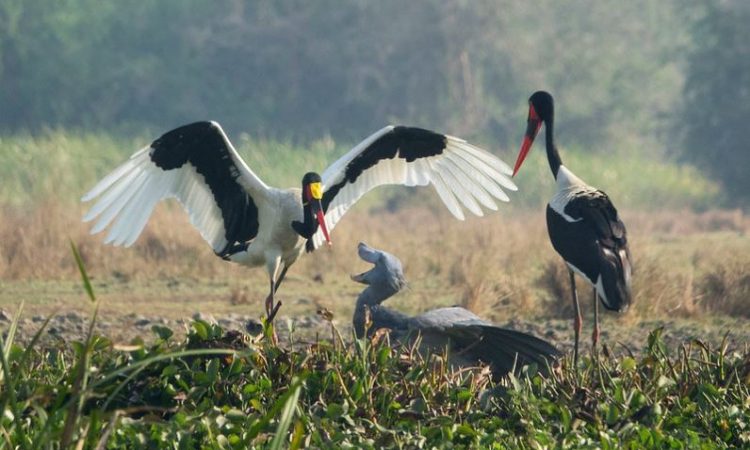
A Uganda bird watching safari typically costs between $250 and $500 per person per day for mid-range packages, with options ranging from budget ($150+) to luxury ($600–$1,000+ per day). Specialized, long-duration birding trips (15–20+ days) generally offer the best value, while short, 1-day birding excursions near Kampala start from around $100–$200.
Popular Uganda bird watching tour packages
25-days-complete-uganda-birding-safari-extravaganza-with-wildlife-viewing
22-days-best-uganda-primate-and-birding-safari-adventure
21-days-uganda-birding-safari-extravaganza-to-best-uganda-safari-parks
20-days-uganda-birding-safari-to-uganda-national-park
20-days-uganda-birding-safari-wildlife-gorilla-and-chimpanzee-tracking
14-days-classic-uganda-birding-safari-expedition
12-days-uganda-birding-tour-looking-for-rift-valley-endemic-birds-west-circuit
10-days-best-uganda-birding-safari-and-wildlife-experience
Key Cost Factors for 2026
- Duration & Scope: Specialized, long-duration birding trips (15–20+ days) generally offer the best value, while short, 1-day birding excursions near Kampala start from around $100–$200.
- Accommodation Type: Budget, mid-range, or luxury lodges significantly alter daily costs.
- Transport & Guide: Private, specialized birding guides ($50–$150/day) and 4x4 vehicles are standard, with fuel for long-distance driving to different habitats impacting the total.
- Park Fees: National Park entry fees typically range from $40 to $100 per day, depending on the location.
Sample Birding Safari Costs (USD)
- 1-Day Mabamba Swamp (Shoebill Search): $105 – $275 per person.
- 3-Day Magical Birding Trip: Approx. $748 per person.
- 10-Day Classic Birding Safari: $4,300 – $4,400+ per person.
- 16-Day Uganda Endemics & Birding Tour: $4,400 – $5,700+ per person
What Is Usually Included
On a Uganda bird watching safari, the inclusions are designed to provide a seamless transition from the dense rainforests of Bwindi to the vast savannas of Murchison Falls. Because birding is a highly specialized activity, these packages bundle logistics that would be difficult to coordinate independently.
Expert Birding Guide Fees
The backbone of any successful Uganda bird watching safari is the expertise of the lead guide. Unlike a general wildlife guide, a specialist birding guide is often an ornithologist with an encyclopedic knowledge of calls, habitats, and behaviors. Their fee covers the "skill of interpretation"—the ability to locate a Green-breasted Pitta in the thick undergrowth of Kibale or identify a distant raptor circling over the Albertine Rift. These experts are equipped with high-quality binoculars, spotting scopes, and field guides to ensure clients don't just "see" a bird, but truly observe its features and lifestyle.
The inclusion of these fees ensures that you have a dedicated professional who understands the specific "birding pace"—which is much slower and more meticulous than a standard game drive. Their expertise is especially critical for spotting Uganda’s 1,000+ species, including the elusive Shoebill or the 24 Albertine Rift endemics. Without a specialist, many of these species remain hidden in plain sight. In addition to the lead guide, many packages include local community guides at specific sites like the Mabamba Swamp. These local experts provide granular, day-to-day knowledge of exactly where a particular bird was last seen nesting, significantly increasing your success rate.
Accommodation and Meals
Accommodation on a Uganda bird watching safari is strategically selected for its proximity to key birding "hotspots." Most packages include full-board stays (breakfast, lunch, and dinner) at lodges ranging from mid-range eco-camps to luxury forest retreats. The choice of lodging is functional; for example, staying at a lodge on the edge of Bwindi Impenetrable Forest allows for "porch birding," where you can spot sunbirds and weavers without leaving your room. These lodges often cater specifically to birders by offering very early breakfasts or packed "bush lunches" so you can stay in the field during the peak morning activity hours.
Meals are typically comprehensive, focusing on fresh local produce and international cuisine. Since birding can be physically demanding—involving long walks through humid forests—the inclusion of all meals ensures you remain energized. Most operators also include unlimited bottled mineral water in the safari vehicle, which is essential for hydration in tropical climates. While alcoholic drinks and sodas are often excluded, the peace of mind of having your lodging and food pre-paid allows you to focus entirely on the checklist. Staying at specialized birding lodges also means you are surrounded by like-minded enthusiasts and guides who share sightings over dinner, creating a rich, immersive community experience throughout your journey.
Ground Transportation in 4x4 Safari Vehicles
Reliable transportation is the literal engine of a Uganda bird watching safari. Given the rugged terrain—ranging from the muddy tracks of the southwest to the dusty plains of the north—4x4 safari vehicles (usually Toyota Land Cruisers or customized safari vans) are standard inclusions. These vehicles are modified with "pop-up" roofs that allow for 360-degree viewing and photography without the obstruction of glass. This is particularly useful when spotting raptors or canopy-dwelling species from the safety of the vehicle. The 4x4 capability is non-negotiable for reaching remote areas like Semuliki National Park or the high-altitude trails of the Rwenzori foothills.
The transportation inclusion covers more than just the vehicle; it includes the fuel and the services of a professional driver-guide. These drivers are skilled at navigating Uganda’s "African massage" roads and are trained to stop instantly when a bird is spotted—a flexibility you don't get with public transport or standard car rentals. Most vehicles are also equipped with charging points for cameras and phones, ensuring your gear stays powered for those once-in-a-lifetime shots. Furthermore, the vehicle remains at your exclusive disposal throughout the trip, allowing for spontaneous detours if a rare migrant is reported nearby.
Park Entrance and Activity Fees
A significant portion of your investment goes toward the conservation of Uganda’s biodiversity through park entrance and activity fees. These are typically bundled into your Uganda bird watching safari package to avoid the hassle of daily cash payments at remote gates. Every entry into a protected area—such as Queen Elizabeth or Murchison Falls—requires a daily fee that supports the Uganda Wildlife Authority (UWA) in its anti-poaching and habitat restoration efforts. For birders, these fees grant access to some of the most productive ecosystems on the planet, from papyrus swamps to montane forests.
Beyond simple entry, specific activity fees are included for the "bucket list" experiences. This might include boat cruises on the Kazinga Channel or the Nile, which are arguably the best ways to see water birds like the Malachite Kingfisher and African Skimmer. Specialized permits for "forest walks" are also covered, which are mandatory for birding inside Bwindi or Budongo Forest. If your safari includes "add-ons" like Gorilla trekking or Chimpanzee tracking, those high-value permits are also managed by the operator as part of the total package. By including these fees upfront, operators ensure that all community and conservation levies are paid, allowing you to move through the country’s diverse parks with a single, all-access itinerary
What is the average cost per day for birding in Uganda?
The average daily cost for a Uganda bird watching safari is a reflection of the "niche" nature of the activity. For a mid-range experience, expect to pay between $250 and $500 per person per day. This price point typically includes a high-standard 4x4 vehicle, a specialist guide, and comfortable lodge accommodation. At this level, you are paying for the reliability of equipment and the expertise of staff who understand the specific needs of birders, such as early starts and long field hours.
If you are looking for budget options, prices start around $150–$200 per day. This usually involves simpler guest houses or campsites and potentially a general wildlife guide who has a good grasp of birding, rather than a top-tier ornithologist. On the other end of the spectrum, luxury birding safaris can easily exceed $700 per person per day. These high-end tours utilize premium forest lodges or luxury tented camps that offer top-tier amenities, gourmet meals, and often private, exclusive access to certain trails or habitats. The cost variance is primarily driven by the "comfort factor" and the exclusivity of the lodging.
How much is a 15-day birding safari in Uganda?
A 15-day comprehensive Uganda bird watching safari usually falls within the $3,500 to $6,000 range per person. This duration is considered the "sweet spot" for birders, as it allows enough time to cover the primary altitudinal and habitat gradients—from the shores of Lake Victoria to the Albertine Rift mountains and the northern savannas. A trip of this length is logistically complex, involving significant mileage and stays at multiple different lodges, which contributes to the overall cost.
In a 15-day itinerary, you aren't just paying for time; you are paying for access. This timeframe allows for dedicated days in high-yield areas like the "Royal Mile" in Budongo or the diverse sectors of Bwindi. The $6,000+ luxury tier often includes internal "bush flights" to bypass long drive times, maximizing your hours in the forest. Conversely, the $3,500 mid-range option focuses on efficient ground travel. When calculating this cost, it is vital to check if high-value permits (like those for the Shoebill or Gorillas) are included, as these can shift the total price significantly.
What is included in the safari cost?
Most professional operators structure their Uganda bird watching safari packages as "all-inclusive" ground arrangements. This means your quote covers the essentials: a professional specialist bird guide, all accommodation, three meals a day, all national park entrance fees, and a dedicated 4x4 safari vehicle with a pop-up roof and fuel. Including these items upfront is standard because managing individual payments for fuel, park gates, and meals in remote areas would be highly impractical for the traveler.
Furthermore, many operators include "site guides"—local experts at specific locations like the Bigodi Wetland Sanctuary or Mabamba Swamp—within the total cost. These local guides have intimate knowledge of their specific patches and work in tandem with your lead guide. Drinking water in the vehicle is also a standard inclusion. It is important to note that while the "meat" of the trip is covered, items of a personal nature—such as laundry, tips, alcoholic beverages, and souvenir shopping—are almost always excluded and should be budgeted for separately.
Are specialized bird guides more expensive?
Yes, securing a top-tier specialist for a Uganda bird watching safari carries a premium. An expert birding guide often adds $50–$150 per day to the overall tour cost compared to a general wildlife driver-guide. This price difference exists because true birding specialists are a rare commodity. They undergo years of training to master the calls, plumage variations, and migratory patterns of over 1,000 species. Their ability to identify a "Little Greenbul" by a single chip-note is what separates a successful birding trip from a general holiday.
The higher fee also covers the specialized equipment they bring, such as high-powered spotting scopes and laser pointers to help guests lock onto a bird in a dense canopy. Additionally, these guides are often active members of conservation and ornithological communities, meaning they have the latest "intel" on rare sightings. While a general guide can drive you to a park, a specialist guide acts as a biological detective, significantly increasing your chances of ticking off rare endemics and elusive species that the untrained eye would simply miss.
When is the cheapest time for a birding safari in Uganda?
The most budget-friendly periods for a Uganda bird watching safari are the rainy seasons, specifically April to May and October to November. During these "low seasons," many lodges offer significantly discounted rates—sometimes up to 25-40% off—to attract travelers. Additionally, some safari operators may reduce their vehicle or guide fees during these quieter months. Traveling during this time can result in a much higher-standard trip for the same price as a budget trip in the high season.
However, there is a trade-off. While the price is lower, the logistical challenges increase. Rain can make forest trails slippery and some dirt roads impassable even for 4x4s. From a birding perspective, however, the "wet" months aren't necessarily bad; many birds are in breeding plumage, and the influx of Palearctic migrants occurs during the later months. If you are a hardcore birder who doesn't mind a bit of mud and rain, the low season offers incredible value and the added benefit of having famous birding trails almost entirely to yourself.
Does a birding safari cost more than a traditional wildlife safari?
In general, a Uganda bird watching safari does tend to be more expensive than a standard "Big Five" wildlife tour. This is due to three main factors: duration, specialization, and geography. Birders usually require more time in the field; while a wildlife tourist might spend 30 minutes with a lion, a birder might spend two hours waiting for a single forest species to emerge. This leads to longer itineraries, which naturally increases the total cost of accommodation and transport.
Secondly, as mentioned, the cost of a specialist guide is higher. Finally, birding often requires visiting specialized, remote habitats—like the Semuliki rainforest or the high-altitude swamps of the Albertine Rift—which are further off the beaten path than the standard savanna parks. Reaching these areas requires more fuel and often involves staying at specialized eco-lodges that don't benefit from the "economies of scale" seen in larger safari hotels. While the price is higher, the reward is a far more intimate and technically challenging experience than a standard game-viewing trip.
What is the cost of park entry fees for birding?
Park entry fees are a fixed cost of any Uganda bird watching safari, and they are set by the Uganda Wildlife Authority (UWA). For foreign non-residents, these fees typically range from $40 to $100 per day depending on the status of the park. For example, "Category A" parks like Murchison Falls or Queen Elizabeth usually sit at the higher end of the scale. These fees are per person, per 24-hour period, and they are essential for funding the rangers and researchers who protect the habitats.
For a specialized birding trip, these costs can add up quickly because birding often involves multiple days in different protected areas. It is also important to differentiate between "entry fees" and "activity fees." While $40 might get you through the gate, specific birding walks or boat trips (like the boat to the base of Murchison Falls) often carry an additional fee of $30–$60. Most reputable tour operators will bundle all these anticipated fees into your initial quote so you aren't constantly reaching for your wallet at every ranger station or ferry crossing.
Are group safaris cheaper than private birding tours?
Absolutely. A group Uganda bird watching safari is almost always more affordable than a private one. The primary reason is the sharing of "fixed costs." On a private tour, one or two people bear the entire cost of the 4x4 vehicle, the specialist guide's daily fee, and the fuel. In a group of four to six people, these costs are divided, often bringing the per-person price down by 20-30%. This makes high-end birding accessible to those who might otherwise find the private rates prohibitive.
However, group tours come with their own set of dynamics. In birding, a smaller group (4-6 people) is usually preferred over a large bus-load to ensure everyone can get a clear view through the scope and that the noise levels don't scare off shy species. Private tours offer the ultimate flexibility—if you want to spend four hours looking for a Green-breasted Pitta, you can. In a group, you must follow the collective schedule. Most birders find that a small, organized group tour strikes the perfect balance between cost-efficiency and a high-quality sighting experience.
How much does a 5-day birding safari cost?
A short, 5-day Uganda bird watching safari is often a "focused" trip, targeting a specific area like Entebbe/Mabamba and Kibale Forest. For a private, mid-range trip for two people, the cost generally ranges from $2,500 to $3,200 per person. While the daily rate might seem high, this is because the "fixed costs" of the vehicle and guide are spread over fewer days, and shorter trips often involve more intense driving or higher-value activities compressed into a small window.
A 5-day trip is often chosen by business travelers or those adding a birding "extension" to a broader African holiday. Because time is limited, these trips often prioritize efficiency, perhaps including a domestic flight to save time. When booking a 5-day trip, it is crucial to be realistic about what can be seen; you might focus entirely on the Shoebill and forest endemics around the central region. The cost includes all the high-quality elements of a longer safari—specialist guide, 4x4, and solid lodging—but in a shorter, more concentrated burst.
Is the Shoebill tracking fee included in the safari package?
In most comprehensive Uganda bird watching safari itineraries, the Shoebill tracking fee is included because it is considered the "holy grail" for visitors. However, if you are booking a more general tour or a "flexible" package, it might be listed as an optional extra. Tracking the Shoebill—most commonly done via a traditional wooden canoe in the Mabamba Swamp—usually costs roughly $50–$100 per person. This fee covers the boat rental, the local community guide, and the site entrance.
It is rare to see this excluded on a dedicated birding trip because the Shoebill is the primary draw for most birders visiting Uganda. The fee is vital as it directly supports the local fishermen who have transitioned into "Shoebill Guardians," ensuring that the presence of the birds provides a tangible economic benefit to the local community. If you are planning your own trip, always confirm with your operator if this specific activity is "pre-paid," as it requires coordination with local boatmen at the swamp edge.
How much should I tip my birding guide?
Tipping is an integral part of the safari culture in East Africa and is a way to show direct appreciation for the guide's hard work. For a Uganda bird watching safari, the standard tip for a specialist guide is at least $10–$15 per person per day. This may seem like an additional burden, but remember that birding guides work incredibly long hours—often starting at 5:00 AM for "dawn chorus" sessions and finishing late after doing the daily bird-list tally with guests.
If your guide goes above and beyond—perhaps spending extra hours to track down a specific "lifer" for you—you might choose to tip more. It is also customary to tip lodge staff (usually via a communal tip box) about $5–$10 per day and local site guides $5–$10 per activity. Tips are best given in local currency (Uganda Shillings) or small-denomination USD bills (printed after 2013). While tipping is technically "discretionary," it is highly expected and forms a significant part of the income for those working in the tourism sector.
Does a budget tour mean I will not see as many birds?
Not necessarily. A budget Uganda bird watching safari can still yield a massive species count, as the birds don't know the price of your hotel. The main difference lies in "logistics and fatigue." A budget tour might involve staying in simpler accommodations that are further away from the park gates, meaning you spend more time commuting and less time in the "prime" birding hours. It may also mean using a vehicle without the best sightlines or a guide who is less experienced with the more obscure forest calls.
However, many "budget" guides are incredibly hungry for sightings and will work just as hard as the veterans. If you are a hardy traveler who is happy with basic food and a simple bed, you can still see the Shoebill, the Great Blue Turaco, and many endemics. The "mid-range" and "luxury" tiers aren't necessarily paying for more birds; they are paying for better access to them, more comfortable recovery time between sessions, and a higher level of technical interpretation from a world-class guide.
How does accommodation choice impact cost?
Accommodation is the single biggest variable in the cost of a Uganda bird watching safari. Uganda’s lodging landscape is divided into three clear tiers. Budget guesthouses and "lazy camping" (pre-set tents) are the most affordable. Mid-range lodges—often beautiful, eco-friendly structures with en-suite bathrooms and hot water—sit in the middle. Luxury lodges, however, can triple or quadruple the daily cost of a trip. A luxury forest lodge in Bwindi can cost $600+ per night, whereas a solid mid-range lodge nearby might be $150.
For birders, the "mid-range" is often the most popular choice because it provides the necessary comfort to recover from long days in the field without the "excess" of luxury amenities (like spas or swimming pools) that birders rarely have time to use anyway. However, some luxury lodges are located inside the parks or in exclusive concessions, which provides a massive birding advantage by allowing you to bird right from your balcony at dawn. Your choice of lodge dictates whether your safari is a rugged adventure or a high-end retreat.
Is a 7-day combo (birding + gorillas) expensive?
Yes, a 7-day combined Uganda bird watching safari and gorilla trekking tour is relatively expensive due to the high cost of the gorilla permit. In Uganda, a single gorilla permit costs $800 per person. When you add this to a 7-day mid-range safari package, the total price usually ranges from $3,800 to $4,500 per person. The permit alone can account for nearly 20-25% of the total trip cost.
Despite the price, this is a very popular option because many of the best birding areas (like Bwindi Impenetrable Forest) are also the primary habitats for the mountain gorillas. Combining the two makes logistical sense. You aren't just paying for the permit; you are paying for the specialized logistics of getting to the remote trekking sectors and the higher-standard lodging usually required in these areas. For many, the chance to see a Broadbill and a Mountain Gorilla in the same 24-hour period is worth every cent of the investment.
Are visas and international flights included?
It is a standard industry practice that international flights and visas are not included in the quoted price of a Uganda bird watching safari. Your ground operator’s quote usually starts from the moment you land at Entebbe International Airport (EBB) and ends when they drop you back there. You must budget separately for your flight from your home country, which can vary wildly depending on the season and your location.
Additionally, the Uganda Tourist Visa (approx. $50) must be applied for and paid for online in advance. If you are planning to visit Kenya or Rwanda on the same birding trip, you might consider the East Africa Tourist Visa ($100), which allows multiple entries between the three countries. Other "hidden" costs to keep in mind are travel insurance (highly recommended) and any required vaccinations, such as the Yellow Fever certificate, which is a mandatory entry requirement for Uganda. Always read your tour contract’s "exclusions" list carefully to avoid surprises.
Booking Uganda bird watching safari with us Roads of Adventure safaris
Book a tailored Uganda bird watching safari with Roads of Adventure Safaris, specializing in expert-led, 5 to 28-day itineraries focusing on Albertine Rift endemics, Shoebills in Mabamba Swamp, and Bwindi Impenetrable National Park. They offer customized, mid-range tours ($300–$1,000 per person/day) featuring 4x4 transport, professional guides, and secure, comfortable accommodation
