Uganda is home to approximately 1,060 to 1,090 confirmed bird species, depending on the specific taxonomic checklist used. This massive variety represents roughly 50% of all bird species in Africa and 11% of the world's total bird population, packed into a relatively compact geographic area.
9-days-classic-uganda-birding-safari-tourn
13-days-uganda-birding-safari-and-wildlife
20-days-uganda-birding-safari-to-uganda-national-park
21-days-uganda-birding-safari-extravaganza-to-best-uganda-safari-parks
10-days-best-uganda-birding-safari-and-wildlife-experience
9-days-best-uganda-birding-safari-tour-from-swamps-to-savannah-eastern-route
30-days-best-uganda-birding-safari-extravaganza-and-wildlife-safari
25-days-complete-uganda-birding-safari-extravaganza-with-wildlife-viewing
Why Uganda Has So Many Birds
Uganda's high avian diversity is driven by its position at the intersection of several major African ecosystems.
Uganda packs over 1,000 distinct bird species into a landmass roughly the size of Great Britain—a mind-boggling ten percent of the entire planet’s avian diversity. To understand why this compact East African nation is such an extraordinary magnet for birdlife, you have to look at how geography, terrain, and global flight paths collide here.
Ecological Crossroads
Imagine taking Africa's most iconic natural landscapes and stitching them together right at the center of the continent. That is precisely what happened to Uganda. Geographically, it sits at the absolute meeting point of three massive ecological realms. To the west lies the dense, humid rainforest of the Congo Basin—an ancient jungle ecosystem that spills across Uganda's border into spots like Bwindi Impenetrable and Budongo forests. Head south and east, and the landscape opens up into sweeping acacia-dotted savannahs typical of East Africa. Push north toward the South Sudan border, and the environment transitions into dry, sun-baked semi-arid scrublands.
Because Uganda straddles these distinct natural worlds, species that normally live thousands of miles apart end up sharing the same country. A birder can spend the morning searching for secretive Albertine Rift endemics like the African Green Broadbill under a thick jungle canopy, and by the next afternoon, spot classic savannah dwellers like the Crested Crane or Secretary Bird patrolling open plains. Uganda acts as nature’s grand mixing bowl; it doesn't just host one ecosystem, but serves as the front door to almost every major biome central Africa has to offer.
Diverse Habitats
Having overlapping borders means little if the landscape itself is uniform, but Uganda’s topography is wildly varied. Altitude across the country plunges to around 650 meters along the floor of the Albertine Rift Valley and skyrockets to over 5,000 meters atop the snow-capped Rwenzori Mountains—the legendary "Mountains of the Moon." This extreme height difference creates distinct vertical climate zones stacked on top of one another, each supporting its own tailored bird community.
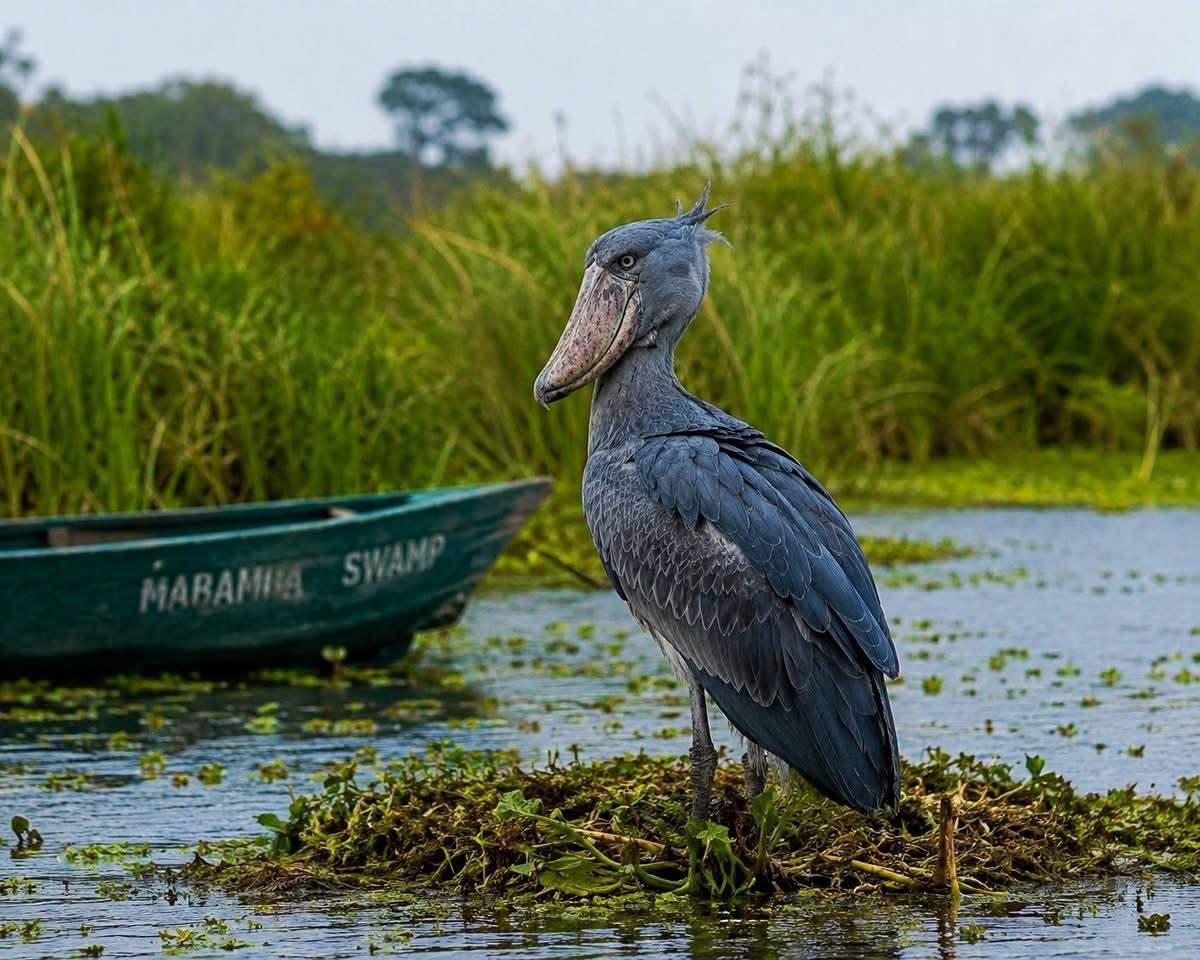
In the lowland troughs, vast freshwater networks dominate. Lake Victoria, the Nile River, and endless expanses of papyrus swamps—the prime hunting ground of the prehistoric-looking Shoebill stork—provide fertile sanctuary for waterbirds, kingfishers, and herons. Climb higher, and these wetlands give way to lush tropical rainforests brimming with hornbills and greenbuls. Higher still, mist-shrouded montane forests transition into surreal Afro-alpine zones, where sunbirds feed on giant lobelias amidst sub-zero night temperatures. Every change in elevation creates a whole new pocket of food, climate, and shelter. Because these wildly different environments are packed closely together, birds can find exact niches suited to their survival without having to cross vast deserts or oceans to get there.
Seasonal Migrants
The final piece of Uganda's birding puzzle comes from the sky. Uganda isn't just a permanent residence for local species; it functions as one of the world's most critical rest stops and wintering grounds for migratory birds. Every year between November and April, millions of travelers arrive on two major flight paths: the Palearctic migration route from Europe and northern Asia, and intra-African migration routes from other regions of the continent.
As winter freezes northern Europe and Asia, freezing temperatures and scarce food force birds to journey south. Millions of songbirds, raptors, and waders travel thousands of miles across deserts and seas, using the Great Rift Valley as a natural highway that leads them straight into Uganda. Here, the warm tropical climate and abundant food supply offer a reliable haven to wait out the northern freeze. White Storks, European Bee-eaters, and Barn Swallows settle into Ugandan marshes and grasslands alongside local residents. At the exact same time, intra-African migrants move across the continent following seasonal rainfall patterns to breed. This seasonal influx turns Uganda's skies into a bustling international airport, temporarily boosting the local bird count and creating an ever-changing spectacle of life.
Notable and Endemic Species
While many checklists such as the Clements Checklist on Wikipedia record around 1,088 species, local conservation bodies like the Uganda Wildlife Conservation Education Centre commonly cite figures between 1,061 and 1,073 species.
- Country Endemic. Fox's Weaver is the only bird species found exclusively within Uganda's borders, primarily around the northeastern wetlands and savannahs.
- Albertine Rift Endemics. Uganda shares 23 to 24 unique species with neighboring countries along the Albertine Rift, including the African Green Broadbill and the Rwenzori Turaco.
- Iconic Birds. Top attractions for birdwatchers include the prehistoric Shoebill stork, the Great Blue Turaco, and Uganda's national bird, the Grey Crowned Crane.
Where is the absolute best place to spot the famous Shoebill stork in Uganda?
If you want to see the prehistoric-looking Shoebill stork, head straight to Mabamba Bay Wetland on the northern shores of Lake Victoria. It is less than an hour's drive from Entebbe or Kampala, making it super accessible. You hop into a traditional wooden canoe early in the morning with a local guide who knows every channel in the thick papyrus reeds. Gliding silently across the water at dawn is magical in itself, and spotting that giant, shoe-billed bird standing statue-still while hunting for lungfish is a memory that stays with you forever. Other great spots include the Nile Delta in Murchison Falls National Park and the Makanga Wetland in Lake Mburo, though Mabamba remains the most reliable place for an up-close encounter.
What is Uganda’s national bird, and why was it chosen?
Uganda’s national bird is the Grey Crowned Crane, and you can spot it proudly standing right in the center of the Ugandan flag and coat of arms. Back in 1893, Sir Frederick Jackson, the British governor of Uganda at the time, chose it as the official emblem for the protectorate. He loved its gentle nature, striking beauty, and vibrant colors—black, yellow, and red—which matched the national flag's palette. Beyond its royal golden crown of stiff feathers, the crane symbolizes peace, grace, and loyalty because these birds mate for life and perform elaborate, joyful dances together. While they used to flock across wetlands everywhere in Uganda, habitat loss has made them endangered, making every sighting in the wild feel extra special.
When is the best time of year to go birdwatching in Uganda?
You can enjoy fantastic birdwatching in Uganda all year round because of its equatorial climate, though November to April is widely considered the peak season. During these months, resident birds are joined by hundreds of migratory species escaping the harsh winters of Europe and northern Asia, pushing the country's daily species count through the roof. Many local birds also put on their brightest breeding plumage during this time. That said, the drier months from June to August and December to February make forest trails much easier to hike, especially in rugged spots like Bwindi Impenetrable Forest. Even during the wetter months, rain usually falls in short afternoon bursts, leaving your mornings clear and packed with singing, active birds.
Which national park in Uganda has the highest number of bird species?
Queen Elizabeth National Park takes the crown as Uganda’s birding heavyweight, boasting over 600 recorded species within a single protected area. That is one of the highest concentrations of birdlife in any national park on the planet. The secret lies in its incredible mix of habitats—open savannahs, acacia woodlands, crater lakes, papyrus swamps, and the lush Maramagambo Forest. Taking a boat cruise along the Kazinga Channel is an effortless way to tick off dozens of waterbirds in an afternoon, from African Skimmers and Pink-backed Pelicans to Malachite Kingfishers. Whether you are a seasoned birder chasing rare raptors or a casual traveler who simply loves colorful wildlife, Queen Elizabeth delivers non-stop action without even trying.
Is there a bird species found only in Uganda and nowhere else on Earth?
Yes, there is just one true endemic bird found exclusively inside Uganda’s borders: Fox’s Weaver. Named after the collector who first described it in the early twentieth century, this small, striking yellow-and-black bird lives in the seasonally flooded grasslands and papyrus swamps of eastern and northeastern Uganda, particularly around Lake Bisina and Lake Opeta. Because its habitat is so restricted and vulnerable to wetland drainage, seeing one feels like finding hidden treasure. Birders travel from across the globe just to add Fox's Weaver to their life lists. Protecting these eastern wetlands is critical, as preserving this quiet corner of Uganda is the only way to keep this unique species flying free.
Why do birders get so excited about the Albertine Rift endemics?
The Albertine Rift is the western branch of the East African Rift, stretching through western Uganda, Rwanda, Burundi, and eastern Congo. Millions of years of geological shifts isolated high-altitude forests here, creating an evolutionary island where unique species evolved in total isolation. Around 24 of these rare birds live in Uganda’s southwestern forests, such as Bwindi Impenetrable Forest, Mgahinga, and the Rwenzori Mountains. Because these birds simply do not exist anywhere else in the world, spotting beauties like the Rwenzori Turaco, Handsome Francolin, or the elusive African Green Broadbill is a huge deal for wildlife lovers. Trekking through misty mountain bamboo to catch a glimpse of them feels like stepping into a lost world.
What makes Semuliki National Park different from other Ugandan birding spots?
Tucked away in the remote Bundibugyo district along the Congolese border, Semuliki National Park is the only true lowland tropical rainforest in East Africa. It is actually an eastern extension of the massive Ituri Forest of the Congo Basin. Because of this, Semuliki holds over 440 bird species, including dozens of Central African forest specialties you cannot find anywhere else in East Africa. Walking along the Kirumia Trail feels completely different from classic East African savannah parks. Under the dense, humid canopy, you can spot showstoppers like the White-crested Hornbill, Lyre-tailed Honeyguide, and Nkulengu Rail. It is wild, off the beaten path, and offers a genuine taste of Congo rainforest birding right inside Uganda.
Can you go birdwatching right inside Kampala or Entebbe?
You do not even need to leave the city to start spotting amazing birds in Uganda. Both Kampala and Entebbe are remarkably green, and birds thrive in their gardens, lakeside shores, and golf courses. In Entebbe, the Botanical Gardens along Lake Victoria are famous for noisy troops of Great Blue Turacos, Ross’s Turacos, and Eastern Plantain-eaters flitting through ancient trees. Over in Kampala, spots like the Makerere University campus, the Uganda Golf Course, and lakeside wetlands around Munyonyo regularly host Hadada Ibises, Marabou Storks, Pied Kingfishers, and colorful sunbirds. Even sitting on a hotel veranda with your morning coffee, you can easily identify twenty or thirty different species before breakfast.
What are the biggest threats facing Uganda’s bird populations today?
Despite Uganda’s incredible avian wealth, many of its birds face growing pressure from habitat loss and wetland encroachment. As the human population expands, papyrus swamps are increasingly drained for agriculture, brick-making, and urban housing, directly threatening swamp specialists like the Shoebill, Papyrus Gonolek, and Fox’s Weaver. Deforestation outside protected national parks also shrinks the corridors birds use to move between feeding and breeding grounds. Climate change adds another layer of stress by shifting rainfall patterns and disrupting seasonal migrations. Thankfully, local conservation groups like NatureUganda work tirelessly with community guides to protect key wetlands, proving that eco-tourism gives local communities a strong financial reason to keep habitats intact.
What basic gear should a beginner pack for birding in Uganda?
You do not need thousands of dollars in camera lenses to enjoy birding in Uganda, just a few smart essentials. First and foremost, pack a reliable pair of 8x42 or 10x42 binoculars, which offer the best balance of brightness and magnification inside dim rainforest canopies. Bring neutral-colored, breathable clothing in greens, browns, or khakis—bright white or neon colors startle shy forest birds, while dark blue attracts tsetse flies in savannah parks. Sturdy, waterproof hiking boots are a must for muddy forest trails, alongside a lightweight rain jacket for sudden tropical showers. Finally, download a digital field guide app on your phone or carry a copy of Birds of East Africa so you can check markings on the spot.
How do local birding guides make a difference on a Ugandan safari?
Hiring a local Ugandan birding guide completely transforms your trip from a simple walk in the woods into an unforgettable wildlife experience. Many forest birds stay high in the thick canopy and are nearly impossible for untrained eyes to spot. Experienced Ugandan guides recognize hundreds of birds purely by a faint two-second whistle or the rustle of leaves, locating them in seconds. Beyond their sharp eyes and ears, these guides know the exact territories of rare species, understand animal behavior, and share fascinating local folklore about the birds. Plus, hiring local guides directly supports conservation-minded livelihoods in rural communities around national parks, ensuring that protecting birds remains valuable to the people living alongside them.
Are there nocturnal birds worth looking for in Uganda?
Once the sun dips below the horizon, an entirely different cast of feathered characters wakes up across Uganda’s forests and savannahs. Night drives and guided evening walks reveal fascinating nocturnal birds like the Pennant-winged Nightjar, whose males grow extraordinarily long, ribbon-like wing feathers during breeding season that trail behind them like kites in flight. You can also hear the haunting, rhythmic calls of the African Wood Owl, Verreaux’s Eagle-Owl—Africa’s largest owl—and the Pearl-spotted Owlet. Listening to the night chorus in places like Budongo Forest or Lake Mburo National Park, with torchlight catching the glowing eyes of a nightjar resting on a dirt track, adds a thrilling dimension to any birding adventure.
Booking Uganda birding safari with us Roads of Adventure safaris
Book your Uganda birding safari with Roads of Adventure Safaris to explore over 1,065 bird species across prime circuits like Mabamba Swamp for the elusive Shoebill, Bwindi Impenetrable National Park for Albertine Rift endemics, and Queen Elizabeth National Park.
We handle all private 4x4 transport, permits, expert birding guides, and comfortable lodge stays from arrival to departure. Whether you want a short excursion or a 13-to-17-day grand circuit, our team tailors the pacing to your goals.
Reach out via email at info@roadsofadventuresafaris.com or call +256 701 041 637 to plan your trip.