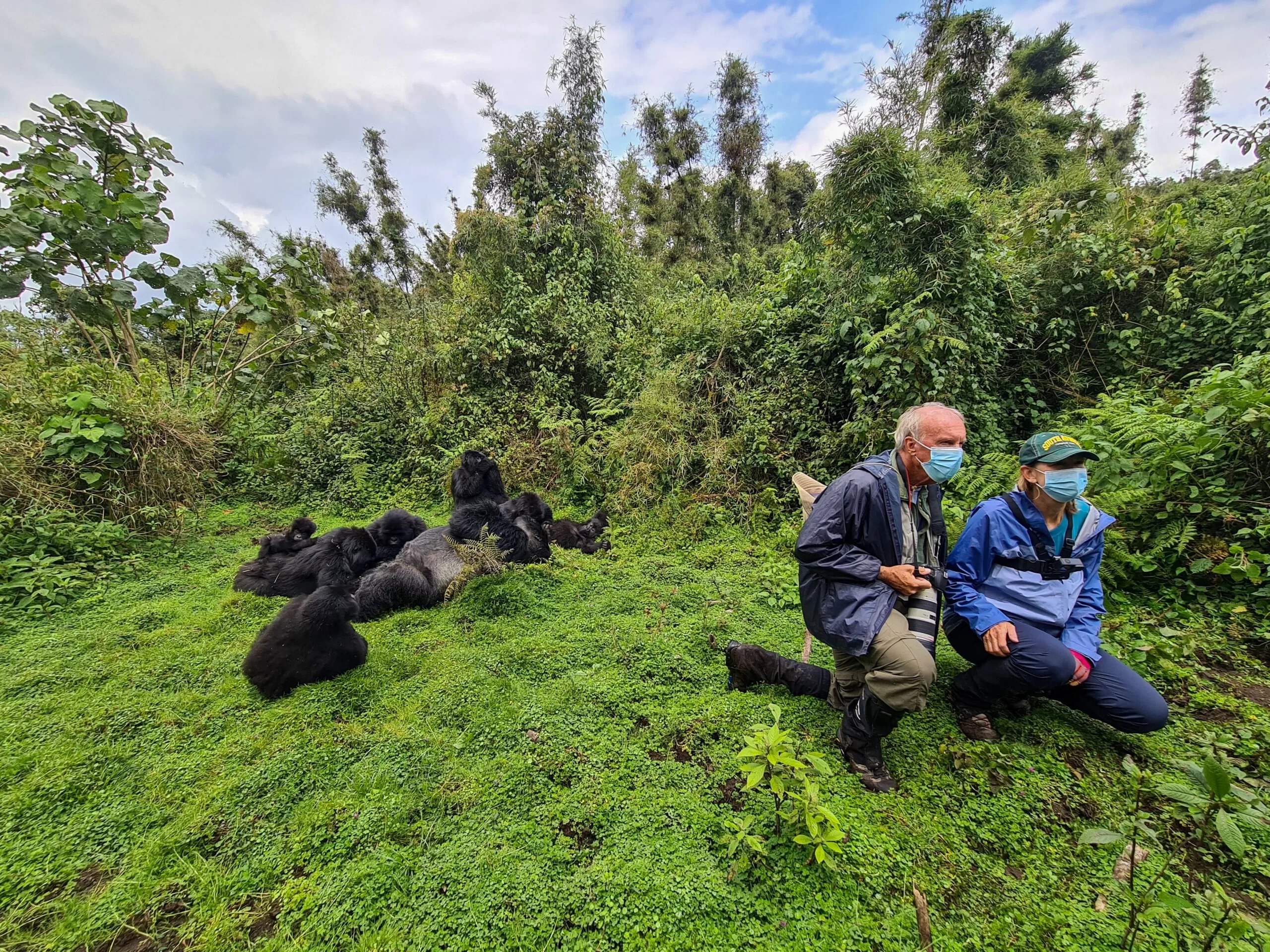
Gorilla trekking hikes in Rwanda’s Volcanoes National Park typically take between 2 and 6 hours in total. This includes roughly 30 minutes to a few hours of hiking to locate the gorillas, the mandatory strict 1 hour of observation, and the hike back.
3-days-rwanda-gorilla-trekking-safari-itinerary-in-volcanoes-park
4-days-volcanoes-national-park-and-akagera-rwanda-wildlife-safari
4-days-rwanda-primates-safari-gorilla-trekking-and-chimpanzee-all-inclusive-package
5-days-best-gorilla-and-uganda-safari-holiday-from-kigali
6-days-luxury-rwanda-gorilla-trekking-safari-tour-vacation
7-days-6-nights-midrange-rwanda-gorilla-trekking-holiday
What to Expect
The exact duration of the hike depends on the specific gorilla family you are assigned to and their location on the day of the trek. Because mountain gorillas are wild and constantly moving, some families are spotted in as little as 30 minutes, while others may require up to 5 hours or more of deep trekking.
Your experience begins early in the morning (usually 7:00 AM to 7:30 AM) with a briefing at the Volcanoes National Park Headquarters where you are assigned to a trekking group.
How long does the gorilla trekking hike take on a Rwanda safari tour?
The total duration of a gorilla trekking hike in Volcanoes National Park generally ranges between 1 and 6 hours round-trip. On rare occasions involving distant families or challenging weather, a trek can extend up to 8 hours. The adventure begins with an early 7:00 AM briefing at the Kinigi park headquarters, after which visitors are driven to designated trailheads surrounding the Virunga Volcanoes. The trekking time required to locate the gorillas varies dramatically based on where the animals nested the night before and how far they have moved while foraging.
The hike to reach a family can take as little as 30 to 40 minutes for close-range groups like the Sabyinyo family, or up to 3 to 4 hours of steep uphill hiking for mountain-dwelling groups like the Karisimbi family. Advance park trackers enter the forest at dawn to locate the gorillas and relay their exact location via radio to your ranger guide. Once your group reaches the gorilla family, you are permitted exactly 1 hour of direct observation time. After your 60 minutes with the gorillas, you hike back down to the trailhead to meet your driver-guide.
What factors determine how long a gorilla trek in Volcanoes National Park will take?
Several environmental, biological, and physical factors influence the overall duration of a gorilla trek in Rwanda. The primary variable is the natural movement of the gorilla family. Mountain gorillas are wild primates that travel between 0.5 and 3 kilometers daily in search of bamboo shoots, wild celery, and foliage. If a family moves higher up the volcanic slopes of Mount Karisimbi or Mount Bisoke, the trek naturally takes longer.
Weather conditions and physical terrain also play significant roles in determining trekking speed. During heavy rainforest showers, trails become slippery, muddy, and more challenging to navigate, which slows down the group's overall pace. Furthermore, the foliage density, altitude changes, and individual fitness levels of the slowest members in your assigned group dictate travel time, as ranger guides deliberately adapt the pace to ensure everyone moves safely together.
What is the daily timeline and schedule for a gorilla trekking day in Rwanda?
A gorilla trekking day in Volcanoes National Park follows a structured daily schedule designed to maximize safety and wildlife protection. The day begins early at 6:00 AM with breakfast at your safari lodge, followed by a transfer to the Kinigi Park Headquarters. By 7:00 AM, guests arrive for registration, complimentary Rwandan coffee, cultural dance performances, and an essential briefing by park wardens.
By 7:30 AM, trekkers are allocated into small groups of eight and assigned to specific gorilla families based on age and physical fitness. At 8:00 AM, groups drive to their assigned trailheads and enter the forest alongside armed park rangers. Between 10:00 AM and 12:30 PM, most groups locate their assigned gorilla family and enjoy their allocated 1-hour observation window. By early to mid-afternoon, trekkers return to the trailhead to receive their official trekking certificates before returning to their lodges.
How much time are visitors allowed to spend directly with the mountain gorillas?
Visitors are permitted to spend exactly 1 hour (60 minutes) with a habituated mountain gorilla family once the group is located in the forest. This strict time limit is enforced by Rwanda Development Board (RDB) park rangers to minimize human disturbance in the gorillas' natural habitat and preserve their wild behaviors.
Restricting contact to 60 minutes reduces stress on the gorilla family, prevents habituation over-exposure, and minimizes the potential risk of human-borne disease transmission. During this hour, visitors can observe silverbacks, females grooming infants, and juveniles playing in the bamboo canopy, while taking photos without flash. Once the hour expires, rangers guide the group away to allow the gorillas to resume their daily routines undisturbed.
How difficult is the gorilla trekking hike in Volcanoes National Park?
The hiking difficulty during a gorilla trek in Volcanoes National Park ranges from moderate to physically demanding. Unlike established walking trails, gorilla trekking requires navigating unmaintained forest paths, dense bamboo thickets, tangled vines, and uneven volcanic rocks under dense canopy cover.
Hikes involve steep ascents through soil that can become slick and muddy during frequent rain showers. Trekkers do not need to be elite athletes, but basic cardiovascular endurance, good balance, and sturdy footwear are required. Rangers accommodate varying fitness levels by taking periodic resting breaks to ensure all trekkers complete the journey safely and comfortably.
What is the elevation and terrain like during a gorilla trek in Rwanda?
Gorilla trekking in Rwanda takes place along the forested slopes of the Virunga Volcanoes at elevations ranging from 2,500 to 3,500 meters (8,200 to 11,500 feet) above sea level. At these high altitudes, the air is noticeably thinner, which can cause visitors to fatigue faster than at sea level.
The terrain consists of farmland borders, dense bamboo forests at lower elevations, and humid rainforest or sub-alpine vegetation higher up the mountain slopes. Expect uneven, damp ground covered in organic leaf litter, mud, and loose volcanic stone, requiring steady footing throughout the hike.
How are gorilla families assigned to trekkers based on fitness levels?
During the early morning briefing at Kinigi headquarters, park authorities divide visitors into groups of up to eight people per gorilla family. Driver-guides coordinate with chief park wardens to match guests with suitable gorilla groups based on age, mobility, and expressed fitness preferences.
Seniors or visitors seeking a less strenuous walk are typically assigned to closer gorilla families that frequent lower slopes near the park boundary. Conversely, active travelers requesting a physical challenge are assigned to mountain families requiring steeper, longer climbs up the volcanic slopes.
What is the minimum age requirement for gorilla trekking in Rwanda?
The official minimum age requirement for gorilla trekking in Rwanda is 15 years old. Children under 15 are not permitted on gorilla treks, a rule strictly enforced by the Rwanda Development Board during passport verification at registration.
This age threshold exists for safety and conservation reasons: younger children are more susceptible to contagious childhood diseases that can infect wild gorillas. Additionally, children are more likely to panic or react unpredictably if a silverback makes a sudden charge or vocalization.
How much does a mountain gorilla trekking permit cost in Rwanda?
A single gorilla trekking permit in Rwanda costs $1,500 USD per person for foreign non-residents. This fee includes park entry, ranger guide services, advance trackers, security enforcement, and 1 hour of gorilla viewing time.
A portion of permit revenue (10%) is redistributed directly into local communities surrounding Volcanoes National Park. This funding supports local schools, health centers, clean water access, and infrastructure projects, incentivizing community-led wildlife conservation.
Are there low-season discounts or promotional rates for Rwanda gorilla permits?
Yes, Rwanda offers promotional permit discounts under specific conditions. During the low-season months of November to May, international tourists receive a 30% discount ($1,050 USD per permit) if they book a gorilla trek alongside visits to Akagera National Park and Nyungwe National Park.
Special promotional rates also apply for East African Community (EAC) citizens, African continent residents, and corporate conference delegates attending MICE events in Kigali, subject to official documentation.
How far in advance should you book a gorilla trekking permit in Rwanda?
Because permits are capped at 8 visitors per gorilla family per day across 12 habituated groups, only 96 permits are issued daily in Volcanoes National Park. During peak travel months (June to September and December to February), permits sell out quickly.
It is recommended to book your gorilla permit 4 to 6 months in advance through a licensed local ground operator or directly via the official Irembo government portal. Last-minute permits during high season are rarely available.
What habituated gorilla families live in Volcanoes National Park?
Volcanoes National Park protects 12 fully habituated gorilla families for tourism, alongside additional groups reserved exclusively for scientific research. Notable groups include the Sabyinyo family, known for large silverbacks and lower slope locations, and the Amahoro family, led by peaceful silverback Gahinga.
Other habituated groups include Agashya (Group 13), Karisimbi (Group 11), Umubano, Kwitonda, Hirwa, Muhoza, Igisha, Titus, Bwenge, and Noheli. Each group possesses distinct social dynamics and ranges across different sectors of the park.
What happens during the early morning briefing at the Kinigi park headquarters?
Arriving at Kinigi by 7:00 AM, visitors check in at registration counters where passports and permit vouchers are verified. While enjoying complimentary Rwandan tea or coffee and cultural Intore dance performances, park wardens organize tourists into groups of eight.
At 7:30 AM, an assigned lead ranger conducts a 20-minute safety briefing detailing forest rules, gorilla etiquette, distance guidelines (7–10 meters), gear checks, and emergency protocols before setting off to the trailhead.
Why is hiring a porter strongly recommended for gorilla trekking in Rwanda?
Hiring a local porter at the trailhead (costing $15 to $20 USD plus tip) is one of the best choices a trekker can make. Porters assist by carrying your daypack, camera equipment, and water bottles, freeing you to focus on hiking safely.
Porters provide a steady hand across slippery muddy slopes, river stones, and steep inclines. Hiring a porter directly supports local community employment, as many porters earn a sustainable living through ecotourism.
What essential clothing should you wear for a gorilla trek in Volcanoes National Park?
Dressing correctly ensures comfort and protection against stinging nettles, insects, and wet weather. Wear sturdy, broken-in waterproof hiking boots with deep traction soles and good ankle support, paired with long, lightweight, quick-dry trousers tucked into socks or gaiters.
Long-sleeved moisture-wicking shirts guard against scratches and nettles, while a lightweight waterproof rain jacket protects against sudden mountain downpours. Sturdy leather or rubber gardening gloves are also recommended to grip muddy vegetation safely.
What gear and equipment should you carry in your daypack during the hike?
Pack a comfortable, lightweight waterproof backpack containing at least 2 liters of drinking water and energy snacks like nuts, dried fruit, or protein bars. Include a rain cover for your backpack to protect items during downpours.
Carry camera equipment with extra batteries and memory cards sealed in waterproof dry bags, alongside personal medication, insect repellent, sunblock, and small cash notes for tipping porters and park rangers.
What are the main rules and safety guidelines when approaching mountain gorillas?
Visitors must maintain a minimum distance of 7 to 10 meters (23–33 feet) from the gorillas at all times. Camera flash photography is strictly prohibited, as flashes can startle the animals and provoke defensive reactions.
Keep your voice low, move calmly, and refrain from eating, drinking, or smoking within 200 meters of the gorillas. If a silverback charges, crouch down, avoid direct eye contact, lower your head, and follow your ranger's instructions without running.
What health regulations and disease prevention measures apply to gorilla treks?
Because mountain gorillas share roughly 98% of their DNA with humans, they are highly susceptible to human respiratory illnesses. Visitors suffering from colds, flu, fever, or contagious infections are barred from trekking to protect the gorillas.
Wearing a medical face mask (N95 or surgical) is mandatory when observing the gorilla family. If you need to cough or sneeze during the encounter, turn your face away and cover your mouth with your arm or a tissue.
What is the best time of year for gorilla trekking in Volcanoes National Park?
The optimal time for gorilla trekking in Rwanda is during the dry seasons: June through September and December through February. During these months, rainfall is lower, forest trails are drier, and hiking conditions are generally more comfortable.
However, gorilla trekking operates year-round, and rainforest showers can occur in any season due to the mountainous equatorial climate.
Can you trek mountain gorillas during Rwanda's rainy seasons?
Yes, gorilla trekking takes place every day of the year, including during the rainy seasons (March to May and October to November). While trails are muddier and rainfall is more frequent, wet-season trekking offers unique advantages.
Gorillas often stay at lower altitudes during wet months where fresh bamboo shoots are abundant, resulting in shorter hikes. Lodges and permit packages may also feature promotional seasonal discounts.
What is the difference between gorilla trekking in Rwanda versus Uganda's Bwindi?
Volcanoes National Park in Rwanda is a paved 2.5-hour drive from Kigali Airport, whereas Uganda's Bwindi Impenetrable Forest requires an 8 to 9-hour drive from Entebbe Airport (or a 4 to 5-hour drive across the border from Kigali).
Rwanda features bamboo slopes and volcanic soil, while Bwindi features dense rainforest foliage and steep ridges. Permit prices are $1,500 USD in Rwanda compared to $800 USD in Uganda.
Is a high level of physical fitness required to trek gorillas in Rwanda?
Elite athletic fitness is not required, but a basic level of mobility and cardiovascular endurance is necessary. The combination of steep hiking trails, muddy terrain, and high altitude (2,500+ meters) causes physical exertion.
Regular walking, stair climbing, or light hiking exercises in the weeks leading up to your trip will adequately prepare your legs and lungs for the trek.
What options are available for elderly, disabled, or mobility-impaired trekkers?
Gorilla trekking is accessible to travelers with limited mobility or disabilities through the traditional sedan chair service. A custom sedan chair carried by a team of 8 to 12 local porters allows guests to be carried smoothly to and from the gorilla family.
Park authorities also prioritize mobility-impaired guests by assigning them to closer gorilla families located near the park boundary to minimize walking distance.
What other wildlife might you encounter during a gorilla trekking hike?
While mountain gorillas are the primary focus, Volcanoes National Park protects rich mountain biodiversity. Trekkers may encounter golden monkeys (Cercopithecus kandti), L'Hoest's monkeys, and red-tailed monkeys in the canopy.
Mammals such as forest elephants, bushbucks, duikers, and buffaloes inhabit the forest (rangers carry protective firearms for safety), alongside over 200 bird species, including Albertine Rift endemics like the Ruwenzori turaco.
How close can visitors get to the mountain gorillas during the encounter?
Official guidelines require maintaining a 7 to 10-meter (23–33 feet) distance from the gorillas. However, wild gorillas do not recognize human boundaries and may move closer on their own.
Curious infant or juvenile gorillas may approach visitors, or silverbacks may walk past along narrow forest paths. If a gorilla approaches, stay still, follow your ranger's instructions, and step back slowly if space permits.
What photography rules and equipment guidelines should you follow?
Flash photography is strictly prohibited as it can startle the gorillas. A versatile telephoto zoom lens (e.g., 70–200mm f/2.8) is ideal for capturing clear images in low-light forest understories.
Keep your camera gear sealed in waterproof dry bags during the hike until you reach the gorilla group to protect equipment from moisture and dust.
How does the gorilla tracking team locate the gorilla families each morning?
Rwanda employs a team of professional advance trackers who enter the forest at 6:00 AM daily. Trackers hike to the exact location where the assigned gorilla family built their nests and slept the previous night.
From those nests, trackers follow crushed vegetation, dung, and broken bamboo stems until they visually spot the gorillas, radioing the exact GPS coordinates to your ranger guide.
What cultural experiences can be added after completing a gorilla trek?
After finishing your hike, you can enhance your afternoon with local community visits, such as the Gorilla Guardians Cultural Village (Iby'Iwacu) near Musanze, which offers traditional Intore dancing and cultural demonstrations.
You can also visit the Ellen DeGeneres Campus of the Dian Fossey Gorilla Fund, a world-class conservation research center featuring interactive exhibits on gorilla conservation history.
Where should visitors stay during a gorilla trekking safari in Rwanda?
Accommodations surrounding Volcanoes National Park cater to various preferences, including ultra-luxury options like Bisate Lodge, Singita Kwitonda Lodge, and One&Only Gorillas' Nest.
Luxury and mid-range options include Virunga Lodge, Sabyinyo Silverback Lodge, Five Volcanoes Boutique Hotel, Mountain Gorilla View Lodge, and Le Bambou Gorilla Lodge.
Why is gorilla trekking in Volcanoes National Park considered a major conservation success story?
Gorilla trekking in Rwanda demonstrates how controlled ecotourism funds biodiversity preservation. In the 1980s, mountain gorilla populations hovered near extinction with fewer than 250 individuals in the Virunga region.
Through strict park protection, community revenue sharing (10%), veterinary intervention (Gorilla Doctors), and anti-poaching patrols funded by permit fees, global mountain gorilla numbers have grown to over 1,060 wild individuals.
Booking gorilla trekking in Rwanda with us Roads of Adventure safaris
To book a gorilla trekking safari in Rwanda with Roads of Adventure Safaris, you will need to confirm your travel dates, agree on a customized package (such as a standard 3-day Volcanoes National Park itinerary), and have them secure your non-refundable gorilla permit (which is priced at $1,500 per person)
